
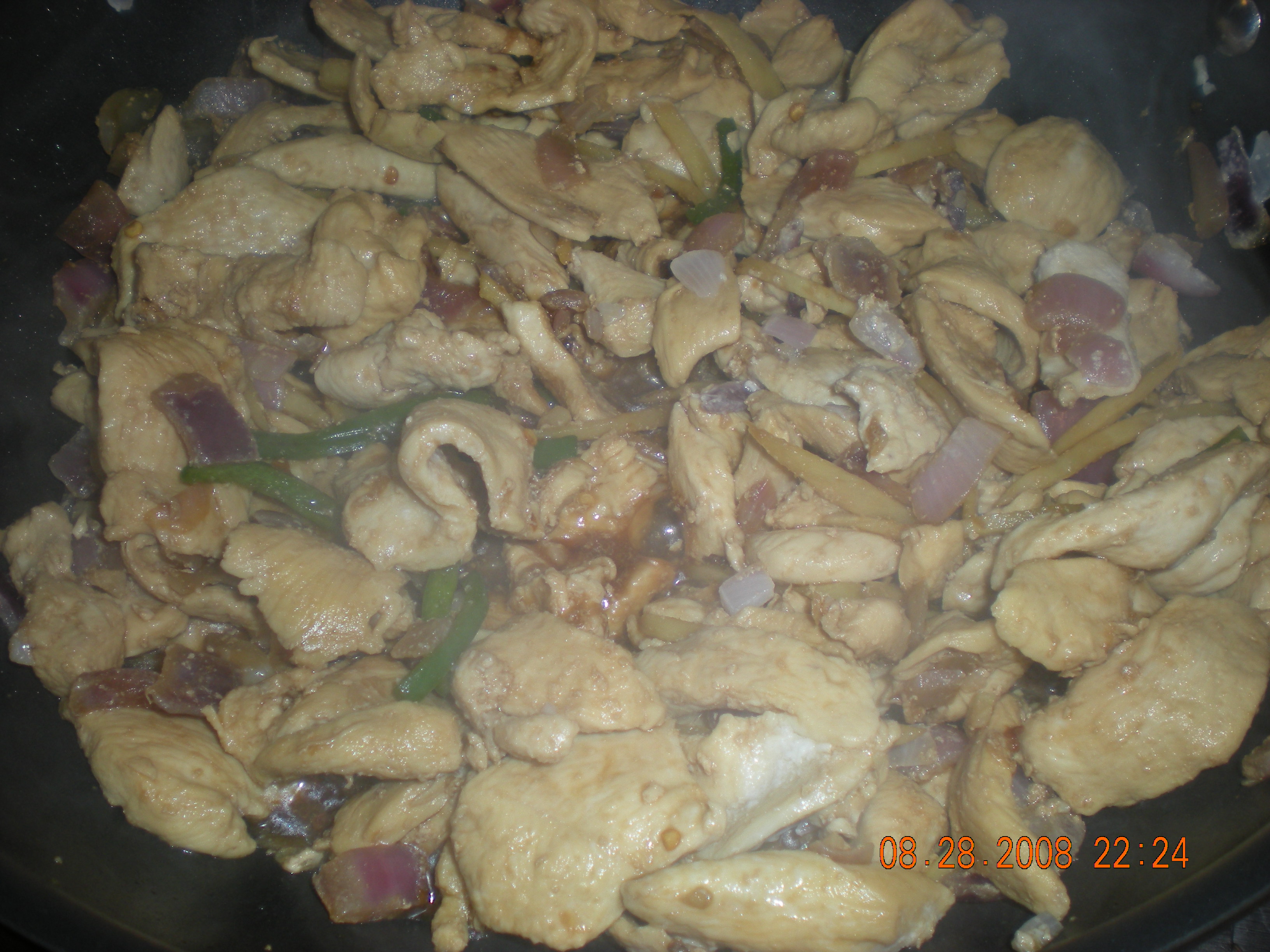
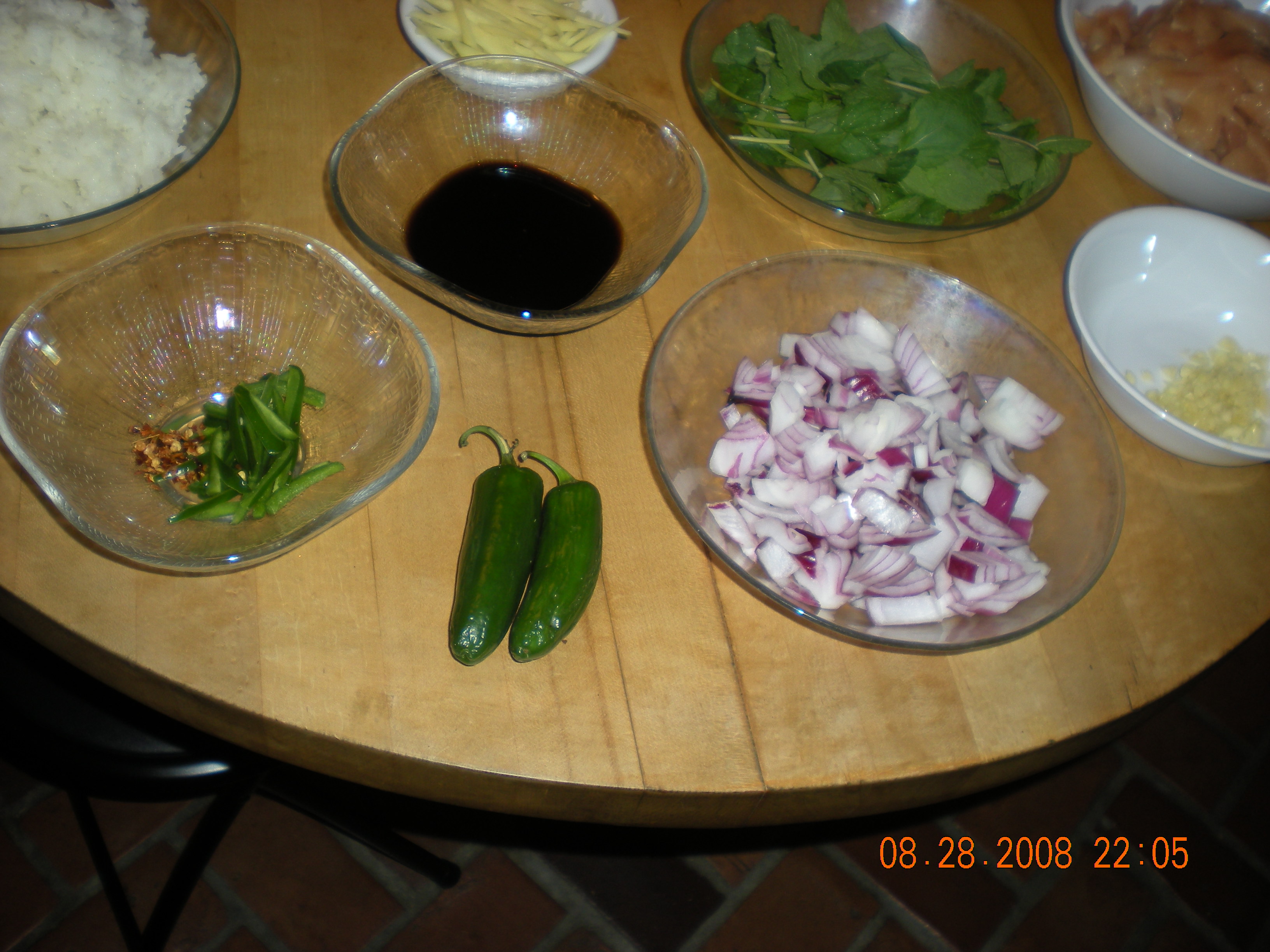
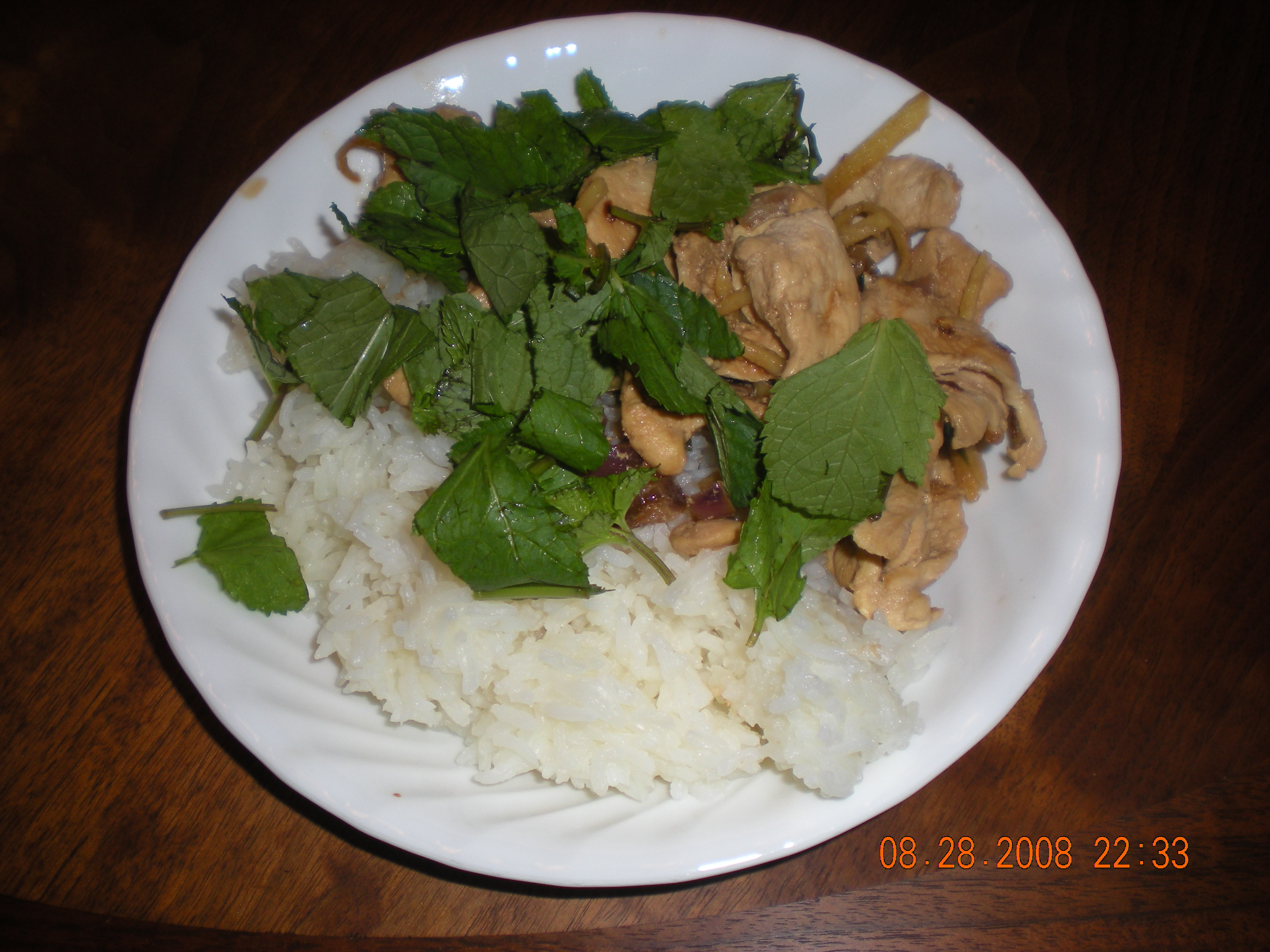
An especially good dish, we see it here garnished with mint leaves.
An especially good dish, we see it here garnished with mint leaves.
Posted by lefalcon on October 8, 2008
https://losthunderlads.com/2008/10/08/so-called-ginger-chicken/

Upper left: hunks of stew meat with potatoes and zucchini, in a sauce of blended vegetables. Foreground: “casa grande” a rice-based side dish. Upper right: salad with avocadoes & other paraphernalia.
Posted by lefalcon on October 8, 2008
https://losthunderlads.com/2008/10/08/food/

Cube steak provencal, garnished with zucchini & tomatoes, accompanied by a hearty homemade risotto…and some pre-packaged vegetables that you can heat up in a microwave.
Posted by lefalcon on October 8, 2008
https://losthunderlads.com/2008/10/08/cube-steak-provencal-2/
CONDALEEZZA’S FRIED RICE (Indonesian style)
Ingredients:
1.7-ounce IndoFood fried rice seasoning packet
Cooking oil
2-3 cloves garlic
1 bunch green onions
1 onion
Salt and pepper
1/3 pound shrimp (de-shelled, pre-cooked, tails removed)
4-5 cups (approximately) cooked white rice
2 eggs
Optional:
Cucumber and tomato slices
Krupuk
Sambal sauce
Here’s a simple fried rice recipe. It is, however, dependent on having available to you a 1.7-ounce fried rice seasoning packet, manufactured by a company called IndoFood. In my experimentation over time, I’ve discovered that just using one of these seasoning packets is both simpler and yields a superior result, than somewhat more complex prescriptions that don’t rely on pre-packaged flavoring.
Use a pot or wok-like frying pan. Saute in oil the following chopped-up stuff: some garlic (2-3 cloves or a spoonful), a bundle of green onions, one onion. As they cook briefly over medium heat, sprinkle in some salt and pepper. Essential: about one-third pound of shrimp. I use the pre-cooked ones with the shell removed. Get rid of tails. If they’re larger ones, cut them in smaller pieces. The shrimp are important because, in addition to being delicious in themselves, they add a subtle seafood taste to the rice.
After all this has cooked briefly, start spooning in the plain white rice. Could be leftover plain rice. Once there’s a generous amount (maybe 4 or 5 cups) of rice in the pan, start stirring everything around and getting everything mixed together. Dump in the contents of the seasoning packet. (It’s a brownish paste, not powder.) Get that well mixed in.
Tip: Don’t have the heat too high. Periodically add a little oil and/or water, to keep things moist and to avoid the rice browning and sticking against the bottom of the pan.
Once everything is nicely mixed and cooked, use your stirring spoon to push the rice off to the sides of the pan and clear a circular opening in the center. Dump two beaten eggs into this opening. As the eggs solidify, keep breaking them apart. Then stir the bits of scrambled egg into the rice, to produce, finally, a heap of fried rice. Adjust the amounts of salt and pepper.
Garnishes: A few slices of cucumber and tomato at the edge, along with a dozen or so krupuk, if you can find them. (They’re an Asian snack food, like styrofoam potato chips.) If you like spicy stuff *and* your gastro-intestinal system does not rebel too strongly against its ingestion, use one or two spoonfuls of sambal sauce (chili pepper-based sauce).
Posted by lefalcon on October 8, 2008
https://losthunderlads.com/2008/10/08/fried-rice/

Ingredients:
Cooking oil
1 onion, chopped
2 cloves garlic, chopped
1-2 tablespoons curry powder (Use your judgment here. Too much of this stuff can have a strong effect, if you know what I mean. Fart sounds in background.)
2 tablespoons tomato paste
1 (14.5-ounce) can diced tomatoes
1 cube vegetable bouillon
10 ounces of frozen mixed vegetables
1.5 cups water
Salt and pepper as needed
In a pot or large saucepan over medium-high heat, saute your onions and garlic. Add your curry powder and tomato paste. Cook briefly for a couple minutes.
Now add diced tomatoes, vegetable bouillon cube, frozen mixed vegetables, and water. Salt and pepper to taste. Let simmer for 30 minutes.
This easy recipe is a G.W. Bush favorite. I’ve made it several times, and all I can say is, you wouldn’t believe something so simple could be so hearty and flavorful. Potatoes might be a welcome addition, but it’s still great without them. I recommend adding some sort of meat. Last time, I took boneless skinless chicken breast fillets, grilled them in a George Foreman grill, chopped the cooked fillets into bits, and tossed the bits into the mix. Next time I might add in bite-size hunks of catfish while the curry simmers and see how that works. In any event, the vegetarian version (presented here and garnering our president’s enthusiastic approval) is a cheaper option and quite delicious. Make sure you have some nice fresh boiled rice on hand, Basmati or other. Additionally, I strongly recommend garnishing with big blobs of nonfat plain yoghurt and fresh chopped cilantro.
Posted by lefalcon on September 19, 2008
https://losthunderlads.com/2008/09/19/texas-air-national-guard-curry/

This post is a tribute to Paste Pot Pete.
Where would we be without him?
Posted by lefalcon on April 29, 2008
https://losthunderlads.com/2008/04/29/paste-pot-pete/
If you’re in the mood for some cute shit, click here:
If you can get over the whole cutesy aspect of the thing,
you realize you’ve discovered the answer to the question:
What happens to people who don’t have 24/7 access to a channel
specializing in trashy films like ‘The Patriot’ starring Mel Gibson.
And the answer, of course, is that they turn to religion as a convenient
pretext for playing silly-ass little games with (if not destroying)
other people’s lives…and then congratulating
themselves for their own piety! Look, goddammit:
Jacking your dick to images of Mel Gibson’s long musket makes you a
disgusting pervert. But it’s not reprehensible like making a fifty-some-year-old
woman submit to a series of lashes for essentially no reason except she was
stupid enough to come to your country and try to help educate small children.
Posted by lefalcon on November 29, 2007
https://losthunderlads.com/2007/11/29/cute-shit/
Well, it’s really a pleasure to be hosting this posting. I translated the first couple pages of a pamphlet which I think could be a transcription of an orally-delivered sermon. Such sermons are often recorded on audio cassettes. I guess this one was so darn good, it had to be issued in the form of a printed pamphlet. I think what I’ve got here is long enough that you start to sense a vague moralistic sermonizing tone. I hold people in particular regard if they resort to accusing other people that they don’t agree with, of having some type of moral “disease,” which can only be cured by the shining “remedy”: a platform of religious attitudes / baggage, to be swallowed & accepted wholesale…er er that is if one wishes to exonerate oneself from *evilness*…or at least from some sort of grievous misguidedness… [The world needs more such discourses.]
Praise belongs to God, the lord of the worlds and the goal of the godfearing. And prayers and peace upon His slave and messenger and the trustee of His revelation and of the bounty of His creation: our prophet and leader and master Muhammad bin Abdullah bin Abdul-Muttalib. And also upon his family and his associates, and upon whoever follows his way and is guided by his right guidance to the Day of Judgment. Now then: The lords of Islamic thought, and the adherents of Islamic zeal, and the adherents of plentiful speculation – all are concerned with the condition of the Muslims and with what their affairs are leading to. These affairs preoccupy them much, and they engage in much pondering about the causes for the weakness of the Muslims, their underdevelopment in the face of their enemy, and their disunity and their differences. They also consider the causes behind the exertions of the enemy against the Muslims, to the point of having taken over some of the Muslim lands. Then, having established these causes – these being clear – they are also concerned about establishing the treatment for these causes of underdevelopment and weakness – and it too is well known. But it is necessary for the causes to be spread and explained. For, if the disease is described, then the remedy will be a great means for healing and well-being. Once the sick individual has established his disease and its remedy, then it is suitable to move without delay to accepting the remedy and then imposing it on the disease. This is the nature of the reasonable man who loves life and loves rescue from illnesses. It is important to him to know the disease and the remedy. But some people have mastered the disease and taken possession of it until they are satisfied with it and find it pleasant and until their clear perception has perished. They are not concerned about who describes the remedy to them, because the disease has become character and nature to them. They like it and are content with its continuance. They have a deviation in their temperament and a weakness in their discernment. The victory of whim over them and over their reason and their heart and their behaviors – such is the case with most people as regards religious diseases and their treatment.
Posted by lefalcon on October 19, 2007
https://losthunderlads.com/2007/10/19/hosting-a-posting/
Here is another post, to rival my last one in pointlessness and ridiculousness. This time it is a translation of a modern poem. For maximum pretentiousness, I’m including the original in transliteration. As an additional bonus, there is also a paragraph from the back of the book, which provides some insight into the particular qualities of this poet’s oeuvre, not to mention its glittering sweetness.
“Another Flowerpot”
This is what you want, thus
The rifle of the hunt,
and the horse’s saddle
and the bag of tobacco suspended from the ceiling.
This, therefore,
is what has called you to return, friend.
Take also,
the colorful bundle of papers.
(You still attend to the lighting of firewood.)
And the shaving implements – those – that are on the shelf.
And the jacket of hide..
And also bottles of wine buried in straw.
Do not grieve, friend,
for your flowers grow, now,
in another flowerpot.
aSiiSun aaxaru
haaðaa maa turiidu-hu, iðan
bunduqiyyata al-Saydi,
wa-sarja al-HiSaani
wa-Surrata al-tibği al-mu<allaqata fii al-saqfi.
haaðaa, iðan,
maa da<aa-ka ilaa al-<awdati ayyuhaa al-Sadiiqu.
xuð ayDan,
Huzmata al-awraaqi al-mulawwanata
fa-maa tazaalu tuSliHu li-ish<aali al-HaTabi.
wa-adawaati al-Hilaaqati – tilka – allatii <alaa al-raffi.
wa-sutrata al-jildi..
wa-ayDan zujaajaati al-nabiiði al-maTmuurata fii al-qašši.
laa ta’sa ayyuhaa al-Sadiiqu
fa-azhaaru-ka tanbutu, al-aana,
fii aSiiSin aaxara.
The first of what he discloses to you (in this collection by Amjad Nasir) are his conditions of mind, which flourish, isolated from language’s protection: very naked poems, with far-reaching sensitivity. Some are natural compositions, while others enlist technical skills. Each poem is a short idea, an idea like a brief gleam of light, intelligent and compassionate. Amjad paves the way for them with spare introductions, with just a minimal flavor, through which he leads you into the snare of a conclusion glittering with sweetness.
Posted by lefalcon on October 8, 2007
https://losthunderlads.com/2007/10/08/glittering-with-sweetness/
I’ve decided to post a translation I did. It consists of three paragraphs from an editorial in a Yemeni newspaper. It does not make sense, on the whole. This translation probably represents about a quarter of the original article. I’m beginning to develop a theory that translation is impossible between certain languages. For example: Arabic to English. I attribute this to two reasons:
(1)The dictionary meanings of words do not convey how a given word is truly used in a context. There tends to be some subtlety of meaning, some particular requirement of how a word should be used, which the dictionary just cannot explain.
(2)Writers of different languages not only use entirely different sets of conventions but employ completely different textures of expression. Arabic seems to have the ability to pile clause upon clause in run-on, nay “runaway” sentences which English could never replicate without severely violating some of its most cherished constitutional pillars…and we’re sure not abrogating those after more than 200 years!
[Intro / Summary]
The people who are debating [the disputants] about the political rights of women consider that the most [an end-point] that can be arrived at [of what it is possible that he / it ?? arrives at] is the opening [the horizon] of a standing dialogue between the political decision-makers. This would be in conformity to [it is agreement about] the relative shaping of the existing female scope in situations of authority and [strength of work ??]. [This is] in accordance with what they [??] view as a transformation in a direction of [availability] of new [growth] pertaining to female bearing, as long as they [had proceeded] within the narrowest margins of their political program.
“The Disconcerting Impetuosity in the Direction of Women”
In the shadow of the debate like this or the horizon like that, which they’re sketching for the future of women, the most remote thing that can be predicted at the present time is the disconcerting impetuosity which forces some of the nationally politically strong into riding the wave of keeping away from the animosity about the general direction. It is a fact that it is necessary to have in mind its [cautions] before the declaration of any document of national work which Yemeni parties and arrangements obtain access to.
[Skip SIX PARAGRAPHS; last paragraph:]
What we hope for is a detailed, logical reading of the Yemeni reality, from whose horizons spring forth clear political visions. It is defined by its reason better […] political strengthening for the woman, by which it makes her with good thought of the leadership of the brother and president Ali Abdullah Salih who […] its great trust in its expansive and humanistic stage.
Posted by lefalcon on October 8, 2007
https://losthunderlads.com/2007/10/08/when-language-ceases-to-have-meaning/
 acilius
 believer1
 lefalcon
 losthunderlads
 vthunderlad
 Panther Red