
Some time ago, I used this picture to illustrate a post here:

Grocery Checkers, by Scott Moore
Scott Moore has been working in this vein for some time. For example:

High Bread
Some time ago, I used this picture to illustrate a post here:
Grocery Checkers, by Scott Moore
Scott Moore has been working in this vein for some time. For example:
High Bread
Posted by acilius on April 27, 2009
https://losthunderlads.com/2009/04/27/scott-moore/
Slate‘s “Dear Prudence” answers a letter from someone in a category I’ve been thinking about for years: people who do need handicapped parking spaces, but who look like they do not need them.
http://www.slatev.com/index.html?bcpid=988092926&bctid=20980628001
Posted by acilius on April 27, 2009
https://losthunderlads.com/2009/04/27/handicapped-parking/
Here’s a pleasant little ukulele number, by a guy who posts on youtube under the name “teepeeok”:
And “The Devil and the Deep Blue Sea,” covered by Ariana Gillis. She only plays her uke for part of it, but she has a nice voice and her band plays well. Besides, I love the song:
Posted by acilius on April 26, 2009
https://losthunderlads.com/2009/04/26/two-ukuleleists/

The Reverend Ann Holmes Redding
This issue of Chronicles tells the story of Seattle’s Reverend Ann Holmes Redding, who has been ordered to leave her position as an ordained priest in the Protestant Episcopal Church in America simply because she has converted to Islam. They do not seem to have great sympathy for Rev. Redding’s complaint of religious discrimination, but they don’t have much respect for the Episcopal Church, either. Surveying the willingness of that Church’s leaders to discard all of the more hostile-sounding parts of the Christian tradition, they conclude that the Episcopalians’ “understanding of ‘Christ-follower’ must mean a disciple of the imaginary Jesus who never, no never, discriminates.”
The issue’s main feature is a roundtable under the title “Can the Republic be restored?” Not without a moral revolution, says Thomas Fleming: “Constitutions do not make a people free any more than clothes nake the man. Men, in fact, make clothes, and a free people makes a constitution that expresses its character.” It is because Americans have lost the moral character of a free people that we have lost our Republic, not because we have lost our Republic that we have been degraded. I think Fleming is right as far as he goes- political institutions express the habits of the people among whom they exist, they don’t transform those habits. So there isn’t much point in writing a constitution that guarantees free speech, for example, to a people who fear unfamiliar ideas and habitually defer to authority. On the other hand, those habits don’t appear spontaneously, but become widespread because of social institutions that reward them.
Can the American Republic be restored? Donald Livingston says no, because there never was such a thing. The states were Republics when they formed the Union, the Union itself was something less: “a federation of republics is not itself a republic any more than the federation of nations in the United Nations, or in the European Union, is a nation. A federation is a service agency of the political units that compose it. Whatever else a republic might be, it is not a service agency of something else.”
Can the American Republic be restored? Clyde Wilson doesn’t claim to know, but he is quite clear on what will have to happen first if it is to be: the US presidency will have to be reined in. “The American president began as Cincinnatus, a patriot called to the temporary service of his country (a republican confederation.) The president ends as Caesar, a despot of almost unlimited power, presiding over a global empire.”
Posted by acilius on April 26, 2009
https://losthunderlads.com/2009/04/26/chronicles-may-2009/

The recent release of Bush-era “torture memos” occasions an argument to the effect that those responsible for the writing of those memos and the implementation of the procedures described in them must be held to account. This must be done, less to honor a duty to the past than to establish a precedent for the future:
As a former constitutional law lecturer, Obama should have a firmer grasp of the point of executive accountability. It is not merely to “lay blame,” as he suggests; it is to set boundaries on presidential behavior and to clarify where wrongdoing will be challenged. Presidents, even those who profess honorable intentions, do not get to write their own rules. Congress must set and enforce those boundaries. When Obama suggested that CIA personnel who acted on the legal advice of the Bush administration would not face “retribution,” Illinois’s Jan Schakowsky, chair of the House Permanent Select Committee on Intelligence’s subcommittee on oversight and investigations, offered the only appropriate response. “I don’t want to compare this to Nazi Germany, but we’ve come to almost ridicule the notion that when horrific acts have been committed that people can use the excuse that, Well, I was just following orders,” explained Schakowsky, who has instructed aides to prepare for a torture inquiry. “There should be an open mind of what to do with information that we get from thorough investigations,” she added.
There must also be a proper framework for investigations. Gathering information for the purpose of creating a permanent record is only slightly superior to Obama’s banalities about wanting to “move forward.” Truth commissions that grant immunity to wrongdoers and bipartisan commissions that negotiate their way to redacted reports do not check and balance the executive branch any more than “warnings” punish speeding motorists.
A short piece remarks on the success leading neocons have had in publicizing the view that piracy off the Horn of Africa is a national security threat to the USA. The Washington Post, for example, the other day tossed off a reference to “ties between al Qaeda and” the group that recently hijacked the Maersk Alabama, ties which appear to be wholly imaginary.
Posted by acilius on April 24, 2009
https://losthunderlads.com/2009/04/24/the-nation-11-may-2009/

None of the good cartoons this time are pastable; the magazine’s website doesn’t even have the current cover up. But there are some good one-liners. From Jason Love’s column: “Remember that you are totally unique just like everyone else”; “The best part about gay men is that they aren’t always trying to prove that they’re not gay”; “Live each day like it’s your second-to-last. That way you can fall asleep at night”; and (recommended by Mrs Acilius) “Men are hit by lightning four times more often than women, proof that God is improving Her aim.”
Curmudgeon has a couple of good one-liners, too. Robert Benchley, told that drinking is “slow poison”: “So who’s in a hurry?” Homer Simpson’s toast: “Here’s to alcohol, the cause of- and solution to- all life’s problems.” Denis Leary: “I would never do crack. I would never do a drug named after a part of my own ass, okay?”
Posted by acilius on April 23, 2009
https://losthunderlads.com/2009/04/23/the-funny-times-may-2009/
Thanks to LeFalcon for alerting me to this:

Posted by acilius on April 23, 2009
https://losthunderlads.com/2009/04/23/followers/
Keith Knight is writing about Los Angeles (the city he’ll soon be leaving, perhaps for Seattle), but might be writing about any number of places in the USA. Including, unfortunately, Seattle.
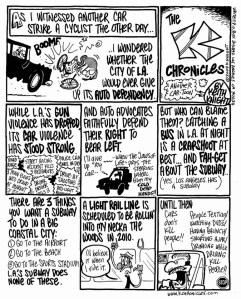
Posted by acilius on April 22, 2009
https://losthunderlads.com/2009/04/22/car-violence/
 Recently attempts have been made to launch spacecraft that would sail on the force of photons emanating from the sun. “Solar sailing” may be a technology that will make it possible to achieve very high speeds, perhaps more than half the speed of light. An article describes these efforts and the history behind them. The first place I heard of solar sailing was in a story by Arthur C. Clarke, who according to the article was a major figure in the drive to build them. Clarke suggested that solar sails might power the first probes intentionally sent to the stars. The article also mentions the late astrophysicist Thomas Gold, who argued that solar sailing was impossible for the same reasons that perpetual motion machines are impossible. Once advocates manage to get a sail out of the atmosphere, we should find out whether Gold was right and solar sailing is a physical absurdity, or Clarke was right and it is the royal road to deep space.
In a review of recent books on the Holocaust, Benjamin Schwarz points out that ordinary Germans knew a great deal about the slaughter of European Jewry as it was going on. Not only was the genocide too vast to be truly secret, but the leaders of the Nazi regime may actually have wanted a certain degree of knowledge of their worst crimes to leak out:
By establishing the murder of the Jews as an open secret—open enough that awareness of it pervaded society but secret enough that it couldn’t be protested or even openly discussed—the Nazis devilishly nudged the nation into complicity, and further bound the population to its leaders.
Did the German population perceive the killing of the Jews as a crime, or were they so far gone in their anti-semitism that it seemed like a reasonable thing to do? Apparently a psychologist named Michael Müller-Claudius conducted interviewed senior Nazi party members in 1938 about their attitudes towards Jews. He found that 5% of these “fully rejected antisemitism,” while another 69% would not admit to being hostile towards Jews. If even senior Nazis hesitated to embrace their party’s official antisemitism, one would expect the population at large to have very queasy consciences about the Holocaust. Schwarz closes his piece with discussion of a line by Goebbels, “As for us, we’ve burned our bridges behind us … We will either go down in history as the greatest statesmen of all time, or the greatest criminals.” I have no idea whether the Nazi regime really did play this coy game with the German public, but the thought that they might have is the sort of idea I tend to find irresistible.
Peter Hitchens’ less interesting brother writes a piece about Edward Upward, who for a little while in the 1930s was perhaps England’s most influential man of letters. By the time Upward died this February at the age of 105, he had outlived all the authors on whom he was an influence; certainly his name was not familiar as theirs still are (Christopher Isherwood, W. H. Auden, Stephen Spender, Louis MacNiece, Cecil Day-Lewis, among others.) I note the piece here because of its reference to “Upward’s novel Journey to the Border, which was thought of by many as the only English effort at Marxist fiction that was likely to outlast the era in which it was written.” I might want to read that some day.
Posted by acilius on April 22, 2009
https://losthunderlads.com/2009/04/22/the-atlantic-monthly-may-2009/
Here we have the children’s book Goodnight Moon set to music.
And here we have it in the International Phonetic Alphabet.
Posted by acilius on April 21, 2009
https://losthunderlads.com/2009/04/21/goodnight-moon-good-morning-phonetics/
 acilius
 believer1
 lefalcon
 losthunderlads
 vthunderlad
 Panther Red