
Here’s an edition of Jen Sorenson‘s Slowpoke from a few months back.
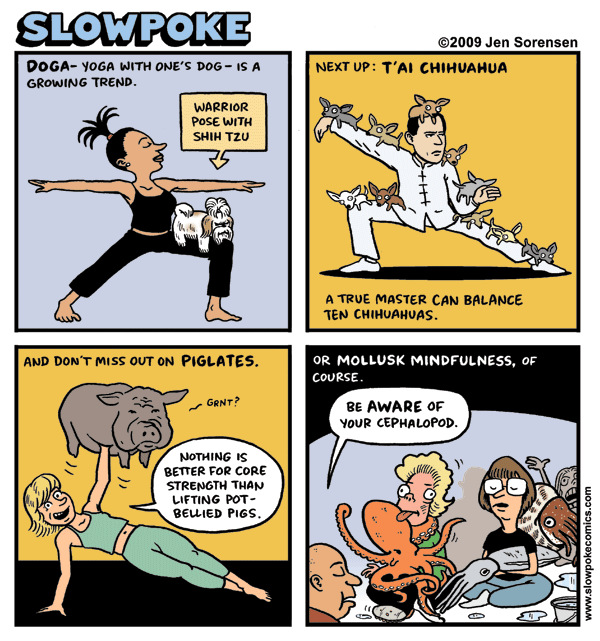
Here’s an edition of Jen Sorenson‘s Slowpoke from a few months back.
Posted by acilius on June 29, 2009
https://losthunderlads.com/2009/06/29/doga-yoga/
 It’s hard to make South African president Jacob Zuma seem an attractive figure, and the profile of him here doesn’t try. What intrigued me was its description of an art Zuma has mastered, Zulu stick fighting:
During my November 2007 visit to his homestead, I spoke with one of his brothers, Mike. As we stood by an enclosure where an ox had been slaughtered earlier in the day, Mike told me that his brother was clever, and should never be counted out. He said that from an early age, Zuma had been a masterful practitioner of traditional Zulu stick fighting. His distinctive technique had been to forego the formalities and hold his stick casually, as if he was on a lark. He’d turn away from his opponent, crack a joke, and smile. When it was least expected, he would sweep the other boy off his feet. Stick fighting is essentially a test of balance, not brute strength, in which one turns an adversary’s lunging attacks back on him.
That sounds like a martial art anyone with the makings of a successful politician would be well suited to practice.
An article called “Do CEOs Matter?” describes the classification of corporate leaders into two major categories, “Unconstrained Managers” and Titular Figureheads.” The men who coined these phrases were Professors Donald Hambrick and Sydney Finkelstein. In the article where they introduced the dichotomy, Hambrick and Finkelstein wrote that “If we had to choose as a society between doing away with Figureheads or Unconstrained Managers, clearly it is the Figureheads we would keep.”
Posted by acilius on June 29, 2009
https://losthunderlads.com/2009/06/29/the-atlantic-monthly-june-2009/
Thanks to 3quarksdaily for posting about this article that answers the question “How did the Sumerians count to 12 on one hand and to 60 on two?”
Posted by acilius on June 27, 2009
https://losthunderlads.com/2009/06/27/why-are-there-60-minutes-in-an-hour/
 Alex Cockburn rages at the Americans who cheerlead for the protests in Iran while they ignore politics in their own country, giving the Obama administration carte blanche to break every promise Mr O made to help working people and curb the national security state. As for Cockburn’s view of Iran, readers of his newsletter Counterpunch are familiar with his suspicion that the protests are something of a phony put up by advocates of war.
An editorial about the Obama administration’s approach to the righs of sexual minorities begins by pointing out that in Mr O’s first bid for public office, for the Illinois state senate in 1996, he was asked where he stood on same-sex marriage. Unlike other candidates, who either checked “yes” or “no,” Mr O went out of his way to add the sentence “I favor legalizing same-sex marriages, and would fight efforts to prohibit such marriages.” At that time no state recognized same-sex marriages, and many criminalized same-sex sex. Now, the country has moved on. Even the governor of Utah has endorsed civil unions for same sex couples. And Mr O has moved backward. Now he opposes same-sex marriages, presides over the continuation of “don’t ask- don’t tell,” and hasn’t lifted a finger to support legislation to protect sexual minorities from workplace discrimination, legislation 89% of Americans say they favor. The editorial sums it up: “At this rate, Obama is in danger of being outpaced on gay rights not just by the American people but by the nonsuicidal wing of the Republican Party.”
Lisa Duggan celebrates Salt Lake City’s surprisingly visible, surprisingly politicized sexual minorities. Countering those who have called for a boycott of Utah to protest the role of Mormons in the campaign to end gender-neutral marriage in California, Duggan quotes Salt Lake City residents who’ve called for a “New Queer Pioneer Movement,” one that would emulate the sect trains of the Mormon nineteenth century and flood the state with same-sexers.
Joseph Stiglitz claims that the current global economic crisis presents us with a stark alternative: either we adopt nationalistic policies of subsidy and protection that mean we renounce economic globalization, or we adopt United Nations-based regulatory schemes that mean we embrace political globalization. As Stiglitz is the head of the UN’s Commission of Experts on the crisis, it will not come as a complete surprise that he favors the latter option.
Posted by acilius on June 26, 2009
https://losthunderlads.com/2009/06/26/the-nation-13-july-2009/
If this site were your only source of information about the world of the ukulele, you would never have known about last week’s London Uke Festival, where a world record was set for mass uking. Fortunately, our friend Woodshed keeps the world informed of these things.
Nor would you know that Nashville, Indiana is the home of the Bushman Ukulele Luau, which has already convened twice this summer and will gather again in August.
Still less would you know to mark your calendar for the Paris Ukulele Festival on the 4th of July.
Heck, you wouldn’t even know that the Ukulele Orchestra of Great Britain was organizing a mass uke-in at the Royal Albert Hall on 18 August. Everyone is supposed to show up, jumping flea in hand, and play Beethoven’s Ode to Joy. Here’s a video they’ve made to promote the great event:
When I told Mrs Acilius what tune they were using, she was chagrined. She walked onto the stage at our wedding to the UOGB’s recording of Finlandia, and we exited to some non-ukulele rendition of the Ode to Joy. “If only they’d done this two years ago!” she exclaimed. “Then they might have had a version of it on CD by the time of the wedding.”
Posted by acilius on June 26, 2009
https://losthunderlads.com/2009/06/26/ukulele-festivals/

The Balance of Power
Michael Desch’s cover story, “Apocalypse Not,” argues that while Iran is nowhere near having nuclear weapons, things wouldn’t be so bad even if it did have them. Desch quotes some of the overheated rhetoric of anti-Iranian hawks. One line that stuck out for me was a quote from Israeli prime minister Binyamin Netanyahu: “You don’t want a messianic apocalyptic cult controlling atomic bombs. When the wide-eyed believer gets hold of the reins of power and the weapons of mass death, then the entire world should start worrying.” To which an uncharitable observer might add, he should know…
In response to assertions of this sort, Desch points out, first, that deterrence kept both Joseph Stalin and Mao Tse-tung from using nuclear weapons, and no one seriously argues that Iran’s leadership today is more warlike than were Stalin or Mao. Second, the Iranian political system does not centralize decision-making to any one man, as the Soviet and Chinese systems did in the days of Stalin and Mao. Therefore, it is far less vulnerable to the paranoid delusions of a single leader than were the systems those men dominated. So if nuclear deterrence was good enough to keep Stalin and Mao in check, it should be good enough to keep Ahmedinejad in check as well. Desch goes further, arguing that acquiring a nuclear arsenal might even lead the Iranian regime to become less difficult for its neighbors to live with. The existence of such an arsenal might enable the US and Israel to adopt a containment strategy towards Iran, which might lead to a mellowing of the regime, as the Soviet regime mellowed in the decades of containment following Stalin’s death.
Stuart Reid claims that “The truth is that man is no longer civilized enough to wage war.” What we call war, earlier ages would have seen as sheer murder.
A review of Defending the Republic: Constitutional Morality in a Time of Crisis commends its authors, conservative legal scholars and political theorists, for recognizing that while the center-left still tries to use the courts to do what should be done through the elected branches of government, “there is an anti-constitutional Right as well.” Irving Babbitt scholar Claes G. Ryn contributes an essay to the volume in which he equates the neoconservatives with the Jacobins of the French Revolution, likening the wars of the Bush/Cheney years with the Vendée and the first stirring of Napoleon’s campaigns of conquest. The title of Ryn’s essay is “Neo-Jacobin Nationalism or Responsible Nationhood?,” proposing a dichotomy of the sort Babbitt would have relished. Ryn develops the same dichotomy here.
Posted by acilius on June 26, 2009
https://losthunderlads.com/2009/06/26/the-american-conservative-18-may-2009/
 The June and July issues of Chronicles, the rightwardmost of my regular reads, include a couple of pieces that seem to acknowledge that the basis of conservatism is nostalgia. That isn’t so bad, I suppose; everyone feels nostalgia, and people who are nostalgic for the same things can share a bond, and can sometimes nurture a gentleness together.
June: Roger McGrath reminisces about his childhood in a thinly populated, mostly rural California. He makes it sound like paradise, or like a place a rambunctious boy might have preferred to paradise.
Thomas Fleming builds a scholarly argument to the effect that early Christians were not pacifists. I often suspect that Fleming has a grudge against Quakerism. I’m not sure where he would have picked up such a grudge- he grew up in a family of atheists, so it isn’t rebellion against his parents. But this article seems like a detailed response to some or other Quaker tract. And he frequently denounces many practices that are associated with Friends, such as silent worship.
In a piece lamenting the rapid decline of global birthrates over the last 20 years, Philip Jenkins makes an interesting suggestion. Most demographers claim that when religious beliefs lose their social power, people choose to have smaller families. Jenkins suggests that the arrow of causality should point in the opposite direction. Perhaps it is the fact that people have fewer children that disinclines them from taking religion seriously. “Without a sense of the importance of continuity, whether of the family or of the individual, people lose the need for a religious perspective.” He quotes the philosopher Rüdiger Safranski. Safranski claims that a drop in birthrate
results in a dramatic lack of maturity in the way people choose to live their lives… For childless singles, thinking in terms of the generations to come loses relevance. Therefore, they behave more and more as if they were the last, and see themselves as standing at the end of the chain.
George McCartney praises Richard Yates’ 1961 novel Revolutionary Road as a biting satire of self-styled “nonconformists” who congratulate themselves on their superiority to others while they are in fact utterly conventional. McCartney condemns the recent film of the same title as an example of the sort of thing Yates was ridiculing. He praises Eran Riklis’ film The Lemon Tree, the story of a Palestinian woman who insists on taking care of the lemon grove she inherited from her father even after an Israeli cabinet minister appropriates the land in which it grows for his own private use. Her refusal to give up her ancestral claim is the sort of thing that warms the reactionary hearts of the Chronicles crowd, and I suppose it reflects the kind of nostalgia that a person really could build a humane politics around.
Posted by acilius on June 25, 2009
https://losthunderlads.com/2009/06/25/looking-back-and-further-back/
 The 1-15 June issue of Counterpunch features a story about the US government’s snooping on Professor Seymour Melman during the years 1958-1974. What I wanted to note were the titles of two of Melman’s books, Our Depleted Society and The Permanent War Economy. Also noteworthy is a review of Melman’s 1962 book The Peace Race that appears in his FBI file; apparently a researcher at the Bureau’s Central Research Section was assigned to write the book up. The remarkable thing about this review is how favorably it reported Melman’s argument against the Cold War military buildup.
Posted by acilius on June 25, 2009
https://losthunderlads.com/2009/06/25/seymour-melman/
Here’s a simple experiment. Go to Google Images. Turn off safe search. Type in the word “man.” Look at the first screen of results. Note how many are nsfw. Then search for “woman,” and make the same note. Repeat the process with “girl,” “boy,” “male,” “female,” “she,” “he,” and other gender words. Include pairs of masculine and feminine names, such as “Julia” and “Julius,” in your search.
Posted by acilius on June 24, 2009
https://losthunderlads.com/2009/06/24/is-the-internet-sexist/
 From Ed Yong’s “Not Exactly Rocket Science,” a report on a recent study of turn-taking conventions among speakers of various languages. The surprising thing is how little variation there seems to be from culture to culture. It seems that every language group prizes speed of communication; nowhere is it the norm to pause noticeably between speakers. While I’m posting about Ed Yong’s coverage of linguistics, I should note that a few days ago he posted this piece about a study that seems to show that five-month old babies can recognize their native languages when they hear unfamiliar speakers use them.
Posted by acilius on June 19, 2009
https://losthunderlads.com/2009/06/19/fast-talking-furriners/
 acilius
 believer1
 lefalcon
 losthunderlads
 vthunderlad
 Panther Red