What you see depends on what you look for

the findHere are two reports on the same archaeological find.  From Reuters:

ANKARA (Reuters) – Archaeologists in the ancient city of Troy in Turkey have found the remains of a man and a woman believed to have died in 1,200 B.C., the time of the legendary war chronicled by Homer, a leading German professor said on Tuesday.

Ernst Pernicka, a University of Tubingen professor of archaeometry who is leading excavations on the site in northwestern Turkey, said the bodies were found near a defense line within the city built in the late Bronze age.

The discovery could add to evidence that Troy’s lower area was bigger in the late Bronze Age than previously thought, changing scholars’ perceptions about the city of the “Iliad.”

“If the remains are confirmed to be from 1,200 B.C. it would coincide with the Trojan war period. These people were buried near a moat. We are conducting radiocarbon testing, but the finding is electrifying,” Pernicka told Reuters in a telephone interview.

Ancient Troy, located in the northwest of modern-day Turkey at the mouth of the Dardanelles not far south of Istanbul, was unearthed in the 1870s by Heinrich Schliemann, the German entrepreneur and pioneering archaeologist who discovered the steep and windy city described by Homer.

Pernicka said pottery found near the bodies, which had their lower parts missing, was confirmed to be from 1,200 BC, but added the couple could have been buried 400 years later in a burial site in what archaeologists call Troy VI or Troy VII, different layers of ruins at Troy.

Tens of thousands of visitors flock every year to the ruins of Troy, where a huge replica of the famous wooden horse stands along with an array of excavated ruins.

(Writing by Ibon Villelabeitia; Editing by Ralph Boulton)

From Digital Journal, under the headline “Remains of Ancient Trojan Warriors Found”:

Archaeologists in Turkey have found the remains of a man and a woman who died fighting in the legendary Siege of Troy, some 3,000 years ago.
According toReuters, the bones of the two were discovered in the layers VI and VII. Troy VII is believed to be the site of the legendary war brought about by the abduction of the beautiful Helen, Queen of Sparta, by Paris, prince of Troy. The siege of Troy by Greek heroes is the subject of theIlliadby the great poet of antiquity, Homer. Ernst Pernicka, an archaeologist from the University of Tübingen, said:

We were able to calculate their approximate times of death and their ages. If our estimates are correct, we can confirm that we have found the first dead of the Trojan War.

The report said archaeologists could also increase their estimates of the size of the ancient city, as the recent excavations show a larger Bronze Age settlement than was previously believed. Pernicka told Reuters:

If the remains are confirmed to be from 1,200 B.C. it would coincide with the Trojan war period. These people were buried near a moat. We are conducting radiocarbon testing, but the finding is electrifying,

The German amateur archaeologist Heinrich Schliemann discovered the remains of the city in 1871. The ruins of Troy near the Dardanelles Straight remain one of Turkey’s key tourist attractions.

Digital Journal illustrates its piece, not with the photo of the find above, but with an image of a warrior’s helmet.

The American Conservative, November 2009

american conservative november 2009In this issue, former FBI employee Sibel Edmonds names some prominent US officials whom she believes to have accepted bribes from foreign governments.   

Eve Tushnet visits a Washington, DC locale known to the federal government as Meridian Hill Park, though she has “only seen its maiden name in two places: District government plaques and local girl Florence King’s autobiography, Confessions of a Failed Southern Lady.”  Everyone else calls it Malcolm X Park.  Tushnet compares the design of the place to a ziggurat, a Sicilian village, a complex borad game, and the world’s largest Slinky.  I can see why; there are also some views which remind me of M. C. Escher.  Whatever the park’s designers were thinking, they don’t seem to have been thinking of crime prevention.  “It’s an array of alcoves linked by narrow paths and staircases… The high walls and ample foliage make it a haven for people whose professions or hobbies require a talent for lurking.”  No one seems to be committing any crimes during Tushnet’s visit, though she does have her suspicions about a man who introduces himself as a podiatrist.  

A humor piece is written as if it were a diary entry by classicist-cum-neoconservative madman Victor Davis Hanson.  The locution “No American wishes to contemplate the idea of war, but” occurs three times, the locution “No Namibian mercenary wishes to contemplate the idea of war, but” occurs once.  A truly Hansonian piece, I’d say.   

(more…)

News for View Master Fans

3dstereoFrom the latest bulletin Las Vegas-based 3DStereo  sent to its mailing list:

News and More News:
Sources at Fisher-Price have disclosed that View-Master products are listed in the product list of 2010. A discontinued product line would have no such listing. And although it was not clear what new products are in the offing, it is heartening to hear that View-Master is at least listed for next year.

Of much greater significance, is the news that a tentative agreement has been reached between Fisher-Price and a group of private parties to carry on the work of the now disbanded Custom/Scenic Division. With a surviving reel making machine in Seattle, like the Phoenix rising out of the fire, it appears that the future holds in store for the world, new and favorite scenic View-Master reel sets as well as the ability for custom reel production for the commercial sector.

The Seattle based Alpa Cine, which produced the processed film for the F-P factory in Mexico has combined with Debra Borer, former, able steward of the Custom/Scenic Division pre-2006 will once again head up that exciting, new part of Alpa Cine.

But all is not perfect, probably because the absence was too short, once again Finley-Holiday is being considered distributor of the scenic reels even though their inefficient attitude to View-Master in the past and its resultant distribution practices may have been partly the initial reason that Fisher-Price gave up on scenic View-Master. But then, nothing is always perfect.

More news will be forthcoming and 3Dstereo will endeavor to keep all informed.

Quotation “marks”

Via Language Log, a website devoted to pictures of signs that use quotation marks unnecessarily.  It’s hilarious, as these examples should illustrate:

 chicken

Well, it tastes like chicken…

dekken and

To use the colloquialism, “and.”

jesus

He told me that was his name!

refund

You wanna refund?  I give you a real good refund, sure- right in da face!

The Atlantic Monthly, October 2009

atlantic october 2009Mark Bowden starts his piece, “The Story Behind the Story,”  by recounting TV coverage of the announcement that President Obama had nominated Sonia Sotomayor to the US Supreme Court.  Within minutes of the announcement, Bowden turned on Faux News and was impressed by the depth of their reporting.  He then turned to MSNBC, which was airing precisely the same report, using precisely the same quotes from Judge Sotomayor.  Flipping through the channels, he found that every station was airing the same report.  Curious, he looked into the matter.  The report apparently originated as a post on a conservative blog called verumserum, which not only did the TV channels’ work for them, but even did a better job of trying to be fair to the judge, giving far more of the context in which she made her remarks than did any of the broadcasters. 

Andrew Sullivan asks George W Bush to apologize for promoting torture.  Sullivan is oh-so-sure that Bush didn’t know what was being done in his name.  It reminded me of something about Cuba I read in Reader’s Digest when I was a teenager.  The reporter described ordinary Cubans’ habit of looking at injustices and sighing “If only Fidel knew.”  I had the reaction I was supposed to have, which was to feel sorry for those poor benighted victims of tyranny and certain that Americans would never delude themselves into letting a leader off the hook that way.  Whether there was any truth to Reader’s Digest‘s  description of Cuba I don’t know, but I do now know that we in the USA are not immune from the delusion it attributed to the people of that island. 

Benjamin Schwarz’ review of some new books about the economic slump of the 1930s contains an intriguing sentence, “The defining characteristic of the middle classes has always been their orientation toward the future.”  That sounds like the summary of some sociological theory.  Mrs Acilius is a sociologist; I should ask her if she recognizes the summary and can identify the school of thought in which such a claim might have arisen.  The backbone of his piece is a discussion of Robert Stoughton Lynd and Helen Merrell Lynd’s 1937 study of life in Muncie, Indiana, Middletown in Transition:

The seminal book—really the starting point for the others—is Robert S. and Helen Merrell Lynd’s Middletown in Transition (1937). The Lynds, husband-and-wife sociologists, had first descended on “Middletown”—the then-prosperous if stratified city of Muncie, Indiana—with their team of researchers in 1924, during the boom years. For the next 18 months, they dissected the everyday lives, habits, and attitudes of its inhabitants, concentrating on the middle classes. The book that resulted, Middletown (1929), remains a classic of immersive sociology and the most incisive and complete portrait of American bourgeois life in the 1920s. Having taken this minute snapshot, Robert Lynd and a smaller team returned to Muncie 10 years later to see what had changed in the intervening period, which included the darkest years of the Depression. They interviewed the city’s industrial barons, plant workers, and prostitutes; chatted up its teachers, prosecutors, and real-estate agents (although all sources were anonymous, this much of their identities can be gleaned); and pored over its newspaper files and tax rolls. Mostly, they seem to have gossiped, lingered over dinners, and played bridge with the members of a stratum that ran from the “less-secure business class” to the engineers and middle managers, the young married set, and the well-established doctors, lawyers, and executives in the lower-upper class. The fruit of their sojourn, Middletown in Transition, reveals, fact by fact, detail by detail, anecdote by anecdote, the “staggering, traumatic effect” of “the great knife of the depression,” which “cut down impartially through the entire population, cleaving open the lives and hopes of rich as well as poor.”

Terry Eagleton’s “Reflections on the God Debate”

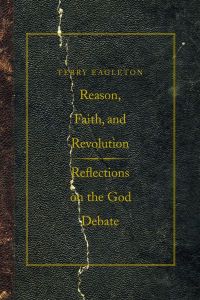
eagleton bookVia 3quarksdaily, an interview in which Terry Eagleton discusses his book, first published this March, Reason, Faith, and Revolution: Reflections on the God Debate.  In his introduction, the interviewer quotes Eagleton as saying that the “New Atheists” (Richard Dawkins, Sam Harris, etc) “buy their rejection of religion on the cheap.”  In the interview, he enlarges on this point, claiming that Dawkins and his ilk reduce religions to sets of propositions and behave as if arguments for and against these propositions were grounds for accepting or rejecting religions.  So far from being new, this approach represents positivism at its most naive.  They ask only, “What do the believers say about their creeds?,” never “What do believers accomplish by saying what they do about their creeds?”  For Eagleton, the life of the religion is in the relationship between beliefs and actions, and it is a ruinous mistake to treat a system of religious beliefs in the same abstract way that we would treat the propositions in a geometric proof.  Indeed, this is the same mistake fundamentalists make:

NS: You say he emphasizes a “propositional” account of religious faith above a “performative” one. But how far can one go believing in God performatively, through political acts, before it becomes a proposition?

TE: All performatives imply propositions. There’s no point in my operating a performative like, say, promising, or cursing, unless I have certain beliefs about the nature of reality: that there is indeed such an institution as promising, that I am able to perform it, and so on. The performative and the propositional work into each other. But it is a typically positivist kind of mistake to begin with the propositional, just as it would be for someone trying to analyze a literary text, which is basically a performance. Somebody who didn’t grasp that would be making a root-and-branch mistake about the kind of thing being confronted. These new atheists, and, indeed, the great majority of believers, have been conned rather falsely into a positivist or dogmatic theology, into believing that religion consists in signing on for a set of propositions.

(more…)

Aptronyms

Helen Scales

Helen Scales

A new book about seahorses has appeared; the author is a marine biologist named Helen Scales.  In its review, The Economist grants that “Scales” is an apt name for a person interested in fish. 


Emily Hornett

Emily Hornett

Some new discoveries have come from examinations of old collections of butterflies; the lead researcher is a biologist named Emily Hornett.  In his note about these findings, Ed Yong of Not Exactly Rocket Science mentions that Hornett is a “great name for an entomologist.” 


A name that is especially suited to the profession of its owner is sometimes called an “aptronym.”  The Wikipedia page for aptronyms lists some famous cases of this coincidence, including such ironic examples as the sometime primate of the Philippines, Jaime, Cardinal Sin.  According to blogger and aptronym maven Nancy Friedman of the “Fritinancy” blog, the American Name Society had a panel about aptronyms at its annual session this January.  Friedman cites a New York Times blog that had a little contest a couple of years ago for best aptronym; the winners included Peru, Indiana’s Eikenberry funeral home.  Friedman also mentions that Slate has posted lists of aptronyms from time, including lawyer Soo Yoo, psychiatrist William Dement, and former White House press secretaries Larry Speakes, who spoke, and Tony Snow, who snowed ’em under.  Here is a list of 180 aptronyms, including such worthies as a financial-services scammer named Robin Banks.  Some aptronyms are really quite eloquent, as for example in the anti-Apartheid activism of actress Honor Blackman

(more…)

The Nation, 5 October 2009

nation 5 october 2009We take sexual violence seriously here at Los Thunderlads, and so welcome the first installment of The Nation‘s investigation of sex trafficking and of what’s being done in the name of stopping it.  The first part looks at some projects that don’t seem to be helping; the second part will look at other approaches that might represent an improvement.

At the opening of this first part, Noy Thrupkaew interviews Gary Haugen and Patrick Stayton of International Justice Mission, an evangelical Christian group that stages vigilante raids on brothels in southeast Asia; Thrupkaew then talks with other people who have tried to help the women and girls IJM has “freed,” finding that many of them wind up returning to sex work, if anything finding themselves more helpless after the raid than they had been before.  Not only did IJM dump their “rescuees” with other NGOs, simply assuming that those organizations would somehow take care of them, they made no effort to differentiate between, on the one hand, women who had chosen sex work as the least worst option available to them and, on the other, women and girls who had been forced or deceived into it.  Nor did they choose their allies intelligently; IJM’s strategy of working closely with the Cambodian police seems rather dubious when we read one Cambodian policeman’s confession of the nightly rapes he and his colleagues perpetrated against the sex workers in their district, and when we read reports that many Cambodian policemen are active in sex trafficking rings.  Thrupkaew closes this first part of the series with the voices of two other women who are on the ground in Cambodia trying to help victims of sex trafficking there:

(more…)

The search for life as we know it, behaving as we would expect it to do

Today’s xkcd:

the_search


This may not really be fair to researchers who are currently searching the radio waves for signs of artificially produced transmissions from other planets.  After all, there is only one electromagnetic spectrum, while there might be any number of ways species might use or not use chemical traces to communicate.  Still, I think the basic point is well taken.

Stating the obvious

Via LemmusLemmus, a true (or at least, extremely plausible) story of life in the academy:

A colleague presented a fairly complex paper on how firms might use warranties to extract rent from certain users of their products.  No one in the audience seemed to follow the argument. Because I found the argument to be perfectly clear, I repeatedly defended the author and I was able to bring the audience to an understanding of the paper. The author was so pleased that I was able to understand his work and explain it to others that he asked me if I was willing to coauthor the paper with him. I said I would be delighted.

I immersed myself in the literature for a few months so that I could more precisely fit our contribution into the existing literature. We managed to reduce the equations in the paper to six. At this stage the paper was perfectly clear and was written at a level so that it could reach a broad audience. When we submitted the paper to risk, uncertainty, and insurance journals, the referees responded that the results were self-evident. After some degree of frustration, my coauthor suggested that the problem with the paper might be that we had made the argument too easy to follow, and thus referees and editors were not sufficiently impressed. He said that he could make the paper more impressive by generalizing the model. While making the same point as the original paper, the new paper would be more mathematically elegant, and it would become absolutely impenetrable to most readers. The resulting paper had fifteen equations, two propositions and proofs, dozens of additional mathematical expressions, and a mathematical appendix containing nineteen equations and even more mathematical expressions. I personally could no longer understand the paper and I could not possibly present the paper alone.

The paper was published in the first journal to which we submitted. It took two years to receive one referee report. The journal sent it out to a total of seven referees, but only one was able to write a report on it. Apparently he was sufficiently impressed. While the audience for the original version of the paper was broad, the audience for the published version of the paper has been reduced to a very narrow set of specialists and mathematicians. Even for mathematicians, the paper may no longer pass a cost-benefit test. That is, the time and effort necessary to read the paper may exceed the benefits received from reading it. I am now part of the conspiracy to intentionally make simple ideas obscure and complex.

 The original paper, by David R. Hakes, can be downloaded as a pdf here.