Christmas Ukulele Videos

Al Wood has posted two collections of Christmas-themed videos at Ukulele Hunt (here and here); his top pick from these two is Mad Tea Party’s “Oh Shit, It’s Christmastime.”  Armelle has posted an excellent collection at Ukulele and Languages.  My favorite of her picks is “Ukulele Christmas” by “yosinobu1950.”  UkeToob hasn’t put up a dedicated collection, but there are some Christmas songs there, most notably GensBlue’s Django Reinhardt-inflected “All That Ukulele Christmas” and Ukulele Mike’s appealingly earnest cover of “Merry Christmas (War is Over.)” 

I won’t embed any of those videos here.  Instead, Ill post two of Armelle’s own, non-Christmas oriented, performances. 

Sverige (in Swedish)

What if a day, by John Dowland

The Origin of Superwoman

This issue of The Atlantic has been lying around our apartment for several weeks while I worked on my actual job; last night, I had time to read it.  The one thing I wanted to note was Sandra Tsing Loh’s piece about how her view of herself as a mother has changed in the aftermath of her divorce.  Partly because she’s now virtually homeless, partly because she’s been smeared as a symbol of neglectful parenting on “blogs large and small all across our fair nation” (oh, and in the Los Angeles Times as well,) Tsing Loh now takes a hard look at the ideals of motherhood into which she was once indoctrinated and which she can no longer hope to meet.  She turns for enlightenment to a pair of books that I remember seeing all over the place in the 1970s, but that have apparently become hard to find in the last couple of decades: Germaine Greer’s The Female Eunuch and Shulamith Firestone’s The Dialectic of Sex.  She particularly recommends Greer’s chapter on “Family,” which traces the change from the traditional norm of a multigenerational extended family consisting of dozens of people related by blood who live and work together to the modern Western norm of the nuclear family, a couple and their children separated from their “stem families,” often by hundreds or thousands of miles.  Tsing Loh quotes Greer’s statement that the traditional family was a more stable system than the nuclear family because responsibility for its most crucial functions did not “rest on the frail shoulders of two bewildered individuals trying to apply a contradictory blueprint.”     

Some months ago I quoted Kurt Vonnegut’s remark that, “When a couple has an argument nowadays, they may think it’s about money or power or sex, how to raise the kids, or whatever. What they’re really saying to each other, though, without realizing it, is this: ”You are not enough people!”  It seems that Vonnegut and Greer were thinking along the same lines in some ways.  Not in all ways; Vonnegut seems to be suggesting that we as humans, by our nature, can be nurtured only in the bosom of a close-knit multigenerational extended family, while Greer’s argument leaves open the possibility that our need for extended families is one side of a contradictory inheritance from our pre-capitalist past, and that we might in time be reshaped so that we can find happiness without returning to the days before capitalism.  That’s a big difference, of course.   And Vonnegut’s remarks leave out the main theme of Greer’s study, the inequality of the sexes in various forms of family structure.  Close-knit multigenerational extended family groupings are usually, perhaps always, strongly patriarchal; the nuclear family may dethrone  the paterfamilias, but it may also isolate a wife from other women during her marriage and throw her naked to the cold winds of the labor market in case of divorce. 

Still, where Vonnegut and Greer do agree is that the nuclear family does not put enough people under a roof to maintain a stable home life.  The Supermom ideal which Tsing Loh has bitterly learned she will never be able to meet is a symptom of this underpopulation.  The future Supermom is supposed to establish herself in “a cool Creative Class career, like Writer.”  Then, she adds to that career a second career, as Child Care Provider Extraordinaire.  “Today’s Professional Class mothers are expected to have… the personalities- and the creative aspirations- of elementary school teachers.  But if you’re like me, you can’t compete with those seasoned professionals for whom child education is an enthusiastic vocation.”  Unless your Creative Class career is as an elementary school teacher, you are almost certain to be like Tsing Loh.  Surely it would be a miracle of sorts if a person whose background was in one profession could, on the strength of no particular training, match a qualified and experienced professional in another profession, whatever her personality.     

Supermom, by dint of her miraculous gift for childhood education, then shepherds her children into Creative Class careers of their own.  And the requirements for membership in the Creative Class are unforgivingly narrow; “We see, at our Creative meetings, the line that separates state-college folk from Ivy alums.”  It’s all well and good if your kids are writers or artists or whatever, but if their degrees are from humble adult education programs like the University of Michigan or UC Berkeley, it doesn’t count, apparently.  You’re still a flop as a mother.  The Creative Class Supermom not only guides her children into this fantastically narrow mold, she does it  without stifling their individuality; “the last thing she wants to be is a 1950s style nag.” 

For those who accept defeat in the contest to be Supermom, there is consolation in the works of D. W. Winnicott, a 1950s psychoanalyst who developed a concept of the “good enough” mother.  Tsing Loh finds that Winnicott’s “good enough” mother is “actually pretty close to perfect.”  

Supermom is devoted to her children; so devoted, in fact, that she is racked with guilt if she suspects that she loves their father more than she loves them.  This, to Tsing Loh’s disappointment, is why Ayelet Waldman titles her memoir Bad Mother.  While Tsing Loh fears that she is a bad mother because she left her husband for another man, Waldman fears that she is a bad mother because she can’t keep her hands off her husband, her children’s biological father.  Tsing Loh says that this isn’t so crazy; after all, “The very success of the modern American family- where kids get punctually to SAT tutoring classes, the mortgage gets paid, the second-story remodel stays on budget- surely depends on spouses not being in love.”  Being in love simply takes up too much time and attention to meet all of Supermom’s, or for that matter Superdad’s, obligations. 

This is where it becomes crucial that “You are not enough people.”  Not only are spouses dissatisfied with a marriage that only gives them one more person to talk to, and that person a member of the opposite sex, but children are dissatisfied too.  Without grandparents, uncles and aunts, cousins, all under the same roof, they direct all their demands to their parents.  Without their own parents, siblings, in-laws, nieces and nephews, parents direct all of their aspirations to their children.  Because each person is only one person, nothing parent or child does can satisfy the other’s need for a bigger group.  What the parents do have to offer is chauffeur service, fees for tutoring, and entry into structured activities led by adults who wear whistles around their necks.  What the children have to offer is the good opinion of such adults.  These goods can only for a moment quiet the longing for a larger kinship group, and so each side demands ever more of them.  The two beleaguered parents insist on providing ever more education to their children; they pride themselves on it, to the point where it becomes inconceivable for them not to judge other parents based on the lengths to which they have gone in playing this particular game.

Some whimsical pictures of ukuleles

Whether you think the ukulele is the instrument of Christ, of the Devil, or of an outline of a topless lady, this page on Ukulele Powa is for you.

Pete Seeger

Pete Seeger turned 90 in May; his birthday party, an intimate little gathering of 18,000 of his closest personal friends, was released on DVD this month, leading to some publicity.  Here are a few videos in his honor.

If You Love Your Uncle Sam (Bring ’em Home.)  Sadly, this Vietnam-era song is not just for nostalgia; here‘s an updated version.  

Wimoweh, with the Weavers

What Did You Learn in School Today?

Guantanamera

Solidarity Forever

The Answer is Y6

If “Y6” is the answer, what was the question?  Was it to do with that yellow blob crashing into the cartoon woman’s lower back?  I assume it’s crashing into her back, I suppose it might be a cloud of some kind emerging from her rear end.  The stink lines coming off it would support this latter interpretation.  Still, that doesn’t explain “Y6.” 

Photo by Acilius

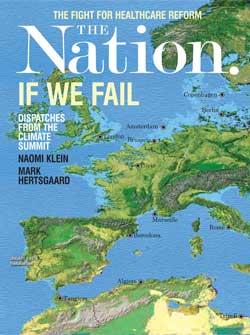
The Nation, 4 January 2010

Several reports on the Copenhagen summit on climate change draw Alexander Cockburn out with a column trumpeting his dissent from the view that by dumping such great volumes of greenhouse gases in the upper atmosphere humans are doing enormous harm to the environment.  Cockburn never convinces me when he mounts this hobby-horse of his, but I must confess to taking pleasure in the self-righteous sputtering that fills the letters to the editor in the subsequent issues.  For every well-reasoned counterargument from someone with a grasp of the science and a solid case to make against Cockburn’s claims, the magazine must receive hundreds of letters from people who are not at all equipped to analyze climate data but who are entirely prepared to denounce a heretic and cast him out.  I’m fairly sure that Cockburn is wrong and his detractors are right about climate.  At the same time, I’m quite certain that he is doing a public service by luring would-be enforcers of orthodoxy into the open.  He’s even doing a favor to them; if the self-appointed Grand Inquisitors have the sense to read their letters and realize that they have made fools of themselves,  they might shed their crusading demeanor and adopt a more wholesome attitude.

On The Nation‘s website, there’s a piece about the president of Italy’s parliament, Gianfranco Fini.  The piece notes the rather amazing fact that this man whose political career began in the neofascist Italian Social Movement has became “the country’s most responsible right-wing politician.”  Several months ago, The Independent praised Fini’s willingness to stand up to Prime Minister Silvio Berlusconi in defense of values like accountable government, a secular state, and openness to immigration, values that liberals and socialists are supposed to care about but that the leaders of Italy’s center-left parties seldom lend their full-throated support.  The Independent called Fini “the best leader the Italian Left never had.”  This really is an extraordinary transformation; as recently as 1994, Fini described Benito Mussolini as “the greatest statesman of the twentieth century.”  How anyone could possibly apply that label to il Duce is beyond me.  Before Mussolini came to power he was in some ways an intriguing figure, I grant you.  He led an highly colorful life, full of adventure and rich in ideas.  As a national leader, however, Mussolini was a disaster by any standard of evaluation.  The evil he did (for example, sending 3,000 Italian Jews to die in Hitler’s camps) infinitely outweighed any good with which he could be credited, yet in the end it was his sheer incompetence that triumphed even over his murderous villainy.  This is a digression, I suppose; Gianfranco Fini seems to be highly competent, and no more likely to commit murder than the average Western European politician. 

Katha Pollitt’s annual list of worthy charities includes, as usual, MADRE, a fund that backs various groups of women in poor countries who have organized themselves to combat their own problems on their own terms.  For example:

In Iraq, it supports Yanar Mohammed’s network of secret shelters for women fleeing domestic violence and honor murder. In Kenya, it works on water purification projects that free women from the task of transporting water over long distances. In Bolivia, it helps indigenous women prepare to run for political office. Right now, 100 percent of your gift goes directly to projects.

Barry Schwabsky’s review of some recent retrospectives on abstract painting includes a snippet that may provoke a response.  After telling us that he experiences art one work at a time and looks with a skeptical eye on all art history that describes movements and schools, Schwabsky says:

Abstraction arguably should have even less to do with movements than any other art: a movement of abstractionists would be a contradiction in terms, like a church of atheists. Abstractionists, like atheists, are united only in what they reject. Abstraction is not a specific way of doing art–on what basis can Jackson Pollock, Lucio Fontana and Daniel Buren be considered part of a single movement? Rather, it is a considered effort not to do what Western artists have made it their job to do for hundreds of years: namely, to construct credible depictions of people, places and things. What if anything else goes?

Perhaps that’s why, as Bob Nickas points out in his new book Painting Abstraction: New Elements in Abstract Painting (Phaidon Press; $75), “so many contemporary artists who paint nonrepresentational pictures reject the notion that their work is in fact abstract.” They realize that the name itself, as handy and unavoidable as it undoubtedly may be, conveys a false sense of unity. Other commonalities, even those that would rightly strike us as quite superficial, can be more important.

Tiger Woods crops up.  Ever since news started hitting the papers of Woods’ very active extramarital sex life, I’ve been thinking of William Blake.  “Tiger, tiger, burning bright,/ in the forests of the night…”  Or is it “Tiger, Tiger, burning sensation/ experienced during urination…”  Anyway, the item here is all about how Tiger Woods has spent his career promoting sleazy schemes by global bad actors such as Chevron and the Philippine government, all the while pretending that he had nothing to do with politics.

Crushie swims again

Here’s some imagery of our turtle Crushie swimming around his tank.  You can see his pet, Red The Goldfish, in some of the frames. 

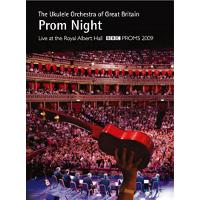
Prom Night: The Ukulele Orchestra of Great Britain Live at the Royal Albert Hall

On Tuesday, 18 August 2009, the Ukulele Orchestra of Great Britain was a headline act at the BBC Proms, an annual festival more formally known as the Henry Wood Promenade.  The BBC Proms goes on for about ten weeks and includes dozens of concerts in London’s Royal Albert Hall, as well as chamber music performances in nearby Cadogan Hall and a variety of lectures, films, and other fringe events devoted to music.  The UOGB’s performance at this year’s Proms was a big hit; here’s a high-resolution picture of the audience (beware, it can hypnotize you; I just spent three solid minutes trying to follow people’s lines of sight and figure out who was looking at whom,) and an article from The New York Times (the NYT piece is the same one I linked to in my review of the UOGB’s album Live in London #2, if it looks familiar to you that may be why.)  

A DVD of the performance went to press on the 3rd of this month, and today a copy of that DVD arrived at the Acilius household. 

The UOGB has already released audio tracks of ten of the fifteen songs from this set.  Performances of “Anarchy in the UK,” “Life on Mars,” “Teenage Dirtbag,” “Pinball Wizard,” “The Dambusters March,” “Melange,” and “Wuthering Heights” can be found on Live in London #1; “Silver Machine” and “Thunderball” are on Live in London #2; “Psycho Killer” is on Precious Little.  Two songs, “Anarchy in the UK” and “Life on Mars,” are already available on their previous DVD, Anarchy in the Ukulele.  The five numbers that are new to disc are “Puffin’ Billy,” “The Ride of the Valkyries,” “Danse Macabre,” a fragment of Beethoven’s Ninth Symphony “arranged for 1008 ukuleles”; and “Jerusalem.”  Of those five, “Puffin’ Billy” is chiefly a setup for “Anarchy in the UK,” and “The Ride of the Valkyries,” while an astounding example of musicianship, turns out to be an extended intro for “Silver Machine.”  Is it really worth  paying £15.00 plus postage for so much old rope? 

I say yes, emphatically yes.  The disc records not only fifteen fine performances, but an extraordinary moment in the history of the ukulele.  The most anticipated number was the Beethoven fragment, the UOGB leading 1000 audience members in the “Ode to Joy.”  The camera pans through the audience, showing hundreds of ecstatic faces.  A DVD extra shows the rehearsal the UOGB did with the uke-bearing members of the audience beforehand.  The “Ode to Joy” is of course a setting of a poem about universal brotherhood; it’s a bit breath-taking to know that and see such a large and diverse crowd join in playing the piece.  It’s almost a shame that UOGB does such a good job with the “Ode to Joy”; I wish it could become part of their regular repertoire, but where will they find 1000 sidemen to accompany every performance? 

Emotions clearly ran high in the hall throughout the concert.  Towards the beginning, Dave Suich recalls his last visit to the Royal Albert Hall, when he paid five shillings to sit in the gallery and listen to Black Sabbath.  Peering up, apparently at the spot those five shillings had bought him, he seems amazed to be on stage.  When Hester introduces “Teenage Dirtbag,” she makes a joke that it’s a poignant song for her because she’d expected to be alone on Prom Night; as she mentions the 6000 people in the hall and tens of thousands more listening on BBC 3, she loses her comic timing and seems to choke up.  High definition usually isn’t a friend to anyone over 30; Hester is an exception.  She doesn’t look a tenth of her true age, and the flicker of emotion on her face in that moment is worth a great deal.  When I talked about Hester’s “Teenage Dirtbag” in my review of Live in London #1,  I summarized it as a “ballad of adolescent lesbian angst”; it’s sobering to see how many visitors still come to this site having googled “hester goodman lesbian.”  At the risk of drawing more of that traffic, I’ll say that the human race would be the poorer if some among us did not go through adolescent lesbian angst.  I’d go so far as to label adolescent sexual angst in all its forms as an indispensable part of the human experience.  Hester has produced a powerful testament to that form of adolescent angst, and my hat’s off to her for it.  Not only mine; Mrs Acilius turned to me as we were watching “Teenage Dirtbag” and said the song filled her with pride every time she hears Hester sing it. 

In a DVD extra showing the players getting ready, Kitty Lux confides to the camera that singing “Jerusalem” as a solo in the Royal Albert Hall is “a dream come true.”  Introducing it on stage, she confesses that she isn’t sure she has the “temerity” to do it.  She wasn’t feigning the nerves; she stumbles over the lines at one point, and at the end Richie and Will touch her shoulders to reassure her.  With so much strong feeling, it’s only right that by the end of the evening hundreds in the audience are waving their ukuleles above their heads in time with the music.

I don’t want to give the impression that it’s all about weeping the tears of inspiration.  “Puffin’ Billy,” a tune used as the theme song for a number of radio and TV programs for small children, leads into an especially hilarious rendition of “Anarchy in the UK.”  “Ride of the Valkyries” and “Silver Machine” are a humorous pairing, and would get laughs even if Dave hadn’t made a comment comparing the “European” Wagner piece with the “British” rock tune.  Peter plays it cool singing “Thunderball,” letting the words get the laughs.  The moment in “Pinball Wizard” when the other seven shout at George to “Shu-duppa-yo-face!” is hilarious as audio, even funnier with video. 

I first heard Saint-Saens’ “Danse Macabre” in school when I was a little boy.  The recording our music teacher played for us featured pizzicato very prominently.  I asked him what instrument that was; he said the violin, plucked rather than bowed.  I wanted to sign up for violin lessons on the spot.  What I really wanted, I now realize, was a ukulele.  The UOGB’s version of the piece lets ukuleles sound like themselves, rather than trying to use violins to substitute for them.  While George introduces the piece by warning us that the ukukele doesn’t have enough sustain to play the “Danse Macabre” quite the way Saint-Saens wrote it, the version they play is thoroughly excellent.  Not least in its ability to get the listener up and dancing. 

Most of the performances are the same musically as the versions on their albums, but the video adds a great deal nonetheless.  For example, listening to “Psycho Killer” on Precious Little, you hear a rousing song and suspect that it’s supposed to be funny somehow.  Seeing Will play the role of a seriously disturbed person as he sings about being a “psycho killer,” you laugh at the absurdity of the song, even while you want to dance.  

The obvious place to end the set was with the “Ode to Joy,” but since most of the audience had just attended a rehearsal of that one, it wouldn’t have been much of a climax.  The regular program ends rousingly enough with the “Dambusters March”; the first encore, “Melange,” would also have been a suitable conclusion, amazing the audience as it does with the UOGB’s ability to keep a common thread while each member of the band is alternating between 3 or 4 songs, most of which are solos.  The second encore, “Wuthering Heights,” gives the audience the satisfaction of shouting “Heathcliffe!” en masse, but otherwise seems to be an odd choice to wind the concert up.  Still, it’s very strong overall, and I recommend it highly.

Language extinction

In a recent email to me and Le Falcon, blog founder VThunderlad included this link:

http://www.independent.co.uk/news/world/asia/the-beckoning-silence-why-half-of-the-worlds-languages-are-in-serious-danger-of-dying-out-1837179.html

VThunderlad commented on the way the link includes an abstract of the article.

Le Falcon replied:

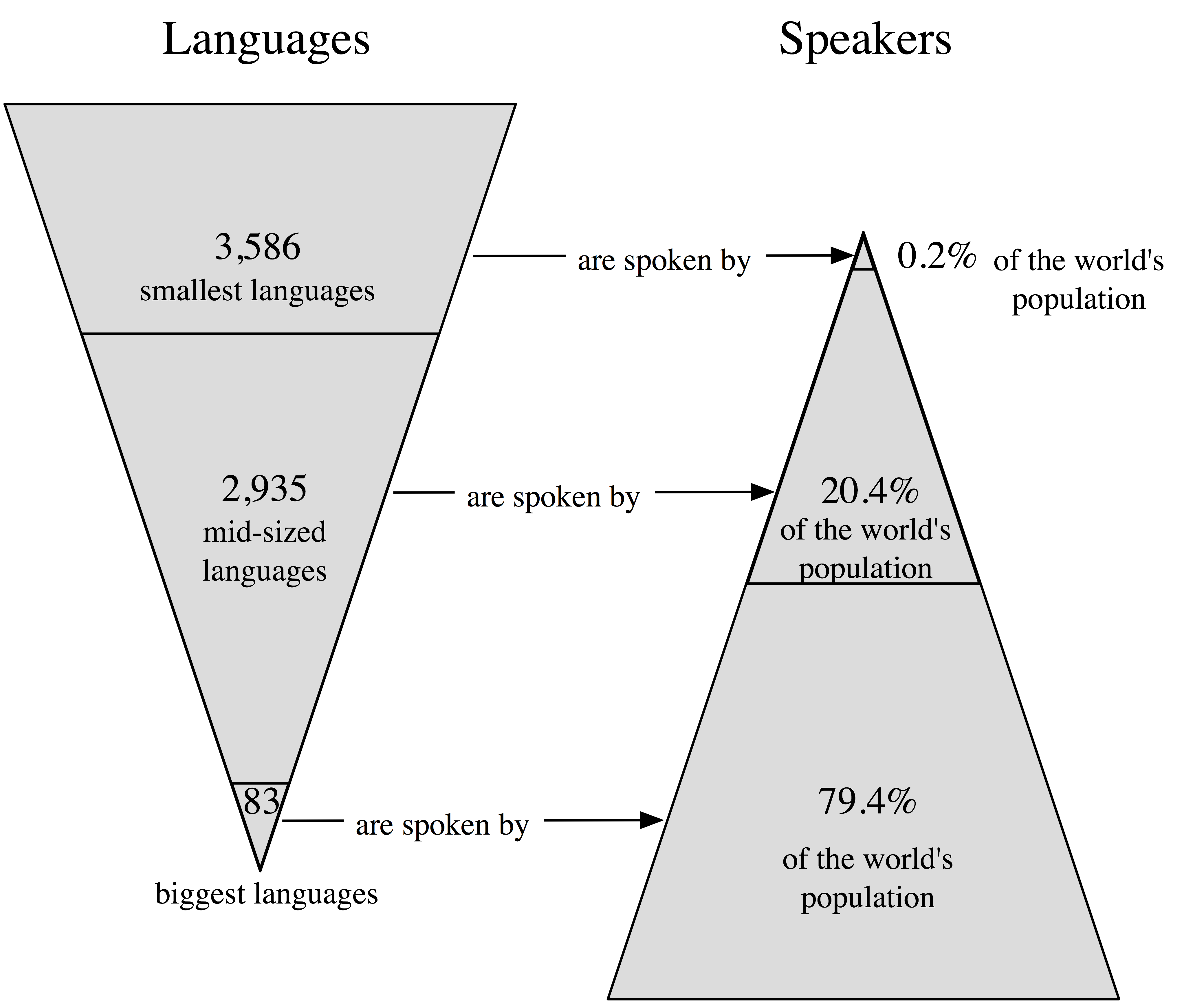
I saw a diagram (along these lines) of two triangles.
One has the point up; the other has the point down.
The first represents world population;
the second represents world languages.

It was a striking graphic depiction of this inverse
relation  :  how most
languages on Earth have very small speech communities;
while a small handful have enormous speech communities.

Here’s an example of such a diagram.  I’d have embedded it here, but it’s a bitmap file, which this site does not support. 

VThunderlad went on to wonder whether it really makes sense to see the fact that so many languages are faced with extinction as a moral issue in and of itself.  I replied that I thought it does.  When a language goes extinct, it becomes that much more difficult for a community to understand its ancestors.  A break in communication between one generation and another may sometimes be necessary, but is never costless.  Language extinction is the result of political and economic policies that people can either support or oppose; therefore, when we decide what our stand will be on those policies, their likely impact on endangered languages should be one of the considerations we take into account.

The Nation, lately

Here are the first two paragraphs of Stuart Klawans’ review of Richard Linklater’s docudrama, Me and Orson Welles:

 The story of an omelet told from an eggshell’s point of view, Me and Orson Welles relates the events of one week in November 1937, when a fictional high school student named Richard happens upon some actors goofing off on New York’s Forty-first Street and gets cast in a show that just might open: the Mercury Theatre’s soon-to-be-legendary Caesar. A day-tripping kid from the suburbs will accidentally participate in greatness. As the Mercury’s office manager and all-purpose sweetheart puts it, he will get to sit at the feet of Orson Welles and be showered with his spittle.

As swift and stripped-down as its title, the Caesar into which Richard has wandered will thrillingly transform Shakespeare’s Roman general into a present-day dictator in jackboots and black shirt, provided the director and star ever lets the play get out of rehearsals. Welles is a dictator too, you see, though without any ideal of military discipline, and evidently can’t bear to set an opening date, because then the chaos would end and he could no longer go on bullying and seducing and making everyone in the company wait on his every whim. “Can you play the ukulele?” Welles demands of Richard upon seeing him on the sidewalk, as if it were the first question that would pop into anyone’s mind. Without asking why, Richard looks Welles in the eye, lies and says yes. Welles stares back, recognizes the lie and hires him anyway, telling him he’s now Lucius. It seems the dictator has found a new underling, one with just enough spirit to make him temporarily interesting to break.

“Can you play the ukulele?” is a fine greeting so far as I’m concerned… 

That’s from the 21 December issue, as is Lori Wallach’s piece about the World Trade Organization.  Wallach has done yeoman work over the years publicizing the fact that the World Trade Organization is not just about “trade,” but takes a wide variety of issues out of the democratic process in its member states and subjects them to cloistered bureaucracies that respond only to major corporate interests.   

The main thing I want to remember from the 14 December issue is a piece about the killing of Fred Hampton.  Fred Hampton was the chairman of the Black Panther Party in Chicago when police shot him to death at his home, 2337 West Monroe Street, on 4 December 1969.  The official story from the Chicago Police Department at the time was that Hampton fired first; crime scene photos showing that most of the blood Hampton lost drained into his mattress suggested that he was in bed throughout the gun battle.  Hampton must have been very tired indeed to have remained in bed while waging a firefight against the police.    

The author of the piece is Jeffrey Haas.  Here is Haas’ summary of his own role in the response to Hampton’s death:

I was the first person to interview the survivors in the police lockup, where Hampton’s crying and pregnant fiancée told me that after she was pulled from the room, police came in and fired two shots into Hampton and said, “He’s good and dead now.” The autopsy showed he had been shot twice in the head at point-blank range. My colleagues went to the raid scene, examined the bullet holes and found that the trajectory of all the bullets except one was from the direction of the police toward the Panthers. Later, an FBI firearms expert testified that more than eighty shots were fired by the police at the Panthers, with only one coming from a Panther. That one shot was fired in a vertical direction by a falling Mark Clark after he had been fatally wounded.

Two years after the murder, antiwar activists raided the FBI office in Media, Pennsylvania, and found and distributed documents that demonstrated that FBI chief J. Edgar Hoover was conducting a secret war on the left–the Counterintelligence Program, or Cointelpro. Its most aggressive and lethal tactics were used against the black movement, and the Panthers in particular. Cointelpro mandated FBI agents in cities with Panther chapters to “cripple,” “disrupt” and “destroy” the Panthers and their breakfast program and to prevent the rise of a “messiah” who could unify and electrify the black masses.

In 1969 I was a young, newly radicalized lawyer, one of the founders of a collective called the People’s Law Office, which represented the Panthers. After successfully defending the survivors of the raid against bogus criminal charges, we filed a civil rights suit against the police and the prosecutor, and later the FBI. My book The Assassination of Fred Hampton chronicles our long legal and political struggle to uncover the truth about the FBI’s role in the killing. After thirteen years of litigation, we proved that the raid was a Cointelpro operation. FBI agents in Chicago gave Hanrahan and the Chicago police a floor plan of Hampton’s apartment, which included the location of the bed where Hampton would be sleeping. They urged Hanrahan to conduct the raid and later took credit for it in internal documents. The FBI informant who provided the floor plan was given a bonus because his information was deemed to be of “tremendous value” to what one agent referred to as the “success” of the raid.

Noam Chomsky has called the murder of Fred Hampton “the gravest domestic crime of the Nixon Administration.” It is hard to imagine a more serious abuse by a government than the deliberate assassination of a citizen for his political beliefs and activity. But though we were finally able to reveal that Hampton’s death had been an assassination, it has never gotten the attention it deserves. The government’s cover-up and stonewalling basically worked.

(more…)