
I don’t get this joke:
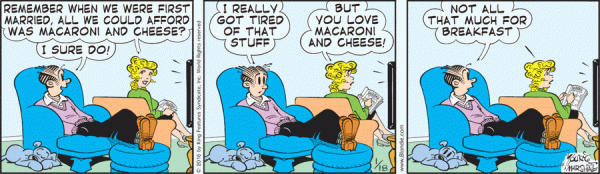
Why not have macaroni and cheese for breakfast? That would seem like as good a meal as any for it.
I don’t get this joke:
Why not have macaroni and cheese for breakfast? That would seem like as good a meal as any for it.
Posted by acilius on January 19, 2016
https://losthunderlads.com/2016/01/19/a-puzzling-comic-strip/

Donald Trump admires a typical resident of the UK
There was a debate today in the Palace of Westminster on a proposal to urge the Home Secretary to ban Donald Trump from entering the United Kingdom. Mr Trump is a demagogic politician whose support in his bid to become US president is based primarily on nationalistic resentment. Therefore, it would be difficult to imagine a development more perfectly calculated to increase his support and to improve his odds of becoming his party’s nominee for that office than a formal censure of him by the former colonial power, especially if that censure is delivered a few days before the voting begins in the first electoral contests.
This much is so obvious that one cannot suppress a cynical curiosity as to the true motives of those sponsoring the proposal. The foremost advocates of the recommendation represent predominantly Muslim constituencies. Why would members of parliament representing people towards whom Mr Trump has shown such extraordinary hostility embrace a proposal that would do more than anything else in their power to help him become president of the United States? Well, in the first place, it is unlikely the Home Secretary will actually take any such action. So they can go home and tell their constituents that they did something to express their alarm at the rise of so objectionable a figure, without triggering any real-world consequences.
If by some odd chance Mr Trump actually were banned from entering the UK, his resulting surge of support in the USA would certainly bode ill for British Muslims, especially if it were to take him all the way to the White House. But it might not harm Muslim M.P.s. On the contrary, they would be able to invoke fear of him and of the USA to consolidate support for themselves as a last line of defense for British Muslims in an openly hostile West.
Moreover, a President Trump, taking office after the UK government had taken a stand against him in so dramatic a fashion, would be in a position to inflict almost unlimited humiliations on that government. If you wonder how that would play out, just think of the consequences of John Major’s decision to actively promote George H. W. Bush’s reelection campaign in 1992. In the period from 20 January 1993 to 1 May 1997, John Major’s life took on an almost nightmarish quality as Bill Clinton demonstrated time and again just how severely an American president can punish a British prime minister who displeases him. Mr Clinton did all of that out of the public eye, as a purely private vendetta. Imagine what Mr Trump could do with the full force of US public opinion behind him. The sponsors of this recommendation, in a world where the news is daily showing the prime minister, the cabinet, the Queen, and all of the other nominal leaders of the UK crawling on their bellies and begging the US president to relent from his wrath against them, might even attract support from non-Muslim Britons disgusted by that desperate tableau. They might emerge as symbols of patriotic defiance against the power that was grinding Britain into the dust and exposing its leaders as gormless sycophants.
Posted by acilius on January 18, 2016
https://losthunderlads.com/2016/01/18/former-colonial-power-considers-censuring-nationalist-demagogue/

He wants a crackdown
I think one of the least appealing characteristics of white Americans is an excessive tendency to identify with authority figures. We can see this tendency among whites who lean to the political right, who are often ridiculously tenacious in their defense of police officers who shoot unarmed suspects or presidents who invade barely-armed countries. I’m a white American myself. Even though I usually tend towards the opposite extreme, being overly leery of authority, there are times when I revert to the norm. For example, when I’m under stress, my first reflex when I hear about a conflict is to identify with the more powerful side and ask impatiently why they don’t just go in with overwhelming force and sort the whole mess all out once and for all.
When I was a kid in the 1970s, people were still talking about the 71-day standoff that began when activists associated with the American Indian Movement took control of the town of Wounded Knee, South Dakota. Those activists were armed, and in the course of the standoff they shot United States Marshal Lloyd Grimm, paralyzing him from the waist down. When the topic of the Wounded Knee Incident came up in a room full of whites, there was always a good chance someone would say that the authorities should have resolved the situation with a violent assault, that organizers Russell Means and Dennis Banks should have been prosecuted on the gravest possible charges, and that the patience the government showed during the standoff and the acquittal of Mr Means and Mr Banks at their federal trial in 1974 were special treatment accorded to the activists because they were Native American.
For the last several days an armed group made up of whites has been in control of a federal bird sanctuary in Oregon. While the group who seized Wounded Knee were moved to action by their belief that their tribal government was corrupt and in need of reform, a belief that connected to a wider vision of Native American history and the place of Native peoples on this continent, the group in Oregon is incensed about what they see as the unjust federal prosecution of one man who, like them, was upset about federal land policy in the West. What strikes me is the sheer number of left-leaning whites whom I’ve heard in the last couple of days talking exactly like the people who were frothing at the mouth about Russell Means and Dennis Banks almost 43 years ago. I’ve heard them call for police violence to end the standoff; I’ve heard them call for prosecutions under federal anti-terrorism statutes; I’ve heard them say that a failure to do either of those things is the result of special treatment for the occupiers due to the their race. White people haven’t changed very much over the years, and don’t change just because they put down one political party’s banner and pick up another’s.
I’ve seen a number of interesting things about this situation. Counterpunch isn’t what it was when Alexander Cockburn was alive and co-editing it with Jeffrey St. Clair; Cockburn would probably have had a great deal of sympathy for the occupation and never had anything but scorn for people who interjected the word “terrorism” into a political discussion, but Mr St. Clair is the co-author of a piece there today calling the occupiers terrorists and chronicling the woes of a federal land management official who has long been in conflict with them and their relatives. Mr St. Clair certainly makes out a strong prima facie case that the occupiers are a bunch of jerks and that they they would be an unwelcome addition to any neighborhood, but that’s a long way from justifying the use of the “terrorist” label, a word which, these days, is virtually trademarked by those who demand a submissive attitude to the law enforcement and intelligence-gathering apparatuses of the US government.
Artur Rosman, citing his status as a naturalized citizen of the USA, declares himself incompetent to form an opinion about the Oregon standoff, and quotes at length from an African American friend of his:
If over the last several years you’ve thought that any of the black lives cut short by police violence “had it coming” because they were not compliant with law and order and/or were disrespectful and aggressive towards those in authority, then surely you are now advocating for a quick and overwhelming amount of lethal force to be brought against the activists in Burns, Oregon, who are openly breaking the law, actually bearing and threatening to use arms against police forces, intentionally flouting authority, etc. You can’t have it both ways. Conversely, if you think that the patience and calm with regard to the disgruntled and armed activists in Burns, Oregon, is probably the better part of wisdom, then surely you have been deeply outraged at the lack of patience and calm shown by police officers in so many cases in recent years involving un-armed black men and women posing far less of a threat to authority and government than is represented by this “militia” in Oregon. Again, you can’t have it both ways. Or, if you want to have it both ways, especially if you’ve been tempted by the “all lives matter” clap-trap, you have some serious explaining to do.
At Slate, Jamelle Bouie cautions against an interpretation of the situation which is phrased in solely racial terms. He also points out how bizarre it is that people who present themselves as opponents of police violence appear to be frustrated that the police are not handling this matter with an immediate recourse to violence. Mr Bouie’s last two paragraphs sum this aspect of it up well:
In any case, why won’t they shoot at armed white fanatics isn’t just the wrong question; it’s a bad one. Not only does it hold lethal violence as a fair response to the Bundy militia, but it opens a path to legitimizing the same violence against more marginalized groups. As long as the government is an equal opportunity killer,goes the argument, violence is acceptable.
But that’s perverse. If there’s a question to ask on this score, it’s not why don’t they use violence, it’s why aren’t they more cautious with unarmed suspects and common criminals? If we’re outraged, it shouldn’t be because law enforcement isn’t rushing to violently confront Bundy and his group. We should be outraged because that restraint isn’t extended to all Americans.
Libertarian stalwart Justin Raimondo has taken a lively concern with the case; in this piece, he anticipates the arguments Mr St. Clair and others have made about the basic rottenness of the people occupying the bird sanctuary and the cause they represent. Mr Raimondo defends the occupiers and extols their cause, unconvincingly to my mind, but vigorously.
He’s also spent a lot of time tweeting at people who have expressed authoritarian rage at the Oregon activists; here are a couple of samples:
and:
Glenn Greenwald has also mounted his Twitter account and taken it to the heart of this particular battle. As for instance:
https://twitter.com/ggreenwald/status/684078947877928960
and:
Posted by acilius on January 5, 2016
https://losthunderlads.com/2016/01/05/something-thats-wrong-with-white-people/
https://twitter.com/BoingBoing/status/684059994707329024
When blogger Geoff Micks first raised this vital question in 2012, I responded with a spreadsheet rating the 43 men who have served as US president on six variables: Coalition-Building Ability, Visual Inconspicuousness, Expertise in Hand-to-Hand Combat, Willingness to Kill (a.k.a. Badass Quotient, or BQ,) Physical Fitness, Spatial Awareness. The numbers I assigned each president under each variable came from the POOMA Institute, but I think they look pretty reasonable. So here it is again:
| President | Coalition Building | Visual Inconspicuousness | Hand to Hand | BQ | Physical Fitness | Spatial Awareness | Total |
| Washington | 5 | 2 | 4 | 4 | 3 | 3 | 21 |
| J Adams | 2 | 5 | 1 | 2 | 4 | 2 | 16 |
| Jefferson | 5 | 2 | 1 | 2 | 5 | 4 | 19 |
| Madison | 2 | 5 | 1 | 1 | 4 | 2 | 15 |
| Monroe | 3 | 3 | 5 | 4 | 5 | 4 | 24 |
| J Q Adams | 3 | 3 | 1 | 2 | 5 | 3 | 17 |
| Jackson | 5 | 1 | 5 | 5 | 3 | 5 | 24 |
| Van Buren | 3 | 3 | 1 | 1 | 4 | 3 | 15 |
| W Harrison | 2 | 3 | 3 | 3 | 1 | 4 | 16 |
| Tyler | 1 | 3 | 1 | 2 | 5 | 3 | 15 |
| Polk | 1 | 4 | 1 | 2 | 1 | 3 | 12 |
| Taylor | 2 | 2 | 4 | 4 | 2 | 5 | 19 |
| Fillmore | 2 | 4 | 2 | 3 | 3 | 3 | 17 |
| Pierce | 2 | 2 | 1 | 2 | 3 | 3 | 13 |
| Buchanan | 2 | 4 | 1 | 1 | 2 | 3 | 13 |
| Lincoln | 5 | 1 | 5 | 4 | 4 | 3 | 22 |
| A Johnson | 2 | 3 | 4 | 3 | 3 | 3 | 18 |
| Grant | 3 | 4 | 3 | 3 | 4 | 4 | 21 |
| Hayes | 3 | 1 | 2 | 2 | 5 | 4 | 17 |
| Garfield | 4 | 3 | 3 | 3 | 5 | 4 | 22 |
| Arthur | 2 | 1 | 1 | 1 | 1 | 3 | 9 |
| Cleveland | 1 | 1 | 1 | 1 | 1 | 3 | 8 |
| B Harrison | 1 | 3 | 1 | 1 | 5 | 3 | 14 |
| McKinley | 3 | 4 | 4 | 4 | 4 | 5 | 24 |
| T Roosevelt | 4 | 1 | 5 | 4 | 5 | 4 | 23 |
| Taft | 1 | 1 | 1 | 1 | 1 | 3 | 8 |
| Wilson | 1 | 3 | 1 | 1 | 5 | 3 | 14 |
| Harding | 3 | 3 | 1 | 1 | 2 | 3 | 13 |
| Coolidge | 2 | 4 | 1 | 2 | 3 | 3 | 15 |
| Hoover | 3 | 4 | 1 | 1 | 5 | 5 | 19 |
| F Roosevelt | 3 | 1 | 3 | 3 | 1 | 4 | 15 |
| Truman | 2 | 3 | 3 | 4 | 5 | 5 | 22 |
| Eisenhower | 4 | 2 | 3 | 3 | 3 | 4 | 19 |
| Kennedy | 2 | 1 | 2 | 2 | 2 | 3 | 12 |
| L Johnson | 4 | 1 | 2 | 3 | 2 | 3 | 15 |
| Nixon | 1 | 3 | 1 | 1 | 4 | 1 | 11 |
| Ford | 3 | 2 | 3 | 3 | 5 | 4 | 20 |
| Carter | 1 | 3 | 2 | 2 | 5 | 5 | 18 |
| Reagan | 3 | 2 | 2 | 1 | 1 | 3 | 12 |
| G H W Bush | 2 | 2 | 2 | 3 | 4 | 5 | 18 |
| Clinton | 3 | 3 | 1 | 1 | 4 | 3 | 15 |
| G W Bush | 2 | 2 | 2 | 1 | 5 | 4 | 16 |
| Obama | 1 | 1 | 1 | 1 | 4 | 3 | 11 |
Posted by acilius on January 4, 2016
https://losthunderlads.com/2016/01/04/presidential-deathmatch-revisited/
Two new visual representations have been catching people’s attention today. Each, in its own way, offers a view of all the matter in the known universe.
One is the periodic table of elements, now with four additional elements, completing the seventh row:

And the other is this picture by Pablo Carlos Budassi:

Posted by acilius on January 4, 2016
https://losthunderlads.com/2016/01/04/heres-everything/

One of the less well-known legends of Helen’s later life, from Star Trek comics #9
The Classics blog Sententiae Antiquae has a post today about the story that the Trojan War was triggered by Queen Helen of Sparta running off with Paris, alias Alexander, a Trojan prince. The post quotes several ancient Greek authors, sketching a variety of ways in which the ancients crafted the tale and a variety of purposes which they used it to serve.
They quote Herodotus’ remarks about the story:
“If Helen really were in Ilium, they would have given her back to the Greeks whether Paris wanted them to or not. Priam was not so out of his mind, nor were his other subjects, that they would want to risk their own bodies and children and the city itself just so that Paris could sleep with Helen.”
εἰ ἦν Ἑλένη ἐν Ἰλίῳ, ἀποδοθῆναι ἂν αὐτὴν τοῖσι Ἕλλησι ἤτοι ἑκόντος γε ἢ ἀέκοντοςἈλεξάνδρου. οὐ γὰρ δὴ οὕτω γε φρενοβλαβὴς ἦν ὁ Πρίαμος οὐδὲ οἱ ἄλλοι οἱ προσήκοντες αὐτῷ, ὥστε τοῖσι σφετέροισι σώμασι καὶ τοῖσι τέκνοισι καὶ τῇ πόλι κινδυνεύειν ἐβούλοντο, ὅκως Ἀλέξανδρος Ἑλένῃ συνοικέῃ.
(Book 2, chapter 110)
I offered this comment:
I’ve always been puzzled by the tradition that regards it as self-evidently absurd that a major war could have been sparked by something like Helen and Paris running off together. It sounds pretty plausible to me.
Had Priam known, as a certainty, that Menelaos and Agamemnon would raise the army Homer describes, lay siege to Troy for 10 years, and then destroy the city, probably he would have handed Helen over the minute Menelaos demanded her. The legend says that it took years to put the coalition together, so that first demand probably came from a military power that Priam could easily have defeated. For Priam to have complied with that demand would have been to present himself as a soft target to every power with designs on Troy.
Even if he had known that a vast army was coming after him and that they would defeat him, however, after that first minute had passed it would have become extremely difficult for Priam to surrender Helen. Every moment Helen was in Troy, a larger share of Priam’s prestige was invested in keeping her there. After just a few days, giving her up would have been a severe loss of face. And the way politics works, if you lose face severely enough, there’s no limit to what you can lose.
I think of the week that followed 11 September 2001. The USA demanded that the Taliban hand over Osama bin Laden; some very well-informed people of my acquaintance were quite sure that bin Laden and his circle had planned and ordered the attacks without informing the Taliban leadership, but were also sure that the Taliban leaders would not comply with the American demand, even though they knew that refusing to do so would result in the bombing, invasion, and occupation of Afghanistan, because complying would invite out-factions within their movement to stage a coup. Either way, they would lose control of the country. But while they might escape from the American onslaught with their lives, and perhaps even with a chance at returning to power if the occupation went badly, a coup would lead directly to their deaths.
Large-scale rationality, with economic interests and geopolitical power structures and so on, that’s very important in keeping a war going and setting the range of possible postwar environments. But the events that lead up to war take place at a different level, where there’s a lot of contingency and a lot of personality. That must have been quite obvious in ancient times, when a policymaker in Asia Minor had no way of getting information in real time about military alliances that are or are not being formed in mainland Greece, but plenty of information about who’s dominant in the face to face relationships he has with the people around him.
I teach Latin and Greek at a mid-ranking college in the interior of the USA. When the story of Helen and Paris comes up in my classes, I ask my students to imagine what might happen if Michelle Obama fell in love with Ji Xinping’s son and the two of them ran off together. It would be a tremendous challenge to diplomacy to prevent even that situation from ending in disastrous violence. How much more volatile would the situation be if, instead of a bilateral confrontation between nuclear-armed superpowers who are connected by an incalculable number of electronic communications on a daily basis, the parties were loose and shifting coalitions with no access to even the most basic information about each other’s positions and capabilities.
Posted by acilius on December 29, 2015
https://losthunderlads.com/2015/12/29/war-for-helen/

That barrel is terrific
The winning candidates in each of the last few US presidential races have headed campaigns in the course of which about $1,000,000,000 was spent. There is no reason to suppose that the winner of the 2016 race will ride any smaller a wave of money.
Donald Trump claims to possess a personal fortune of $10,000,000,000. This claim is unlikely to be true. More to the point, whatever the true scale of Mr Trump’s wealth, very few businesspeople are in a position to liquidate 10% of their holdings in order to finance one personal project. Mr Trump’s debts and other commitments are such that he is surely not at liberty to do that. Estimates of Mr Trump’s cash on hand range from $70,000,000 to $250,000,000, far short of the amount that is typically spent even on winning a major party’s nomination, let alone competing against the nominee of the other major party in the general election.
Mr Trump continues to assert that he has enough money to self-finance. His refusal to solicit campaign donations is so essential to his appeal that it is unclear how he could start asking for money without dynamiting his base of support.
That creates two problems. First, Mr Trump’s campaign expenditures thus far have been quite modest. He has received so much coverage free of charge from cable news and other media outlets (all the way down to this blog post, apparently) that he hasn’t needed to buy advertising. The only way he can keep gaining that free coverage is to make news, and the only way he can make news is by making remarks that are more shocking than any he has made before. Unless conditions turn so bad that the electorate starts looking for an out-and-out revolution, that’s a one-way street that leads directly to a brick wall.
If Mr Trump somehow manages to be elected president, he would face a second problem. Assume that the net worth of all of his assets really were as high as $10,000,000,000. And assume that he was able to sell them all at their full value, despite the fact that every potential buyer would know that that he was under pressure to sell them. Assume all that. A US president is effective only to the extent that s/he is the leader of an effective party. If Mr Trump has $10,000,000,000, it might conceivably be possible for him to spend $1,000,000,000 of that and finance a successful campaign for the presidency. But even $10,000,0000,000 would not be enough to finance the entire Republican Party for four to eight years. Presidents help their parties raise money. They are expected to do it. If Mr Trump should refuse to do that, he would quickly lost the support of his party and with it any chance he might have of enacting his platform.
Posted by acilius on December 14, 2015
https://losthunderlads.com/2015/12/14/donald-trump-is-too-poor-to-run-for-president/
When we started this blog, my attitude towards religion was very much that expressed by Philip Larkin in his poem “Church-Going.” Visiting a church on an empty weekday, the poet wonders “who/ will be the last, the very last, to seek/ This place for what it was”; will it be someone looking for scholarly information, or for a nostalgic thrill, or for something to steal; or:
will he be my representative,
Bored, uninformed, knowing the ghostly silt
Dispersed, yet tending to this cross of ground
Through suburb scrub because it held unspilt
So long and equably what since is found
Only in separation – marriage, and birth,
And death, and thoughts of these – for whom was built
This special shell? For, though I’ve no idea
What this accoutred frowsty barn is worth,
It pleases me to stand in silence here;A serious house on serious earth it is,
In whose blent air all our compulsions meet,
Are recognised, and robed as destinies.
And that much never can be obsolete,
Since someone will forever be surprising
A hunger in himself to be more serious,
And gravitating with it to this ground,
Which, he once heard, was proper to grow wise in,
If only that so many dead lie round.
In those days, as indeed in all my days up to that point, I was like my parents, a mellow sort of agnostic who had a sense that the grown-up thing to do was to treat all the world’s major religions with as much respect, and as little outright incredulity, as possible. I was indeed Larkin’s representative, visiting churches and other houses of worship on occasion, not to humble myself before the God in whom I could not quite imagine believing, but as a step towards assuming an adult mien.
Nowadays I’ve become a mellow sort of Christian. But the last day or two, I’ve found myself reminiscing about my Larkin-like past self. What brought me back to this was the front page of yesterday’s New York Daily News:
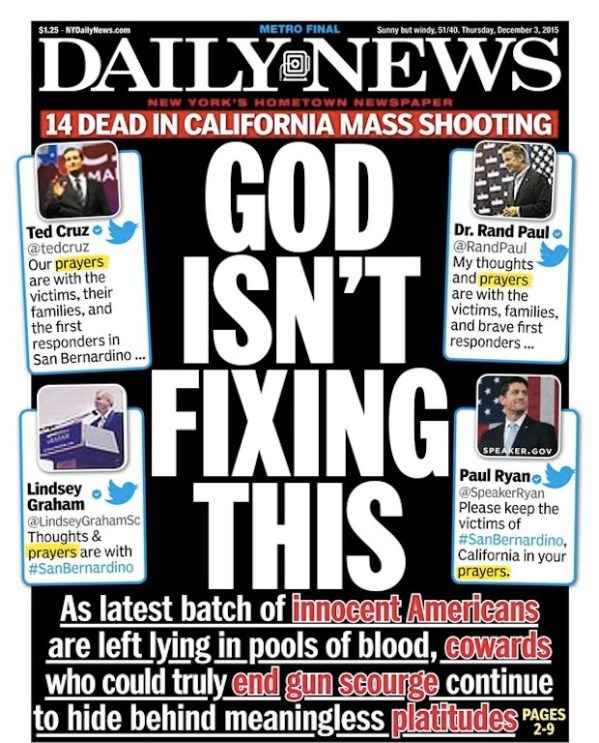
I saw a blog post about this by Rod Dreher that got me thinking. I read Mr Dreher’s blog every day, largely because his views are very different from mine. He is a self-identified member of the Christian Right, while I would be considered an ultra-progressive Christian if I had joined almost any group other than the Episcopal Church. So, Mr Dreher regularly hyperventilates with rage and terror over developments that I find either unimportant or entirely desirable, and occasionally ignores or even praises developments that would move me to purple-faced fury. It does me a lot of good to look at him when he’s worked up and to realize that I would look as ridiculous to him or people like him if I were to choose to get on my high horse and get all worked up about my opinions as his profession of opinion writing requires him to do about his opinions.
Mr Dreher’s post yesterday wasn’t entirely free of hyperventilation, but it did include some very good bits. There were long quotes from an Atlantic Monthly piece in which Emma Green patiently dissects the understanding of prayer that seems to inform this “prayer-shaming,” contrasting it most pungently with a request for prayer that one of the victims texted while hiding from the gunmen. Mr Dreher also quotes to good effect an essay by mellow secularist Roland Dodds on why the Left needs a vibrant Christianity.
And Mr Dreher contributes several highly trenchant remarks of his own. For example:
This is not a post about gun control, about which I believe honorable people can disagree (though let it be said that not everyone who disagrees, on both sides of the issue, does so honorably). This is a post about liberals — ordinary liberals, not fringe folk like boob-choppers — who hate conservative Christians so much that they react to a mass shooting by denouncing those Christians for praying for the dead, calling their prayers “meaningless platitudes” (unlike #SendOurGirlsHome, I guess).
This is where I remembered my Larkin-like former self. Hashtag activism, like the #SendOurGirlsHome campaign, differs from prayer, as prayer is practiced in the world’s major religions, in that it is simply an attempt to make oneself feel powerful in the face of a situation where one is in fact powerless. Prayer can be used to do that, of course, as can any practice around which superstitions accrete.
But look at the most prominent prayers of the world’s major religions. When Muslims make their confession of faith, they say that there is no God but God and Muhammad is his prophet. To say that there is no God but God is to acknowledge that there are limits to the power of human beings. The state can’t raise the dead and deliver final justice, which is what “Fixing This” would mean in the aftermath of a mass shooting. The market can’t, and the individual can’t. Those are all phantasms created by human beings in the course of their interactions with one another, by themselves as inert and as much a dead-end as were any of the idols of wood and stone that Muhammad busied himself destroying. To say “Muhammad is his prophet” is to say that, limited as we are, we do have access to knowledge of our duties and we have been granted the power to at least try to fulfill those duties. So a prayer like that acknowledges both the scope and the limits of human power and of human moral responsibility.
In my youth, I spent a great deal of time studying the works of the theorist Irving Babbitt (1865-1933.) As I was when I was reading his works, Babbitt was an agnostic who believed that there were great truths to be found in the world’s religions. He embarked on a Perennialist project, finding that all of the great wise men of history, including the founders of every major religion, agreed with him on all the most important issues of morality, politics, art, etc. It’s easy to look at that sort of conclusion and chuckle, but it is worth pointing out that Babbitt’s students from China, such as the famous Lin Yutang, remarked that his understanding of Confucius was deep and that his learning in Confucian and Buddhist thought was comparable to that of experts in their homeland.
One of Babbitt’s great contributions to the study of Buddhism was his translation of the Dhammapada. In that translation and in the accompanying essay, “The Buddha and the Occident,” Babbitt stresses the contrast the Buddha draws between pamada, which Babbitt translates as “laziness,” and its negation, appamada, which he translates in a variety of ways. Since pamada is often characterized by frantic activity, it may seem odd to call it laziness- perhaps “procrastination” would create a clearer mental image. What one does in a state of pamada, one does as an evasion of the true work of adjusting one’s will to the higher law, the moral constants of the cosmos.
In this distinction, I think I see the same sense of the scope and limits of human responsibility that informs the Muslim confession of faith. Our attempts to control the material world, to control other people, to remake the past, are futile, are pamada, because these things are not in fact within our power. We show true appamada only when we surrender our useless attempts to control the outside world and concentrate our energies on controlling ourselves so that we may conform to the supernatural order. As we approach this conformity, we may become more active or less active in the world, but that activity is incidental to the great struggle within.
As for Christians, when we say the Lord’s Prayer we too acknowledge the scope and limits of our powers. “Our Father,” we call God- we are his children, not his servants, for the servant does not know the master’s business; but we know God’s business. If we are children, we are heirs, and heirs have the power and the duty to do the father’s business. But our knowledge is limited, and our power is limited. The prayer brings us up against those limits sharply. We are so weak and needy as to be dependent on God even for our daily bread; so broken that we are dependent on him even for the forgiveness we continually need to receive and to give, and for freedom from an infinite array of temptations, none of which we could resist on our own. It is his will that is to be done, not ours.
“Thy will be done.” I often think of a colleague of mine who, many years after earning his doctorate, after decades of toiling in low-paying jobs in and out of his his field, was finally about to receive tenure at a university. Then his wife, a nurse who worked with the severely disabled, was hit by a reckless driver and herself rendered massively disabled, physically and cognitively. He took early retirement to care for her full-time. He remarked “Sometimes it dawns on you just what those words we say every day really mean.” Thy will be done.
Whatever else it may or may not do, prayer does cure the state of mind which reflexively demands “Fix this!” in the face of death. It may be, as Alexander Schmemann so memorably argued, that the Christian does look at death with defiance, confident that God will fix this. But God will fix it in God’s own time, in God’s own way, which is beyond our power and beyond our imagining.
As for gun control, if it is a good idea, then surely prayers like those which Muslims, Buddhists, Christians, and others say will incline them to support it, inasmuch as these prayers involve accepting that there is a sphere within which do have the power and therefore the duty to do good things. Most of the world’s population does, after all, follow one or another of the great religions, and in very few countries are legislators and rulers unable to find ways to pass the time.
What does induce culpable inactivity, I would say, is exhausted panic. Earlier today I saw a brief article in which Hamilton Nolan points out that, in all likelihood, “You Will Not Die in a Mass Shooting.” Of course the first comment identified “this pronouncement” as “basically the working talking point of every conservative politician ever” and extrapolated from it the idea that “People don’t ever really die in ‘mass shootings.'” As if people who do not actively believe that they personally are about to die in a mass shooting will not accept the reality of mass shootings or support policies that they were convinced would reduce the likelihood of mass shootings, as if there was no space between panicked lunacy and sullen lunacy. Realism, as in the acceptance of the fact that human power is considerable but not infinite that prayer induces, creates such a space, while sentimentalism collapses it. So, I call for your prayers today.
Posted by acilius on December 4, 2015
https://losthunderlads.com/2015/12/04/scope-and-limits/
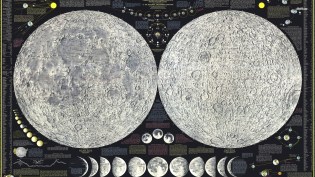
One of my favorite maps, available for purchase here
It’s odd how the mind works. If you’d asked me last night if I’d ever heard the phrase “stackable probabilities,” I would have said that I had not. Yet this morning, I woke up from a dream in which I was looking at a photograph of the surface of the Moon while a voice in the background explained that “a map is not an image depicting a territory, it is a graphic representation of related sets of stackable probabilities.”
I woke up before the voice could explain what that meant. Since I have never studied statistics, and did not know until I googled it that there really is such a phrase as “stackable probabilities,” probably the only way a voice in a dream of mine could explain it would be if I were sleeping in a room where someone was giving such an explanation. Making it even stranger that such a phrase would pop into my head, most of the results for “stackable probability” that came up in that Google search were from gaming forums, and I haven’t spent any time playing or discussing electronic games since about 1983.
Anyway, it is in fact plausible that someone might describe a map as graphic representation of related sets of stackable probabilities. As I understand it, a set of probabilities is stackable if it is made up of a series of variables, each of which is dependent on the item preceding it in the series but independent of the item following it. So there can be river systems only where the parts of a landmass vary in elevation, but parts of a landmass can vary in elevation where there are no river systems.
It becomes plausible to think of maps as summaries of probability structures rather than as images of territory when we consider that maps of large areas of the Earth’s surface do not feature cloud formations, and that maps of coastlines do not show the tide either coming in or going out. It’s virtually certain that a satellite photo of a continent or an ocean would show at least a few clouds, and utterly certain that the seas continuously show tidal motion, but there is no relationship between the probability that any particular cloud formation or state of the tides will prevail at a given moment and the probability that a user will consult the map at that moment.
Standard features of large-scale maps of populated areas, features such as mountains, rivers, roads, cities, centers of extractive industry, coasts, political boundaries, etc, are likely to be there and to be of interest to a user of the map. Moreover, these standard features are also the features most plainly related to each other. Roads connect cities to each other and to centers of extractive industry, unless mountains, coastlines, or political boundaries block them; rivers flow from mountains to coasts and cities grow along them; etc.
In my dream, I was looking at a photograph of the surface of the Moon. There are no rivers, roads, cities, industries, coasts, or political boundaries there. So, what is the difference between a photograph of the Moon’s surface and a map of the Moon’s surface? Add labels naming the mountains, craters, maria, etc, add notations of the elevation of those features, and isn’t the result a map?
I’m inclined to think not. Several times Apollo astronauts lost their way on the Moon; the best-known such episode came during the Apollo 14 extra-vehicular activity, when Alan Shepard and Edgar Mitchell lost so much time trying to orient themselves that they did not manage to reach the rim of Cone Crater, a key mission objective. Many have accused Admiral Shepard of showing a cavalier attitude to the geological aspects of the mission; most notable of these is perhaps David Reynolds, author of a well-regarded book called Apollo: The Epic Journey to the Moon, 1963-1972 (Zenith Press, 2013.) Be that as it may, Captain Mitchell is a famously conscientious man (as witness his willingness to sound rather odd at times,) and it is difficult to believe that he did not use every available resource to prepare himself for such an important assignment.
I suspect the problem was that the resources available to Captain Mitchell and his superior officer included too many photographs and too few real maps. On a surface where the horizon is so much closer than it is on the Earth, people do not have conventional reference points and cannot rely on reflexive mental habits to determine their location. The essential visual aid for such travelers is therefore one which illustrates, not the surface features which their experience on Earth has not prepared them to interpret, but such statistical relationships among those surface features as are likely to shape their journey.
Posted by acilius on November 30, 2015
https://losthunderlads.com/2015/11/30/maps-and-territories/
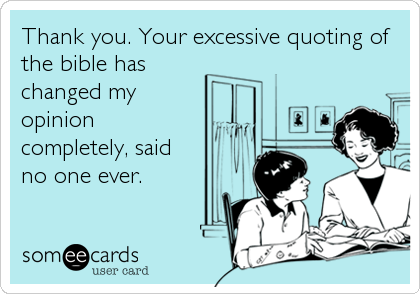 I spend a fair bit of time hanging out with mild-mannered progressive Christians. One thing that I like about the members of that group is that they don’t often try to spring Bible quotes on you as a means of settling political disagreements. The last couple of weeks, though. there has been a tremendous amount of backsliding among progressive Christians in this regard. As a result, I’ve been avoiding social media lately.* So many of my friends have been quoting passages from Leviticus and the Gospel According to Luke as if those passages made it obvious what policies the United States of America and the European Union should adopt towards refugees and migrants from southwest Asia, and have been calling down fire and brimstone on those who are unconvinced, that my news feed on Facebook and my stream on Twitter have started to feel like a tent revival with an especially dyspeptic preaching staff. Quite a few people whom I know to be committed universalists, believers in a doctrine holding that all souls are destined for salvation, have posted statements that those who do not share their position on this issue will be going to Hell.
There are many hazards to attempts to use the Bible to settle political disagreements. Some are more obvious than others. For example:
And so they may. But beware. One Samaritan is good to the beaten man; three Jews are bad to him. That story could as easily be called “The Parable of the Bad Jews” as the “The Parable of the Good Samaritan.” And so on with the rest of the Gospel of Luke, including the sheep and the goats. The consistent, overarching theme of the whole thing is that early first century Jews are hypocrites, unworthy of their divine heritage, and that they will be punished unless they join the movement forming around Jesus. Progressive Christians reflexively identify themselves and the church as the heirs of this rebuke, and say that the strictures that Jesus lays upon the superficially pious Jews of his day apply to the superficially Christians of our day. But that is not the only interpretation Luke has received over the centuries. Plenty of readers, among them people wielding whatever form of sacred or secular authority you may find impressive, have read Luke as a mandate for every form of anti-Jewish activity, up to and including genocidal violence. If that’s the road you’re bent to follow, nothing in the Bible will stop you traveling down it.
To which a smart-aleck might reply that the command to uproot the seed of Amalek is limited neither by the liturgical calendar nor by the passage of centuries, and inquire if that is the model Mr Willis would have us follow.
If we do want to stick with something specifically called for by the liturgical calendar, in the impeccably progressive Episcopal Church this morning’s Daily Office reading from the Old Testament was from the prophet Joel (chapter 3, verses 1-2 and 9-17.) It includes a call for the Jews of the Diaspora to reverse what Isaiah had seen, to beat ploughshares into swords and pruning hooks into spears, to stand in the valley and do battle for the heritage of Israel. It concludes with the lines “And Jerusalem shall be holy, and strangers shall never again pass through it.”
I’d certainly rather we lean towards a relaxationist line than a restrictionist one, and if we have no choice but to cite Bible verses in defense of border policy, I’d always prefer a sanitized view of Luke to a full-throated version of Joel, or Exodus, or Deuteronomy, or Samuel, or Joshua. But I think a wiser use of the Bible starts with verses 26.4 and 26.5 of the Book of Proverbs:
26.4. Answer not a fool according to his folly, lest thou also be like unto him.
26.5. Answer a fool according to his folly, lest he be wise in his own conceit.
Do these verses contradict each other? Obviously they contradict each other; that’s the point. The Bible is a reliable companion, and can be a wise counselor, if we listen to it in the right mind. But it doesn’t make our decisions for us. We’re still responsible for living our lives. We need our own judgment to tell us whether any particular group of people are fools or not. Having decided that they are fools, we need our judgment to decide whether, in a given situation, it is more important to keep ourselves distinct from their foolishness or to try to persuade them to leave it behind. Once we’ve made that decision, the appropriate proverb will tell us the consequence of our decision. Holding aloof from folly, we must abide it in silence. Trying to correct folly, we must ourselves become somewhat foolish.
In regard to border policy, I think the Bible is useful to us only after we have decided whether we, like Moses and Joshua and Samuel and Joel, are members of a community that is called upon to establish itself as a distinct people with a distinct destiny in the divine drama of history, or whether we, like the contemporaries of Jesus as described in Luke, are members of a community that has gone as far in that drama as distinctiveness will take it and so must set our distinctions aside and embrace a new kind of identity. I tend to lean toward the shedding distinctiveness side, and rarely read the violent passages of scripture without horror and revulsion. But my progressive friends, in their spasms of self-righteousness, have managed to take their immigration relaxationism so far that I am coming to see value even in the injunctions to smite Amalek.
*WordPress is an unsocial medium, an online hermitage, as witness the fact that it’s almost indecent to blog under your real name here.
Posted by acilius on November 23, 2015
https://losthunderlads.com/2015/11/23/four-reasons-why-quoting-the-bible-rarely-settles-political-disagreements/
 acilius
 believer1
 lefalcon
 losthunderlads
 vthunderlad
 Panther Red