
This animated gif appeared in Slate some time ago, I love it:
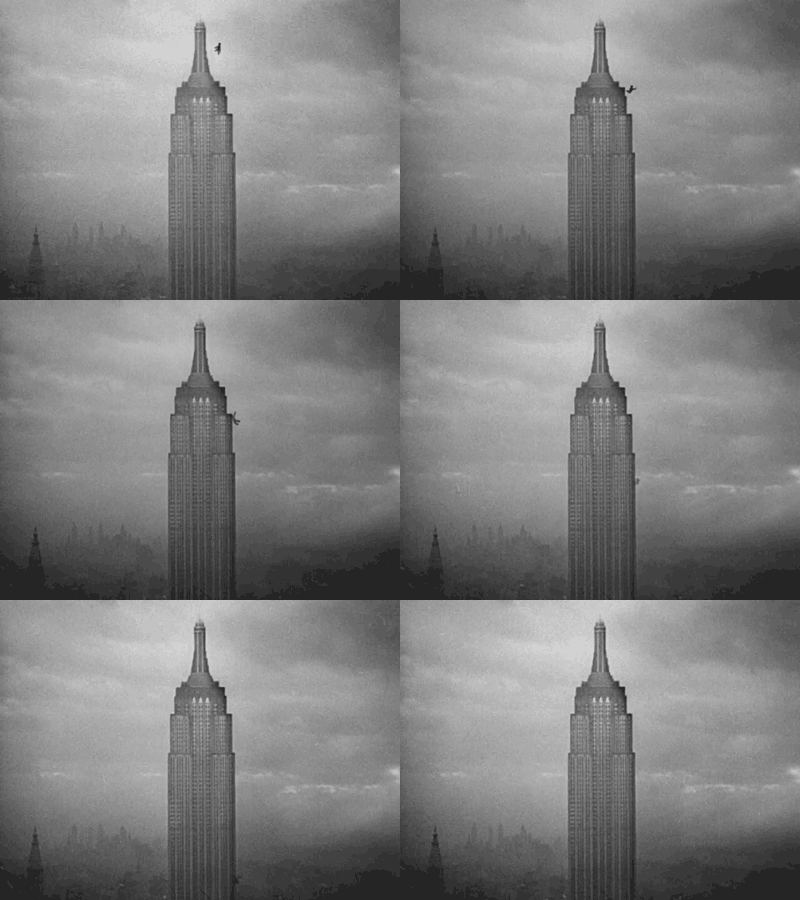
This animated gif appeared in Slate some time ago, I love it:
Posted by acilius on August 17, 2012
https://losthunderlads.com/2012/08/17/king-kong-falling-off-the-empire-state-building/
Way back in the 4 June issue of The Nation, William Deresiewicz published a review essay about Kurt Vonnegut. As I read Mr Deresiewicz’ piece, it dawned on me that I had never read Slaughterhouse-Five. I’d read several of Vonnegut’s novels and miscellaneous writings, but had missed the most famous one. Embarrassingly enough, I had talked about Slaughterhouse-Five with a number of people over the years, conversations in the course of which I sincerely, if somewhat vaguely, believed that I had read the book at some point. Once, while still in high school, I even suggested to a friend that we co-author a tribute to Slaughterhouse-Five in comic book form. If he’d taken me up on that, I suppose it would have become clear to both of us quickly enough that I hadn’t read it, but we settled on a tribute to Froissart’s Chronicles instead.
So, not long after I read that issue, I reported to the library and checked out a copy of Slaughterhouse-Five. It was well worth reading. Mr Deresiewicz says that the novel’s real subject is not the firebombing of Dresden, but the Post-Traumatic Stress Disorder that the firebombing bequeathed to Vonnegut and other survivors. Mr Deresiewicz quotes a remark from the beginning of the novel, “there is nothing intelligent to say about a massacre.” The novel is great, he argues, because Vonnegut doesn’t try to offer answers or find meanings. He looks directly at an unintelligible world, a world in which human beings by the thousand can be incinerated in their homes, and does not flinch by looking away to something else, something reassuring in its logic. Instead, the novel’s Billy Pilgrim, like Vonnegut in his own authorial voice, says simply, “I was there.” Mr Deresiewicz writes:
“I was there,” he says. And he adds, “So was my old war buddy, Bernard V. O’Hare.” The moment prefigures the novel’s moral climax a few pages before the end. Billy’s in a hospital in 1968, after the plane crash. His roommate is a former Air Force general who is working on a history of the Army Air Corps in World War II. He is wealthy, healthy, masterful, accomplished (his name is Rumfoord, by the way), and he dismisses Billy, in his quasi-comatose state, as so much human refuse. He is telling someone that the raid on Dresden had been kept a secret for so long
“For fear that a lot of bleeding hearts…might not think it was such a wonderful thing to do.”
It was now that Billy Pilgrim spoke up intelligently. “I was there,” he said.“I was there.” Meaning not, I suffered, but simply: It happened. It doesn’t fit the story that we tell ourselves about the war, but it happened. And I alone escaped to tell the tale. But not completely alone: my old war buddy was there as well, which means you can’t dismiss me as a lunatic. I was there. Or as the novel’s famous invocation, thrice repeated, puts it: Listen.
“I was there”—not, “The death of Dresden was a bitter tragedy, needlessly and willfully executed.” The sentence comes from a short, unpublished manuscript, included in the Library of America edition, that Vonnegut had worked on in the years immediately following the war. Before he could write the novel, I believe, he needed to surrender that sense of judgment. “It had to be done,” Rumfoord finally says to Billy. “I know,” Billy replies, “everybody has to do exactly what he does.”
Elsewhere in the novel, Vonnegut explicitly disavows judgment of the pilots who carried out the raid. He never did blame them, he says; he has known bombers and admired them. He describes the bombs as if they acted on their own, unassisted by human agency. In the novel, that description figures not as a psychological evasion, but as the facing of a supreme horror. A world dominated by malevolence and permeated by guilt would have a structure, and so would be intelligible. As such, even a realm of villainy would be easier to bear than the realm of sheer absurdity into which the massacre introduced its survivors.
In a bit of the novel that Mr Deresiewicz does not quote, Billy Pilgrim and his fellow prisoners are herded into Dresden. The crowd gives Billy dirty looks; one man confronts him and demands to know if he “thought we would laugh”? Billy is confused, then realizes that the miscellaneous items of clothing he has scavenged to cover his nakedness in his weeks as a prisoner adds up to a clown’s costume. Here, Billy parallels his creator. Cobbling together a way to tell his story, Vonnegut has gathered up bits of wartime memoir, of science fiction, of midlife-crisis narrative, of soft-core porn, of half a dozen other genres, and pasted them together. The result is a very odd book, at first glance an aggregation as clownish as Billy’s costume. It is precisely because Vonnegut is entirely willing to play the fool, to make himself as much a stranger to smart rhetoric as the war has made Billy a stranger to smart attire, that Slaughterhouse-Five is a possession for the ages.
As the Periodicals Notes section of this website attests, I read a lot of magazines. After the attacks of 11 September 2001, I dropped several titles from my list of regular reads. These included The New Statesman, The National Review, The London Review of Books, and The American Spectator. Each of these magazines carried a number of piece about that series of massacres. There were many things to find objectionable about those pieces; certainly the right-wing publications did not cover themselves in glory by arguing that the appropriate response was to adopt policies that would punish all Muslims everywhere, and the others did their reputations no favors when they published remarks such as “the United States had it coming.” What I found most rebarbative about all of them was something I couldn’t put into words at the time, but Vonnegut crystallizes it perfectly. Each of those commentators, left and right, treated the massacres and their aftermath as a continuation of their lifelong quest to display their own brainpower to the utmost possible advantage. Because there is nothing intelligent to say about a massacre, the result of this contest to be the smartest one was an exhibition of moral idiocy on a spectacular scale.
If we don’t endeavor to make intelligent remarks about a massacre, how do we honor the dead it leaves behind? This is typically a religious question, so let’s see what we can say about Vonnegut and religion.
As Mr Deresiewicz documents, Vonnegut was raised to be skeptical of conventional religion*:
Vonnegut saw our spiritual anxiety, in the postwar chaos, and as a former public relations man, he knew our mass gullibility. He had also studied anthropology, an experience, he later said, that “confirmed my atheism, which was the faith of my fathers anyway. Religions were exhibited and studied as the Rube Goldberg inventions I’d always thought they were.” Now machines were taking control, so we needed to pretend that something else was in control. Or as he puts it in The Sirens of Titan, “Gimcrack religions were big business.” The Age of Aquarius surely came as no surprise to him—the age of crystals and gurus and mystical hucksters. Charles Manson and Jim Jones surely came as no surprise, and neither did L. Ron Hubbard, a man who started writing science fiction but decided he was writing Scripture.
If we reject the belief systems and hierarchies of traditional religions and the rites that go with them, how do we go about honoring the dead? I think I detect a kindred spirit in the Vonnegut/ Deresiewicz emphasis on “I was there, and so was Bernard V. O’Hare.” We honor the dead by remembering them. To do this we must turn our attention from ourselves and focus it on them, on them as they were individually and as they interacted with each other in groups. To sustain this focus we must resist the temptation to retreat into distractions, whether those distractions take the form of ideologies that make our losses bearable or of activities in which we ourselves become again the center of attention. We must give the dead our undivided attention, if only for a moment, if we are to honor them.
Religions can certainly be fruitful source of excuses for keeping the focus off the dead. Many funerary rites focus attention on clergy or other performers; many include invitations to dwell on recondite theological doctrines about the relationship between life and death. So I sympathize with opponents of religion like T. H. Huxley who say that respect for the dead requires us to renounce the conventional forms of religion. On the other hand, for many mourners these things quiet their minds and take them outside of themselves, enabling them to maintain a clear, unwavering focus on the dead. And there’s nothing to say that persons who find the ritual elements a distraction can’t learn to respond to them in the desired way. After all, the others learned it; no religious practice comes instinctively to anyone, even if there is an instinct for something called religion in general. So even proceeding from my idea that mourning should be a matter of focusing our attention on the dead, we don’t find an argument against funerary rites.
Of course, funerary rites do something else as well. They reassure the mourners that the remembrance of the dead is not a burden they will carry alone, but a bond they share with their community. Funerary rites aren’t the only social practices that give that assurance; one of the reasons we want medical professionals to make heroic efforts to save our loved ones is that we want to know that those professionals will remember them, at least as an interesting case. When someone is to blame for the death of a loved one, we want the same attention from the criminal justice system, in part for the same reason. That’s probably why murder mysteries are so popular. Some time ago, I saw an episode of Columbo on some cable TV channel that specializes in nostalgia. Lieutenant Columbo had caught the murderer hiding the victim’s body. In his bizarrely friendly way, Lieutenant Columbo was trying to keep the murderer from feeling too bad about himself, telling him, “Dead bodies have a way of turning up.” In reality, of course, they don’t. The only thing dead bodies actually have a way of doing is decomposing. Given enough time, it will be as if the dead had never lived. That may well be the world’s most unbearable fact. Many years ago, my wife lost her closest friend to an act of violence that was never investigated; with each passing year, fewer people remember her, and her family’s burden grows more obvious.
Medicine and the criminal justice system, whatever their virtues, are never entirely satisfactory substitutes for funerary rites. A course of medical treatment is an exercise in technology and finance that revolves around the person of a patient, but is never simply a tribute to that patient; a criminal proceeding is an exercise in institutionalized conflict in the course of which a person who is unavailable to participate actively is likely to vanish from view altogether.
Many people recommend political action as a way to honor the dead. I’m all for democracy, and I understand the power of martyrs to arouse a citizenry to action. So I’m not opposed to the idea of waging a campaign for reform in the name of some dead person. But consider. Every political dispute is complex; every political issue shades into other, related issues, and every person who takes part in a political disagreement is pursuing several objectives at once. To turn a person into a political symbol, therefore, is likely to make it virtually impossible to focus our undivided attention on that person. Again, not everyone sees that focus as the essence of honoring the dead; some may define honoring the dead in a way that begins and ends with the political utility of martyrdom, or in other ways that put a low priority on memory of them as they were. But for me, and perhaps for Vonnegut, the key thing is to meet the dead on their own terms, not to impose our preconceived notions on them or to lose sight of them in the midst of some other activity.
If we say that our ways of honoring the dead are part of our religion, whether we belong to any recognized religious tradition or not, then Vonnegut and I may share a religion. Moreover, at least in my version of that unnamed religion, politics is not part of the funerary rites by which we honor the dead. The rites of the various religious traditions that do have names and belief systems and hierarchies aren’t really part of it either, though they can serve the same purpose. What is a part of it? How do we go about focusing our attention simply on a person, not on desires and ideas of our own that we may associate with that person?
In a post a few years ago, I quoted a man who had said that his way of praying for a person was to hold an image in his mind of that person against a plain white background. This meditative exercise does not involve any words; that way he isn’t tempted to wish things on the person, or to try to recruit God as an ally in an effort to make the person do what he thinks is right. Instead, it enables him to see the person clearly, to listen to what the person is actually saying, to accept the person as s/he is, and to respect his or her journey in life. I’ve tried this exercise myself on many occasions, and can recommend it highly.
So that exercise is part of my religion, if you call it that. Science is part of it, too. Richard Feynman said in his 1974 commencement address at Caltech that in science, “The first principle is that you must not fool yourself- and you are the easiest person to fool.” My favorite living philosopher, Alasdair MacIntyre, argues that healthy religious traditions represent lines of inquiry that guide their followers away from particular forms of self-deception. I don’t really understand how that is supposed to work; MacIntyre’s own religious tradition, as embodied in the Roman Catholic Church, seems to me to be an ever-flowing fountain from which self-deception springs in forms unimagined anywhere else. Be that as it may, science offers its practitioners tools unmatched in any other avenue of human pursuit for disabusing oneself of one’s pet ideas. Thomas à Kempis said that the highest reward of the contemplative life was that it had enabled him to free himself of a multitude of opinions; to the extent that Thomas’s words apply to religious practice in general, scientific inquiry is the most efficient of all forms of worship.
*To be precise about it, the Vonneguts were members of All Souls Unitarian Church in Indianapolis, Indiana when the novelist was growing up. At that time, the congregation met in a building designed by architect Kurt Vonnegut, Senior. In his maturity, Kurt Vonnegut, Junior did not identify even with the creedless religion of the Unitarians, or the Unitarian-Universalists as they became in 1961.
Posted by acilius on August 16, 2012
https://losthunderlads.com/2012/08/16/there-is-nothing-intelligent-to-say-about-a-massacre/
In an extract from a forthcoming book, Kenan Malik summarizes some of Alasdair MacIntyre’s views.
Posted by acilius on August 16, 2012
https://losthunderlads.com/2012/08/16/6392/
 Irving Babbitt (1865-1933) and Paul Elmer More (1864-1937) were American literary scholars, famous in their day for arguing that Socrates, the Buddha, Samuel Johnson, and a wide array of other sages throughout the history of the world had conceived of the freedom of the will as the ability to defy one’s impulses. Babbitt and More gave this conception a variety of names; perhaps the most familiar of these names is “the inner check.”
The other day, I picked up a copy of the August 2012 issue of Scientific American magazine while I was waiting for the pharmacist to fill a prescription. Lo and behold, a column by Michael Shermer described neurological study conducted in 2007 by Marcel Brass and Patrick Haggard. Doctors Brass and Haggard found support for an hypothesis that will sound familiar to students of Babbitt and More. As Mr Shermer puts it:
[I]f we define free will as the power to do otherwise, the choice to veto one impulse over another is free won’t. Free won’t is veto power over innumerable neural impulses tempting us to act in one way, such that our decision to act in another way is a real choice. I could have had the steak—and I have—but by engaging in certain self-control techniques that remind me of other competing impulses, I vetoed one set of selections for another.
Support for this hypothesis may be found in a 2007 study in the Journal of Neuroscience by neuroscientists Marcel Brass and Patrick Haggard, who employed a task… in which subjects could veto their initial decision to press a button at the last moment. The scientists discovered a specific brain area called the left dorsal frontomedian cortex that becomes activated during such intentional inhibitions of an action: “Our results suggest that the human brain network for intentional action includes a control structure for self-initiated inhibition or withholding of intended actions.” That’s free won’t.
If this is true, then Babbitt and More’s works take on a new interest. If such a control structure exists in the human brain network, it wouldn’t necessarily be the case that humans would be consciously aware of it. There are any number of facts about the operation of our brains that no one ever seems to have guessed until quite recent scientific findings pointed to them. So, if Babbitt and More were right and a great many distinguished intellectuals operating in many times and cultures conceived of moral agency as a matter of “self-initiated inhibition or withholding of intended actions,” it would be reasonable to ask whether this conception is evidence that the process Doctors Brass and Haggard detected in the left dorsal frontomedian cortex is perceptible to the person who owns the brain in which it occurs.
The same issue included a couple of other interesting notes on psychological and neurological topics. A bit by Ferris Jabr discusses Professors George Mandler and Lia Kvavilashvili, who have been studying a phenomenon they call “mind-pops.” A mind-pop is a fragments of memory which suddenly appears in one’s conscious mind for no apparent reason. Most mind-pops are very slight experiences; the example in the column is a person washing dishes who suddenly thinks of the word “orangutan.” That’s the sort of thing a person might forget seconds after it occurred. Trivial as an individual mind-pop might be, perhaps as a class of experiences they may point to significant aspects of mental functioning. Professors Kvavilashvili and Mandler:
propose that mind pops are often explained by a kind of long-term priming. Priming describes one way that memory behaves: every new piece of information changes how the mind later responds to related information. “Most of the information we encounter on a daily basis activates certain representations in the mind,” Kvavilashvili explains. “If you go past a fish-and-chips shop, not only the concept of fish may get activated but lots of things related to fish, and they may stay activated for a certain amount of time—for hours or even days. Later on, other things in the environment may trigger these already active concepts, which have the feeling of coming out of nowhere.” This phenomenon can boost creativity because, she says, “if many different concepts remain activated in your mind, you can make connections more efficiently than if activation disappears right away.”
The same researchers also suspect that mind-pops have a connection to a variety of mental illnesses and emotional disorders, so it isn’t all so cheerful as that paragraph may suggest.
Morten Kringelbach and Kent Berridge, in a feature article titled “New Pleasure Circuit Found in the Brain,” describe a study conducted in the 1950s that involved electrical stimulation of certain areas of the brain. Subjects expressed a strong desire that the stimulation should continue. From that desire, researchers concluded that the areas in question were producing pleasure. However, more recent work suggests that these are in fact areas that produce, not pleasure, but desire. Indeed, none of the patients in the original study actually said that they enjoyed the stimulation, they simply said that they wanted more of it. Researchers were jumping to an unwarranted conclusion when they interpreted that desire as a sign of pleasure. The actual process by which the brain produces pleasure is rather more complicated than those researchers, and the “pleasure-center” model of the brain that grew out of their work, might lead one to assume.
Posted by acilius on August 4, 2012
https://losthunderlads.com/2012/08/04/inner-check-inner-dash/
I just spent a few minutes doing various online searches involving the terms “dehydration” and “self-awareness.” I don’t know anything about medicine or psychology, but I’m pretty sure one of the symptoms of dehydration is a loss of emotional self-awareness. I was thinking about that this morning; yesterday was a hot, humid day, and I was strangely moody. Some friends stopped over at our house; I’m always happy when they come, and always miss them when they go, but yesterday I was overjoyed to see them, so much so that I became annoyingly silly, and unreasonably sad when they left, so much so that I had to take a nap. Neither of these reactions was so far out of the ordinary as to cause a problem; after a few moments of annoyingness, I was able to dial my silliness back, and after my nap, I was no longer sad. After drinking water and eating fresh fruit, I was fine.
As I reflected on this minor episode, it struck me that my exaggerated emotional responses may have been the result of a loss of self-awareness. Usually, when our friends showed up, at some level of my mind I would have had a thought like “I’m happy because they are here”; when they left, I would have had some thought like “I’m sad because they are going.” In my dehydrated condition, that level of my mind seemed to have closed up shop. If I had been asked why I was happy at one time and sad at the other, I don’t suppose it would have been difficult for me to explain it in terms of our friends’ arrival and departure, but that knowledge didn’t seem to connect with the feelings or to give them the shading that emotions usually have.
Among the most famous lines of Percy Bysshe Shelley’s famous “Ode to a Skylark” are these:
Shelley thinks that this marks us as inferior to the skylark, who feels the “clear keen joyance” of one emotion at a time. Thinking of my summer sadnesses, I disagree. Drained by heat and squeezed dry by the humidity of the North American interior, I’ve often experienced a loss of self-awareness and a severely simplified emotional life while dehydrated. The highs can be intoxicating. I use the word “intoxicating” advisedly; of course, alcohol consumption brings both dehydration and low self-awareness.
A recent installment of Unwinder’s Tall Comics deals with a similar point:

Posted by acilius on August 1, 2012
https://losthunderlads.com/2012/08/01/a-summer-sadness/
Anthropologist David Price contributes an article (subscriber-only link, sorry) to the latest issue of Counterpunch. Under the title “Resistance’s Half-Life: Militarization and the Growing Academic Silence,” Professor Price contrasts the widespread refusal of American anthropologists to join military-sponsored research projects during the 1960s with the far more compliant attitude of their counterparts today. Professor Price’s narrative begins in 1965, when sociologist Johan Galtung, then director of the Institute of Peace Research in Oslo, publicized Project Camelot, a plan under which social scientists would work under the direction of US military and intelligence officials to produce a study of insurgent movements and counterinsurgent operations in Latin America and elsewhere. In response to Professor Galtung’s efforts, both Latin American public opinion and US academic associations demanded, and received, official assurances from the Johnson administration that Project Camelot would be canceled and that the warmaking organs of the Washington regime would not use scholarly research as a pretext for activities “which in the judgment of the Secretary of State would adversely affect United States foreign relations.”
Later attempts by the military and intelligence agencies to press social science into the service of covert operations met with equally strong resistance. Professor Price illustrates the resistance defense contractors were likely to encounter from social scientists with a series of highly amusing quotations from an exchange between sociologist Pierre van den Berghe and the late Hans Weigert, in which Professor van den Berghe patiently explains why he would regard it as unethical for a scholar to conduct intelligence work for the United States in the Congolese Republic, while Weigert responds with name-calling.
Professor Price reports:
Because I have written about the militarization of anthropology since the mid-1990s, after the post-9/11 recruitment renaissance began, I often received copies of recruitment emails forwarded to me along with the angry replies that scholars had sent to the unwanted solicitors. I have a file of these forwarded angry replies from 2004-2008, when these feelers from the military and contractors were seen by many as shocking. Sometimes a single recruitment emailing would be forwarded to me by a dozen concerned scholars. These were then new, previously unthinkable proposals, shocking that they were made so openly and broadly circulated. In many cases, the approached anthropologists vented spleen in ways reminiscent to Van den Berghe’s above response, giving history and ethics lessons to would-be recruiters – who I’m sure generally did not read past the first few lines of anger and deleted the replies, or perhaps deleted the sender from an e-list. Certainly no minds were changed from these responses, but the reaction measured the outrage many anthropologists felt over these disciplinary border intrusions. In some instances it is possible to deduce having obviously taken the contract.
In the last four years, these messages have ceased to come Professor Price’s way. He draws an ominous conclusion from this silence. US society has become thoroughly militarized; “there has been a shift in the acceptance that these military and intelligence intrusions into our daily lives are now a normal feature of our world. These military advances into academia have become regular features of our social fabric. These are the social facts of a militarized society.” Perhaps it no longer occurs to scholars that they have an obligation to something other than the dictates of the national security apparatus.
Professor Price quotes a phrase coined by anthropologist Catherine Lutz: “the military normal.” Professor Price describes the military normal as “the ubiquitous spread of the military into all aspects of American daily life and consciousness, advancing at such a rate that we internalize the militarization of everything from police departments, hiring practices, educational processes, discussions of healthcare, workplace regimentations, to an extent where the militarization of everything becomes a normal part of our cultural fabric in ways we hardly notice anymore.” Professor Lutz herself described it in these terms in the abstract of the paper where she introduced the phrase:
Prevailing mainstream media discussions of the counterinsurgency wars in Iraq and Afghanistan have a deeply restricted kind of range, focusing on how the wars are being .fought, or should be fought – with what tactics, for how long, and with what level of “success.” The pundits, with the populace in tow, debate whether the military is stretched too thin, well-enough resourced or not, or in need of tens of thousands more troops to do the job. They do not ask more fundamental questions about the US military, history’s most powerful and most globally expansive in its positioning. This talk considers the emergence of what can be called the military normal in World War II and its wake, the contemporary political economy of the military, as well as the cultural understandings that currently legitimate it.
Professor Price complains of a growing silence that has resulted from the rise of “the military normal.” Both of these descriptions make it clear that the silence is a natural consequence of this process. The heart of the process itself is the reverse of silence. The military and the intelligence agencies can carry on their operations and the moneyed elite that controls the US political system can reap profits from those operations untroubled by public opposition even if scholars speak out against them, if the public is not in the habit of listening to critical voices. Silence is what we experience when we listen in quietness; what our warlords wish on us is not quietness, but noise, constant, deafening noise, noise sufficient to knock all impertinent questions and inconvenient qualms out of our heads. Cable television, talk radio, the internet, and other outlets of prefabricated opinion produce a great deal of noise, and often suffice to drown out the unfamiliar voices that present us with complex, closely reasoned, ethically challenging arguments.
Surely, however, that sort of noise is not adequate by itself to drive scholars to abandon ethical standards based on ideals of disinterested inquiry and service to a truth that exists independently of national allegiance or corporate profit and take up positions as functionaries of a warmaking regime. A different kind of noise is necessary to bury those ideals so deeply that they no longer trouble the mind of the potential recruit. Professor Price touches on this kind of noise at the end of his article. Listing the developments that have discouraged scholars from holding to principles that would lead them to refuse war contacts and speak out against them, he includes “three decades of neoliberal programs’ impacts on student loan debt, campus austerity programs, and new promises of military funding.” Scholars working in American universities from the 1960s through the 1990s may have had many realistic possibilities of making a living. A scholar who would not subject his or her research project to the warmaking ambitions of the power elite might in those days have been confident that other, more peaceful opportunities would present themselves.
Today, the noise that rings through the halls of the American academy is the noise of desperation. Every year, graduate schools produce more Ph. D.s; virtually every year, universities hire fewer faculty members. The newly minted doctors of philosophy generally enter the glutted labor market saddled with tens or even hundreds of thousands of dollars of student loan debt. Therefore, the alternative facing an academic today is rarely between ethically acceptable and ethically unacceptable work. Rather, the academic must choose, on the one hand, to making himself or herself agreeable to whoever might be in a position to grant the favor of a career, or, on the the other hand, to vanish from the academic world and sink into a life of poverty. When noise like that is battering away at one’s mind, it can be difficult indeed to hear the voice of conscience.
Posted by acilius on July 1, 2012
https://losthunderlads.com/2012/07/01/cap-and-gown-helmet-and-uniform/
Nowadays there’s a lot of controversy among believers as to what if anything the latest trends in historical scholarship, literary theory, and the social sciences can teach us about how to read holy books. That isn’t new; Professor Maren Niehoff of the Hebrew University of Jerusalem has written a book called Jewish Exegesis and Homeric Scholarship in Alexandria about evidence that sheds light on how the Jews of Alexandria read the Bible in the years from 322 BC to AD 50.
The ethnically Greek residents of Alexandria had developed the study of Homer’s poems in directions that sometimes seem unsettlingly modern, and some Jewish Alexandrians had applied their techniques to the study of the Bible. People who think it’s anachronism to hear about Mikhail Bakhtin or Judith Butler or Wolfgang Iser or Wendy Doniger in a study of the Bible might sympathize with ancients like Aristeas and Philo of Alexandria who were incensed with their fellows who seemed to think that you had to read Aristotle and other cutting-edge intellectuals to understand the scriptures.
I haven’t seen Professor Niehoff’s book yet. I’ve read a review of it by Bruce Louden that was sent to a mailing list I’m on. Here’s an interesting paragraph from Professor Louden’s review:
Part II, “Critical Homeric Scholarship in the Fragments of Philo’s Anonymous Colleagues,” situates Philo by demonstrating his differences with his contemporaries. Some anonymous contemporary exegetes, for instance, apply something close to the techniques of comparative mythology to analyze the Tower of Babel episode (comparing it to the myth of the Aloeidae), which he rejects. In their analysis of biblical texts they evidence the influence of Aristotle, and Alexandrian Homeric text-critics, seeing parallels between Homeric epic and the Bible. They place the story of Isaac in a context of actual narratives of child sacrifice, resolving interpretive issues by arguing for historical distance, as Aristotle does in the fragments of the Aporemata Homerica. They thus argue that the Bible, and its religion, has developed and evolved over time. Philo himself espouses a strongly conservative perspective, that Moses has written “eternal, unchanging truth” (95). His contemporaries, in strong contrast, criticize some of God’s acts, such as the confusing of languages in Genesis, as making matters worse for humanity. The section concludes with discussion of how the biblical exegetes, applying Alexandrian Homeric text-critical methods to passages with grammatical problems or flaws in the Greek text, were willing to correct words or phrases. While neither Philo nor his anonymous colleagues know Hebrew (they only know the Old Testament in the LXX), Philo nonetheless argues that the “flaws” could be explained by finding deeper meaning of some sort.
Posted by acilius on June 30, 2012
https://losthunderlads.com/2012/06/30/jewish-exegesis-and-homeric-scholarship-in-alexandria-by-maren-niehoff/
Shortly before the stock markets closed yesterday afternoon, the US Supreme Court announced a ruling on the so-called “Affordable Care Act” (also known as ACA.) Health care stocks generally rose on the news of the ruling, in some cases sharply, while shares in health insurers showed a mixed reaction. Today, the trend has been slightly downward across the board.
A majority of the US Supreme Court held that the US government does have the power to compel citizens and other residents of the USA to buy health insurance. While the court rejected the Obama administration’s argument that this power, the core of the law, was within the scope of the authority the Constitution grants the federal government to regulate interstate commerce, it concluded that, because the law is to be enforced by the Internal Revenue Service in the process of collecting taxes, it is supported by the government’s authority to levy taxes.
In effect, the law establishes a tax that will be paid directly to health insurance companies. US residents who refuse to pay this tax will be assessed an alternative tax, one paid to the treasury. As written, the statute did not include the word “tax,” speaking instead of “premiums” and “penalties.” These words are euphemisms. This is clear not only from the Supreme Court’s legal reasoning, but also from the most basic economic logic. A law which directs people to dispose of their wealth in a particular way to advance a particular set of policy objectives is a tax, whatever label marketing-minded politicians may choose to give it.
Many opponents of the ACA have spoken out against the idea of a tax directly payable to private citizens. For example, today on the Counterpunch website Dr Clark Newhall complains that the bipartisan Supreme majority represents “Corporatists United.” Dr Newhall denounces the statute and the ruling in strong terms. I would like to make three quotes from Dr Newhall’s piece abd add my own comments to them:
In an eagerly anticipated opinion on the Patient Protection and Affordable Care Act, colloquially known as “Obamacare’, an unusual alignment of justices upheld the Act nearly entirely. The crucial part of the decision found the ‘odd bedfellows’ combination of Chief Justice Roberts joining the four ‘liberal’ justices to uphold the ‘individual mandate’, the section of the law requiring all Americans to buy health insurance from private health insurance companies…
Many supporters of the ACA object to the term “Obamacare.” The law was crafted on the model of a regime of health insurance regulations and subsidies enacted in Massachusetts in 2006. That regime is widely known as “Romneycare,” in honor of Willard M. Romney (alias “Mitt,”) who, as Massachusetts’ governor at the time, had been its chief advocate. So calling the federal version “Obamacare” is simply a matter of continuing to follow the Massachusetts model. Now, of course, Mr Romney is the Republican Party’s choice to oppose Mr Obama in this year’s presidential election. Therefore Mr Romney and his surrogates are creating much merriment for political observers by trying to attack the president’s most widely-known legislative achievement, which as it so happens is identical to Mr Romney’s most widely-known legislative achievement.
Dr Newhall goes on:
Those who make, interpret and enforce the laws no longer lie on the ‘left-right’ political continuum. Instead, they are in effect at ‘right angles’ to that continuum. The ideology that drives the Supreme Court, the political administration and the Congress is not Conservative or Liberal but can best be described as “Corporatist.” This is the ideology that affirms that “corporations are citizens, my friends.” it is the ideology that drove the Roberts Court to the odious Citizens United decision. it is the ideology behind a bailout for banks that are ‘too big to fail.’ And it is the ideology that allows Congress to pass a law like the ACA that is essentially written by a favored industry…
It seems to me very clear what Dr Newhall means to evoke in these sentences is the spectre of fascism. During the 1930’s, fascists in Italy, Britain, Belgium, and several other countries used the words “fascism” and “corporatism” interchangeably, and economic historians still cite Mussolini’s Italy, and to a lesser extent Hitler’s Germany, as examples of corporatist economics in practice. The American diplomat-turned-economist-turned-journalist-turned-pariah Lawrence Dennis argued in a series of books in the 1930’s that laissez-faire capitalism was doomed, that state ownership of industry was a dead end, and that the economic future of the developed world belonged to a system in which the state coordinated and subsidized the operations of privately-owned corporations. The most famous of the books in which Dennis endorsed this system was titled The Coming American Fascism.
Not only the word “corporatism,” but also the image of a ruling elite “at right angles” to the old left/right politics might well remind readers of fascism. The fascists continually claimed to represent a new politics that was neither left nor right; while such anticapitalist fascist tendencies as il fascismo della sinistra or Germany’s Strasserites were not markedly successful in the intra-party politics of fascist movements,* all fascist parties used anticapitalist rhetoric from time to time (think of the “National Socialist German Workers’ Party,” and of Joseph Goebbels’ definition of revolution as a process by which the right adopts the language and tactics of the left.) Moreover, the image of “left” and “right” suggests that political opinions form a continuum that stretches from one extreme to another, with any number of points in between. That in turn suggests that people who disagree may have enough in common with each other that their conflicts may be productive. Fascism, on the other hand, demands a one-party state in which a single ideology is imposed on everyone. Fascism finds nothing of value in political conflict, and strives to annihilate disagreement. I think that’s what the late Seymour Martin Lipset was driving at in his book Political Man when he placed most fascist movements, including the Italian fascists and German Nazis, not on the far right, but in the “Radical Center.”
Counterpunch is edited by Alexander Cockburn, who recently declared that the United States of America has completed its transition to fascism. So it would not be surprising if by these remarks Dr Newhall were insinuating that the ACA is fascist in its substance. I would demur from such an assessment. Before I can explain why, permit me to quote one more paragraph from Dr Newhall’s piece:
Why does Corporatism favor Obamacare? Because Obamacare is nothing more than a huge bailout for another failing industry — the health insurance industry. No health insurer could continue to raise premiums at the rate of two to three times inflation, as they have done for at least a decade. No health insurer could continue to pay 200 million dollar plus bonuses to top executives, as they have done repeatedly. No health insurer could continue to restrict Americans’ access to decent health care, in effect creating slow and silent ‘death panels.’ No health insurer could do those things and survive. But with the Obamacare act now firmly in place, health insurers will see a HUGE multibillion dollar windfall in the form of 40 million or more new health insurance customers whose premiums are paid largely by government subsidies. That is the explanation for the numerous expansions and mergers you have seen in the health care industry in the past couple of years. You will see more of the same, and if you are a stock bettor, you would do well to buy stock in smaller health insurers, because they will be snapped up in a wave of consolidation that dwarfs anything yet seen in this country.
Certainly the health insurance industry was in trouble in 2009, and the ACA is an attempt to enable that industry to continue business more or less as usual. In that sense, it is a bailout. Indeed, the health insurance companies are extremely influential in both the Democratic and Republican parties, and there can be little doubt that whichever of those parties won the 2008 elections would have enacted similar legislation. Had Mr Romney been successful in his 2008 presidential campaign, doubtless he would have signed the same bill that Mr Obama in fact signed. The loyal Democrats who today defend the ACA as a great boon to working-class Americans would then be denouncing it in terms like those Dr Newhall employs, while the loyal Republicans who today denounce the ACA as a threat to the “free-enterprise system” that they fondly imagine to characterize American economic life would then defend it on some equally fanciful basis.
In a deeper sense, however, I disagree with Dr Newhall’s assessment quite thoroughly. A moment ago, I defined taxation as any law that requires people to dispose of their wealth in particular ways to advance particular policy objectives. If we think about that definition for a moment, we can see that the United States’ entire health insurance industry exists to receive taxes. In the USA, wages paid to employees are subject to a rather heavy tax called FICA. Premiums that are paid for employees’ health insurance policies are not subject to FICA, and so employers have an incentive to put a significant fraction of their employees’ compensation packages into health insurance premiums. Since the health insurers have been collecting taxes all along, it is quite misleading to call the ACA a bailout. It is, rather, a tax increase.
Now, as to the question of fascism, certainly fascist regimes did blur the line between the public and private sectors. The most extreme case of this was of course the assignment of concentration camp inmates as slave labor for I. G. Farben and other cartels organized under the supervision of the Nazi state. So it would not have been much of a stretch for fascists to grant corporations the power to collect taxes. Even if they had done so, however, fascists could hardly claim to have made an innovation. Tax farming, the collection of taxes by private-sector groups in pursuit of profit, was the norm in Persia by the sixth century BC, and spread rapidly throughout the ancient world. In ancient Rome under the later Republic, tax farming proved itself to be a highly efficient means of organizing tax collection. So the fact that tax farming is one of the principal aspects of the US economy is not evidence that the USA is a fascist or a proto-fascist regime. Indeed, the fact that the Supreme Court seriously considered a case that would have challenged the legitimacy of tax farming is an encouraging sign, however unedifying the opinions that the court issued as a result of that consideration might be.
Of course, in the ancient world tax farmers bid competitively for the right to collect taxes, and the winners put their bids into the public treasury. In the USA, there is no such bidding, and no such payment. Instead, wealthy individuals and interest groups buy politicians by financing their campaigns and their retirements. Perhaps we would be better off to adopt the ancient system.
At any rate, “fascism” seems a misnomer for our economic system, almost as misleading as “free enterprise” or as anachronistic as “capitalism.” A more accurate term, at least as regards the components that are dominated by tax farming, would be neo-feudalist. The US political class is increasingly an hereditary class; Mr Obama defeated the wife of a former president to win his party’s nomination to succeed the son of a former president, and now faces the son of a former presidential candidate in his campaign for a second term. This hereditary nobility will now sit atop a system in which the non-rich are legally obligated to pay tribute or provide service to those in power in the land, who will in turn honor certain obligations to them.
*Fascism being what it was, “not markedly successful in intra-party politics” often meant “shot several times in the head and dismembered,” as happened to Gregor Strasser.
Posted by acilius on June 29, 2012
https://losthunderlads.com/2012/06/29/ancient-regime/
I haven’t posted much here lately, though I’ve been quite active at our sister site, Thunderlads After Hours (our tumblr.) Just today, I put up three pictures of dogs riding tricycles, as well as a post that starts with an old Peanuts strip, continues with a quote from Oliver Cromwell, and concludes with a remark about the purpose of theology. Also today, I put up a quote from Franz Kafka and added a comment in which I tried to explain my attitude towards mysticism. In fact, I posted a total of fifteen things there today. Aside from the five I’ve listed, the rest are just photos to which I added little or no comment when I saw them on my dash and hit “reblog.” That’s the thing about tumblr, it’s so easy to slap stuff up there.
Posted by acilius on June 9, 2012
https://losthunderlads.com/2012/06/09/where-the-action-is-these-days/
 acilius
 believer1
 lefalcon
 losthunderlads
 vthunderlad
 Panther Red
