How not to write a blog post

Here Mencius Moldbug provides an example of what I try to avoid doing when I write a post. 

1.  It’s very long, 32 screens of text. 

2. It starts with a series of acronyms that are neither generally familiar to the public nor explained anywhere in the text. 

3.  It deals with a wide range of topics.  The terms “Right” and “Left” as applied to politics, the advantages of royalism over democracy, Carlyle’s theory of the state, the ongoing financial crisis, the relationship of money to value, the evils of John Maynard Keynes, the supreme importance of a strong state, the virtues of corporate CEOs, the mental illnesses of Hitler and Stalin, the evils of separation of powers, and the impossibility of changing anything for the better. 

4. It contains strong claims about many matters which the author does not appear to understand.  Making an analogy between political systems and stellar evolution, he say that “Betelgeuse, of course, will end in supernova”; a commenter points out that Betelgeuse is not massive enough to end this way.  He lumps all proposals to respond to economic difficulties by loosening the fiscal policy of the government under the label “Keynesian,” then attacks John Maynard Keynes for them, regardless of what Keynes actually said or what theories the proposals in question may actually reflect.  He claims that all systems which divide of powers within the state violate the Roman strictures against  imperium in imperio,  ignoring the rest of Roman political thought and the whole practice of the Roman Republic. 

These four flaws all point to the same thing: the author of this post needs an editor.  An editor would have assigned him a maximum length; would have blue-penciled the acronyms; would have insisted on a coherent arc of development; and would asked the author for the basis of his factual claims.  It’s a shame this person blogs instead of submitting his work to an editor, because the piece contains several interesting points as well. 

(more…)

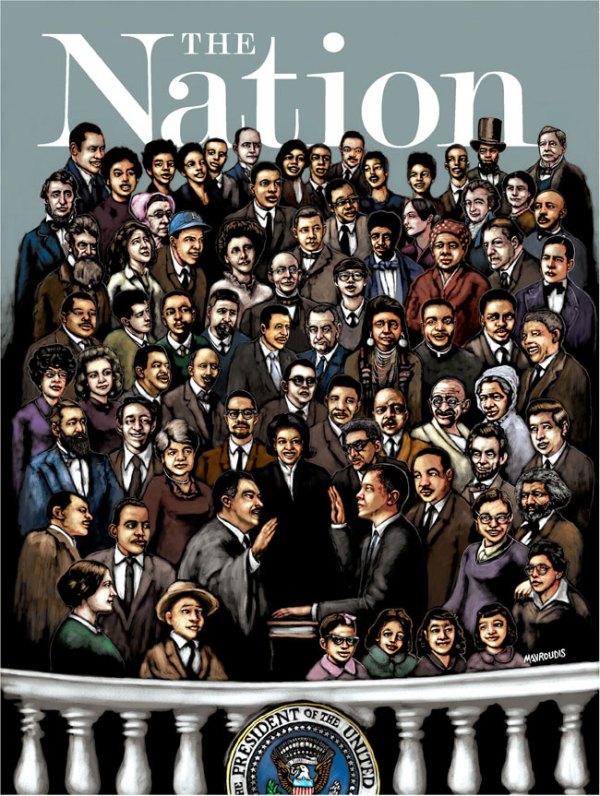
The Nation, 2 February 2009

Click on the image to see who's who

Click on the image to see who's who

Several articles about Barack Obama and what he should do, now that all the historical figures pictured on the cover are watching him. 

A review of a new biography of George Plimpton makes me want not only to look at that book, but also to read some of Plimpton’s own writings, notably Shadow Box, Paper Lion, and Edie

The preacher who delivered the invocation at Mr O’s inauguration, Rick Warren, represented a disappointment to those advocates of the rights of sexual minorities who had done so much to support Mr O when he was seeking the nomination.  Jon Wiener points out that Warren’s clout is so far reaching that the US Senate in 2002 voted unanimously for a bill to relieve him of the necessity to pay federal income tax.  The bill was specifically craftedto nullify an ongoing suit against Warren for tax evasion.  The key parts of the bill appear to apply to Warren, and only to Warren.  If Rick Warren has that kind of power, no wonder  Mr O thought he could gain by favoring him over some of his most important supporters. 

On a happier note, we read about Julius Genachowski, an old friend whom Mr O has named to head the Federal Communications Commission.  John Nichols assures us that Genachowski sees the main question in media policy as the question of democracy.  Committed to the promotion of “openness, free speech, competition, innovation, access, economic growth, and consumer welfare,” Genachowski will be in a position to strengthen America’s democratic institutions.

Ukulelezo

I sometimes worry that this site might turn into a satellite of Woodshed’s ukulelehunt.  Even so, I can’t resist posting videos from Ukulelezo, another ukuleleist whom I first saw there. 

Ukulelezo’s “Optional Accessory,” in which she purports to have a mustache fetish, took her to the finals of the Ukulele Video of 2008 contest.   And deservedly so; here’s the video:

Even better, imho, is the song that Woodshed put on last week’s selection of youtube highlights, “When I Grow Up I’m Gonna Wear a  Bikini.”  “Optional Accessory” makes me glad to have a mustache; “When I Grow Up I’m Gonna Wear a Bikini” does not particularly make me want to accessorize it with a bikini, but it is a catchy song.  Her performance is terrific, I’d like to hear the song in other arrangements as well.  I think Tom Waits could do a good job with it, for example.

The two songs above are originals.  She can also do inventive covers.  Listen to her rhythm uke playing as she accompanies herself on “One for My Baby”:

Chronicles, February 2009

lincoln-coverChronicles is often criticized for its “neo-Confederate” bent.  The two hundredth anniversary of Abraham Lincoln’s birth draws that side of the magazine out in force. 

Joseph E. Fallon quotes extensively from Lincoln’s friends and associates to the effect that the sixteenth president had little use for Christianity.  He then analyzes Lincoln’s use of religious imagery in his speeches, arguing that he exploited beliefs which he did not share to browbeat his countrymen into supporting a policy of extreme violence and unaccountable executive power.  Fallon dwells on the Second Inaugural Address, claiming that the famous passage saying that we must acquiesce in God’s will to punish us for that sin even if  “all the wealth piled by the bondman’s two hundred and fifty years of unrequited toil shall be sunk, and until every drop of blood drawn with the lash shall be paid by another drawn by the sword” represents a particularly gruesome moral inversion.  “Lincoln assiduously promoted the idea that, while he was blameless for the war, its death and destruction served some higher good.”  Fallon closes with a paraphrase of a well-known line which he attributes to Voltaire, that those who can make you believe absurdities can make you commit atrocities. 

Thomas Fleming asserts that the Civil War cost the lives of “600,000 American soldiers and perhaps twice as many noncombatants (most of them black.)”  I’ve often heard the figure 621,000 as the number of combat fatalities in the Civil War, the other two claims in that sentence were news to me.  I don’t know all that much about the Civil War, so for all I know Fleming could be right.  He goes on: “Some years ago, when I was debating Lincoln’s legacy, a graduate student asked if I did not think the war that freed the slaves was worth the cost.  He was actually shocked that I did not think that hundreds of thousands of dead slaves would have agreed with him.” 

The cost of the Civil War to southern blacks is also a major theme of Clyde Wilson’s “The Trasury of Counterfeit Virtue.”  “The notion that soldiers in blue and emancipated slaves rushed into each other’s arms with shouts of Glory Hallelujah is pure fantasy,” writes Professor Wilson.  Instead, the historical record shows one case after another when Union forces tortured, raped, and slaughtered blacks with impunity.  Wilson cites Ambrose Bierce to the effect that the only blacks he saw with the Union army were those whom officers were using as slaves. 

Joseph Sobran mentions Lincoln’s statement, from the First Inaugural, that “the Union is much older than the Constitution,” only to dismiss it as evidence that “Lincoln’s knowledge of history was shaky.”  I think there’s a bit more to be said for this claim than Sobran allows.  Certainly the thirteen colonies that broke away in 1775-1783 had by that time for many years been much more closely linked to each other than any of them had been to other parts of the British Empire. 

Justin Raimondo, editor of antiwar.com, looks at the comparisons between President Obama and his predecessor that one hears so often these days and takes them with undiluted seriousness.   Lincoln, Raimondo reminds us, “suspended habeas corpus, jailed his opponents, and closed down newspapers that displeased him.”  Raimondo evidently fears that Mr O’s praise of Lincoln might mean that he plans to follow this example.  Lest this fear seem overdone, Raimondo does refer to the powers that presidents between Lincoln and Mr O have claimed for themselves.  One rather silly moment in Raimondo’s article comes near the beginning, when he quotes a description of the similarities between these two Illinoisan presidents that mentions the fact that they are both quite thin.  “Two thin men?  What normal person would make such a comparison?  To our elites, thinness is a sign of moral virtue.”  Well, perhaps the mention of it is also a sign that Lincoln and Mr O don’t really have that much in common, so that likeners have to draw on the most superficial resemblances. 

Daniel Larison, of the Eunomia blog, goes into depth on a theme that Professor Wilson also addressed, the role of Lincoln in fusing Big Government with Big Business and laying the foundations of the corporatist-militarist economic and political system the United States has today.  Larison mentions Canadian philosopher George Grant, a critic of bigness in both economic and political institutions.  “Over 40 years ago, Canadian philosopher George Grant said that American conservatives must oppose economic centralization if they seriously hope to pursue political decentralization.”

The Nation, 26 January 2009

26-jan-nationEric Foner finds much to praise in Abraham Lincoln, chiefly his “capacity for growth” and his belief that “there was a bedrock principle of equality that transcended race- theequal right to the fruits of one’s labor.”  Foner dwells on the Second Inaugural, asking us to imagine the moral courage it must have required for Lincoln to name the evil at the heart of the Civil War not as Southern treason, but as “American slavery.”  The famous passage saying that we must acquiesce in God’s will to punish us for that sin even if  “all the wealth piled by the bondman’s two hundred and fifty years of unrequited toil shall be sunk, and until every drop of blood drawn with the lash shall be paid by another drawn by the sword” raises Foner’s special approbation.  “In essence, Lincoln was asking Americans to confront unblinkingly the legacy of bondage and to think about the requirements of justice.”

Two other pieces deal with the relationship between modern institutions and the ancient past.  Britt Peterson‘s  review of several books about looted work from southwest Asia and southeast Europe that has made its way into museums around the world begins with a story that raises a basic question.  In 1995, the Metropolitan Museum of Art in New York was forced to send acollection known as”the Lydian hoard” to Turkey, since the artifacts had been stolen from sites in that country.  However, the Turks had not yet come to Turkey when those artifacts were produced in the seventh and sixth centuries BC.  Therefore, the artifacts are not especially interesting to nationalist-minded Turks.  They are now housed in a small museum in the town of Usak.  This museum receives barely 100 visitors a year, fewer than the exhibit used to recieve in a typical  hour at the Met.  Some pieces have been stolen and replaced with obvious copies.  Do the artifacts have a value intrinsic to themselves?  Or is their worth a function of the use we make of them and the concern we have for them?  If the latter is the case, then what, exactly, was stolen from the Turks when the Hoard was originally looted? 

Anthony Grafton’s review of the recently published correspondence of Gershon Scholem and Morton Smith revolves around the question of whether Morton Smith’s greatest claim to fame was a forgery.  In 1973, Morton Smith published a document that he claimed to have discovered fifteen years before.  This Greek manuscript, apparently written in the eighteenth century, Morton Smith identified as a copy of a second century letter from one of the fathers of the church, Clement of Alexandria.  The letter consisted of a complaint that a group of heretics were giving Christianity a bad name by following practices outlined in a text they called “the secret gospel of Mark.”  The letter allows that there was in fact a secret gospel of Mark, which added to the canonical gospel stories about Jesus initiating select followers into mysterious kinds of knowledge.  The heretics, the letter claims, have taken this secret gospel and added even more to it.  In fact, they claimed that Christians were exempt from all moral laws and could find salvation by committing sins.  Their favorite sins seems to have involved homosexual behavior, and their version of “secret Mark” seems to have suggested that Jesus also had a fondness for such behavior. 

As soon as Morton Smith published the letter, there was suspicion that it was a forgery.   Red flags went up when it was noticed that every single word in the letter appears somewhere else in the extant works of Clement of Alexandria.  Students preparing assignments for ancient Greek and Latin prose composition classes have traditionally been required to imitate the style of one or another ancient author.  Those students will typically draw their vocabulary from lists of words their model used.  But of course the author himself would not have had such a list in front of him. Writing in his native language, he would have been at liberty to use whatever word seemed best to him.  Indeed, no ancient text of any substance consists exclusively of words the author uses elsewhere.  The fact that this letter does makes it look more like the work of an outstanding Greek prose comp student, which Morton Smith was, than like a genuine ancient text.  As a clincher, a writer named Stephen Carlson pointed out that a reference to the packaging of salt in “Clement’s” letter makes no sense in the context of ancient practices, but is intelligible only in light of the anti-clumping process patented in 1910 by the Morton Salt Company.  Thus, Morton Smith may have signed his work.

UPDATE:  It’s in this issue that Stuart Klawans praises Silent Light, Carlos Reygadas’ film about Mennonites in Mexico, and delivers one-paragraph slams against Oscar contenders The Curious Case of Benjamin Button, Slumdog Millionaire, The Reader, Revolutionary Road, and Doubt.   I’ve seen Doubt and liked it, but his description is as funny as it is unfair:

Doubt: It was a dark and stormy night in American Catholicism, when Sister Meryl Streep and Father Philip Seymour Hoffman settled in for 104 minutes of shouting at each other. Co-starring Amy Adams as the sweetest young nun in the parish–a role I’d be happy to see her play, if John Waters were the director. Maybe in the new year.

Neil Diamond

Phranc as Neil Diamond

Phranc as Neil Diamond

In the news it says that there’s a big tribute to 70s crooner Neil Diamond going on tonight.  That reminds me that Phranc, the all-American Jewish lesbian folk singer, did a Neil Diamond tribute act in the 90s.  No word on whether she’ll be there tonight.

Zippers

Crooked Brains has a long post featuring a gallery of zipper-themed designs.  Several of the images suggest natural phenomena replaced or altered to include zippers.  Among them are trees, eggs, and a human tongue.  The one for us:

zipper-banana

Jesus Will Help You Stop Masturbating!

huffingtonpost.com

huffingtonpost.com

Simply buy this tee-shirt and wear it on the days you don’t masturbate.

Warren Buffett, Ukulele Apostle

Thanks to ukulelehunt for linking to this story about a pair of ukuleleists who played all 185 Beatles songs as a benefit performance for Warren Buffett, the world’s richest man.  An ardent uke player himself, Buffett donated the money to Girls, Inc., a group that offers services to at-risk girls in and around Omaha.  They are to use it to buy ukuleles, of course. 

Here’s an interview in which Buffett explains the importance of the ukulele in his own life, in Bill Gates’ development as a parent, and in the potential salvation of the American economic system.  “The miracles of the ukulele are spread all over,” the Sage of Omaha explains: 

Here’s Warren Buffett playing ukulele, accompanied by his son Peter.  He may not exhibit a tremendous amount of virtuosity, but he does have a winning way about him.  It reminds me of what B. B. King said at the National Press Club in 1995 when he was asked what he thought of Bill Clinton as a musician.  He quoted his father’s favorite saying, “The boss may not always be right, but he’s always the boss.”  “So, in that spirit, the president, as the president, is a good musician.”  So, in the spirit of B. B. King, I can say that the world’s richest man, as the world’s richest man, is a good ukuleleist. 

Oh, and one more thing.  Since I’m always posting about the writings of various “paleoconservative” pundits, I’d be remiss if I didn’t mention that Warren Buffett’s father, Congressman Howard Buffett, is one of the patron saints of America’s antiwar Right.

Amy Crehore in the News

An interview with Amy Crehore appears online in Sadie magazine.  Another interview is on newsstands in Inked, a magazine that caters to men who like pictures of girls who have lots of tattoos.
Black Ball Finale

Black Ball Finale

She talks about her art, about ukuleles, and about “Dreamgirls and Ukes,” her upcoming solo show at Thinkspace gallery in Los Angeles.  If you’re going to be in LA anytime between 13 February and 6 March, you should go.  (Yes, I know the instrument pictured here isn’t a ukulele.)

On her blog, Amy Crehore posted a link to an interview Thinkspace did with her as part of their promotion of the show.  

While I’m at it, I should mention that in the 90s Amy Crehore was in the band The Hokum Scorchers with her friend, ukuleleist Lou Reimuller.  She promises that the Hokum Scorchers will play at Thinkspace opening night.  And in 1981-1985, she and a guy named Tom Campagnoli were behind some really trippy comic books called “Boys and Girls Grow Up.”