
On the NASA webpage, the Moon is egg-shaped in this picture.
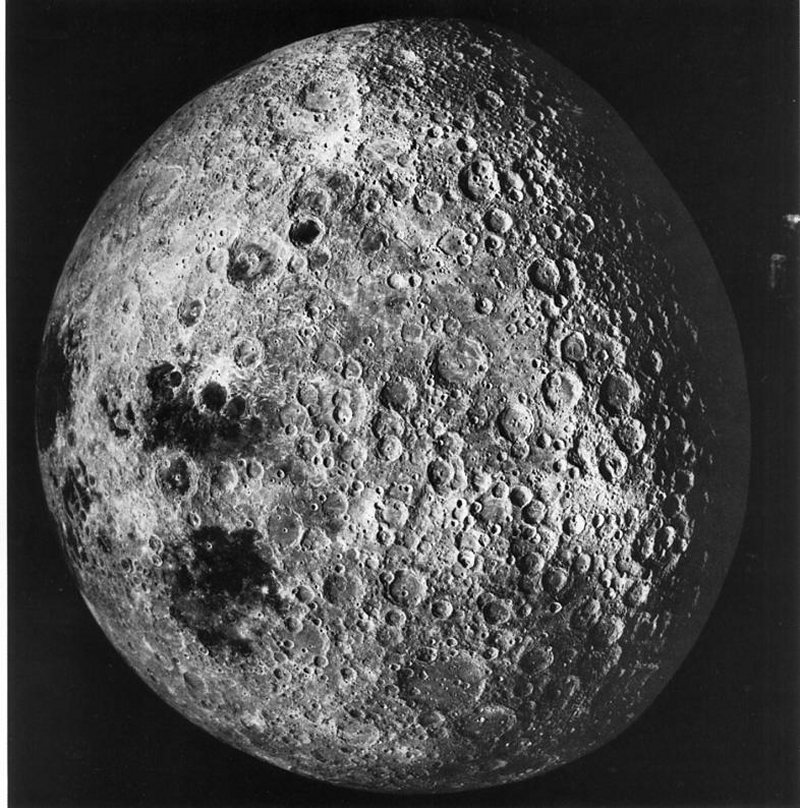
On the NASA webpage, the Moon is egg-shaped in this picture.
Posted by acilius on October 2, 2008
https://losthunderlads.com/2008/10/02/the-far-side-of-the-moon/
This issue includes several pieces about the 2008 presidential campaign, but some interesting things as well.
A note mentions a RAND Corporation study of piracy which reached the reassuring conclusion that, contrary to hype, terrorists and pirates are natural adversaries. While terrorists “would presumably aim for the destruction of the maritime economy, pirates depend on it for their livelihood.”
Guy Gugliotta recounts the increased interest in space-based weaponry in the US defense establishment since the current administration took power, then argues that nothing is to be gained and a great deal lost from the development or use of such weapons.
Lisa Margonelli’s “Gut Reactions” explains how the biochemical reactions that take place in a termite’s stomach could provide a model for efficient biofuel production. Along the way, she discusses the complexity of the communities of bacteria found in termites’ stomach’s and quotes the idea that “Maybe the termite is just a fancy delivery system for the creatures in the gut.” And maybe humans are really controlled by their stomach bacteria, too…
The jewelry of Ted Muehling is the topic of a new book; Benjamin Schwarz reviews the book, taking the opportunity to write at length about how obscure the location of Muehling’s New York shop is (“tucked on a short stretch of the four-block, semi-hidden Howard Street- reportedly the last street in Manhattan to get street lights”) and how all the most sophisticated ladies in New York know and wear his work.
In 1974, heiress Patty Hearst was abducted by the Symbionese Liberation Army. During her captivity, she was beaten repeatedly, raped hundreds of times, and brainwashed into joining the SLA’s bank robberies. Apparently something just like that happened to Caitlin Flanagan. Well, minus the abduction, captivity, beating, rape, brainwashing, and bank robberies. Her sister left home and became a hippie for a while back in the early 70’s, much to her mother’s dismay. So as you can see, she knows exactly what Patty Hearst must have gone through, and is the person most qualified to write a highly judgmental essay about her in the guise of a review of a recent book about her case.
Corby Kummer takes a cooking class on the Greek island of Kea. His slideshow about the island and its food can be found here.
Posted by acilius on October 2, 2008
https://losthunderlads.com/2008/10/02/the-atlantic-monthly-september-2008/
Here‘s a comparison of the novelist Celine (Louis-Ferdinand Destouches) with the singer Celine Dion.
Posted by acilius on October 2, 2008
https://losthunderlads.com/2008/10/02/celine-vs-celine/
Here’s a website devoted to strange maps.
Posted by acilius on October 2, 2008
https://losthunderlads.com/2008/10/02/strange-maps/
In 2004, London refused to allow artist Doug Fishbone to install an artwork consisting of 10,000 bananas at a site in the City’s then-fashionable Spitalfield district. Fishbone had in August 1999 had a triumph with a similar display in Ecuador. Here‘s a pic of his March 2005 installation in his native Brooklyn, consisting of 20,000 bananas piled up in the middle of the street.

Fishbone
Posted by acilius on October 2, 2008
https://losthunderlads.com/2008/10/02/more-banana-art/
4/ 11 August-JoAnn Wypijewski introduces her column “Carnal Knowledge,” about the intersection of sex and politics. The opener is about how sexy Mr & Mrs Barack Obama are. Subsequent issues of The Nation would report that Wypijewski’s column generates enormous amounts of negative mail from readers.
18/25 August- Rebecca Traister celebrates the rise of TV newswoman Rachel Maddow. At about the same time, Alison Bechdel wrote a fan letter to Maddow and put it on the “Dykes to Watch Out For” homepage. Elvis Costello’s latest album provides David Yaffe with an opportunity to review Costello’s career.
Posted by acilius on October 2, 2008
https://losthunderlads.com/2008/10/02/the-nation-411-august-2008-and-1825-august-2008/
Robert Whitechurch’s engraving shows a scene from the debate in the US Senate over the Compromise of 1850.
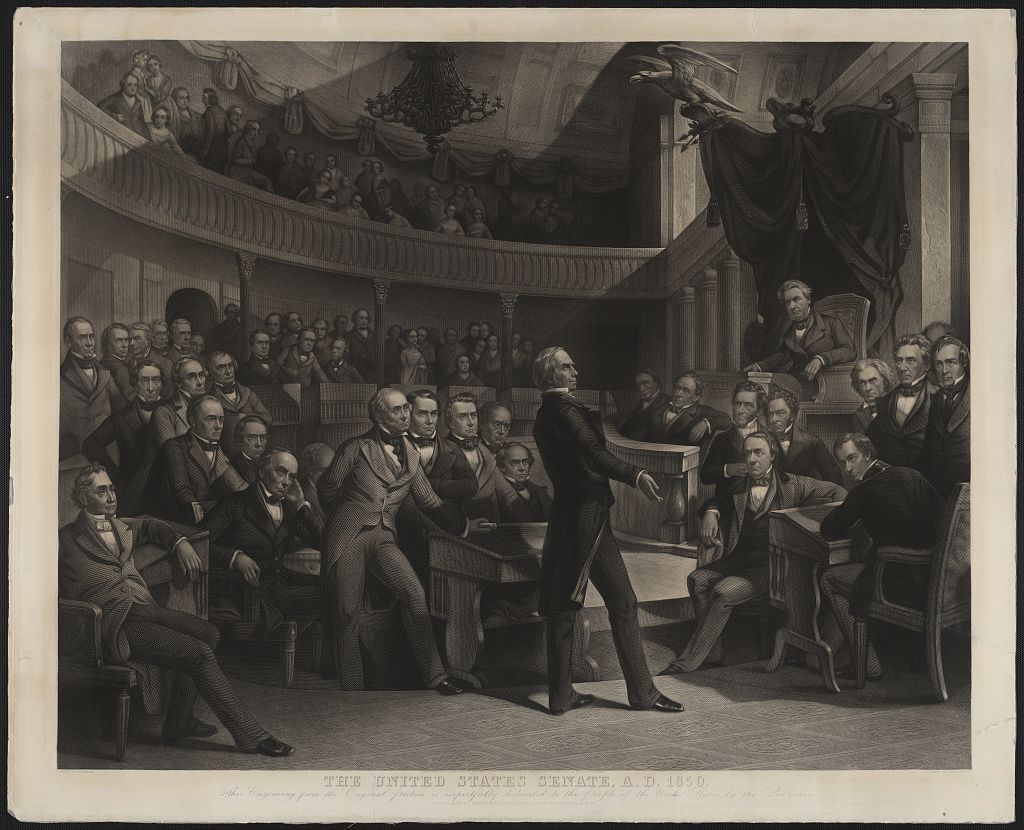
Clay Addresses the Senate
Posted by acilius on October 2, 2008
https://losthunderlads.com/2008/10/02/clay-addresses-the-senate/
16 June– William Lind writes about the “New Urbanism,” arguing that the right should embrace this movement‘s defense of neighborhoods and face-to-face human interaction. A profile of Rep. Walter Jones (R-NC) “shows that antiwar conservatives can win- for now.”
Gerald Russello reviews a collection of essays by philosopher Michael Walzer. As a marxisant leftist associated with the hawkish Journal Dissent, Walzer would seem like the last person one would expect to see praised in this journal of the antiwar right, yet Russello finds much to admire in Walzer’s exploration of the tensions between the claims of community and the right of the individual to self-directed development.
30 June– Localvores beware! TAC agrees with you! At least one of their contributors, John Schwenkler, does; he calls for a new economy of food to be built on a small scale, on the impeccably conservative grounds that “Heavily concentrated industries demand expensive and centralized government.” Scale agriculture down from world-feeding corporate behemoths to neighborhood-feeding family farms and community gardens, and you can both restore the human scale to life and cut taxes.
Philip Weiss, of the mondoweiss blog, visits the American Israeli Public Affairs Committee‘s annual conference. Readers of mondoweiss will wonder why they let him in, but they did, and he had a wonderful time. “Even a sharp critic like myself of what AIPAC is doing to American policy in the Middle East was frequently moved by the pure loving feeling that surrounds you at every moment.” Surrounds you, because AIPAC is a lobby that has nothing to do with desire for money: “the AIPACers didn’t come for selfish reasons. They are devoutly concerned with the lives of people they don’t know, very far away. Yes, perople with whom they feel tribal kinship.”
US Senator James Webb (D-VA) documents his opposition to the more bellicose aspects of American foreign policy in the Middle East over the last 25 years. He quotes a memo he wrote on 7 August 1987 while serving as Ronald Reagan’s navy secretary. In that memo, he expressed his opposition to the administration’s policy of flying the American flag over Kuwaiti oil tankers, a policy that would lead directly to the first US/ Iraq war three years later.
Posted by acilius on October 2, 2008
https://losthunderlads.com/2008/10/02/the-american-conservative-16-june-2008-and-30-june-2008/
I should have mentioned this in my notes on the latest issue of Funny Times, since I learned about it there. Anyway, here’s the report from Chuck Shepherd’s News of the Weird:
Great Art!
Artist Michael Fernandes’ exhibit in Halifax, Nova Scotia, in June caused a commotion because it was merely a banana on a gallery’s window sill, and Fernandes had it priced at $2,500 (Cdn) (down from his original thought, $15,000). Actually, Fernandes changed bananas every day (eating the old one), placing progressively greener ones out to demonstrate the banana’s transitoriness. “We (humans) are also temporal, but we live as if we are not,” he wrote. Despite the steep price, two collectors placed holds on the “work,” requiring the gallery’s co-owner, Victoria Page, to get assurance from callers. “It’s a banana; you understand that it’s a banana?” [Globe and Mail (Toronto), 7-2-08]
The installation was the target of a crime when a “prankster” broke into the gallery and replaced the banana with an apple and a handwritten note. Here‘s the gallery’s site devoted to the exhibition. In 1992, Fernandes gave this interview and published it in a book of his.
Posted by acilius on October 1, 2008
https://losthunderlads.com/2008/10/01/michael-fernandes-banana-artist/
The song says “I like bananas because they have no bones.” That’s one of the reasons I like bananas. I also like the Hoosier Hotshots, though apparently they did have bones.
Posted by acilius on October 1, 2008
https://losthunderlads.com/2008/10/01/i-like-bananas/
 acilius
 believer1
 lefalcon
 losthunderlads
 vthunderlad
 Panther Red

