Down with Justinian!

justinian-mosaic

In ancient times, the Romans observed a festival called the Parilia every year on 21 April.  We remember this festival as “Foundation of Rome Day,” since first-century Romans like Ovid believed that 21 April was the day when Romulus laid out the boundaries of the new city.  The Romans settled on  753 BC as the year of the city’s founding only centuries after they had agreed on 21 April as the day.  From their point of view, the day returned regularly and could be celebrated, while the year was gone forever and therefore had no practical value.   

Apparently to emphasize the association between the Parilia and the founding of Rome, the emperor Hadrian changed the name of the festival to Romaea in AD 121.  The importance of 21 April outside the city of Rome rather declined as the center of the empire moved eastward in the centuries after Hadrian; by the time the western empire officially collapsed in AD 476, it is doubtful whether the festival was observed in the east at all.  When in AD 547 the Byzantine emperor Justinian decreed a new system for naming years, the Romaea or Parilia lost all official status in the east. 

So, those of us who have a soft spot for Foundation of Rome Day have a grudge against Justinian.  Apparently, we are represented at Language Log, where Bill Poser today posts a note about some of the more hideous aspects of Justinian’s proudest achievement, the law code known as the Corpus Iuris Civilis.

More adventures in commenting

Over the last couple of weeks, I (Acilius) have posted some comments on two sites I read daily.  At “Dykes to Watch Out For,”  I quoted the opening of the “Periodicals Note” about Chronicles magazine that triggered so much discussion here a few weeks ago.  

At Language Log, I posted a comment which confused the author of the original post.  That comment kicked off a discussion in which I felt constrained to post several followup comments (here, here, here, and here), and which spilled over onto The Volokh Conspiracy.

Strict Police

Another funny item via Language Log.

Language Log takes a strange turn

Recently one of my daily reads, Language Log, seems to have turned into an archive for newspaper comic strips.  I for one welcome our new insect overlords this turn.  The last three days have seen  posts about Blondie, Doonesbury,  and Partially Clips.  Earlier this month, Grand Avenue and Get Fuzzy were represented.   Check their category “Linguistics in the Comics” to see the trend.

Misheard lyrics

On Monday, Language Log posted about this video:

Today, cymast and I had an exchange in the comments on one of her posts about something similar. 

So, here are three links. 

A very ambitious collection, where visitors vote to rank mishearings by comic value and submitters include stories to show that they did sincerely mishear the lyrics, that they are not making up parodies; another collection, almost equally ambitious in the number of mishearings recorded and keys by which they are indexed, but without the same means to filter out parodies; and an explanation of why misheard lyrics are known as “Mondegreens,” from snopes.

Statistically Significant

Thanks to Language Log for this comic strip:

boyfriend

It’s Greek to Me

What it is to me

What it is to me

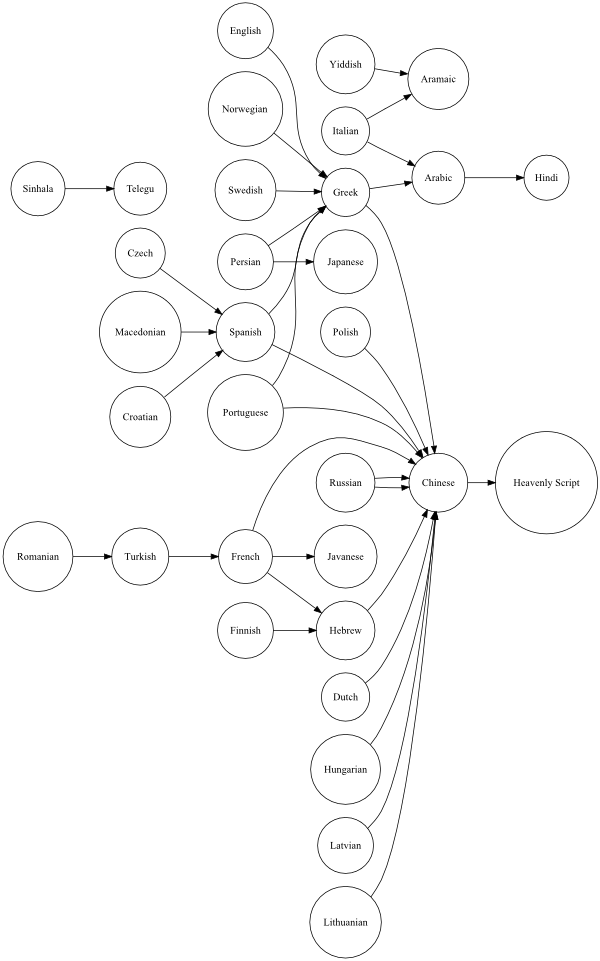
The chart above illustrates a post on Language Log about expressions of the form “It’s Greek to me.”  As you can see, in Greek expressions translated as “It’s Arabic to me” and “It’s Chinese to me” are attested in the sense “I can’t understand it at all,” while in Arabic we find an expression “It’s Hindi to me” and in Chinese “It’s Heavenly Script to me” with the same sense. 

I’m surprised they didn’t find “It’s Czech to me” anywhere.  Czech is apparently famed throughout central and eastern Europe as a particularly forbidding language.  Questions about “simplicity” and “complexity” in language structure have been kicked around on Los Thunderlads before, in a desultory way;  in the post I’m linking to here, Language Log cites a scholarly discussion of that very question.

Virgins of various sorts

fred-and-gingerAt Language Log, Arnold Zwicky has posted two remarks about expressions of the sort “x virgin,” meaning someone new to x, whatever that x may be.  In his first  post, Zwicky gives some examples, some very incongruous such as “Pippi virgin” meaning “someone has has not yet read the Pippi Longstocking books.”  He first defines “x virgin” as “someone who has not yet experienced x,” then immediately concedes that this definition is not adequate.  “An Astaire virgin, for instance, is not really someone who hasn’t experienced an Astaire, but refers to experience with something involving a particular Astaire (Fred and not Adele), namely the experience of watching movies starring Fred Astaire.”  The expression “x virgin,” Zwicky explains, is like other noun-noun compounds in that the relationship between the two nouns can be quite complex and indirect, a topic dealt with elsewhere on the same blog.  In his second post, Zwicky asks whether we would expect this profusion of virginities to give rise to a retronym, “sex virgin,” and does in fact find a few examples of this expression in use.

A feature of Black English

John McWhorter on the tendency of Black English to drop the possessive -‘s case ending.  I wonder if Black English is really different from other Englishes in this tendency, or if it is just more advanced.  English speakers tend to drop case endings generally; so for many English speakers, alternations like I/me and we/us don’t come naturally any longer, and as a result we hear expressions like between you and I.    All oblique case forms seem to be on the way out.  Why would we expect -‘s to survive?

Translating Games

Grocery Checkers, by Scott Moore

Grocery Checkers, by Scott Moore

Is it possible to translate games as we translate language?  That is, can a particular instance of game- one round of table tennis, say-  be said to represent a particular instance of another game- say, one swim meet- in the same way that a particular sentence of English can be said to represent a particular sentence of Latin?  It would seem obvious that the answer is no, and it probably is.  But here’s an argument that the answer might not be so obvious.  Follow the argument to the end, and you begin to suspect that if games can’t be translated into each other, then metaphors in general might be trickier than they at first seem.