Seven recent issues of The Nation

Ever since I started writing here, I’ve been referring to “Mrs Acilius.”  Until last month, that was a bit of an exaggeration, as I had not actually married the lady in question.  We tied the knot 12 May.  So lately, I’ve had things on my mind other than this blog.  That’s why I haven’t been posting “Periodicals Notes” regularly.  But I’ve vowed to catch up.  So here are my notes on the last seven, yes seven, issues of The Nation.
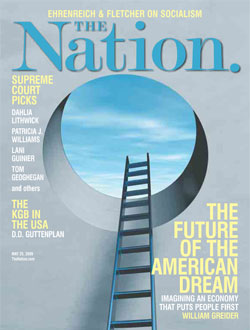
nation 25 may 200925 May: It’s been almost 60 years since a jury found that former State Department official Alger Hiss was lying when he denied that he had passed classified documents to an agent of Soviet military intelligence during the years 1934-1938.  The Nation has never let go of the Hiss case, and still publishes articles, columns, and reviews at regular intervals maintaining his innocence.  When Hiss died in 1996, I read a few books about the case.  Hiss’ own book, In the Court of Public Opinion, and his son Tony’s memoir of him, Laughing Last; Alistair Cooke‘s A Generation on Trial; and Allan Weinstein’s Perjury.  I mention the fact that I read these four books not because they qualify me as an expert on a matter as complex and hotly disputed as the Hiss case; obviously they do not.   All I want to do is explain that I have a certain familiarity with the Hiss case, and that I take an interest in discussions of it. 

D. D. Guttenplan reviews two recent books, Susan Jacoby‘s Alger Hiss and the Battle for History and Spies: The Rise and Fall of the KGB in America, by John Earl Haynes, Harvey Klehr, and Alexander Vassiliev.  In regard to Spies, Guttenplan’s main goal is disprove the book’s accusation that journalist I. F. Stone was a Soviet agent.  I would be inclined to say that Guttenplan achieves that goal easily.  I haven’t read the book, but unless there is a great deal more to it than Guttenplan acknowledges it would seem that its authors have not only failed to make the case against Stone, but have actually made a compelling case that Stone could not have been the man the Soviets codenamed “Blin” “”Pancake.”)  

Guttenplan’s contribution to the Hiss debate is less of a triumph.  The review goes on and on about the absence of Hiss’ name from declassified KGB documents.  It would be difficult to imagine a less relevant point.  Hiss was never accused of spying for the KGB.  The KGB was an organ of Soviet State Security.  Hiss was accused of passing documents, not to Soviet State Security, but to Soviet Military Intelligence (the GRU.)  The man who identified himself as Hiss’ contact was Whittaker Chambers, whom no one denies was an operative of Soviet Military Intelligence.  In the Soviet system, Military Intelligence was a bitter rival of State Security; they most assuredly did not share with each other the names of highly placed agents whom they had recruited. 

Hiss’ defenders are not alone in ignoring this point.  So, those who are most convinced of his guilt often bring up the “VENONA Intercepts,” cables sent by KGB station chiefs in Washington to Moscow and intercepted by the FBI in the years 1946-1980.  These cables use the codename “ALES” to refer to a man who sounds more like Alger Hiss than anyone else, and describe him as an agent of Soviet intelligence.  They do not report direct contacts with ALES, however, nor do they include any intelligence gathered from him.  The likeliest explanation, then, is that the station chief had heard a rumor that Hiss was working for Soviet Military Intelligence and was reporting this rumor to headquarters.  That such rumors were circulating about Hiss in various intelligence services around the world before Chambers made his charges public has been known for some time; in the first edition of Perjury, published in 1978, Allan Weinstein devoted a whole appendix to indications that a number of European intelligence services believed Hiss was a Soviet agent.  VENONA does nothing but add Soviet State Security to the list of these services.   

nation 1 june 20091 June:  Akiva Gottlieb reviews Clint Eastwood’s latest bout of macho self-pity masquerading as a movie.  The last two paragraphs sum up Gottlieb’s view:

In the closing scene of Gran Torino, a lawyer reads from the dead man’s will, which Walt had written himself. It turns out that he had chosen to bequeath the titular totem of middle-class luxury to Thao, “on the condition that you don’t chop-top the roof like one of those beaners, don’t paint any idiotic flames on it like some white trash hillbilly and don’t put a big gay spoiler on the rear end like you see on all of the other zipperheads’ cars.” In other words, Walt gets to keep his racial epithets and be the hero, too. The closing credits roll over a shot of Thao cruising in his new vehicle of assimilation, with Eastwood’s raspy voice cooing gently on the soundtrack, reminding the next generation just who we have to thank for our liberty.

Read the full post »

Rockabilly Roustabout

I’m back in the office, doing actual work.  So I need ukulele in the background.  Here‘s a number from Al Wood, aka Woodshed of Ukulele Hunt.

Excuse me, do you have change for $134,000,000,000?

Thanks to blog founder vthunderlad for pointing me to this story.

Brubakers Got Back

Obama the Exterminator; or, Obama Commits Funny

Wounded Knee, nanotech, Serbian broadcasting, and the car industry

The headquarters of Radio Television Serbia after the 23 April 1999 bombing

The headquarters of Radio Television Serbia after the 23 April 1999 bombing

Go away for a month, and things pile up.  Time to get back at it.  Here are “Periodicals Notes” on three recent issues of Counterpunch

16-30 April: Tiphaine Dickson reports on the case of Dragoljub Milanovic, the only person ever to have been tried and punished for NATO’s 23 April 1999 bombing of Radio Television Serbia (RTS), an attack on an undefended target that killed 16 civilians and served no military purpose other than to disrupt broadcasting between the hours of 2 and 5 AM that morning.  The attack followed an ultimatum NATO issued to the Serbs that the station would be considered a legitimate target unless they consented to broadcast six hours a day of NATO-approved western programs, an ultimatum NATO dropped when the Serbs accepted it.  Mr Milanovic has been in prison for seven years because of his role in this wanton act of murder.  What was that role?  He was one of NATO’s intended victims.  The director of RTS, Mr Milanovic was at his desk in the building less than an hour before the bombing.  Dickson details a story of the dizzyingly absurd injustices that Mr Milanovic has suffered, illustrating the workings of the West’s anti-Serb policies of the last couple of decades. 

In the same issue, former US Senator James Abourezk (Democrat of South Dakota) gives a synopsis of the relations between the Minneconjou tribe of the Sioux nation and the US government before, during, and after the 1890 massacre of Minneconjou people at Wounded Knee in South Dakota.  This is to serve as an introduction to Senator Abourezk’s recollections in the next issue of the 1973 occupation of Wounded Knee by militant American Indian Movement (AIM) activists.  

1-15 May: Senator Abourezk tells the story of his trip to Wounded Knee in 1973, when he and George McGovern (his senior colleague in the US Senate from South Dakota) tried to mediate between AIM and the federal agents surrounding them.  The senators left thinking that they had negotiated a peaceful resolution to the standoff, only to find that the Nixon administration had blocked the deal.  Senator Abourezk suspects that the president wanted to keep the crisis going in order to stoke anti-Native feeling among whites.  

In the same issue, Steven Higgs looks at nanotechnology.  After listing such applications as self-cleaning eyeglasses (very attractive to me!), he quotes experts who are concerned that carbon nanotubes strongly resemble the microstructure of asbestos and that exposure to them may pose some of the same risks as does exposure to asbestos.  Other nanotechnologies also seem to represent considerable dangers; for example, the minute portions of silver used in high-end washing machines can enter living cells and may alter DNA there, threatening cancer.  Higgs notes that after years of federal inaction, the Obama administration has issued notice that it may begin a review of regulations in this area.   

16-30 May: Eamonn Fingleton points out that all the explanations for the decline of the US auto industry favored by corporate media are bogus.  For example, one often reads that the Big Three fail to produce any models with the steering wheel on the right, and that this explains why the Japanese won’t buy American cars.  In fact, Fingleton reports, Detroit makes dozens of models with the steering wheel on the right, and has done so for years.  We also hear that closing a country to imports will doom its manufacturers to eventual irrelevance in the global contest for shares of the export market.  Yet the Japanese and Korean car markets have been the most tightly closed in the world for decades, as Japanese and Korean car makers have gone from strength to strength and now dominate the US market. 

In the same issue, Bill Hatch reports on Michelle Obama’s visit to the University of California’s new campus at Merced.  Hatch quotes Mrs O’s criticism of the University of Chicago’s development of the Hyde Park neighborhood as abuffer between itself and the South Side of Chicago, then points out that UC-Merced is trying to do exactly the same thing.  Hatch tells how UC-Merced was built during the California real estate bubble, and how the construction of the university and the bubble worked together to shatter the working class town that had existed there.  In Hatch’s telling, Merced sounds like a ghost town in the making.

Cheesus

Best of Los Thunderlads

Cow People?

04/29/2009
Published

This cow person was made by visionary Patricia Piccinini.

This cow person was made by visionary Patricia Piccinini.

Cow people and human people are due any day now . .

OK I’m just kidding about the cow people . .

But I’m NOT kidding about sheep with human parts!

Artist Patricia Piccinini’s vision.

patriciapiccinini.net

Best of Los Thunderlads

(The following was originally posted by Acilius on 9 December 2008)

aaaorangehowfi_m

Teamwork

Last month, I mentioned that  the Ukulele Orchestra of Great Britain was releasing two new albums.  Our copies arrived last week, and Mrs Acilius and I can give them enthusiastically positive reviews. 

fidicula-inter-angelosThe Christmas album, referred to on their website as “Christmas with the Ukulele Orchestra of Great Britain” but labeled as Fiducula inter Angelos (“Miniature Lyres among the Angels,”)  does not after all include the performances they issued last year as a virtual album called “Never Mind the Reindeer.”  Those performances are still available on iTunes.   I do miss the rendition of “The Holly and the Ivy” from last year, but new tracks like the “Wenceslas Canticle” and a vocalese version of  “Winter Wonderland” more than make up for its absence.  Their “Jingle Bells Canticle” gets us (Mr & Mrs Acilius and the dogs) dancing every time we hear it.  Here’s ukulelehunt‘s review of the album. 

live-in-londonIn a comment on last month’s post, ukulelehunt’s proprietor Al Wood, a.k.a. Woodshed, gave it as his opinion that Live in London #1 is the UOGB’s best album yet.   I agree, though Mrs Acilius still leans toward Precious Little.  She plans to walk down the aisle to that album’s recording of “Finlandia” when we make the “Mrs” part official in May, so it has a sentimental importance to her.  Though when we listened to Live in London #1 and heard Hester Goodman’s rendering of “Teenage Dirtbag” as a ballad of adolescent lesbian angst, Mrs Acilius was so enthusiastic I wondered if she was about to suggest using that instead.  She assured me that her enthusiasm was strictly political, stemming from a conviction that sexual minorities need representation in music.  That she has a crush on Hester is purely by the way.  Here is an unflattering picture of Hester sitting next to George Hinchliffe that I could look at if I were in a jealous mood, which of course I never am.    

Read the full post »

Best of Los Thunderlads

(The following was originally posted by Acilius on 18 September 2008)

Via Weirdomatic:

Approaching the event horizon

Approaching the event horizon

More pix from this artist available at his website.