The labors of Hercules

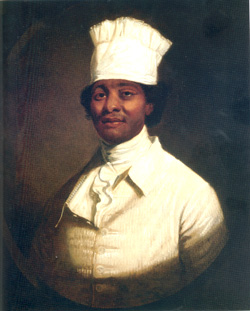
A painting sometimes identified as a portrait of Hercules the chef and attributed to Gilbert Stuart

George Washington may have been in some ways uniquely admirable as a political leader, but as a slaveholder he was no better than he found it convenient to be.  Today’s Philadelphia Inquirer reports on recently discovered documents that show how brutally Washington could treat even his most favored household slaves.  

When Washington went to Philadelphia to head the federal government there, he took his chef Hercules with him to the President’s Mansion.   Hercules’ talent as a gourmet cook made him famous shortly after his arrival in the reestablished capital, and the president acknowledged his skill by allowing him unheard-of privileges, for example allowing him to earn income by selling leftovers from the kitchen, and to use this income to dress himself in a style that gained him a reputation as one of Philadelphia’s foremost dandies.    

In the spring of 1787, Prince Louis-Philippe of France visited Mount Vernon.  He reports that the Washingtons were upset that Hercules had escaped.  Any thought that Washington might have been a benevolent master loved by his slaves should be dispelled by a conversation his manservant had with Hercules’ six year old daughter.  The servant asked the little girl if she was sad that she might never see her father again.  “Oh!  Sir, I am very glad, because he is free now.”  What could she have seen that would have made a little girl happy that her father had gone away, never to return? 

For many years, it was assumed that Hercules had escaped while in Philadelphia.  The Quaker city was after all the world’s foremost center of abolitionism; it might have been relatively easy for a skilled man who had collected some savings to find his way to freedom there.  Perhaps Hercules had seen freedom ready at hand, and simply taken it. 

With a recently uncovered farm report and a cache of letters it makes intelligible, we now learn a far darker story.  In the spring of 1796, a year before the end of Washington’s second term as president, a woman named Oney Judge, who was Martha Washington’s personal maid,  disappeared from the President’s Mansion.  Washington would employ detectives to hunt for Oney Judge, eventually running her to ground in Portsmouth, New Hampshire.  Oney Judge may have been trying to make her way to Nova Scotia, where several fugitives from Washington’s plantation at Mount Vernon had already made homes.  The Washingtons then decided that it was too dangerous to try to keep slaves in Philadelphia.  When they went to Mount Vernon that summer, they took the whole establishment with them.  When they returned to Philadelphia, they returned alone. 

With the president and his lady 130 miles away in Philadelphia, there was no need for a gourmet chef at Mount Vernon.  Hercules and his sons were sent to the fields.  Evidently the demotion came as a shock to Hercules’ son Richmond, who was soon caught stealing money.  Informed of this theft, President Washington saw a plot to escape, and surmised that it might be a father-son enterprise.  He ordered Hercules and Richmond sent to the clay pits, the hardest and most degraded task given to slaves at Mount Vernon.  On 22 February 1797,  as George Washington celebrated his 65th birthday, Hercules disappeared from the plantation.  President Washington’s term was due to expire 10 days later, when John Adams was inaugurated as president on 4 March.  One might imagine that Hercules was afraid of what might happen when Washington came home.  Afraid, perhaps, that his capricious master might find new ways of humiliating him; afraid, perhaps, that he would be unable to restrain his own anger at the thoughtless and unjust treatment he had received, so that if he stayed he might do something that would lead the Washingtons to make life even worse for his children than they would make it in response to his escape.


Higher Education (Look Around You)

A great artificial man

In the introduction to Leviathan, English thinker Thomas Hobbes famously compared the state to a “great artificial man, or monster, composed of other men, with a life that might be traced from its generation under the pressure of human needs to its dissolution through civil strife proceeding from human passions.”  The nerves and sinews of this artificial man, as he is constituted in modern society, are the laws and regulations of a rationalized bureaucracy.  He can function because he acts in accord with these laws and regulations as predictably as automata made of metal follow the algorithms of their programming.  As a being made of rules, the state interacts most smoothly with other beings made of rules.  Whenever possible, the state will tend to reduce everything it touches to a body like itself, a body defined by rules.  

Where the modern state has been established longest, bureaucratization respects the fewest boundaries.   The March 2010 issue of Chronicles carries a piece by a man from Hobbes’ own homeland, Thomas McMahon.  McMahon writes of the policies which the New Labour governments led by Tony Blair and Gordon Brown have adopted in the name of protecting children from sex offenders.  After the 2002 killing of 10 year old girls Jessica Chapman and Holly Wells, the government introduced plans to require everyone in the United Kingdom who comes “into regular contact with children in any semioffical capacity to register with a national database.”  As McMahon points out, “‘Regular’ could mean mean as little as a few times per year, and ‘semiofficial’ covers everyone from cleaners at sports facilities to a parent who gives lifts to a group of kids in the morning.  Anyone wishing to help out with after-school activities would be required to register.”  How is this registry to be compiled?  McMahon explains:

Upon application for membership on the list, opinions would be sought on the suitability of the candidate.  Acquaintances and workmates may be asked for their comments, internet forums and networking sites may be trawled, “lifestyles” would be examined.  Even the most baseless accusation would be recorded in perpetuity on a central state database.  There would be no investigation to determine whether the accusation was malicious.  There would be no requirement that the accusations be proven in court. 

How closely were these provisions designed to address the case of Misses Chapman and Wells?  Not at all, as it turns out; the man convicted of their murder was not an employee of their school, nor did he fill any other “semiofficial capacity” that might have brought him into contact with them.  He was, rather, the boyfriend of one of their teachers.  He happened to be alone at her house when the girls dropped in to see her.  The law does not require teachers to date only people from the approved list, and so would have done nothing to protect Jessica Chapman and Holly Wells had it been in effect in 2002. 

Read the full post »

Places to go when you can’t stay anywhere

None of the three pieces that I wanted to note were mentioned on the cover. 

The state of Florida has a long list of crimes that require a convict to be registered for life as a sex offender.  Registered sex offenders in the state are prohibited from being close to schools, playgrounds, and other areas where children congregate.  Some Florida towns decree that registered sex offenders must stay at least 1000 yards (914.4 meters) from such areas; most put the boundary at 2500 yards (2286m.)  Since the average town has quite a few child-friendly spaces, the consequence of these laws is that Floridian sex offenders cluster into little ghettoes.  Irina Aleksander spent some time following a man who runs a business that shepherds registered sex offenders into these ghettoes.  The man, himself a registered sex offender whose crime was watching a 19 year old girls perform a sex act on a 15 year old boy, is evidently getting pretty rich.  The neighborhoods where he send his clients tend to get very inexpensive very quickly.  He seems like a good person to know if you are a real estate developer and want to find a way to reduce startup costs for redevelopment projects in Florida…

A person who has a lot of anger might answer the question of where registered sex offenders should go by referring to another article in this issue.  A business in Switzerland has taken advantage of that country’s very lax laws on assisted suicide to offer foreigners an easy death.  Zurich has thus become the world’s capital of “suicide tourism.” 

French playwright and novelist Henry de Montherlant committed suicide in 1972.  Had he asked for assistance, one suspects he would have found no end of volunteers.  Read the full post »

Conway’s Game of Life

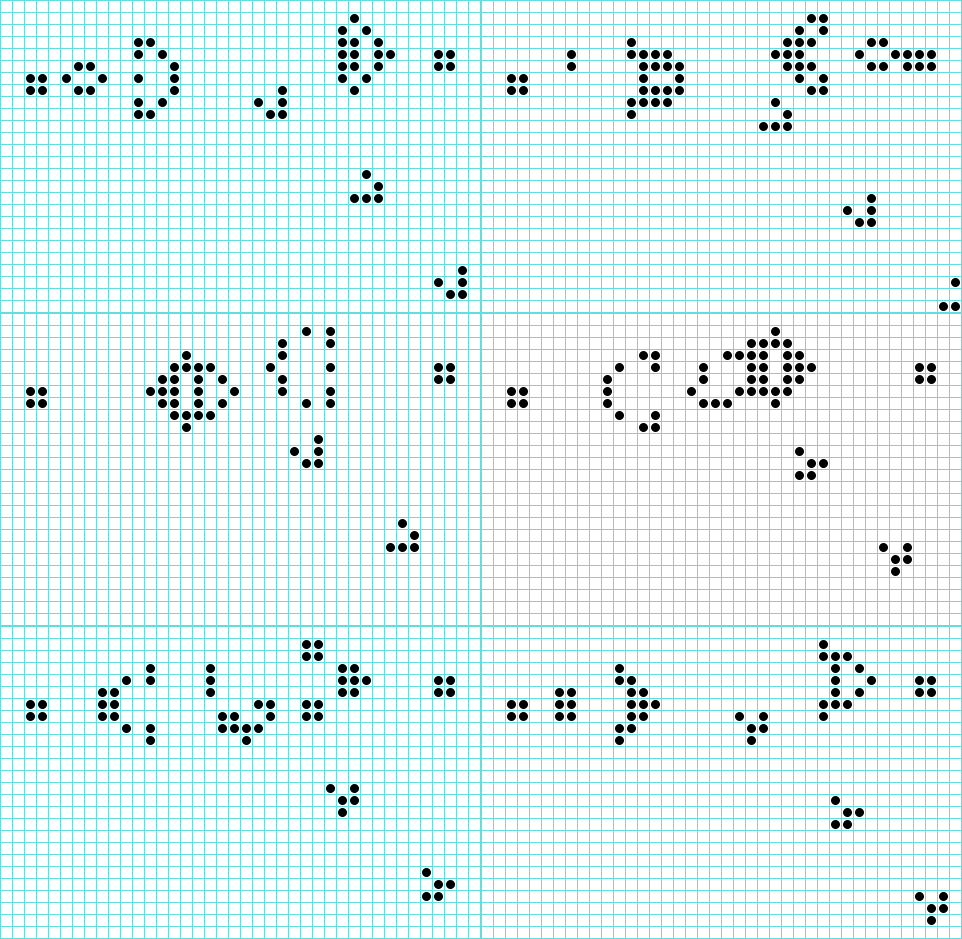
A celebrated Conway Life pattern, the "Gosper Glider"

Years ago, I read a piece in The Atlantic about something demographer Thomas Schelling had figured out:  

In the 1960s he grew interested in segregated neighborhoods. It was easy in America, he noticed, to find neighborhoods that were mostly or entirely black or white, and correspondingly difficult to find neighborhoods where neither race made up more than, say, three fourths of the total. “The distribution,” he wrote in 1971, “is so U-shaped that it is virtually a choice of two extremes.” That might, of course, have been a result of widespread racism, but Schelling suspected otherwise. “I had an intuition,” he told me, “that you could get a lot more segregation than would be expected if you put people together and just let them interact.”

One day in the late 1960s, on a flight from Chicago to Boston, he found himself with nothing to read and began doodling with pencil and paper. He drew a straight line and then “populated” it with Xs and Os. Then he decreed that each X and O wanted at least two of its six nearest neighbors to be of its own kind, and he began moving them around in ways that would make more of them content with their neighborhood. “It was slow going,” he told me, “but by the time I got off the plane in Boston, I knew the results were interesting.” When he got home, he and his eldest son, a coin collector, set out copper and zinc pennies (the latter were wartime relics) on a grid that resembled a checkerboard. “We’d look around and find a penny that wanted to move and figure out where it wanted to move to,” he said. “I kept getting results that I found quite striking.”

Programming computers to play this game, Schelling found that strong residential segregation arose even if he assumed that each member of the set would stay put with only a single neighbor of the same category.  This provided evidence, not only that Schelling might be right about residential segregation, but also that social order in general can arise in ways that do not directly reflect the intentions of any particular member of that society.  All of Schelling’s virtual people wanted to live in integrated neighborhoods, yet it was precisely the actions they took to pursue that goal that inexorably led to the creation of segregated neghborhoods. 

Schelling’s tests reminded me of Conway’s Game of Life, a cellular automaton that mathematician John Conway invented in 1970.  The procedure of Conway is very similar to Schelling’s.  An indefinite number of square cells are arranged in a square grid.  Each cell is in one of two conditions, live or dead.  Each cell is in contact with eight other cells: one directly above, one directly below, one directly to the right, one directly to the left, and one on each of the four corners.  If a cell is alive, it remains alive if and only if it is in contact with two or three other live cells.  If a cell is dead, it remains dead unless it is in contact with exactly three dead cells.    Some very simple initial patterns take a surprisingly long time to stabilize in Conway Life: for example, this fellow (which Conway called the R-pentomino, though others call it the F-pentomino) goes on generating new forms for 1103 generations, and along the way produces a number of spectacular structures:

You can easily test out patterns here; some especially famous patterns are collected here and here.

Conway’s Game of Life came back to mind a couple of weeks ago, when this xkcd strip appeared:

Someone came up with a cellular automaton that could qualify as “Strip Conway’s Game of Life”:

Various commenters tried to put humans in the role of the automated cells, and tried to devise rules based on what the people around each human are wearing that would determine which clothes the human was required to remove.  It occurred to me that a more promising approach would be to have one person start by wearing a great many articles of clothing, leaving those clothes on that were touching either two or three other articles of clothing, removing those that were touching fewer than two or more than three articles of clothing, and putting clothes on bare spots that were bordered by exactly three articles of clothing.  Eventually, somebody might get naked. 

Then yesterday, Alison Bechdel announced on her blog that she’d drawn a comic for McSweeney’s magazine.  The comic represents a modified version of Milton Bradley’s board game called The Game of Life

Bechdel's Life

In the comments on that post, I brought up Conway’s Game of Life.  So, I decided the time had come to post about it here.

Can the USA become a normal country again?


He wanted to to return to normalcy

I posted a “Periodicals Note” about The American Conservative‘s March issue a few weeks ago, then realized I’d never put one up for the February issue.  That’s a shame, because there was a lot of great stuff in it. 

I loved this line, a quote from Julian Sanchez of the libertarian Cato Institute: “Thus far, the approved conservative position appears to have been that Barack Obama is some kind of ruthless Stalinist with a secret plan to turn the United States into a massive gulag—but under no circumstances should there be any additional checks on his administration’s domestic spying powers.”

Ted Galen Carpenter sums up The American Conservative‘s whole worldview with the opening paragraphs of his piece titled “New War Order.”   So I’ll quote them in extenso:

For a fleeting moment 20 years ago, the United States had the chance to become a normal nation again. From World War II through the collapse of European communism in 1989, America had been in a state of perpetual war, hot or cold. But with the fall of the Berlin Wall, all of that could have changed. There were no more monsters to destroy, no Nazi war machine or global communist conspiracy. For the first time in half a century, the industrialized world was at peace.

Then in December 1989, America went to war again—this time not against Hitler or Moscow’s proxies but with Panamanian dictator Manuel Noriega. Tensions between George H.W. Bush’s administration and Noriega’s government had been mounting for some time and climaxed when a scuffle with Panamanian troops left an American military officer dead. On Dec. 20, U.S. forces moved to oust and arrest Noriega. Operation Just Cause, as the invasion was called, came less than a month after the Berlin Wall fell, and it set America on a renewed path of intervention. The prospect of reducing American military involvement in other nations’ affairs slipped away, thanks to the precedent set in Panama.

How real was the opportunity to change American foreign policy at that point? Real enough to worry the political class. Wyoming Sen. Malcolm Wallop lamented in 1989 that there was growing pressure to cut the military budget and that Congress was being overwhelmed by a “1935-style isolationism.” But the invasion of Panama signaled that Washington was not going to pursue even a slightly more restrained foreign policy.

That the U.S. would topple the government of a neighbor to the south was hardly unprecedented, of course. The United States had invaded small Caribbean and Central American countries on numerous occasions throughout the 20th century. Indeed, before the onset of Franklin Roosevelt’s Good Neighbor Policy in the 1930s, Washington routinely overthrew regimes it disliked.

During the Cold War, however, such operations always had a connection to the struggle to keep Soviet influence out of the Western Hemisphere. The CIA-orchestrated coup in Guatemala in 1954 and the military occupations of the Dominican Republic in 1965 and Grenada in 1983 all matched that description. Whatever other motives may have been involved, the Cold War provided the indispensable justification for intervention. And for all the rhetoric about democracy and human rights that U.S. presidents employed during the struggle against communism, there was no indication that Washington would later revert to the practice of coercing Latin American countries merely, in Woodrow Wilson’s infamous words, to teach those societies “to elect good men.” Thus the invasion of Panama seemed a noticeable departure. Odious though he may have been, Noriega was never a Soviet stooge.

Read the full post »

New post on Weirdomatic: Carnivorous Plants

FotB Alexandra has posted another of her well-curated photo galleries at Weirdomatic, this time focusing on plants that eat animals.

Do you favor or oppose ___ serving in the military?

Thanks to Language Log for results of a CBS News poll showing these response rates:

Do you favor or oppose homosexuals serving in the military?  Strongly favor, 34%; somewhat favor, 25%; somewhat oppose, 10%; strongly oppose, 19%

Do you favor or oppose gay men and lesbians serving in the military?  Strongly favor, 51%; somewhat favor, 19%; somewhat oppose,7%; strongly oppose, 12%

Classical Ukulele

For some days I’ve been thinking that I ought to put up a series of posts focusing on the ukulele as a classical instrument.  The more I thought about it, the clearer it became that what I was thinking of was something that could and should stand on its own.  So I’ve set up a blog called “Classical Ukulele.” 

Below I’ve pasted a copy of the inaugural post, a tribute to the late, great John King.  There’s also a post up in which we see videos of “Jesu, Joy of Man’s Desiring” in John King’s and other arrangements for ukulele.  Among these arrangements is one Colin R. Tribe posted on YouTube today, which gave me the idea for the post; a characteristically exquisite rendition by Valéry Sauvage; and a performance the Langley Ukulele Ensemble  did last year that will rock your socks. 

John King plays the Bouree from Bach’s Partita #3

When John King died in April 2009, his New York Times obituary explained that it was no great leap for him to come up with the idea of arranging Johann Sebastian Bach’s third Partita for the ukulele:

After attending Old Dominion University in Virginia, Mr. King became a guitar instructor at Eckerd College in St. Petersburg. He also worked in the campus bookstore.

He picked up a ukulele occasionally, but not successfully. Then he learned that the diminutive ancestors of today’s guitars were tuned like ukuleles. He tried Bach on the ukulele and was deeply intrigued. He soon commissioned Gioachino Giussani, the Italian luthier, to make a ukulele expressly for classical music. After a decade of practice, he put out a record, including the Bach partita, on his own label in 2001.

Pepe Romero concluded in the liner notes: “The sound of the ukulele is exquisitely well suited for Bach’s music, and I delight in this discovery.”

The whole Partita #3 is available on the CD “The Classical Ukulele,” John King’s label was Nalu Music.

Here’s another of John King’s performances of Bach, preserved on YouTube.

Prelude from Cello Suite #1

Comments on youtube by Howard Zinn

You guys might be interested in this.