More Veiled Women

Hijabi Barbie

Years ago, LeFalcon posted a few stray remarks here about women’s dress in Islam.  Last year, Cymast posted a news item about Nicolas Sarkozy’s push to ban the burqa in France.  Months ago, I posted some images of veiled Muslim women.  That’s a rather slim selection of material, and yet every day search terms such as “burqa,” “hijab,” “chador,” “abaya,” and “niqab” send people to this blog.  As a service to those readers, here are some links to images of veiled women.   

  1. Indonesian Women Preparing to Pray. A dynamic study in white and red.
  2. Niqabi Riding an Escalator.   An airport scene.    
  3. Two Women With Soft Drinks. One heavily veiled, the other in Western dress.
  4. Two Women Riding the London Tube.  One in a chador, the other in Western dress.
  5. Veiled Catwalk Model.  The veil looks strange to most Westerners; this shot brings out the strangeness of a custom many of those same Westerners take for granted, the model’s catwalk.   
  6. A Partly Veiled Catwalk Model.  Recognizably Middle Eastern dress, though nothing especially “Islamic” about it
  7. The Outfit is Advertised as “Modest”  The model’s attire is quite modest, but her pose suggests a prostitute waiting for customers.  
  8. Warhol-style Hijabi.   I’m sure she’s somebody famous, but I can’t place her.  The picture appeared with this news story about the play The Hijabi Monologues
  9. Simpsons Character in Hijab.  Apparently sometime after I stopped watching The Simpsons, they introduced some Muslim characters.
  10. Punk Hijabi” She’s very clever, I’d recommend taking a moment to study her outfit. 
  11. On the Internet, No One Knows You’re Wearing a Niqab.  In the USA, the two women in this photo would probably be separated by a sheet of bulletproof glass. 
  12. Her face is covered by the colors of the American flag,  the rest of her is covered by a chador
  13. The Iranian women’s volleyball team in action.  Their opponents seem distracted by their outfits. 
  14. Academic Robes and Face Veil.  I rather wish the angle were wider.  The expression on the face of the graduate behind her makes me suspect there was a sort of contest to see who could be the most modest. 
  15. Women Holding a Sign that Reads “Hijab is My Choice, Not Compulsion”

Also worth a look is a site called “The Hijablog,” fashion commentary addressed to the conservative Muslim woman.

Four bureaucracies

I’ve always been interested in the power of bureaucracy.  The word “bureaucracy” is often used to mean an inefficient organization, but if that’s all bureaucracy really was it would never have become the most pervasive form of social organization in the modern world.  In fact, bureaucracies are the most efficient of organizations.  We become frustrated with them not because they can do nothing right, but because they often seem to do everything except what we need. 

The current issue of The Nation got me thinking about four major bureaucracies in particular: the regime of Nazi Germany; the state of Israel; the hierarchy of the Roman Catholic Church; and the criminal justice system in the USA.   

One of the writers whose works have done the most to inform my interest in bureaucracy was Raul Hilberg, the historian of the Holocaust.  An essay about Hilberg in the current issue of The Nation quotes a key sentence from Hilberg’s 1961 book The Destruction of the European Jews: “The destruction of the Jews was an administrative process, and the annihilation of Jewry required the implementation of systematic administrative measures in successive steps.”  Hilberg’s masterwork lays out the operation of this process according to the drastically simplified rationality that makes an impersonal bureaucracy so powerful a form of organization. 

The essayist comments on the chapter of The Destruction of the European Jews that Hilberg devotes to an absurdly harsh diatribe against the Judenräte, the Jewish councils that tried to develop a policy of accommodation with the Nazis.  Keeping in mind that much of the power of the Nazi regime came from the smooth functioning of its bureaucratic apparatus, we can see why the Judenräte were not able to be very helpful to their coreligionists.  The informal, traditional, neighborhood-based influence of the Judenräte was no match for the modern bureaucratic state. 

Being unfair to the Jews of Holocaust-era Europe is not a way to win friends; one of the reasons the essay is titled “A Conscious Pariah” is the criticism his chapter on the Judenräte brought Hilberg.   Something else hat might have made Hilberg a pariah among the left-wingers who write for The Nation was his outspoken Zionism.  The Nation is sometimes described as anti-Israel; I don’t think that’s a fair characterization, but certainly the word “Zionist” does not often appear there as a term of praise.  The magazine is largely written by left-wing Jews from New York, and its coverage of Israel/Palestine is mostly based on reports from left-wing Jews in Tel Aviv.  So its views tend to reflect the Meretz/Peace Now line, and to dismiss arguments as to whether it was a good idea to found Israel as distractions from the peace process.  Someone of Hilberg’s orientation would almost have to be a Zionist, though.  If the only force that can resist a modern bureaucratic state is another modern bureaucratic state, then we not only have to condemn the Judenräte of the 1930s and 1940s as  worse than useless to the Jews targeted by the Third Reich’s policy of extermination, but we must also say that the only thing that could have helped them was a modern bureaucratic state with their interests at heart. 

In the same issue, Katha Pollitt voices her exasperation that the Roman Catholic Church is still treated as a source of moral authority despite the endless cascade of scandals involving bishops who have sheltered pedophile priests from exposure.  Pollitt responds to defensive Catholics who claim that the hierarchy of their church is being singled out by listing other individuals and groups that have been accused of sexually abusing children.  She goes on to say that there is a difference between the Roman church and these others:

The difference is, when other professionals who work with children are caught out, justice takes its course. People are fired. Licenses are lost. Reputations are ruined. Sometimes jail is involved. No human institution is perfect, and it would be foolish to suggest that incidents are always investigated and that abusers who don’t happen to be priests are never protected by colleagues or superiors. Still, it’s probably safe to say that if a principal was accused of overlooking a child molester in his classrooms or recycling him to other schools, nobody would compare his suffering to Christ’s.

Read the full post »

Search terms that brought people to this site on 6 April

I can explain some of these:

burqa  
snake  
indian tennis star sania mirza  
veiled woman  
panther aharoni  
john sloan  
sulla  
a snake  
fetus week 6  
sania mirza  
burqas  
“sania mirza” nude  
atlantic monthly  
victoria fontan  
catholic pedophiles  
the cove  
georgia o keeffe paintings  
gay batman naked  
sania mirza in burka  
banana  
song about tree sheep ukulele  
patterns conway  
ghosts of mars  
crowded store  
the economist obama cover  


But not all…

The Baroque Embalmer

I can’t believe that only after hearing the name “Barack Obama” daily for six years did it finally pop into my head this morning that it sounds vaguely similar to “Baroque Embalmer.”  My talent for pointless wordplay must have deserted me in my old age.  The only consolation is that others have also overlooked it.  So a Google search for “Baroque Embalmer” this morning brought up only three hits, only one of which appears to be a reference to Mr O.  The others are just random word strings.

The Cat That Is Not There

Ron Aharoni, professor of mathematics at the Israeli Institute of Technology and the subject of the post below, writes us at losthunderlads @ gmail. com to let us know that his book The Cat That Is Not There has been published.  The book is only out in Hebrew so far, but Ron was kind enough to send along an English language summary that begins below.  You can find the whole thing after the “More” tag, including his proposed definition of “philosophy”: “Philosophy studies human thinking, while assuming that the conceptual system studied is identical with the one used for the study. ” 

A definition of “philosophy”
 
Introduction 

This article suggests a definition for the term “philosophy”. It is a summary of a book, “The Cat That is Not There”, published by Magnes Publishing House (Hebrew University Press), 2010. The title comes from a dictum attributed to William James: “A philosopher is a blind man searching in a dark room for a black cat that isn’t there.”  

Why define “philosophy”? 

It is clear why philosophers are interested in the definition of “philosophy”, but why should a layman care? Here is one reason: philosophy is the only field in which you can find problems 2500 years old that are still open, and that despite tremendous efforts no tangible progress has been made towards their solution. You may find this as motivation to try your own luck against the problems. But a more reasonable approach is to try to understand what in the nature of philosophy makes the existence of such problems possible. 

People regard philosophy with a mixture of awe and suspicion. Awe because its problems look deep, suspicion because no concrete insights emerge from philosophical discussions. But nobody, including philosophers, is sure what precisely philosophy is. What is its subject matter? And is it the topic that makes a discussion philosophical, or the way the topic is studied? Philosophy is concerned with human thinking, but human thinking is part of the world – why should its study be different from that of any other subject? The object of a philosophical discussion is always a fata morgana, that disappears when you get closer. If it becomes tangible, it no longer belongs to the realm of philosophy. There is undoubtedly something unique about philosophy, setting it apart from all other branches of knowledge. 

Beyond all this, the definition of “philosophy” is interesting because it bears on the philosophical problems themselves. At least, the definition given in this article does.  

Peculiarities

    Why is the philosophical discussion meaningful, if it destroys everything great, interesting and important? Because what we destroy is nothing but a tower of cards. (Wittgenstein) 

The touchstone of any definition of philosophy should be the ability to explain its many peculiarities. For example, the fact mentioned above, that two and a half millennia of research have not brought any progress on the main problems. As Wittgenstein put it, “Today’s philosophers are not any nearer to understanding reality than Plato. Isn’t it amazing how far Plato advanced?” In other fields robust edifices of knowledge are constructed, one solid layer upon another. Nothing of the sort exists in philosophy. As Wittgenstein’s remark cited above testifies, every construction is accompanied by just as much destruction. Nothing is agreed upon, and the general spirit is that of constant debate. “There is undoubtedly confusion, absurdity and puzzlement in philosophy” (Peter Strawson). More than in any other field, philosophical study usually relates to the sayings of previous researchers rather than to the object of study. All these puzzling characteristics must have a common origin, and more likely than not, one that can be sharply defined.  
 

What kind of problem is “what is philosophy”? 

Let me start by expropriating the problem of “what is philosophy” from the possession of philosophers. It is not a philosophical problem at all. The last statement may sound circular, because it depends on the definition of “philosophy”, but one property of philosophy that is agreed upon by all is that it is not empirical. A problem answerable by observation cannot be philosophical. However, the definition of “philosophy” (like all other definitions) is empirical. Finding it means identifying the conceptual structure that people recognize as “philosophy”. This should be done by scrutinizing philosophical writings, to find their common underlying structure.  

The ease and confidence with which people recognize philosophical problems testify to the sharpness of this structure. This is not to mean that it is easy to discover: the fact that a mechanism (in this case, that of recognizing philosophical discussions) operates well in our minds does not mean we necessarily know how it operates. In this respect, mental mechanisms are not different from physical ones: having a well functioning digestive system does not mean its owner knows how it works.  
 

Read the full post »

Ron Aharoni

ron aharoniRon Aharoni is a mathematician at the Israeli Institute of Technology.  On his webpage, he explains that he’s writing a book about philosophy:

Philosophy is possibly the most enigmatic of human intellecutal endeavors. I am mainly interested in what it is, really. What are the philosophers really doing? Their own answer to this question is usually complimentary: they clarify concepts, they clean up the stables of human thinking. This has very little to do with reality – the mind-body problem, for example, or the problem of determinism-free will, are not about the clarification of concepts. There is some other secret to it, having to do with the very specific way that philosophers investigate concepts. They study their concepts without making the necessary separation between the concepts investigated and those used for the investigation. This is the topic of a book, in the process of writing, “The cat that is not there”.

The Cat That is Not There doesn’t seem to be in a very advanced stage; a Google search for  his name and “the cat that is not there” does not bring up any results.  But it sounds promising.  When I was in college, I had to read a lot of W. V. O. Quine, and something about Quine’s arguments drove me nuts.  I could never figure out he was doing that irritated me so intensely, whatever it was, it was way too subtle for me to identify.  Maybe Quine was committing the fallacy Aharoni describes, and failing to make “the necessary separation between the concepts investigated and those used for the investigation.”

Barack Obama Looking at Awesome Things

Via Zompist, a slide show revealing how Mr O spends his time.

The Periodic Table of Periodic Tables

Via haha.nu, a “Periodic Table of Periodic Tables.”  The more closely you look, the more clever it is.

J. C. Boyle’s Saluting Device, US Patent # 556,248

Via Old Magazine Articles, a device that will raise and lower a man’s hat for him as he bows.  I fully expect to see these on the heads of the steampunk crowd soon. 

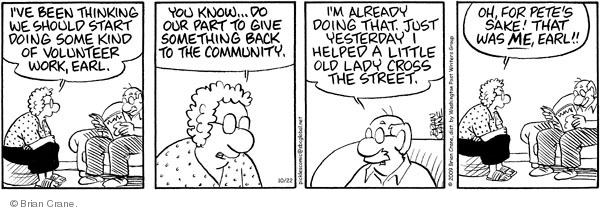
I like Pickles

Those in authority have decreed that reading the comic strip Pickles makes a person unhip.  I for one care nothing for hipness if I must sacrifice my daily reading of Pickles to attain it, and so I defy their judgment.