What James K. Polk Knew

President James Knox Polk

I’ve long tended to look at American history and see in the presidency of James Knox Polk (1845-1849) the origin of a great curse.  President Polk led the United States into war with Mexico.  In consequence of that war, the United States forced Mexico to cede its claims on all territory north of its present boundaries.  The US victory was quick and easy; for a loss of about 13,000 soldiers, the USA gained an internationally undisputed claim to almost a million square miles of territory, stretching from the Missouri River to the Pacific Ocean.  Americans would flood into this territory, displacing and slaughtering the native peoples on whom the Mexicans had made so little impression during their years of nominal rule.  Northern and Southern states vied with each other for influence over this newly secured territory, a contest that laid the political groundwork for the Civil War twelve years later.  As the USA’s first successful attack on a sovereign nation, the invasion of Mexico crossed a psychological boundary which previous attacks on native peoples and British possessions had left in place.  Moreover, the relatively low cost and fantastically rich rewards of the US victory fed in Americans the cannibal appetites of militarism.  So the curse that I have seen as the legacy of the Polk administration includes nearly all of America’s subsequent wars.    

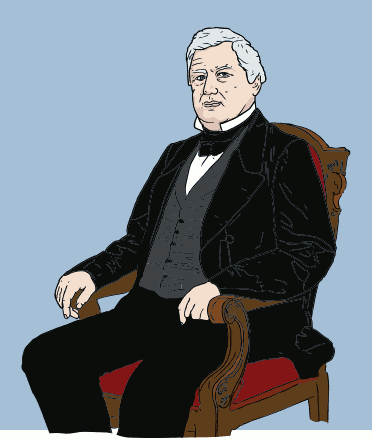
President Polk represented the Democratic Party; his chief opposition was the Whig Party.  I’m a bit of a Whig myself, which is one reason why I chose a cartoon image of Millard Fillmore as my WordPress avatar.*  Leading Whigs like Fillmore spoke out against the invasion of Mexico.  The Whig-dominated Massachusetts legislature passed a resolution during the war denouncing the US effort as the result of a criminal conspiracy to extend slavery into the West.  When Polk claimed that Mexico’s hostile greeting to a US cavalry column he had dispatched into Mexican territory between the Rio del Norte and the Nueces somehow constituted an act by which “American blood was shed on American soil,” Illinois’ Whig Congressman Abraham Lincoln introduced a resolution into the US House of Representatives demanding that the president show the Congress the spot on which this had occurred.  The so-called “Spot Resolution” had the support of the congressional Whig party, and made Lincoln a national figure.  Among future President Lincoln’s colleagues in the House was former President John Quincy Adams.  Technically an independent, Adams was a hero to the Whigs, a friend to Whig Party mastermind Henry Clay, and a reliable supporter of the Whigs’ core policies.  Adams would collapse on the House floor and die in the Capitol; virtually his last earthly act was to vote against a resolution commending US veterans of the war against Mexico.  Many young Whigs who fought in the war would afterward match their elders in the fervor with which they denounced it; Ulysses S. Grant, for example, would write in his memoirs that as a young captain he had won his medals as a perpetrator of “the most unjust war ever waged.”     

The Whigs championed industrialization.  They saw economic centralization as indispensible to industrialization.  Therefore, they were allies of big business and generally sympathetic to established elites.  As such, they would have to be called a conservative party, and their opposition to the war against Mexico would qualify them, if only for the duration of the Polk  administration, as specimens of the antiwar Right.  Chronicles magazine is a voice of today’s antiwar Right, but not of renewed Whiggery.  Their July issue included a review of Robert W. Merry’s A Country of Vast Designs: James K. Polk, the Mexican War, and the Conquest of the American Continent which praises Merry for making a case that Polk was right.  Since I’m so far out of sympathy with Polk and his war, I will quote at length from this review:

Here is the geopolitical reality that Polk grasped.  In the 1840’s, the western third of the North American continent was in play.  The players were the United States, Great Britain, Russia, and Mexico.  Each claimed some portion of that vast territory.  Polk understood that the question was not which of those claims was most legitimate (who, after all, would decide that?),  but which of the four powers had the means and will to enforce their own claims.  Mexico did not.  She “was a dysfunctional, unstable, weak nation whose population wasn’t sufficient to control all the lands within its domain.”  Bernard deVoto made the same point two generations ago:

[I]t is a fundamental mistake to think of Mexico in this period, or for many years before, as a republic, or even as a government.  It must be understood as a late stage in the breakdown of the Spanish Empire. 

There was no stability or institutional legitimacy in Mexico.  Revolution followed revolution, coup succeeded coup.  Mexican governments could neither govern, protect, nor populate the country’s far northern provinces.  That incapacity was most obvious in New Mexico, where the people were oppressed by taxes and terrorized by Indian raids, and consequently not inclined to fight in its defense.  Thus did Gen. Manuel Armijo’s army of conscripts flee at the approach of the Americans.  Col. Stephen Watts Kearney’s army of frontier dragoons and Missouri volunteer cavalry took Santa Fe without a fight.   

There are some good points in this.  What Mexico ceded to the USA in the Treaty of Guadalupe Hidalgo was not land that was populated by people loyal to Mexico and protected by its government, but was instead a claim on territory chiefly inhabited by native people who were barely aware of the existence of Mexico.  It is not too harsh to say that by 1846 Mexico had failed to make good on this claim.  And it is also true that in the mid-1840s Russia and Britain were both very active in the nortwestern parts of North America.  So if Polk had lost 1844 election to Whig nominee Henry Clay, and Clay had as president refused to make war on Mexico, then there would have been a considerable likelihood that instead of confronting each other in a the Crimea in 1854-1856 Britain and Russia would have had their showdown in San Francisco Bay.  But I’m still not for the Mexican War.        

*Here’s the cartoon Fillmore, for those of you who’d like a look:

Ambrose Bierce and The Man Without Illusions

Several weeks ago, The Nation ran a review-essay about Ambrose Bierce.  A few days before happening on this piece, I’d my old Dover Thrift Edition collection of Bierce’s Civil War stories, a paperback I’d bought for a dollar in 1996 and had been meaning to read ever since.  I was interested in the reviewer’s remarks about one of those stories in particular:

In another powerful story, “The Affair at Coulter’s Notch,” Bierce writes of a face-off between two batteries of well-fortified Confederate cannons, twelve in total, and a single Union cannon crew led by Captain Coulter. Coulter’s crew is forced into an open notch and ordered to engage in a firefight just because a general in the field wants to see if the stories of Coulter’s bravery are true. Though Coulter hesitates, he follows the order. He and his crew wheel one cannon out to the notch and commence firing. Soon the twelve Confederate cannons respond and the two sides are lost in the thunderous explosions and enormous clouds of artillery smoke. Each time one of Coulter’s cannons is destroyed, his crew wheels a new one up to the notch so the fight can continue. Eventually the Union officers ride up to the notch to check on Coulter and his men:

Within that defile, barely broad enough for a single gun, were piled the wrecks of no fewer than four. They had noted the silencing of only the last one disabled—there had been a lack of men to replace it quickly with another. The debris lay on both sides of the road; the men had managed to keep an open way between, through which the fifth piece was now firing. The men?—they looked like demons of the pit! All were hatless, all stripped to the waist, their reeking skins black with blotches of powder and spattered with gouts of blood. They worked like madmen, with rammer and cartridge, lever and lanyard. They set their swollen shoulders and bleeding hands against the wheels at each recoil and heaved the heavy gun back to its place. There were no commands; in that awful environment of whooping shot, exploding shells, shrieking fragments of iron, and flying splinters of wood, none could have been heard. Officers, if officers there were, were indistinguishable; all worked together—each while he lasted—governed by the eye. When the gun was sponged, it was loaded; when loaded, aimed and fired. The colonel observed something new to his military experience—something horrible and unnatural: the gun was bleeding at the mouth! In temporary default of water, the man sponging had dipped his sponge into a pool of comrade’s blood.

The cannon drooling blood is certainly a memorable image, and as I read the story I was sure it would be the detail that stayed with me.  By the end, however, even that horror has been put into the shade.  At first we think that Captain Coulter’s commanding officer sent him to that desperately exposed position and ordered him to shell the house opposite simply because he “wants to see if the stories of Coulter’s bravery are true.”  Then one officer tells another that Coulter was a southerner who had left his family behind Confederate lines to join the Union army.  He goes on to report a rumor that the commander had led an occupying force that patroled the area where Coulter’s family was.  This rumor held that the commander had made advances to Coulter’s wife.  She rebuffed him, and the officer wonders if that was why the commander put Coulter in such danger.  By the end of the story, even this grotesque idea is shown to be short of the full horror of the situation. 

The Nation‘s reviewer quotes Bierce’s definition of “realism” from The Devil’s Dictionary as “The art of depicting nature as it is seen by toads.”  This quote is at the center of a little disquisition on Bierce’s use of improbable events in his fiction.  The last two paragraphs of the review sum this disquisition up:

Bierce often resorted to horror, whether grisly war stories or even supernatural tales, but he didn’t do this to avoid writing about reality; he used the genre to confront the truths of his day—the monstrosity of battle, the terror of extinction.

Read Bierce and try not to think of soldiers fighting in Iraq and Afghanistan. Read Bierce and consider the ways “probability” can be a poor test; sometimes realism just fails. Every era needs a genre through which it understands itself. We are living in the age of the uncanny once again. Time to testify.

This point is very close to something that came to my mind while I was reading that collection of Bierce’s Civil War stories.  The stories are full of wildly improbable events; random shots fired at distant enemies can be relied upon to kill the gunners’ fathers, brothers, wives.  Bierce presents these freak occurrences not to undercut the sense of his stories’ reality, but to emphasize their truthfulness.   

What truth does Bierce want us to think fills his stories?  I think it is the same truth that was publicized almost two decades ago, when a hit movie was advertised with an image of a Marine colonel shouting “You can’t handle the truth!”  Even though the movie passed through theaters in 1992,  a Google search for “You can’t handle the truth” restricted to results that went up this week draws over 16,000 hits.  I wonder if the resonance of that line and the power of Bierce’s stories don’t combine to show that there is an idea at large in American culture of truth as something necessarily violent, of war as the ultimate truth.  If so, the colonel in the movie and the highly decorated Civil War veteran Bierce would both figure as men with a privileged access to truth, as warriors who had seen the heart of battle. 

Read the full post »

No one was barred from the conversation back when there was a conversation

Three paragraphs from Bill Kauffman’s column in the latest issue of The American Conservative:

The War Party called the Peace Party Nazis in 1941, Communists in 1951, Soviet dupes in 1961, dirty hippies in 1971 … must I go on? In 2011, those who heed George Washington’s counsel to seek “peace and harmony with all” will be called mullah-headed appeasers of Irano-fascism.

[snip]

Blame war. Blame TV. Blame the nationalization of political discourse, as regional variations and individual peculiarities are washed away by the generic slime of poli-talk shows. Radicals—even naïve Tea Partiers or idealistic left-wing kids—are dehumanized in ways unthinkable when America was a free country. No one was barred from the conversation back when there was a conversation. No dispatch ever read, “Wingnut Henry David Thoreau today issued a manifesto from his compound near Walden Pond…”

[snip]

The squeezing out even of establishment dissent—especially since 9/11—has left us with an antiwar movement so feeble it makes the Esperanto lobby look like the AARP. Enter the new organization Come Home, America, its name taken from the magnificent 1972 acceptance speech delivered by George McGovern in the last unscripted Democratic convention.

I don’t agree that there was ever a time in the USA when “no one was excluded from the conversation”; when Thoreau published Walden in 1854, after all, chattel slavery existed in 15 states, women’s suffrage in none, and the one thing every US voter could support was war against Native Americans.  That said, Come Home, America and its goal of a left-right coalition against militarism seem to be worth a cheer or two.

Remarkable coincidence

Here’s a comment I just had occasion to post on Alison Bechdel’s site:

This morning, I was teaching a class about English words derived from Latin and Greek. One of the exercises required them to write definitions of English words and illustrate their definitions with examples of the words in use.

I wanted to show them how they could use Lexis-Nexis* to find example sentences. So I projected the computer onto the screen in front of the classroom and opened the Lexis-Nexis search window. I asked the class which word they wanted me to look for in my demonstration. From a list of several dozen words, someone picked “neurosis.” So I typed “neurosis” into the search window. Up came hundreds of results. Looking these over, we could see not only potential definitions, but a good deal about the usage of the word. For example, finding it in hundreds of daily newspapers but only one medical journal we formed the hypothesis that it is a word that is no longer in technical use, an hypothesis which that one journal reference** explicitly confirmed.

Then I wanted to show them that you can narrow the search so that it only brings up items posted today. When I did that, paragraphs six through eight of this article appeared on the screen***:

http://www.guardian.co.uk/books/2010/jul/18/comics-grow-up-graphic-novels-harvey-pekar

You could have knocked me over with a feather. I gave a little eulogy for Harvey Pekar and said something like, “Hey, Alison Bechdel! She’s great!”****  Then it was back to lexicography.

*Here’s a link to Lexis-Nexis.  My students and I have access to their “Academic” service

**It was the 2 May 2009 edition of The Lancet, in case you’re curious; “Twisted Science, Regulation, and Molecules,” by Peter Tyrer, Pg. 1513 Vol. 373 No. 9674, wherein appear the sentences “The condition from which my patient suffers used to be called depressive neurosis. It was not a very good diagnostic label, and its boundaries were unclear, but it did allow anxiety and depression to coexist without the need for splitting them into interminable subgroups that, when they were subsequently found together in one person, were pompously described as “comorbidity.”” 

***The portion that appears on screen starts with the search term you used to find the article.  The first appearance of “neurosis” was near the top of paragraph six, and the screen I was using had room for that paragraph and the next two. 

**** Come to think of it, it may have been closer to “Whoa, there’s Alison Bechdel!”  Or maybe “Whaa–!  Alison Bechdel!”  It may even have been “Alison Bechdel!  Golly!”  I taught another class right after that one, so I can’t be certain of my exact phrasing.

New Post on Weirdomatic

FotB Alexandra has posted a new gallery on her terrific site, Weirdomatic.  The title is “Happy Things Pictures,” and it’s irresistible. 

Tuli Kupferberg, RIP

They say there’s a “rule of threes,” that celebrities always die three at a time.  It’s nonsense, of course, but it often seems that way.  So, the other day we lost Harvey Pekar.  Yesterday, we heard that George Steinbrenner had died.  And now, news comes to us of the death of Tuli Kupferberg.  We featured Tuli’s song “Nobody for President” here in November 2008; here it is again.

Tom Tomorrow, Today

A quote from General David Petraeus, commander of US forces in Afghanistan.  As always, click on the picture to go to the original site:

Harvey Pekar, RIP

Obits for Harvey Pekar from NPR, The New York Times, and the Cleveland Plain Dealer.

The Interpreter

I teach at a university deep in the interior of the USA.  Most of the residents in the apartment complex where I live are students at that same university.  Several of these neighbors are Iraqis who have come here as part of an exchange program between our university and one in Baghdad. 

One morning a couple of weeks ago, I left my apartment and walked to the bus stop.  Two of my Iraqi neighbors were sitting on the bench, a man named Abdullah and a woman whose name I did not know.  Abdullah greeted me; his friend turned her face shyly and tugged on her headscarf.  Abdullah offered me his hand.  I declined to shake it, explaining that I had a cold and did not want him to catch it.  Abdullah turned to his friend and said a few words in Arabic.  She nodded at him and gave a grateful smile, saying nothing.  As we waited for the bus, Abdullah and I talked about colds and remedies for them.  After each exchange, Abdullah turned to his friend and spoke for moment in Arabic.  Each time he did, she nodded at him and gave the same smile, never saying a word.  It was clear to me that he was interpreting for her. 

I wondered how well Abdullah was doing as an interpreter.  I was talking slowly and making an effort to keep my vocabulary simple, but still I came up against the limits of his English a number of times.  That didn’t stop Abdullah.  Even when he wrinkled his brow and paused for a few seconds, he still turned to his friend and talked, I suppose offering an Arabic version of whatever he had gathered from my words.  His friend seemed quite pleased with Abdullah, impressed with his gallant efforts. 

The bus came into sight.  Distracted to see it, I forgot to keep my English simple.  Thoughtlessly, I gave poor Abdullah a challenge that even professional interpreters can rarely meet successfully: I made a joke.  “Well, there’s a saying,” I told him.  “A cold usually lasts about seven days, unless the patient is under a doctor’s care.  Then it lasts about a week.”  When I said this, Abdullah’s friend immediately burst out laughing.  Abdullah gave a blank stare for a moment.  He wrinkled his brow and leaned forward.  Then he turned to his friend and interpreted.  She nodded at him, smiled gratefully, and said nothing.

The future ain’t what it used to be

In the twentieth century, many people looked ahead and saw high-tech solutions to high tech problems.  In the twenty first century, we have the high tech solutions, but as Tom the Dancing Bug points out, many low tech problems still leave us stumped.