
The sound you hear is my jaw hitting the floor. I’ve been the one monitoring our gmail account (losthunderlads at gmail dot com) lately. So today I opened it and saw two messages from George Hinchliffe. As in the co-founder of the Ukulele Orchestra of Great Britain. He made some kind remarks about this blog.
Brush with greatness
Posted by acilius on September 7, 2010
https://losthunderlads.com/2010/09/07/brush-with-greatness/
Popular web comic mentions “Ancient Texts”
Classical scholars take note! Jessica Hagy of Indexed may be aware of your existence.
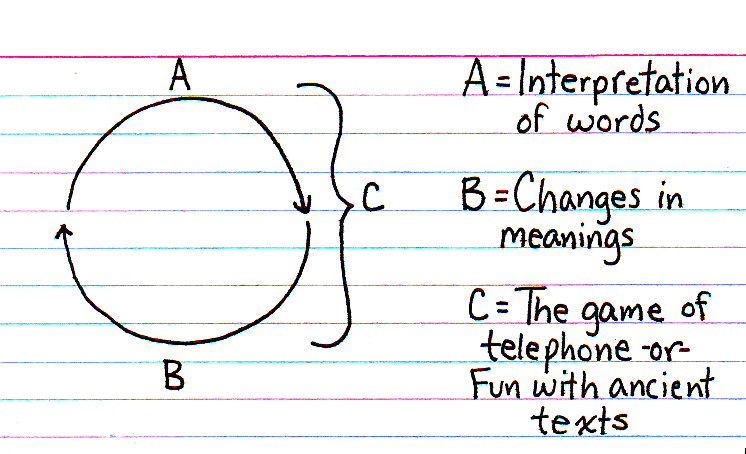
Posted by acilius on August 17, 2010
https://losthunderlads.com/2010/08/17/popular-web-comic-mentions-ancient-texts/
Is all social life schooling?
I’ve always read a lot of magazines. Before we started this blog in June 2007, if I came up with an idea while reading one of them I would sometimes make a note of it in a word processing document. More often I would just forget about it. Now I post “Periodicals Notes” in which I make those ideas available here.
Among these old documents I recently found some speculation triggered by this paragraph on page 23 of The Nation for 19 June 2006: “In his 1964 book Ma’alim fi al-Tariq (Milestones), [Sayyid] Qutb wrote that ‘if woman is freed from her basic responsibility of bringing up children’ and, whether on her own or by pressure from society, seeks to work in jobs such as ‘a hostess or a stewardess in a hotel or ship or air company,’ she will be ‘using her ability for material productivity rather than the training of human beings.’ This, he claimed, would make the entire civilization ‘backward.’” What intrigued me about this précis was the idea that “the training of human beings” is the activity that separates healthy societies from backward ones.
Augustine of Hippo, in the City of God and the dialogue de Magistro, takes a similar view. The City of God is a sort of cultural history of the Roman Empire, tracing how various religious ideas have influenced events from the legendary period of the seven kings of Rome up to Augustine’s own day. Rather than simply dismissing the ideas he disagrees with, Augustine treats them as early stages in the process that would prepare the Mediterranean world for Christian doctrine. This process of learning involved the whole of Greco-Roman society. In the dialogue de Magistro, he asks what purposes speech serves, and concludes that every one of those purposes is a form, of teaching. If all speech is teaching, then all social life must be educational.
Around the same time I read the issue of The Nation with that essay about Sayyid Qutb, I read the Spring 2006 issue of Telos. That issue includes an article by Aryeh Botwinick called “A Monotheistic Ethics: Ben Zoma’s Mishnah” which finds such a view in the Babylonian Talmud, in Ben Zoma’s comments on the passage “Who is wise? He who learns from everyone.” I rather doubt that Sayyid Qutb read the Babylonian Talmud, or Augustine for that matter. I suspect that Qutb, Augustine, and Ben Zoma came independently to the view that society is above all a place for teaching and learning.
Posted by acilius on August 12, 2010
https://losthunderlads.com/2010/08/12/is-all-social-life-schooling/
Herman Vandecauter, “Meusette d’Argenteau”
Here’s one of our favorite ukulelists, Herman Vandecauter:
Posted by acilius on August 6, 2010
https://losthunderlads.com/2010/08/06/herman-vandecauter-meusette/
Fundamentalisms
I’ve often wondered about the word “fundamentalism.” The word seems to refer less to a specific set of beliefs than to an attitude of militant certitude about one’s beliefs. So an “Islamic fundamentalist” and a “Christian fundamentalists” can look at each other, each serene in the conviction that the other will be damned for obscene folly.
How widely can the word be applied? We hear sometimes about “Hindu fundamentalists”; while no one can deny that there are aggressively militant Hindus, some do deny that the word “fundamentalism” can be stretched to cover a body of religious practices that are not built around a holy book or the story of a prophet. On the other hand, there are those who argue that militant Hindu nationalists have been trying to refashion Indian religious traditions in the image of the monotheistic movements commonly known as fundamentalist.
If fundamentalism isn’t particular to any one religion or even to any one category of religions, is it even necessary to be religious to be a fundamentalist? Or, to ask a related question, if fundamentalism isn’t about particular religious doctrines but about the believer’s attitude towards doctrines, then wouldn’t we expect fundamentalists who change only in that they have lost faith in their religious doctrines to approach disbelief in the same way they had formerly approached belief? That is, would we not expect fundamentalist theists who ceased to believe in their God or gods to become equally fundamentalist atheists unless they had undergone some change in their approach to their beliefs?
Yesterday, Arts & Letters Daily linked to a several-week-old piece on Slate that reminded me of these questions. The most interesting bits of that piece were quotes from Australian science blogger John Wilkins. Wilkins has denied that “fundamentalist atheism” is a meaningful phrase, but his description of the mindset that sets the “New Atheists” apart from the agnosticism he approves does sound very similar to fundamentalism:
For now my objections to the “New” Atheists (who are a vocal subset of the Old Atheists, and who I call Affirmative Atheists) are the same as my objections to organized religion:
1. Too much of the rhetoric and sociality is tribal: Us and Them.
2. [The New Atheism] presumes to know what it cannot. More on this below.
3. As a consequence of 1 and 2, it tries to co-opt Agnosticism as a form of “weak” Atheism. I think people have the right to self-identify as they choose, and I am neither an atheist nor a faith-booster, both charges having been made by atheists (sometimes the same atheists).
4. Knowability: We are all atheist about some things: Christians are Vishnu-atheists, I am a Thor-atheist, and so on. But it is a long step from making existence claims about one thing (fairies, Thor) to a general denial of the existence of all possible deities. I do not think the god of, say John Paul II exists. But I cannot speak to the God of Leibniz. No evidence decides that.
5. But does that mean no *possible* evidence could decide it [existence or nonexistence of God]? That’s a much harder argument to make. Huxley thought it was in principle Unknowable, but that’s a side effect of too much German Romanticism in his tea. I can conceive of logically possible states of affairs in which a God is knowable, and I can conceive of cases in which it is certain that no God exists.
Posted by acilius on August 5, 2010
https://losthunderlads.com/2010/08/05/fundamentalisms/
Really basic web defense
Yes, your browser is under attack and dark forces want to know which sites you visit and what you click.
One thing going on is user tracking via cookies – bits of identifying stuff left on your computer as you browse. There’s no keeping up with all the various schemes used by major sites like Google, Yahoo, and others, but suffice to say they and other third party providers to web sites are doing their best to follow your web activity and then “customize” your view of the web. Some of this works when you’re logged in to sites like Facebook, My Yahoo, etc., but some also works just by the basic actions of loading pages and images. Almost all of it is hidden from casual users. It may not bother you, and you may be content to allow marketers to guide you to products and services they hope you’ll like. On the other hand…
To resist this to some degree, in rough order of increasing effort and increasing inconvenience:
DO NOT CLICK ON WHAT YOU DO NOT UNDERSTAND
The first, most vital rule. Delete all email or classify it as “spam” unless you are positive of its provenance. What’s the worst that could happen? You might delete a bill notification or a personal note. Usually those things have a way of working themselves out – clicking on a faux “Free $1,000,000 Watch If you Click the Hamster’s Cute Nose” inducement is guaranteed to lead only to tears.
DO NOT GO TO UNKNOWN SITES
Harsh, a restatement of the most vital rule, and not much fun, but isn’t a quick Google of a site’s domain name or vetting with a friend better than leaping into a boiling cauldron of corruption?
IE, NOT
- Don’t use Internet Explorer. Just don’t. Sorry, if you like it. It’s worse on security and privacy. Yes, it is
- If you insist, make sure Explorer is not saving your passwords and set the security level high – otherwise you’re insane
FIREFOX
- Close your browser and restart it often, especially after visiting any encrypted or secure sites (sites like financial institutions, even shopping sites – anything with “https://” instead of “http://” in the URL.) This will flush (depending on Privacy Mode and cookies settings) cookies away and eliminate JavaScript “Klingons” that have accumulated, limpet-like, on your computer
- On the Firefox browser, set to “Private Browsing”
- Set your Preferences to “Allow cookies” but disable “Allow 3rd party cookies”
- Turn off cookies altogether, or force cookie-by-cookie acceptance
You’ll experience failures and ugly pages on many sites if you do this. You’ll have to authorize MANY cookies if you choose to do so manually. You can always reenable to access a bank site or other cookie-requiring site, and you can also choose to accept cookies only from particular domains – but the proliferation of 3rd-party services used by sites means broken pages can still result.
ALL BROWSERS
- Turn off Java support (only need this if a particular site does, be very wary)
- Turn off JavaScript support (Painful – many pretty and useful sites use JavaScript extensively. Yet it has a lot of unpleasant new attack vectors. Notice it’s far down this list, as this one will annoy you and may require turning on for MOST places you like to visit)
SECURITY IS PROPORTIONAL TO INCONVENIENCE: THE HARD PART
- Research additional software tools/add-ons that actually do block ads, monitor annoying cookies, and so on, which will work with YOUR particular computer and software
- Learn how to use said software and actually use it
- It would be great if I could offer specific suggestions that required no effort, but at the moment I can’t
- If you don’t have time to learn a security tool and use it correctly, it will only drive you crazy and cause you more worry than the Bad Guys
Good luck!
Posted by vthunderlad on August 1, 2010
https://losthunderlads.com/2010/08/01/really-basic-web-defense/
Seceding from the Nation
 Eric Foner is a major historian of the mid-19th century USA and a regular contributor to The Nation magazine. In a recent issue, he reviewed two books about politics in the South during and after the Civil War, Stephanie McCurry’s Confederate Reckoning and Victoria Bynum’s The Long Shadow of the Civil War. This paragraph of Foner’s got me thinking:
McCurry begins by stating what should be obvious but is frequently denied, that the Confederacy was something decidedly odd in the nineteenth century: “an independent proslavery nation.” The Confederate and state constitutions made clear that protecting slavery was their raison d’être. Abandoning euphemisms like “other persons” by which the US Constitution referred to slaves without directly acknowledging their existence, Confederates forthrightly named the institution, erected protections around it and explicitly limited citizenship to white persons. McCurry implicitly pokes holes in other explanations for Southern secession, such as opposition to Republican economic policies like the tariff or fear for the future of personal freedom under a Lincoln administration. Georgia, she notes, passed a law in 1861 that made continuing loyalty to the Union a capital offense, hardly the action of a government concerned about individual liberty or the rights of minorities.
I can certainly understand Foner’s exasperation with neo-Confederates who see the Old South as a proud symbol of liberty and elide the role of slavery in the Civil War. In the legal documents he cites, the Confederate States of America advertised its cause as the defense of slavery. In prominent speeches delivered at the outbreak of the war, such southern leaders as Confederate Vice President Alexander Stephens and Confederate President Jefferson Davis said openly that the cause which justified secession was the threat that the newly ascendant Republican Party would free blacks from slavery. While Stephens and Davis each spent a great deal of time after the war trying to explain his earlier remarks away and argue that he had been motivated by concern for something other than the maintenance of human bondage, it is hardly unreasonable to attach greater weight to the contemporary documents and to say that in the Civil War, the South fought to defend slavery.
What is less reasonable is to leave it at that, with the implication that the North fought to abolish slavery. The evidence would suggest that when the United States armed forces were sent to quash secession, the men who sent them had little interest in emancipating anyone. Emancipation came later, propelled by the exigencies of war. As Davis and Stephens would shift their public statements from prewar calls to defend slavery to postwar invocations of the rights of the states, so too did the leaders of the North change their stands very substantially as the war went on. The most obvious example may be the contrast between Abraham Lincoln’s two Inaugural Addresses. Lincoln delivered his First Inaugural Address in March of 1861, when the war had not yet broken out. The Second Inaugural Address was delivered in March of 1865, a few weeks before the end of the war. Lincoln spends much of the First Inaugural Address vowing to enforce the Fugitive Slave Act and leave slavery alone in all the states where it was a legal institution. In the Second Inaugural Address, he looks back on the war as a struggle to emancipate the slaves and declares that it would only be just were God to decree that the war should “continue until all the wealth piled by the bondsman’s two hundred and fifty years of unrequited toil shall be sunk, and until every drop of blood drawn with the lash shall be paid by another drawn with the sword.”
In the First Inaugural, Lincoln capitulates to every demand the South could possibly make in regard to slavery. Time and again, of course, Lincoln would declare his belief that people whose ancestors came from Africa could not live among whites except in conditions of subjugation, and he rarely missed a chance to distance himself from Abolitionists. These facts do not mean that the South was not fighting to keep blacks enslaved. Seeing that the Republicans, a party which did include a sizeable antislavery bloc, could elect as president a candidate who did not receive a single vote in the ten states south and west of Virginia, slaveholders might well have drawn the conclusion that their grip on the national government was permanently broken and that some future president would lead the push for abolition. While Lincoln himself might not in 1861 have had the inclination to take that task on, proslavery southerners may well have thought that it would have been unwise to wait for the crisis they feared.
What the First Inaugural does show, however, is that whatever the South may have been fighting for, the North was not at the outset of the war fighting against slavery. Why did the North fight to keep the South in the Union? Why for that matter did so many Northerners vote for Lincoln when it should have been clear that the election of a purely regional candidate would trigger secession? I suspect Foner’s dismissal, in the paragraph above, of the tariff as a cause for the war applies only to the motivations of the South. The South opposed a protective tariff because it wanted equal access to the products of industry in the North and in England. Indeed, the South wanted Northerners to bid competitively with English interests for Southern cotton. Since the chief goal of US policy since 1776 had been to get the British out of North America, the idea that the southern states of the USA would form an economic relationship with English industry that might very well lead to their absorption into the British Empire could hardly be expected to meet with general approval in the rest of the country.
The Second Inaugural is among the most widely read of all Lincoln’s writings, certainly the most widely read of his state papers. That is no surprise. Not only is it an extraordinary specimen of eloquence, but it also flatters Americans’ national self-esteem. The Second Inaugural caters to Americans who want to look at the Civil War and see a moral awakening to the evils of human bondage and to the possibility that black and white might live together in equality. Beyond that; it also allows us to cast that moral awakening as a drama in which our enlightened twenty-first century selves have the leading role. The Civil War, Lincoln invites us to believe, was fought so that later generations of Americans could be untainted by the guilt of slavery. In other words, the dead had to die, so that we could look down on them.
If, instead of reading the Second Inaugural and congratulating ourselves on our superiority to our ancestors, we Americans read the First Inaugural and put the Civil War in the context of international Realpolitik, we might shed some of our national narcissism and be warier next time some group of con artists try to sell us another war. We wouldn’t necessarily be any less proud of our country- opposing the British Empire was a mighty project in the eighteenth and nineteenth centuries, and it isn’t every country that would have the patience to stick with such a project until the UK’s prime minister openly declares his country to be the USA’s junior partner in world affairs. But we might learn to express pride in our country without pretending that the country itself has some divine commission to institute a world order based on pure justice.
Posted by acilius on July 30, 2010
https://losthunderlads.com/2010/07/30/seceding-from-the-nation/
The Political Stupidity Index; or, What separates the USA from the world to its south

Some US presidents not powered by petroleum
The July issue of Counterpunch just showed up in my mailbox; I suppose I could have read it weeks ago if I subscribed to the email version rather than the paper-and-ink one. If I did that, however, I wouldn’t be able to leave old copies in laundromats and doctor’s offices and wonder who is getting a shock from them.
There are three pieces remembering the late and much lamented Ben Sonnenberg, founder of the (alas, equally late and much lamented) literary quarterly Grand Street and a longtime eminence of the American Left. I want Alexander Cockburn and Jo Ann Wypijewski to write my obituary. As they went on about Sonnenberg’s historical greatness, profound learning, unfailing humility, inexhaustible compassion, and cheerful lovable-ness, I started to wonder why he hadn’t risen from the tomb on the third day. Still, they do show that Sonnenberg devoted his life to celebrating and advancing the achievements of the human intellect, and that he was fearless in bringing reason to bear when entrenched interests intimidated others into accepting the official story.
Two muckraking pieces tackle official stories which claim that the US government protects its citizens from menaces approaching the country from the south. Jeffrey Saint Clair’s “How BP and the Obama Administration Have Been Joined at the Hip” tells how Mr O has overseen “a profound bureaucratic lethargy that ceded almost almost absolute control over the response to the spill to BP.” While he might have invoked powers under the 1968 National Contingency plan and “seized control of both the well and the cleanup operations,” leaving BP’s officers with nothing to do but “sign checks for billions of dollars,” Mr O in fact sidelined all advisors who showed any sign of independence from the oil giant, instead relying on former lobbyists for and executives of BP. The administration did little to nothing to contain the damage the leak would do to the Gulf coast, its wildlife and fisheries, but a great deal to help BP contain the damage to its public relations. Most of Saint Clair’s facts are also reported in this Rolling Stone piece.
Frank Bardacke’s “Why the Border Can Never Be ‘Secured'” introduces the phrase “the Political Stupidity Index,” which Bardacke defines as “the difference between the words politicians say and the way we actually live.” Bardacke argues that the national debate about immigration registers a remarkably high level of this sort of stupidity, taking it to a level where “the words at the top have nothing to do with life at the bottom.” “Despite what may be said in the public debate, people know there is no way to stop Mexicans coming to the USA, as long as Mexico remains poor and the USA relatively rich,” writes Bardacke. More enforcement at the border only means more corruption among border patrol agents and more power for criminal enterprises that have set out “to make border crossing a big, corporate business.” Amnesty for undocumented workers, whether marketed under the label “a path to citizenship” or under some other brand name, will only increase the rate of illegal immigration, as the upsurge in immigration after 1986 legalization definitively proved. Guest-worker programs are “a bad idea all around,” as the experience of the Bracero Program showed. By the mid 1960s, the poor working conditions to which braceros were subjected had raised the ire of liberals who objected to the program because it was a form of indentured servitude, while conservatives were alarmed by number of braceros who left their places of indenture to blend into the general population of the USA.
I’m not at all sure Bardacke is right that the border cannot be “secured.” Israel has certainly shown that walls can keep highly motivated people from crossing borders, and enforcement of citizenship requirements at points of employment need not be any more difficult than enforcement of laws that require employees to be at least a particular age or paid at least a particular wage. In order to implement those measures, the US government would have to confront the people who profit from the current system. Considering the absurd timidity our current government has shown in its dealings with BP, it is rather difficult to imagine a future government that would be prepared to take on all the interests that benefit from keeping US wages from rising too far above the Mexican average. Difficult though it may be, it is hardly impossible that such a thing might happen, and therefore unjustified to say that “the border can never be ‘secured’.”
Whether it should be secured is of course another question. If a government ever does come to power in the USA that has the backbone to stand up to the low-wage lobby, that government would likely be the result of a profound change in the country’s whole political culture. If that change ever does come about, it might reveal more attractive possibilities for the US-Mexican economic relationship than fortifying the border and adding a new layer of policing in employment. Maybe if working people get hold of real political power they will find ways to work together to develop the US and Mexico in tandem, rather than submitting to policies that exacerbate economic inequality and hollow out industry on both sides of the border.
Posted by acilius on July 29, 2010
https://losthunderlads.com/2010/07/29/the-political-stupidity-index-or-what-separates-the-usa-from-the-world-to-its-south/
Why I Post Under a Pseudonym

Under a false name
Lately I’ve been leafing through the Penguin Classics version of Søren Kierkegaard’s Papers and Journals. One of the major themes is his relationship to the pseudonyms under which he wrote. For example, on page 204 we find this passage, dated 9 February 1846:
Up to now I’ve been of service by helping the pseudonyms to become authors. What if I decided from now on to do in the form of criticism what little writing I can allow myself? I’d then commit what I have to say to reviews in which my ideas developed out of some book or other, so that they could also be found in the book. At least I’d escape being an author.
I suppose my use of the pseudonym “Acilius,” together with the preponderance of “Periodicals Notes” and Quick Links here, is among other things a strategy to avoid becoming an author. But that isn’t the whole story. Returning to Kierkegaard, here is a passage from later in 1846, found on page 225 of the book:
The idea I expressed in my life to support the pseudonymous writings was in total consistency with them. If, with such an enormous productivity, I had led a secluded, hidden life, seldom appearing in public and then with a serious mien as befits a thinker, a professor face, heaven help me! All that crawls of silly girls, young students, and the like would have discovered that I was profound. That would have been hugely inconsistent with my work. But what care fools about consistency- and how many wise men are there in each generation?
When I first read this bit two or three weeks ago, I had just been thinking about my reasons for blogging under a pseudonym. Coming upon it helped me formulate three specific reasons.
First, I teach at a college. Many of my students look me up on Google. If I blogged under my real name, they would immediately find this site. I already catch them spouting opinions which they take to be mine in an attempt to make points. If I were to make hundreds of posts in which I give my opinions about virtually every possible subject so easy for them to find, I could expect to encounter that sort of thing every day.
Second, I often tell little stories about people I know. Since I use a pseudonym and do not identify these people, the reader cannot be expected to know who they are. Even readers who know me and recognize the characters may find something of the detachment of fiction in a story published under a pseudonym. If I were to use my real name, however, I would have an obligation to give the others a right to rebut what I have written about them.
Third, I am not the sole author of this site. Others post here, still others comment here. Some of these are people who are connected to me in some identifiable way (for example, my wife) and who may occasionally make remarks here that they would not want to share with everyone in the world. If I obscure my identity by using a pseudonym, those others may be able to preserve some measure of privacy.
Posted by acilius on July 28, 2010
https://losthunderlads.com/2010/07/28/why-i-post-under-a-pseudonym/
The Ukulele Orchestra of Great Britain rereleases two early albums

The re-released
The Ukulele Orchestra of Great Britain will soon be making its entire back catalog available for purchase in the form of mp3 downloads; despite this, they have reissued two of their early albums as CDs, Pluck (1997) and Hearts of Oak (1989.) A copy of each came to our house came a couple of weeks ago. Mrs Acilius and I have been listening to them more or less continuously ever since.
Hearts of Oak features eleven originals and four covers. Pluck features twelve covers and four originals. Two cuts from Hearts of Oak (“The World’s Number One Scat Singer” and “Western Lands”) and seven from Pluck (“Try Hard,” “Sugar Plum Fairy,” “Completely Broken Hearted,” “I Wish I Could Shimmy Like My Sister Kate,” “Devil’s Galop,” “In a Monastery Garden,” and “I Think You’re Neat”) were among the eighteen tracks on the 2006 compilation album Top Notch. The band no longer offers Top Notch for sale on their website. I don’t know whether this means that they plan to make all of the tracks on it available in their original contexts by rereleasing 1994’s A Fistful of Ukuleles and 2000’s Anarchy in the Ukulele as CDs, or if those numbers will only be on the market as mp3s. I hope for the former; not only are the individual tracks worth having, but they flow into each other to make terrific sets.
Hearts of Oak is structured as an overture and two movements. The overture is “Chord Trick,” an abridgement of Henry Purcell’s 1695 Funeral March for Queen Mary arranged for electric ukulele; the result sounds vaguely like 80s Progressive Metal. The set is 21 years old; while several other cuts are recognizably artifacts of the period, this opening number is the only one that has aged badly. The flat electronic sound captures none of the urgency that builds so insistently through the original. An attempt to render the Funeral March for Queen Mary in the style of Queensryche may be typical of the UOGB’s eclecticism, but this performance is by far the weakest on the disc.
The next seven tracks represent what I call the set’s first movement, a series of vocals in various genres. “Just a Game” is as much part of 1989 as is “Chord Trick,” but evokes the bubblegum pop of the period far more successfully than “Chord Trick” evokes the metal. “Whatever It Takes” led Mrs Acilius to exclaim that Kitty Lux has the perfect voice for hillbilly music; as the missus is a card-carrying hillbilly herself, this was high praise. Indeed, Kitty Lux is the undoubted star of the band in these two albums. I can’t help but think it’s a bit of a shame that she’s taken a lower profile in recent years. On “There Was a Man,” Kitty sings about a man who needed shoes and was so excited when she gave him hers that he wore them out dancing for joy. When I first heard this folk-inspired number my main response was to wonder what it might have sounded like if it had been written in Spanish. It’s grown on me with subsequent listenings, but it’s not for those with a low tolerance for the twee.
The liner notes quote the Guardian hailing the fifth track, “Anything is Beautiful Which…,” as the moment when the ukulele “at last found its avant-garde.” The reviewer probably said that because of the lyrics, which consist of Kitty’s electronically distorted voice making little references to various nineteenth-century theories of aesthetics. If you aren’t up on these theories, don’t worry- the words are no more distracting than the nonsense lyrics of most pop songs, and the rhythm is powerful enough to get me, the missus, and both of our dogs up and dancing every time we play the disc. If you are up on aesthetic theory, the song is actually pretty funny, but you’ll have to take my word for that. Even funnier are the lyrics to “The World’s Number One Scat Singer,” which is George’s one turn as vocalist on this album. The song, which would appear on Top Notch as “The World’s Greatest Scat Singer,” actually does include some first-rate scatting, as well as lines that can get a laugh from any audience. “Easter Sunday,” a cover of Bertolt Brecht and Hanns Eisler’s “Ostersonntag 1935,” is dark and dissonant, as one would expect from a Brecht/ Eisler lied. Though it is an arrangement of a song that was already 54 years old by the time the disc was first released, it is much closer to being avant-garde than is “Anything is Beautiful Which…” The speaker’s anxiety about an upcoming “Holocaust/ that will destroy this island, and these people,/ and the continent of Europe” calls for a great deal of dissonance, and the players execute the song brilliantly. That fearful song is the perfect lead-in for the title track. “Hearts of Oak” is short and arresting, a simple chord progression backing lyrics that express complex ideas about human connectedness. Following “Easter Sunday,” a song with lines like “Isolation and communion are written in hearts of oak” prompts deep thoughts about what it means to live a peaceful life as a human being among human beings.
With that, we move on to the third movement, seven instrumental tracks. To keep the pairing of “Easter Sunday” and “Hearts of Oak” from taking the listener too deep into intellectualism to enjoy the music, this starts with a sort of Texas two-step number, “Western Lands.” I don’t actually know the Texas two-step, but Mrs Acilius and I have devised a little dance for this one where I do a quasi-foxtrot and she dances with her shoulders while seated. “Nevada” is a quiet, steady number that might have sounded somber immediately after “Easter Sunday” and “Hearts of Oak”; with “Western Lands” lightening the mood in between, it’s no more downbeat than is a spaghetti western. The pace slows down even more for an arrangement of Rentaro Taki’s koto classic “The Moon over the Ruined Castle.” I used to live next to a professional koto player; she had a low tolerance for the ukulele. This performance is impressive enough that I might be tempted to play it for her, if she and I were still in contact. If anything could raise her opinion of the ukulele, this would be it.
After those two slow pieces, the pace picks up again with “Formica Top,” a Memphis Soul number that would have made Booker T and the MGs proud. Then comes an equally fast-paced novelty tune, “Minimal Rag.” “Minimal Rag” is the one Mrs Acilius wants me to learn. “Karaoke Corral” is another Western-swing themed fast dance.
The set closes with “The Con Man’s Chord Trick,” an arrangement for acoustic ukulele of the same Purcell march which had started it off in so unsatisfactory a fashion. This acoustic version is far superior to the electronic one. The repetitions that had been so tedious on the electric uke give this version an irresistible driving force. If only it had been chosen as track one and the electronic version had been cut, the album would have been in a different league.
Unlike Hearts of Oak, Pluck shows the UOGB in their now familiar form. Several members of the band take turns on lead vocals, most of the tracks are covers, and comedy is never far away. The band redid a couple of numbers in later performances. The version of “Life on Mars” here features Jonty Bankes giving a far less assured vocal performance than he would turn in when he sang the same song at the Barbican in 2005, even though the later performance also included several more voices making a melange of other, similar tunes. Here, Jonty’s only competition is George chiming in with the occasional line from “My Way.” That Barbican set also included Will Grove-White clowning through “Hot Tamales,” which he sings on this disc in a relatively straight version. The version here is more danceable, and I’m glad to have both.
The Wild West influence that is so much in evidence on Hearts of Oak peeks out a bit on Pluck, notably in the theme from “The Magnificent Seven.” Slowed down from the original version and played with reggae-like holes in the rhythm, this number will remind most listeners of the UOGB’s version of the theme from “The Good, the Bad, and the Ugly” (also part of the 2005 Barbican set.) That’s a shame; while the later piece is a much more impressive feat of musicianship, this one is also fun, and an interesting comment on the original.
Anyone who laughed at Tom Lehrer’s “Masochism Tango” will howl through “Can I Break Your Heart?” Not only they; Mrs Acilius, for example, doesn’t seem to care for Tom Lehrer or that song, but she sings along and laughs when “Can I Break Your Heart?” comes on the CD player.
Amid all the jokiness, there are some serious songs. The lyrics to “Try Hard,” with its criminally-inclined narrator, may read like a joke, but the song as they play it turns out to have a touch of pathos; George and Kitty’s “Completely Broken Hearted” is quite affecting; and George’s rendition of “(You Make Me Feel Like) A Natural Woman” makes me want to jump up and cheer every time I hear it.
The best introduction to the band is a live show, or failing that, a video. So, if you are going to start buying their stuff, I would recommend starting with the videos they’ve released so far, one showing the 2005 Barbican show and the other showing last year’s performance at the BBC Proms. Once you have those, I would recommend Hearts of Oak. Pluck is a treat for confirmed fans, but I suspect most others would rather just download the mp3s of a few selected tracks.
Posted by acilius on July 27, 2010
https://losthunderlads.com/2010/07/27/the-ukulele-orchestra-of-great-britain-rereleases-two-early-albums/
Who writes this?
 acilius
 believer1
 lefalcon
 losthunderlads
 vthunderlad
 Panther Red