On Halloween, I posted about Ambrose Bierce’s idea of ghosts as beings who come from nowhere, go nowhere, and are powerless to play a direct role in human life. I suggested that Bierce might have been expected to come up with an idea like this, given that his religious background was a self-conscious Protestantism that made a point of renouncing notions like Purgatory and intercessory prayer. Bierce grew up hearing that at the moment of death, a soul passes either to Heaven or to Hell. With that belief as the starting-point for his thoughts about the afterlife, how could Bierce have crafted a drama of any substance for the dead to enact? How could he have attributed to them the power to influence our lives?
Similar thoughts seem to have been working lately in the mind of cartoonist David Malki. The four most recent installments of his Wondermark have dealt with ghosts. Here’s one from earlier this week:
Bierce has his ghost explain that the spirits of the dead are “invisible even to ourselves, and to one another”; on rare occasions, she says, “we are seen by those whom we would warn, console, or punish. What form we seem to them to bear we know not; we know only that we terrify even those whom we most wish to comfort, and from whom we most crave tenderness and sympathy.” Perhaps the ghost in this comic is under the impression that she is communicating with the medium, who does not really hear her at all but is deceiving her and his clients; or perhaps the medium does hear her and is faithfully reporting what he hears, which is distorted in the way that Bierce’s ghost had complained her attempts to communicate with the living had been distorted.
You don’t often hear the names of Susie Bright and Steve Sailer linked (though apparently they both commented on the same article once, Sailer here and Bright here) but the two have each written insightful pieces on the 2010 US national election. Here is Bright’s piece; here is Sailer’s.
The differences are obvious; while Bright’s dire prediction #4 is that “Racist appeals to quarantine, imprison, deport, and execute will become unrelenting. Look forward to pronouncements like, ‘I’m not a bigot, but brown and bearded people have GOT to be go!’ Four talking heads will then agree on every media channel,” Sailer argues that population growth resulting from high levels of immigration has raised the average cost of living in the US, then predicts that the newly elected Republican politicians will move to raise those levels still higher.
Nonetheless, there’s actually a good deal of overlap in their views. Both see politicians as spokespersons for powerbrokers behind the scenes; Bright says that “Female GOP candidates are the sign of one thing: The Shitty PR Job that girls always get, while patriarchs elsewhere pull the strings. It’s a sign of how little candidates are worth,” while Sailer explains the reelection of Nevada’s unpopular but well-connected Senator Harry Reid by asking “Could it be possible that some residents of Las Vegas are less motivated by principle than by money? I know it sounds crazy. But I think we have consider that disillusioning possibility about Vegasites.” Both dread a future in which whites will vote as an ethnic bloc; in her dire prediction #14, Bright declares that whites who see the Republicans as the white party are deluded, since it is controlled by people who care only about the color of money. Sailer wouldn’t disagree, but he predicts that whites will vote as an ethnic bloc as they move toward minority status in the USA. “You’d prefer not to live in a country where whites vote like a minority bloc? Me too! But maybe we should have thought about that before putting whites on the long path to minority status through mass immigration.”
1. Al Wood, proprietor of the magnificent Ukulele Hunt, disclaims any interest in politics, but he has a post up about copyright law that everyone should read. He calls for a scrapping of the 95-year term of protection that is now standard in the developed world, and a return to the once-standard renewable 14 year term.
People began getting worried about all these tests. In order to pacify the people, the Atomic Energy Commission issued a statement- this was the beginning of 1955- saying you didn’t need to worry at all about the fallout because the dose which people in the United States received from the tests was not more than from a chest X-ray.
Most people didn’t know how much radiation you get from a chest X-ray. I knew… [A]fter this statement, I thought this was terribly dangerous.
3. A new article about T S Eliot in Commentary asks “But might it be allowed that one can write or say anti-Semitic things without being an anti-Semite? Eliot is guilty of the former, but does not, I think, stand guilty of the latter.” The major theme of the piece is the great difficulty his Calvinist heritage left the Tse-Tse in his attempts to enjoy life. Certainly a man who made several well-publicized anti-Semitic remarks, then earnestly declared anti-Semitism to be a sin, would seem to be an example of someone not having fun.
4. Seats in the US Senate are not apportioned by population, with the result that a candidate can lose by a landslide in one state, while candidates in other states can receive fewer votes and win elections.
One of Ambrose Bierce’s most famous stories is “The Moonlit Road.” Three narrators describe the same killing. The third narrator is the victim, speaking through a medium. Two of the victim’s remarks suggests that Bierce had worked out some sort of a theory about what it’s like to be a ghost:
Fear has no brains; it is an idiot. The dismal witness that it bears and the cowardly counsel that it whispers are unrelated. We know this well, we who have passed into the Realm of Terror, who skulk in eternal dusk among the scenes of our former lives, invisible even to ourselves, and one another, yet hiding forlorn in lonely places; yearning for speech with our loved ones, yet dumb, and as fearful of them as they of us. Sometimes the disability is removed, the law suspended: by the deathless power of love or hate we break the spell — we are seen by those whom we would warn, console, or punish. What form we seem to them to bear we know not; we know only that we terrify even those whom we most wish to comfort, and from whom we most crave tenderness and sympathy.
A bit later, she elaborates on this:
You think that we are of another world. No, we have knowledge of no world but yours, though for us it holds no sunlight, no warmth, no music, no laughter, no song of birds, nor any companionship. O God! what a thing it is to be a ghost, cowering and shivering in an altered world, a prey to apprehension and despair.
While I’m at it, I should mention John Zmirak’s recent Halloween essay. Who likes Halloween? Radical traditionalist Catholics, that’s who likes Halloween. Zmirak expresses a measure of sympathy for anti-Halloween Protestants:
Some homeschooling friends of mine confessed to me that they felt torn over whether or not to let their son dress up and go trick-or-treating; their Protestant friends kept telling them that this holiday was pagan or even Satanic. And given their theology, you can see their point: The souls of the dead are either in Heaven — in which case they’re not walking the earth and need not be appeased, represented, mocked, or even commemorated, depending on which reading you give to the way we Catholics appropriated old pagan customs that marked this time of year– or else they’re in Hell, and not worth remembering.
Only if you believe in Purgatory, Zmirak argues, can you fit earth-haunting ghosts into the world of Christian imagination. Zmirak gladly claims the Addams family as rad-trad Catholics. “Indeed, I think I may have spotted several Addamses at the indult parish in New York City…” He urges devout parents not to dress their little trick-or-treaters as saints, but to give them costumes that display the eerie and frightening parts of life that Halloween is meant to confront. He does draw the line somewhere, though:
Now, I’m very much in agreement that two-year-old children should not be dressed as Satan. For one thing, it’s a little bit too realistic. Indeed, the fallenness of children, which Augustine bemoaned in his Confessions, is so evident to everyone that garbing the little tykes in the robes of absolute evil seems to overstress the point. Nor do we wish to trivialize the serious, deadly purpose of our infernal enemy — dragging each of us screaming to Hell. If you’re feeling puckish, it’s in much better taste to dress up your kids as Osama bin Laden, Annibale Bugnini, or some other of the Evil One’s lesser minions. If you must dress your boys as saints, choose military martyrs, canonized crusaders, or patriarchs from the Old Testament. One suggestion I made as editor of the Feasts and Seasons section of Faith & Family magazine was this: Dress up your daughters as early Roman martyrs, like Agnes and Agatha, and your sons as the Roman soldiers, gladiators, and lions that sent them to heaven. Stock up on lots of fake blood for the girls’ machine-washable tunics, and let the games begin! (Alas, this idea never saw print.)
Bierce grew up in Ohio in the 1840s and 1850s; his family and neighbors were staunch Calvinists. One of his sisters was so committed to that faith that she went to Africa as a missionary. She was never heard from again; many Ohioans thought that she had been eaten by cannibals. Perhaps she was an inspiration for the cartoons magazines used to run showing pith-helmeted figures in great pots of boiling water. Bierce himself was alienated from religion; at times he made a show of atheism, at other times he cultivated a reputation for the Satanic. The God in whom Bierce did not believe was the God of Calvin. When he turned his imagination to the supernatural, Calvinism would have been his starting point. Perhaps the isolated, helpless, misunderstood ghosts of Ambrose Bierce and Lila Burns represent a stage in the decay of Calvinist theology, even as the Addams family and other products Zmirak endorses represent the current stage of rad-trad Catholicism.
For a while, I’ve been thinking about sentences of the form “I’m not a [label,] but [statement.]” After some quick searches on LexisNexis and Google, I think I can assign these sentences to two major categories: those which are a way of saying “Please don’t dismiss me after you hear this statement,” and those which are a way of saying “Please don’t dismiss me before you hear this statement.”
1. “Please don’t dismiss me after you hear this statement” sentences seem to break into two major sub-categories. First, those where the form is “I’m not a [person who is hostile to group X,] but [idea that might be unhelpful to members of group X.]” Second, those where the form is “I’m not a [person who stands to benefit from policy Y,] but [endorses policy Y.]”
Examples of the form “I’m not a [person who is hostile to group X,] but [idea that might be unhelpful to members of group X]” are not abundant in the results of the simple searches I have done, perhaps because the form has become such a cliché. So, a Google search for “I’m not a racist, but” draws up many more examples of people denouncing sentences of the form “I’m not a racist, but [associates self with racist idea]” than actual examples of that form. Among these results are a number of sites devoted to an award-winning book called I’m Not a Racist, But… Perhaps the form is more common in spoken language than online. It’s easy to come up with jokes about sentences of this form, jokes making it obvious that the person disclaiming the label is precisely the person for whom the label was invented. So, this was the top result in my latest Google search for “I’m not an anti-semite, but.” These jokes in turn have become so familiar that they can themselves be joked about, sometimes in jokes like this where the label does not suggest hostility at all.
The fact that a label shows up between “I’m not a” and “but” can suggest that the speaker believes that s/he would be dismissed if s/he accepted it. By association with sentences like those above, this might in turn suggest that the label names some form of hostility. So, “I’m not a feminist, but [endorses basic principle of feminism]” is a form of sentence that annoys people who regard “feminist” as a label to be worn with pride, not least because it may suggest that feminism represents a form of group hostility.
Examples of the form “I’m not a [person who stands to benefit from policy Y,] but [endorses policy Y]” are a bit trickier to find, but do not seem uncommon. So, the top result for “I’m not rich, but” is this statement opposing taxes on the rich.
2. “Please don’t dismiss me before you hear this statement” seems to be, if anything, the more common meaning for this locution in online text. Here the meaning seems to be “I’m not a [person qualified to give an expert opinion about this topic,] but [statement which calls for the support of an expert’s opinion.] The top result for an overall Google search in the form “i’m not a *, but” is at the moment “I’m not a Buddhist, but…,” a list of books about Buddhism on Amazon.com. Not being a Buddhist, the person is not someone we would typically regard as a guide to Buddhism. S/He acknowledges this, and asks to be heard in spite of it. And I suppose we’ve all heard sentences that begin with “I’m not a scientist, but…”
Most Americans have heard the line “I’m not a doctor, but I play one on TV.” This was the opening of a widely-ridiculed advertisement that ran on US television in 1986. As I recall, it was on quite frequently for a good many weeks. I never found out what they were trying to sell, as the rest of the commercial was always drowned out by the sound of my laughter. Perhaps what makes that line so very preposterous is that it calls attention to the speech act. The actor seemed to be saying “I’m not a [person qualified to give an expert opinion about this topic,] but [you obviously don’t care about that, since you’re watching this ad.]”
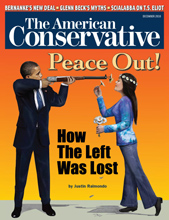
It’s been quite a few weeks since the appearance of the October 2010 issue of my favorite “Old Right” read, The American Conservative; I’d begun to fear that it would have no successor. That particularly bothered me, as people who really should know better had in the interval set out to deny that an anti-militarist Right had ever existed. Fortunately, the December issue is now up.
Highlights include George Scialabba’s piece on T. S. Eliot’s “revolutionary conservatism,” Justin Raimondo’s analysis of the Obama administration’s devastating impact on the antiwar Left that did so much to elect Mr O, and Bill Kauffman’s argument that the professional classes in the USA do not merely accept rootlessness and social isolation, but that they insist on it as a qualification for membership. There is of course a heartfelt eulogy for the late Joseph Sobran, full of praise for Sobran’s principled antiwar conservatism, his quick wit, and his deep learning, though a bit skimpy on his rather less appealing habit of hobnobbing with Holocaust-deniers (a habit at least mentioned in this post on the magazine’s website.)
Stephen Baskerville’s piece about gender-neutral marriage bears the promising title “Divorced from Reality: Don’t Blame Gays for the Decline of Marriage.” Baskerville argues that “marriage creates fatherhood.” Unlike Germaine Greer, who argued in The Female Eunuch that women should rise up against marriage in order to revoke “the gift of paternity” that the institution unjustifiably gave men, Baskerville sees in the social creation of paternity the chief justification for marriage. He opposes gender-neutral marriage, as with much greater vehemence he opposes liberal divorce laws, precisely because such reforms threaten to deprive patriarchy of its charter.
Last week there was an xkcd strip that bothered me for three reasons. Here’s the strip:
Two of the three things that bothered me about it were raised in this comment in the forum, more forcefully than I likely would have done. So I’ll take the liberty of quoting “woodrobin”:
1. Dowsing is used by oil prospectors, as well as people looking for places to dig water wells. Less often these days, but it’s still used. Does that mean it works? No. Does people not using it mean it doesn’t work? No. Very few people use horses to pull plows, except the Amish and people in developing countries. Does that mean that horses can’t pull plows?
2. Health care cost reduction. That was funnier, taken seriously, than the original joke. When was the last time you ran into a doctor, hospital or insurance company that was interested in cost reduction through treatment? Any treatment, scientific or otherwise? Doctors and hospitals want to make money, and insurance companies have figured out it’s easier to save money by denying coverage for treatment, either in whole by canceling coverage, or in part by excluding anything “experimental” or “unproven.” In other words, it’s cheaper to exclude entire types of health care than to consider or cover them, whether or not they’re quackery notwithstanding.
“woodrobin” goes on to make two more points, about irrational practices that are in fact quite common in financial planning and military operations.
I would add one thing to woodrobin’s point 1, that people who defend dowsing usually claim only that it is a good way of finding water that is near the surface. Most oil prospecting these days is concerned with deposits that are deep underground, so no method of shallow surveying is going to “make a killing” for anyone in that area.
My third objection hinges on the word “eventually” in the caption. In the long run, the caption seems to say, market competition tends to eliminate irrational practices. That may well be true. However, that long run can be very long indeed, and in the interval those irrational practices can be reinforced by any of a wide variety of social forces.
Moreover, the rationality that competitive markets enforce is not the rationality Plato talked about in The Republic, not a single process that must culminate in a vision of unmixed truth and untainted justice. Rather, it is the rationality Max Weber had in mind when he said that modern society traps its members in an “iron cage of rationality.” Economic agents respond to the incentives of the market and develop ever more efficient ways of meeting the demands of other economic agents who have purchasing power. Whether those demands accord with the sort of truth and justice Plato hoped to discover has nothing to do with it. The mouseover text on this strip reads “Not to be confused with ‘selling this stuff to OTHER people who think it works,’ which corporate accountants and actuaries have zero problems with.” The distinction between making a killing selling financial advice based on astrology to suckers who think astrology works and making a killing selling financial advice based on astrology because astrology really works may have made perfect sense to Plato, but it seems awfully tenuous from the viewpoint of someone like Weber.
Truthout has a report about a movement that started among peace-minded young people in central Afghanistan and that is beginning to attract followers elsewhere. Here’s a quote:
In the United States, we may find it hard to believe that anything good can actually come out of Afghanistan, or we may have fallen into a trap of thinking that Afghans cannot accomplish anything useful without foreign aid and assistance. I confess that I struggle to live outside the shadow of this narrow-mindedness and ethno-centrism. Certainly, if the scope of our imaginations is limited by CNN and Fox News, we would not be likely to imagine an indigenous peace group forming in Bamiyan Province. But this is exactly what has happened.
More information is available here and here and here.
The general U.S. Jewish position is like the Stanley Milgram experiment, the famous Yale study in which paid research subjects were instructed by a researcher to apply higher and higher levels of shock to someone on the other side of a curtain every time he got an answer wrong on a test. And with increasing levels of shock that other subject– who wasn’t really a subject but a confederate of the researcher– howled louder and louder and passed out from pain. Still the students applied the shock. That is the American Jewish community. They hear the Palestinians screaming for 60 years but they have been told by an authority figure that the Palestinians deserve the shocks they are getting– because they are resisters, because they are terrorists, because they are animals, because they are violent, because their women cover themselves, because they live off the land, because they want their houses back, because they don’t have gay rights, because they read the Koran, because they want to return to their homes, because they elected Hamas… on and on the instructor justifies it with lies and bullshit, still the community cranks the dial and ignores the screams.
The Milgram experiment seems to have a powerful resonance for a certain kind of American intellectual. For example, in his 1999 book The Holocaust in American Life, Peter Novick suggested that the USA might be a better place if, instead of recurring so often to the Holocaust as the ultimate index of political evil, Americans were in the habit of referring to the findings of the Milgram experiment. I attended a talk Professor Novick gave in that year; from the podium, he made such a strong claim for the symbolic power of the Milgram experiment that half the Q & A session consisted of expressions of disbelief. Still, I highly recommend Weiss’ essay, and for that matter Novick’s works.



 acilius
 believer1
 lefalcon
 losthunderlads
 vthunderlad
 Panther Red
