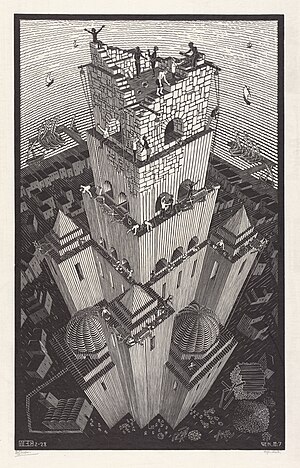
Before Babel?

The Tower of Babel, by M. C. Esher

Fotb Maggie Jochild has reminded us of a study that was published in Science in April and publicized in The New York Times.  Biologist Quentin D. Atkinson applied mass comparison methods familiar in genetic research to the analysis of phonemes, the sounds that languages use to distinguish one word from another.  If a geneticist found the same pattens in a set of single-nucleotide polymorphisms that Atkinson found in the phonemes of the world’s languages, that geneticist would likely conclude that the set represented descent from a single common ancestor.  So, Atkinson suggests that all languages known to us, both those currently spoken as mother tongues and ancient languages known to us only through writings, descend from a language spoken in Africa tens of thousands of years ago.

When Atkinson’s paper appeared, it attracted strong criticism from some of our favorite writers.  To mention only the two posts about it that appeared on the incomparable Language Log, Mark Liberman analyzed Atkinson’s methodology, and Sarah Thomason reproduced a letter that anthropologists Ives Goddard and Bruno Frohlich sent to Science, but which that journal refused to publish.  Professor Liberman is lightly skeptical of Atkinson’s methods, but optimistic that his conclusions might prove true, while Professors Goddard, Frohlich, and Thomason express more severe reservations.

For my part, I’ve often wondered how many languages were spoken when language was first spoken.  For various reasons, it would be interesting if the idea of  “a language” were familiar to the first generations of language speakers.    The New York Times article says that Atkinson’s work “implies, though does not prove, that modern language originated only once, an issue of considerable controversy among linguists.”

I don’t think it does imply that, actually.  Even if it were proven that all languages available to us for study shared a common ancestor, it would not thereby be proven that “language originated only once.”  That language may well have been one of many languages spoken at the time, and may well have been descended from other languages spoken many millennia earlier.  Consider the languages of ancient Italy.  Latin is the ancestor of many languages spoken around the world today; the dozens of other languages that flourished on the peninsula before the rise of Rome have left no descendants.  If it weren’t for the written evidence that has come down to us from antiquity, we might be tempted to conclude that language originated in Italy only once, and in Latium.  Extending the processes that singled Latin out as the only Italian language of the mid-first millennium BC to leave descendants back another 50,000 years to a time when all of our ancestors may still have lived in Africa, we can see that they may well have left only one language spoken at that period with descendants, even if at the time it had thousands of contemporaries.

Indeed, that might have happened even if that hypothetical mother tongue had not stood out among its contemporaries.   To resume for a moment the parallel with Latin, before the late fifth century BC it would have been a rare observer who would have guessed that varieties of that language would grow into languages that would continue to be spoken for thousands of years after the language of the far wealthier and more powerful Etruscans had died without issue.  Going back further, the people who spoke the language that was the common ancestor of the Anatolian and Indo-European language families probably lived sometime around the year 4000 BC.  They were likely a rather scruffy group of nomads who lived in some of the less desirable corners of the Black Sea coast, what Moe the Bartender would no doubt call “one of them loser countries.” *    Even the early Romans would have seemed impressive set against them.  Yet something like half the people in the world now speak one or another of the hundreds of languages that descend from theirs.  If such an undistinguished group can launch a language that crowds out so many of its contemporaries over a period of 6,000 years, surely there is little we can say about the career in the world of a language that is likely 1o times that old.

Read the full post »

We’re still here

Hmm, been a bit of a hiatus since the last post.  But we’re still here.  Here are a couple of links to interesting things:

Andrew Gelman has redesigned his blog; same material, but a fresher look and you no longer have to go through the back door to link to individual posts.  A couple of days ago he put up a terrific post called “One of the easiest ways to differentiate an economist from almost anyone else in society.”  He wonders why it is that so many economists can simultaneously believe these two things:

1. People are rational and respond to incentives. Behavior that looks irrational is actually completely rational once you think like an economist.

2. People are irrational and they need economists, with their open minds, to show them how to be rational and efficient.

Anatoly Liberman, the Oxford Etymologist, put up a nice little piece in May about the odd career of the letter “H.”  I must register one small demurrer concerning this piece.  Liberman writes:

Everything would have been fine if th were not also used in Greek words for rendering the letter theta. We have it in such monstrosities as phthisis and chthonic.  Very few people are so pedantic as to pronounce the initial consonants in them, but th is part of both words.

Surely the charge of pedantry holds no terrors for anyone who speaks the words phthisis and chthonic aloud, and gives them no motive to suppress the initial consonant of either word.  Come to think of it, I’ve had occasion to pronounce the word chthonic a few times while teaching classes in which it came up, and I did say it very much as I would have if it were spelled χθωνικ-.*

A post on “Understanding Uncertainty” appears to be about mobile phones and brain cancer, but comes to this twist ending:

The moral of this story has nothing at all to do with mobile phones or cancer. It is that you can’t get a full story of what’s going on on a health issue by simply following what’s in the mainstream media. What you’ll find there is not necessarily what you want to read, but what other people want you to read.

Be careful out there!

*I know there’s supposed to be an acute over the omega, but WordPress doesn’t do diacriticals well enough to make it worthwhile.

Paradox of Humanism

The oldest of Irving Babbitt’s published writings is an essay called “The Rational Study of the Classics,” which appeared in The Atlantic Monthly in March 1897 (in volume 79, issue 473, pages 355-365.)   Babbitt, then in his early 30s, ends this piece with this paragraph:

There was never a greater need of the Hellenic spirit than there is today, and especially in this country, if that charge of lack of measure and sense of proportion that foreigners bring against Americans is founded in fact.  As Matthew Arnold has admirably said, it is the Greek writers who best show the modern mind the path that it needs to take; for modern man cannot, like the man of the Middle Ages, live by the imagination and the religious faculty alone; on the other hand, he cannot live solely by the exercise of his reason and understanding.  It is only by the fusion of these two elements that of his nature that he can hope to attain a balanced growth, and this fusion of the reason and the imagination is found realized more perfectly than elsewhere in the Greek classics of the great Age.  Those who can receive the higher initiation into the Hellenic spirit will doubtless remain few in number, but those few will wield a potent force for good, each in his own circle, if only from the ability they will thereby have acquired to escape from contemporary illusions.  For of him who has caught the profounder teachings of Greek literature we may say, in the words of the Imitation, that he is released from a multitude of opinions.  (Quoted from pages 57-58 of Irving Babbitt: Representative Writings, edited by George A. Panichas; University of Nebraska Press, 1981.)

I find the paraphrase of Thomas á Kempis strangely telling.  Babbitt continually asserted the unity of human experience, arguing that the similarities between a properly lived human life in any one time or place and a properly lived life in any other time and place will prove to be more important than the differences between them.  To sustain this idea, it is necessary to do two apparently contradictory things at the same time.  On the one hand, one must hold as few opinions as possible and set as low a value as possible on opinions, since opinions are plainly among the things that set one person apart from another.  On the other hand, one must have an opinion ready to account for each of the differences that sort people into groups.

Babbitt himself abounded with opinions.  Sometimes the number of his opinions, the range of topics about which he had opinions, and the vehemence with which he expressed his opinions drove Babbitt to the point of self-parody.  Perhaps the most obvious example of this is chapter six of his magnum opus, Rousseau and Romanticism (1919), titled “Romantic Love.”    In this piece, Babbitt analyzes the love lives of various leading Romantic poets and novelists, arguing that the instability and eccentricity of some of their intimate attachments was the consequence of their theory of the will, and denouncing them ferociously for it.  Babbitt hands down his verdicts on Novalis, Shelley, Chateaubriand, and any number of other figures in such dizzyingly rapid succession that one cannot but smile at his gusto.  I’ve often suspected that Vladimir Nabokov had at some point read Babbitt’s withering attack on Novalis’ infatuation with the pubescent Sophie von Kühn and used it as the basis of Lolita.

I bring this up, not to beat old Babbitt when he’s down (he’s been dead since 1933, you can’t get much further down than that,) but to point out that I have fallen into the same dilemma.  In December 2009, I reviewed the Ukulele Orchestra of Great Britain’s performance at the Albert Hall on this blog; in that review, I wrote the following sentences about Hester Goodman’s rendition of “Teenage Dirtbag”:

When I talked about Hester’s “Teenage Dirtbag” in my review of Live in London #1,  I summarized it as a “ballad of adolescent lesbian angst”; it’s sobering to see how many visitors still come to this site having googled “hester goodman lesbian.”  At the risk of drawing more of that traffic, I’ll say that the human race would be the poorer if some among us did not go through adolescent lesbian angst.  I’d go so far as to label adolescent sexual angst in all its forms as an indispensable part of the human experience.  Hester has produced a powerful testament to that form of adolescent angst, and my hat’s off to her for it.

In that “indispensable part of the human experience” and the proclamations that surround it, we have a humanistic opinion eliding the differences of sexual identity and sexual response that often sort people into groups.  More recently, I asked here “Why do people have opinions about homosexuality?”  In that post, I wondered whether there was any need for anyone to hold an opinion about that topic.  Clearly those two posts don’t sit very comfortably together.  Perhaps their apparent contradiction, like Babbitt’s apparent self-contradiction, points up a paradox that humanists in general are hard put to escape.

Of what narrative is the US Civil War a chapter?

A couple of days ago, I found a mass mailing from the libertarian Independent Institute in my inbox.  It included these paragraphs:

The 150th Anniversary of the Outbreak of the U.S. Civil War

April 12 marked the 150th anniversary of the outbreak of the American Civil War, when Confederates fired on U.S. troops holding Fort Sumter, in the Charleston, South Carolina, harbor. Although people routinely succumb to the temptation to reduce the cause of the war to a single factor (e.g., to the slavery issue or to “states’ rights”), the cause was more complex. Independent Institute Research Fellow Joseph R. Stromberg discusses one causal factor that often gets short shrift in public discourse (although he cites many historians who support his analysis): interest groups with material, rather than ideological, stakes in promoting the war.

Antislavery, Stromberg writes, “was one of many themes generally serving as the stalking horse for more practical causes.” The Republican Party Platform of 1860, for example, focused less on antislavery grievances than on proposals designed to benefit northeastern financial and manufacturing interests and Midwestern and western farmers–policies that would have become harder to implement if southern states were allowed to secede. Lest he overgeneralize, Stromberg hastens to add that northern trading and manufacturing interests that bought from the suppliers of southern cotton–“the petroleum of the mid-nineteenth century,” as he puts it–were aware that they would face severe disruptions if war broke out.

In a post on The Beacon, Independent Institute Research Editor Anthony Gregory argues that April 12, 1861, also marks the date of the federal government’s repudiation of the Founders’ vision of the American republic and the birth of Big Government. “The war ushered in federal conscription, income taxes, new departments and agencies, and the final victory of the Hamiltonians over the Jeffersonians…. Slavery could have been ended peacefully, to be sure, but ending slavery was not Lincoln’s motivation in waging the war–throughout which this purely evil institution was protected by the federal government in the Union states that practiced it, and during which slaves liberated from captivity by U.S. generals were sent back to their Southern ‘masters.'”

“Civil War and the American Political Economy,” by Joseph R. Stromberg (The Freeman, April 2011)

“The Regime’s 150th Birthday,” by Anthony Gregory (The Beacon, 4/12/11)

“The Real Abraham Lincoln: A Debate,” an Independent Policy Forum featuring Harry V. Jaffa and Thomas J. DiLorenzo (5/7/02)

“The Civil War: Liberty and American Leviathan,” an Independent Policy Forum featuring Henry E. Mayer and Jeffrey Rogers Hummel (11/14/99)

“The Bloody Hinge of American History,” by Robert Higgs (Liberty, May 1997)

It’s true enough that “people routinely succumb to the temptation to reduce the cause of the war to a single factor… the cause was more complex.”  Though I would not disagree with this statement, I would go on to say something subtly different as well.  Much public discussion of the US Civil War turns on a rather odd question.  This question is, “Of what narrative is the US Civil War a chapter?”

As the press release above suggests, libertarians tend to say that the war was a chapter in a narrative titled “The Growing Power of the Nation-State in the Mid-Nineteenth Century.”  Anthony Gregory’s description of the powers which the federal government first exercised during the war, and never renounced, gives an idea of the structure of this narrative.  Right-wing libertarians like Gregory focus on the conflict between the growing power of the nation-state and the unregulated operations of the free market, while left-wing libertarians like Joseph Stromberg point out that no unregulated free market has ever existed and focus instead on the role of the nation-state in forming the economic elites that actually have wielded power throughout history.

Most other Americans tend to say that the US Civil War was a chapter in a narrative titled “The Rise and Fall of Human Slavery.”  In this narrative, the United States figures as the champion of Emancipation and the Confederate States figure as the champions of Enslavement.  This story elides the facts that Gregory and others point out, that six slave states remained in the Union, that federal forces enforced slavery in the South throughout 1862, and that President Lincoln took office vowing to leave slavery alone.  However, it is undoubtedly true that all the Confederate states were slave states and that its leaders bound themselves time and again to defend and promote slavery, while the United States did eventually move to abolish the institution.

It should be obvious that the question, “Of what narrative is the US Civil War a chapter?,” is a meaningless one.  Of course the Civil War is a chapter of “The Growing Power of the Nation-State in the Mid-Nineteenth Century,” of course it is a chapter of “The Rise and Fall of Human Slavery,” of course it is a chapter of any number of other narratives.  Why, then, is this nonsensical question agitated so intensely?

I blame the schools.  More precisely, I blame the tradition of presenting history to students as a grand narrative.  It’s natural for people who have spent a decade or so of their early life hearing history presented as a single grand narrative to go on assuming that every story is part of one, and only one, larger story.  Perhaps schools must present history this way; if so, I would say that it is a point in favor of a proposal left-libertarian thinker Albert Jay Nock made early in the last century.  Nock recommended that schools should teach mathematics “up to the quadratic equation,” Greek and Latin, and a course in formal logic.  Equipped with this training, students would be able to educate themselves in everything else, with some here and there finding it possible to benefit from association with some advanced scholar.

Be that as it may, in US schools, the grand narrative of history is usually packaged under some label like “The Story of Freedom.”  The word “freedom” in these labels raises the question “freedom from what”?  For libertarians, the freedom most urgently needed today is freedom from state bureaucracy.  In the story of that freedom, the US Civil War cannot but figure as a vast reverse.  For others, the freedom most urgently needed today is freedom from white supremacy.  In the story of that freedom, the war may appear as an advance, albeit a rather problematic one.  For still others, the freedom most urgently needed today is the individual’s freedom from domination by irresponsible private interests, whether employers, families, or other groups in civil society.  In the story of that freedom, the war stands as a moment of triumph, perhaps the supreme moment in American history.

Few would say that the freedom most urgently needed by the United States today is freedom from foreign domination, but I would point out that if the war had ended differently this need might very well be felt very keenly indeed.  When the war broke out, Southern leaders claimed that their cause was the defense of slavery, while Lincoln disavowed any plan to interfere with slavery.  By the end of the war, Southern leaders were discoursing earnestly about the theory of state sovereignty, while Lincoln declared that “if God wills that it continue until all the wealth piled by the bondman’s two hundred and fifty years of unrequited toil shall be sunk, and until every drop of blood drawn with the lash shall be paid by another, drawn with the sword, as was said three thousand years ago, so still it must be said: ‘The judgments of the Lord are true and righteous altogether.'”  What remained constant through all this flip-flopping was the Northern intention to protect the domestic US market with a high tariff, while the South wanted to trade on equal terms with the industrial centers of the North and those of Britain.  The world economy being what it was in the mid-nineteenth century, a nominally independent Confederate States of America would likely have been drawn into Britain’s economic sphere, and thus into the orbit of the British Empire.  We should therefore add “US Resistance to the British Empire” to the list of narratives in which the US Civil War figures as a chapter.

What Acilius has been up to lately

Over the last couple of days, I’ve posted several little things in several places.  I put several links on Twitter, including these:

A post on Secular Right complaining about an Episcopalian bishop who wrote an essay called “Budgets, Leadership, and Public Service” led me to post two comments.  In this one, I expressed the opinion that one of the great advantages is that its founder’s political opinions are unknowable.  The bishop seemed to be throwing that advantage away by attributing an extremely detailed set of political opinions to Jesus.   In this one, I replied to a commenter who pointed out that Jesus seems to have been convinced that the end of the world was coming soon by saying that any number of political positions are compatible with that conviction.  Another immense number of positions are incompatible with it, of course, but by itself the idea that Jesus was an apocalyptic thinker doesn’t tell us what his political opinions might have been.

Also, here’s a nice cool jazz number by Jane Ira Bloom, called “Freud’s Convertible.”

When is it ethical to accept a prize?

In a post here a few months ago, I described some views expressed by my namesake, Roman historian Gaius Acilius.  Acilius, who was in his prime in the year 155 BC, apparently had some concerns about the conditions under which it was appropriate to accept praise.  In particular, Acilius seems to have wondered if it could be right to accept praise offered on a particular basis if one were not prepared to accept blame offered on that same basis.

I was reminded of this a few moments ago, reading the news.  Martin Rees, Britain’s Astronomer Royal, has accepted the Templeton Prize.  This exchange from an interview Rees gave to Ian Sample of The Guardian made me wonder what Acilius would have said:

IS: What do you think the Templeton prize achieves? What is the value of it?

MR: That’s not for me to say to be honest.

IS: You must have a view?

MR: No.

IS: But you think it achieves something?

MR: Well, I mean as much as other prizes, certainly, but I wouldn’t want to be more specific than that.

IS: That’s a shame. Might you at some time in the future?

MR: They are very nice people who are doing things which are within their agenda, but their agenda is really very broad. I should say that I was reassured by the rather good piece in Nature a few weeks ago, which talked about the Foundation and I found that reassuring. Certainly Cambridge University, I know, has received grants from Templeton for editing Darwin’s correspondence, which is a big Cambridge project, and also for some mathematical conferences. They support a range of purely scientific issues.

Imagine if the judges who grant the Templeton Prize had sent Rees a letter, not offering to give him £1,000,000 and add his name to a list of distinguished thinkers as a reward for his achievements, but demanding that he pay them £1,000,000 and allow his name to be added to a list of ill-doers as a punishment for his delinquencies.  Would he accept that demand so blithely?


You Told Me You Loved Me on April Fool’s Day

Poopy Lungstuffing sings an original composition (by Puppetrina) in honor of 1 April.

The Norwegian Association for the Blind is an even funnier group than their name might suggest

A couple of years ago, Believer1 embedded a short video here from the Norwegian Association for the Blind.  It was hilarious, as is this video, produced around the same time, making it clear why people shouldn’t bother service dogs while they’re on the job:

The Believer’s service dog is an important part of our family; when the three of us are out on the town, people sometimes ask me when it’s appropriate to pet him.  I tell them, first, that the key thing is to ask her permission before paying any attention to her dog.  I then compare him to a dentist.  If a dentist was drilling your teeth, you wouldn’t want someone to wander into the room and start rubbing your dentist’s head and shoulders, exclaiming “What a good dentist!”  If you can understand why it would be wrong to do that, you should be able to understand why it is wrong to interrupt a service dog on the job.

“Great Universities” and “Great Cities”

The other day, I made a long comment on a post at the blog commonly known as “Gelman.”  The original post is by the blog’s namesake, Professor Andrew Gelman.  Gelman referred to a newspaper piece by Professor Edward Glaeser on the idea of developing an applied sciences center in New York City.  Glaeser makes some rather strong claims for the power of universities to promote economic development in the cities to which they are attached.  Blogger Joseph Delaney had put something up in which he expressed doubts about Glaeser’s general claims, challenging those who would defend them to explain why New Haven, Connecticut, home of Yale University, is such a dump.

Gelman is impressed by Delaney’s post.  He also picks up on a paragraph in Glaeser’s piece that includes a quote from New York’s late US Senator Daniel Patrick Moynihan:

The late Senator Daniel Patrick Moynihan of New York is often credited with saying that the way to create a great city is to “create a great university and wait 200 years,” and the body of evidence on the role that universities play in generating urban growth continues to grow.

Gelman doesn’t dwell on Moynihan’s words; he makes it clear in the comments (here and here) that what really interests him is the question of the economic impact of universities on their urban environments in the (moderately) long run.  Many other commenters (for example, this person) expressed doubt as to whether any answer to the question could be tested quantitatively, considering how few “great universities” and “great cities” there are at any point in time.  In my comment, I suggest that if we take Moynihan’s words literally (admittedly, a rather silly thing to do) we might be able to develop a quantitative test of his hypothesis:

Well, if we take Moynihan’s claim literally, what we need are two lists: a list of “the great universities” as of year n, and a list of “the great cities” as of year n + 200. Of course we wouldn’t want to top-of-the-head either of those lists, so as to avoid some kind of Clever Hans effect.

I haven’t looked for any list that anyone has put forward of “the great universities” as of any particular year, but it sounds like the sort of thing many historians would be fond of producing. And lots of people like to make lists of “the great cities.” Once we have a list, however subjectively it was generated, we can look over the items, try to find quantifiable characteristics that most or all items on it share, and having found such characteristics we can refine the list by adding other items that share them or deleting items that don’t share them. So we can try to work backward to foundations.

As for Yale, I doubt very much that you could find any reasonable criterion by which it either was or had been a “great university” in 1811. Nowadays, sure, but in its first centuries it was a backwater. Would any American university have qualified as “great” in 1811? The faculty of the College of New Jersey, later renamed Princeton University, had been home to quite a few distinguished scholars from Edinburgh in the late eighteenth century, and Columbia had produced a lot of impressive alumni by 1811. Still, it would seem a bit much to call either of them a “great university” at that early date.

Other commenters, such as universally beloved public figure Steve Sailer,  have brought up the idea that it isn’t great universities that make the cities attached to them great, but great cities that make the universities attached to them great.  Here again, I’d ask to see two lists: the world’s “great cities” as of year n, and the world’s “great universities” as of year n + whatever number you like. New Haven continues to be a counterexample; while Yale may never have been on any list of the world’s “great universities” until the middle of the twentieth century, it undeniably has a place on any such list today.  Yet New Haven has never been anyone’s idea of a “great city.”  How many seats of the “great universities” have been?

Of course, one challenge in analyzing such lists would be deciding which universities are attached to which cities.  It may not be controversial to say that Cambridge, Massachusetts is part of Boston, and so to give Harvard as an example of a (currently) great university located in (what I’d call) a great city; but what about San Francisco and the two great universities in the Bay Area?  Is Berkeley really part of San Francisco?  You go through Oakland to get from one to the other, and Oakland is most definitely not part of San Francisco.  Is Palo Alto part of San Francisco?  The relationship between Stanford University and San Francisco is often cited as one of the things that makes that city great, but Palo Alto is in fact 35 miles from San Francisco at their closest points, and Stanford’s campus is further than that.  San Jose, a very different city, is only half as far, and it’s southward to and beyond San Jose that Stanford-based tech entrepreneurs have usually gone.


Libertarians and marriage

I’ve fallen far behind my usual pace in sharing my “Periodicals Notes“; that pesky offline part of the world keeps distracting me with things like work, family, etc etc.  There’s a great deal of work I ought to be doing right now, as a matter of fact, but I can’t resist taking time to note a couple of pieces in the latest issue of The American Conservative. As you can see from the cover illustration, the magazine’s contributors generally oppose official recognition of homosexual unions, holding that marriage is an institution that must be reserved for one elephant and one statue, and solemnized by a self-certified ophthalmologist.

I’ve long been puzzled by the low quality of arguments offered against same-sex marriage.  Opponents have had a great deal of time to come up with reasons why only opposite sex couples should be allowed to marry.  Their position is broadly popular, and they have at their disposal the resources of major religious organizations, conservative think-tanks, and much of the press.  You’d think that with all that on their side, they would be able to produce an argument that would be at least superficially plausible.  Yet, when asked to defend their position, supporters of the status quo trot out arguments that are so feeble they inspire, not even laughter, but sheer pity.  At the outset of his article in this issue, “Stonewalling Marriage,*” Justin Raimondo describes the situation with admirable clarity:

Opponents of same-sex marriage have marshaled all sorts of arguments to make their case, from the rather alarmist view that it would de-sanctify and ultimately destroy heterosexual marriage to the assertion that it would logically lead to polygamy and the downfall of Western civilization. None of these arguments—to my mind, at least—make the least amount of sense, and they have all been singularly ineffective in beating back the rising tide of sentiment in favor of allowing same-sex couples the “right” to marry.

Raimondo goes on to offer what the cover advertises as “A Libertarian Case Against Gay Marriage.”  Indeed, it would be difficult to imagine a statement more typical of libertarianism than these paragraphs:

Of course, we already have gay marriages.  Just as heterosexual marriage, as an institution, preceded the invention of the state, so the homosexual version existed long before anyone thought to give it legal sanction. Extending the authority of the state into territory previously untouched by its tender ministrations, legalizing relationships that had developed and been found rewarding entirely without this imprimatur, would wreak havoc where harmony once prevailed.  Imagine a relationship of some duration in which one partner, the breadwinner, had supported his or her partner without much thought about the economics of the matter: one had stayed home and tended the house, while the other had been in the workforce, bringing home the bacon. This division of labor had prevailed for many years, not requiring any written contract or threat of legal action to enforce its provisions.

Then, suddenly, they are legally married— or, in certain states, considered married under the common law. This changes the relationship, and not for the better. For now the property of the breadwinner is not his or her own: half of it belongs to the stay-at-home. Before when they argued, money was never an issue: now, when the going gets rough, the threat of divorce—and the specter of alimony—hangs over the relationship, and the mere possibility casts its dark shadow over what had once been a sunlit field.

Who finds libertarianism appealing?  This passage might suggest two groups.  First, there are people who have known many couples who lived together for a long time, then married, only to go through a calamitous divorce shortly afterward.  I suppose most Americans under the age of 60 could name at least a dozen such couples among their personal acquaintances.   When I’ve seen the sequence long cohabitation/ brief marriage/ bitter divorce, I’ve always tended to explain the marriage as a desperate attempt to put some life back into a failing relationship.

But some might look at the sequence differently, and wonder whether the relationships would have continued had the partners not ventured into the dread precincts of matrimony.  Elsewhere in the issue, a piece* is built around the observation that young Americans tend to take many Libertarian ideas for granted; perhaps the changes in family structure that have shaped the lives of so many in recent generations have been part of the reason for this intellectual climate. Second, there are people who hold power in their relationships with others because they control economic resources on which those others depend.  Some such people acknowledge the responsibilities that come with such power.  Others not only refuse to accept those responsibilities, but do not like even to admit that they are in a position of power at all.  For them, “money was never an issue,” when the other parties in their relationships simply submitted to their will as regards it.  Once those parties gain a share in the control of those resources as a matter of right, suddenly the terms of the relationship must be negotiated, not decreed by the “breadwinner.”  From the viewpoint of the deposed “breadwinner,” this development might very well look like a departure from a “sunlit field”  of liberty to the “dark shadow” of conflict, but the newly empowered “stay-at-home” may see matters quite differently.

Of course, it isn’t only in the relationship between income-earners and their non-employed partners that one holding economic power may deny the existence of that power and see only the prospect of conflict when a subordinate acquires an independent standing.  Employers often pretend that they are on an equal footing with their employees, and denounce trades unions as monstrous powers which bring disharmony into what would otherwise be an idyll of brotherhood.  A fine example of this sort of thing can be found in this issue, in Peter Brimelow’s “Less Perfect Unions,” which denounces American schoolteachers for organizing their profession.

When Raimondo reaches the heart of his argument against same-sex marriage, he presents a case that will be familiar to anyone who has followed the arguments gay liberationists have made over the years.  Same-sexers, he argues, simply do not need “to entangle themselves in a regulatory web and risk getting into legal disputes over divorce, alimony, and the division of property.”  Opposite sex couples may believe that their shared interest in any children they may produce justifies such “entanglement”; Raimondo doesn’t agree with them, but in deference to their assessment of their needs he stops short of the gay liberationist cry of “Smash the Family!  Smash the State!,” and does not call for the end of official recognition of opposite sex unions.

He does take a page from the gay liberationist handbook, though, when he argues that same-sex marriage threatens to “take the gayness out of homosexuality.”  “By superimposing the legal and social constraints of heterosexual marriage on gay relationships, we will succeed only in de-eroticizing them.”  Raimondo extols the gay liberation movement of the late 1960s and early 1970s for its anti-state focus, and insists that the lack of official sanction and the formalization that goes with it have made homosexuality itself a force to resist the modern state.  Same-sex marriage, Raimondo argues, would rob homosexual relations of their anarchic character, and reconstitute them as a pillar of the established order. Why, then, has the demand for gender-neutral marriage become central to the role of same-sexers in US politics?  Raimondo has a theory:

The homosexual agenda of today has little relevance to the way gay people actually live their lives.

But the legislative agenda of the modern gay-rights movement is not meant to be useful to the gay person in the street: it is meant to garner support from heterosexual liberals and others with access to power. It is meant to assure the careers of aspiring gay politicos and boost the fortunes of the left wing of the Democratic Party. The gay marriage campaign is the culmination of this distancing trend, the reductio ad absurdum of the civil rights paradigm.

The modern gay-rights movement is all about securing the symbols of societal acceptance. It is a defensive strategy, one that attempts to define homosexuals as an officially sanctioned victim group afflicted with an inherent disability, a disadvantage that must be compensated for legislatively. But if “gay pride” means anything, it means not wanting, needing, or seeking any sort of acceptance but self acceptance.  Marriage is a social institution designed by heterosexuals for heterosexuals: why should gay people settle for their cast-off hand-me-downs?**

It seems a bit indecent to quibble with the content of so impassioned a peroration, especially considering that the issue is a more personal one for a same-sexer like Raimondo than it is for me.  However, I would point out that he is shifting his ground here.  Earlier, he had claimed that marriage evolved spontaneously among heterosexuals, who improvised various means of ensuring their interest in their children would be recognized.  To the extent that the institution was “designed,” that design came after the state intervened in this evolution and hijacked it to serve its own purposes.  Now, he implies that marriage is suitable for heterosexuals after all, but not for homosexuals.  This shift is important, because it shows him backing away from liberationism and its implication that people should discard the labels they wear, band together, and create a world free of the old restrictions.  It leaves him all too much at home under the banner of “American Conservative.”

*Sorry, subscribers only

**UPDATED: Paragraph breaks inserted here after publication