
Some time ago I came upon this video clip of a decades-old interview with actor Tom Baker, and have been trying ever since to imitate him when I say “the United States of America”:
Some time ago I came upon this video clip of a decades-old interview with actor Tom Baker, and have been trying ever since to imitate him when I say “the United States of America”:
Posted by acilius on June 3, 2015
https://losthunderlads.com/2015/06/03/tom-baker-saying-the-united-states-of-america/
I just logged onto Twitter and saw these two images, one on top of the other:
https://twitter.com/BoingBoing/status/604132766343643136
In the Twitter stream, I saw the top half of the first image above the lower three quarters of the second image, forming a single circle. Somewhat like this:


Perhaps one of the young Jesus’ questions was “What is rickrolling?” I’ve heard the term for years, have no idea what it means, and can’t imagine caring enough about it to click on the link and find out why I should be against it. Anyway, an interesting accidental image.
Posted by acilius on May 29, 2015
https://losthunderlads.com/2015/05/29/full-circle-2/
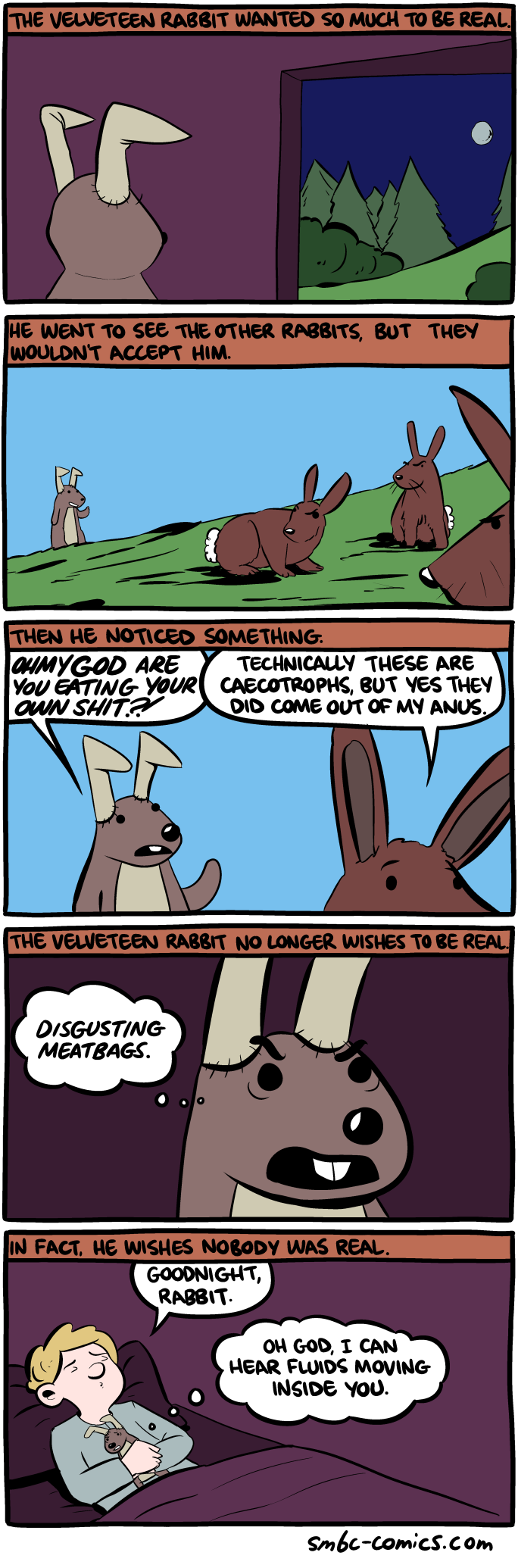
Two of my favorite comic strips dealt with similar topics recently:
Robbie and Bobby, 7 May 2015:

Saturday Morning Breakfast Cereal, 21 May 2015:
Posted by acilius on May 22, 2015
https://losthunderlads.com/2015/05/22/biohorror-in-recent-web-comics/
A few days ago, I left a long comment on Chris Dillow‘s blog “Stumbling and Mumbling.” Mr Dillow had posted about a controversy that began when someone participating in a march protesting the results of Britain’s recent general elections (results which I predicted with less than total accuracy) added these words to a war memorial:

The controversy took on a life of its own after journalist Laurie Penny tweeted about it:
The furore that greeted Ms Penny’s remark reminded Mr Dillow of a book that I happened to have read just the other day: The Righteous Mind, by Jonathan Haidt. I’d heard about this book more or less continually, from various people, since its original publication three years ago, and had been meaning to get round to reading it ever since. Professor Haidt, a social psychologist, argues that moral reasoning is best understood not as any one thing, but as a network of six interlocking systems. These systems are the ways we have learned to differentiate between Care and Harm, Fairness and Cheating, Sanctity and Degradation, Loyalty and Betrayal. Authority and Subversion, and Liberty and Oppression. According to Professor Haidt and his fellow advocates of “Moral Foundations Theory,” analyzing the opinions people express about what is right and wrong in terms of these six systems and of the relationships among them enables researchers to give more accurate accounts of the concerns of people who differ from them in class and culture than do other models, especially models drawn from reductionist philosophical projects such as utilitarianism.
Excerpts from Mr Dillow’s post:
The left and right don’t understand each other’s conceptions of morality, and don’t even try to do so. This is the message I take from last night’s row about Laurie Penny’s reaction to the vandalism of a war memorial….
“Destruction” isn’t entirely hyperbole. The Tories’ proposed £12bn cut in welfare spending is equivalent to £45 per week per working age benefit recipient. That would impose horrible hardship upon many.
Instead, Laurie’s mistake consists in doing exactly what Jonathan Haidt in The Righteous Mind accused the left of: she’s seeing morality as comprising just one idea whereas the right sees others.
Haidt and his colleagues claim that there are (at least) five foundations of morality: care/harm, fairness/cheating, loyalty/betrayal, authority/subversion and sanctity/degradation. The left, he says, stresses the first two of these but underweights the last three.
And this is just what Laurie was doing. She was emphasizing the care principle, whilst being blind to the sanctity principle – to the idea that we believe that some things, such as vandalizing war memorials, are wrong because they break taboos even if they don’t do material harm to anyone…
Which brings me to the problem. Far too many – on left and right – are so wrapped up in their own narcissism and so quick to condemn others that they fail to understand (or even try to) where others are coming from: the virtue of Haidt’s framework is that it facilitates such understanding.
What’s being lost in all this is Mill’s classical liberal idea – that there is a strong case for cognitive diversity. For me, Laurie’s voice is a welcome contributor to this diversity. If the herdthink that rushes to condemn leads to her being more inhibited, something valuable will be lost.
My comment was largely directed at earlier commenters who were too fired up about the issue to address the material about Professor Haidt’s theories that Mr Dillow had raised, and so consisted largely of an elaboration on some points Mr Dillow had already made:
Just the other day I finally got round to reading The Righteous Mind, and here you bring it up.
I think Professor Haidt gives us a very clear vocabulary for explaining, among other things, why religious freedom is so hard to maintain. Different religious groups have different conceptions of sanctity. What one person sees as deeply holy another person might see as purely functional, so that Laurie Penny’s comparison of the welfare state to a war memorial might be unintelligible to someone who regards the welfare state simply as a set of policies and institutions to be evaluated by their effectiveness at helping poor people get on, rather than as a transcendent force that sanctifies society. Likewise, the depth of horror that many people feel when a war memorial is vandalized is unintelligible to those who regard that memorial in purely functional terms; clean it up, and it sends the same message it sent before. The uncleanness that bothers those who are most horrified is a ritual impurity, not the marks that bleach or acetone can remove.
What really makes it difficult for people with different senses of the sacred to share a homeland is that something which one group regards as the most sanctified of all things might strike another group as the vilest of all pollutions, and vice versa. Go to an old church and look at the niches from which the Puritans tore the visual artwork during their days of iconoclasm, and think of all the other religious conflicts in history.
War memorials are very much part of this kind of thing. They appeal to Professor Haidt’s Loyalty and Hierarchy axes, but to Sanctity as well. So, if you regard a particular war as an abomination, a particular cause as hideously unjust, then a memorial commemorating those who died to advance that cause may strike you not only as a symbol of disloyalty and subversion, but also as a pollution of the space it occupies. Imagine if a memorial to the Kouachi brothers were erected outside the front window of the offices of Charlie Hebdo. Would it be enough to drape that memorial with a cloth so that no one could see its message? Would it be enough to remove it quietly and replace it with a flagpole flying the Tricoleur? Or would you feel an urge to destroy the memorial as noisily and dramatically as possible and to put some object on the site to which the Kouachis would have objected (perhaps an obscene image of Muhammad)? Indulging that urge would hardly be necessary to display one’s loyalty to France, and would likely involve violation of the hierarchy of the French state. It would make sense only as an attempt to exorcise the ritual impurity that association with the Kouachis would bring upon the site.
Now, the protestors who scrawled “Fuck Tory scum” under the words “Women of World War Two” were probably not objecting to the women of World War Two, not even to those among them who took Tories with poor hygiene as lovers. Still, to the extent that the war memorial is a symbol of the state and the Cameron government has come to be identified with the state, presumably they would have seen the memorial as an unclean thing and their graffiti would be an attempt to purge its uncleanness.
In fairness to Ms Penny, I should probably mention that she does seem to be more aware of these issues than either Mr Dillow or I have implied in the remarks above. So the first tweets she posted after the one that caused all the trouble describe her grandmother’s contribution to the United Kingdom’s efforts in the Second World War and the role that the postwar development of the welfare state played in improving her lot. Ms Penny tells us that her story and those of women like her consecrate the welfare state as a monument to the memory of the “Women of World War Two,” and that the Cameron government’s policies are a desecration of this monument:
So Ms Penny explicitly acknowledges the importance of the Sanctity/ Degradation axis as part of moral reasoning. For her, that axis may be subordinate in its importance to the Care/ Harm axis and the Fairness/ Cheating axis. But those who responded to her tweet in ways like this:
don’t seem to be treating the Sanctity/ Degradation system as an independent thing either- calling Ms Penny a “cunt,” libeling her late grandmother, etc, are not obvious ways of increasing the overall holiness of Twitter. For these tweeps, Sanctity seems to be a function of Loyalty and Authority, Degradation a function of Betrayal and Subversion. Perhaps healthful dialogue between people who disagree on moral questions requires, not only that we all acknowledge the full spectrum of moral concerns, but that we respect each of the six systems on its own terms, not trying to reduce the concerns of one to the terms of another.
Posted by acilius on May 15, 2015
https://losthunderlads.com/2015/05/15/the-clean-and-the-unclean/

Putting everyone in the picture (click for source)
Cartoonist, memoirist, and Broadway legend Alison Bechdel has found herself involved in the controversy over PEN’s decision to give an award to Charlie Hebdo. She explains her mixed feelings about this situation, and why she took the action she took, in this blog post.
I added a comment to that post, in which I expressed my admiration for Ms Bechdel (she really is quite admirable!) and briefly rehearsed some of the points I made in posts here and here.
Posted by acilius on May 11, 2015
https://losthunderlads.com/2015/05/11/alison-bechdel-is-pretty-great/

The latest issue of this Old Right journal bears Geertgen tot Sint Jans’ (circa 1465-circa 1495) lovely painting “The Holy Kinship” on its cover.
Last month’s issue featured an article in which Claude Polin traced the intellectual influence of Calvinism in the early USA. A letter in this month’s issue objects that some of the Calvinist ideas Professor Polin discussed there were not representative of John Calvin’s own thinking. Professor Polin’s response to this is a succinct and admirable statement of one of the basic tenets of intellectual history: “Either there never was any true Calvinist besides Calvin, or Calvin generated an attitude that was not his, but was logically derived from his writings.”
Steve Sailer (known to some who read this blog simply as “the hated SAILER”) writes about Thomas Jefferson’s contributions to the system of land ownership and property registration in the early USA, a system which Mr Sailer argues has given the USA a crucial advantage in economic development. Mr Sailer’s argument that the abstract nature of the grid plan along which Jefferson led the USA’s lands to be surveyed made for a far more efficient structure than the more concrete metes-and-bounds system it replaced makes a odd counterpoint to Chronicles‘ editor Thomas Fleming’s column, in which he declares Jefferson’s similarly abstract, anti-historical views on inheritance to be of a piece with the exaltation of the nuclear family that has enabled the destruction of traditional kinship bonds and therefore of traditional community structures and traditional gender roles in today’s world. Both Mr Sailer and Dr Fleming agree that Jefferson’s ideas have led to the rise of capitalism, but while Mr Sailer’s chief concern is extolling the prosperity that capitalism has brought, Dr Fleming’s emphasis is on capitalism’s destruction of those bonds and identities that have traditionally ennobled human life.
Clyde Wilson, editor of The John Calhoun Papers and an unreconstructed defender of the Old South, may be the last person you would expect to speak up in favor of the view that agents of the US government killed Martin Luther King, Junior, yet that is precisely what he does in his review of John Emison’s The Martin Luther King Congressional Cover-Up. Professor Wilson seems to believe that the Central Intelligence Agency orchestrated the assassination, pointing out that the agency had a file on small-time criminal James Earl Ray, the supposed gunman, and that the two federal judges who were, “years apart,” poised to reopen the case died of sudden heart attacks, which are “a standard tool of the CIA.” Professor Wilson also refers to two other notorious 1960’s-era activities of the American national security state, Operation Northwoods, a Joint Chiefs of Staff plan to carry out terrorist acts in the USA and blame them on Fidel Castro, and Cointelpro, a Federal Bureau of Investigation project overseen by W. Mark Felt, who was among other things the FBI’s liaison with the Joint Chiefs. For my part, if there was a high-level conspiracy to kill Martin Luther King, I suspect Mark Felt was its mastermind and the offices of the Joint Chiefs were its nursery. Professor Wilson closes his review with a lament about all the crimes whose true provenance we will never know because high US officials saw to the destruction of evidence, the intimidation of witnesses, and the railroading of convenient suspects; his first example is the assassination of President Abraham Lincoln. Many documents connected with the assassination of Martin Luther King are sealed until 2029; until they have been opened and examined, I think it is premature to put the King assassination into the same baleful category.
Scott Richert writes about Indiana’s “Religious Freedom Restoration Act,” which, unlike the federal law and the many state laws of the same name, does not apply only to civil suits to which the government is itself a party, but to a wide variety of lawsuits between private citizens. Mr Richert, responding to the widespread fear that the law would enable unjust discrimination against sexual minority groups in Indiana and the consensus in favor of legal protection for such groups against discrimination which this fear revealed,* argues that the growth of civil rights protection for sexual minorities is the result of a strategy on the part of big businesses in the USA. These businesses want the benefits of a reputation for friendliness to sexual minorities, but don’t want competitors to carve out a niche in which they could exploit any costs that such a reputation might entail. So, big businesses want to advertise their own “gay-friendly” programs, while outlawing or stigmatizing any “unfriendly” programs competitors might come up with.
*I commented on the Indiana law here when it was first passed.
Posted by acilius on April 30, 2015
https://losthunderlads.com/2015/04/30/chronicles-may-2015/
In his Dialogues Concerning Natural Religion, philosopher David Hume concluded that the classical arguments for the existence of God, even if they were logically sound, would not in fact prove what believers want to have proven. The characters Cleanthes and Demea set out to demonstrate to the existence of God, and find themselves unable to satisfy their friend Philo. After Cleanthes has made the case for believing that the orderliness of the observable world demonstrates that it is the creation of a supernatural being, Philo responds with a series of conclusions that follow at least as logically from Cleathes’ arguments as do the conclusions which he would like to draw. The final item in this series is the following:
In a word, CLEANTHES, a man, who follows your hypothesis, is able, perhaps, to assert, or conjecture, that the universe, sometime, arose from something like design: but beyond that position he cannot ascertain one single circumstance, and is left afterwards to fix every point of his theology, by the utmost licence of fancy and hypothesis. This world, for aught he knows, is very faulty and imperfect, compared to a superior standard; and was only the first rude essay of some infant deity, who afterwards abandoned it, ashamed of his lame performance: it is the work only of some dependent, inferior deity; and is the object of derision to his superiors: it is the production of old age and dotage in some superannuated deity; and ever since his death, has run on at adventures, from the first impulse and active force, which it received from him. You justly give signs of horror, DEMEA, at these strange suppositions: but these, and a thousand more of the same kind, are CLEANTHES’s suppositions, not mine. From the moment the attributes of the Deity are supposed finite, all these have place. And I cannot, for my part, think, that so wild and unsettled a system of theology is, in any respect, preferable to none at all.
This passage came to mind when I read yesterday’s Saturday Morning Breakfast Cereal. Zach Wienersmith has sharpened Philo’s hypotheticals a bit:

Posted by acilius on April 29, 2015
https://losthunderlads.com/2015/04/29/the-argument-from-design-at-its-best/
 The Atlantic is largely written from the viewpoint of the rich, and this month’s issue is no exception. But then, the rich are not a monolithic group, and it can be instructive to think about the differences that separate one subgroup of them from another. After all, it is in their conflicts and contests that spaces sometimes open up in which the rest of us can make our voices heard.
A profile of Michele Roberts, head of the players’ union in the National Basketball Association, brought to my mind Yogi Berra’s remark, “The players don’t deserve it, but the owners don’t deserve it more.” It also includes a concise explanation of the economics that give the owners the upper hand as they collect billions and leave the players with millions:
Despite (or perhaps because of) their athletic gifts, players have little incentive to engage in a protracted fight with the league. LeBron James may be a talent like no other, but even his prowess will not last long, which means a strike or a lockout could be devastating to his earning potential.
“The problem is that basketball players have an average career of four years and an average salary of $5 million per year,” says Andrew Zimbalist, a sports economist at Smith College. “Given that and given that these guys love to play basketball, they don’t really have the basis to stay unified for a substantial period of time. They’re saying, ‘You want me to risk half a season so my salary could go from $5.1 million to $5.2 million?’ That’s going to be Michele Roberts’s main challenge.”
Tim Harford reports on businesses that scalp reservations for tables at fashionable New York City restaurants, and asks why restaurants shouldn’t charge for reservations. The only reason I can think of is that it might take some of the sport out of it. A table at a fashionable NYC restaurant is the prize in a game with rules and tactics known only to a few, and is as such a sign of one’s initiation into that select company. If such tables were awarded to the highest bidder, well, if you’re one of the richest people in New York, everyone who might see you at a fashionable eatery already knows that about you. You can’t add anything to the reputation you already have by simply buying another expensive thing, while winning at the reservation game may show that you are still youthful enough to go to the trouble of playing the game and still wily enough to win it. So making reservations simply a money game might reduce the attractiveness to super-rich New Yorkers of the most fashionable restaurants, Whether that would make NYC restaurants more or less profitable overall I don’t know, but it certainly would reduce the premium that the most fashionable restaurants can charge.
Ross Douthat, of all people, asks “Will Pope Francis Break the Church?” Close to half the article consists of concessions that most of the remarks quoted in the press as evidence that the pope is a bold reformer are exactly the same as remarks that his two immediate predecessors made, while a sizable chunk of the remainder are things he never actually said at all. But Mr. Douthat still tries to play up the “reformer pope” storyline that has been running in world media for over two years now.
A profile of Justin Trudeau, leader of Canada’s opposition Liberal Party, includes this paragraph about polling data comparing his image with that of the current prime minister, Stephen Harper:
Earlier this year, pollsters asked Canadians which party leader would be best in various roles. Trudeau—who has, since joining parliament, smoked pot, gotten a tattoo, and practiced yoga in front of the parliament building—was the top choice for vacation buddy, dinner guest, pet-sitter, movie recommender, and wilderness survivor, and was rated “most likely to stop and help if your car was stranded.” Harper got picked for head of a company and contract negotiator.
Considering the relative importance in a prime minister’s working day of, on the one hand, management and negotiation, and, on the other, vacation buddying, dinner-guesting, pet-sitting, movie recommending, wilderness surviving, and roadside assisting, one may as well say “Harper got picked for prime minister.”
On the magazine’s website, Robinson Meyer offers suggestions on “What to Say When the Police Tell You to Stop Filming Them.” Included is a link to the American Civil Liberties Union’s very handy guide on photographers’ rights.
Posted by acilius on April 28, 2015
https://losthunderlads.com/2015/04/28/the-atlantic-may-2015/
Monday’s xkcd made an interesting point:
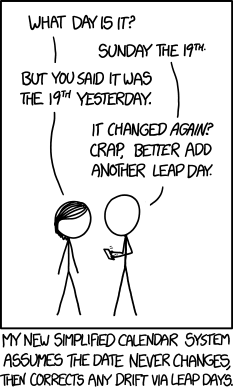
I’ve sometimes asked people to imagine that they had an expandable ruler. If an object measured as longer than they expected, they could add a centimeter or two to the ruler to match their expectations.
Such a ruler would not be much of a measuring device. Likewise, the calendar, with its expandable and contractible bits, its subdivision into the week, which is not commensurable with the other major subdivisions of the calendar, its months of varying lengths, etc, is not particularly satisfactory as a measuring device. Indeed, if its chief purpose were to serve as a measuring device, it would have been replaced long ago.
What a calendar chiefly is, is a series of commands. Many of these commands are tied to specific events in nature, and so we resort to leap days and the like to ensure that they come up at reasonable times. That today is 22 April means, in much of the world, “Observe Earth Day!”* That yesterday was 21 April meant, to Latin teachers, that it was Foundation of Rome Day, and so they have to organize some cheesy kind of classroom activity, possibly involving togas.** That tomorrow is 23 April means, to Christians in certain categories, that it will be Saint George’s Day and so they ought to do whatever it is they do to commemorate Saint George.***
*xkcd fans will understand me when I say that my first reaction to this command is to resolve that I will not be going to space today.
**I am a Latin teacher, but I teach in a college, and I don’t have language classes on Tuesdays. So I got out of it.
***I recently assigned myself in one of those categories, and I value Saint George for various reasons. First. as a soldier who was put to death for refusing an unjust command, his memory should give courage to others whose consciences urge them to say no when it might be easier to join in atrocities, such as Albert Battel or Hugh Thompson. Second, as a saint revered in all the major communions of the East and also in parts of the West, George is a potent symbol of Christian unity. Third, the particular category of Christian I’ve ended up in is Anglicanism, and that’s one of the Western churches where Saint George has played a special role. And fourth, my grandmother was born on 23 April, so I like to make a fuss about something on of that day.
Posted by acilius on April 22, 2015
https://losthunderlads.com/2015/04/22/what-is-a-calendar/
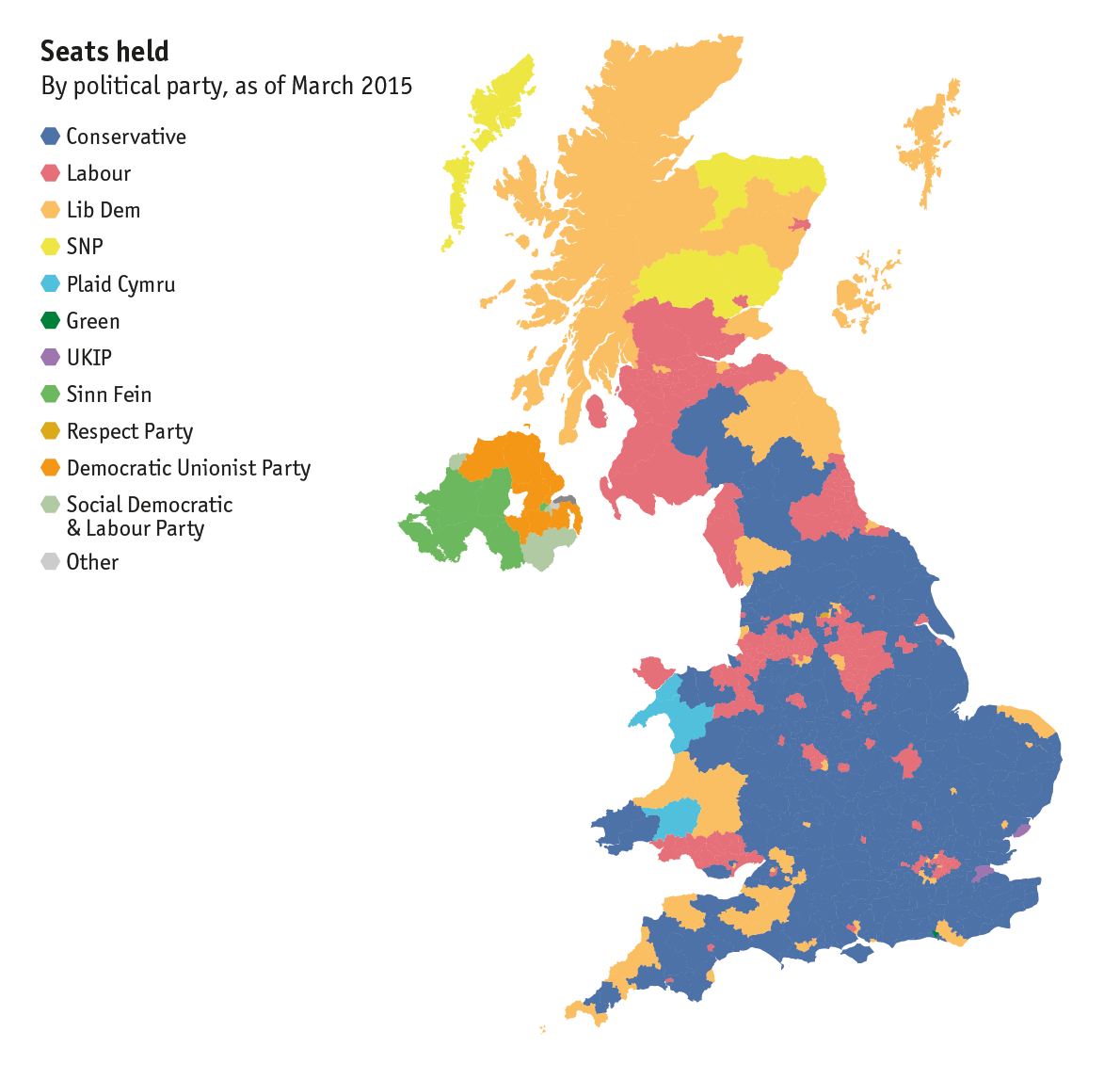
Might look slightly different in a few weeks.
Brian Barder, a retired diplomat who has been Britain’s senior representative in five countries (as Ambassador in Ethiopia, Poland, and Benin, and High Commissioner in the Commonwealth nations of Nigeria and Australia,) maintains a blog on which he has recently been sharing his thoughts about the general election that will be held in the United Kingdom on the seventh of May. A while ago, he gave his opinion that the Labour Party and the Scottish National Party (or SNP, as it is known) were likely to form an agreement after this election under which Labour would conduct a minority government with the SNP lending its support when needed to pass relatively controversial legislation. In two posts (here and here,) Ambassador Barder* recommended that Labour and the SNP should negotiate the terms of this agreement before the election, ideally in public, so that the electorate would know what it was being offered.
I believe that such public negotiations would be unwise. At election time, parties ask activists to volunteer a great deal of time, do a lot of hard work, and present themselves to the public at a considerable risk of rejection and abuse, all without monetary compensation. Their motivation is their belief in their party’s destiny and the opposing parties’ wickedness, Public negotiations based on the premise that Labour will not win a majority, but will do a deal with one of its fiercest opponents, would demoralize Labour’s activists and energize supporters of the other parties. Here is the first comment I offered in response to one of Ambassador Barder’s posts on this topic:
Surely if substantive conversations are going on between Labour and SNP, we won’t know about them for many years. No political party would be well-advised to publicly concede, prior to an election, that it does not expect to win a majority and is planning to govern in concert with a party whose chief commitment is deeply at odds with its whole outlook and tradition.
“To empty chair” is indeed an awkward construction.** “To graveyard whistle” has at least the benefit of being intransitive, so it doesn’t drop a direct object thudding onto the end of the phrase. And I do suspect you are engaging in a bit of graveyard-whistling in this post. If Scootland (sic) does vote as overwhelmingly for SNP as now seems likely, and if as a result of that vote SNP becomes a powerbroker at Westminster, the Scottish branches of the other parties will likely go the way of their counterparts in Northern Ireland. A Scotland where politics is a contest between the SNP and two or three Scottish Unionist parties without formal affiliations south of the border may not lead to the breakup of the UK, but it’s hard to see how it doesn’t advance the ghettoization of Scotland in the same way that such a party system has contributed to the ghettoization of Northern Ireland.
Ambassador Barder responded to this as he customarily does, with unfailing promptness and consideration. He enlarged on his idea that Britain has entered a period of “New Politics,” in which an honest admission that multiparty politics have come to stay is likelier to help a party than to hurt it.
I cannot say that I was convinced by this argument, admirably though Ambassador Barder stated it. I did raise another concern in this followup comment:
“enough LibDems and some other fence-sitters might be tempted, or bribed, to vote for the status quo to rob Labour of its opportunity to take office.” Difficult as it is to predict first-past-the-post races where the polls show so many parties receiving 5-10% support, I can’t really imagine the LibDems winning enough seats this year to hold the balance of power. They have enough strongholds now that they are unlikely to be wiped out completely, but they look to be headed for disaster.
Be that as it may, my greater concern is not so much with the Westminster parliament beginning this year as with subsequent parliaments in Westminster and Holyrood. If SNP comes close to the level of success the polls are now predicting, it will be very difficult for any ambitious Unionist politician in Scotland to support Scotland’s current party system. A party that represents none but Scottish interests and that can point to a time when the UK government depended on its support for its continued existence will have a credibility that no local branch of an all-UK party will be able to claim. To compete with that kind of appeal, Scots Unionists will have to form their own party, matching the SNP’s independence from London and erasing divisions among the old parties. That would be a new politics, all right, but the experience of Northern Ireland shows that it would likely be a dead end that would leave the UK longing for the old politics.
I must also say that you seem to have made rather a damaging admission when you say that “there isn’t necessarily anything substantive” for Labour and the SNP to discuss. If all the agreement that’s needed is on the sort of points that can be settled with a smile and a nod, then what is the need for these Labour-SNP talks you keep proposing? As for the pig-in-a-poke argument, who doubts that if Labour and SNP combine for a majority of seats they will arrive at just such a confidence and supply arrangement as you propose? And if they don’t combine for a majority, well, who cares what the eventual losers planned to do had they won an election?
Ambassador Barder added his reply to these concerns as a note within the original comment, saying that SNP would not actually have much power were it to enter a confidence and supply arrangement with Labour, since its supporters so hate the Tory Party (also known as the Conservatives) that they could not credibly threaten to throw their support to it. This made me wonder why SNP would enter an arrangement that did not give them new power. They are a political party, after all, power is their business. But I did not want to drag the discussion out, so I left it there.
A few days ago, Ambassador Barder posted his reflections on the televised debate held last week among the leaders of the seven parties contesting multiple seats in Britain.*** Ambassador Barder indicated his overall assessment of the debate with the title “Ten Depressing Things About the Seven-Leader Election Debate Last Night.” Several of the depressing things had to do with Labour Party leader Ed Miliband’s not-very aggressive approach to his Tory counterpart, British premier David Cameron; another had to do with Liberal Democratic Party leader Nicholas Clegg’s focus on deficit reduction. The non-depressing things were to be found in the fine performances of the three women on stage, SNP leader Nicola Sturgeon, Green Party leader Natalie Bennett, and Plaid Cymru (viz, Welsh nationalist) leader Leanne Wood.****
In the weeks since that earlier post, I’d thought more about the election, and Mr Miliband’s behavior in the debate, like Ms Sturgeon’s and Mr Clegg’s, seemed to be quite reasonable. In a comment, I began to explain:
I’m beginning to suspect that the likeliest outcome is a grand coalition. I know that all the insiders keep saying that the SNP vote won’t be nearly as high on the night as the polls are suggesting, and they may be right, but there is still likely to be a parliament in which SNP, plus either Labour or the Tories, would have a majority. I can’t imagine Labour doing anything that would help SNP present itself to Scottish voters as a serious force in national politics, and Tory backbenchers are all going to be such in a cold sweat if the UKIP vote swings even a dozen seats from Conservative to Labour that any leader who wanted to make a deal with SNP would be ousted immediately. So that leaves a grand coalition as the only available outcome. Unless, of course, the SNP vote collapses more dramatically than anyone is predicting while UKIP surges more dramatically than anyone is predicting, in which case Labour may squeak in with a narrow majority,
So perhaps what we saw in the Miliband-Cameron exchanges was a phase in what you’ve been calling for, a semi-public discussion between potential coalition partners, and not a debate between opponents at all.
Ambassador Barder’s response to this was rather incredulous. I quote it in full:
I don’t believe that a ‘grand coalition’ of the Conservatives with Labour is conceivable or desirable. I can’t imagine that Ed Miliband, brought up from infancy in the heart of the Labour party, would consider it for a second: I’m convinced that he would resign as leader without hesitation in the unlikely event that his party colleagues tried to steer him into it. It would split the party in a way that would make the defection of the Gang of Four seem like a minor disagreement among friends. The echoes of Ramsay MacDonald, the great betrayer, would be defeaning. A huge proportion of Labour party members (certainly including me!) would resign from the party in anger and disgust if the Labour leadership were to go into a partnership with the most reactionary, anti-social, inhumane, chauvinist and incompetent Conservative party of our lifetimes. Conflicting attitudes to Europe and to the welfare state alone make any such collaboration unthinkable. I guess that the Conservatives would be equally deeply split. It’s not as if the country faces the kind of existential threat that made an all-party national government essential in 1939-40: we face grave problems but there are clear remedies for most of them readily available — and almost no consensus between the two major parties about what the remedies should be. And, finally, it’s unnecessary. As experience in Scotland and continental Europe has demonstrated, a minority government can function quite satisfactorily in a multi-party parliament provided that it can forge temporary ad hoc alliances on specific issues at different times to enable it to win parliamentary support for at least some of its programme.
To which I responded:
The makeup of the next government all depends on what the state of parties is after the election, of course. If, let’s say, Labour win enough seats that they can put together a majority by agreement with either the LDP or SNP or a combination of other small parties, then there will be a chance of a government based on “temporary ad hoc alliances on specific issues at different times.” If, however, it turns out that Labour and the Tories are each separated from an overall majority by fewer seats than SNP hold, that will be impossible.
Granted Labour voters are deeply hostile to the Tories, and would hate a Grand Coalition almost as much in 2015 as they did when Ramsey Macdonald tried it in 1931. But that does not mean that a party split would be on the cards, as it was then, if Ed Miliband were to form such a coalition as a way of keeping SNP on the fringes of UK politics. Labour politicians may share some measure of their supporters’ antipathy to the Tories, but in the SNP they see a direct threat to their own personal ambitions. A Labour-SNP pact would risk putting the SNP in a position of dominance in Scotland in decades to come comparable to that which the Ulster Unionist Party held in Northern Ireland half a century ago, and no Labour politician can fail to see how dramatically that outcome would reduce his or her chances of ever being a senior figure in government. And if no Labour MPs bolt the party, there can be no party split, no matter how unhappy the rank-and-file may be.
An historical comparison that comes to mind is the aftermath of the February 1974 General Election. After his meeting with Ted Heath, Jeremy Thorpe announced to the press “He offered us nothing.” Well, of course Heath offered Thorpe nothing. Moderate, pro-Common Market, anti-Powellite Tory MPs- precisely that faction of his party who formed the core of Heath’s support- tended to represent moderate, pro-Common Market, anti-Powellite constituencies which were the most responsive to Jeremy Thorpe’s Liberal Party, and so those MPs saw in the Liberals an immediate threat to their ability to hold their seats. By approving a deal that would have made the Liberals a serious party of government those MPs would have been signing their own political death warrants. Far better to let Harold Wilson form another government and to oppose that government than to make a bargain that involves the end of one’s own career.
Continuing with the scenario in which SNP could provide a majority to either Labour or the Tories, we can rather safely rule out the idea that one of the major parties might carry on for more than a few months as a minority government with a confidence and supply arrangement with the other. That arrangement would give the official opposition all the power and none of the responsibility in the policy-making process. Assuming neither Labour nor the Tories want to call a second election before the year is out, that means a Grand Coalition.
Again, that is only one possible scenario. I notice that 538 dot com is now***** predicting that the new parliament will be made up of 287 Tories, 271 Labour, 42 SNP, 27 LDP, 17 from the Northern Ireland parties, and 6 others. If that comes true, there would be almost as little prospect of a Labour government sustaining itself by the sort of shifting alliances you describe as there would be if (let’s say) Labour and the Tories tied at 287 with SNP holding 42 seats and a majority for either. Labour would need the SNP and virtually everyone else any time they faced Tory opposition, a situation that could well require the party not only to give up on Scotland but to write off seats wherever the LDP or Plaid Cymru were strong. Even if Ed Miliband’s upbringing had instilled in him a genuinely fanatical hatred of the Tories, he would have to match that hatred with an equal hatred of the Labour Party to try that course.
As for the Tories, under the 538 dot com scenario they too would be stuck with a Grand Coalition. As I mentioned in my first comment, UKIP doesn’t have to win a single seat to scare Tory backbenchers into demanding that their party turn further to the right. They just have to receive, in a handful of constituencies, more votes than separated the Tory candidate from the winning candidate. That will tell Tory backbenchers that if they do not appease UKIP voters they might lose their seats. So a Tory deal with SNP would not only be unpopular in Scotland, it would be a non-starter in the parliamentary Tory party. Likewise a renewed pact with the LDP, even if the LDP had the votes to give the Tories a majority. The only government the Tories could enter, on 538 dot com’s projection, would be a Grand Coalition, as indeed the only government Labour could enter on that projection would be a Grand Coalition.
When so many voters are leaning to minor parties, polls are particularly tricky to evaluate, so it is certainly possible that one of the major parties could emerge with a majority, or that LDP might bounce back and be in a position to give Labour a majority, or that multiple small parties will break through and it will become possible to have the a government by ad hoc, informal agreements. At the moment, however, the likeliest outcome of next month’s general election would seem to be a Grand Coalition. Mr Miliband’s debate performance, the aspects of it that puzzled you, might then be best understood as a stage in the negotiations to set that coalition in place. For that matter, both Ms Sturgeon’s glittering performance in the debate and the peculiar controversy that has sprung up about her since then might be evidence that she too expects such a coalition to emerge, and is taking advantage of the freedom it gives her to attack both Labour and the Tories as the tactical exigencies of the moment may require.
As this comment was already quite unreasonably long, I did not add that Mr Clegg’s focus in the unpromising topic of fiscal rectitude might make quite a bit of sense if he expected his party to be in opposition to a grand coalition in the next parliament. Before they became a party of government by entering the present ruling coalition with the Tories, the Liberal Democrats tended to be something of a clean government lobby, hectoring whichever party was in power about administrative irregularities and, especially, about cloudy statements from the Treasury. Perhaps Mr Clegg is preparing the Liberal Democrats for a return to this role.
Ambassador Barder, in his reply to this, expressed admiration for my “ability to marshal such a weight of argument and evidence in support of such an inherently improbable proposition.” He went on to defend his view that a grand coalition is still overwhelmingly unlikely to be the result of the election, pointing out that the manifestos of SNP, the Greens, and Plaid Cymru are so much closer to what Labour voters want than are the policies of Labour’s own leadership that Labour would be risking a massive revolt if it did not strive to make a deal with them. He closed with “We shall see!,” a nice way of asking for respite.
My reply started with a pleasantry, to assure Ambassador Barder that I appreciated his time and efforts, and proceeded to another bland remark that I hoped would allow us to part in good spirits:
Thanks very much for your replies. You are not only consistently informative and thought-provoking, but may well be the most courteous blogger on the web.
Certainly, in view of Labour’s history, a grand coalition is an “inherently improbable proposition.” But the very thing that makes politics so fascinating is that yesterday’s inherently improbable proposition can occasionally become today’s sole viable alternative, and tomorrow’s tediously settled reality. Who knows, perhaps the next parliament will feature something even harder to imagine than a Labour-Tory coalition. Indeed, we shall see!
*Brian Barder would more properly be referred to as “Sir Brian,” since he is a Knight Commander of the Order of Saint Michael and Saint George. Those sorts of titles strike me as impossibly silly, however. Since he is an extremely polite person, I will not call him simply “Barder.” So “Ambassador Barder” it is.
**In that same post, Ambassador Barder had complained about this ungainly neologism.
***Leaders of parties contesting seats only in Northern Ireland were not included, nor were leaders whose parties were not likely to keep their deposits in more than one constituency race.
****Nigel Farage of the right-wing United Kingdom Independence Party (UKIP) struck Ambassador Barder as “the most shameless,” an unsurprising assessment given Mr Farage’s low opinion of the institutions to which Ambassador Barder has devoted his life’s work.
*****That’s what 538 was predicting when I wrote that comment. It’s adjusted the prediction a bit in the hours since. Now, Labour are down to 270 and SNP are up to 43.
Posted by acilius on April 7, 2015
https://losthunderlads.com/2015/04/07/my-guesses-about-the-upcoming-uk-general-election/
 acilius
 believer1
 lefalcon
 losthunderlads
 vthunderlad
 Panther Red