The Atlantic Monthly, October 2007

For some time I’ve been thinking I ought to take notes when I read magazines.  Not very extensive or systematic notes, just a few jottings of things I might want to remember.   To motivate myself to start doing this, I’ve decided to post these jottings on the blog.  Here’s are my notes on the current issue of THE ATLANTIC.

In a review of C L R James’ BEYOND A BOUNDARY, Joseph O’Neill laments the decline of American cricket since the brief period in the 1760’s when the sport was popular here.  He argues, apparently in earnest, that James’ book is so good that it justifies the lifetime of cricket fandom necessary to appreciate it. 

 Clive Crook notes that several prominent economists have in recent years suggested that globalization might not be the road to paradise and assures us that this is because they are growing senile.  “No empirical work even comes close to supporting the claim that globalization is failing to benefit America in the aggregate.”  Crook does not ask how those benefits have been distributed among Americans, let alone whether globalization will create new forms of inequality and what those new forms of inequality might mean for our society and politics.  For me, these are the essential questions about trade policy. 

Vthunderlad might be interested in Graeme Wood’s “Riders on the Storm,” an article about new technological developments that promise to give us a degree of control over the weather.  Christopher Hitchens’ nasty review of Philip Roth’s latest novel will bring a chortle to any right-wing antiwar types  who are so uncharitable as to enjoy the spectacle of two well-known left-wing hawks at each others’ throats.  And the “Word Fugitive” column’s canvass for words that would mean ” that happy feeling of kinship one feels for a car of the same make and model as one’s own” (the winner is “”badgeraderie”) and “that guy (or girl) who, once he starts dating someone new, abandons all of his friends” (they choose “hiberdater.”)

The cover story is about rich guys like Bill Clinton who try to take control of people and groups to whom they donate money.  Of course, the magazine is owned by David Bradley, who is just such a guy, so they present this as a good thing.  It’s the “new philanthropy”!  Other feature stories deal with “social investing,” the evolution of altruistic behavior, and the future of Pakistan.

http://www.theatlantic.com/

Ironjaw

I posted a link to some funny stuff from this guy’s blog a while back.  Here is his tribute to a comic book that ran for a few months in 1975 (from Atlas Comics, which Lefalcon will remember.)   

http://www.thesneeze.com/mt-archives/000189.php

Irving Babbitt, Casino Master

The International Herald Tribune
April 4, 2006 Tuesday
IN OUR PAGES: 100, 75 AND 50 YEARS AGO;
1931: Gambling At Harvard


SECTION: NEWS; Pg. 2

LENGTH: 113 words

BOSTON: Harvard students have invented a new lottery which has resulted in an epidemic of gambling fever sweeping the campus according to the ”Harvard Crimson.”

This journal today [April 3] confirms persistent reports that classes in ”comparative literature” conducted by Professor Irving Babbitt have evolved a betting pool based on the number of writers mentioned during one of his lectures. One hundred chances are sold at 10 cents each, and three tally-keepers count the writers. The man holding the right number wins the lottery minus 10 percent, which goes to the inventors. They have found that 47 constitutes the average number of authors mentioned by Professor Babbitt.


Superman vs the… Fashion Designers?

superman-vs-the-dude.jpg

Universalized Conscriptionment

 It’s necessary ASAP. How else to get the country to move beyond caring and moping about to mobilizing against war? Plus, if we believe ourselves to be a powerful force for good we should have plenty more combat troops to enforce our goodness.

I’m not kidding.

(Title Bushinated so’s our children and leaders can understand. – Earl)

A provocation from Mencius Moldbug

Lefalcon seems to be interested in “political theology,” the notion that all political ideologies are really religious doctrines in disguise.  Below, Mencius Moldbug of the “Unqualified Reservations” blog tries to identify the religious doctrine behind the liberal internationalism that animates supporters of things like NATO, the UN, etc.

  http://unqualified-reservations.blogspot.com/2007/07/universalism-postwar-progressivism-as.html

If you don’t want to follow the link, I’ll put the key paragraphs after the jump:

Read the full post »

Powerpoint Version of the Gettysburg Address

Have you seen too many PowerPoint presentations?  Here’s a satire.

http://norvig.com/Gettysburg/sld001.htm

Bush’s logical successor

Courtesy of Wonkette, a photo of the candidate the Republican Party wishes it could might as well try to put in the White House in 2008.

Bush’s logical successor

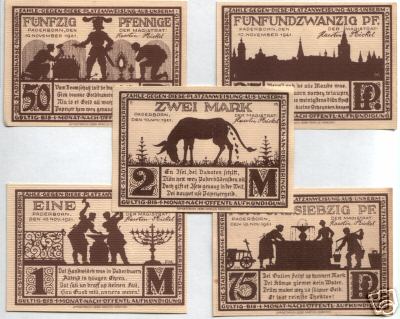
Some Banknotes from the Weimar Republic, as seen on eBay

What’s that in the middle?

What’s that in the middle?

Mahmood Mamdani on Iraq and Darfur

The following paragraphs began an article by Columbia University’s Mahmood Mamdani comparing Western attitudes to Iraq and Darfur.  The article originally appeared in the LONDON REVIEW OF BOOKS in March and was reprinted in THE AMERICAN CONSERVATIVE last month. 

The Politics of Naming: Genocide, Civil War, Insurgency

Mahmood Mamdani

The similarities between Iraq and Darfur are remarkable. The estimate of the number of civilians killed over the past three years is roughly similar. The killers are mostly paramilitaries, closely linked to the official military, which is said to be their main source of arms. The victims too are by and large identified as members of groups, rather than targeted as individuals. But the violence in the two places is named differently. In Iraq, it is said to be a cycle of insurgency and counter-insurgency; in Darfur, it is called genocide. Why the difference? Who does the naming? Who is being named? What difference does it make? Read the full post »