
(Originally posted 24 December 2008)

Charles Addams
Scholars ask, where did Santa Claus come from?

Thomas Nast Cartoon
Others ask the same question, and come up with other answers.
Charles Addams
Scholars ask, where did Santa Claus come from?
Thomas Nast Cartoon
Others ask the same question, and come up with other answers.
Posted by acilius on December 24, 2009
https://losthunderlads.com/2009/12/24/santa-claus-and-his-enemies/
When I read about the latest Jesus sighting in Methuen, Massachusetts, I thought about making the 1 1/2 hour pilgrimage to see the iron Jesus, but then I remembered I see Jesus in my tea bag every morning.
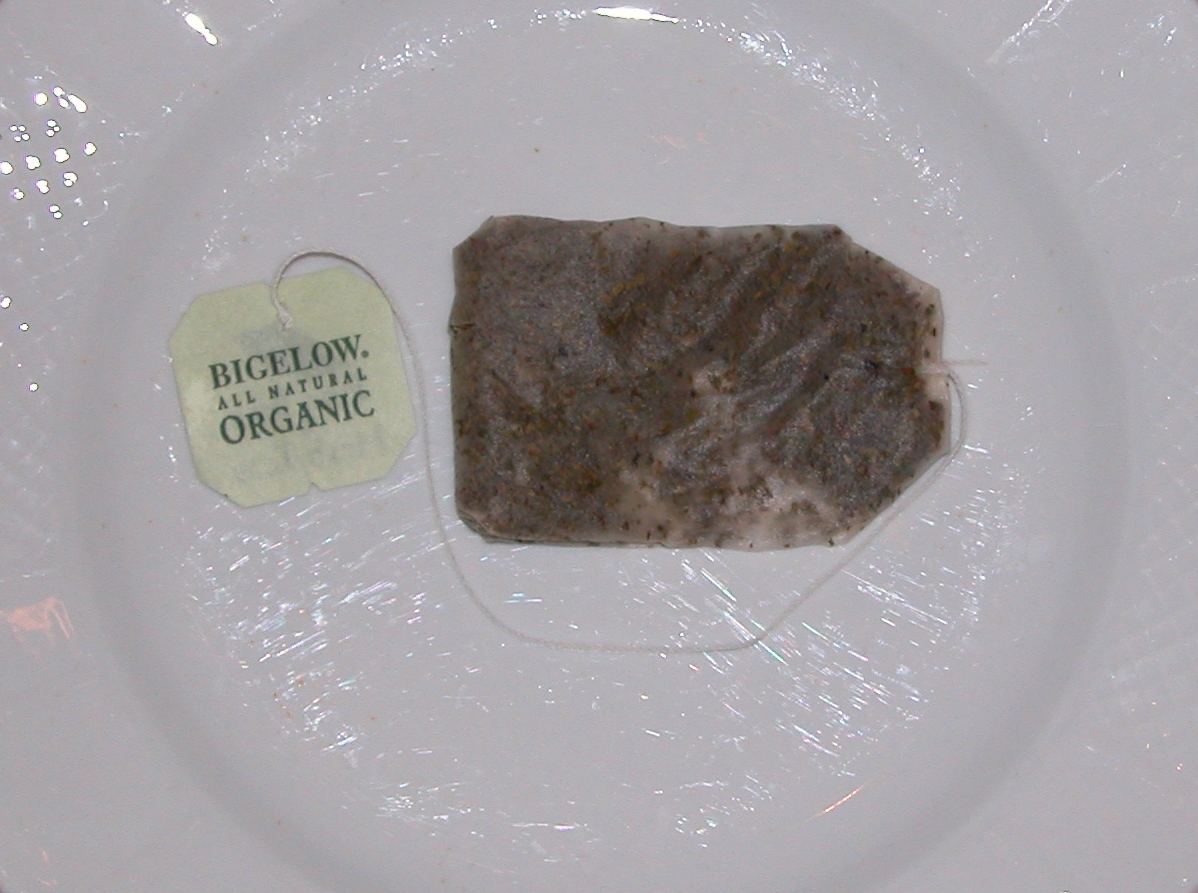
The image of Jesus is clearly visible within the bagged tea leaves.
Posted by CMStewart on November 28, 2009
https://losthunderlads.com/2009/11/28/jesus-and-mary-sightings/
Last night I dreamed my allergist told me I was allergic to- and I quote- “Flying Ravioli Monster.” I questioned her (in my dream) and she explained that particular allergen comes from the inside out. I woke up feeling itchy and snotty. I had somehow forgotten to wheel my air purifier into the bedroom last night.
Of course we all know there’s no Flying Ravioli Monster.
There is, however, a Flying Spaghetti Monster!
Posted by CMStewart on November 3, 2009
https://losthunderlads.com/2009/11/03/praise-pasta/
Posted by CMStewart on October 31, 2009
https://losthunderlads.com/2009/10/31/christians-burn-bibles-on-halloween/
Posted by CMStewart on October 28, 2009
https://losthunderlads.com/2009/10/28/atheist-melon/
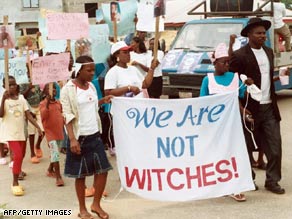
Nigerian Child Witch Hunt Protest
Nigerian families pay pastors to exorcise, torture, and kill suspected witch children.
Posted by CMStewart on October 18, 2009
https://losthunderlads.com/2009/10/18/christians-torture-witch-children/
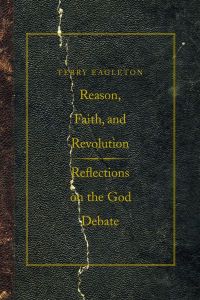 Via 3quarksdaily, an interview in which Terry Eagleton discusses his book, first published this March, Reason, Faith, and Revolution: Reflections on the God Debate. In his introduction, the interviewer quotes Eagleton as saying that the “New Atheists” (Richard Dawkins, Sam Harris, etc) “buy their rejection of religion on the cheap.” In the interview, he enlarges on this point, claiming that Dawkins and his ilk reduce religions to sets of propositions and behave as if arguments for and against these propositions were grounds for accepting or rejecting religions. So far from being new, this approach represents positivism at its most naive. They ask only, “What do the believers say about their creeds?,” never “What do believers accomplish by saying what they do about their creeds?” For Eagleton, the life of the religion is in the relationship between beliefs and actions, and it is a ruinous mistake to treat a system of religious beliefs in the same abstract way that we would treat the propositions in a geometric proof. Indeed, this is the same mistake fundamentalists make:
NS: You say he emphasizes a “propositional” account of religious faith above a “performative” one. But how far can one go believing in God performatively, through political acts, before it becomes a proposition?
TE: All performatives imply propositions. There’s no point in my operating a performative like, say, promising, or cursing, unless I have certain beliefs about the nature of reality: that there is indeed such an institution as promising, that I am able to perform it, and so on. The performative and the propositional work into each other. But it is a typically positivist kind of mistake to begin with the propositional, just as it would be for someone trying to analyze a literary text, which is basically a performance. Somebody who didn’t grasp that would be making a root-and-branch mistake about the kind of thing being confronted. These new atheists, and, indeed, the great majority of believers, have been conned rather falsely into a positivist or dogmatic theology, into believing that religion consists in signing on for a set of propositions.
Posted by acilius on September 21, 2009
https://losthunderlads.com/2009/09/21/terry-eagletons-reflections-on-the-god-debate/
 One of the traits of this magazine is a tendency to grandiose theoretical explanations. That’s one of the things I like about it; I’m into grandiose theoretial explanations myself. It isn’t scholarly publication, and few of its authors have academic reputations to defend, so that tendency is not always restrained by the standards that keep theorizing under control in academic journals. Sometimes that means that the magazine runs a provocative, bold idea that might not have survived heavier editing; sometimes it means that it runs something that’s just plain cheesy quality. Again, I’m a pretty cheesy guy, so that’s okay with me.
For example, this month Ted Galen Carpenter points out that Americans by and large are quick to view political disputes in foreign countries in a romantic light, seeing the ghost of Thomas Jefferson in all sorts of unlikely figures. The next piece, by John Laughland, picks up on this same theme, explaining this American tendency as a sign of the influence of the philosophy of the Enlightenment. Laughland writes that “the key to understanding the West’s love of revolutions” is Westerners’ characteristic desire to believe that “politics can and should be a story with a happy ending.” This desire has run rampant in the West ever since the thinkers of the Enlightenment undermined the traditional Christian belief that the cosmos was ordered in a hierarchy, that justice was to be found in that hierarchy, and that the ruler’s power should be limited because the ruler was subordinate to God. Laughland identifies Immanuel Kant as “the greatest of all Enlightenment philosophers,” and summarizes Kant’s theory as a belief that ordinary reality is unknowable, but that the highest reality is “the categorical imperative- an abstract universally valid proposition that becomes real when it is willed.” Proceeding from these rather drastic simplifications, Laughland declares that:
The attraction of Enlightenment liberalism, therefore, is the result of a deep emotional need for a philosophical sytem that enables man to create a reality in a universe he does not understand and thereby to escape from the difficulties of the world by believing that everything will turn out all right in the end. Lacking a real belief in the afterlife, it also holds that the drama of human salvation is played out in this world, in history and politics.
Again, this is a severe oversimplification, but it has a certain plausibility. Where Laughland really goes off the rails is in his closing section, in which he argues that Enlightenment liberalism has an “objective ally” in Islam:
[B]ecause it has no priesthood, Islam, and especially Shi’ism, is fundamentally a “democratic” religion comparable to Puritanism and other forms of Presbyterianism. There is no established hierarchy; the Koran must be read equally by all. Of course Allah is supreme and Islam demands absolute submission to Him; on the face of it, this seems the opposite of the liberal model in which the individual is subjected only to himself. But this very submission is egalitarian, creating a mass of individuals who are equal in their abstractness. Moreover, God’s will is [merely] will, it has no correlation with natural law as in the Christian or Jewish traditions. Islam is therefore a profoundly voluntarist religion. Because Allah is absolutely transcendent and unknowable, he is like the Kantian thing-in-itself: mere command.
Posted by acilius on July 31, 2009
https://losthunderlads.com/2009/07/31/the-american-conservative-september-2009/
3 times, at his request.
Posted by CMStewart on June 29, 2009
https://losthunderlads.com/2009/06/29/gay-teen-undergoes-christian-therapy/

imcworldwide.org
Posted by CMStewart on June 22, 2009
https://losthunderlads.com/2009/06/22/burqa-officially-unfashionable-per-france/
 acilius
 believer1
 lefalcon
 losthunderlads
 vthunderlad
 Panther Red
