Highlights of some recent issues of The American Conservative

 It’s been a while since I’ve posted a “Periodicals Note” about my favorite “Old Right” read, The American Conservative.  So here are quick links to some good articles from the last four months.

Richard Gamble, author of the indispensable book The War for Righteousness: Progressive Christianity, The Great War, and the Rise of the Messianic Nationwrites an appreciation of the anti-imperialist essays of William Graham Sumner.  The magazine’s website carries one of these, an 1896 piece called “The Fallacy of Territorial Expansion.”   Sumner was a pivotal figure in my early intellectual development, not superseded as an influence until I came upon the writings of Irving Babbitt.  I am glad to see that Professor Gamble, who has studied Babbitt deeply, also shares my admiration for Sumner.  Not that Babbitt and Sumner would have had much use for each other, I hasten to add.  Sumner (1840-1910) the sociologist was contemptuous of classics and philosophy, proposing that both subjects be removed from the curriculum at Yale, while Babbitt (1865-1933) the humanist was impatient with the nascent social sciences of his day and proposed that those students at Harvard who were fit to study nothing else should be released with a three-year baccalaureate, while the first-rate men who could handle the traditional humanities might stay for a fourth year.  Both were right-wing critics of militarism, but that was a common enough combination in the USA in the early decades of the twentieth century that the two professors would have been unlikely to see it as a source of kinship.

Ron Unz remembers the late Alexander Cockburn, whose name has been a familiar one on this site from its beginning.  Not only have we mentioned Cockburn more frequently here than virtually any other commentator; we have disagreed with him less frequently, and agreed with him more fervently, than perhaps any other.

Two pieces in the September issue remember another distinguished dissident, Gore Vidal.  Bill Kauffmann discusses his correspondence with the great man, and Noah Millman reviews the current Broadway revival of Vidal’s play The Best Man.

Samuel Goldman writes about meritocracy, arguing that elites who can believe themselves to have earned their positions are worse for everyone than are elites that know themselves to be the heirs of multigenerational systems of governance.  The first time this idea occurred to me was in 1988, when I was observing the US presidential campaign between George H. W. Bush, scion of an old New England dynasty, and Michael Dukakis, son of hardworking immigrants.  I was happy to vote for Mr Dukakis, but could understand a friend of mine who looked at a newspaper photo of him playing the trumpet, asked “Have you ever noticed that Dukakis can do everything?,” and went on to cast a ballot for Mr Bush.

In the August issue, Ron Unz wrote an important piece called “Race, IQ, and Wealth,” in which he argued that the work of scholars Richard Lynn and Tatu Vanhanen presents data that directly contradicts Professors Lynn and Vanhanen’s thesis that differences in average IQ among various ethnic groups are unlikely to vary over time and are largely attributable to biological differences among those groups.   Mr Unz goes so far as to say that “an objective review of the Lynn/Vanhanen data almost completely discredits the Lynn/Vanhanen ‘Strong IQ Hypothesis.'”  Professor Lynn replied to Mr Unz here, and Mr Unz rebutted him here.

In that same issue, Michael Brendan Dougherty presented an article about conservatives who have supported and continue to support Barack Obama.  I am neither a conservative nor a backer of Mr O, but Mr Dougherty is always worth reading.

A third piece from the August issue that I would recommend is William Lind’s “America Goes Jousting,” about the remarkably tenuous relationship between US military spending and US security interests.  Mr Lind reports a conversation he once had when he was a senior congressional staffer dealing with the defense budget.  An Air Force general asked him what use he was supposed to have for 18 B-2 bombers.  Mr Lind suggested towing them to county fairs and charging admission.  Mr Lind declares that it is nuclear weapons that keep the peace, and that the Marine Corps is likely sufficient to defeat any enemies the USA might be so imprudent as fight on land. He brands the rest of the US military an elaborate show, useless for national defense, a mere vessel for funneling tax dollars to workers in favored congressional districts and to investors well-connected on Capitol Hill.

A fourth is Michael Brendan Dougherty’s “Faith in the Flesh,” about a German court’s decision to forbid Jews from circumcising their sons.  Mr Dougherty examines the “human rights” doctrines behind this astounding ruling and traces them back to a conception of religion specific to the German Anabaptist movement.  From the Anabaptists, the idea has become widespread among Protestants that religious affiliation ought to be the result of an intellectual decision by an adult to accept certain propositions as true.   This idea is unknown in most of the world’s religious traditions, and was unknown to Christians before the German Reformation.  Even today, it is accepted by only a minority of Christians.  For most of the world, religion is about connections to people first, and affirmations of verbal statements somewhere later on.  So of course one inherits one’s religion from one’s parents.  A disproportionate share of the politicians, jurists, and intellectuals who crafted the doctrines known as “human rights” come from Protestant backgrounds, and take this peculiar idea for granted.  That’s how it is possible that German judges, successors of the very men most thoroughly discredited by their participation in the Holocaust, can quite sincerely fail to see an ethical problem in a ruling that would prohibit Jews from practicing Judaism in Germany.

Back in July, Stephen B. Tippins wrote a column about Fisher Ames, one of the founders of the United States.  Mr Tippins opens with a conversation he had with a friend who was puzzled as to why he would write about Ames.  The friend wanted to know how writing about Ames would help elect Willard “Mitt” Romney as president of the United States.  Mr Tippins didn’t suppose it would advance such a goal.  His friend could imagine no other justification for political writing than the promotion of Mr Romney’s fortunes.  Mr Tippins spends the rest of the piece arguing that readers who develop a proper appreciation of Ames’ work will face no such difficulty, and that they will come to have a view of what politics is for that does not revolve around any one man or any one office.

 June’s issue also contained some interesting pieces.  Sean Scallon contrasts Mr Romney’s career as a private equity operator with his father’s career as an industrialist and finds an ominous indication of the direction American capitalism has taken.

Rod Dreher writes about the growth of Orthodox Christianity in the USA, arguing that this shows that Americans of a conservative bent have grown dissatisfied not only with mainline Protestantism, but with the Roman Catholic church as well.  Certainly, if one takes the word “conservative” literally, the churches of the East are the most conservative parts of Christendom.  So it is not surprising that in a time when the word has such a cachet, Orthodox churches are growing rapidly, albeit from a very small base.*  As Mr Dreher reports:

Whatever role Orthodox Christians in America have to play in this drama, it will certainly be as a minuscule minority. In worldwide Christianity, Orthodoxy is second only to Roman Catholicism in the number of adherents. But in the United States, a 2010 census conducted by U.S. Orthodox bishops found only 800,000 Orthodox believers in this country—roughly equivalent to the number of American Muslims or Jehovah’s Witnesses.

Yet converts keep coming, and they bring with them a revivifying enthusiasm for the faith of Christian antiquity. One-third of Orthodox priests in the U.S. are converts—a number that skyrockets to 70 percent in the Antiochian Orthodox Church, a magnet for Evangelicals. In the Greek Orthodox Church, around one-third of parishioners are converts, while just over half the members of the Orthodox Church in America came through conversion. For traditionalist conservatives among that number, Orthodoxy provides an experience of worship and a way of seeing the world that resonates with their deepest intuitions, in a way they cannot find elsewhere in American Christianity.

Also in June, W. James Antle reported on Virgil Goode, a former congressman from Virginia who is challenging Mr Romney from the right as the Constitution Party’s candidate for president.  I confess to being rather mystified as to what is motivating Mr Goode to run, and the Constitution Party to support him.  His views do not seem to be far from Mr Romney’s on any of the major issues of the day.  As a congressman, he supported the Iraq War, the so-called USA-PATRIOT Act, and many other measures that third parties left and right tend to view as steps toward tyranny.   He has yet to renounce any of those positions, though in Mr Antle’s eyes it is “clear that Goode’s positions were evolving in the Constitution Party’s direction” when he became the party’s presidential nominee.

*If that rings a bell, maybe you’ve been looking at this cartoon.

 

Mansplanations

The other day, Rebecca Solnit (a.k.a. America’s National Treasure) wrote a column for TomDispatch that The Nation‘s website picked up.  The title is “Men Still Explain Things to Me.”  Ms Solnit tells a little story about a strange man who responded to some comment she’d made about photography pioneer Eadweard Muybridge by chastising her for not having read a new book about Muybridge that had come out earlier that year.  It turned out that the book he had in mind was River of Shadows: Eadweard Muybridge and the Technological Wild West, by- Rebecca Solnit.   Ms Solnit’s friends repeatedly tried to tell the man that the woman he was scolding for not knowing the book was in fact its author; that didn’t slow him down a bit.  Ms Solnit gives other examples of men shutting women down by loudly and persistently “explaining” to them.  Acknowledging that not all men use this passive-aggressive technique and that those who do use it  sometimes use it against other men, Ms Solnit mentions that young women nowadays call the technique “mansplaining.”

Ms Solnit posted this piece shortly before a truly spectacular example of mansplaining burst into public view and briefly dominated the US political news cycle.  US Congressman Todd Akin, Republican of Missouri, is his party’s nominee for the US Senate from that state in this year’s election.  In response to a question from a television interviewer, Mr Akin said that he did not believe that abortion should be legal.  Asked about women who become pregnant as the result of rape, he said that he would not make an exception for them, in part because he believes that such a scenario is rare.  “The female body has ways to try and shut that whole thing down,” he said, launching into an explanation of physiological processes that, according to him, prevent women who are the victims of what the congressman called “legitimate rape” from becoming pregnant.

In the aftermath of Mr Akin’s remarks, several prominent Republicans, including presidential nominee Willard “Mitt” Romney, criticized him harshly.  At this writing, it is unclear whether Mr Akin will remain a candidate.  A Google search estimates over 900,000 results for “Akin vows to stay in race”; usually candidates vow to stay in a race shortly before they announce their withdrawals.

A couple of interesting pieces have appeared in response to this matter.  On The Nation‘s website, health columnist Dana Goldstein contributes a handy guide to “How the Body Reacts to Sexual Assault” (spoiler: not by spontaneously producing contraceptives.) Ms Goldstein explains that ideas about sexual response that are not informed by biology lead many people, victims of rape among them, to draw distinctions between women who are more worthy or less worthy of support and respect after sexual assault.  These distinctions, Ms Goldstein argues, turn rape exceptions to abortion bans into a means by which other people can exercise unwanted control over a woman’s body.  As such, they reenact the original offense.

And at Religion Dispatches, Sarah Posner writes a fascinating analysis of “The Theological Roots of Akin’s ‘Legitimate Rape’ Comment.”  Mr Akin is an outspoken member of the Presbyterian Church in America (or PCA,) the second-largest Presbyterian denomination in the USA.  Unlike the larger and quite liberal Presbyterian Church USA, the PCA is fiercely traditional both in its general theology and in its views of relations between the sexes.  Posner cites a series of PCA position papers on abortion which mirror Mr Akin’s remarks very closely.  They even go into detail about the unlikelihood of pregnancy resulting from rape, details unsupported by documentation.  Ms Posner links to a column by Garance Franke-Ruta of The Atlantic; Ms Franke-Ruta describes some of the political infrastructure that has been developed to popularize the idea that rape rarely causes conception, including a group called “Physicians for Life” which seems to consist of physicians who trained and practice in some parallel universe.   A parallel universe which sends representatives to the US Congress, for some reason.

Do fundamentalist students make life harder for biology teachers than for history teachers?

The comment thread on this recent Saturday Morning Breakfast Cereal closed down before I got around to posting a comment, so I’ll make my remarks on it here:


My first reaction to the punchline was this, which I posted on our Tumblr site: “The punchline to this comic strip doesn’t really work.  There are many parts of the world where history teachers attempting to introduce the Holocaust meet with exactly this kind of resistance, and then some.”

I thought a bit more about it, and decided that comment was a false start.  It would be more interesting to take the comic on its own terms and ask what happens when history teachers come into contact with fundamentalist students, as opposed to what happens when biology teachers come into contact with fundamentalist students.

In most school districts in the USA, every time evolution comes up in biology class the teachers have to brace themselves for a vocal onslaught from students who have been extensively briefed in denialist talking points by highly organized groups.  That’s a challenge history teachers don’t usually face in the USA.  Sometimes a history teacher might have to talk about some topic the students find distressing, and they may respond with anger.  But it is quite rare for those angry students to present their views in a form worked out by the kind of ideological apparatus that Creationists have set up for themselves.  There are countries in the world where other forms of denialism are supported by prestigious institutions that drill a mass audience in their talking points, as acquaintances of mine who have tried to teach 20th century European history in the Gulf states can attest.  In the USA, there are political interest groups that would like to establish a presence as widespread as that of the Creationists; for example, a couple of years ago the corn lobby had some success with efforts to punish academics for saying that cows eat grass.  But those efforts have not (yet!) become a routine factor in classrooms.  So, it is fair to say that in the USA, Creationism stands alone among denialist ideologies as a systematic challenge to classroom teachers.

Still, I would say that it is going too far to claim that “Teaching Intro Biology is harder than teaching Intro History,” even in regard to the narrow question of the challenges fundamentalist students present to their teachers.  Fundamentalist students may not come to history class ready to spout ideological boilerplate every time the teacher gets to something interesting, and so they are not as immediately obnoxious a presence there as they are in biology, geology, or astronomy class.  Indeed, I’ve taught many classes on history, and every class has included several fundamentalists.  I can say that fundamentalists are usually very quiet through such classes.

So when it comes to keeping good order and discipline in the classroom and getting through material, fundamentalist students do not represent a special challenge to history teachers.  But if you actually want to engage them in the subject, that’s a different story.  I’m a classical scholar, so when I teach history it is the history of ancient Greece and Rome.  Many times, I’ve put this question on a test: “How did the religious life of Rome change in the second century BC?”  A significant percentage of the students in every class has responded that the Romans converted to Christianity in the second century BC.  After I’ve graded the tests, I read the question aloud to them, then mention that many of the students said that the Romans converted to Christianity in the second century BC.  It usually takes half a minute or so before everyone realizes what “BC” stands for and starts laughing.  That’s an example of a widespread problem.  Students from fundamentalist backgrounds simply cannot imagine a world in which Christianity is not the only religion worth mentioning, or even a form of Christianity other than the one within which they were raised.

That problem, in turn, is the tip of a much bigger iceberg.  Fundamentalists realize that science is powerful and important; that’s why they package Creationism as “Creation Science.”  They do not have any reason to believe that history is important, however.  Fundamentalists hold that the Bible or Qu’ran or whatever text is sacred to their religion represents an unchanging truth, complete and identical from one age to the next, and that this is the only truth that ultimately matters.  Not only does the text not have a history, but the interpretation of that text does not have a history.  There is only one right way to read the text,  that is the only way that has ever been or will ever be right, and the right way exhausts the meaning of the text completely.  If you believe that, then the record of history is not part of the ongoing engagement between humanity and the world through which communities are formed and humans  come to understanding; understanding has already come to us, complete and error-free, deposited in your hotel room free of charge by the Gideons International, and community is the byproduct of that understanding.  For people who look at it that way, history  is just one damn thing after another, at best an amusing diversion from the serious business of life.

And of course it gets worse.  Demonstrate that the modern age is an extremely peculiar time, that the ideas which fundamentalists take for granted are possible only in an age of mass-produced books, the nation-state, and rationalized bureaucracy, bring home to them the fact that none of these things existed in the first millennium and a half of Christianity, and they go into an intellectual tailspin.  Some of them do become highly defensive; though they are not armed with the prefabricated circular reasoning of the Creationists, they can make a nuisance of themselves in the classroom.

That, of course, is to say nothing of their written work.  When fundamentalists try to stuff their ideology into a scientific report, the result is simply wrong.  A teacher can respond with a low grade and a reference to the standards of scientific writing.  In the humanities, we have to take a wider variety of writing seriously.  That isn’t to deny that there are standards, or that it is possible to structure an assignment so that you avoid wasting a great deal of time following the deadest of ideological dead ends.  Still, you can’t keep a humanistic discussion alive if you set the bounds as narrow as those in scientific writing.

The humanities, like the sciences,  are possible only where people are prepared, not only to challenge each others’ preconceptions, but also to challenge their own preconceptions.  In science, writing is usually the record of observations, experiments,  and analyses that presented the researcher with such challenges.  In the humanities, writing is not the record of these challenges, it is itself the process by which they are presented.  So, if you make it impossible for fundamentalist students to write fundamentalist essays, you make it impossible for them to profit from an exposure to history, literary studies, or any other branch of the humanities.

“There is nothing intelligent to say about a massacre.”

Way back in the 4 June issue of The Nation, William Deresiewicz published a review essay about Kurt Vonnegut.  As I read Mr Deresiewicz’ piece, it dawned on me that I had never read Slaughterhouse-Five.  I’d read several of Vonnegut’s novels and miscellaneous writings, but had missed the most famous one.  Embarrassingly enough, I had talked about Slaughterhouse-Five with a number of people over the years, conversations in the course of which I sincerely, if somewhat vaguely, believed that I had read the book at some point.   Once, while still in high school, I even suggested to a friend that we co-author a tribute to Slaughterhouse-Five in comic book form.  If he’d taken me up on that, I suppose it would have become clear to both of us quickly enough that I hadn’t read it, but we settled on a tribute to Froissart’s Chronicles  instead.

So, not long after I read that issue, I reported to the library and checked out a copy of Slaughterhouse-Five.  It was well worth reading.  Mr Deresiewicz says that the novel’s real subject is not the firebombing of Dresden, but the Post-Traumatic Stress Disorder that the firebombing bequeathed to Vonnegut and other survivors.  Mr Deresiewicz quotes a remark from the beginning of the novel, “there is nothing intelligent to say about a massacre.”  The novel is great, he argues, because Vonnegut doesn’t try to offer answers or find meanings.  He looks directly at an unintelligible world, a world in which human beings by the thousand can be incinerated in their homes, and does not flinch by looking away to something else, something reassuring in its logic.  Instead, the novel’s Billy Pilgrim, like Vonnegut in his own authorial voice, says simply, “I was there.”  Mr Deresiewicz writes:

“I was there,” he says. And he adds, “So was my old war buddy, Bernard V. O’Hare.” The moment prefigures the novel’s moral climax a few pages before the end. Billy’s in a hospital in 1968, after the plane crash. His roommate is a former Air Force general who is working on a history of the Army Air Corps in World War II. He is wealthy, healthy, masterful, accomplished (his name is Rumfoord, by the way), and he dismisses Billy, in his quasi-comatose state, as so much human refuse. He is telling someone that the raid on Dresden had been kept a secret for so long

“For fear that a lot of bleeding hearts…might not think it was such a wonderful thing to do.”
It was now that Billy Pilgrim spoke up intelligently. “I was there,” he said.

“I was there.” Meaning not, I suffered, but simply: It happened. It doesn’t fit the story that we tell ourselves about the war, but it happened. And I alone escaped to tell the tale. But not completely alone: my old war buddy was there as well, which means you can’t dismiss me as a lunatic. I was there. Or as the novel’s famous invocation, thrice repeated, puts it: Listen.

“I was there”—not, “The death of Dresden was a bitter tragedy, needlessly and willfully executed.” The sentence comes from a short, unpublished manuscript, included in the Library of America edition, that Vonnegut had worked on in the years immediately following the war. Before he could write the novel, I believe, he needed to surrender that sense of judgment. “It had to be done,” Rumfoord finally says to Billy. “I know,” Billy replies, “everybody has to do exactly what he does.”

Elsewhere in the novel, Vonnegut explicitly disavows judgment of the pilots who carried out the raid.  He never did blame them, he says; he has known bombers and admired them.  He describes the bombs as if they acted on their own, unassisted by human agency.  In the novel, that description figures not as a psychological evasion,  but as the facing of a supreme horror.  A world dominated by malevolence and permeated by guilt would have a structure, and so would be intelligible.  As such, even a realm of villainy would be easier to bear than the realm of sheer absurdity into which the massacre introduced its survivors.

In a bit of the novel that Mr Deresiewicz does not quote, Billy Pilgrim and his fellow prisoners are herded into Dresden.  The crowd gives Billy dirty looks; one man confronts him and demands to know if he “thought we would laugh”?  Billy is confused, then realizes that the miscellaneous items of clothing he has scavenged to cover his nakedness in his weeks as a prisoner adds up to a clown’s costume.  Here, Billy parallels his creator.  Cobbling together a way to tell his story, Vonnegut has gathered up bits of wartime memoir, of science fiction, of midlife-crisis narrative, of soft-core porn, of half a dozen other genres,  and pasted them together.  The result is a very odd book, at first glance an aggregation as clownish as Billy’s costume.   It is precisely because Vonnegut is entirely willing to play the fool, to make himself as much a stranger to smart rhetoric as the war has made Billy a stranger to smart attire, that Slaughterhouse-Five is a possession for the ages.

As the Periodicals Notes section of this website attests, I read a lot of magazines.  After the attacks of 11 September 2001, I dropped several titles from my list of regular reads.  These included The New Statesman, The National Review, The London Review of Books, and The American Spectator.  Each of these magazines carried a number of piece about that series of massacres.  There were many things to find objectionable about those pieces; certainly the right-wing publications did not cover themselves in glory by arguing that the appropriate response was to adopt policies that would punish all Muslims everywhere, and the others did their reputations no favors when they published remarks such as “the United States had it coming.”  What I found most rebarbative about all of them was something I couldn’t put into words at the time, but Vonnegut crystallizes it perfectly.  Each of those commentators, left and right, treated the massacres and their aftermath as a continuation of their lifelong quest to display their own brainpower to the utmost possible advantage.  Because there is nothing intelligent to say about a massacre, the result of this contest to be the smartest one was an exhibition of moral idiocy on a spectacular scale.

If we don’t endeavor to make intelligent remarks about a massacre, how do we honor the dead it leaves behind?  This is typically a religious question, so let’s see what we can say about Vonnegut and religion.

As Mr Deresiewicz documents, Vonnegut was raised to be skeptical of conventional religion*:

Vonnegut saw our spiritual anxiety, in the postwar chaos, and as a former public relations man, he knew our mass gullibility. He had also studied anthropology, an experience, he later said, that “confirmed my atheism, which was the faith of my fathers anyway. Religions were exhibited and studied as the Rube Goldberg inventions I’d always thought they were.” Now machines were taking control, so we needed to pretend that something else was in control. Or as he puts it in The Sirens of Titan, “Gimcrack religions were big business.” The Age of Aquarius surely came as no surprise to him—the age of crystals and gurus and mystical hucksters. Charles Manson and Jim Jones surely came as no surprise, and neither did L. Ron Hubbard, a man who started writing science fiction but decided he was writing Scripture.

If we reject the belief systems and hierarchies of traditional religions and the rites that go with them, how do we go about honoring the dead?  I think I detect a kindred spirit in the Vonnegut/ Deresiewicz emphasis on “I was there, and so was Bernard V. O’Hare.”  We honor the dead by remembering them.  To do this we must turn our attention from ourselves and focus it on them, on them as they were individually and as they interacted with each other in groups.  To sustain this focus we must resist the temptation to retreat into distractions, whether those distractions take the form of ideologies that make our losses bearable or of activities in which we ourselves become again the center of attention.  We must give the dead our undivided attention, if only for a moment, if we are to honor them.

Religions can certainly be fruitful source of excuses for keeping the focus off the dead.  Many funerary rites focus attention on clergy or other performers; many include invitations to dwell on recondite theological doctrines about the relationship between life and death.  So I sympathize with opponents of religion like T. H. Huxley who say that respect for the dead requires us to renounce the conventional forms of religion.  On the other hand, for many mourners these things quiet their minds and take them outside of themselves, enabling them to maintain a clear, unwavering focus on the dead.  And there’s nothing to say that persons who find the ritual elements a distraction can’t learn to respond to them in the desired way.  After all, the others learned it; no religious practice comes instinctively to anyone, even if there is an instinct for something called religion in general.  So even proceeding from my idea that mourning should be a matter of focusing our attention on the dead, we don’t find an argument against funerary rites.

Of course, funerary rites do something else as well.  They reassure the mourners that the remembrance of the dead is not a burden they will carry alone, but a bond they share with their community.  Funerary rites aren’t the only social practices that give that assurance; one of the reasons we want medical professionals to make heroic efforts to save our loved ones is that we want to know that those professionals will remember them, at least as an interesting case.  When someone is to blame for the death of a loved one, we want the same attention from the criminal justice system, in part for the same reason.  That’s probably why murder mysteries are so popular.  Some time ago, I saw an episode of Columbo on some cable TV channel that specializes in nostalgia.  Lieutenant Columbo had caught the murderer hiding the victim’s body.  In his bizarrely friendly way,  Lieutenant Columbo was trying to keep the murderer from feeling too bad about himself, telling him, “Dead bodies have a way of turning up.”  In reality, of course, they don’t.  The only thing dead bodies actually have a way of doing is decomposing.   Given enough time, it will be as if the dead had never lived.  That may well be the world’s most unbearable fact.  Many years ago, my wife lost her closest friend to an act of violence that was never investigated; with each passing year, fewer people remember her, and her family’s burden grows more obvious.

Medicine and the criminal justice system, whatever their virtues, are never entirely satisfactory substitutes for funerary rites.  A course of medical treatment is an exercise in technology and finance that revolves around the person of a patient, but is never simply a tribute to that patient; a criminal proceeding is an exercise in institutionalized conflict in the course of which a person who is unavailable to participate actively is likely to vanish from view altogether.

Many people recommend political action as a way to honor the dead.  I’m all for democracy, and I understand the power of martyrs to arouse a citizenry to action.  So I’m not opposed to the idea of waging a campaign for reform in the name of some dead person.  But consider.  Every political dispute is complex; every political issue shades into other, related issues, and every person who takes part in a political disagreement is pursuing several objectives at once.  To turn a person into a political symbol, therefore, is likely to make it virtually impossible to focus our undivided attention on that person.  Again, not everyone sees that focus as the essence of honoring the dead; some may define honoring the dead in a way that begins and ends with the political utility of martyrdom, or in other ways that put a low priority on memory of them as they were.  But for me, and perhaps for Vonnegut, the key thing is to meet the dead on their own terms, not to impose our preconceived notions on them or to lose sight of them in the midst of some other activity.

If we say that our ways of honoring the dead are part of our religion, whether we belong to any recognized religious tradition or not, then Vonnegut and I may share a religion.  Moreover, at least in my version of that unnamed religion, politics is not part of the funerary rites by which we honor the dead.  The rites of the various religious traditions that do have names and belief systems and hierarchies aren’t really part of it either, though they can serve the same purpose.  What is a part of it?  How do we go about focusing our attention simply on a person, not on desires and ideas of our own that we may associate with that person?

In a post a few years ago, I quoted a man who had said that his way of praying for a person was to hold an image in his mind of that person against a plain white background.  This meditative exercise does not involve any words; that way he isn’t tempted to wish things on the person, or to try to recruit God as an ally in an effort to make the person do what he thinks is right.  Instead, it enables him to see the person clearly, to listen to what the person is actually saying, to accept the person as s/he is, and to respect his or her journey in life.  I’ve tried this exercise myself on many occasions, and can recommend it highly.

So that exercise is part of my religion, if you call it that.  Science is part of it, too.  Richard Feynman said in his 1974 commencement address at Caltech that in science, “The first principle is that you must not fool yourself- and you are the easiest person to fool.”  My favorite living philosopher, Alasdair MacIntyre, argues that healthy religious traditions represent lines of inquiry that guide their followers away from particular forms of self-deception.  I don’t really understand how that is supposed to work; MacIntyre’s own religious tradition, as embodied in the Roman Catholic Church, seems to me to be an ever-flowing fountain from which self-deception springs in forms unimagined anywhere else.  Be that as it may, science offers its practitioners tools unmatched in any other avenue of human pursuit for disabusing oneself of one’s pet ideas.  Thomas à Kempis said that the highest reward of the contemplative life was that it had enabled him to free himself of a multitude of opinions; to the extent that Thomas’s words apply to religious practice in general, scientific inquiry is the most efficient of all forms of worship.

*To be precise about it, the Vonneguts were members of All Souls Unitarian Church in Indianapolis, Indiana when the novelist was growing up.  At that time, the congregation met in a building designed by architect Kurt Vonnegut, Senior.  In his maturity, Kurt Vonnegut, Junior did not identify even with the creedless religion of the Unitarians, or the Unitarian-Universalists as they became in 1961.

Jewish Exegesis and Homeric Scholarship in Alexandria, by Maren Niehoff

Nowadays there’s a lot of controversy among believers as to what if anything the latest trends in historical scholarship, literary theory, and the social sciences can teach us about how to read holy books.  That isn’t new; Professor Maren Niehoff of  the Hebrew University of Jerusalem has written a book called Jewish Exegesis and Homeric Scholarship in Alexandria about evidence that sheds light on how the Jews of Alexandria read the Bible in the years from 322 BC to AD 50.

The ethnically Greek residents of Alexandria had developed the study of Homer’s poems in directions that sometimes seem unsettlingly modern, and some Jewish Alexandrians had applied their techniques to the study of the Bible.    People who think it’s anachronism to hear about Mikhail Bakhtin or Judith Butler or Wolfgang Iser or Wendy Doniger in a study of the Bible might sympathize with ancients like Aristeas and Philo of Alexandria who were incensed with their fellows who seemed to think that you had to read Aristotle and other cutting-edge intellectuals to understand the scriptures.

I haven’t seen Professor Niehoff’s book yet.  I’ve read a review of it by Bruce Louden that was sent to a mailing list I’m on.  Here’s an interesting paragraph from Professor Louden’s review:

Part II, “Critical Homeric Scholarship in the Fragments of Philo’s Anonymous Colleagues,” situates Philo by demonstrating his differences with his contemporaries. Some anonymous contemporary exegetes, for instance, apply something close to the techniques of comparative mythology to analyze the Tower of Babel episode (comparing it to the myth of the Aloeidae), which he rejects. In their analysis of biblical texts they evidence the influence of Aristotle, and Alexandrian Homeric text-critics, seeing parallels between Homeric epic and the Bible. They place the story of Isaac in a context of actual narratives of child sacrifice, resolving interpretive issues by arguing for historical distance, as Aristotle does in the fragments of the Aporemata Homerica. They thus argue that the Bible, and its religion, has developed and evolved over time. Philo himself espouses a strongly conservative perspective, that Moses has written “eternal, unchanging truth” (95). His contemporaries, in strong contrast, criticize some of God’s acts, such as the confusing of languages in Genesis, as making matters worse for humanity. The section concludes with discussion of how the biblical exegetes, applying Alexandrian Homeric text-critical methods to passages with grammatical problems or flaws in the Greek text, were willing to correct words or phrases. While neither Philo nor his anonymous colleagues know Hebrew (they only know the Old Testament in the LXX), Philo nonetheless argues that the “flaws” could be explained by finding deeper meaning of some sort.


The Pope’s Hat in Two Recent Web Comics

I understand the appeal of hats and am puzzled by the appeal of popes.  The pope has distinctive headgear for which he is known.  So I sometimes wonder if I can use what I know about hat-fancying to gain some insight into the minds of pope-fanciers.  I haven’t had any success with this effort so far.  Apparently web comic writers also find the pope’s hats to be interesting, as the examples below illustrate:

Zach Weiner, Saturday Morning Breakfast Cereal, #2526, 27 March 2012

Matt Bors, “Arrogance,” 11 April 2011

A long comment at 3QuarksDaily

A moment ago, I posted a very long comment in response to a post by Quinn O’Neill at 3QuarksDaily.  Ms O’Neill’s post was a response to criticism that she had received after saying, in an earlier piece on the same site, that the most effective strategy for increasing the likelihood that schools will teach a biology curriculum based on sound scientific research might not consist of atheists making displays of personal hostility toward religious believers.  Much of the criticism Ms O’Neill received was based on the premise that anyone who questions the efficacy of such displays has betrayed the holy cause of Science and opened the gates to the Satanic hordes of Creationism.  In her response, Ms O’Neill felt obligated to reassure everyone that she is a True Unbeliever who renounces religion and all its works, and said among other things that she does not “believe that science and religion, as worldviews, are compatible and I don’t believe that evolution is logically compatible with theism.”  I had to respond to that statement, and did so at a length that is really quite unreasonable for a blog comment.  Here it is:

“I don’t believe that science and religion, as worldviews, are compatible and I don’t believe that evolution is logically compatible with theism.”

That sentence includes some pretty broad terms.  I grant you that a religious sect which demands that its followers believe the earth to have been created in October 4004 BC is not likely to be pleased by the findings of geology, or biology, or astronomy.  But what about a religion like Confucianism, which, to the extent that it represents a worldview, does so not by preaching doctrines but by guiding its followers through ceremonies and structuring their social relations?  Where is the faith/ reason battle there?

To the extent that “religion” is a meaningful category, I suspect that its defining features have far less to do with the belief systems that many religions  have than with the social bonding that they all promise.  I’m inclined to agree with James P Carse, longtime professor of religious studies at New York University, who in his 2009 book THE RELIGIOUS CASE AGAINST BELIEF argues not only that religious can get along perfectly well without having belief systems attached, but that their belief systems often keep religions from achieving their real value, which is their ability to bind people together into communities that endure for many generations.

Professor Carse’s argument may seem odd, but if we draw an analogy with science I think we can see more clearly what he’s driving at.  The point of science isn’t to uphold certain doctrines or theories, but to challenge all doctrines and theories with evidence and logic.  A scientist who would rather defend a pet theory than face the facts that cast that theory in doubt isn’t making the most of science.  Likewise, religious believers who wage holy war in the name of militant ignorance in order to protect a cherished belief aren’t breathing life into the past and binding the present to the future; they are condemning past and present to the contempt of the future.

So “religion” is a problem.  “Theism” is a problem, too.  So far as I can tell from the Oxford English Dictionary, “theism” was first coined in 1678 by Ralph Cudworth as a contrary to “deism.”  While deists affirmed the existence of some sort of god but denied that the god they believed in had communicated directly with the world, Cudworth wanted a word to name persons who, like himself, believed in divine revelation.  Later it was used as we would now use “monotheism,” and presented as a contrary to “polytheism” and “atheism.”  Nowadays “theism” sometimes embraces polytheism and deism, and is defined in smaller dictionaries as “belief in a deity, or deities, as opposed to atheism.”

Does this attitude actually exist?  Is there, anywhere in the world, anyone who, as a matter of pure intellect, simply believes that there is at least one deity in existence?  I suspect not.  On the contrary, it seems likely that every person who would sincerely agree to such a proposition would also be a supporter of some particular religion, and of various other ideas and practices that come bundled with that religion.

However, let us assume, for the moment, that there is some point in talking about “theism” and “theists” in the very broad sense of agreement with the proposition that at least one deity exists.  Is it true that this proposition is not “logically compatible with” evolution?  Surely not.  An ancient Greek like Hesiod would fervently agree that at least one deity exists; however, in his THEOGONY, Hesiod describes the origin of the physical world as a spontaneous process that predated the birth of any gods, and frames the origins of the gods within the processes of nature.  It is admittedly unlikely that science will show Hesiod’s claims to be factually sound.  However, they are not only logically compatible with evolution, but are in the strictest sense of the words a story about evolution.

What about monotheism?  Is it logically inconsistent to say, on the one hand, that a single personal God created the world and rules over it, and on the other hand to say that life as we know it is the result of an evolutionary process.  I don’t presume to know why you think that these ideas are logically incompatible, but I can think of some other people who hold them to be so.  What I say next is directed at them, not at you.

In the early modern era, the idea took hold that the physical world operates like a machine.  It came to be widely expected that, given adequate knowledge, it would always be possible to predict what output would result from any given input.  In time, this idea became so familiar that it was fashionable to claim that reason could function only if events in the world were all predetermined.

When determinism of this sort reigned supreme and nature appeared to be a grand machine, theologians often described God as a grand machinist.  For thinkers like Jean Calvin or William Paley, reason demanded determinism and so faith demanded a God whose plans were complete before the creation of the universe and were bound to be realized in every detail. For people still invested in these theologies, evolutionary theory is profoundly disquieting, since it suggests a world in which events not only need not be predetermined to be described rationally, but in which many events may be in principle impossible to predict.  Obviously, quantum mechanics is a problem for them as well.

Is an unpredictable world logically incompatible with monotheism?  It seems not.  Not only was the idea of a universe that operated like a machine as alien to the ancient Hebrews as it was to everyone else before modernity, but the idea of a God who has nothing to learn from nature is absent from the record of their religious ideas preserved in scripture.  At several points in the Hebrew scriptures God changes his mind in response to appeals from the prophets and patriarchs.  Evidently these men, members of nature as they are, have told God something he did not know.  As a result of what he learned from them, God alters his plans.  These passages were a scandal in the early modern era, but they don’t seem to have bothered the Jews before the West had its encounter with mechanistic determinism.  Now that evolutionary theory and quantum mechanics have shown that reason can get along quite well without determinism, why should the idea of a God who can learn from the world and change his mind as a result of that learning bother any believer?

John S Wilkins’ “Evolving Thoughts”

A year and a half ago, in September 2010, blogger John S. Wilkins posted something I meant to remark on here.  A response to the public discussion going on at the time about Stephen Hawking’s book The Grand Design, it was titled “Stephen Hawking and the Creation of the Universe.”  Mr Wilkins’ point was that, while some presented Professor Hawking’s book as presenting an argument against the existence of God, the argument Professor Hawking actually presents tells only against a theology that was discredited in the nineteenth century.  Once mathematicians demonstrated that simple processes could yield complex and stable systems, the Enlightenment theory of the universe as a grand machine and of God as the grand machinist, a view expressed in, among other movements, deism, lost its logical warrant.  Mr Wilkins closing paragraphs read thus:

Can we come up with a deist god that is consistent with the modern physics? One way is called “block universe” theory, and I have discussed this before. Any deity that is not themselves bounded by ordinary causal relations and time is able to set up a universe that does things causally even if that universe is unpredictable within spacetime. But this is rather more like the traditional theist God, only without all the intervention. In losing the Laplacean deist god we find ourselves back with the Augustinian-Thomist deity. If you think it matters. I’m a block theorist for other reasons than theology, but the option is there if you need it.

A universe that can “create” itself is a state of affairs that is actualised, and may very well be actualised by a deity that desired it. The notion of cause has been so stretched and modified that it is almost unrecognisable, but there is nothing I can see that is self-contradictory about it, and so I conclude that Hawking, if he’s being reported correctly, has disproven a view of God that had currency solely among scientists and philosophers who were still Enlightenment thinkers.

Now somebody will tell me that the book is more subtle and interesting than that. Which is what these posts are for…

I bring this up now because Mr Wilkins has announced that both his blog and his Twitter account are likely to be dormant for a time, since he’s out of work and short of funds.  If you have profited from his temperate and learned posts on biology, the philosophy of science, and the case for agnosticism, you might consider donating money to him.  If you haven’t read him and are interested in the natural world, philosophy, science, or religion, or if you simply enjoy hearing a calm and rational voice, you should have a look.  Even if you don’t decide to help him financially, I’m sure your reading of his blog would bring both satisfaction to him and fresh intellectual stimulation to you.

Atheism is no excuse for skipping church

In a recent review of Alain de Botton‘s Religion for Atheists: A Non-Believer’s Guide to the Uses of Religion, John Gray writes:

Rarely mentioned in the debates of recent years is that atheism has been linked with all kinds of positions in ethics, politics and philosophy. More particularly, there is no necessary connection – either as a matter of logic or in the longer history of atheist thinking – between atheism and the rejection of religion.

Atheist thinkers have rejected and at times supported religion for many different reasons. The 19th-century anarchist Max Stirner rejected religion as a fetter on individual self-assertion. Bakunin, Marx and Lenin rejected it because it obstructed socialist solidarity, while Nietzsche hated religion (specifically, Christianity) because he believed that it had led to ideologies of solidarity such as socialism. Auguste Comte, an atheist and virulent anti-liberal, attempted to create a new church of humanity based on science.

In contrast, the French atheist and proto-fascist Charles Maurras, an admirer of both Comte and Nietzsche, was an impassioned defender of the Catholic Church. John Stuart Mill – not exactly an atheist but not far off – tried to fuse Comte’s new religion with liberalism. In marrying atheism with very different ethical and political positions, none of these thinkers was confused or inconsistent. Atheism can go with practically anything, since in itself it amounts to very little.

Certainly a dictionary definition such as “the doctrine that there are no gods” amounts to very little.  Professor Gray champions such a definition:  “Rightly understood, atheism is a purely negative position: an atheist is anyone who has no use for the doctrines and concepts of theism.”  For my part, I am reflexively skeptical of any very simple, purely abstract definition of an ideological label.  I doubt that anyone adopts such a label as a self-description or responds powerfully to it as a description of a participant in a debate unless it suggests a rather substantial narrative.   “Atheist” is a label that millions of people wear with fierce pride, and that raises equally fierce anger and fear in hundreds of millions of others.  The strength of those reactions proves that the word has connotations for these people that go far beyond the tidy little abstractions of the dictionary, and their predictability shows that these connotations are much the same from person to person.   Therefore, I am not convinced that anyone anywhere is an atheist simply in the dictionary sense of the word.  There are people who reject particular religious beliefs that involve the existence of gods, and there are people who accept particular beliefs that exclude the existence of gods.  The key thing about each of these people is their relationship to those particular beliefs, to the people they know who espouse those beliefs, and to the institutions in their social worlds that are associated with those beliefs.  A label such as “atheist,” in the dictionary sense, would sort a pious Confucian, an orthodox Communist, and a militant freethinker together.  Certainly no category that includes three such disparate people could be a very important part of our understanding of the world.

As I am skeptical of the dictionary version of the word “atheism,” so too am I skeptical of the word “theism.”  The Oxford English Dictionary gives four definitions for “theism.”  (Not counting another, unrelated, word spelled the same way, which means “illness as the result of drinking tea.”)  These definitions are: “belief in a deity or deities; as opposed to atheism”; “belief in one god, as opposed to polytheism or pantheism”; “belief in the existence of god, with denial of revelation”; “belief in the existence of god, without denial of revelation.”  n the first of these senses, the word appears to be a back formation created by taking the prefix off of “atheism.”  The word is obsolete in the second sense, having been replaced by “monotheism.”  The third sense has been replaced by “deism”; where deism is a live option, its opponents still use the word “theism” to describe themselves.  In view of the word’s history, then, it would be as true to say that “theism” names a “purely negative position” as it is to say that “atheism” names a “purely negative position.”  A theist is someone who rejects the labels “atheist” and “deist” and will not play the social roles that come with those labels.

Again, no one does only this.  Those who call themselves “theists” are adherents of particular religions.  Surely, no one believes in “a personal god”; billions of people believe in the God their favorite preacher describes.  Mere theism is as unreal as C. S. Lewis’ “Mere Christianity.”  Indeed, the labels that name world religions cover so many people and so many cultures of faith that anyone can see the point the late Edward Said made when he proposed scrapping the term “Islam” on the grounds that such a word “imputes a unified and monolithic religious and cultural system” to what is in fact an infinitely diverse range of experiences lived by over a billion people scattered all over the globe.  How much worse then is a label that encompasses not only that range, but also the ranges of experience grouped under “Christianity,” “Judiasm,” Sikhism,” “Hinduism,” etc.

Professor Gray does recover a bit as the review goes on.  So:

Most people think that atheists are bound to reject religion because religion and atheism consist of incompatible beliefs. De Botton accepts this assumption throughout his argument, which amounts to the claim that religion is humanly valuable even if religious beliefs are untrue. He shows how much in our way of life comes from and still depends on religion – communities, education, art and architecture and certain kinds of kindness, among other things. I would add the practice of toleration, the origins of which lie in dissenting religion, and sceptical doubt, which very often coexists with faith.

Today’s atheists will insist that these goods can be achieved without religion. In many instances this may be so but it is a question that cannot be answered by fulminating about religion as if it were intrinsically evil. Religion has caused a lot of harm but so has science. Practically everything of value in human life can be harmful. To insist that religion is peculiarly malignant is fanaticism, or mere stupidity.

De Botton has done us a service by showing why atheists should be friendly to religion. Where he could have dug deeper is the tangled relations between religion and belief. If you ask people in modern western societies whether they are religious, they tend to answer by telling you what they believe (or don’t believe). When you examine religion as a universal human phenomenon, however, its connections with belief are far more tenuous.

The fixation on belief is most prominent in western Christianity, where it results mainly from the distorting influence of Greek philosophy. Continuing this obsession, modern atheists have created an evangelical cult of unbelief. Yet the core of most of the world’s religions has always been holding to a way of life rather than subscribing to a list of doctrines. In Eastern Orthodoxy and some currents of Hinduism and Buddhism, there are highly developed traditions that deny that spiritual realities can be expressed in terms of beliefs at all. Though not often recognised, there are parallels between this sort of negative theology and a rigorous version of atheism.

A couple of years ago, we noticed James P. Carse’s The Religious Case Against Belief, a book which argues not only that its beliefs are not the things which make a religious tradition most valuable, but that an excessive emphasis on beliefs is the surest way to drain a religious tradition of its value.  Professor Gray seems to be approaching Professor Carse’s views here.  He goes on to write paragraphs that will make any admirer of Irving Babbitt wince:

The present clamour against religion comes from confusing atheism with humanism, which in its modern forms is an offshoot of Christianity.

Unfortunately, de Botton falls into this confusion when he endorses Comte’s scheme for a humanist church. “Regrettably,” he writes, “Comte’s unusual, complex, sometimes deranged but always thought-provoking project was derailed by practical obstacles.” It is true that in accepting the need for religion Comte was more reasonable than the current breed of atheists. But it is one thing to point out why atheists should be friendly to religion and another to propose that a new religion should be invented for atheists.

The church of humanity is a prototypical modern example of atheism turned into a cult of collective self-worship. If this ersatz faith came to nothing, it was not because of practical difficulties. Religions are human creations. When they are consciously designed to be useful, they are normally short-lived. The ones that survive are those that have evolved to serve enduring human needs – especially the need for self-transcendence. That is why we can be sure the world’s traditional religions will be alive and well when evangelical atheism is dead and long forgotten.

I mention Irving Babbitt because of the episode that briefly made him a celebrity.  In 1930, Babbitt was 65 years old, and had for over 30 years taught French and Comparative Literature at Harvard University.  In those decades, he and his friend Paul Elmer More had assembled a school of learned followers who labeled themselves “the New Humanists.”  1930 was the year the New Humanists chose to make their debut as a movement.  A book featuring essays by Babbitt, More, and many of their followers (including Babbitt’s pupil T. S. Eliot) appeared under the title Humanism and America: Essays on the Outlook of Modern Civilization; Babbitt himself gave a lecture at Carnegie Hall, drawing an audience of 3000.  Much to the dismay of Babbitt and company, a circle around philosopher John Dewey also chose 1930 to launch a project under the name “the New Humanism.”  While Babbitt traced the criticism that he and his school practiced back to Erasmus and the other the Christian humanists of the Renaissance and claimed that it offered a way even for irreligious people such a himself to recognize the value of religion, the Deweyans were hostile to traditional religion and favored views quite similar to those Professor Gray describes above.  The extent of the Deweyans’ triumph in the battle for the word “humanist” can be measured not only by remarks like Professor Gray’s but also by the prosperity of the American Humanist Association, which had its origins in the Dewey group’s 1930 activities and which stands today as the USA’s foremost institutional champion of atheism.  Needless to say, the American Humanist Association’s successive “Humanist Manifestoes” make no reference to Babbitt and More, and certainly take no notice of Erasmus or any other Christian humanists.

Babbitt’s “humanism” suffered from many weaknesses, not least the fact that it was at least as sweeping a collection of diverse beliefs and experiences as would be sorted under the label “theism.”  Indeed, at the height of the “Humanist” controversy Paul Shorey slashed away at the New Humanists precisely because they made the term “humanism” bear an impossible burden.  Even as the dictionary versions of “theism” and “atheism” elide the whole world of religious experience, so too Babbitt’s conflation of all the sages, philosophers, and prophets of the past is, in Shorey’s words, “exposed to misunderstandings and misapplications, and Professor Babbitt wishes to deduce from it precisely his own ideals in religion, ethics, culture, philosophy, politics, and education.”  By contrast, Shorey declared himself  “content to take the word in a loose, fluid, literary way and in the traditional Renaissance sense of devotion to the Greek and Latin classics and to the cultural and ethical ideals that naturally result from an educational system in which they hold a considerable place.”  Babbitt would likely have claimed that he and his school used the word in the same way, but that they, unlike Shorey, had thought through the question of what “cultural and ethical ideals” can be expected to “naturally result” from various educational systems in which the Greek and Latin classics hold various places that might be called considerable.  In other words, what Shorey was doing with the word “humanism” may be very much like what Professor Gray is doing by invoking the dictionary definition of “atheism.”  In each case, the critic is trying to avoid a controversy by associating himself with a version of a word that is artificially drained of its connotations and narrative content and confined to a purely formal significance.  In each case, however, the word has associations that cannot be suppressed.  By trying to hide those associations behind the dictionary, the critic puts himself in a weak position.  If Shorey wished to escape from Babbitt’s attempt to overstuff the word “humanism” with all the wisdom in the world and to ground in it all of his preferred ideas, he would have been better advised to consider the particular uses of the word as evidenced by identifiable people in specific situations than to express a preference for a use of the word that differs from Babbitt’s chiefly in its greater vagueness.

Philosopher that he is, Professor Gray was never likely to declare that a term and the prejudices it expresses are best left unexamined.  His refuge in the dictionary, however, leaves him in a very awkward position.  For example:

“Religion,” writes Alain de Botton, “is above all a symbol of what exceeds us and an education in the advantages of recognising our paltriness.” It is a thought reminiscent of Blaise Pascal. One of the creators of modern probability theory, the 17th-century thinker invented an early calculating machine, the Pascaline, along with a version of the syringe and a hydraulic press. He made major contributions to geometry and helped shape the future development of mathematics. He also designed the first urban mass transit system.

Pascal was one of the founders of the modern world. Yet the author of the Pensées – an apology for Christianity begun after his conversion to Catholicism – was also convinced of the paltriness of the human mind. By any standards a scientific genius and one of the most intelligent human beings that may ever have lived, Pascal never supposed that humankind’s problems could be solved if only people were smarter.

The paradox of an immensely powerful mind mistrusting the intellect is not new. Pascal needed intellectual humility because he had so many reasons to be proud of his intelligence. It is only the illiteracy of the current generation of atheists that leads them to think religious practitioners must be stupid or thoughtless. Were Augustine, Maimonides and al-Ghazali – to mention only religious thinkers in monotheist traditions – lacking in intellectual vitality? The question is absurd but the fact it can be asked at all might be thought to pose a difficulty for de Botton. His spirited and refreshingly humane book aims to show that religion serves needs that an entirely secular life cannot satisfy. He will not persuade those for whom atheism is a militant creed. Such people are best left with their certainties, however childish.

I would be the last to deny that Pascal was a great mind, but neither would I say that atheism, even of the militant variety, has confined its appeal to people who can be dismissed as “best left with their certainties, however childish.”  As Professor Gray says, a bare denial of the existence of gods, considered in the abstract, doesn’t “amount to much.”  Yet there is something in the label “atheist” and the roles that atheists play in society that has a powerful attraction even to people who could have matched wits with Pascal.  Like Paul Shorey before him, Professor Gray has not followed his own lead.  As he is willing to break the “fixation on belief” in discussing religion, so too should he break the same fixation when discussing irreligion.

The smallest and the largest

In 1968, designers Charles and Ray Eames released a short film called “Powers of Ten.”  Here it is:

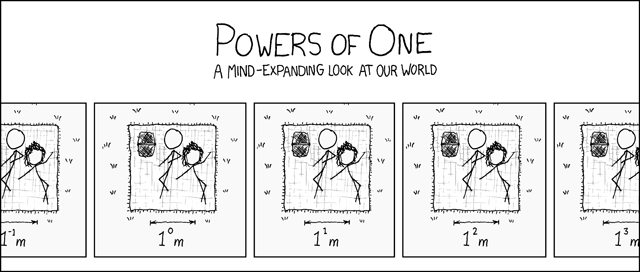
Here’s a tribute to the film that appeared as xkcd #271:

There’s something I occasionally wonder about.  People sometimes say that hearing about the scale of the universe at its largest makes them feel small and unimportant.  On that scale, the earth figures as a minuscule portion of a solar system that is itself a minuscule portion of a galaxy that is in turn a minuscule portion of one of countless clusters of galaxies in the universe.  When I hear that remark, I think about the scale of the universe at its smallest.  Tiny as our world is in comparison with the deepest reaches of the sky, how large do we bulk in comparison with the smallest units of the submicroscopic world?

This flash animation from Cary and Michael Huang, released a couple of days ago as a followup to a similar project they put out in 2010, takes us from the Planck length, which is evidently the smallest size a thing can be, up to what theorists currently suspect is the total size of the universe, which extends at least 7000 times as far as we will ever be able to see.  The latest theories hold that the total size of the universe might be about 1.6 times 10 to the 27th power meters.  That theory may be as mistaken as all the previous theories about the same thing have been, but it’s the best we have going at the moment.   So, if that theory is correct and you were to lay humans end to end, the number of them you would need to stretch from one end of the universe to the other would be 28 digits long.  The Huang brothers note in their animation that the total height of all living humans is much shorter than that, of course; in fact, if we were all to lie down end to end we would only reach about 1o million kilometers, only about 1/15 of the way from the earth to the sun.  Even if all 100,000,000,000 humans who ever lived were to be reincarnated and join us, we would still reach less than 15 billion kilometers, which would barely get us from one side of the Solar System’s Kuiper Belt to the other.

So, compared to the largest scale of structure in the universe, we are indeed quite small.  But let’s take a moment and look at the smallest scale of things in the universe.  The Eameses stopped their exploration at the level of the proton.  In 1968, there wasn’t much point in trying to delve deeper.  Since then, science has made advances.  The Planck length is 1.6 times ten to the minus 35th power meters; so, if you laid the shortest possible objects end to end, the number of them it would take to stretch from one end of your body to the other would be 36 digits long. A 36 digit number is of course bigger than a 28 digit number, vastly bigger.  So our size is much closer to that of the entire universe than it is to that of an object that exists on the scale of the Planck length.  The 2010 version of the Huangs’ flash animation illustrated this dramatically, with a human symbol standing well to the right of the center of the zoom bar. If contemplating the scope of the universe as a whole makes us feel small and insignificant, does contemplation of the Planck length make us feel large and mighty?

Perhaps it does.  If it doesn’t, I can think of two possible reasons.  First, it might be that the feature of astronomy that gives people the feeling of smallness and weakness is not the size of the structures astronomers study, but the fact that those people don’t understand what astronomers are talking about and don’t feel confident in their ability to figure it out.  That sense of smallness is not likely to be relieved when the conversation turns from light-years and dark energy to yoctometers and the quantum foam.

Second, it might be the legacy of monotheism.  When we visualize the universe on the largest scale, we imagine ourselves to be standing outside it, taking it in at a glance.  To minds formed under the influence of a belief in an all-powerful, all-knowing, ever-present Creator God, such a visualization is clearly an imitation of God.  In such an imagination, it shows an awesome power to zoom in and find individual humans, to number the hairs on their heads (between 50,000 and 200,000, according to the Huang brothers) and keep an eye on the sparrow.  On the other hand, to look up from the level of the Planck length may not suggest much to such a mind.  It’s true that medieval theologians like Albertus Magnus and Thomas Aquinas developed ideas about angels as one-dimensional beings who had the power to assume visible form as the situation required; to those titans of Scholasticism, the idea of two-dimensional strings vibrating at the smallest levels of scale in the universe and forming the basis of the physical world might have been extremely interesting.  Still, to the extent that people think about angels today, it’s in terms that neither Albertus nor Thomas would have recognized as rational, or even as Christian.  Aside from a few eccentric philosophers like Massimo Cacciari and the late Mortimer Adler who maintain an interest in the Scholastic conception of angels, the only people who bring them up nowadays seem to be those who believe that the souls of holy people become angels.  For the Scholastics, this would have been rank heresy.  They believed that angels represented an order of creation separate from humans, who may operate within time and space on occasion, but who are not generally subject to the passage of time or extended in three-dimensional space.  Humans, they held, were destined either to be resurrected in perfected bodies, as Jesus had been, or to be cast into Hell.  In either case, we would continue to be three-dimensional beings of something about a meter and a half in height.  I can’t see what motive believers in the Hollywood-derived conception of the afterlife would have for attaching any special significance to a view of the universe that looks up from the smallest scale, and indeed they do not seem to be excited about the submicroscopic world.