Is all social life schooling?

I’ve always read a lot of magazines.  Before we started this blog in June 2007, if I came up with an idea while reading one of them I would sometimes make a note of it in a word processing document.  More often I would just forget about it.  Now I post “Periodicals Notes” in which I make those ideas available here.

Among these old documents I recently found  some speculation triggered by this paragraph on page 23 of The Nation for 19 June 2006: “In his 1964 book Ma’alim fi al-Tariq (Milestones), [Sayyid] Qutb wrote that ‘if woman is freed from her basic responsibility of bringing up children’ and, whether on her own or by pressure from society, seeks to work in jobs such as ‘a hostess or a stewardess in a hotel or ship or air company,’ she will be ‘using her ability for material productivity rather than the training of human beings.’  This, he claimed, would make the entire civilization ‘backward.’”  What intrigued me about this précis was the idea that “the training of human beings” is the activity that separates healthy societies from backward ones.

Augustine of Hippo, in the City of God and the dialogue de Magistro, takes a similar view.  The City of God is a sort of cultural history of the Roman Empire, tracing how various religious ideas have influenced events from the legendary period of the seven kings of Rome up to Augustine’s own day.  Rather than simply dismissing the ideas he disagrees with, Augustine treats them as early stages in the process that would prepare the Mediterranean world for Christian doctrine.  This process of learning involved the whole of Greco-Roman society.  In the dialogue de Magistro, he asks what purposes speech serves, and concludes that every one of those purposes is a form, of teaching.  If all speech is teaching, then all social life must be educational.

Around the same time I read the issue of The Nation with that essay about Sayyid Qutb, I read the  Spring 2006 issue of Telos. That issue includes an article by Aryeh Botwinick called “A Monotheistic Ethics: Ben Zoma’s Mishnah” which finds such a view in the Babylonian Talmud, in Ben Zoma’s comments on the passage “Who is wise?  He who learns from everyone.”  I rather doubt that Sayyid Qutb read the Babylonian Talmud, or Augustine for that matter.  I suspect that Qutb, Augustine, and Ben Zoma came independently to the view that society is above all a place for teaching and learning.

(more…)

Seceding from the Nation

Eric Foner is a major historian of the mid-19th century USA and a regular contributor to The Nation magazine.  In a recent issue, he reviewed two books about politics in the South during and after the Civil War, Stephanie McCurry’s Confederate Reckoning and Victoria Bynum’s The Long Shadow of the Civil War.  This paragraph of Foner’s got me thinking:

McCurry begins by stating what should be obvious but is frequently denied, that the Confederacy was something decidedly odd in the nineteenth century: “an independent proslavery nation.” The Confederate and state constitutions made clear that protecting slavery was their raison d’être. Abandoning euphemisms like “other persons” by which the US Constitution referred to slaves without directly acknowledging their existence, Confederates forthrightly named the institution, erected protections around it and explicitly limited citizenship to white persons. McCurry implicitly pokes holes in other explanations for Southern secession, such as opposition to Republican economic policies like the tariff or fear for the future of personal freedom under a Lincoln administration. Georgia, she notes, passed a law in 1861 that made continuing loyalty to the Union a capital offense, hardly the action of a government concerned about individual liberty or the rights of minorities.

I can certainly understand Foner’s exasperation with neo-Confederates who see the Old South as a proud symbol of liberty and elide the role of slavery in the Civil War.  In the legal documents he cites, the Confederate States of America advertised its cause as the defense of slavery.  In prominent speeches delivered at the outbreak of the war, such southern leaders as Confederate Vice President Alexander Stephens and Confederate President Jefferson Davis said openly that the cause which justified secession was the threat that the newly ascendant Republican Party would free blacks from slavery.  While Stephens and Davis each spent a great deal of time after the war trying to explain his earlier remarks away and argue that he had been motivated by concern for something other than the maintenance of human bondage, it is hardly unreasonable to attach greater weight to the contemporary documents and to say that in the Civil War, the South fought to defend slavery. 

What is less reasonable is to leave it at that, with the implication that the North fought to abolish slavery.  The evidence would suggest that when the United States armed forces were sent to quash secession, the men who sent them had little interest in emancipating anyone.  Emancipation came later, propelled by the exigencies of war.  As Davis and Stephens would shift their public statements from prewar calls to defend slavery to postwar invocations of the rights of the states, so too did the leaders of the North change their stands very substantially as the war went on.  The most obvious example may be the contrast between Abraham Lincoln’s two Inaugural Addresses.  Lincoln delivered his First Inaugural Address in March of 1861, when the war had not yet broken out.  The Second Inaugural Address was delivered in March of 1865, a few weeks before the end of the war.  Lincoln spends much of the First Inaugural Address vowing to enforce the Fugitive Slave Act and leave slavery alone in all the states where it was a legal institution.  In the Second Inaugural Address, he looks back on the war as a struggle to emancipate the slaves and declares that it would only be just were God to decree that the war should “continue until all the wealth piled by the bondsman’s two hundred and fifty years of unrequited toil shall be sunk, and until every drop of blood drawn with the lash shall be paid by another drawn with the sword.” 

In the First Inaugural, Lincoln capitulates to every demand the South could possibly make in regard to slavery.  Time and again, of course, Lincoln would declare his belief that people whose ancestors came from Africa could not live among whites except in conditions of subjugation, and he rarely missed a chance to distance himself from Abolitionists.   These facts do not mean that the South was not fighting to keep blacks enslaved.   Seeing that the Republicans, a party which did include a sizeable antislavery bloc, could elect as president a candidate who did not receive a single vote in the ten states south and west of Virginia, slaveholders might well have drawn the conclusion that their grip on the national government was permanently broken and that some future president would lead the push for abolition.  While Lincoln himself might not in 1861 have had the inclination to take that task on, proslavery southerners may well have thought that it would have been unwise to wait for the crisis they feared.

What the First Inaugural does show, however, is that whatever the South may have been fighting for, the North was not at the outset of the war fighting against slavery.  Why did the North fight to keep the South in the Union?  Why for that matter did so many Northerners vote for Lincoln when it should have been clear that the election of a purely regional candidate would trigger secession?  I suspect Foner’s dismissal, in the paragraph above, of the tariff as a cause for the war applies only to the motivations of the South.  The South opposed a protective tariff because it wanted equal access to the products of industry in the North and in England.  Indeed, the South wanted Northerners to bid competitively with English interests for Southern cotton.  Since the chief goal of US policy since 1776 had been to get the British out of North America, the idea that the southern states of the USA would form an economic relationship with English industry that might very well lead to their absorption into the British Empire could hardly be expected to meet with general approval in the rest of the country.   

The Second Inaugural is among the most widely read of all Lincoln’s writings, certainly the most widely read of his state papers.  That is no surprise.  Not only is it an extraordinary specimen of eloquence, but it also flatters Americans’ national self-esteem.   The Second Inaugural caters to Americans who want to look at the Civil War and see a moral awakening to the evils of human bondage and to the possibility that black and white might live together in equality.  Beyond that; it also allows us to cast that moral awakening as a drama in which our enlightened twenty-first century selves have the leading role.  The Civil War, Lincoln invites us to believe, was fought so that later generations of Americans could be untainted by the guilt of slavery.  In other words, the dead had to die, so that we could look down on them.

If, instead of reading the Second Inaugural and congratulating ourselves on our superiority to our ancestors, we Americans read the First Inaugural and put the Civil War in the context of international Realpolitik, we might shed some of our national narcissism and be warier next time some group of con artists try to sell us another war.  We wouldn’t necessarily be any less proud of our country- opposing the British Empire was a mighty project in the eighteenth and nineteenth centuries, and it isn’t every country that would have the patience to stick with such a project until the UK’s prime minister openly declares his country to be the USA’s junior partner in world affairs.  But we might learn to express pride in our country without pretending that the country itself has some divine commission to institute a world order based on pure justice.

The Political Stupidity Index; or, What separates the USA from the world to its south

Some US presidents not powered by petroleum

The July issue of Counterpunch just showed up in my mailbox; I suppose I could have read it weeks ago if I subscribed to the email version rather than the paper-and-ink one.  If I did that, however, I wouldn’t be able to leave old copies in laundromats and doctor’s offices and wonder who is getting a shock from them. 

There are three pieces remembering the late and much lamented Ben Sonnenberg, founder of the (alas, equally late and much lamented) literary quarterly Grand Street and a longtime eminence of the American Left.  I want Alexander Cockburn and Jo Ann Wypijewski to write my obituary.  As they went on about Sonnenberg’s historical greatness, profound learning, unfailing humility, inexhaustible compassion, and cheerful lovable-ness, I started to wonder why he hadn’t risen from the tomb on the third day.  Still, they do show that Sonnenberg devoted his life to celebrating and advancing the achievements of the human intellect, and that he was fearless in bringing reason to bear when entrenched interests intimidated others into accepting the official story.  

Two muckraking pieces tackle official stories which claim that the US government protects its citizens from menaces approaching the country from the south.  Jeffrey Saint Clair’s “How BP and the Obama Administration Have Been Joined at the Hip” tells how Mr O has overseen “a profound bureaucratic lethargy that ceded almost almost absolute control over the response to the spill to BP.”  While he might have invoked powers under the 1968 National Contingency plan and “seized control of both the well and the cleanup operations,” leaving BP’s officers with nothing to do but “sign checks for billions of dollars,” Mr O in fact sidelined all advisors who showed any sign of independence from the oil giant, instead relying on former lobbyists for and executives of BP.  The administration did little to nothing to contain the damage the leak would do to the Gulf coast, its wildlife and fisheries, but a great deal to help BP contain the damage to its public relations.  Most of Saint Clair’s facts are also reported in this Rolling Stone piece.   

Frank Bardacke’s “Why the Border Can Never Be ‘Secured'” introduces the phrase “the Political Stupidity Index,” which Bardacke defines as “the difference between the words politicians say and the way we actually live.”  Bardacke argues that the national debate about immigration registers a remarkably high level of this sort of stupidity, taking it to a level where “the words at the top have nothing to do with life at the bottom.”  “Despite what may be said in the public debate, people know there is no way to stop Mexicans coming to the USA, as long as Mexico remains poor and the USA relatively rich,” writes Bardacke.  More enforcement at the border only means more corruption among border patrol agents and more power for criminal enterprises that have set out “to make border crossing a big, corporate business.”  Amnesty for undocumented workers, whether marketed under the label “a path to citizenship” or under some other brand name, will only increase the rate of illegal immigration, as the upsurge in immigration after 1986 legalization definitively proved.  Guest-worker programs are “a bad idea all around,” as the experience of the Bracero Program showed.  By the mid 1960s, the poor working conditions to which braceros were subjected had raised the ire of liberals who objected to the program because it was a form of indentured servitude, while conservatives were alarmed by number of braceros who left their places of indenture to blend into the general population of the USA. 

I’m not at all sure Bardacke is right that the border cannot be “secured.”  Israel has certainly shown that walls can keep highly motivated people from crossing borders, and enforcement of citizenship requirements at points of employment need not be any more difficult than enforcement of laws  that require employees to be at least a particular age or paid at least a particular wage.  In order to implement those measures, the US government would have to confront the people who profit from the current system.  Considering the absurd timidity our current government has shown in its dealings with BP, it is rather difficult to imagine a future government that would be prepared to take on all the interests that benefit from keeping US wages from rising too far above the Mexican average.  Difficult though it may be, it is hardly impossible that such a thing might happen, and therefore unjustified to say that “the border can never be ‘secured’.” 

Whether it should be secured is of course another question.  If a government ever does come to power in the USA that has the backbone to stand up to the low-wage lobby, that government would likely be the result of a profound change in the country’s whole political culture.  If that change ever does come about, it might reveal more attractive possibilities for the US-Mexican economic relationship than fortifying the border and adding a new layer of policing in employment.  Maybe if working people get hold of real political power they will find ways to work together to develop the US and Mexico in tandem, rather than submitting to policies that exacerbate economic inequality and hollow out industry on both sides of the border.

What James K. Polk Knew

President James Knox Polk

I’ve long tended to look at American history and see in the presidency of James Knox Polk (1845-1849) the origin of a great curse.  President Polk led the United States into war with Mexico.  In consequence of that war, the United States forced Mexico to cede its claims on all territory north of its present boundaries.  The US victory was quick and easy; for a loss of about 13,000 soldiers, the USA gained an internationally undisputed claim to almost a million square miles of territory, stretching from the Missouri River to the Pacific Ocean.  Americans would flood into this territory, displacing and slaughtering the native peoples on whom the Mexicans had made so little impression during their years of nominal rule.  Northern and Southern states vied with each other for influence over this newly secured territory, a contest that laid the political groundwork for the Civil War twelve years later.  As the USA’s first successful attack on a sovereign nation, the invasion of Mexico crossed a psychological boundary which previous attacks on native peoples and British possessions had left in place.  Moreover, the relatively low cost and fantastically rich rewards of the US victory fed in Americans the cannibal appetites of militarism.  So the curse that I have seen as the legacy of the Polk administration includes nearly all of America’s subsequent wars.    

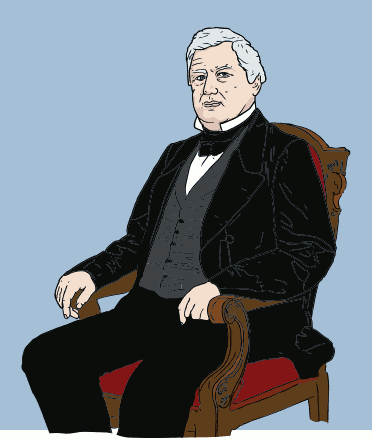
President Polk represented the Democratic Party; his chief opposition was the Whig Party.  I’m a bit of a Whig myself, which is one reason why I chose a cartoon image of Millard Fillmore as my WordPress avatar.*  Leading Whigs like Fillmore spoke out against the invasion of Mexico.  The Whig-dominated Massachusetts legislature passed a resolution during the war denouncing the US effort as the result of a criminal conspiracy to extend slavery into the West.  When Polk claimed that Mexico’s hostile greeting to a US cavalry column he had dispatched into Mexican territory between the Rio del Norte and the Nueces somehow constituted an act by which “American blood was shed on American soil,” Illinois’ Whig Congressman Abraham Lincoln introduced a resolution into the US House of Representatives demanding that the president show the Congress the spot on which this had occurred.  The so-called “Spot Resolution” had the support of the congressional Whig party, and made Lincoln a national figure.  Among future President Lincoln’s colleagues in the House was former President John Quincy Adams.  Technically an independent, Adams was a hero to the Whigs, a friend to Whig Party mastermind Henry Clay, and a reliable supporter of the Whigs’ core policies.  Adams would collapse on the House floor and die in the Capitol; virtually his last earthly act was to vote against a resolution commending US veterans of the war against Mexico.  Many young Whigs who fought in the war would afterward match their elders in the fervor with which they denounced it; Ulysses S. Grant, for example, would write in his memoirs that as a young captain he had won his medals as a perpetrator of “the most unjust war ever waged.”     

The Whigs championed industrialization.  They saw economic centralization as indispensible to industrialization.  Therefore, they were allies of big business and generally sympathetic to established elites.  As such, they would have to be called a conservative party, and their opposition to the war against Mexico would qualify them, if only for the duration of the Polk  administration, as specimens of the antiwar Right.  Chronicles magazine is a voice of today’s antiwar Right, but not of renewed Whiggery.  Their July issue included a review of Robert W. Merry’s A Country of Vast Designs: James K. Polk, the Mexican War, and the Conquest of the American Continent which praises Merry for making a case that Polk was right.  Since I’m so far out of sympathy with Polk and his war, I will quote at length from this review:

Here is the geopolitical reality that Polk grasped.  In the 1840’s, the western third of the North American continent was in play.  The players were the United States, Great Britain, Russia, and Mexico.  Each claimed some portion of that vast territory.  Polk understood that the question was not which of those claims was most legitimate (who, after all, would decide that?),  but which of the four powers had the means and will to enforce their own claims.  Mexico did not.  She “was a dysfunctional, unstable, weak nation whose population wasn’t sufficient to control all the lands within its domain.”  Bernard deVoto made the same point two generations ago:

[I]t is a fundamental mistake to think of Mexico in this period, or for many years before, as a republic, or even as a government.  It must be understood as a late stage in the breakdown of the Spanish Empire. 

There was no stability or institutional legitimacy in Mexico.  Revolution followed revolution, coup succeeded coup.  Mexican governments could neither govern, protect, nor populate the country’s far northern provinces.  That incapacity was most obvious in New Mexico, where the people were oppressed by taxes and terrorized by Indian raids, and consequently not inclined to fight in its defense.  Thus did Gen. Manuel Armijo’s army of conscripts flee at the approach of the Americans.  Col. Stephen Watts Kearney’s army of frontier dragoons and Missouri volunteer cavalry took Santa Fe without a fight.   

There are some good points in this.  What Mexico ceded to the USA in the Treaty of Guadalupe Hidalgo was not land that was populated by people loyal to Mexico and protected by its government, but was instead a claim on territory chiefly inhabited by native people who were barely aware of the existence of Mexico.  It is not too harsh to say that by 1846 Mexico had failed to make good on this claim.  And it is also true that in the mid-1840s Russia and Britain were both very active in the nortwestern parts of North America.  So if Polk had lost 1844 election to Whig nominee Henry Clay, and Clay had as president refused to make war on Mexico, then there would have been a considerable likelihood that instead of confronting each other in a the Crimea in 1854-1856 Britain and Russia would have had their showdown in San Francisco Bay.  But I’m still not for the Mexican War.        

*Here’s the cartoon Fillmore, for those of you who’d like a look:

Ambrose Bierce and The Man Without Illusions

Several weeks ago, The Nation ran a review-essay about Ambrose Bierce.  A few days before happening on this piece, I’d my old Dover Thrift Edition collection of Bierce’s Civil War stories, a paperback I’d bought for a dollar in 1996 and had been meaning to read ever since.  I was interested in the reviewer’s remarks about one of those stories in particular:

In another powerful story, “The Affair at Coulter’s Notch,” Bierce writes of a face-off between two batteries of well-fortified Confederate cannons, twelve in total, and a single Union cannon crew led by Captain Coulter. Coulter’s crew is forced into an open notch and ordered to engage in a firefight just because a general in the field wants to see if the stories of Coulter’s bravery are true. Though Coulter hesitates, he follows the order. He and his crew wheel one cannon out to the notch and commence firing. Soon the twelve Confederate cannons respond and the two sides are lost in the thunderous explosions and enormous clouds of artillery smoke. Each time one of Coulter’s cannons is destroyed, his crew wheels a new one up to the notch so the fight can continue. Eventually the Union officers ride up to the notch to check on Coulter and his men:

Within that defile, barely broad enough for a single gun, were piled the wrecks of no fewer than four. They had noted the silencing of only the last one disabled—there had been a lack of men to replace it quickly with another. The debris lay on both sides of the road; the men had managed to keep an open way between, through which the fifth piece was now firing. The men?—they looked like demons of the pit! All were hatless, all stripped to the waist, their reeking skins black with blotches of powder and spattered with gouts of blood. They worked like madmen, with rammer and cartridge, lever and lanyard. They set their swollen shoulders and bleeding hands against the wheels at each recoil and heaved the heavy gun back to its place. There were no commands; in that awful environment of whooping shot, exploding shells, shrieking fragments of iron, and flying splinters of wood, none could have been heard. Officers, if officers there were, were indistinguishable; all worked together—each while he lasted—governed by the eye. When the gun was sponged, it was loaded; when loaded, aimed and fired. The colonel observed something new to his military experience—something horrible and unnatural: the gun was bleeding at the mouth! In temporary default of water, the man sponging had dipped his sponge into a pool of comrade’s blood.

The cannon drooling blood is certainly a memorable image, and as I read the story I was sure it would be the detail that stayed with me.  By the end, however, even that horror has been put into the shade.  At first we think that Captain Coulter’s commanding officer sent him to that desperately exposed position and ordered him to shell the house opposite simply because he “wants to see if the stories of Coulter’s bravery are true.”  Then one officer tells another that Coulter was a southerner who had left his family behind Confederate lines to join the Union army.  He goes on to report a rumor that the commander had led an occupying force that patroled the area where Coulter’s family was.  This rumor held that the commander had made advances to Coulter’s wife.  She rebuffed him, and the officer wonders if that was why the commander put Coulter in such danger.  By the end of the story, even this grotesque idea is shown to be short of the full horror of the situation. 

The Nation‘s reviewer quotes Bierce’s definition of “realism” from The Devil’s Dictionary as “The art of depicting nature as it is seen by toads.”  This quote is at the center of a little disquisition on Bierce’s use of improbable events in his fiction.  The last two paragraphs of the review sum this disquisition up:

Bierce often resorted to horror, whether grisly war stories or even supernatural tales, but he didn’t do this to avoid writing about reality; he used the genre to confront the truths of his day—the monstrosity of battle, the terror of extinction.

Read Bierce and try not to think of soldiers fighting in Iraq and Afghanistan. Read Bierce and consider the ways “probability” can be a poor test; sometimes realism just fails. Every era needs a genre through which it understands itself. We are living in the age of the uncanny once again. Time to testify.

This point is very close to something that came to my mind while I was reading that collection of Bierce’s Civil War stories.  The stories are full of wildly improbable events; random shots fired at distant enemies can be relied upon to kill the gunners’ fathers, brothers, wives.  Bierce presents these freak occurrences not to undercut the sense of his stories’ reality, but to emphasize their truthfulness.   

What truth does Bierce want us to think fills his stories?  I think it is the same truth that was publicized almost two decades ago, when a hit movie was advertised with an image of a Marine colonel shouting “You can’t handle the truth!”  Even though the movie passed through theaters in 1992,  a Google search for “You can’t handle the truth” restricted to results that went up this week draws over 16,000 hits.  I wonder if the resonance of that line and the power of Bierce’s stories don’t combine to show that there is an idea at large in American culture of truth as something necessarily violent, of war as the ultimate truth.  If so, the colonel in the movie and the highly decorated Civil War veteran Bierce would both figure as men with a privileged access to truth, as warriors who had seen the heart of battle. 

(more…)

No one was barred from the conversation back when there was a conversation

Three paragraphs from Bill Kauffman’s column in the latest issue of The American Conservative:

The War Party called the Peace Party Nazis in 1941, Communists in 1951, Soviet dupes in 1961, dirty hippies in 1971 … must I go on? In 2011, those who heed George Washington’s counsel to seek “peace and harmony with all” will be called mullah-headed appeasers of Irano-fascism.

[snip]

Blame war. Blame TV. Blame the nationalization of political discourse, as regional variations and individual peculiarities are washed away by the generic slime of poli-talk shows. Radicals—even naïve Tea Partiers or idealistic left-wing kids—are dehumanized in ways unthinkable when America was a free country. No one was barred from the conversation back when there was a conversation. No dispatch ever read, “Wingnut Henry David Thoreau today issued a manifesto from his compound near Walden Pond…”

[snip]

The squeezing out even of establishment dissent—especially since 9/11—has left us with an antiwar movement so feeble it makes the Esperanto lobby look like the AARP. Enter the new organization Come Home, America, its name taken from the magnificent 1972 acceptance speech delivered by George McGovern in the last unscripted Democratic convention.

I don’t agree that there was ever a time in the USA when “no one was excluded from the conversation”; when Thoreau published Walden in 1854, after all, chattel slavery existed in 15 states, women’s suffrage in none, and the one thing every US voter could support was war against Native Americans.  That said, Come Home, America and its goal of a left-right coalition against militarism seem to be worth a cheer or two.

Some hide themselves, and some are hidden; some are forgotten, and some forget themselves

July’s issue of The American Conservative features a piece by Sydney Schanberg arguing that American prisoners of war were left over in Vietnam after direct US involvement in the war there ended in the early 1970s.  Several other pieces pick up on Schanberg’s claims, drawing various dire conclusions about the nature of the political leadership in the USA.   

In October 2008, The Nation ran an article in which Schanberg made this same case.  I noted that article here, remarking that I had never given that idea much credence, but that I was impressed by what Schanberg wrote.  Amid the pro-Schanberg pieces in this issue of The American Conservative is a short article by Gareth Porter titled “The evidence doesn’t stack up.”  Unlike the readers who wrote The Nation to protest the appearance of Schanberg’s piece there , Porter does not list his credentials as a scholar of the US military involvement in Vietnam.  Also unlike them, he does not declare himself to be displeased that the topic is being discussed.  Most profoundly unlike them, he looks at Schanberg’s evidence and judges it on its merits.  Indeed, the only way in which Porter resembles the outraged letter writers of The Nation is that he finds Schanberg’s case entirely unconvincing.  Porter argues that the document to which Schanberg has attached the greatest weight is almost certainly a forgery, and in any case doesn’t say what Schanberg claims it says.   Porter goes on to find many other faults with Schanberg’s argument. 

Something that is, I think, quite well-founded appears in Andrew Bacevich’s contribution to the discussion:

Like slavery or the Holocaust, Vietnam is part of the past not yet fully consigned to the past.

The practice of publicly displaying the POW/MIA flag testifies to this fact. On the one hand, it represents a lingering communal acknowledgment of loss and more broadly of massive national failure. On the other, it sustains the pretense—utterly illusory—that a proper accounting, not only of the missing but of the entire Vietnam experience, is still forthcoming. “You deserve to be brought home,” the flag implicitly states, “And we deserve to know why you were sent in the first place.”

Yet to undertake a serious accounting would find Americans facing a plethora of discomfiting truths, not only about the knaves and fools who concocted the Vietnam War but about the American way of life and the premises on which it is based. Tell the whole truth about Vietnam and you crack open a door that few Americans wish to peer behind. To do so is to come face-to-face with troubling questions about the meaning of freedom and democracy as actually practiced in the United States.

Few Americans are willing to confront such questions, the answers to which could oblige us to revise the way we live. So we salve our consciences by flying flags, sustaining the pretense that we care when what we desperately want to do is to forget as much as possible.

In the same issue, Paul Gottfried finds it odd that many Americans who stand on the political Right are so fond of calling their opponents “fascists” and of claiming that fascism was a left-wing movement.  Gottfried is himself very, very conservative in his politics.  Much as he might like to disassociate himself and his fellow Rightists from the taint of fascism, Gottfried also has a scholarly reputation and a lifetime of intellectual integrity, both of which he would like to preserve.  Gottfried lists a number of facts which, he says, make it impossible for a serious person of any disposition to see fascism as anything other than a phenomenon of the extreme Right, and ridicules those who disregard these facts.    

If the idea of fascism as a leftist movement is so ludicrous, why does it have so much support among American right-wingers?  Gottfried gives four possible reasons.  First, Leftists who keep their cool when they are accused of being Communists or utopians tend to sputter and look silly when they hear themselves being called fascists.  While this might be fun for conmservatives who are frustrated to meet opponents who don’t take their ideas seriously, Gottfried says that “only a cultural illiterate could believe that interwar fascists were intent on pursuing a massive welfare state centered on the achievement of social equality, with special protection for racial minorities, feminists, alternative lifestyles, and whatever else the latter-day Left is about.”    

Second, some American right-wingers in the 1930s “had a very limited understanding of the European Right or the European Left” and so “made the unwarranted leap from thinking that all forms of economic planning were unacceptable to believing that all were virtually identical.”  Thus they came to believe that the New Deal of Franklin Roosevelt, the Five-Year Plans of Stalin, and the corporatism of Mussolini were three names for the same thing.  Those thinkers started a tradition that is still alive and well in some circles in today’s USA. 

Third, the use of “fascism” as an all-purpose term of abuse represents an appeal to the argumentum ad Hitlerem, in which any resemblance between one’s opponent and Adolf Hitler, no matter how superficial or strained, is treated as if it released one from the obligation to answer that opponent’s claims.  Fourth, by attempting to brand what Gottfried calls “the latter-day Left” as fascist, the latter-day Right can pretend to be more different than it in fact is from its opposition.  

I can think of a fifth possible reason.  American economic analyst Lawrence Dennis became notorious in the 1930s and 1940s for a series of books in which he argued that market-driven capitalism was doomed, and that representative democracy would go down with it.  The economic system of the future, Dennis decided, was one in which capitalists retained nominal ownership and day-to-day control of the means of production, but government coordinated their activities.  The political system that would go along with this corporatist economy might be dressed up to look like a democracy, but would in fact be dominated by an elite that would remain in power regardless of the outcome of any elections that might be held.  To keep the public in support of this system and to keep the money supply from contracting, the elite would likely encourage an attitude of militant nationalism and a warlike foreign policy.  This system Dennis called fascism. 

 Dennis consistently said that when fascism came to America, it would not be called by that name.  Rather, it would be marketed as a new form of democracy, as the very antidote to fascism.  He predicted that he himself would be among the first dissidents prosecuted once the USA had become fascist.  Indeed, in 1944 Dennis was put on trial for sedition.  The prosecution collapsed, and Dennis wrote a book about it

In his 1969 book Operational Thinking for Survival, Dennis reviewed the arguments he had made in the 1930s and early 1940s.  He concluded that his predictions had been substantially correct.  Avoiding the word “fascism,” he wrote that our current political and economic system “is one that has no generally accepted name.” 

So, perhaps the reason Left and Right are so eager to fling the word “fascism” at each other is that each is haunted by the fear that it is powerless to keep the country from becoming fascist.  For all that Rightists might long to restore the Old Republic and Leftists might long to create a new system “centered on the achievement of social equality, with special protection for racial minorities, feminists, alternative lifestyles,” each looks on helplessly as events make a mockery of these ambitions.  Whatever success each side might have in its attempts to promote its vision of freedom, the movement towards fascism goes on relentlessly.

A place for everyone

Laws against prostitution are usually supported by people who want to help women break free of men who are coercing them into that line of work.  When one asks why it is that such laws usually include criminal penalties for the very women they are supposed to help, the answer is often that only when police and prosecutors have such penalties to use as threats can they be sure that women will turn against their exploiters. 

In practice, those laws often seem to have the opposite effect.  Arrested, a woman needs money to make bail.  If she is under the influence of a pimp, she will likely call him or an associate of his.  Labeled a criminal, she will find it no easier than it was before the police picked her up to find other employment.  So, the law which may have been advertised as a way of helping her find a way out of prostitution may in its actual operation push her deeper into it.  The law marks prostitution as her place and acts to keep her in that place.

What reminded me of this was a column by Katha Pollitt in the 14 June 2010 issue of The Nation.  Pollitt does not mention prostitution, but mentions a set of proposed laws that seem to be designed to work the same way: bills pending before the French and Belgian parliaments that would prohibit Muslim women from wearing headscarves, face veils, or other garb traditional to women of their persuasion.  Like laws against prostitution, these bills are marketed as means to pry women loose from men who are coercing them into a demeaning way of life.  Also like those laws, the bills include penalties against the women themselves.  Pollitt expresses the fear that men who are in fact coercing women who live with them into covering up more than they would like would respond to a ban by keeping them from going out at all; surely this fear is well-founded.  Moreover, whether a woman wears the veil freely or under compulsion, the threat that if she does go out the police will arrest and search her, then take the men of her family into custody and threaten her with criminal sanctions unless she gives information against them will hardly convince her that France is her home and the Franks are her ancestors.  Quite the contrary, I should think; with such a threat looming in the background, even a woman who would not have been likely to cover up otherwise might feel herself a traitor to the only community that really wants her unless she does put on traditional Muslim attire. 

In the same issue, a number of experts argue that the direction education policy has been taking in the USA in the last 20 years has been gravely counterproductive.  I only wanted to note one of these, by Linda Darling-Hammond of Stanford University’s education school.  Darling-Hammond looks at the country-by-country league tables for average student achievement in various subjects, pointing out that American students were not performing especially well in 1989 and that their average performance has been declining ever since.  In some subjects, the decline has been steady, in others catastrophically rapid.  Meanwhile, American schools have become more thoroughly segregated by race, the number of subjects offered has shrunk, and the prison population is booming.  Darling-Hammond not only points out these evils; she also  gives examples of countries where the same years have seen movement in the opposite direction.  While the current system tends to lock students into whatever social position they inherited from their parents, Darling-Hammond argues that it is still possible for public education to open doors for social mobility.

Movement from one social status to another often comes in tandem with physical movement from one place to another.  A review of a couple of books about African American history, under the title “Movement and Rootedness,” discusses ways in which the theme of migration has reshaped thinking about that subject in recent years.  It includes a quote from scholar Ira Berlin: “The history of the United States rests upon movement, and then embrace of place.”  The new scholarship on which the review focuses finds ways in which African Americans managed to embrace some places that would strike most of us as quite unembraceable.  While the integrationist story that has been the academic orthodoxy since the 1960s tends to reduce African American history to the relationship between African Americans and whites, so that relationships among African Americans are pushed into the shadows, the new scholars want to find out what sort of communities African Americans built for themselves even during the grimmest days of slavery and Jim Crow.

Designed to fail

Jeffrey Reiman

The June 2010 issue of the ultra-conservative Chronicles magazine contains this paragraph, in a column by Philip Jenkins:

The concept of “designed to fail” was formulated back in 1979 in an influential study by leftist scholar Jeffrey Reiman entitled The Rich Get Richer and the Poor Get Prison.  Following Marxist theory, Reiman argued that the goal of the criminal-justice system was not to suppress crime but to promote and sustain acceptable levels of social misbehavior, with the aim of enhancing the power and resources of official agencies.  Crime, in short, is useful, even essential, for the preservation of state power.  Reiman was not postulating a conspiracy theory but exploring the dynamics of agencies charged with tasks that were literally impossible.  Yet rather than being discredited or disheartened by their failures, agencies stood to benefit mightily from them and actively sought out still more absurdly quioxotic challenges.  They were in a no-lose situation. 

This description reminds me of an idea I’ve sometimes tried to express.  In a representative democracy, political power is in the hands of the electorate, yet the electorate consists almost entirely of people who are in no position to know what the state is doing.  If the government undertakes a program meant to discourage certain crimes, the most the majority will now about this program is that it represents a campaign to fight crime.  Even if this program is an absolute success in rational terms, and entirely eliminates the crimes it was aimed at discouraging, the public will observe that other crimes still go unchecked.  The electorate, therefore, will count the program as a failure.  

Because of these disparate perceptions, advocates of increased state power find themselves in a position to appeal simultaneously to political insiders and to the public at large.  Insiders may respond to the fact that the program succeeded in its actual goals, and support future programs to pursue other goals.  The public at large will focus on the program’s imagined failures, and demand a more aggressive program to make good on promises that they suppose the first program to have made.  As a result, the degree of police authority and other sorts of bureaucratic domination tends to ratchet ever upward as a representative democracy develops.  When this idea first popped into my head a while back, I thought of labeling it “the authoritarian spiral.”  I was disappointed to find that political scientist Ian Loader had already coined the phrase “authoritarian spiral,” with another meaning, a few years before.  So I started calling it “the authoritarian ratchet effect,” which is admit not at all catchy.   

To prevent this ratchet effect from transforming a representative democracy into a despotism, I call for a revival of direct democracy.  People who are actively involved in drafting, approving, and carrying out particular laws are likelier to have an idea what can reasonably be expected of those laws than are people whose only involvement in that process is the right to cast one vote out of 100,000,000.

The Atlantic, June 2010

Several interesting pieces this time:

How the private sector could build railways again, and save neighborhood life in the USA in the process

Mark Bowden explains the Conficker worm and the threat it may represent to computers on and off the internet. 

A piece on the revival of some centuries-old recipes for mixed drinks at fashionable bars in London.  The “shrub” sounds alarming, but might be delicious. 

There are lots of witchcraft trials in the Central African Republic; here‘s an attempt to see the bright side of that state of affairs.

Benjamin Schwarz isn’t impressed with the “New Urbanism,” and tries to dismiss the reading of Jane Jacobs’ works that has inspired many in that movement. 

Michael Kinsley adds a column to the already enormous amount of coverage given to the political movement known as the “teabaggers.”   This paragraph contributes something of value to the discussion:

“I like what they’re saying. It’s common sense,” a random man-in-the-crowd told a Los Angeles Times reporter at a big Tea Party rally. Then he added, “They’ve got to focus on issues like keeping jobs here and lowering the cost of prescription drugs.” These, of course, are projects that can be conducted only by Big Government. If the Tea Party Patriots ever developed a coherent platform or agenda, they would lose half their supporters.

I suspect Kinsley is right and “Big Government” is needed to keep jobs in the USA and lower the cost of prescription drugs, but the big government we actually have doesn’t seem to be geared to accomplishing either of these goals.  Quite the contrary, in fact. 

James Parker tries to find something interesting to say about pop star Lady Gaga.  I don’t think he succeeds, but I do think that it’s a waste that someone who is not a drag queen has monopolized the name “Lady Gaga.”