
A website devoted to the preservation and revival of very obscure English words.
All posts in category Language
Save the Words
Posted by acilius on April 15, 2009
https://losthunderlads.com/2009/04/15/save-the-word/
Strict Police
Another funny item via Language Log.
Posted by acilius on February 24, 2009
https://losthunderlads.com/2009/02/24/strict-police/
Bush Jr. Ends Illegal Occupation of White House
January 20, 2009

ladybunny.net
Posted by CMStewart on January 20, 2009
https://losthunderlads.com/2009/01/20/bush-jr-ends-illegal-occupation-of-white-house/
It’s Greek to Me
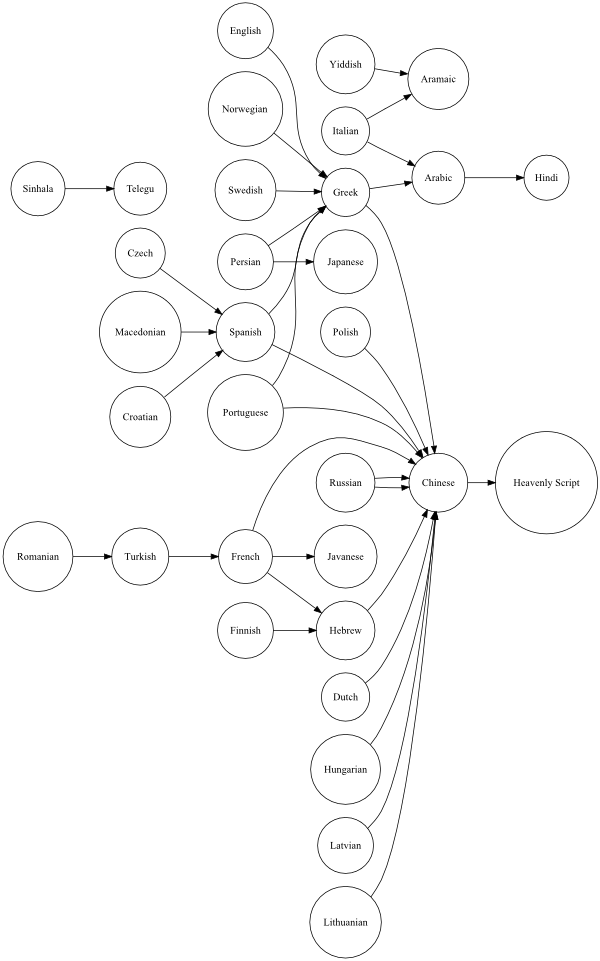
What it is to me
The chart above illustrates a post on Language Log about expressions of the form “It’s Greek to me.” As you can see, in Greek expressions translated as “It’s Arabic to me” and “It’s Chinese to me” are attested in the sense “I can’t understand it at all,” while in Arabic we find an expression “It’s Hindi to me” and in Chinese “It’s Heavenly Script to me” with the same sense.
I’m surprised they didn’t find “It’s Czech to me” anywhere. Czech is apparently famed throughout central and eastern Europe as a particularly forbidding language. Questions about “simplicity” and “complexity” in language structure have been kicked around on Los Thunderlads before, in a desultory way; in the post I’m linking to here, Language Log cites a scholarly discussion of that very question.
Posted by acilius on January 17, 2009
https://losthunderlads.com/2009/01/17/its-greek-to-me/
Words with nonpejorative technical uses and nontechnical pejorative uses
There are some words which have both a technical meaning in some field of study and a pejorative meaning that is more widely known. A notorious example is “Negro,” which now tends to be used as a slur in colloquial English but which physical anthropologists still use because none of the alternatives captures the meaning they need to express. Another example would be “cult.” In the study of religion, “cult” is the rites and practices of a particular group. A scholar of religion could refer to any faith group as having a “cult” in this sense and be confident that no one would take offense. Of course, there’s also the pejorative sense of “cult,” a sect considered false or extreme.
The word “essentialism” is at the head of a whole category of examples. Some philosophers hold that each entity in the universe has a number of qualities, that some of these qualities are more important to the entity than others, and that human reason is capable of distinguishing the more important qualities from the less important ones. This view is called essentialism. Essentialism in this sense is a perfectly respectable philosophical position, and from the days of Plato and Aristotle down to the present it has consistently commanded the allegiance of many eminent thinkers. Few would claim that these thinkers have proven beyond doubt that essentialism is true, but it is certainly plausible. Indeed, while virtually anyone who has read a little Plato can put up a reasonable case for essentialism, it takes a considerable philosophical background to make a sensible case against it.
The same word is used in a different, though related sense. Many postmodernist thinkers use the word “essentialist” as a sort of curse word. In their parlance, “essentialist” often seems to mean something like “stereotyped” or “inattentive to details.” The “essentialism” they invoke seems to be an image of a person who slaps hasty definitions on categories, assigns other people to those categories, and proceeds to interact with the people as if the only qualities they had were those that defined the categories to which they were assigned. So, someone who decides to equate “ukuleleist” with “weirdo who doesn’t want to grow up” might meet someone who plays the ukulele and insist on always and only treating that person as a weirdo who doesn’t want to grow up. Sociologists among you will be reminded of the role of labeling in social relationships, but I think you can see that this use of the word “essentialism” is a gross caricature of the philosophical position I sketched above.
The names of many philosophical schools and positions have been subjected to this kind of semantic shift. So the ancient Epicureans argued that pleasure was a positive good; their opponents transformed their name into a synonym for “gourmand.” The Stoics argued that a right understanding of nature’s laws would free the mind from fear; now we say “stoic” when we mean “unemotional.”
Posted by acilius on December 29, 2008
https://losthunderlads.com/2008/12/29/words-with-nonpejorative-technical-uses-and-nontechnical-pejorative-uses/
Bernd Dombrowski Wishes You a Merry Christmas from the Bottom of His Heart
Posted by CMStewart on December 25, 2008
https://losthunderlads.com/2008/12/25/bernd-dombrowski-wishes-you-a-merry-christmas-from-the-bottom-of-his-heart/
Drifters vs Passersby
Canadian commentator Colby Cosh calls attention to the way the word “drifter” is used in news reports. A “drifter” is always up to no good, usually a serial killer. “Here’s a headline you will never see: “HEROIC DRIFTER SAVES FIVE FROM FLAMING BUS”.” Someone who performs an admirable deed ceases to be a drifter and becomes a passerby.
Posted by acilius on December 18, 2008
https://losthunderlads.com/2008/12/18/drifters-vs-passersby/
Virgins of various sorts
 At Language Log, Arnold Zwicky has posted two remarks about expressions of the sort “x virgin,” meaning someone new to x, whatever that x may be. In his first post, Zwicky gives some examples, some very incongruous such as “Pippi virgin” meaning “someone has has not yet read the Pippi Longstocking books.” He first defines “x virgin” as “someone who has not yet experienced x,” then immediately concedes that this definition is not adequate. “An Astaire virgin, for instance, is not really someone who hasn’t experienced an Astaire, but refers to experience with something involving a particular Astaire (Fred and not Adele), namely the experience of watching movies starring Fred Astaire.” The expression “x virgin,” Zwicky explains, is like other noun-noun compounds in that the relationship between the two nouns can be quite complex and indirect, a topic dealt with elsewhere on the same blog. In his second post, Zwicky asks whether we would expect this profusion of virginities to give rise to a retronym, “sex virgin,” and does in fact find a few examples of this expression in use.
Posted by acilius on December 17, 2008
https://losthunderlads.com/2008/12/17/virgins-of-various-sorts/
A feature of Black English
John McWhorter on the tendency of Black English to drop the possessive -‘s case ending. I wonder if Black English is really different from other Englishes in this tendency, or if it is just more advanced. English speakers tend to drop case endings generally; so for many English speakers, alternations like I/me and we/us don’t come naturally any longer, and as a result we hear expressions like between you and I. All oblique case forms seem to be on the way out. Why would we expect -‘s to survive?
Posted by acilius on December 10, 2008
https://losthunderlads.com/2008/12/10/a-feature-of-black-english/
Translating Games

Grocery Checkers, by Scott Moore
Is it possible to translate games as we translate language? That is, can a particular instance of game- one round of table tennis, say- be said to represent a particular instance of another game- say, one swim meet- in the same way that a particular sentence of English can be said to represent a particular sentence of Latin? It would seem obvious that the answer is no, and it probably is. But here’s an argument that the answer might not be so obvious. Follow the argument to the end, and you begin to suspect that if games can’t be translated into each other, then metaphors in general might be trickier than they at first seem.
Posted by acilius on December 9, 2008
https://losthunderlads.com/2008/12/09/translating-games/
Who writes this?
 acilius
 believer1
 lefalcon
 losthunderlads
 vthunderlad
 Panther Red