The “Academic We” again

From a brief interview with Martha Nussbaum on The Nation‘s website.  Speaking of various things people say when they are trying to come up with arguments against same-sex marriage, Nussbaum says:

Then there’s finally the argument that legalizing same-sex marriage will degrade or defile straight marriage. What’s that about? It looks something like the claim that admitting all these baseball players who use steroids to the Hall of Fame would degrade the achievements of the genuine competitors. It taints the achievement. But what can that be about? We don’t think that heterosexuals who are flaky, silly or awful, Britney Spears marrying on a whim and then divorcing almost immediately, we don’t think that that taints the institution of heterosexual marriage.

I share Nussbaum’s puzzlement that opponents of same-sex marriage have offered such a poor array of arguments to defend their stand.  You’d think that with all the financial and political resources on their side they might have come up with something that at least took some work to disprove, yet what they’ve come up with is simply preposterous.  My quarrel is not with Nussbaum’s position on this issue, but with the last sentence of the section I’ve quoted. 

That sentence here features what I like to call “the Academic We.”  I suppose everyone is familiar with the Royal “We“, first-person plural pronouns monarchs use to refer to themselves when they are speaking in their official capacity.  And there is the Editorial “We,”  which editorialists use when expressing the official position of their publications.  In a case of the Academic “We,” a college professor uses first person plural pronouns when characterizing the current state of knowledge or opinion among some unspecified group of people. 

Who exactly is in Nussbaum’s “we”?  Nussbaum gives so little detail about Britney Spears and her marriage that it is clear she expects the reader to know who Britney Spears is and to know the story of her marriage.  Moreover, her flat conjunction of  the words “silly, flaky, or awful” with her reference to Spears shows that she does not expect to hear from anyone who approves of what Spears did.  If everyone can be expected to know a story and no one can be expected to defend the behavior of one figure in it, clearly that story must have some moral force in the community where it is told.  To me, it would seem that the likeliest moral for a story in which a person who takes marriage lightly is represented as “silly, flaky, or awful” is that taking marriage lightly is an abuse of a valuable institution. 

Nussbaum says that when we hear arguments about institutions being debased, “We can’t understand what’s being said without going back to some kind of magical idea about stigma or taint.”  While the antigay statements Nussbaum is considering may well be examples of magical thinking, no such thinking is on display in the debate about whether to include steroid users and other notorious cheaters in the  Baseball Hall of Fame.   To people who respect baseball and who see their values reflected in its rules, excellence in baseball can be a point of pride or a source of legends.  To those for whom baseball is a foolish activity and who find its rules alien to their culture, excellence in baseball will count for nothing.  Therefore, to admit known juicers to the Hall of Fame is to cheapen the achievements of clean players. 

Baseball is a very strange example for Nussbaum to choose to illustrate her point.  One might say that there are actions that have value in themselves, apart from any particular social institution.  Perhaps the creation of a monogamous sexual relationship between people who share property and a common social identity may be such an action.  Maybe there’s something inherent in the nature of things that ordains such relationships as a telos of human virtue.  In that case, even if the people who enact such a relationship are entirely isolated from any broader community, a self-sufficient entity called “honor” might still inhere in it.  Hey, for all I know, that could be true. 

But I do know that no action performed in a baseball game is of any value apart from the rules, traditions, and social standing of baseball.  The honor that baseball players earn is solely a function of baseball as an institution.   A swing of the bat that sends a ball to one side of the foul line may be an achievement; a swing that sends it to the other side is not.  Had the institution of baseball evolved to draw the line in a different place, swings that now mean nothing would become the stuff of legend, while swings that made history would have passed unnoticed.  Indeed, the idea that honor could inhere in the achievements of Satchel Paige or Babe Ruth even in a society where the institution of baseball had lost its moral salience is a pure example of magical thinking.

Do you favor or oppose ___ serving in the military?

Thanks to Language Log for results of a CBS News poll showing these response rates:

Do you favor or oppose homosexuals serving in the military?  Strongly favor, 34%; somewhat favor, 25%; somewhat oppose, 10%; strongly oppose, 19%

Do you favor or oppose gay men and lesbians serving in the military?  Strongly favor, 51%; somewhat favor, 19%; somewhat oppose,7%; strongly oppose, 12%

“Language Related Efforts to Help Out in Haiti”

A post at Language Log.

“A Language with a Name is an Idea, Not a Fact”

Bruegel's "Tower of Babel"

In 1995, Michael Billig published a book called Banal Nationalism, in which he argued that the ideology of nationalism has penetrated the modern mind more deeply than we commonly realize.  I haven’t read the book, but I might soon, since a remark about it on Ingrid Piller’s blog at  “Language on the Move” has been preying on my mind for several weeks.  In a post called “Sociolinguistics 2.0,” Piller wrote:

Michael Billig (1995) coined the term “banal nationalism” to describe all those mundane forms of nationalism that produce and reproduce the nation – such as the daily weather forecast on TV, which even in the smallest landlocked nation is presented against the background of a national map as if the weather was tied to national boundaries. Irritatingly, for any critical sociolinguist, the ToC of many journals in the field reads like a list of textbook examples of banal nationalism: study after study of this, that and the other thing in this, that and the other national language. Bourdieu (1991, p. 45) says it all:

To speak of the language, without further specification, as linguists do, is tacitly to accept the official definition of the official language of a political unit.

Sociolinguistics 2.0 can and must do better! Let’s stop pretending that English, German, Japanese or any other language with a name have some kind of primordial existence and are not in need of further explanation. The interesting questions are around language as “a cause, a solution, a muse for the national self, and a technology of the state” (Ayres 2009, p. 3).

(Follow the link above for the full citations.) 

The sentence “A language with a name is an idea, not a fact” is the heading Piller gives these remarks.  The more I think about that sentence and these remarks, the more puzzled I become. 

Certainly it is up to people to decide the boundaries that separate one language from another.  These boundaries do not exist in nature, as things that scientists working in a laboratory can discover and reveal to an unknowing world.  So to ask whether Flemish and Dutch, for example, are separate languages is to ask who does and does not believe that Flemish and Dutch are separate languages, and how those beliefs affect their linguistic behavior.  I think this is what Piller means by “A language with a name is an idea, not a fact”, but I’m not sure- who believes what and how those beliefs show in their behavior are questions of fact, after all. 

The references to Billig and Pierre Bourdieu suggest to me that the “idea” Piller has in mind is the modern nation-state.  If that is so, then I’m not sure how broadly she means her assertions to apply.  The idea of languages as individual entities with names was thousands of years old before the nation-state emerged.  Doubtless the emergence of the nation-state and of nationalism as an ideology has given us a different understanding of this idea than the ancients had.  So when we read, for example, an ancient Roman like Ennius claiming that he had three hearts because he could speak three languages, Latin Greek, and Oscan, we may well attribute thoughts to him that a man of the third century BC could not have entertained. 

Still, an idea of a language as an entity distinct from other languages and capable of bearing a name seems to be very widespread and very old.  Perhaps very old indeed; in 2008, I posted a link to an argument to the effect that when language was first spoken, more than one language may have been spoken.  If so, the idea of “a language” may already have been familiar to the first generation of language speakers.   

This is mere speculation, of course.  But I wonder how deep the idea that there are multiple languages in the world goes in the practice of language.  Perhaps the very act of speaking is always the act of speaking a particular language, as opposed to any other language.  So if Ennius spoke Oscan as a boy in a mostly Greek-speaking town in Calabria, he was, among other things, asserting his identity as a non-Greek.  If he spent his adult life in Rome speaking Latin, he was, among other things, signaling his intention to assimilate to Roman social norms.  Of course, in those days “identity” and “assimilation” were very different things than they are in a world where they are mediated by the modern state and its ideologies.  But perhaps something recognizable as identity and something recognizable as assimilation have existed from the dawn of language.

Language extinction

In a recent email to me and Le Falcon, blog founder VThunderlad included this link:

http://www.independent.co.uk/news/world/asia/the-beckoning-silence-why-half-of-the-worlds-languages-are-in-serious-danger-of-dying-out-1837179.html

VThunderlad commented on the way the link includes an abstract of the article.

Le Falcon replied:

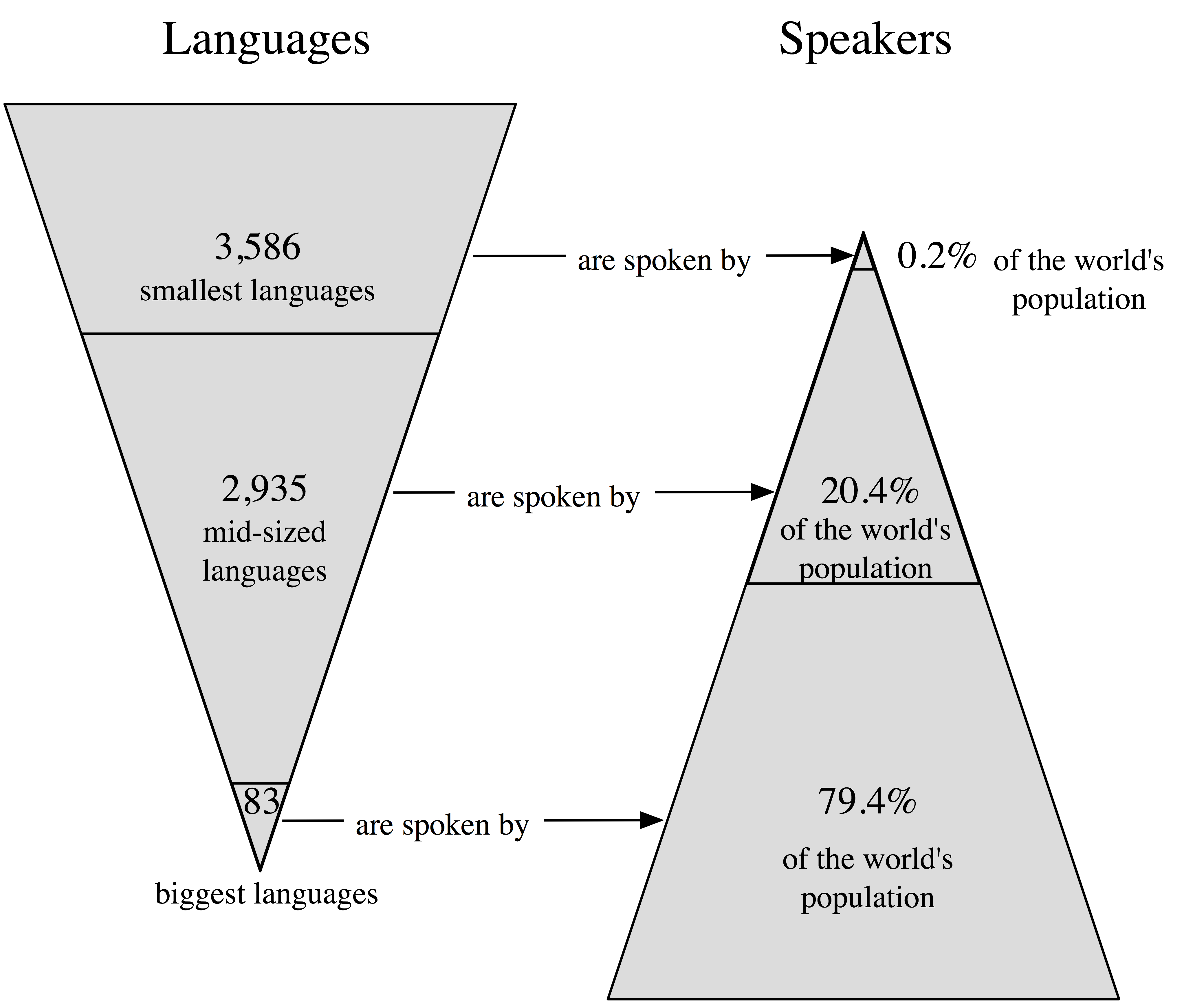
I saw a diagram (along these lines) of two triangles.
One has the point up; the other has the point down.
The first represents world population;
the second represents world languages.

It was a striking graphic depiction of this inverse
relation  :  how most
languages on Earth have very small speech communities;
while a small handful have enormous speech communities.

Here’s an example of such a diagram.  I’d have embedded it here, but it’s a bitmap file, which this site does not support. 

VThunderlad went on to wonder whether it really makes sense to see the fact that so many languages are faced with extinction as a moral issue in and of itself.  I replied that I thought it does.  When a language goes extinct, it becomes that much more difficult for a community to understand its ancestors.  A break in communication between one generation and another may sometimes be necessary, but is never costless.  Language extinction is the result of political and economic policies that people can either support or oppose; therefore, when we decide what our stand will be on those policies, their likely impact on endangered languages should be one of the considerations we take into account.

Copernicium

In a comment on the post below, I referred to “Cp” as the chemical symbol of the element #112.  It was by reading reports like this one and this one that I got this idea.   It turns out that the symbol is actually “Cn.”  By way of correction, here’s a YouTube from “The Periodic Table of Videos” about the name “Copernicium.”  

And their earlier post about the element and its name:

Words that can be spelled using chemical symbols

Fans of National Public Radio’s Sunday Puzzle segment will remember occasional challenges (for example, the one described here) to spell English words using chemical symbols.  So, you could spell the word “iron” using the symbols for iridium, oxygen, and nitrogen (IrON.)  The example should make it clear that this has nothing to do with chemistry; iridium, nitrogen, and neon cannot form a compound, and if they could it wouldn’t be notated in that sequence.  It is just a matter of treating the symbols as if they were Scrabble tiles. 

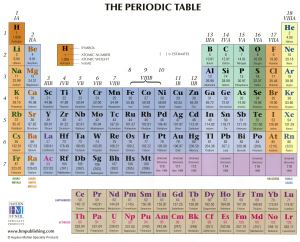
I’ve been thinking about this, not only because I listen to the NPR Sunday Puzzle, but also because I teach in a classroom decorated with a big poster showing the periodic table.  When the students are taking a test or quiz, there are always at least a couple of minutes when I have nothing to do but look at that poster.  So I try to form words from the symbols. 

Here’s an exhaustive list of all the English words in the tenth edition of Merriam Webster’s dictionary that can be formed in this way.  It not only lists 26,811 words (with a total of 56,407 spellings,) but also includes word squares and word ladders.

What is a word for “grandparents of the same child”?

A simplified chart of Latin kinship terms

At Language Log, a post asks whether many English speakers use the expression “brothers-in-law” to refer to men whose relationship is that their wives are sisters and “sisters-in-law” to refer to women whose relationship is that their husbands are brothers.  So would it be idiomatic to say that my wife and my brother’s wife  are one another’s sisters-in-law?  Commenters on that post have mentioned the poverty of English vocabulary in kinship terms as compared to other languages.  One linked to a Wiktionary article about the expression “co-mother-in-law,” an article which ends with sixteen examples of languages which do have words in widespread use that mean “the mother of one spouse, in relation to the parents of the other spouse.” 

For a long time it’s struck me as strange that English has so few kinship terms.   About 14 years ago, I was in graduate school and I read an article that was then already rather old, “What does Latin tell us about the Romans?” by Carl R. Trahman.  If you have access to JSTOR, here’s a link to Trahman’s article; if you don’t, you can go to the nearest research library, look up volume 67, number three of The Classical Journal (February/ March 1972,) and turn to pages 240-250.  Here’s one thing Latin told Trahman about the Romans:

Perhaps the most telling evidence, in the case of the Romans, that the vocabulary of a language will lead to an understanding of its users lies in the terminology of Latin for family relationships.  In English we are content to speak of “in-laws,” of “cousins once removed,” of “uncles on the father’s side.”  Latin has specific words for all of these and for dozens more such affinities.  Your great-great-grandmother is your abavia; your uncle on your father’s side is patruus, but on your mother’s side is avunculus.  Your mother-in-law is socrus.  The hated step-mother is noverca and the stepson privignus.  Does your husband have a sister?  The word is glos.  Does he have a brother?  The word is levir.  In such matters, the Romans truly had a word for it.  They actually possessed a word to denote the relationship of two women married to two brothers: they were ianitrices.  Now what is the significance of such precision?  It indicates the immense importance of the family in Roman life.  If we had no other testimony of this feeling for family, which can hardly be overstated, this amazingly rich terminology would be more than enough.  It is interesting that two of the phrases used for our word prejudice, for which as I have said Latin had no proper word, are iudicia iam facta domo (Cicero) and domo adlata opinio (Seneca.)  They suggest family councils at which policy was determined and the stand to be taken by the gens on public issues yet to be debated.  (page 244)

Writing in the early 1970s, Trahman devoted a fair bit of space to the Sapir-Whorf hypothesis, an idea that the structural limitations of a given language are in some way commensurate with the range of thoughts available to the speakers of that language.   In its most extreme form, the Sapir-Whorf hypothesis can be identified with the view that a people whose language lacks a word for a given concept must therefore lack that concept.   Trahman himself clearly does not go to that extreme.  In the passage quoted above, Trahman identifies the concept expressed by Latin phrases like iudicia iam facta domo and domo adlata opinio with the concept that we express by the single word prejudice.  So he believes that they had the concept, even though they lacked a specific word for it.  Trahman does seem to suggest that something like the Sapir-Whorf hypothesis was already familiar to the ancients.  He quotes the Roman poet Ennius who said that because he spoke Latin, Greek, and Oscan he had three hearts; Trahman elaborates, “The word he used was cor, which in his day meant not only ‘heart’ but ‘mind and soul’ as well.  So [Ennius had] it all, and it could not be improved upon.” 

So we can’t say that English speakers have a poorer set of concepts for family relationships than did Latin speakers just because we have so much poorer a vocabulary through which to express those concepts.  What we can say is that the Romans probably talked about those relationships more often than we do.  This isn’t surprising.  Most people in the developed world today live in nuclear family households and see members of their extended families only occasionally, so it isn’t especially likely on any given day that you will have to explain that someone is your spouse’s sibling’s sibling’s spouse.  If it takes several words and repeated case-endings to identify that person, you probably won’t lose much time over the course of a long life.  But in the ancient world it was more usual for several generations of a family to live under the same roof, grandparents and their siblings, parents and their siblings, one’s own siblings and their spouses and children and grandchildren, one’s own spouse and children and grandchildren, etc etc, and to spend all day working side by side with other members of that population.  So of course you would need single words that could express those relationships quickly and easily.  Not only might it become tiresome to have to speak a lot of words every time you had to clarify a family relationship, but it would certainly be taxing to have to listen to a lot of convoluted phrases connecting one kinship title to another.  If you tell me that some person is your spouse’s sibling’s sibling’s spouse, I’m likely to come away thinking that the person is your sibling’s spouse’s sibling’s spouse unless I concentrate.  If we have a word like ianitrix in common, we can relax. 

So why does it strike me as strange that we have fewer kinship terms in English than the Romans had in Latin?  For one thing, because English has such a huge vocabulary overall; for another, because it doesn’t seem English was particularly rich in kinship terms even when most English speakers lived in extended family groups.  But most of all because there are a number of relationships that really are quite important to English speakers that have no simple names in English.  For example, I would think it was safe to say that most grandparents would agree that they have something important in common with their grandchildren’s other grandparents.  Yet they have no single word to express that relationship.  And a Google search for “grandparents of the same child” brings up just two hits, as I write this.  “Co-grandparent” produces hits for laws concerning grandparents in the state of Colorado (postal abbreviation CO,) for “The Grandparent Company,” and for a number of uses of “co-grandparent” meaning something like  “honorary grandparent.” 

At about the same time Trahman was writing his article, Archie C. Bush published an article in the journal Ethnology under the title “Latin kinship extensions: An interpretation of the data.”  Here’s a JSTOR link; the citation is Ethnology, volume 10, number 4, (Oct 1971) pp 409-432.  Bush opens with a list of Latin names for 110 family relationships, sorted into six grades of consanguinity.  The system of grades derives from Roman law; a text attributed to the jurist Julius Paulus listed 448 family relationships. 

Strikingly, there is no Latin word for “grandparent of the same child” on Bush’s list or in Paulus, nor can I come up with such a word in any of the dictionaries to which I have ready access at the moment.  This is really amazing.  Most marriages in the ancient world were arranged by the couple’s parents in order to build a kinship relation between one household and another household.  In that sense, one could say that the basis of marriage in those days was the hope of the parents of the bride and groom that they would be bound together as grandparents of the same child.  One could hardly imagine a more highly valued relationship.  Yet it was a relationship with no name of its own.

Singular and plural

There don’t seem to be any rules in English about which collective nouns will be treated as singular and which will be treated as plural.  By some arbitrary process, English speakers settle on singular forms for some collective nouns and plural forms for others.  Yesterday’s Andy Capp got me thinking about this:

Of course,  the joke doesn’t make sense- no one says “”I was just wondering how my saving is doing?,” no matter how logical it might be to say such a thing.   

The question that all this raises, of course, is why I read Andy Capp.   To which the answer is, it was in the paper when I was five, and I thought then that the reason it never made me laugh was that I wasn’t sufficiently grown-up for it.  By the time it occurred to me that there might be a different reason, I was in the habit.

Some collective nouns

A herd of cows; a flock of sheep;  a pride of lions; a pack of dogs.

A murmur of starlings;  an exaltation of larks;  a murder of crows; a parliament of owls.

Just in time for Halloween, David Malki’s Wondermark offers a list of collective nouns for beings of species less well-documented than those above (click the image to read a legible version of it on his site.) 

wondermark collective nouns