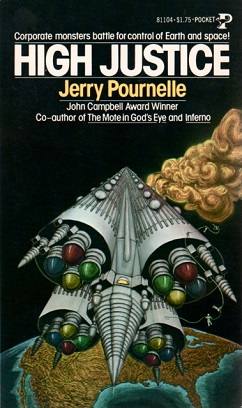
High Justice, by Jerry Pournelle

A few weeks ago, I stopped in a used book store I hadn’t visited in a long while. I picked up some old paperback science fiction novels. One that shed quite a bit of light on contemporary politics was Jerry Pournelle’s 1977 High Justice. There’s the requisite dose of grandiose technological fantasy- fusion powered tugs hauling icebergs to deserts, massive ocean thermal energy conversion projects, brain implants giving individuals instant access to computer networks, and of course space stations and asteroid mining. There is also a grim political landscape in which all governments are hopelessly corrupt and only multinational corporations run by visionary billionaires can deliver industrial development, and they only if they are left unaccountable to anyone or anything.

The characters are pure cardboard, simply illustrations of whatever tendency the author is trying to depict. When he wants to make some harsh remarks about Africa south of the Sahara, he first tells us that the people who speak them are black; when he wants to say something that could be taken as demeaning to women, he gives the lines to a figure with a given name like “Laurie Jo” or “Ann.” Not that the white men are realized any more substantially, but at least they are not always sock puppets for his own potentially objectionable views. Sometimes they are sock puppets for opinions he disagrees with.

Pournelle’s political ideas are summed up in this exchange between utterly idealistic liberal politician Aeneas MacKenzie and utterly realistic billionaire Laurie Jo Hansen:

“Laurie Jo, should power like yours exist?”

“Without power, none of this would exist. You can’t do anything without power.”

“Yes.” They’d been through it before, endlessly. “But it must be responsible power. It must be directed for–“

“For what, Aeneas? Something trite, like ‘the betterment of mankind’? Who chooses the goals? And how do you see that the choice is kept, once made? Responsible, Aeneas? To the people? You tried that.”

Jerry Pournelle, High Justice, New York 1977, page 100.

And that’s it- the dash following “directed for” is all the consideration given to political theory, the branch of philosophy concerned with the questions “Who chooses the goals?” and “How do you see that the choice is kept, once made?” And “You tried that” is all the consideration given to the idea of government in the name of the people. Books like Pournelle’s had an obvious influence on the multi-billionaires whose voices are so loud in today’s politics; his grisly vision is not the weakest of the many factors that drive their behavior.

More fictional presidents

An article in The New York Times Magazine reminds me of my typology of stories involving fictional US presidents. Fictional presidents appear in three kinds of stories- satires, nightmares, and fairy tales. In satires, they show that the rot goes all the way to the top. In nightmares, they show that even the highest authorities are powerless to help. In fairy tales, they stand in for the king and say the magic words or make the grand gestures that solves everyone’s problems. The most memorable stories tend to mix these three genres. So Fail-Safe, Superman II, and Independence Day mixed nightmare and fairy tale, Dr Strangelove and Mars Attacks mixed nightmare and satire, and Dave mixed satire and fairy tale. But pure forms can be effective too. Among examples mentioned in the article, Veep is pure satire, Seven Days in May is pure nightmare, and The West Wing and The American President are pure fairy tale, but they are all quite memorable.

The article mentions the apparently happy ending of Seven Days in May as a relic of a more optimistic time, but in fact it just heightens the nightmare. Sure, the president foils the coup and removes the villainous General Scott and the other plotters from the top echelons of the military, and the press corps applauds him on live television. But the president is still despised by the electorate, Scott is still hugely popular, and the president admits to Scott that he can never expose his crimes. He won’t even reveal what he knows about Scott’s extra-marital affair and complicate his public image. The Constitution will survive until the next scheduled election, but there is little doubt how that election will turn out, or what Scott will do once he has been voted into the office he was so narrowly prevented from seizing.

The novel makes this even clearer. Written in 1962, it supposes that John Kennedy lived to serve two full terms as president, at the end of which the country was mired in a war between Communists and non-Communists in a country on the other side of the world (in the novel, Iran,) crime in the streets was spiraling, college and university campuses were hotbeds of unrest, African American neighborhoods were scenes of large-scale rioting, and the economy suffered from high rates of inflation. This imaginary 1968 saw the election of a Republican president who failed to address any of those problems in a way the public could accept, and so President Lyman defeated him for reelection in 1972. Lyman ends the war in Iran with a treaty that at first seems to ensure a division of Iran like that of Korea after 1953, and that treaty is popular enough that he can persuade the Senate to ratify a nuclear disarmament treaty he has negotiated with the Soviet Union. But the Iranian Communists don’t respect their treaty, and they take over the rest of the country. Alarmed by the thought of what might happen if the Soviets don’t honor their part of the disarmament treaty, the US electorate votes for a Republican Senate in 1974, but Lyman insists on going ahead with dismantling the USA’s nuclear warheads. The coup attempt takes place in May 1975, and after foiling it Lyman moderates his stance on disarmament. The other problems are still in place, and American democracy looks like a dead duck.

The movie Seven Days in May was directed by John Frankenheimer, who not long before had directed the film version of another political nightmare, The Manchurian Candidate. That one doesn’t have a president character, just a couple of senators and some presidential candidates. But it is an unusually pure example of a cinematic nightmare. That’s clear if you try to explain the plot. How does any event in it follow from any other, how could the villains have imagined their plans would work, what are the scope and limits of their power of mind control, and why does Frank Sinatra’s character have the authority to do any of the things he does? None of these questions has an answer that even begins to make sense by the logic we use in the daylight hours, but by the associative logic of dreams it all flows with a terrible inevitability.

Three novels by David Lodge

A couple of years ago, I picked up a volume at a used book sale titled A David Lodge Trilogy. It includes three novels, Changing Places (1975,) Small World (1984,) and Nice Work (1988.) When those novels were relatively new and I was a college student thinking of going to graduate school in Classics, a professor of mine had recommended Small World to me, so I’d been aware of Lodge’s fiction for a long time.

The very cover of the edition I read (Penguin, 1993)

Changing Places evokes life on the campuses of the University of California at Davis and the University of Birmingham in 1969 with a great deal of atmosphere. Unfortunately, the story has many weak points and Lodge uses the same device to paper over all of them, which is to set the characters having sex with each other. For example, when one of the two middle-aged professors at the center of the book stumbles into a roomful of hippies and Lodge can’t figure out a way to get him out without ruining the jokes, an orgy starts up, from which the professor excuses himself. And when the novel is approaching its ending and Lodge doesn’t have a conclusion, the two professors swap wives and the four of them wind up talking about it. That conversation does involve an interesting moment, when the professors have run out of things to say about the situation and wind up talking about literary theory. The wives are exasperated with this, and the one who is becoming a feminist asks the other if she doesn’t recognize the sound of men talking. A page after that, the book just stops. As it may as well- once you realize Lodge isn’t going to go more than twenty pages without another unmotivated, inconsequential sexual encounter, there isn’t any logical reason for it to be any particular length. It would be bad enough if these encounters appeared as real erotica, but Lodge is so much a professional Englishman that no sex scene he writes is complete until the parties break an awkward silence with embarrassed apologies.

Small World has the same problem on an even larger scale. About half the book consists of sex scenes that merely cover up an awkward spot in story logic or a character’s lack of personality. He even pads it out with excurses here and there assuring us that everyone is having a tremendous amount of sex.

The main story is a young literary scholar’s quest to find a mysterious woman he met at a conference. She is a specialist in romance from Apuleius to Spenser. At one point, the young man is at an airport and a gate agent tells him he missed the woman not long before. She repeats to the young man something the young woman told her:

Real romance is a pre-novelistic kind of narrative. It’s full of adventure and coincidence and surprises and marvels, and has lots of characters who are lost or enchanted or wandering about looking for each other or for the Grail or something like that. Of course, they’re often in love, too.

A David Lodge Trilogy: Small World (Penguin, 1993) pages 493f

That’s what, in the literary criticism business, they call a programmatic statement. The parts of Small World that go somewhere make up a romance in that sense.

I should mention that there are some funny bits. For example, at one point a character is kidnapped by a gang who know that his wife has written a novel that sold millions of copies and made her very rich. What they don’t realize is that she is in fact his ex-wife, and the novel is about how much she hates him. When they demand that she pay them $500,000 to release him, she responds by asking how much she would have to pay for them to keep him. When her agent explains that it will be bad for her image if she sticks to that line, she offers them $10,000. The negotiations that follow are worth several laughs.

I was tempted to stop after Small World, but was glad I read Nice Work. It is by far the best of the three. I was a bit concerned at the outset. Lodge pauses several times to give detailed reports on the characters’ bathroom functions. That was hardly a step up from the sex scenes, but it tapers off after the first 40 pages. From then on, there is no filler and there are no dead spots to paper over.

The two main characters are a young woman who teaches English literature and Women’s Studies at the same lightly fictionalized version of the University of Birmingham that had figured in the two previous novels, and a middle-aged man who manages a factory across town from campus. The woman has a very apt name for a literary critic- Doctor Penrose. That’s what critics do, doctor what was left behind when the pen rose for the last time. Her first name is Robyn, suggesting that her work involves robbin’ the texts of some meaning they ought to have.

Doctor Penrose makes a programmatic statement herself. She tells students in a tutorial:

Unable to contemplate a political solution to social problems they described in their fiction, the industrial novelists could only offer narrative solutions to the personal dilemmas of their characters… In short, all the Victorian novelist could offer as a solution to the problems of industrial capitalism were: a legacy, a marriage, emigration, or death.

A David Lodge Trilogy: Nice Work (Penguin 1993) page 643

From this moment, we know that before we reach the end of the novel the four solutions available to Penrose’s own problems will be a legacy, a marriage, emigration, or death. It’s also worth noting that at no point does it seem to dawn on her that she has disproven her own thesis. If those were the only answers Dickens, Gaskill, Kingsley, Gissing, and company could give to questions about the problems of industrial capitalism, either they were a load of idiots, or those were not the questions they were asking at all.

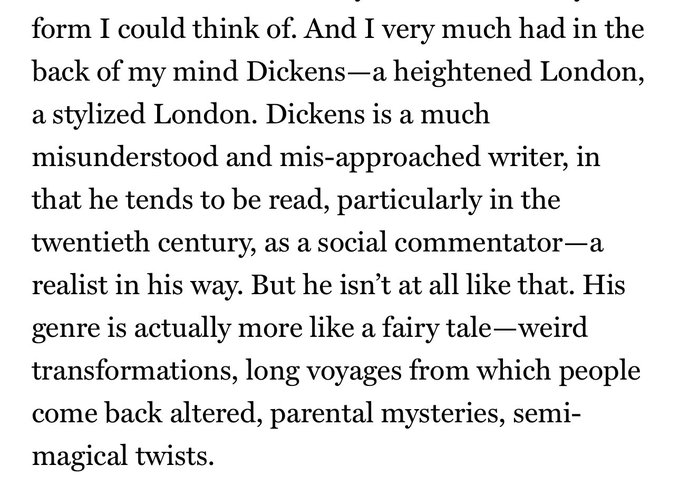
The very day I read that passage, I looked at Twitter and saw that several people had posted this quote from the recently deceased Martin Amis:

Martin Amis quoted in David Wallace-Wells, “New New Yorker Martin Amis Talks Terrorism, Pornography, Idyllic Brooklyn, and American Decline.” Vulture, 22 July 2012. Screenshot by John Wemmick.

Nice Work was shortlisted for all the major prizes in 1988, and Amis made that remark in 2012. So there is a very good chance Amis read the book when it was new, and by the time twenty four years had passed had forgotten that it was not an original insight.

It is also just possible that Amis had read the theorist Lodge has studied most deeply in his work as a literary scholar, Mikhail Bakhtin. It’s the sort of observation a reading of Bakhtin’s work on genre and the carnivalesque might inspire.

At any rate, Nice Work is the sort of romance that appeals to people who fancy themselves hard-headed realists. Lodge gives enough detail about how people who work in universities interact with each other, how people who work in factories interact with each other, and how people from each interact with people from the other that it’s easy to imagine someone taking him to task for failing to propose a concrete solution to the problems of the higher education and manufacturing sectors of the British economy of the 1980s. So easy, in fact, that I suspect Lodge was playing a practical joke on the real-life Robyn Penroses of the period. Even if you aren’t inclined to fall into his trap, it is still enjoyable to read his plausible description of those two sides of Birmingham in those days and feel that you have visited a real place and become acquainted with a whole society.

What’s wrong with Sherlock Holmes

http://moicani.over-blog.com/2018/07/ceci-n-est-pas-sherlock-holmes.htmlThe other day, Aeon published an outstanding short essay by Professor Rima Basu of Claremont McKenna College. Professor Basu argues that, when applied to humans, the sort of detached, empathy-free reasoning dramatized in fiction by Sherlock Holmes is reliable neither as a source of factually accurate information nor as an incentive to morally acceptable behavior. Professor Basu writes:

Consider how upset Arthur Conan Doyle’s characters get with Sherlock Holmes for the beliefs this fictional detective forms about them. Without fail, the people whom Holmes encounters find the way he forms beliefs about others to be insulting. Sometimes it’s because it is a negative belief. Often, however, the belief is mundane: e.g., what they ate on the train or which shoe they put on first in the morning. There’s something improper about the way that Holmes relates to other human beings. Holmes’s failure to relate is not just a matter of his actions or his words (though sometimes it is also that), but what really rubs us up the wrong way is that Holmes observes us all as objects to be studied, predicted and managed. He doesn’t relate to us as human beings.

She continues:

This kind of indifference to the effect one has on others is morally criticisable. It has always struck me as odd that everyone grants that our actions and words are apt for moral critique, but once we enter the realm of thought we’re off the hook. Our beliefs about others matter. We care what others think of us.

I’m reminded of a little incident that took place five or ten years ago. I teach ancient Greek and Latin in a university in the midwestern USA. I was telling one of my classes, an ancient civilization class conducted in English, about family life in ancient Greece. My explanations usually tend to lean on the brutally economic side, so when I came to the custom of exchanging dowries, everything I said was about the role that dowry exchange played in underwriting joint business ventures between neighboring farmers.

One student who came up to me after this presentation was obviously struggling to restrain her anger. In fact, she was furious with me. She was from India, and when she got married, her family gave her husband a dowry. As she labored to keep herself calm, she explained to me that giving him a dowry wasn’t “about” the economic relationship between the households. It was “about” mutual respect between the families, it was “about” the idea of a common future, it was “about” a pledge to be available to each other in times of need.

Now, I had addressed all of those points in my presentation. But I had subordinated all of them all to the cold facts of the struggle for existence and the high stakes of trust in a subsistence economy. So at first, I just encouraged her to keep talking. After she seemed to have run out of things to say, I asked if she had reason to believe that anything I had said about the ancient Greeks was false. She thought for a second and said no, that it might all have looked that way in the cold light of economic analysis, but that the people inside the culture could never have looked at it in such a light. So I was missing the most important point of the whole custom by presenting it as I did.

The reference to Sherlock Holmes reminds me of an event in a story featuring one of the most appallingly wicked fictional characters ever to anchor a series of popular novels, Brigadier General Sir Harry Flashman, VC, KCB, KCIE. In one of George MacDonald Fraser’s last Flashman stories, 1999’s Flashman and the Tiger, the old reprobate has managed to tangle himself up in some bad business with Sherlock Holmes’ nemesis Tiger Jack Moran. After Moran fails in the attempt, described in “The Adventure of the Empty House,” to assassinate Holmes, Flashman tries to escape arrest and disgrace by flopping down on the street and pretending to be a derelict in an alcoholic stupor. Two characters whom he does not name as Holmes and Watson come near:

If they’ve any sense they’ll just pass by, thinks I– well, don’t you, when you see some ragged bummaree sleeping it off in the gutter? But no, curse their nosiness, they didn’t. The footsteps stopped beside me, and I chanced a quick look at ’em through half-closed lids– a tall, slim cove in a long coat, bare-headed and balding, and a big, hulking chap with a bulldog moustache and a hard hat. They looked like a poet and a bailiff.

“What’s this?” said the bailiff, stooping over me.

“A tramp,” says the poet. “One of the flotsam, escaping his misery in a few hours of drunken slumber.”

“Think he’s all right?” says the bailiff, rot him, and blow me if he wasn’t fumbling for my pulse. “Going at full gallop,” says he, and blast his infernal impudence, he put a hand on my brow. “My goodness, but he’s feverish. D’you think we should get help for him?”

“You’ll get no thanks beyond a flood of curses if you do,” says the poet carelessly. “Really, doctor, even without close examination my nose can tell me more than your fingers. The fellow is hopelessly under the influence of drink– and rather inferior drink, at that, I fancy,” says he, stooping and sniffing at the fumes that were rising from my sodden breast.  “Yes, American bourbon, unless I am mistaken. The odour is quite distinctive– you may have remarked that to the trained senses, each spirit has its own peculiar characteristics; I believe I have in the past drawn your attention to the marked difference between the rich, sugary aroma of rum, and the more delicate sweet smell of gin,” says this amazing lunatic. “But what now?”

The bailiff, having taken his liberties with my wrist and my brow, was pausing in the act of trying to lift one of my eyelids, and his next words filled me with panic.

“Good Lord!” he exclaimed. “I believe I know this chap. But no, it can’t be surely– only he’s uncommonly like that old general… oh, what’s-his-name? You know, made such a hash of the Khartoum business, with Gordon… yes, and years ago he won a great name in Russia, and the Mutiny– VC and knighthood– it’s on the tip of my tongue–”

“My dear fellow,” says the high-pitched poet, “I can’t imagine who your general might be– it can hardly be Lord Roberts, I fancy– but it seems more likely that he would choose to sleep in his home or his club, rather than in an alley. Besides,” he went on wearily, stooping a little closer– and damned unnerving it was, to feel those two faces peering at me through the gloom, while I tried to sham insensible– “besides, this is a nautical, not a military man; he is not English, but either American or German– probably the latter, since he certainly studied at a second rate German university, but undoubtedly he has been in America quite lately. He is known to the police, is currently working as a ship’s steward, or in some equally menial capacity at sea, — for I observe that he has declined even from his modest beginnings– and will, unless I am greatly mistaken, be in Hamburg by the beginning of next week– provided he wakes up in time. More than that–” says the know-all ignoramus, “I cannot tell you from a superficial examination. Except of course for the obvious fact that he found his way here via Piccadilly Circus.”

“Well,” says the other doubtfully, “”I’m sure you’re right, but he looks extremely like old what’s-his-name. But how on earth can you tell so much about him from so brief a scrutiny?”

“You have not forgotten my methods since we last met, surely?” says the conceited ass, who I began to suspect was some kind of maniac. “Very well, apply them. Observe,” he went on impatiently, “that the man wears a pea-jacket, with brass buttons, which is seldom seen except on sea-faring men. Add that to the patent fact that he is a German, or German-American–”

“I don’t see,” began the bailiff, only to be swept aside.

“The dueling scars, doctor! Observe them, quite plain, close to the ears on either side.” He’d sharp eyes, all right, to spot those; a gift to me from Otto Bismarck, years ago. “They are the unfailing trade-mark of the German student, and since they have been inexpertly inflicted– you will note that they are too high– it is not too much to assume that he received them not at Heidelberg or Gottingen, but at some less distinguished academy. This suggests a middle-class beginning from which, obviously, he has descended to at least the fringes of crime.”

“How can you tell that?”

“The fine silver flask in his hand was not honestly acquired by such a seedy drunkard as this, surely. It is safe to deduce that its acquisition was only one of many petty pilferings, some of which must inevitably have attracted the attention of the police.”

“Of course! Well, I should have noticed that. But how can you say that he is a ship’s steward, or that he has been in America, or that he is going to Hamburg–”

“His appearance, although dissipated, is not entirely unredeemed. Some care has been taken with the moustache and whiskers, no doubt to compensate for the ravages which drink and evil living have stamped on his countenance.” I could have struck the arrogant, prying bastard, but I grimly kept on playing possum. “Again, the hands are well-kept, and the nails, so he is not a simple focsle hand. What, then, but a steward? The boots, although cracked, are of exceptionally good manufacture– doubtless a gratuity from some first-class passenger. As to his American sojourn, we have established that he drinks bourbon whisky, a taste for which is seldom developed outside the United States. Furthermore, since I noticed from the shipping lists this morning that the liner Brunnhilde has arrived in London from New York, and will leave on Saturday for Hamburg, I think we may reasonably conclude, bearing in mind the other points we have established, that here we have one of her crew, mis-spending his shore leave.”

“Amazing!” cries the bailiff. “And of course, quite simple when you explain it. My dear fellow, your uncanny powers have not deserted you in your absence!”

“I trust they are still equal, at least, to drawing such obvious inferences as these. And now, doctor, I think we have spent long enough over this poor, besotted hulk, who, I fear, would have provided more interesting material for a meeting of the Inebriation Society than for us. I think you will admit that this pathetic shell has little in common with your distinguished Indian general.”

“Unhesitatingly!” cries the other oaf, standing up, and as they sauntered off, leaving me quaking with relief and indignation– drunken ship’s dogsbody from a second-rate German university, indeed!– I heard him ask:

“But how did you know he got here by way of Piccadilly?”

“He reeked of bourbon whisky, which is not easy to obtain outside the American Bar, and his condition suggested he had filled his flask at least once since coming ashore…”

I waited until the coast was clear, and then creaked to my feet and hurried homeward, stiff and sore and stinking of brandy (bourbon, my eye! — as though I’d pollute my liver with that rotgut) and if my “besotted shell” was in poor shape, my heart was rejoicing.

(Pages 309-312 in George MacDonald Fraser, Flashman and the Tiger, London, 1999)

(Someone called “Workshysteve” has recreated this scene in Lego here; it looks like this: Screenshot 2019-05-24 at 10.33.29 PM)


Make-Believe Presidents

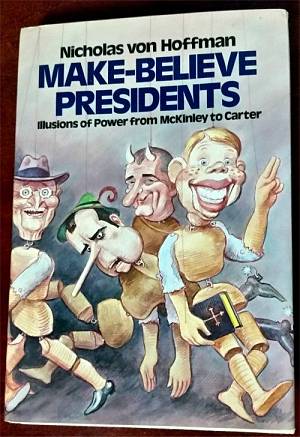
When you spend a lot of time hanging around a collection of books, particular items sometimes take up a place in your imagination whether or not you ever get around to reading them.  For example, I spent a significant chunk of the 1980s in a used book store where a copy of Nicholas von Hoffman’s 1978 Make-Believe Presidents sat on a shelf. I never read that book; I’m not sure I ever opened it. But I can call the cover illustration to mind easily. It looked like this:

makebelievepresidents1

That book was apparently a study of the political realities that limit the actual power of US presidents. The title lingers in my mind as a heading, both for that topic, and for the genre of fictional works featuring imaginary characters in that office.

Since I posted something here the other day about another imaginary US president and his resonance with current events, I’ve spent a little time browsing through Wikipedia’s lists of hundreds of such characters. This guy sounds good:

President Geotekeezu-Chub’Chub-Pegaree (aka Andrew Wheatley/Geotkie)

  • President in George Morgan’s 1935 story Surprise in the White House

  • President Andrew Wheatley is elected in 2004 (a future date at the time of writing) after two terms as a Senator from Wisconsin. He is considered a mediocre politician, neither very Liberal not conspicuously Conservative, and no particularly noteworthy events are expected from his term – and so it seems in his first year. But in February 2006, a sensation does break out: Secret Service bodyguards apprehend Ward Bartolomeu, a White House confidential secretary, in the act of attempting to rape the First Lady, Mary Wheatley. When his trial opens in a blaze of nationwide publicity, Bartolomeu enters a bizarre plea: he asserts that the President and his wife are in fact humanoid extraterrestrials, descendants of the crew of an interstellar ship which crash-landed in Oliver Cromwell‘s England. Bartolomeu further asserts that the Presidential couple are in possession of a powerful unearthly aphrodisiac, produced under a formula handed down from their stellar ancestors, and that Bartolomeu had acted under its influence. Bartolomeu’s assertions are greeted with derision – until the President comes up as a defense witness, confirming all of these assertions and stating that Bartolomeu had unknowingly used a huge overdose of the aphrodisiac and was indeed unable to control himself. Thereupon, Bartolomeu is acquitted and Congress proceeds to impeach President Wheatley – some of its members believing that Wheatley is indeed an extraterrestrial, others considering him as suffering from major delusions and still others regarding him and his wife as grossly immoral – all of these divergent views alike being taken as grounds for impeachment. In the aftermath, the ex-President and his wife drop from view. An industrious journalist traces them to a hut at a fishermen’s village in Patagonia – but they refuse to talk to him. However, in 2011 the world is threatened by an imminent collision with a giant asteroid. Thereupon, the ex-President comes out of seclusion and offers to the League of Nations (still existent in this future) the knowledge of how to construct a powerful Repellor Ray Emitter,which is used in order to push the asteroid harmlessly away. Hailed as a hero and savior, he then runs again for the US Presidency in 2012 and is elected by a landslide – this time under his true name in his ancestral language, President Geotekeezu-Chub’Chub-Pegaree. In his inauguration, he pronounces the full name by its precise correct intonation. However, the public generally calls him “President Geotkie”. His wife – who has a similarly long, unearthly true name – becomes known as “First Lady Medgarie”. Geotkie serves three full terms (the story was written before the enactment of the Twenty-second Amendment), and becomes one of the most successful and highly-popular Presidents in American history. He makes available to the general public much scientific and technological knowledge passed down from his stellar ancestors – but is firm in suppressing and destroying the formula for the infamous aphrodisiac, which he considers too dangerous to unleash upon the world.

How many of President Geotekeezu-Chub’Chub-Pegaree’s real-life counterparts would even have the technical knowledge to build a Repellor Ray Emitter, I’d like to know. Probably the same number as would be willing to publicly admit to something embarrassing rather than let an innocent person go to prison.

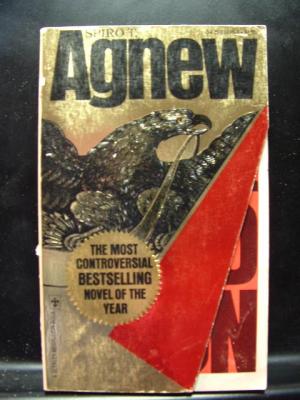
canfield decisionAnother book I’ve occasionally seen on shelves but have never read is The Canfield Decision, a novel by Spiro T. Agnew. Mr Agnew will long be remembered as the second Vice President of the United States to resign his office, and the first to do so in disgrace.* Due to its authors notoriety, The Canfield Decision sold well. Few who wrote about it were favorably impressed. Most reviewers focused on the novel’s dreary prose style and poor construction, while the many tactless remarks it contains about the relationship between Israel and American Jews and about the role of American Jews in shaping US public opinion gained a substantial amount of public attention, eliciting reactions ranging from disgust to outrage. I remember a mid-1970s bit on Saturday Night Live‘s fake news segment when a photograph of a fully robed Ku Klux Klansman appeared above the anchorman’s shoulder. The audience grew silent at this grim picture. The anchorman then spoke a sentence beginning “Former Vice President Spiro Agnew,” at which name they roared with laughter.

One of the kindest reviews of The Canfield Decision was written by John Kenneth Galbraith in the New York Times for 6 June 1976.  Galbraith spends the first half of the review documenting the book’s literary failings and the bigoted views it expresses, and noting its author’s status as a convicted felon, a shameless demagogue, and an all-around blot on the national honor of the United States.  But then he goes on to find some good things to say about it:

As the book proceeds, one does have the feeling that Mr. Agnew struggles less and gets better. Canfield, presiding over the Senate, has an excellent contest with the majority leader over clearing the galleries, one which ends with an adolescent getting pitched over the gallery railing. Canfield’s deeply compassionate concern with turning the incident to his advantage is also convincing. So throughout are his adverse comments on the press.

Mr. Agnew is admirable, as well on the details of Vice‐Presidential travel‐ a matter on which, as distinct perhaps from global conspiracy, he speaks out of experience. The procedures and folk‐rites of the Secret Service, air crew, staff advisers and assistants, speech ‐ writers, stenographers, welcoming committees, local politicians and especially the traveling press are described in sometimes loving detail, and he brilliantly establishes a truth that many must have sensed. It is that Vice‐Presidential movements serve no absolutely no‐public purpose of any kind whatever. Nor is there any reason why any paper or network should cover them, surplus funds or the distant chance of an aircrash or an assassination apart. And there is certainly no reason why the rest of us should pay for them. I contemplate a Vietnam‐type deduction from here on. Though Mr. Agnew establishes this important truth, he is not convincingly aware of it himself.

The “Canfield Decision” may not be a great novel. But Mr. Agnew reminds us of how many and diverse are the people who want to promote trouble between the Soviets and ourselves for their own private purposes. This reminder is especially useful right now as memory of the Vietnam debacle fades, and the Cold Warriors venture out again from under the stones… The book is also useful as a compendium of bureaucratic and other styles, although there is the problem of reading it. And no good citizen will urge Mr. Agnew, as he might another writer, to return to his previous way of life. All will want him to keep on trying. ■

*In 1832, John C. Calhoun resigned the vice presidency to accept a seat as US Senator from South Carolina. Agnew resigned as part of a plea agreement to avoid going to prison for bribery and tax evasion.

Secret Agent Pope: An idea for a novel

Lately I’ve been spending a lot of time reading about the scandals and controversies in the Roman Catholic Church. I’ve never been a Roman Catholic myself; I was an agnostic from childhood until a few years ago, and am now a moderately progressive Anglican.

Not being Roman Catholic, it doesn’t matter to me who the pope is, who his friends are, or what policies they favor, not any more that it would matter to a Roman Catholic who is elected to the General Convention of the Episcopal Church or what measures that Convention adopts. I’m against popes as such, even as Roman Catholics are unimpressed by the General Convention as such, and so no particular pope is going to change my position on the basic issue that divides us. Now, there are other concerns that justify paying attention to these matters. The Roman Catholic Church does command the allegiance of half the world’s Christians, and so all of the rest of us do have to take note of what happens to that institution. And I am a Latin teacher by occupation, so I hope that whoever comes out on top will revive the Vatican’s efforts to keep up interest in that language.  Also, in the 1980s I used to watch Insight, a TV show produced by the Paulist Fathers; I wish they’d make that show more widely available, maybe posting all of the episodes in some streaming format. It’s uneven in quality and very much a product of its time, but the best episodes hold up really well. I would also point out that a lot of popes give themselves funny names, and whenever they elect a new pope I hope he’ll hang a moniker on himself that will give the world a much needed belly laugh.

The most serious reason for a non-Roman Catholic to care what happens in the Vatican is that the four distinct but closely interrelated scandals now coming to light involve great evils that everyone should oppose. We are learning more about the the already long familiar epidemic of sexual abuse of children by priests. We have been introduced to the topic of sexual harassment of young clergymen by their superiors, initially in connection with ex-Cardinal Theodore McCarrick, who apparently treated the seminarians and young priests under his authority the way Harvey Weinstein treated actresses whose careers he could make or break. We’ve also started to hear solid information about blackmail as a means of advancement within the hierarchy.  Perhaps most serious of all these scandals is to be found in the concerted efforts by church authorities to conceal those misdeeds and to shield their perpetrators from punishment. So I want those four things to be stopped.

Not that scandal is unique to the Roman Catholics. We have our share of scandals in Anglicanism too; the Anglican Church of Canada had to declare bankruptcy in 2000 because so many survivors of sex abuse by priests had already proven their cases against it in court. I’ve mentioned that bankruptcy several times in discussions of what’s happening with the Roman Catholics. In 2000, the Anglican Church of Canada had never had a celibate clergy, it had been ordaining women for decades, and was notably friendly to sexual minority groups. So when my liberal Roman Catholic friends say that letting priests marry, ordaining women, and dropping the official anti-gay line will be sure to solve the problem, I have to caution that, while those actions may have good effects and they may be desirable in themselves, they may not accomplish what you think they will accomplish. Still, the sheer size of the Roman Catholic Church, its power and wealth, may have something to do with the scale to which these abuses have grown. It is natural to want to sweep problems under the rug, and when you have the world’s biggest rug whatever you sweep under there can grow to massive proportions.

One of the main things I’ve been looking at for news about the scandals has been Rod Dreher’s blog. He has something about it almost every day. His biases are very clear, but he is a professional journalist and does retract stories that have been proven false, which puts him in the top .0001% of people* who write about this topic on a regular basis. Yesterday I wrote a comment there which, as I think about it, includes the kernel for a novel someone might write. The novelist should be Roman Catholic, well-connected in the Vatican, an experienced journalist, and with some expertise regarding international espionage.  I am none of those things, so I shouldn’t write it myself. But here is the comment, for what it’s worth:

@Siarlys Jenkins: “I don’t include Argentina, because no American intervention was needed, and I’m not sure the CIA knew who they really wanted to support there.”

I often think of something by a CIA veteran (Philip Giraldi?) I read some years ago in the pages of the magazine that maintains this website. Reviewing the CIA’s policy of paying bonuses to officers who recruit local informants, the author argued that the policy produced a large number of agents whose main qualification was that they were easy to recruit. He summed his point up by saying, not only that there ought not be the same bonus paid for recruiting an African police chief as for recruiting an agent who is placed in a genuinely sensitive post, but that there ought to be no bonus paid for recruiting an African police chief.

What brings this to mind is that what is true of African police chiefs might very well be true of Latin American bishops. They are generally pretty cozy with the same elements of the local elites who are most comfortable with overt US intervention, most of them are hated by the same people who most worry the CIA, and, as we’ve seen from all these scandals, bishops are not, as a group, entirely averse to associating with people who are in a position to provide them with a pleasant life.

So, it may not be unreasonable to wonder whether the situation at the top of the Roman Catholic hierarchy in Latin America is altogether alien to the situation in the Russian Orthodox Church. If there is an analogy to be drawn there, even if Bergoglio was never a CIA agent himself, he would likely have been exposed to a great deal of information about his fellow bishops that he would find it more convenient to forget as completely as possible than to spend any time analyzing for its obvious implications.

Considering the ever-growing mountain of evidence that he and his henchmen have cultivated a habit of ignoring and forgetting information about the sexual proclivities of their fellow prelates, it would not be difficult to suppose that her and they have applied the same habit to other forms of compromising behavior they have reason to believe exists. Should it ever be proven that the CIA has deeply penetrated the Roman Catholic hierarchy in Latin America, it would raise a whole new dimension of doubt about Bergoglio’s motives.

This is an idea for a novel, not a proposal for an investigation, because I have no reason at all to suppose that it is true. As I put it in a follow-up comment, “there are these two secretive organizations that have, for their own reasons, created a vacuum of information that is big enough that a story like that could fit inside it without contradicting anything we do know.”

One sub-plot I would like to see in this novel would be a workplace sitcom set in the Oval Office of the President of the United States. The CIA is a headache for the president to deal with even when they are on a losing streak. One day in the early 2010’s he is informed that an asset of theirs has been elected pope. Ugh, thinks he. Now I’m in for it. And indeed the Director of Central Intelligence makes himself well-nigh intolerable around the uppermost echelons of the US national security state from that point on.

Perhaps the main character should be a liberal journalist who has been covering, let’s call him Cardinal Bocchini, for the several years he has been Archbishop of, let’s say Santiago de Chile. When Cardinal Bocchini is elected the first pope from the Western hemisphere (though his parents were born in Italy, and he has been an Italian citizen all his life, and he spoke Italian before he spoke Spanish, and his family has maintained such close connections to Italy that his sister settled there, his residence in Chile allows him to be presented to the press as a non-European pope,) she is apprehensive. He has made very harsh remarks about sexual minorities, leading a campaign identifying gender-neutral marriage with Satan. And he has made strongly nationalistic remarks supporting Chile’s territorial claims against its neighbors, remarks timed to heighten tensions between Chile and Peru and reflective of Bocchini’s connections with some rather dark elements of the Chilean military and security services. Bocchini also has a notably bad record on sex abuse; virtually alone among the world’s major archdioceses, Santiago has not publicized a single case of clerical sex abuse in the previous fifteen years. While some of Bocchini’s most fervent supporters say that this is because the Holy Spirit has protected Santiago to leave no doubt that Bocchini is the man to lead the Roman Catholic Church out of the era of scandal, the heroine’s investigations as a journalist reporting on the church have led her to believe that Bocchini is simply the most skilled of the hierarchy’s cover-up artists.

Bocchini is not only the first pope to have lived most of his life in the Western Hemisphere; he is also the first Jesuit pope. He takes the name Ignatius to honor both the founder of his order and Saint Ignatius of Antioch.  The heroine is assigned to Rome to cover Pope Ignatius.

At first, she is pleasantly surprised by his apparently relaxed attitude toward sexual minorities and relieved that, having become a world figure, he has backed off his Chilean irredentism. She is swept up in the new pope’s popularity, and emerges as a favorite of his, frequently among the first reporters recognized in the impromptu press conferences he gives aboard airplanes. She allows herself to be drawn in sufficiently that she cleans up some of the remarks he makes in these notoriously freewheeling sessions. With every favorable story she sends out, she gains more and more access to the pope and his inner circle.

As time goes on, she notices more and more things that don’t fit with the benevolent image she has been helping to project. Five years into his papacy, scandals begin breaking all around Pope Ignatius.  The pope’s inner circle turns to the heroine in the first rush of these scandals, hoping that she will spin them as effectively as she has spun so many of the pope’s indiscreet airborne comments. They are quickly disappointed in her, however. From her vantage point, she had seen all those scandals brewing, and had reached the conclusion that the pope was not committed to correcting the abuses at the heart of them. What’s more, her proximity to the pope and his top advisers has led her to suspect that he has a relationship with the CIA.

She presses her investigations as far as she can within the Vatican. She loses favor with the pope and his men, and finds herself called back to Santiago. Her paper assigns her to cover farm news. In between trips to chicken farms and agricultural board hearings, she continues to look into the pope’s past, and turns up information that is far more explosive than she had thought possible.

So, that might make a fat little paperback that will induce a lot of frequent flyers to part with their money in the bookstores at the airports.

*A rough estimate.

The dead end above us

A recent note on Slate about Tom Gauld’s Mooncop discusses Mr Gauld’s vision of life in a decrepit and soon-to-be-abandoned lunar colony as “the residue of an older fantasy,” of the Cold War-era dream of thriving human settlements on other planetary bodies.

No doubt there is an element of this at work in Mr Gauld’s imagination, and in other visions of a future in which settlements and stations in outer space are decaying, forgotten remnants of failed enterprises of expansion. Films such as Moon (2009) and The Martian (2015,) with individual space travelers alone on the surface of alien worlds, play to the image of outer space as a realm of abandonment. Yet such visions were part of science fiction before the end, or even the beginning, of the US-Soviet Space Race. Even the founding text of space travel-themed science fiction, Jules Verne’s From the Earth to the Moon (1865,) ends tragically, with its heroes forever separated from the rest of humanity, dying pointlessly in a metal ball orbiting the Moon. A work like Olaf Stapledon’s First and Last Men (1930) is steeped in an overwhelming sense of decline, introducing one species after another descended from humans, each of which meets extinction in its own way.  

Some of the most prominent science fiction productions of the Cold War days also represent space travel as a dead end. Robert Altman’s film Countdown (1968) depicts a US project to land a man on the Moon. The film ends with a lone astronaut wandering the lunar surface, finding a crashed Soviet space-craft and the corpses of the cosmonauts. The final moments of the film are ambiguous, as the astronaut finds a device that may or may not enable him to escape back to the Earth. The overall sense of loss and futility is the same as that with which Verne’s novel ends. The relationship between the cosmonaut and the planetary being in Andrei Tarkovsky’s Solaris (1972) develops the same feeling of isolation and helplessness, though where Altman contrasts the isolation his astronaut suffers on the Moon with the professional camaraderie and relatively satisfactory married life he had enjoyed in his life in Texas, Tarkovsky’s film is openly critical of the Soviet Union as a place where the kind of social isolation his cosmonaut suffers in space is commonplace on Earth.

Arthur Clarke, a novelist strongly influenced by Olaf Stapledon’s work, returned throughout his career to a story set a thousand million years in the future. He turned this story into novels twice, as Against the Fall of Night (1953) and The City and the Stars (1956,) and explored it in many of the unfinished tales published in The Collected Stories of Arthur C. Clarke (2001.)  The heart of the story is that humans had once created a vast stellar empire, an empire fragments of which perhaps still existed in some remote corners of space, but that the Earth had been separated from this empire, and its people had forgotten the major points of the empire’s history.  The abandoned empire, the isolated Earth, and the forgotten history of the conquest of space are also the background of a much more famous series, Isaac Asimov’s Foundation novels (1942-1993.)

The two most familiar products of Cold War science fiction are Star Trek (1966-1969) and Star Wars (1977.) The image of outer space as a realm of unkept promises figures in those as well.

The background of Star Wars is a fight, not to claim new territory or develop new settlements, but to restore the liberties of a lost Republic. We meet the hero, a young man unaware of his true parentage and his lofty destiny, in the grubby place of exile which he has grown up regarding as his home. Using battered ships, antique weapons, and a plotline recycled from 1930s movie serials, the good guys score a victory for their nostalgic cause.

While Star Trek is set in the early days of an expanding interstellar federation, in many episodes our heroes encounter the ruins of lost civilizations and other traces of abandoned developments. The initial pilot, “The Cage”(produced in 1964-1965,) shows us the ship’s captain as the prisoner of a species who have retreated underground after a war found millennia before, and while there have lost so completely lost their technological skills that they can no longer “even repair the machines left behind by their ancestors” and are faced with inevitable extinction.

Many other episodes show societies that have declined from extraordinary heights of technological development into primitive conditions, conditions that suggest either control of the population by a computer mistaken for a deity (for example, “Return of the Archons,” “The Apple,” and “For the World is Hollow and I have Touched the Sky,”) impending doom (for example, “What Are Little Girls Made Of?,” “Miri,” and “The Paradise Syndrome,”) or disconnection between intellectual and carnal satisfactions, resulting in a society of casual sadism and implied cannibalism (for example, “The Man Trap,” “Return to Tomorrow,” “The Gamesters of Triskelion,” “Spock’s Brain,” and “Turnabout Intruder.”)

Nor does Star Trek present decline and abandonment as things that happen only in alien cultures. We meet such luminaries from the history of the Earth as a former ruler of India (“Space Seed,”) the inventor of faster-than-light travel (“Metamorphosis,”) the god Apollo (“Who Mourns for Adonais?,”) and Abraham Lincoln and Genghis Khan (“The Savage Curtain,”) all forgotten and imprisoned in the infinite void of deep space.  Our heroes encounter nightmarish doppelganger versions of political entities such as the Roman Empire (“Bread and Circuses,”) the United States of America (“A Piece of the Action” and “The Omega Glory,”) and Nazi Germany (“Patterns of Force,”)  showing that space is a realm in which not only individual humans can become isolated and powerless, but that whole human societies can be cut off, condemned to stagnation and historical irrelevance, by a misconceived response to technological development.

In developing an image of outer space as a realm of isolation, abandonment, decline, and helplessness, this line of science fiction writers from Jules Verne to Tom Gauld may be harking back quite far into literary history. It is often said that Lucian (circa 125-circa 180 CE)’s “True History,” a satirical tale recounting a journey to the Moon, is the first science fiction story. Lucian’s story is itself more than a little reminiscent of two plays by Aristophanes (circa 450 BCE- circa 386 BCE,) The Birds (414 BCE) and Peace (421 BCE.)  In each of those plays, disreputable characters fly to the heavens and pull off unlikely schemes.

Particularly relevant to our discussion is the scene in Peace when Trygaeus, a poor farmer, arrives in the heavens, having flown there on the back of a giant dung-beetle. Trygaeus’ goal is to arrest Zeus and prosecute him in the courts of Athens for having allowed the wars among the Greek states to go on so long that Greece is weakened and in danger of a takeover by the Persian Empire.  Once in the heavens, Trygaeus finds that Zeus and almost all of the other gods have abandoned their usual realm, going off deeper into space in their disgust at the warlike habits of the Greeks.  Only Hermes remains in his usual spot, and he is a degraded figure, so impoverished that that Trygaeus can easily bribe him with a small bag of meat, so powerless that when the god of war and some of his minions come through, Hermes hides from them.  The lower heaven from which the rest of the gods have departed is as much a realm of isolation, abandonment, decline, and helplessness for Hermes as any of the heavenly bodies are for the characters of the gloomier sort of science fiction.

The man who has lived by truth leaves you with nothing

When Harper Lee’s manuscript Go Set a Watchman, the story to which her novel To Kill a Mockingbird was written as an extended prologue, was published early this summer, I realized that I, unlike virtually everyone else who graduated from a high school in the USA in the last three decades, had never read To Kill a Mockingbird. So I borrowed the copy my wife’s tenth grade English teacher gave her and read that before our copy of Go Set a Watchman came in the mail.

I’m glad I read them back to back.  The key passage in Go Set a Watchman is an imaginary conversation Jean Louise, a.k.a. Scout, Finch has in her head with her friends in New York after she comes home to Alabama and discovers that her adored father is the head of Maycomb County’s white supremacist Citizens’ Council:

New York.  New York?  I’ll tell you how New York is.  New York has all the answers.  People go to the YMHA, the English-Speaking Union, Carnegie Hall, the New School for Social Research, and find the answers.  The city lives by slogans, isms, and fast sure answers. New York is saying to me right now: you, Jean Louise Finch, are not reacting according to our doctrines regarding your kind, therefore you do not exist.  The best minds in the country have told us who you are.  You can’t escape it, and we don’t blame you for it, but we do ask you to conduct yourself within the rules that those who know have laid down for your behavior, and don’t try to be anything else.

She answered: please believe me, what has happened in my family is not what you think.  I can say only this- that everything I learned about human decency I learned here. I learned nothing from you except how to be suspicious.  I didn’t know what hate was until I lived among you and saw you hating every day.  They even had to pass laws to keep you from hating.  I despise your quick answers, your slogans in subways, and most of all I despise your lack of good manners: you’ll never have ’em as long as you exist.

The man who could not be discourteous to a ground-squirrel had sat in the courthouse abetting the cause of grubby-minded little men.  Many times she had seen him in the grocery store waiting his turn in line behind Negroes and God knows what.  She had seen Mr Fred raise his eyebrows at him, and her father shake his head in reply.  He was the kind of man who instinctively waited his turn; he had manners.

Look sister, we know the facts: you spent the first twenty one years of your life in lynching country, in a county whose population is two thirds agricultural Negro.  So drop the act.

You will not believe me, but I will tell you: never in my life until today did I hear the word “n****r” spoken by a member of my family. Never did I think in terms of The N*****s.  When I grew up, and I did grow up with black people, they were Calpurnia, Zeebo the garbage collector, Tom the yard man, and whatever else their names were.  There were hundreds of Negroes surrounding me, they were the hands in the fields, who chopped the cotton, who worked the roads, who sawed the lumber to make our houses.  They were poor, they were diseased and dirty, some were lazy and shiftless, but never in my life was I given the idea that I should despise one, should fear one, should be discourteous to one, or think that I could mistreat one and get away with it.  They as a people did not enter my world, not did I enter theirs: when I went hunting I did not trespass on a Negro’s land, not because it was a Negro’s, but because I was not supposed to trespass on anybody’s land.  I was taught never to take advantage of anybody who was less fortunate than myself, whether he be less fortunate in brains, wealth, or social position; it meant anybody, not just Negroes. I was given to understand that the reverse was to be despised.  That is the way I was raised, by a black woman and a white man.

You must have lived it.  If a man says to you, “This is the truth,” and you believe him, and you discover what he says is not the truth, you are disappointed and you make sure you will not be caught out by him again.

But a man who has lived by truth- and you have believed in what he has lived- he does not leave you merely wary when he fails you, he leaves you with nothing.

I think virtually the whole of To Kill a Mockingbird can be explained as an attempt to clarify this passage.  Throughout Go Set a Watchman, Jean Louise’s father Atticus Finch is described as the perfect type of the Southern gentleman, truthful, courageous, gallant, modest, unfailingly courteous. Yet he does almost nothing in that book.  To Kill a Mockingbird gives these words the force of actions that match them.  And so, having read To Kill a Mockingbird, when in Go Set a Watchman Jean Louise reacts to Atticus’ addressing her as Scout with the furious thought that he had forfeited all right ever to use her childhood nickname, the reader’s heart breaks as it would not were Atticus merely the list of adjectives piled up next to his name in Go Set a Watchman.

What Jean Louise describes as “the way I was raised” by her father Atticus and their housekeeper Calpurnia sounds pretty dreary from some perspectives. Atticus lived by truth in that he, unlike other whites of his class and time, waited his turn when African Americans were in line ahead of him at the grocery.  His African American neighbors may have appreciated the courtesy, but it certainly did not cost him much, and to reward him for it by citing it as evidence of his superiority to his “grubby-minded” white neighbors sounds almost like a joke.

Moreover, that Atticus and Calpurnia raised Jean Louise to be courteous to everyone who had been placed at a disadvantage to her, including African Americans, and to cite this as evidence that the Finches were better than were the ill-bred whites who exploited their advantages and whom she was therefore taught to despise is to accept as a simple fact that is not subject to change that African Americans are and ever will be at a disadvantage to whites in regard to “brains, wealth, or social position.”

Compare the Atticus Finch of Go Set a Watchman who teaches Jean Louise that her obligations towards African Americans are rooted in their status as her inferiors and that she has the same obligations towards her white inferiors as she has towards her black ones with the Atticus Finch of To Kill a Mockingbird saying that the lowest of all creatures is a white man who takes advantage of the ignorance of a Negro.  In both cases, Atticus is teaching that whites are to regard themselves as noble by comparison with African Americans, that nobility creates obligations, and that the most profound moral failure is a failure to meet those obligations. In both cases, Atticus conceives the great moral drama of life taking place among white men, with white women as spectators and African Americans as props.

Seeing this in the abstract, as it is presented throughout Go Set a Watchman, despite the book’s many hilarious, touching, and gorgeously crafted stories of Jean Louise’s childhood, is to remain in the position of Jean Louise’s New York friends, looking down on her as an unconscious racist.  If that were the only position the book allowed us to take, it would in fact be what some critics said To Kill a Mockingbird was, a Southern novel for people who hate the South.  Coupled with To Kill a Mockingbird, however, we can see that this attitude, the very thing that put Atticus Finch at the head of the Citizens’ Council in the mid-1950s, was what led him to defend Tom Robinson in the mid-1930s.  Indeed, the portrayal of Dolphus Raymond in To Kill a Mockingbird, and to some extent the portrayal of Atticus’ brother Dr John Hale Finch in Go Set a Watchman, suggest the man who could have emerged as an ally of the African American freedom struggle in the 1950s might not have been any more use to anyone in rural Alabama in the 1930s than was Atticus in the 1950s.  Perhaps all of us are like that, heroes or villains as circumstances call for, and the lucky ones are those who rise to the occasion when circumstances call for the heroic side of their personalities.

Many have faulted Go Set a Watchman for its obvious lack of editorial revision; one review was titled “Go Get an Editor.”  There are some parts where this lack is a serious problem.  For example, when Jean Louise goes to call on Calpurnia on the occasion of Calpurnia’s favorite grandson’s arrest on a manslaughter charge that is likely to ruin him and blight the whole family’s prospects, she is shocked to find that Calpurnia and her family are looking at her, to whom Calpurnia was virtually a mother, and not seeing her, but seeing only “white folks.”  That’s a poignant moment, and should be one of the centerpieces of the novel.  However, the conversation between Jean Louise and Calpurnia is so jaggedly narrated that it is difficult to tell who is speaking to whom, and so abruptly phrased that it all collapses into Jean Louise’s regard for herself and her own feelings, feelings that apparently lead her to forget all about  Calpurnia’s grandson and the rest of her family almost immediately upon noticing that Calpurnia isn’t particularly excited to see her.  The rest of Go Set a Watchman doesn’t have trouble assigning lines to characters and doesn’t depict Jean Louise as a bizarrely self-absorbed person, so I’m sure that a rewrite would have straightened that scene out.

The ending of Go Tell a Watchman is quite disturbing, letting Atticus and the Finches off the hook almost completely.  That’s a shame for a novel that faces up to so many of the challenges of the period, but it is no different from To Kill a Mockingbird.  At the end of that book, Atticus has had some unpleasant afternoons, but he is reelected to the state legislature without opposition, still practicing law, still living in the same house, still welcomed by the same friends.  I do wonder if people who claim that the sensibility of Go Set a Watchman is less progressive on race than is that of To Kill a Mockingbird were quite honest with themselves when they read To Kill a Mockingbird, or if to them it really was just a Southern novel for people who hate the South.

I wonder about some other things.  Around the time Harper Lee was deciding to put Go Set a Watchman in a drawer and to write a novel about the childhood of its main character, Edmund Wilson was criticizing William Faulkner’s later novels for devoting too many pages to long speeches in which wise but flawed old men defend segregation, speeches which are supposed to make an international audience understand and respect the viewpoint of the white South, but which because of their length and because nothing in the plots of the novels highlights any of the weaknesses in their reasoning seem very much to reflect the author’s own views.  The horror with which Jean Louise reacts to her discovery that Atticus is the head of the Citizens’ Council distances her and Harper Lee from Atticus’ and Dr John Hale Finch’s pro-segregation speeches, but the ending of Go Set a Watchman, together with the length of the speeches, does give it something of the same problem, and because the worst things Jean Louise learns about the Citizen’s Council are the speeches and writings it promotes, it would be quite a challenge to make Atticus and his brother understandable characters without giving them long, largely unrebutted speeches in self-defense.  So perhaps one of the reasons she set the prequel in the 1930s was that the tacit understandings of that time would make such speeches unnecessary, and another part was that the 1930s were Faulkner’s heyday, at least in terms of critical acclamation, and a Southern novel set in that period might not raise the suspicions of Edmund Wilson the way a novel with a contemporary setting would.

Amasa Coleman Lee, who was not universally regarded as a Gregory Peck lookalike

Ms Lee’s decision not to publish Go Set a Watchman after the success of To Kill a Mockingbird  is not so hard to explain.  Atticus Finch was pretty clearly based on her father, Amasa Coleman Lee.  On the set of the film version of To Kill a MockingbirdMs Lee saw actor Gregory Peck made up as Atticus Finch and was moved to tears, saying “Oh Gregory, you’ve got a little pot belly just like my Daddy.”  To which Peck, with the film star’s consciousness of his appearance, rather stiffly replied, “No Nell, it just looks that way because of my acting.”  Anyway, having introduced her father to the world as the prototype of a character so beloved that thousands of boys would be named “Atticus” in his honor, it would take quite a bit of chutzpah to turn around and publish a novel in which she made it clear that whatever her father’s virtues may have been, his vices included a racism so disgusting that at times she couldn’t bear to hear him say her name.

So, if you read either book, I recommend you read them both.  Treat To Kill a Mockingbird as an extended prologue to Go Set a Watchman, and the two books together will shatter complacencies you didn’t know you had.

In which I demonstrate that I am the world’s nerdiest nerd

In a recent email exchange with the cofounders of this blog, known here as VThunderlad and Lefalcon, I shared some thoughts about Star Trek, including a synopsis of an idea for a new Star Trek movie.  Find the relevant bits below the jump.

(more…)

the Help: A Book Review

Title: the Help  Type: Fiction

By Kathryn Stockett

What I like about the book.

My favorite character is Aibileen, and my favorite relationship is the relationship between Aibileen and the little girl she cares for, Mae Mobley.  I am delighted to discover that Aibileen is teaching Mae Mobley not to judge people based on their skin color.  She does this by taking advantage of her special times alone with the little girl.  During these times, she tells Mae stories that capture Mae’s attention.  One such story begins on page 234 and is about two little girls who cannot figure out why one of them is black and one is white.  The girls point out that they both have hair, a nose and toes.  They decide that their skin color is all that is different about them, and that they will be friends.  Telling Mae Mobley these stories is very brave on Aibileen’s part.  I am sure real people in her position in 1960’s Jackson Mississippi were killed for a lot less.

Aibileen is also concerned about how Mae Mobley feels about herself.  Most of the attention Mae gets from her mother is negative, and Mae Mobley has taken to saying “Mae Mobley bad”.  Aibileen decides to try to boost Mae’s self-esteem by getting Mae to say good things about herself each day.  Aibileen says, “’You a smart girl.  You a Kind girl, Mae Mobley.  You hear me?’  And I keep saying it till she repeat it back to me” (P. 107).

Even in times of sadness and stress Aibileen is careful to do what’s right.  On her last day with Mae Mobley, Mae has a high fever, and both Aiboleen and Mae are crying.  When Mae Mobley asks if Aibileen is leaving to care for another little girl Aibileen says, “’No, baby, that’s not the reason.  I don’t want a leave you, but’… How do I put this?  I can’t tell I’m fired, I don’t want her to blame her mama and make it worse between em.  ‘It’s time for me to retire.  You my last little girl’” (P. 520).

I wonder if there were a lot of maids like Aibileen in real life 1960’s Missisippi.  Black women loving and caring for white children.  Loving those children enough to risk their own lives to teach them that good people come in different colors.  I wonder if some of those children grew up to have a positive impact on race relations and other aspects of society.

What I do not like about the book.

I am keeping this part short because I do not want it to take over this review like it took over the book.  I hate the poop pie.  I am very disappointed in Kathryn Stockett for putting it in what could have been one of the most interesting works of fiction on race relations.  This book cannot be considered for such an honor now.  I think I know Minny better than Kathryn Stockett.  Do I think Minny would have gotten the better of Hilly?  Do I think she would have taught Hilly a much needed lesson?  I most certainly do, but Minny would not have committed such a crime to do it.

Note to Sociologists

This would make a great introductory to doing social research.