Al Wood of the mighty ukulelehunt has been doing his bit to promote Ukuleles for Peace. Ukuleles for Peace is one of many groups that aim to bring Israeli and Palestinian children together in a fun and peaceful environment. Sometimes I suspect half the population of the West Bank is there to set up such groups, but this is the best one, since it’s with ukuleles.
All posts in category Wars and Rumors of Wars
Ukuleles for Peace
Posted by acilius on December 18, 2008
https://losthunderlads.com/2008/12/18/ukuleles-for-peace/
The American Conservative, 15 December 2008
Several pieces this time despair of any prospect that traditionalist conservatism will reassert itself as a force to be reckoned with in American politics. What, then, do the writers for this traditionalist publication believe is to be done?
At least two of them seem to think that the time may have come to give up on the USA altogether. Bill Kauffman writes an admiring piece about Kirkpatrick Sale’s Third North American Secessionist Convention, singling out for praise the doughty Yankees of the Second Vermont Republic, who want to break away from the continental Leviathan in the name of Ethan Allen, Robert Frost, and maple syrup. A review of Lee Congdon’s George Kennan: A Writing Life includes remarks on Kennan’s argument in his late work Around the Cragged Hill that the USA is too big for anyone’s good and should be broken into smaller constituent republics.
Elsewhere, a letter to the editor takes issue with those who claim that neoconservative advocates of the 2003 invasion of Iraq could have been so foolish as actually to have believed the sorts of things they said in public at that time. The correspondent asks the magazine to “spare me the ‘neocons were dumb to believe Iraq would turn into Ohio’ nonsense. These grown-up guys, smart enough to become advisors to the political leadership of the most powerful military on the planet, weren’t convinced of something a 10-year old knew? Please. It’s nice to imagine that some massively dumb, partially blind, amazing social phenomena led us into this debacle, but the truth seems simpler and more banal: the neocons didn’t care and neither did we.”
The fallacy here seems obvious. “These grown-up guys, smart enough to become advisors to the political leadership of the most powerful military on the planet”- that’s an impressive description. The correspondent is right to be impressed, we should be impressed as well. But keep in mind, every one of the members of that group was at least as impressed by his or her colleagues as we are. Sitting at a table surrounded by such people, who would dare be the first to say something radically different from what the others were saying? Unless someone goes first and breaks the spell, a roomful of extremely competent people can march blindly into mistakes any well-informed individual, sometimes any normal 10-year old, could have warned them against. Many policymakers are acutely aware of this danger; indeed, when President Truman made George Kennan head of policy planning at the US State Department in the late 1940’s he explicitly defined Kennan’s job as speaking up against the preconceptions under which others were laboring and breaking the spell of those preconceptions.
Posted by acilius on December 17, 2008
https://losthunderlads.com/2008/12/17/the-american-conservative-15-december-2008/
Cuneiform tablets
Thanks to 3quarksdaily for linking to this article in The London Review of Books about an ongoing British Museum show called “Babylon: Myth and Reality.” Apparently the exhibition concentrates on cuneiform tablets. The article explains what we know about cuneiform tablets as a medium and speculates on what we may yet learn about them.
Posted by acilius on December 10, 2008
https://losthunderlads.com/2008/12/10/cuneiform-tablets/
The Nation, 15 December 2008
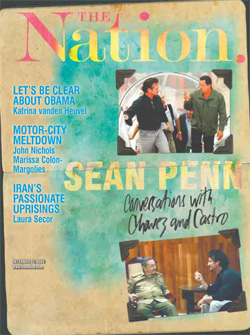
Highlights of this issue include a review of Passionate Uprisings: Iran’s Sexual Revolution, a study of sexual behavior among well-to-do young heterosexual Tehranis by Iranian-American anthropologist Pardis Mahdavi. In the course of extensive field work, Professor Mahdavi discovered that worries older Iranians routinely express about risky sexual behavior among the young are quite well-founded, at least as regards the population she studied. Group sex seems to be common. Evidently repressive laws against premarital sex, enforced ignorance of birth control and STDs, and an intensely patriarchal family structure don’t guarantee universal chastity after all. Who knew? The reviewer, Laura Secor, wishes for further studies that would systematically compare the experiences of Iranians of different social classes, sexual identities, and geographical locations. With that kind of research, we might be able to figure out what if anything this risky behavior means for Iranian politics. Of course, a study like that would be unlikely to take place in today’s Iran. To illustrate the difficulty, Secor begins her review by quoting Mahdavi’s meeting with an Iranian sex ed teacher who could not understand why her students were reluctant to tell her about their sex lives. The woman was wearing a double hijab that gave her such an imposingly traditional appearance that even Professor Mahdavi became self-conscious.
William Greider points out that New York Federal Reserve chief Timothy Geithner, President-elect Obama’s pick to be the new treasury secretary, was the negotiator who worked out many of the worst parts of the Wall Street bailout; Greider frets that Mr O may go down in history as the man responsible for the economic meltdown if he doesn’t withdraw Geithner’s name and rethink his approach to the crisis.
Posted by acilius on December 3, 2008
https://losthunderlads.com/2008/12/03/the-nation-15-december-2008/
The Nation, 1 December 2008
Nick Turse looks into American forces’ conduct of the war in Vietnam’s Mekong Delta in the period from 1 December 1968 to 1 April 1969. Turse concludes that the facts were much worse than has generally been known in the USA. Civilians were targeted more systematically than has been acknowledged, more of them were killed than has been acknowledged, and a coverup of the some of the worst atrocities continued for decades. Turse quotes a contemporary letter signed “Concerned Sergeant.” The otherwise anonymous soldier denounced the operations to which he was attached and estimated that the rate at which unarmed civilians were being killed amounted to “a My Lai a month.”
Ever since Studs Terkel died, The Nation has been memorializing him. In this issue, his editor, Andre Schiffrin, remembers their attempt to put together an oral history on the topic of power. The project failed because none of their prospective subjects would even admit that he held power, let alone give insight into what it was like to use it. That’s hardly surprising when Schiffrin describes the key to Terkel’s work. His subjects talked to him, Schiffrin explains, because “he approached people with utter respect. Those he talked to immediately felt this and poured their hearts out.” Powerful people usually seem to expect to be approached with utter respect, if not indeed with abject servility. That so many people from so many backgrounds found it a shock to be approached with respect is a sad commentary on our society.
Hoosiers and others marveling at the fact that Indiana voted for Obama will enjoy Mark Hertsgaard’s piece about Luke Lefever, a plumber (a real one!) who volunteered for the Obama campaign in Elkhart.
Siddhartha Deb reviews several novels by Elias Khoury. At first, Deb praises the “fragmented” style of Khoury’s work as suitable to his native Lebanon, but at the end he suggests that the time may have come for a smoother style of writing and, apparently, a more settled view of Lebanese identity.
This brings us to Barry Schwabsky’s review of Art Worlds by Howard S. Becker and Seven Days in the Art World by Sarah Thornton. Becker’s newly reprinted 1982 book is a sociological study of various milieux from which products came that could be called “art,” while Thornton, also a sociologist, spent her time in “an art world that claims the right to call itself the art world.” Schwabsky puts the question:
In the sociologist’s art world, hierarchies, rankings, and orders of distinction proliferate. Status and reputation are all, and questions about them abound. Why does the seemingly kitschy work of Jeff Koons hang in great museums around the world while the equally cheesy paintings of Thomas Kinkade would never be considered?… How do conflicting views on the value of different kinds of artworks jell into a rough and shifting consensus about the boundaries of what will be considered art in the first place?
That’s quite a weighty question. As for the Koons/ Kinkade riddle, my suspicion is that perspective drawing and the rest of the conventional skills of representational art are not really all that difficult to master. Some years ago I read an essay by Eric Gill called “Art in Education: Abolish Art and Teach Drawing,” in which he argued that given a chance virtually any child could and would learn these techniques. I haven’t seen any scientific work testing this hypothesis, but it doesn’t seem fantastic to me to think that if all children were introduced to art in the same way that, let’s say, Thomas Kinkade was, that some large percentage of the population would grow up to paint pictures very much like his. If that is so, then the problem with Kinkade isn’t that he’s cheesy, but just that they are nothing special. If a collector wants to attain a high rank, s/he can hardly buy paintings that may be very pleasant but that could be equalled by, let’s say, a third of the adult population.
Posted by acilius on November 24, 2008
https://losthunderlads.com/2008/11/24/the-nation-1-december-2008/
The Nation, 10 November 2008
As you would expect from its cover date, this issue was devoted primarily to the 2008 presidential election. As that event recedes into the past, I find it hard to imagine myself going back to re-read any articles about it. Perhaps I may wake up some morning and find it impossible to believe that it ever really happened, and may want to look up this issue as proof that it did.
What I want to note now is a review essay by Moustafa Bayoumi. Bayoumi treats three books, Mirror of the Arab World: Lebanon in Conflict, by Sandra Mackey; Artillery of Heaven: American Missionaries and the Failed Conversion of the Middle East, by Ussama Makdisi; and Origins: A Memoir by Amin Maalouf. Bayoumi aligns Mackey’s book with “a budding movement on anthropology’s right wing.” Thinkers associated with this movement look at Arab societies and see one institution as paramount, the tribe. Bayoumi cites Philip Carl Salzman, who argues (in Bayoumi’s paraphrase) “that Arabs, universally and throughout history, organize their societies along a series of ‘nested’ relationships- family, lineage, clan, tribe, confederacy, sect, and religion- with each group larger than the preceding one. Indeed, Islam, on this account, postdates tribalism; with its ability to magnify the difference between believer and nonbeliever, it’s simply the largest tribe of all.” The tribalist school has had great influence in recent US policy in the Middle East; a 2003 Brookings Institution report on Iraqi tribalism (“The Iraqi Tribes and the Post-Saddam System,” Brookings Iraq Memo #18, 8 July 2003) has apparently served as one of the blueprints for US occupation policy in Iraq. Inasmuch as, according to Bayoumi, “tribalist theory presumes that tribes always impede the growth of the state,” the influence of the tribalist school over Iraq’s occupiers may explain why so little appears to have been done in the last five and a half years to develop a viable state in Iraq.
Posted by acilius on November 6, 2008
https://losthunderlads.com/2008/11/06/the-nation-10-november-2008/
The American Conservative, 20 October 2008
Psychotherapist Jim Pittaway looks at John McCain and sees a man badly in need of psychiatric evaluation. Pittaway stresses that he would never diagnose a patient whom he has not met, but published accounts of McCain’s experiences and behavior suggest that he may suffer from moderate Traumatic Brain Injury. Pittaway writes:
There are three signal characteristics of moderate TBI: emotional disregulation (volatility), perseveration (inability to let go of thoughts or feelings or to see them in broader perspective), and concrete thinking (abstractions and nuance are compressed into right or wrong, good or evil, people are either “for me or against me.”)
McCain’s notoriously bad temper (for example, hitting a 93 year old colleague on the Senate floor), his insistent repetition of ideas that have been proven false (for example, claiming that Iran was arming the anti-Iranian group “al Qaeda in Iraq,” a claim that earlier this year humiliated him when he had to be publicly corrected by a friend- and which he then continued to repeat at subsequent appearances), and his habit of describing every conflict as a moral struggle (for example, briefed on some structural difficulties in international finance his response was to ask the briefer “So, who’s the villain?”) suggest the behavior patterns associated with moderate TBI. Torture and beatings McCain has described receiving from his North Vietnamese captors could hardly have failed to inflict substantial injury on his brain. Psychiatric tests and neurological scans can rule TBI in or out rather easily, but McCain has made it clear he will never submit to such examination. McCain’s stated belief that he avoided any psychological damage by sheer willpower is what psychologists call “magical thinking,” and suggests that his psychological wounds are surrounded with a formidable structure of denial.
Pittaway himself has treated many TBI patients, and his description of their lives is terrifying if it applies to a man who may find his finger on the nuclear trigger. “Difficulties with abstract thinking breed obsessive behaviors and tendencies to personalize issues in very concrete terms in lieu of dealing with nuance and complexity.” Moreover:
In my work with TBI patients with moderate symptoms, I am invariably struck by the level of frustration they encounter on a daily basis. Unless it is severe, brain injury is a closed wound. Since victims appear undamaged, everyone around them expects- and they themselves often expect- normal skill sets, behaviors, and emotional ranges. The energy it takes to compensate for functional deficits is extraordinary, and the absence of affirming feedback breeds a senseof isolation that morphs over time into deep-seated resentment. It ismuch, much easier to stay focused on one thing, which accounts for the characteristic obsessiveness. Execution is driven by resentment and anger rather than objective circumstances. Thisbreeds a toughness that can endure enormous amounts of stress before decompensation- which is almost always of an extremely violent nature- occurs.
Elsewhere in the same issue, David Gordon looks at Public Choice Economics. Public Choice economists argue that indifference to politics is rational among voters, inasmuch as no one vote is likely to decide an election. Gordon points out that there are other motives for voting than the hope that one will decide the election. For example, even votes for a losing candidate may send a message that the eventual winners will notice, and being among the winners of a high-profile contest brings a satisfaction that many people desire.
John Derbyshire reviews the “Stuff White People Like” book. Unlike The Atlantic‘s reviewer, Derbyshire doesn’t get the significance of the phrase “White People”-the targets of Lander’s mockery are trendy progressives who would hate to be labeled as typically white. He does mention Lander’s personal favorite among sites that have imitated his, “White Stuff People Like” (plaster, cream cheese, plastic bags, swans, mayonnaise, cocaine, and snow are the list so far.)
Posted by acilius on November 1, 2008
https://losthunderlads.com/2008/11/01/the-american-conservative-20-october-2008/
The Nation, 3 November 2008
This issue starts with letters from writers upset with the magazine for publishing Sydney Schanberg’s piece on American POWs unaccounted for after the US disengaged from the Vietnam War. These correspondents cite their own published work indicating that North Vietnam did not hold American POWs back and arguing that the story that it did merely enables Americans to see in their own captive countrymen as the main victims of the Vietnam War. In response, Schanberg points out that his critics do not offer new information or level any specific criticisms of his research.
Eric Foner reviews Philip Dray’s Capitol Men: The Epic Story of Reconstruction Through the Lives of the First Black Congressmen. The sixteen African American members of Congress Dray discusses led exciting lives, and Foner mentions several of the rollicking tales of adventure featured in the book.
Posted by acilius on November 1, 2008
https://losthunderlads.com/2008/11/01/the-nation-3-nov-08/
More from the antiwar Right
The American Conservative, 8 September 2008
Two major articles deal with the fear that haunts many of the “Old Right” contributors to this publication, the fear that America is becoming dependent on foreign powers. An obituary for Lieutenant General William Odom discusses the testimony the general gave to the US Senate in early April, in which he pointed out that US forces in Iraq depend “on a long and slender supply line from Kuwait, which runs through territory controlled by Shi’ite forces friendly to Iran” [a quote from the obituarist, not Odom’s own words.) American service personnel in Iraq are therefore hostages at the disposal of Iran.
Andrew Bacevich attacks American consumerism and its economic consequences. Our insatiable appetite for luxuries, Bacevich argues, has saddled us with debts and a dependence on imported fuels that we can manage only by maintaining a constant war footing, while our wars serve only to increase our debts and deepen our dependence.
The American Conservative, 25 August 2008
Remember George W Bush saying that the fall of Saddam Hussein meant that the “rape rooms” in his prisons would forever close? Abu Ghraib made a sick joke out of that boast. Well, the return of rape rooms wasn’t the end of it. Since the current war began in March 2003, well over 2 million Iraqis have been forced from their homes. Most of them left empty-handed. How have they been surviving since? Kelley Beaucar Vlahos shows how; tens of thousands of Iraqi women and girls have been forced into prostitution. No one in authority is even collecting statistics about these victims of daily rape, much less trying to help them. On the contrary, when it was revealed that a major US defense contractor was shuttling women and girls between Kuwait and Baghdad to be used as sex slaves, the story went nowhere. The matter remained so obscure that even Vlahos misreports the name of the whistleblower who revealed it. She calls him Bruce Halley. His name is Barry Halley.
Posted by acilius on October 7, 2008
https://losthunderlads.com/2008/10/07/more-from-the-antiwar-right/
The Atlantic Monthly, October 2008
This issue‘s cover features a controversial picture of Senator Crazy John McCain.
The controversy mainly has to do with the photographer’s other images of McCain. The Atlantic defended the image above.
The legend, “Why War is His Answer,” seemed eerily apt- the magazine arrived in the same mail as a gift from a friend (thanks, cymast!) a Quaker “War is Not the Answer” bumper sticker.
Interesting points after the jump.
Posted by acilius on October 7, 2008
https://losthunderlads.com/2008/10/07/the-atlantic-monthly-october-2008/