Virtue Engendered; or, Big States Breed Small Souls

I found two highlights in this issue: a review of Michael Sandel’s Justice: What’s the Right Thing to Do? and a review of David Finkel’s The Good Soldiers

Harvard philosopher Michael Sandel is a major figure in the revival of “virtue ethics,” the school of thought pioneered by Aristotle.   As its name suggests, virtue ethics tends to emphasize the importance of developing particular character traits.  Virtue ethics was out of fashion among academic philosophers for quite a long time, but now it seems to be on an equal footing with the two other leading schools of ethical thought, utilitarianism and deontology. Utilitarianism is a set of approaches that take their cue from Jeremy Bentham’s definition of the Good as that which brings the greatest amount of pleasure to the greatest number of people; deontology first crystallized in the work of Immanuel Kant, defender of the idea that moral duty and rational understanding are inseparable one from another.  So, an advocate of utilitarianism might argue that we should sustain friendships because societies composed of people who like each other tend to have lots of healthy and cheerful citizens, and an advocate of deontological ethics might argue that we should sustain friendships because the universe only makes sense to people who recognize a duty to grow close to each other.  An advocate of virtue ethics, on the other hand, might argue that being a friend means developing traits of character that are valuable in themselves and that can be attained in no other way.     

Sandel, like other virtue ethicists, is associated with a tendency in political theory called “communitarianism.”  Communitarians criticize classical liberalism for its image of the individual human being as a self-contained unit.  As The Nation‘s reviewer puts it:

Nearly thirty years ago, in his massively influential debut in political theory, Sandel argued that communal belonging precedes individual freedom–that, in his language, the self is “encumbered” and therefore not altogether prior to the ends it chooses. An intrepid technical dissection of his colleague [John] Rawls’s epoch-making A Theory of Justice (1971), Liberalism and the Limits of Justice made Sandel’s name as a “communitarian.” Sandel demonstrated that for Rawls, the freedom of individual choice alone is the morally relevant starting point for inquiry into justice, an assumption that renders things like family ties, religious belief, group loyalty and historical identity irrelevant, except as a secondary extra. Communitarians like Sandel, Charles Taylor (with whom Sandel studied as a Rhodes scholar at Oxford) and Michael Walzer responded that most people, even in liberal societies, prize those things at least as much as personal autonomy. The most attractive part of Sandel’s criticism was his contention that relationships, rather than being the result of previous choices, are the sphere in which identity is possible at all. (To put it in more technical terms, there is no individual subject not intersubjectively constituted from the first.) Ever since making these claims, even as political theory has substantially evolved, Sandel has continued to argue for the priority of the communal good in an account of justice, even as he recognizes its risks for liberty.

Because a person’s virtues are part of his or her identity, communitarianism and virtue ethics inevitably go hand in hand.    

The same review discusses a book by Amartya Sen that prompts the reviewer to mention that many philosophers were dismayed when political theorist John Rawls declared that the nation-state was “the natural forum for justice.”  Otherwise dedicated Rawlsians rebelled against this pronouncement, arguing that justice requires a worldwide framework.  I value Sandel and the communitarians because their position points to a different response to Rawls.  I haven’t studied Rawls’ work deeply, but what I have read suggests to me that his theory does indeed presuppose the nation-state as the standard of community.  The communitarians, on the other hand, have the intellectual resources to challenge that standard, not by arguing that the nation-state is too small to be just, but that it is too big.  The nation-state, especially in the form of continental behemoths like the USA or the former USSR or China or India or the European Union, is bloated beyond any capacity to nurture healthy relationships.  The only connection citizens of such enormous empires can achieve with each other is the one they feel when they cheer their rulers on and rejoice as their warriors smash the Enemy, whoever that Enemy may be at the moment.  The qualities of character that we develop when we do those things are hardly to be called virtues. 

That big states breed small souls is supported by material cited from David Finkel’s reports from Iraq.  The American public is separated from the perspective of the American soldier by official censorship, and so has a distorted view of what is being done in its name in Iraq.  Senior American commanders, too, have a distorted view, in their case because sycophantic briefing officers tell them what they want to hear rather than what their subordinates on the ground are actually seeing and doing.  The reviewer describes a scene in which Finkel reports on a briefing given to the celebrated General David Petraeus.  Finkel attended the briefing, and had been an eyewitness of the firefights deascribed in the briefing.  He makes it clear that what the general heard had little or no relationship to the events Finkel saw.  Even ground troops themselves see an ever smaller portion of what they are doing; “the Pentagon’s continued dependence on unmanned Predator drone attacks in Afghanistan and Pakistan means that even soldiers aren’t seeing the full contours of the global battlefield,” as the reviewer points out.  Of course, it’s long been an axiom of military history that a researcher should ask a participant in a battle for eyewitness accounts only of events that took place within a meter of that participant’s face, and shouldn’t expect extreme clarity even in those accounts.  But these added degrees of separation certainly don’t improve our ability to take responsibility for what is done in our name.  Finkel apparently pulls out the emotional stops in an attempt to protest against this separation:

The chasm between over here and over there is central to another heartbreaking sequence, when the wife of a severely wounded soldier transferred from Iraq to the National Naval Medical Center in Bethesda, Maryland, remembers a visit from President Bush. Finkel recounts not only what the soldier’s wife said to the president–“Thank you for coming”–and not only what she wished she had said to him–“He doesn’t know how it feels”–but why she hadn’t said it: “Because I felt it would not have made any difference.” Communication is fruitless, because if Bush can’t see the problem staring at him from that hospital bed, he’s already living on too remote a planet.

(more…)

Leopard Seal Encounter

How the US funds the Taliban

nation 30 november 2009Welcome to the wartime contracting bazaar in Afghanistan. It is a virtual carnival of improbable characters and shady connections, with former CIA officials and ex-military officers joining hands with former Taliban and mujahedeen to collect US government funds in the name of the war effort.

In this grotesque carnival, the US military’s contractors are forced to pay suspected insurgents to protect American supply routes. It is an accepted fact of the military logistics operation in Afghanistan that the US government funds the very forces American troops are fighting. And it is a deadly irony, because these funds add up to a huge amount of money for the Taliban. “It’s a big part of their income,” one of the top Afghan government security officials told The Nation in an interview. In fact, US military officials in Kabul estimate that a minimum of 10 percent of the Pentagon’s logistics contracts–hundreds of millions of dollars–consists of payments to insurgents.

Understanding how this situation came to pass requires untangling two threads. The first is the insider dealing that determines who wins and who loses in Afghan business, and the second is the troubling mechanism by which “private security” ensures that the US supply convoys traveling these ancient trade routes aren’t ambushed by insurgents.

Read the article.

The Nation, 9 November 2009

nation 9 nov 09For me, the highlight of this issue was a review of Mary Beard‘s The Fires of Vesuvius: Pompeii Lost and Found.  Beard’s “down to earth portrait of Pompeii” is informed by her grasp of “the latest research in demography, the history of Roman politics, architecture, ancient economics, feminist and post-colonial studies.” 

The same issue includes a number of articles about the war in Afghanistan.  As the editors summarize this symposium:

The principal rationale for America’s expanding military commitment in Afghanistan is that a Taliban takeover there would directly threaten US security because it would again become a safe haven for Al Qaeda to plot attacks against the United States. But the essays by Stephen Walt and John Mueller strongly refute that assumption, pointing out that a Taliban victory would not necessarily mean a return of Al Qaeda to Afghanistan, and that in any case the strategic value of Afghanistan and Pakistan as base camps for Al Qaeda is greatly exaggerated and can be easily countered.

Similarly, proponents of sending more troops to Afghanistan argue that Taliban success would embolden global jihadists everywhere and destabilize Pakistan in particular. Yet, as the essays by Selig Harrison and Priya Satia show, this narrative does not fit the realities. While American policy-makers and Al Qaeda may think of this as a grand meta-struggle between the United States and global jihadism, many Taliban fighters are motivated by other factors: by traditional Pashtun resistance to foreign occupation; by internal ethnic politics, such as rebellion against the Tajik-dominated government of Hamid Karzai; or by anger over the loss of life resulting from American/NATO aerial attacks that have gone awry.

As for Pakistan, the essays by Manan Ahmed and Mosharraf Zaidi explain why the Taliban threat to Pakistan is not as serious as many assume, and why a newly democratic Pakistan has turned increasingly against Islamist extremists. As Ahmed and Zaidi suggest, Pakistanis are quite capable of defending their country–not for American interests but for their own reasons–and Pakistani stability is more likely to be threatened than enhanced by military escalation in Afghanistan.

And finally, Robert Dreyfuss offers an exit strategy: as it winds down its counterinsurgency, Washington should encourage an international Bonn II conference that would lead to a new national compact in Afghanistan.

Well, not quite “finally.”  The issue also includes a piece by Ann Jones about Afghan women.  Jones mentions groups like Feminist Majority that argue for a continued US troop presence in the name of Afghan women’s rights.  She mentions her own years of experience working with women in Afghanistan, and gives it as her assessment that “an unsentimental look at the record reveals that for all the fine talk of women’s rights since the US invasion, equal rights for Afghan women have been illusory all along, a polite feel-good fiction that helped to sell the American enterprise at home and cloak in respectability the misbegotten government we installed in Kabul.”  In light of the fiercely patriarchal Shi’ite Personal Status Law (the SPSL, “or as it became known in the Western press, the Marital Rape Law,”) she goes on to say that “From the point of view of women today, America’s friends and America’s enemies in Afghanistan are the same kind of guys.”  She is unimpressed by the number of women in the Afghan parliament:

But what about all the women parliamentarians so often cited as evidence of the progress of Afghan women? With 17 percent of the upper house and 27 percent of the lower–eighty-five women in all–you’d think they could have blocked the SPSL. But that didn’t happen, for many reasons. Many women parliamentarians are mere extensions of the warlords who financed their campaigns and tell them how to vote: always in opposition to women’s rights. Most non-Shiite women took little interest in the bill, believing that it applied only to the Shiite minority. Although Hazara women have long been the freest in the country and the most active in public life, some of them argued that it is better to have a bad law than none at all because, as one Hazara MP told me, “without a written law, men can do whatever they want.”

Jones sees little hope, and much tragic irony in the possibilities facing Afghanistan:

So there’s no point talking about how women and girls might be affected by the strategic military options remaining on Obama’s plate. None of them bode well for women. To send more troops is to send more violence. To withdraw is to invite the Taliban. To stay the same is not possible, now that Karzai has stolen the election in plain sight and made a mockery of American pretensions to an interest in anything but our own skin and our own pocketbook. But while men plan the onslaught of more men, it’s worth remembering what “normal life” once looked like in Afghanistan, well before the soldiers came. In the 1960s and ’70s, before the Soviet invasion–when half the country’s doctors, more than half the civil servants and three-quarters of the teachers were women–a peaceful Afghanistan advanced slowly into the modern world through the efforts of all its people. What changed all that was not only the violence of war but the accession to power of the most backward men in the country: first the Taliban, now the mullahs and mujahedeen of the fraudulent, corrupt, Western-designed government that stands in opposition to “normal life” as it is lived in the developed world and was once lived in their own country. What happens to women is not merely a “women’s issue”; it is the central issue of stability, development and durable peace. No nation can advance without women, and no enterprise that takes women off the table can come to much good.

Jones knows Afghanistan quite well; I know it not at all.  I can only hope that there is something left in the local culture of the seeds from which a relatively woman-friendly Afghanistan once grew, and that those seeds will again send up green shoots once foreign armies leave the country .

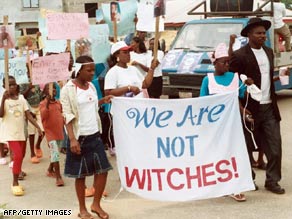
Christians Torture “Witch” Children

Nigerian Child Witch Hunt Protest

Nigerian Child Witch Hunt Protest

Nigerian families pay pastors to exorcise, torture, and kill suspected witch children.

Child Killer Bishop Sunday Ulup-Aya

Petition to Prosecute Child Killer Helen Ukpabio

They cry peace, peace, when there is no peace

nation 2 november 2009Of several pieces on the awarding of the Nobel Peace Prize to Barack Obama, the best is by Alexander Cockburn, who recounts the genuinely gruesome records of other recipients of that prize.  Of the three US presidents who preceded the incumbent as winners of that revered accolade, Cockburn declares the least wicked to have been Jimmy Carter.  That is the same Jimmy Carter who “amped up the new cold war, got Argentinian torturers to train the Contras and above all dragged the United States into Afghanistan.”  In closing, Cockburn lists some recipients of the International Stalin Prize for Strengthening Peace Among Peoples.  It’s rather hilarious sobering  to look at the murderer’s row of Nobel Peace Prize winners and then consider that figures as substantial as Paul Robeson, Bertolt Brecht, and Pablo Neruda won something as disreputable-sounding as the International Stalin Prize for Strengthening Peace Among Peoples. 

Two pieces tell of changing attitudes towards Israel/ Palestine among American Jews.  Adam Horowitz and Philip Weiss (of the Mondoweiss blog) report on the refusal of established American Jewish organizations to follow the people they are supposed to represent and start looking for peaceful solutions to the conflict.  Another article reports on Tom Dine, a former top lobbyist for the hardline American-Israel Political Action Committee who is now working to promote a two-state solution and calling for a warming of relations between the US and Syria.  The online edition of The Nation also carries a noteworthy piece this week about Palestinian children in Israeli prisons.

How to remember the future

nation 26 october 2009Stuart Klawans reviews Alain Resnais’ Wild Grass, in which the 87 year old master filmmaker returns once more to his great theme of memory and desire.  Resnais excels at depicting  characters who cannot quite tell the difference between the past and the future.  In this film, two middle-aged Parisians think about flirting with each other.  Confused as to which of their feelings are hopes for the future and which are regrets for the past, they struggle to see each other as they are and their relationship as it might be.  Successful lovemaking, apparently, requires us to find a way to distinguish between the future and the past.  

Many have said that the purpose of philosophy is to teach us how to die.  This line always reminds me of what John Silber said in 1990 when he was running for governor of Massachusetts and a voter asked him what the public schools should teach children: “Teach them that they are going to die.”  Silber was not elected, needless to say.  A review essay considers the idea of philosophy as a preparation for a good death.  There are some interesting quotes and paraphrases along the way.  For example, Freud contended that such teaching is pointless, because we cannot imagine our own death.  Thinking of Resnais’ films, we might add to Freud’s argument an appendix that although it may be certain that our future will end with death, there is nothing like it in our past.  We cannot envision death, because we cannot remember it.  Nor can we accept it as long as our hopes for the future pervade our minds.  To accept death, we would have to break from both the past and the future, and feel only the present instant as real.  Elizabeth Kubler-Ross saw this, and at times preached a Buddhist-inspired doctrine urging us to emulate death in life by emptying ourselves of ego, and to see only the present, unaffected by memories or regrets, hopes or fears.  But she could not follow this through; as she neared death herself, Kubler-Ross clung to Hollywood-inspired fantasies of indefinitely long life.  Dying, like lovemaking, requires us to distinguish between the future and the past.        

(more…)

US bombs Moon; US president wins Nobel Peace Prize

lcross_right_lg_aPeople interested in space-based warfare often talk about the “kinetic missile.”  If developed, this would be a type of bunker-buster, that is, a weapon designed to destroy underground facilities.  The concept is simple.  Put a metal rod, mounted with rockets and controlled from the ground, into earth orbit.  When you choose, you can aim the rocket at a target on the ground and drive into that target at orbital velocity.  This has the same effect as a meteor strike.  The destructive potential of the kinetic missile is so great that the common nickname for them is “the Rod from God.” 

Today NASA drove a rocket into a target on the Moon.  The stated purpose of this operation was to find water under the surface of the Moon.  It also showed the world that the USA is ready to deploy kinetic missiles at any time.   

Who would be frightened by this demonstration?  Some feverish minds have speculated that the US may be planning a kinetic missile strike on Iranian nuclear facilities in the near term.  Official US sources have fed this speculation by acknowledging that the Defense Department is trying to develop a new generation of bunker-busters specifically to have available against facilities like that at Qom

Whether the Iranians are frightened, we don’t yet know.  The Norwegian Nobel Committee certainly seems to be; they responded to the test by immediately awarding Barack Obama the Nobel Peace Prize.   The Committee’s official announcement gives the reason for Mr O’s selection as “that international policy and those attitudes for which Obama is now the world’s leading spokesman.”  I suppose that sounded better than, “We didn’t want to be the next ones he bombed.”

Juan Cole is Making Sense

Juan Cole looks at the generally accepted facts about Iran’s nuclear program and argues that there is one hypothesis that covers them all.  Iran, Cole argues, is not seeking to build a nuclear weapon, as hawks in the US and Israel claim; nor is it simply maintaining long-established civilian facilities, as others have said.  Instead, it is trying to achieve “nuclear latency.”  That is to say, the Iranians do not want actually to build a nuclear weapon at any particular time; what they want is the ability to build a nuclear weapon on short notice.  Japan, South Korea, Brazil, and several European countries have nuclear latency, and it has served their security interests quite well.

The Atlantic Monthly, October 2009

atlantic october 2009Mark Bowden starts his piece, “The Story Behind the Story,”  by recounting TV coverage of the announcement that President Obama had nominated Sonia Sotomayor to the US Supreme Court.  Within minutes of the announcement, Bowden turned on Faux News and was impressed by the depth of their reporting.  He then turned to MSNBC, which was airing precisely the same report, using precisely the same quotes from Judge Sotomayor.  Flipping through the channels, he found that every station was airing the same report.  Curious, he looked into the matter.  The report apparently originated as a post on a conservative blog called verumserum, which not only did the TV channels’ work for them, but even did a better job of trying to be fair to the judge, giving far more of the context in which she made her remarks than did any of the broadcasters. 

Andrew Sullivan asks George W Bush to apologize for promoting torture.  Sullivan is oh-so-sure that Bush didn’t know what was being done in his name.  It reminded me of something about Cuba I read in Reader’s Digest when I was a teenager.  The reporter described ordinary Cubans’ habit of looking at injustices and sighing “If only Fidel knew.”  I had the reaction I was supposed to have, which was to feel sorry for those poor benighted victims of tyranny and certain that Americans would never delude themselves into letting a leader off the hook that way.  Whether there was any truth to Reader’s Digest‘s  description of Cuba I don’t know, but I do now know that we in the USA are not immune from the delusion it attributed to the people of that island. 

Benjamin Schwarz’ review of some new books about the economic slump of the 1930s contains an intriguing sentence, “The defining characteristic of the middle classes has always been their orientation toward the future.”  That sounds like the summary of some sociological theory.  Mrs Acilius is a sociologist; I should ask her if she recognizes the summary and can identify the school of thought in which such a claim might have arisen.  The backbone of his piece is a discussion of Robert Stoughton Lynd and Helen Merrell Lynd’s 1937 study of life in Muncie, Indiana, Middletown in Transition:

The seminal book—really the starting point for the others—is Robert S. and Helen Merrell Lynd’s Middletown in Transition (1937). The Lynds, husband-and-wife sociologists, had first descended on “Middletown”—the then-prosperous if stratified city of Muncie, Indiana—with their team of researchers in 1924, during the boom years. For the next 18 months, they dissected the everyday lives, habits, and attitudes of its inhabitants, concentrating on the middle classes. The book that resulted, Middletown (1929), remains a classic of immersive sociology and the most incisive and complete portrait of American bourgeois life in the 1920s. Having taken this minute snapshot, Robert Lynd and a smaller team returned to Muncie 10 years later to see what had changed in the intervening period, which included the darkest years of the Depression. They interviewed the city’s industrial barons, plant workers, and prostitutes; chatted up its teachers, prosecutors, and real-estate agents (although all sources were anonymous, this much of their identities can be gleaned); and pored over its newspaper files and tax rolls. Mostly, they seem to have gossiped, lingered over dinners, and played bridge with the members of a stratum that ran from the “less-secure business class” to the engineers and middle managers, the young married set, and the well-established doctors, lawyers, and executives in the lower-upper class. The fruit of their sojourn, Middletown in Transition, reveals, fact by fact, detail by detail, anecdote by anecdote, the “staggering, traumatic effect” of “the great knife of the depression,” which “cut down impartially through the entire population, cleaving open the lives and hopes of rich as well as poor.”