Why didn’t Mitt Romney know he was going to lose?

For a week now, articles, columns, blog posts, and wisecracks have been appearing in their thousands about the fact that former Massachusetts governor Willard M. “Mitt” Romney seems to have been surprised that he lost the presidential election.  The foremost of these publications so far is Conor Friedersdorf’s post on the Atlantic‘s website, “How Conservative Media Lost to the MSM and Failed the Rank and File.”  Also of note are blog posts by Josh Marshall and Claire Potter, a column by Maureen Dowd, and an article on Slate by John Dickerson.

The most quoted section of Mr Friedersdorf’s piece is probably this:

It is easy to close oneself off inside a conservative echo chamber. And right-leaning outlets like Fox News and Rush Limbaugh’s show are far more intellectually closed than CNN or public radio. If you’re a rank-and-file conservative, you’re probably ready to acknowledge that ideologically friendly media didn’t accurately inform you about Election 2012. Some pundits engaged in wishful thinking; others feigned confidence in hopes that it would be a self-fulfilling prophecy; still others decided it was smart to keep telling right-leaning audiences what they wanted to hear.

But guess what?

You haven’t just been misinformed about the horse race. Since the very beginning of the election cycle, conservative media has been failing you. With a few exceptions, they haven’t tried to rigorously tell you the truth, or even to bring you intellectually honest opinion. What they’ve done instead helps to explain why the right failed to triumph in a very winnable election.

Why do you keep putting up with it?

Conservatives were at a disadvantage because Romney supporters like Jennifer Rubin and Hugh Hewitt saw it as their duty to spin constantly for their favored candidate rather than being frank about his strengths and weaknesses. What conservative Washington Post readers got, when they traded in Dave Weigel for Rubin, was a lot more hackery and a lot less informed about the presidential election.

Conservatives were at an information disadvantage because so many right-leaning outlets wasted time on stories the rest of America dismissed as nonsense. WorldNetDaily brought you birtherism. Forbes brought you Kenyan anti-colonialism. National Review obsessed about an imaginary rejection of American exceptionalism, misrepresenting an Obama quote in the process, and Andy McCarthy was interviewed widely about his theory that Obama, aka the Drone Warrior in Chief, allied himself with our Islamist enemies in a “Grand Jihad” against America. Seriously?

Mr Dickerson makes the case that Mr Romney himself was among those deluded by right-wing media into the belief that he was likely to win the election by a comfortable margin:

Mitt Romney says he is a numbers guy, but in the end he got the numbers wrong. His campaign was adamant that public polls in the swing states were mistaken. They claimed the pollsters were over-estimating the number of Democrats who would turn out on Election Day. Romney’s campaign was certain that minorities would not show up for Obama in 2012 the way they did in 2008. “It just defied logic,” said a top aide of the idea that Obama could match, let alone exceed, his performance with minorities from the last election. When anyone raised the idea that public polls were showing a close race, the campaign’s pollster said the poll modeling was flawed and everyone moved on. Internally, the campaign’s own polling—tweaked to represent their view of the electorate, with fewer Democrats—showed a steady uptick for Romney since the first debate. Even on the morning of the election, Romney’s senior advisers weren’t close to hedging. They said he was going to win “decisively.” It seemed like spin, but the Boston Globe reports that a fireworks display was already ordered for the victory. Romney and Ryan thought they were going to win, say aides. “We were optimistic. More than just cautiously optimistic,” says one campaign staffer. When Romney lost, “it was like a death in the family.”

Professor Potter draws harsh conclusions from Mr Romney’s apparent belief in his chances:

Peculiarly, since the race was consistently described as tight for most of the month prior to election day, and Obama had been gaining ground in all the states he needed to win, Mitt was entirely unprepared for the possibility that he was not going to be president. According to the HuffPo, Romney was “shellshocked” that he was not winning on Tuesday night, having genuinely believed that voter suppression would work all the major media polls were wrong. Paul Ryan and both wives were also stunned. According to CBS, “Their emotion was visible on their faces when they walked on stage after Romney finished his [concession speech], which Romney had hastily composed, knowing he had to say something….They all were thrust on that stage without understanding what had just happened.”

Let’s underline this: Romney had no concession speech, despite available data demonstrating that he could lose the election. None of the four adults who had planned to run the United States government, and lead the rest of what we used to call the “Free World,” seem to have understood that this outcome was possible. “On the eve of the election,” Daniel Lippman writes,” a number of polling aggregators, including HuffPost‘s Pollster and New York Times’ FiveThirtyEight, showed Obama with a huge statistical advantage over Romney.” And yet, despite the fact that Nate Silver, the boy genius of FiveThirtyEight, is almost never wrong, Romney chose to believe that these polls were just partisan attempts to persuade his supporters to stay home.

This is the outcome of lying: you have no real compass for when other people are telling the truth and you need to pay attention to it.

Ms Dowd echoes this point:

Until now, Republicans and Fox News have excelled at conjuring alternate realities. But this time, they made the mistake of believing their fake world actually existed. As Fox’s Megyn Kelly said to Karl Rove on election night, when he argued against calling Ohio for Obama: “Is this just math that you do as a Republican to make yourself feel better?”

Much of this growing literature seems to be driven by the desire of those who supported the reelection of President Barack Obama to gloat over Mr Romney’s defeat and to make hostile remarks about his party.  Mr Dickerson’s Slate colleague Katherine Goldstein has appealed for a limit to this gloating, but her piece has attracted far fewer readers than his, and there is no end in sight.  Conservatives had raised similar points, speaking from of course different motivations, shorty before the election.  For example, on Election Day Michael Brendan Dougherty provided a list of five points to make in trying to explain Mr Romney’s defeat to Republicans who get their news from Fox and Rush Limbaugh, starting with “Lots of Republican voters died” between 2008 and 2012, and growing more trenchant as it goes.  Political scientists have been wary of entering the fray; political science blog The Monkey Cage has only featured one post that could be construed as part of the discussion, and that was structured as a conventional media-criticism piece, not a jeer of “Hey everybody, look at the dumbass!”

Turning back for a moment, Professor Potter’s remarks struck me as somewhat oversimplified.  So I replied to them.  I wrote:

I agree with most of what you say, but I do want to register one demurrer.   “Mitt was entirely unprepared for the possibility that he was not going to be president… This is the outcome of lying: you have no real compass for when other
people are telling the truth and you need to pay attention to it.”  I often think of George McGovern’s response when he was asked when he realized he was going to lose the 1972 presidential election.  He said the first time the thought entered his head that President Nixon might possibly beat him was about 10 PM on election night.  Granted, Nate Silver wasn’t around then, but there were quite a few polls, and they all turned out to be right.  What kept the senator from taking those polls seriously wasn’t that he was addicted to lies; he was a remarkably honest man, in fact.  Nor did he surround himself with sycophants.

So why did it not enter Senator McGovern’s mind that he could lose, when it was clear to most observers that he was on his way to the short end of an enormous landslide?  I don’t think it really is such a mystery.  If you’re goal is to win a major party’s presidential nomination, it helps to be the sort of person who never for a moment considers the possibility that s/he might fail in anything s/he sets out to do.  Donors who write big checks, activists who give up their free time to volunteer on campaigns, journalists who bet their next promotions on the campaigns they are assigned to cover, and other major players in the political system all want to attach themselves to the eventual winner.  If you’re given to self-doubt and you’re opponent is certain that s/he will win, you are at a disadvantage in the contest to attract the attention of those players.  Besides, major campaigns make extremely heavy demands on the time, energy, and finances of candidates.  If one candidate is doing a realistic cost-benefit analysis while another is proceeding from the never questioned assumption that s/he will win, the first candidate is less likely to meet those demands.

What about Mr Romney?  I would point out, first, that he has enjoyed considerable success throughout his life.  It’s true that he has only won one of the four elections in which he offered himself as a candidate, and that by a narrow margin, but in his years as a businessman he reaped huge profits no matter what he did.  Moreover, as the son of George Romney and a descendant of Parley Pratt, Mr Romney grew up as a sort of crown prince of Mormonism.  All his life he has been surrounded by people who expected great things of him.  It would be very strange indeed if someone coming from that background and going through a career in which hundreds of millions of dollars devolved upon him were not to believe himself to be a man of destiny.

In other words, I agree that Mr Romney’s privileged background and the overall intellectual climate of his party are probably factors in his placid self-assurance.  However, a highly competitive system like those which have produced major-party nominees for US president will select for candidates who exhibit that precisely that quality, and it is hardly a surprise when a nominee is so deeply shaped by it that s/he cannot see defeat coming even when all indications point to it.

I’d also like to add one point to the comment I posted on Professor Potter’s site.  Every candidate who represents a political party is expected to help that party raise money, build organization, and get its voters to the polls.  Even a nominee who is universally regarded as a sure loser will therefore, if s/he is living up to the terms of his or her covenant with the party, campaign until the moment the last ballot is cast.  Few people are interested in giving money, volunteering, or voting for a candidate who says that s/he is unlikely to win.  Imagine your telephone ringing, and a voice on the other end greeting you with: “Hello, I’m Peter Politician, and I’d like to ask you to devote your resources and efforts to my doomed campaign.  As you know, I have no chance of winning this election.  Can I count on your active support?  It will cost you a great deal of inconvenience, and buy you nothing but a share of my inevitable, humiliating defeat.”  I doubt you’d respond very favorably.  Right up to the moment when the candidate delivers his or her concession speech, s/he is telling potential donors, volunteers, and voters that s/he expects to win.  That’s a lot easier to do if you actually believe what you’re saying.

And they’re off!

So the results are finally in from the 2012 US presidential election, or as it is also known, the first tracking poll for the 2016 US presidential election.

In the last couple of days, I’ve posted a few comments in miscellaneous places making guesses about 2016.  On political science blog The Monkey Cage, I responded to Andrew Gelman’s prediction that the Republican and Democratic nominees in 2016 would be Paul Ryan and Hillary Clinton thus:

The Republicans have a strong history of settling on a presidential nominee early, and defeated vice-presidential candidates need time to put space between themselves and the slough of resentment that follows a loss. So I’d say that Mr Ryan is very unlikely to be the Republican nominee in 2016. The Democrats tend to look for fresh faces and to favor youth; someone like Ms Clinton, who has been a household name for decades, would therefore labor under a disadvantage in a 2016 bid, though her odds would surely not be as long as those confronting Mr Ryan. If I had to guess, I would say a likelier pair of finalists would be Mike Huckabee for the Republicans and Martin O’Malley for the Democrats. I hasten to add emphasis to the words “guess” and “likelier”; I’d be surprised if that were the matchup, just not quite as surprised as I would be to see a Clinton vs Ryan contest.

In response to a post by Daniel Larison on The American Conservative’s website, I expressed the same surmise about Mr Huckabee.
In response to another of Mr Larison’s posts, I explained why I don’t think that the Republicans will be nominating any Mormons for president any time soon.


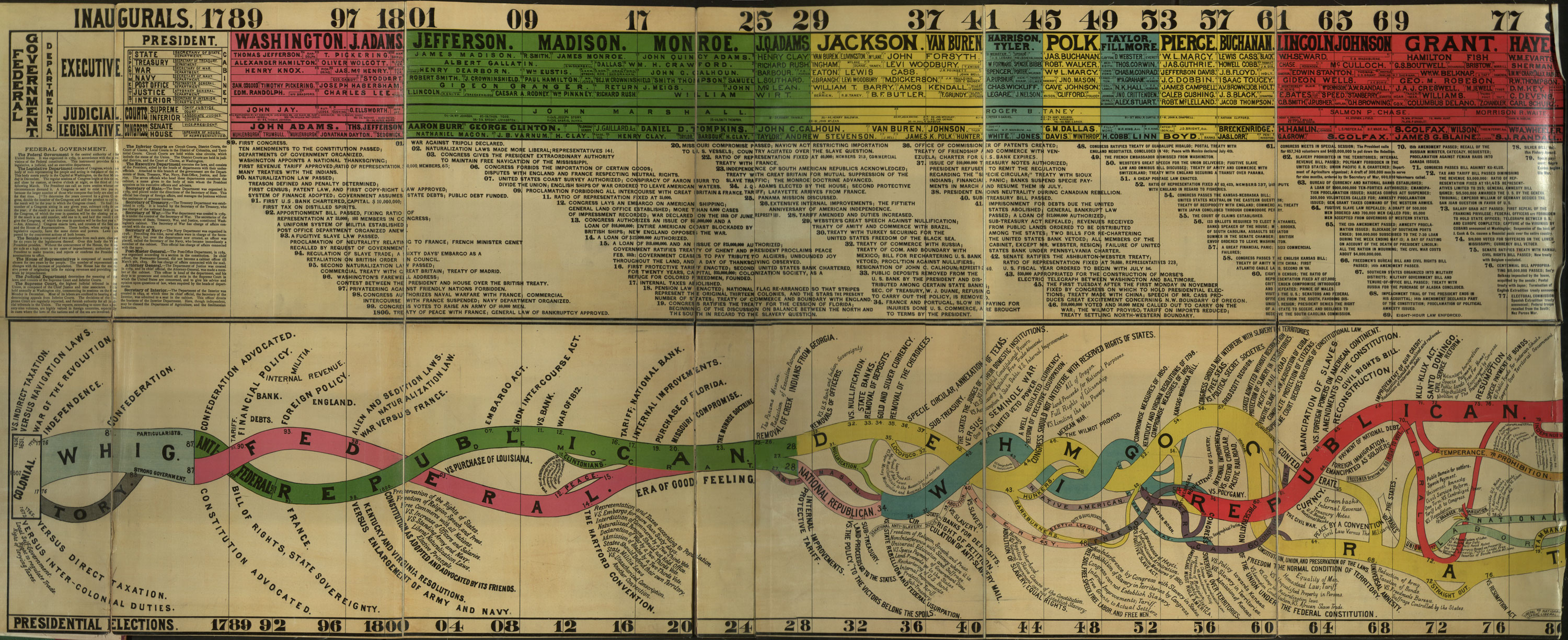
The political history of the USA in two charts

This chart was published in 1880, in a book called Conspectus of the History of Political Parties, by Walter R. Houghton.  In July, Susan Schulten put it on her blog, Andrew Sullivan mentioned it on his, and I put it up on Tumblr.  Here it is full-size.

This was today’s xkcd comic.  Click on it for a zoomable version.

I think the chart from the Houghton book is more elegant, but this one is nice also.


Is the Republican Party strong enough to survive a Romney presidency?

The other day,Jack Balkin of Yale Law School posted an item on The Atlantic‘s website in which he argued that, if former Massachusetts governor Willard M. “Mitt” Romney is elected president of the United States a week from Tuesday, his administration will likely come with great cost to the Republican Party which he nominally leads.  Professor Balkin links to the Amazon listings for two books by political scientist Stephen Skowronek (The Politics Presidents Make and Presidential Leadership in Political Time.)  Professor Skowronek classifies US presidents by the relationship they and their parties have to each other and to what Professor Balkin summarizes as the “interests, assumptions, and ideologies that dominate public discussion.”  Together, these interests, assumptions, and ideologies set the boundaries of the political “regime” of the period.  Professor Skowronek asks two questions about each of the US presidents*: “Skowronek’s key insight is that a president’s ability to establish his political legitimacy depends on where he sits in “political time”: Is he allied with the dominant regime or opposed to it, and is the regime itself powerful or in decline?”  Presidents who lead strong parties that oppose declining regimes can sweep those regimes away and implement sweeping new policies.  Professor Skowronek’s label for the few presidents who have held and capitalized in this enviable position is “reconstructive president.”  If the regime that takes shape under the administration of a reconstructive president continues to thrive after his time in office, his successors can be either “affiliated presidents,” who support the  regime and try to extend it, or “preemptive presidents,” who oppose the regime and try to modify it.  When the regime goes into terminal decline, affiliated presidents go down to political defeat, as “disjunctive presidents,” while preemptive presidents can attempt to join the list of reconstructive presidents.

Professor Balkin argues that the current regime in the USA emerged when the Reagan-Bush administration cut personal income taxes and increased defense spending on big-ticket weapons systems.  These measures were intended to solve certain problems the USA faced at the beginning of the 1980s; the tax cuts did in fact precede an end to the “stagflation” that had plagued the 1970s, and the military buildup did in fact worry the Soviet Union.  These measures, apparently successful as solutions to those particular problems, have been the foundation stones of national policy for nearly a third of a century.  Thus, Professor Balkin classifies Ronald Reagan as a reconstructive president, the two George Bushes as affiliated presidents, and Bill Clinton and Barack Obama as preemptive presidents.  Like observers well to his right, Professor Balkin has come to the conclusion that lower taxes and higher spending on big-ticket weapons systems have run their course.  Our current economic woes are not an example of stagflation, and even if they were it is by no means certain that in an age of global capital further reductions in personal income tax could relieve them.  Nor does the Soviet Union, or any other potential adversary against which the weapons systems that eat up most of our military budget would be useful, exists at present.  Tied to a party that has become increasingly doctrinaire in its attachment to these anachronistic policies, a President Romney would be doomed to join the ranks of the disjunctive presidents.  He might be comfortable in their company; the last two disjunctive presidents were Herbert Hoover and Jimmy Carter, like Mr Romney businessmen who campaigned on their abilities as technocratic managers.  Professor Balkin goes so far as to declare that “The next Jimmy Carter will be a Republican president — a Republican who, due to circumstances beyond his control, unwittingly presides over the dissolution of the Reagan coalition.”

I’m not altogether convinced that a Romney administration would necessarily end as the Hoover and Carter administrations ended, with a landslide defeat for the president after one term and a new American regime created by his successor.  I suppose if I were a Democratic politician considering a bid for the presidency in 2016, I would find the idea irresistible, but it strikes me that an incumbent president does have some influence over his party.  If it is so obvious that the policies that carried Ronald Reagan to reelection in 1984 are no longer applicable to the problems of our day, then a President Romney might not only see this himself, but might well be able to find powerful forces in the Republican Party that will support him in an effort to reorient the party towards some new agenda.  He, not a Democratic successor of his, might then emerge as a reconstructive president who creates a new regime.

If Mr Romney is elected and rises to his historical moment in this way, I would suggest a parallel to the presidencies of William McKinley (1897-1901) and Theodore Roosevelt (1901-1909.)  Those presidents together enacted an agenda of territorial expansion, commercial regulation, and political centralization that marked a significant departure from main line of post-Civil War politics, and established the regime that Herbert Hoover was trying to preserve thirty years later.  Surely we ought to would classify them as reconstructive presidents.  Yet the regime they replaced had been created during the Civil War, when their fellow Republican Abraham Lincoln had played the role of reconstructive president.  By this reckoning Democrat Grover Cleveland was at once a preemptive president ( 1885-1889 and 1893-1897) and a disjunctive president, opposing typical postbellum Republican policies of high tariffs and military pensions, and a disjunctive president, being the last to govern within the bounds set by the old regime.  Barack Obama might follow President Cleveland in this regard, with such measures as his health insurance reform and his moderate stand on social issues qualifying him as a preemptive president while his warmaking and support for Republican-devised subsidies to the financial firms would place him in the line of post-Reagan presidents.

I should add that I am not at all optimistic that a new political regime founded by Mr Romney and his associates would be desirable.  Given his platform, his background, and his associates, I suspect it would be pretty nearly intolerable, with taxes paid directly to the moneyed elite, frequent wars, and an end to civil liberties.  In these ways, such a regime could fairly be labeled fascist.  However, Professor Skowronek’s system focuses, not on what is desirable or undesirable, but on what is sustainable or unsustainable in a particular period of history.  And I suspect that fascism of that sort might very well be sustainable for quite some time.

*No, not about how they would do in a mass knife fight to the death, unfortunately.

Wasted votes

In a couple of weeks, voters in the USA will go to the polls to fill a number of offices, including the electors who will either return Barack Obama to the White House for another four years as the country’s president or replace him with former Massachusetts governor Willard M. “Mitt” Romney.  To be more precise, that is when the last voters will cast their ballots; millions of of Americans, Mrs Acilius and I among them, have already cast absentee ballots.

The missus and I did not, as it happens, vote for either Mr O or his leading opponent.  We had planned to vote for Ross “Rocky” Anderson, former mayor of Salt Lake City, Utah, whose independent bid focuses, first, on opposition to the wars the USA is currently waging or underwriting in Afghanistan, Pakistan, Syria, Libya, Mali, Mauretania, and heaven knows how many other countries; second, on opposition to “anti-terrorism” policies that have compromised the rule of law so drastically that Mr O openly boasts of murders he has ordered and plans to order in the future;  third, on support for investigation and prosecution of any and all war crimes that recent US presidents have sponsored.  But Mr Anderson did not gain sufficient support to be certified as a candidate in our state.  So we voted instead for Green Party nominee Jill Stein.  Dr Stein agrees with Mr Anderson on all of those points, but focuses her campaign on environmental policy and poverty issues.

Many people like to say that, because Mr O and Mr Romney are the only candidates with any chance of winning next month’s election, votes for any other candidate are “wasted.”  On its face, this expression is nonsensical.  It isn’t as if the polling places were casinos where the machines pay out if voters cast a ballot for a winner.  I have often asked people what they meant they say that votes for candidates unlikely to win are “wasted,” and have read many internet comment threads where people have been asked to explain what they mean by it.  The response is invariably a repetition of the claim that some candidate or other is unlikely to win, usually accompanied by a lot of bluster asserting that it is a sign of some moral deficiency to vote for anyone other than a likely winner.

Incoherent as these responses are, they seem to reflect a distinction that political scientists make between two kinds of voting behavior.  They talk about “instrumental voting” and “expressive voting.”  Instrumental voting, in its most basic form, represents a voter’s hope that s/he will cast the decisive ballot; expressive voting represents the voter’s attempt to make his or her policy preferences clear.

Political scientists sometimes go to great lengths to defend the rationality of instrumental voting.  Yet a moment’s reflection should suffice to show that in any election where the electorate is more than 600 or 700 people, the likelihood that there will be a single decisive ballot is quite small.  In a race like that for US president, where over one hundred million ballots will be cast and the electoral process is indirect, the probability that the outcome will be decided by a single ballot is effectively nil.  Meanwhile, if it is generally expected that the same electorate will vote again in the future and that such voting will be comparable in importance to the present election, political actors will analyze the results of the election as they formulate their plans for governing and campaigning.  The more votes a losing candidate receives, the more likely the policies associated with that candidate are to receive serious consideration in the interval before the next election.  Nowadays, the methods of analysis that parties, advocacy groups, candidates, and other political actors apply to election returns are so sensitive that even tiny numbers of votes can provide elected officials with information that they may profitably use in forming their approach to governing and campaigning.  Therefore, it is not too much to say that expressive voting is in fact the only rational form of voting behavior wherever the electorate is larger than a few hundred people.

What brought all this to my mind were three pieces I recently read dealing with the 2012 campaign.  Two of them were from lefties exasperated with Democrats telling them that any vote not cast for Mr O is effectively an endorsement of Mr Romney’s worst proposals; these were from Ted Rall and M. G. Piety of Counterpunch.  Another was from a right-wingers exasperated with Republicans telling him that any vote not cast for Mr Romney is effectively an endorsement of the misdeeds of the Obama administration; this was from Mark P. Shea.  In particular, Mr Rall’s arguments, and even his presentation of them as a series of replies to Frequently-Asked-Questions, are remarkably similar to Mr Shea’s.  Of course, the two are poles apart on most issues, but do unite in opposition to the idea of voting for either Mr O or his Republican counterpart.

The Romney strategy

Earlier today, I posted two long comments at Secular RightOne was about philosopher Alvin Plantinga.   That one I’ll just leave there, as I doubt that anyone who reads this blog would be much interested in it.

The other was about US presidential candidate Willard M. “Mitt” Romney.  I’ll copy it below.  Mr Romney recently made news by saying this:

So, in what are obviously prepared remarks Mr Romney is declaring that “47, 48, 49%” of US voters will never support him under any conditions.  That wouldn’t seem to be a statement that a candidate who expects to win an election would make.  It has been widely reported as a gaffe, and on Secular Right blogger “David Hume” (alias Razib Khan) joins those who say that Mr Romney faces “a longer shot than he had one week ago.”

I’m not so sure.  I explained there (links added):

When you say that Mr Romney’s chances of winning the election are less than they were a week ago, I assume you’re thinking of his remarks about the “47, 48, 49%” of voters who will never support him because their household incomes are too low. If that is an incorrect assumption, please let me know.

I don’t know whether those remarks will hurt him in the end. What does seem clear is that they are part of a deliberate strategy on Mr Romney’s part. A few days before the release of this video, he had said that an annual household income of $100,000 was insufficient to qualify for the middle class, that it took at least $250,000 to be a middle-income family. And there have been so many other remarks of the same kind, from “Corporations are people, my friend” to his challenge to Rick Perry to a $10,000 wager, to “Some of my best friends are NASCAR team owners,” that it is clearly a strong pattern. Mr Romney is an extremely intelligent man, and is continually receiving high-quality market research about the voting public’s response to his statements. Therefore, it is unlikely that he would exhibit such a strong pattern unless he believed that it would help him achieve some goal.

What is that goal? I’d say the answer is in the “47, 48, 49%” formulation. The last survey I saw that asked Americans to rank themselves by the level of household income showed that something like 17% of them thought that they were in the top 1%. That survey is pretty old now, but I suspect that far fewer than 49% of Americans think of themselves as part of the poorest 49%. Those who do know that they are in the bottom half of the income distribution are certainly no less likely to vote for Mr Romney now than they were before these remarks were released; if anything, those voters with sub-median incomes who would consider voting Republican are likely to cheer when they hear a politician casting aspersions on those of their neighbors and coworkers who express concern about the future of public assistance programs.

In other words, I think that Mr Romney is trying to position his candidacy as a luxury brand. He knows that people like to feel rich, and that they sometimes choose luxury products or services because the act of buying them will give them that feeling. He is in fact betting his entire candidacy on this sort of luxury appeal.

Will this wager pay off? It seems very unlikely now. Mr Romney started running for president shortly after he was elected governor of Massachusetts, in George W. Bush’s first term. At that time, he evidently hoped that, in 2008, he would be the Republican Party’s nominee for president, that because of the Bush-Cheney record the Republican Party would be very popular, and that the economy would be booming. Under those conditions, a strategy like Mr Romney’s might very well have won a presidential election.

As it happened, Mr Romney was not nominated until 2012, the Bush-Cheney record made and continues to make the Republican Party unpopular, and the economy has not been truly strong for a good many years. So it would be surprise if his strategy were to succeed. What is not surprising is that he continues to pursue it. On the one hand, Mr Romney’s own personal history is such that he could prove his independence from the plutocracy only by advocating a genuinely populist economic policy. That, obviously, is something which he has absolutely no desire to do. On the other hand, the Republican Party in general has been moving towards a more frankly pro-rich posture in recent years. Look at all the talk from leading Republicans about “broadening the base” of the tax system, that is to say, raising taxes on the non-rich. If that is the direction they are going, the only asset the Republicans are going to have in future elections is their luxury appeal. So, slim as Mr Romney’s chances may be, his decision to base his campaign on the fact that he and his social circle are all very, very rich is in fact a rational one.

The Nation, 24 September 2012

A number of pieces this time argue that, contrary to news outlets that habitually equate the USA’s two major political parties, Republican leaders are demonstrably more likely to tell lies about public policy issues such as antipoverty spending than are their Democratic counterparts.  A piece on The Nation’s website expands on this theme, showing that Republican vice presidential nominee Paul Ryan had privately requested that funds from a federal program he publicly opposed be sent to the congressional district he represents, and that Mr Ryan and the Romney/ Ryan campaign have made a variety of statements explaining this request.  Mr Ryan at first denied that he had requested the funds, then “confessed” (that’s the word The Nation uses) that he had when he learned that a letter with his signature had been released.  The Romney/ Ryan campaign claimed that the funds Mr Ryan requested came from an older program that Mr Ryan had supported, a claim explicitly contradicted by the text of the letter.

Columnist Gary Younge agrees that the Republicans are trying to fool us, but is not as enthusiastic about the Democrats as are some other Nation contributors.  After documenting glaring examples of tokenism he saw while attending the Republican National Convention, Mr Younge writes:

There is nothing inherent in the Republicans’ support for rapacious free-market capitalism that insists on racism. Its role is not ideological but electoral. Racism is simply the means by which the GOP wins over a huge section of the white working class—who, in the absence of class politics, feels its whiteness is its sole privilege worth preserving. Racism may be central to the Republicans’ message but not to its meaning.

Equally, there is nothing in the promotion of a nonwhite politician that need pose a challenge to racism, so long as that person works within the existing racial hierarchies and is dedicated to maintaining them. It is clear what this kind of “progress” can do for Republicans. It’s far more difficult to see what’s in it for blacks and Latinos.

Such is the nature of “diversity” in the modern age—a shift from equal opportunities to photo opportunities that eviscerates the struggle against discrimination of their meaning until we are left with institutions that look different but operate in exactly the same way. A method that, like so many, has traveled seamlessly from the corporate to the political world.

Republicans are not alone in this. Obama’s rise was not consistent with a rise in the economic and political fortunes of African-Americans but, rather, aberrant to it. Under the nation’s first black president the economic gap between black and white Americans has grown. One might argue about the extent to which Obama is responsible for that—but one cannot argue about the fact of it.

The trouble with these symbolic advances is not that they are worthless but that in the absence of substantial advances, the symbolism is all too easily manipulated, misunderstood, discounted and disparaged. The result is stasis for those suffering discrimination, cynicism for those combating it and indifference from those trying to preserve it.

Mr Younge has in the past quoted the line about “diversity” as another word for “black faces in high places.”  That sort of diversity may be preferable to a system where black faces can be found only in low places, but if the system is such that the favored few join with their white colleagues to enforce policies that keep the majority of nonwhites down, it is hardly an inspiring model.   Mr Younge is surely right to argue that it is impossible to make real progress towards equality in either race or class without a politics that challenges both racial and class inequality simultaneously.

Lawrence Joseph offers a poem called “Syria,” about the war currently underway in the country of that name.  A few lines in the middle won’t leave me alone:

“You won’t believe what I have seen”—her voice
lowered almost to a whisper—“a decapitated
body with a dog’s head sewn on it, for example.”
Yes, I know, it’s much more complicated than that.

More complicated, of course, and worse, and worse, and likely to grow still worse.  Graham Usher expresses hopes that the war won’t spread to Lebanon, at least that’s something.
Mark Mazower is a talented writer and a well-informed observer of international affairs.  Readers with high standards will therefore be glad to know that the next time they have trouble falling asleep, an author worth reading has provided that unfailing cure for insomnia, an essay about the European Union.  May almighty Brussels grant us a peaceful night and a perfect end.

Highlights of some recent issues of The American Conservative

 It’s been a while since I’ve posted a “Periodicals Note” about my favorite “Old Right” read, The American Conservative.  So here are quick links to some good articles from the last four months.

Richard Gamble, author of the indispensable book The War for Righteousness: Progressive Christianity, The Great War, and the Rise of the Messianic Nationwrites an appreciation of the anti-imperialist essays of William Graham Sumner.  The magazine’s website carries one of these, an 1896 piece called “The Fallacy of Territorial Expansion.”   Sumner was a pivotal figure in my early intellectual development, not superseded as an influence until I came upon the writings of Irving Babbitt.  I am glad to see that Professor Gamble, who has studied Babbitt deeply, also shares my admiration for Sumner.  Not that Babbitt and Sumner would have had much use for each other, I hasten to add.  Sumner (1840-1910) the sociologist was contemptuous of classics and philosophy, proposing that both subjects be removed from the curriculum at Yale, while Babbitt (1865-1933) the humanist was impatient with the nascent social sciences of his day and proposed that those students at Harvard who were fit to study nothing else should be released with a three-year baccalaureate, while the first-rate men who could handle the traditional humanities might stay for a fourth year.  Both were right-wing critics of militarism, but that was a common enough combination in the USA in the early decades of the twentieth century that the two professors would have been unlikely to see it as a source of kinship.

Ron Unz remembers the late Alexander Cockburn, whose name has been a familiar one on this site from its beginning.  Not only have we mentioned Cockburn more frequently here than virtually any other commentator; we have disagreed with him less frequently, and agreed with him more fervently, than perhaps any other.

Two pieces in the September issue remember another distinguished dissident, Gore Vidal.  Bill Kauffmann discusses his correspondence with the great man, and Noah Millman reviews the current Broadway revival of Vidal’s play The Best Man.

Samuel Goldman writes about meritocracy, arguing that elites who can believe themselves to have earned their positions are worse for everyone than are elites that know themselves to be the heirs of multigenerational systems of governance.  The first time this idea occurred to me was in 1988, when I was observing the US presidential campaign between George H. W. Bush, scion of an old New England dynasty, and Michael Dukakis, son of hardworking immigrants.  I was happy to vote for Mr Dukakis, but could understand a friend of mine who looked at a newspaper photo of him playing the trumpet, asked “Have you ever noticed that Dukakis can do everything?,” and went on to cast a ballot for Mr Bush.

In the August issue, Ron Unz wrote an important piece called “Race, IQ, and Wealth,” in which he argued that the work of scholars Richard Lynn and Tatu Vanhanen presents data that directly contradicts Professors Lynn and Vanhanen’s thesis that differences in average IQ among various ethnic groups are unlikely to vary over time and are largely attributable to biological differences among those groups.   Mr Unz goes so far as to say that “an objective review of the Lynn/Vanhanen data almost completely discredits the Lynn/Vanhanen ‘Strong IQ Hypothesis.'”  Professor Lynn replied to Mr Unz here, and Mr Unz rebutted him here.

In that same issue, Michael Brendan Dougherty presented an article about conservatives who have supported and continue to support Barack Obama.  I am neither a conservative nor a backer of Mr O, but Mr Dougherty is always worth reading.

A third piece from the August issue that I would recommend is William Lind’s “America Goes Jousting,” about the remarkably tenuous relationship between US military spending and US security interests.  Mr Lind reports a conversation he once had when he was a senior congressional staffer dealing with the defense budget.  An Air Force general asked him what use he was supposed to have for 18 B-2 bombers.  Mr Lind suggested towing them to county fairs and charging admission.  Mr Lind declares that it is nuclear weapons that keep the peace, and that the Marine Corps is likely sufficient to defeat any enemies the USA might be so imprudent as fight on land. He brands the rest of the US military an elaborate show, useless for national defense, a mere vessel for funneling tax dollars to workers in favored congressional districts and to investors well-connected on Capitol Hill.

A fourth is Michael Brendan Dougherty’s “Faith in the Flesh,” about a German court’s decision to forbid Jews from circumcising their sons.  Mr Dougherty examines the “human rights” doctrines behind this astounding ruling and traces them back to a conception of religion specific to the German Anabaptist movement.  From the Anabaptists, the idea has become widespread among Protestants that religious affiliation ought to be the result of an intellectual decision by an adult to accept certain propositions as true.   This idea is unknown in most of the world’s religious traditions, and was unknown to Christians before the German Reformation.  Even today, it is accepted by only a minority of Christians.  For most of the world, religion is about connections to people first, and affirmations of verbal statements somewhere later on.  So of course one inherits one’s religion from one’s parents.  A disproportionate share of the politicians, jurists, and intellectuals who crafted the doctrines known as “human rights” come from Protestant backgrounds, and take this peculiar idea for granted.  That’s how it is possible that German judges, successors of the very men most thoroughly discredited by their participation in the Holocaust, can quite sincerely fail to see an ethical problem in a ruling that would prohibit Jews from practicing Judaism in Germany.

Back in July, Stephen B. Tippins wrote a column about Fisher Ames, one of the founders of the United States.  Mr Tippins opens with a conversation he had with a friend who was puzzled as to why he would write about Ames.  The friend wanted to know how writing about Ames would help elect Willard “Mitt” Romney as president of the United States.  Mr Tippins didn’t suppose it would advance such a goal.  His friend could imagine no other justification for political writing than the promotion of Mr Romney’s fortunes.  Mr Tippins spends the rest of the piece arguing that readers who develop a proper appreciation of Ames’ work will face no such difficulty, and that they will come to have a view of what politics is for that does not revolve around any one man or any one office.

 June’s issue also contained some interesting pieces.  Sean Scallon contrasts Mr Romney’s career as a private equity operator with his father’s career as an industrialist and finds an ominous indication of the direction American capitalism has taken.

Rod Dreher writes about the growth of Orthodox Christianity in the USA, arguing that this shows that Americans of a conservative bent have grown dissatisfied not only with mainline Protestantism, but with the Roman Catholic church as well.  Certainly, if one takes the word “conservative” literally, the churches of the East are the most conservative parts of Christendom.  So it is not surprising that in a time when the word has such a cachet, Orthodox churches are growing rapidly, albeit from a very small base.*  As Mr Dreher reports:

Whatever role Orthodox Christians in America have to play in this drama, it will certainly be as a minuscule minority. In worldwide Christianity, Orthodoxy is second only to Roman Catholicism in the number of adherents. But in the United States, a 2010 census conducted by U.S. Orthodox bishops found only 800,000 Orthodox believers in this country—roughly equivalent to the number of American Muslims or Jehovah’s Witnesses.

Yet converts keep coming, and they bring with them a revivifying enthusiasm for the faith of Christian antiquity. One-third of Orthodox priests in the U.S. are converts—a number that skyrockets to 70 percent in the Antiochian Orthodox Church, a magnet for Evangelicals. In the Greek Orthodox Church, around one-third of parishioners are converts, while just over half the members of the Orthodox Church in America came through conversion. For traditionalist conservatives among that number, Orthodoxy provides an experience of worship and a way of seeing the world that resonates with their deepest intuitions, in a way they cannot find elsewhere in American Christianity.

Also in June, W. James Antle reported on Virgil Goode, a former congressman from Virginia who is challenging Mr Romney from the right as the Constitution Party’s candidate for president.  I confess to being rather mystified as to what is motivating Mr Goode to run, and the Constitution Party to support him.  His views do not seem to be far from Mr Romney’s on any of the major issues of the day.  As a congressman, he supported the Iraq War, the so-called USA-PATRIOT Act, and many other measures that third parties left and right tend to view as steps toward tyranny.   He has yet to renounce any of those positions, though in Mr Antle’s eyes it is “clear that Goode’s positions were evolving in the Constitution Party’s direction” when he became the party’s presidential nominee.

*If that rings a bell, maybe you’ve been looking at this cartoon.


Mansplanations

The other day, Rebecca Solnit (a.k.a. America’s National Treasure) wrote a column for TomDispatch that The Nation‘s website picked up.  The title is “Men Still Explain Things to Me.”  Ms Solnit tells a little story about a strange man who responded to some comment she’d made about photography pioneer Eadweard Muybridge by chastising her for not having read a new book about Muybridge that had come out earlier that year.  It turned out that the book he had in mind was River of Shadows: Eadweard Muybridge and the Technological Wild West, by- Rebecca Solnit.   Ms Solnit’s friends repeatedly tried to tell the man that the woman he was scolding for not knowing the book was in fact its author; that didn’t slow him down a bit.  Ms Solnit gives other examples of men shutting women down by loudly and persistently “explaining” to them.  Acknowledging that not all men use this passive-aggressive technique and that those who do use it  sometimes use it against other men, Ms Solnit mentions that young women nowadays call the technique “mansplaining.”

Ms Solnit posted this piece shortly before a truly spectacular example of mansplaining burst into public view and briefly dominated the US political news cycle.  US Congressman Todd Akin, Republican of Missouri, is his party’s nominee for the US Senate from that state in this year’s election.  In response to a question from a television interviewer, Mr Akin said that he did not believe that abortion should be legal.  Asked about women who become pregnant as the result of rape, he said that he would not make an exception for them, in part because he believes that such a scenario is rare.  “The female body has ways to try and shut that whole thing down,” he said, launching into an explanation of physiological processes that, according to him, prevent women who are the victims of what the congressman called “legitimate rape” from becoming pregnant.

In the aftermath of Mr Akin’s remarks, several prominent Republicans, including presidential nominee Willard “Mitt” Romney, criticized him harshly.  At this writing, it is unclear whether Mr Akin will remain a candidate.  A Google search estimates over 900,000 results for “Akin vows to stay in race”; usually candidates vow to stay in a race shortly before they announce their withdrawals.

A couple of interesting pieces have appeared in response to this matter.  On The Nation‘s website, health columnist Dana Goldstein contributes a handy guide to “How the Body Reacts to Sexual Assault” (spoiler: not by spontaneously producing contraceptives.) Ms Goldstein explains that ideas about sexual response that are not informed by biology lead many people, victims of rape among them, to draw distinctions between women who are more worthy or less worthy of support and respect after sexual assault.  These distinctions, Ms Goldstein argues, turn rape exceptions to abortion bans into a means by which other people can exercise unwanted control over a woman’s body.  As such, they reenact the original offense.

And at Religion Dispatches, Sarah Posner writes a fascinating analysis of “The Theological Roots of Akin’s ‘Legitimate Rape’ Comment.”  Mr Akin is an outspoken member of the Presbyterian Church in America (or PCA,) the second-largest Presbyterian denomination in the USA.  Unlike the larger and quite liberal Presbyterian Church USA, the PCA is fiercely traditional both in its general theology and in its views of relations between the sexes.  Posner cites a series of PCA position papers on abortion which mirror Mr Akin’s remarks very closely.  They even go into detail about the unlikelihood of pregnancy resulting from rape, details unsupported by documentation.  Ms Posner links to a column by Garance Franke-Ruta of The Atlantic; Ms Franke-Ruta describes some of the political infrastructure that has been developed to popularize the idea that rape rarely causes conception, including a group called “Physicians for Life” which seems to consist of physicians who trained and practice in some parallel universe.   A parallel universe which sends representatives to the US Congress, for some reason.

“There is nothing intelligent to say about a massacre.”

Way back in the 4 June issue of The Nation, William Deresiewicz published a review essay about Kurt Vonnegut.  As I read Mr Deresiewicz’ piece, it dawned on me that I had never read Slaughterhouse-Five.  I’d read several of Vonnegut’s novels and miscellaneous writings, but had missed the most famous one.  Embarrassingly enough, I had talked about Slaughterhouse-Five with a number of people over the years, conversations in the course of which I sincerely, if somewhat vaguely, believed that I had read the book at some point.   Once, while still in high school, I even suggested to a friend that we co-author a tribute to Slaughterhouse-Five in comic book form.  If he’d taken me up on that, I suppose it would have become clear to both of us quickly enough that I hadn’t read it, but we settled on a tribute to Froissart’s Chronicles  instead.

So, not long after I read that issue, I reported to the library and checked out a copy of Slaughterhouse-Five.  It was well worth reading.  Mr Deresiewicz says that the novel’s real subject is not the firebombing of Dresden, but the Post-Traumatic Stress Disorder that the firebombing bequeathed to Vonnegut and other survivors.  Mr Deresiewicz quotes a remark from the beginning of the novel, “there is nothing intelligent to say about a massacre.”  The novel is great, he argues, because Vonnegut doesn’t try to offer answers or find meanings.  He looks directly at an unintelligible world, a world in which human beings by the thousand can be incinerated in their homes, and does not flinch by looking away to something else, something reassuring in its logic.  Instead, the novel’s Billy Pilgrim, like Vonnegut in his own authorial voice, says simply, “I was there.”  Mr Deresiewicz writes:

“I was there,” he says. And he adds, “So was my old war buddy, Bernard V. O’Hare.” The moment prefigures the novel’s moral climax a few pages before the end. Billy’s in a hospital in 1968, after the plane crash. His roommate is a former Air Force general who is working on a history of the Army Air Corps in World War II. He is wealthy, healthy, masterful, accomplished (his name is Rumfoord, by the way), and he dismisses Billy, in his quasi-comatose state, as so much human refuse. He is telling someone that the raid on Dresden had been kept a secret for so long

“For fear that a lot of bleeding hearts…might not think it was such a wonderful thing to do.”
It was now that Billy Pilgrim spoke up intelligently. “I was there,” he said.

“I was there.” Meaning not, I suffered, but simply: It happened. It doesn’t fit the story that we tell ourselves about the war, but it happened. And I alone escaped to tell the tale. But not completely alone: my old war buddy was there as well, which means you can’t dismiss me as a lunatic. I was there. Or as the novel’s famous invocation, thrice repeated, puts it: Listen.

“I was there”—not, “The death of Dresden was a bitter tragedy, needlessly and willfully executed.” The sentence comes from a short, unpublished manuscript, included in the Library of America edition, that Vonnegut had worked on in the years immediately following the war. Before he could write the novel, I believe, he needed to surrender that sense of judgment. “It had to be done,” Rumfoord finally says to Billy. “I know,” Billy replies, “everybody has to do exactly what he does.”

Elsewhere in the novel, Vonnegut explicitly disavows judgment of the pilots who carried out the raid.  He never did blame them, he says; he has known bombers and admired them.  He describes the bombs as if they acted on their own, unassisted by human agency.  In the novel, that description figures not as a psychological evasion,  but as the facing of a supreme horror.  A world dominated by malevolence and permeated by guilt would have a structure, and so would be intelligible.  As such, even a realm of villainy would be easier to bear than the realm of sheer absurdity into which the massacre introduced its survivors.

In a bit of the novel that Mr Deresiewicz does not quote, Billy Pilgrim and his fellow prisoners are herded into Dresden.  The crowd gives Billy dirty looks; one man confronts him and demands to know if he “thought we would laugh”?  Billy is confused, then realizes that the miscellaneous items of clothing he has scavenged to cover his nakedness in his weeks as a prisoner adds up to a clown’s costume.  Here, Billy parallels his creator.  Cobbling together a way to tell his story, Vonnegut has gathered up bits of wartime memoir, of science fiction, of midlife-crisis narrative, of soft-core porn, of half a dozen other genres,  and pasted them together.  The result is a very odd book, at first glance an aggregation as clownish as Billy’s costume.   It is precisely because Vonnegut is entirely willing to play the fool, to make himself as much a stranger to smart rhetoric as the war has made Billy a stranger to smart attire, that Slaughterhouse-Five is a possession for the ages.

As the Periodicals Notes section of this website attests, I read a lot of magazines.  After the attacks of 11 September 2001, I dropped several titles from my list of regular reads.  These included The New Statesman, The National Review, The London Review of Books, and The American Spectator.  Each of these magazines carried a number of piece about that series of massacres.  There were many things to find objectionable about those pieces; certainly the right-wing publications did not cover themselves in glory by arguing that the appropriate response was to adopt policies that would punish all Muslims everywhere, and the others did their reputations no favors when they published remarks such as “the United States had it coming.”  What I found most rebarbative about all of them was something I couldn’t put into words at the time, but Vonnegut crystallizes it perfectly.  Each of those commentators, left and right, treated the massacres and their aftermath as a continuation of their lifelong quest to display their own brainpower to the utmost possible advantage.  Because there is nothing intelligent to say about a massacre, the result of this contest to be the smartest one was an exhibition of moral idiocy on a spectacular scale.

If we don’t endeavor to make intelligent remarks about a massacre, how do we honor the dead it leaves behind?  This is typically a religious question, so let’s see what we can say about Vonnegut and religion.

As Mr Deresiewicz documents, Vonnegut was raised to be skeptical of conventional religion*:

Vonnegut saw our spiritual anxiety, in the postwar chaos, and as a former public relations man, he knew our mass gullibility. He had also studied anthropology, an experience, he later said, that “confirmed my atheism, which was the faith of my fathers anyway. Religions were exhibited and studied as the Rube Goldberg inventions I’d always thought they were.” Now machines were taking control, so we needed to pretend that something else was in control. Or as he puts it in The Sirens of Titan, “Gimcrack religions were big business.” The Age of Aquarius surely came as no surprise to him—the age of crystals and gurus and mystical hucksters. Charles Manson and Jim Jones surely came as no surprise, and neither did L. Ron Hubbard, a man who started writing science fiction but decided he was writing Scripture.

If we reject the belief systems and hierarchies of traditional religions and the rites that go with them, how do we go about honoring the dead?  I think I detect a kindred spirit in the Vonnegut/ Deresiewicz emphasis on “I was there, and so was Bernard V. O’Hare.”  We honor the dead by remembering them.  To do this we must turn our attention from ourselves and focus it on them, on them as they were individually and as they interacted with each other in groups.  To sustain this focus we must resist the temptation to retreat into distractions, whether those distractions take the form of ideologies that make our losses bearable or of activities in which we ourselves become again the center of attention.  We must give the dead our undivided attention, if only for a moment, if we are to honor them.

Religions can certainly be fruitful source of excuses for keeping the focus off the dead.  Many funerary rites focus attention on clergy or other performers; many include invitations to dwell on recondite theological doctrines about the relationship between life and death.  So I sympathize with opponents of religion like T. H. Huxley who say that respect for the dead requires us to renounce the conventional forms of religion.  On the other hand, for many mourners these things quiet their minds and take them outside of themselves, enabling them to maintain a clear, unwavering focus on the dead.  And there’s nothing to say that persons who find the ritual elements a distraction can’t learn to respond to them in the desired way.  After all, the others learned it; no religious practice comes instinctively to anyone, even if there is an instinct for something called religion in general.  So even proceeding from my idea that mourning should be a matter of focusing our attention on the dead, we don’t find an argument against funerary rites.

Of course, funerary rites do something else as well.  They reassure the mourners that the remembrance of the dead is not a burden they will carry alone, but a bond they share with their community.  Funerary rites aren’t the only social practices that give that assurance; one of the reasons we want medical professionals to make heroic efforts to save our loved ones is that we want to know that those professionals will remember them, at least as an interesting case.  When someone is to blame for the death of a loved one, we want the same attention from the criminal justice system, in part for the same reason.  That’s probably why murder mysteries are so popular.  Some time ago, I saw an episode of Columbo on some cable TV channel that specializes in nostalgia.  Lieutenant Columbo had caught the murderer hiding the victim’s body.  In his bizarrely friendly way,  Lieutenant Columbo was trying to keep the murderer from feeling too bad about himself, telling him, “Dead bodies have a way of turning up.”  In reality, of course, they don’t.  The only thing dead bodies actually have a way of doing is decomposing.   Given enough time, it will be as if the dead had never lived.  That may well be the world’s most unbearable fact.  Many years ago, my wife lost her closest friend to an act of violence that was never investigated; with each passing year, fewer people remember her, and her family’s burden grows more obvious.

Medicine and the criminal justice system, whatever their virtues, are never entirely satisfactory substitutes for funerary rites.  A course of medical treatment is an exercise in technology and finance that revolves around the person of a patient, but is never simply a tribute to that patient; a criminal proceeding is an exercise in institutionalized conflict in the course of which a person who is unavailable to participate actively is likely to vanish from view altogether.

Many people recommend political action as a way to honor the dead.  I’m all for democracy, and I understand the power of martyrs to arouse a citizenry to action.  So I’m not opposed to the idea of waging a campaign for reform in the name of some dead person.  But consider.  Every political dispute is complex; every political issue shades into other, related issues, and every person who takes part in a political disagreement is pursuing several objectives at once.  To turn a person into a political symbol, therefore, is likely to make it virtually impossible to focus our undivided attention on that person.  Again, not everyone sees that focus as the essence of honoring the dead; some may define honoring the dead in a way that begins and ends with the political utility of martyrdom, or in other ways that put a low priority on memory of them as they were.  But for me, and perhaps for Vonnegut, the key thing is to meet the dead on their own terms, not to impose our preconceived notions on them or to lose sight of them in the midst of some other activity.

If we say that our ways of honoring the dead are part of our religion, whether we belong to any recognized religious tradition or not, then Vonnegut and I may share a religion.  Moreover, at least in my version of that unnamed religion, politics is not part of the funerary rites by which we honor the dead.  The rites of the various religious traditions that do have names and belief systems and hierarchies aren’t really part of it either, though they can serve the same purpose.  What is a part of it?  How do we go about focusing our attention simply on a person, not on desires and ideas of our own that we may associate with that person?

In a post a few years ago, I quoted a man who had said that his way of praying for a person was to hold an image in his mind of that person against a plain white background.  This meditative exercise does not involve any words; that way he isn’t tempted to wish things on the person, or to try to recruit God as an ally in an effort to make the person do what he thinks is right.  Instead, it enables him to see the person clearly, to listen to what the person is actually saying, to accept the person as s/he is, and to respect his or her journey in life.  I’ve tried this exercise myself on many occasions, and can recommend it highly.

So that exercise is part of my religion, if you call it that.  Science is part of it, too.  Richard Feynman said in his 1974 commencement address at Caltech that in science, “The first principle is that you must not fool yourself- and you are the easiest person to fool.”  My favorite living philosopher, Alasdair MacIntyre, argues that healthy religious traditions represent lines of inquiry that guide their followers away from particular forms of self-deception.  I don’t really understand how that is supposed to work; MacIntyre’s own religious tradition, as embodied in the Roman Catholic Church, seems to me to be an ever-flowing fountain from which self-deception springs in forms unimagined anywhere else.  Be that as it may, science offers its practitioners tools unmatched in any other avenue of human pursuit for disabusing oneself of one’s pet ideas.  Thomas à Kempis said that the highest reward of the contemplative life was that it had enabled him to free himself of a multitude of opinions; to the extent that Thomas’s words apply to religious practice in general, scientific inquiry is the most efficient of all forms of worship.

*To be precise about it, the Vonneguts were members of All Souls Unitarian Church in Indianapolis, Indiana when the novelist was growing up.  At that time, the congregation met in a building designed by architect Kurt Vonnegut, Senior.  In his maturity, Kurt Vonnegut, Junior did not identify even with the creedless religion of the Unitarians, or the Unitarian-Universalists as they became in 1961.