How to choose a college

John Zmirak

John Zmirak

Today I received a promotional email for a site where I read this:

Question: I am a Bucky-Badger graduate. I am considering having my high school junior son apply to UW Madison. Am I risking changing my Christian conservative son into a communist radical?

John Zmirak: The short answer is Yes.

In all fairness, I should point out that Zmirak goes on to give a longer answer, which is much more nuanced.  And I should probably mention too that Zmirak has written some good stuff, like this book.

The Atlantic Monthly, October 2009

atlantic october 2009Mark Bowden starts his piece, “The Story Behind the Story,”  by recounting TV coverage of the announcement that President Obama had nominated Sonia Sotomayor to the US Supreme Court.  Within minutes of the announcement, Bowden turned on Faux News and was impressed by the depth of their reporting.  He then turned to MSNBC, which was airing precisely the same report, using precisely the same quotes from Judge Sotomayor.  Flipping through the channels, he found that every station was airing the same report.  Curious, he looked into the matter.  The report apparently originated as a post on a conservative blog called verumserum, which not only did the TV channels’ work for them, but even did a better job of trying to be fair to the judge, giving far more of the context in which she made her remarks than did any of the broadcasters. 

Andrew Sullivan asks George W Bush to apologize for promoting torture.  Sullivan is oh-so-sure that Bush didn’t know what was being done in his name.  It reminded me of something about Cuba I read in Reader’s Digest when I was a teenager.  The reporter described ordinary Cubans’ habit of looking at injustices and sighing “If only Fidel knew.”  I had the reaction I was supposed to have, which was to feel sorry for those poor benighted victims of tyranny and certain that Americans would never delude themselves into letting a leader off the hook that way.  Whether there was any truth to Reader’s Digest‘s  description of Cuba I don’t know, but I do now know that we in the USA are not immune from the delusion it attributed to the people of that island. 

Benjamin Schwarz’ review of some new books about the economic slump of the 1930s contains an intriguing sentence, “The defining characteristic of the middle classes has always been their orientation toward the future.”  That sounds like the summary of some sociological theory.  Mrs Acilius is a sociologist; I should ask her if she recognizes the summary and can identify the school of thought in which such a claim might have arisen.  The backbone of his piece is a discussion of Robert Stoughton Lynd and Helen Merrell Lynd’s 1937 study of life in Muncie, Indiana, Middletown in Transition:

The seminal book—really the starting point for the others—is Robert S. and Helen Merrell Lynd’s Middletown in Transition (1937). The Lynds, husband-and-wife sociologists, had first descended on “Middletown”—the then-prosperous if stratified city of Muncie, Indiana—with their team of researchers in 1924, during the boom years. For the next 18 months, they dissected the everyday lives, habits, and attitudes of its inhabitants, concentrating on the middle classes. The book that resulted, Middletown (1929), remains a classic of immersive sociology and the most incisive and complete portrait of American bourgeois life in the 1920s. Having taken this minute snapshot, Robert Lynd and a smaller team returned to Muncie 10 years later to see what had changed in the intervening period, which included the darkest years of the Depression. They interviewed the city’s industrial barons, plant workers, and prostitutes; chatted up its teachers, prosecutors, and real-estate agents (although all sources were anonymous, this much of their identities can be gleaned); and pored over its newspaper files and tax rolls. Mostly, they seem to have gossiped, lingered over dinners, and played bridge with the members of a stratum that ran from the “less-secure business class” to the engineers and middle managers, the young married set, and the well-established doctors, lawyers, and executives in the lower-upper class. The fruit of their sojourn, Middletown in Transition, reveals, fact by fact, detail by detail, anecdote by anecdote, the “staggering, traumatic effect” of “the great knife of the depression,” which “cut down impartially through the entire population, cleaving open the lives and hopes of rich as well as poor.”

The Nation, 5 October 2009

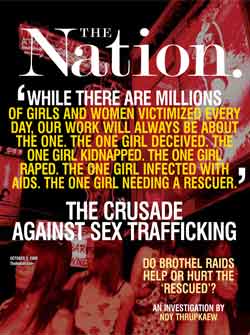
nation 5 october 2009We take sexual violence seriously here at Los Thunderlads, and so welcome the first installment of The Nation‘s investigation of sex trafficking and of what’s being done in the name of stopping it.  The first part looks at some projects that don’t seem to be helping; the second part will look at other approaches that might represent an improvement.

At the opening of this first part, Noy Thrupkaew interviews Gary Haugen and Patrick Stayton of International Justice Mission, an evangelical Christian group that stages vigilante raids on brothels in southeast Asia; Thrupkaew then talks with other people who have tried to help the women and girls IJM has “freed,” finding that many of them wind up returning to sex work, if anything finding themselves more helpless after the raid than they had been before.  Not only did IJM dump their “rescuees” with other NGOs, simply assuming that those organizations would somehow take care of them, they made no effort to differentiate between, on the one hand, women who had chosen sex work as the least worst option available to them and, on the other, women and girls who had been forced or deceived into it.  Nor did they choose their allies intelligently; IJM’s strategy of working closely with the Cambodian police seems rather dubious when we read one Cambodian policeman’s confession of the nightly rapes he and his colleagues perpetrated against the sex workers in their district, and when we read reports that many Cambodian policemen are active in sex trafficking rings.  Thrupkaew closes this first part of the series with the voices of two other women who are on the ground in Cambodia trying to help victims of sex trafficking there:

(more…)

Liberty and Bureaucracy

The Rebecca Solnit piece linked below, together with some recent conversations I’ve had with LeFalcon and VThunderlad, have got me thinking about what we twenty-first century types mean when we use words like “freedom” and “liberty.”  I’m wondering if we can’t update Isaiah Berlin’s “Two Concepts of Liberty” a bit.  Perhaps when we moderns talk about freedom, we are talking about how individuals relate to bureaucracies.  This sets us apart from the ancient Greeks and Romans.  Bureaucracy in the modern sense scarcely existed in ancient times; nor was the individual the  basic unit of society.  It was the household which was the locus of rights and responsibilities.  Challenges which a single household could not meet were met by groupings of households, either traditional groupings based on kinship relations or more-or-less temporary, informal relations based on physical propinquity.  In the absence of bureaucracies that could define their clients and members as parts of a community, it was the ability to form cooperative groupings that made a community.  The ancients, therefore, tended to see freedom as a property, not of individuals in isolation, but of independent households, of men acting as representatives of those households, and of concerted efforts made by collections of households.

If on the other hand we define freedom as the individual’s relationship to bureaucracy, what do we mean when we say that we want to be free? Sometimes we mean that we want to rebel against bureaucracy, to escape from the infantilizing effects of dependence on bureaucracy.  This can lead to absurd extremes; if we do not have a concept of community apart from the bureaucratic organizations that bear the community’s name, this anti-bureaucratic idea of freedom could keep us from calling anyone free but a solitary creature like the Cyclops.  And many among us do not seem to have such a concept of community; the attempt to build a communitarian movement that got so much publicity back in the early 1990s seems to have foundered on the difficulty of talking to modern people about community and eliciting a response that is about anything other than bureaucracies.  Many libertarians seem to be numbered among those who lack a concept of community as something other than bureaucracy.  Libertarians often make penetrating remarks about the dangers of state bureaucracy, but then go on to talk as if corporate bureaucracies were not fraught with the same dangers.  Indeed, if the forces of the market  make the bureaucracies that are subject to them more efficient at meeting the needs of their clients than are bureaucracis that don’t compete for clients, then we would expect market-generated bureaucracies to reduce their clients to dependence, and thus to infantilize them, more rapidly and more thoroughly than do state monopolies. 

Other times we say that we want freedom, and we mean that we want some benefit that a bureaucracy can give us.  So in the 1940s when Franklin Roosevelt spoke of the “Four Freedoms“- freedom of speech, freedom of religion, freedom from fear, and freedom from want- he clearly thought of these as the products of bureaucratic efficiency.  An effective anti-poverty bureaucracy would ensure freedom from want; an effective national-security bureaucracy would ensure freedom from fear; an effective judicial bureaucracy would ensure freedom of religion and of speech, freedoms which in turn would allow people to express themselves by creating denominational bureaucracies for their religious groups and partisan bureaucracies for those who shared their political views.  When Americans today call for a public-sector guarantee of health care for all, they are asking for this kind of freedom.  When other Americans oppose such a guarantee, some are motivated by a concept of freedom as rebellion against bureaucracy, but others are motivated by a belief that the private sector bureaucracies of insurance companies offer a more efficient way of providing freedom from the fear of illness and freedom from the want that often follows illness. 

Still other times when we say that we want freedom, we mean that we want to play a particular role within a bureaucratic organization.  Academic freedom is an obvious example of this concept of liberty.  Professors are free to use their own judgment in teaching their courses and in delivering opinions about topics within their fields of expertise.  Which courses they will teach, what field of expertise is theirs, and what topics lie within each field of expertise are all questions that are answered by continuous bureaucratic activity.  The idea that freedom is a category of roles within bureaucracies can be found also at the heart of the labor movement.  What rules a union sets for the workforce of its shop is a less vital concern than the fact that there are rules in the shop which came from the union.  What deal emerges from collective bargaining is less important than the fact that management is obligated to sit down with the representatives of labor and come to consensus with them. 

Perhaps the concept of liberty as a way of operating within a bureaucracy has been very influential in making the modern world.  When there was a live controversy about whether women should go out of the household to work in bureaucratic organizations, the women’s movement put a great deal of emphasis on the freedom women would gain by participating in the workforce.  This would have been unintelligible in the ancient world, where work in the household was appropriate to free people, while work for wages was proper only to slaves.  In the modern world, by contrast, going out of the household and into wage labor is a sign of freedom, if that wage labor means an opportunity to have an impact on the operations of a bureaucracy.  

The antislavery movement may be another case of liberty conceived as something found within bureaucracy.  Abolitionism was at once a movement against slavery and a movement in support of wage labor.  While the ancient Greeks and Romans might have seen that as a contradiction, it did not seem so by that time.  The ancients would have understood the slogan “forty acres and a mule.”   A grant of land and the means to support a household by farming it would open the way to the creation of a self-sufficient agricultural household.   That would have chartered the kind of freedom they could appreciate.  The freedom merely to leave the master’s household, to venture out as an isolated individual and to enter the world of bureaucracy, whether as a job-seeker or as a client needing services, would not have seemed to them to be freedom at all.   We moderns, on the other hand, find the purest promise of freedom in the African American elected officials and government employees of the Reconstruction era, and the most natural support of freedom in the operations of the Freedmen’s Bureau.

The Wickersham Report on Lawlessness in Law Enforcement

George Wickersham, 1930

George Wickersham, 1930

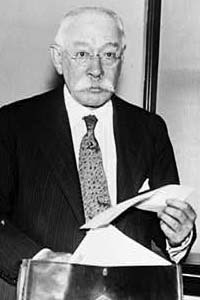
I’ve been meaning to post a “Periodicals Note” about the July issue of Counterpunch, in which “Peter Lee” wrote about the report that a commission headed by one George Wickersham submitted to US President Herbert Hoover on 7 January 1931.  The Wickersham Commission had investigated charges that US law enforcement agencies were using torture to enforce the prohibition of alcohol that was then in effect across the United States.  The commission’s staff was led by a civil liberties lawyer named Zechariah Chafee, and Chafee turned up evidence that made the Wickersham report impossible to ignore.  Lee gives considerable detail from the report, and points out that all of the “enhanced interrogation” techniques that CIA and military interrogators have been accused of using against captives in the “war on terror” were familiar to Prohibition agents in the 1920s.  Those methods disgusted the American public then, and the exposure of them did a good deal to spur the movement that ended Prohibition.  The difference in the outraged public reaction of 1930 and the muted public reaction to the exposure of the same methods in the last five years cannot be attributed to the difference between accused bootleggers and accused terrorists; Lee points out that torture is not in fact a very effective way of thwarting terrorists.  What has changed is us.  The headline above Lee’s piece is “When America Said No!”  His implication is that the American people have lost the moral compass that once enabled them to say no to torture.   

(more…)

The American Conservative, October 2009

american conservative october 2009

The cover may suggest an alarmist piece about Pakistan.  The article actually in the issue, though, is precisely the opposite.  Granting that Pakistan is an important country that has very serious problems, it asserts that there is no chance that it will break up, fall into the hands of Osama bin Laden, or launch a nuclear attack.  If the USA sobers up and pursues a more realistic policy in Afghanistan, Pakistan might even make progress on its real problems.

Elsewhere in the issue, Andrew Bacevich quotes Cold Warrior Richard Pipes’ 1979 declaration to the effect that since Afghanistan is a place of no strategic importance, the Soviet invasion of that country must have been a step towards a goal elsewhere.  Bacevich agrees that Afghanistan was without strategic importance when Pipes said that, and says that it continues to be so.  Where he disagrees with Pipes is in his assessment of the rationality of the Soviet leadership of the 1979-1989 period, and indeed of the US leadership of today.  He claims that the Soviets invaded Afghanistan because they believed that showing power there would shore up their empire; in fact, the Soviet occupation of Afghanistan was a significant factor in the eventual collapse of the USSR.  Likewise, America’s leaders want to persist in Afghanistan, not because of they have made any rational calculation indicating that they should, but because they are dare not make a calculation that might indicate that they should not.

This issue includes a piece by always-intriguing, highly eccentric writer Eve Tushnet.  Tushnet has a gift for the lapidary; she describes growing up in Washington, DC as one of very few white children in her neighborhood, albeit one “weird enough that my skin color was not one of the obvious targets of teasing.”  Recounting her childhood Halloweens, she writes that “A mask is above all an attempt to communicate, to create and reshape meaning over the silence of skin.”  Quite a provocative phrase, “the silence of skin.”  On a par with her line from 2008, “by religion, I mean an understanding of the nature of love.”

(more…)

The American Conservative, September 2009

american conservative september 2009One of the traits of this magazine is a tendency to grandiose theoretical explanations.  That’s one of the things I like about it; I’m into grandiose theoretial explanations myself.  It isn’t scholarly publication, and few of its authors have academic reputations to defend, so that tendency is not always restrained by the standards that keep theorizing under control in academic journals.  Sometimes that means that the magazine runs a provocative, bold idea that might not have survived heavier editing; sometimes it means that it runs something that’s just plain cheesy quality.  Again, I’m a pretty cheesy guy, so that’s okay with me. 

For example, this month Ted Galen Carpenter points out that Americans by and large are quick to view political disputes in foreign countries in a romantic light, seeing the ghost of Thomas Jefferson in all sorts of unlikely figures.  The next piece, by John Laughland, picks up on this same theme, explaining this American tendency as a sign of the influence of the philosophy of the Enlightenment.  Laughland writes that “the key to understanding the West’s love of revolutions” is Westerners’ characteristic desire to believe that “politics can and should be a story with a happy ending.”  This desire has run rampant in the West ever since the thinkers of the Enlightenment undermined the traditional Christian belief that the cosmos was ordered in a hierarchy, that justice was to be found in that hierarchy, and that the ruler’s power should be limited because the ruler was subordinate to God.  Laughland identifies Immanuel Kant as “the greatest of all Enlightenment philosophers,” and summarizes Kant’s theory as a belief that ordinary reality is unknowable, but that the highest reality is “the categorical imperative- an abstract universally valid proposition that becomes real when it is willed.”  Proceeding from these rather drastic simplifications, Laughland declares that:

The attraction of Enlightenment liberalism, therefore, is the result of a deep emotional need for a philosophical sytem that enables man to create a reality in a universe he does not understand and thereby to escape from the difficulties of the world by believing that everything will turn out all right in the end.  Lacking a real belief in the afterlife, it also holds that the drama of human salvation is played out in this world, in history and politics. 

Again, this is a severe oversimplification, but it has a certain plausibility.  Where Laughland really goes off the rails is in his closing section, in which he argues that Enlightenment liberalism has an “objective ally” in Islam:

[B]ecause it has no priesthood, Islam, and especially Shi’ism, is fundamentally a “democratic” religion comparable to Puritanism and other forms of Presbyterianism.  There is no established hierarchy; the Koran must be read equally by all.  Of course Allah is supreme and Islam demands absolute submission to Him; on the face of it, this seems the opposite of the liberal model in which the individual is subjected only to himself.  But this very submission is egalitarian, creating a mass of individuals who are equal in their abstractness.  Moreover, God’s will is [merely] will, it has no correlation with natural law as in the Christian or Jewish traditions.  Islam is therefore a profoundly voluntarist religion.  Because Allah is absolutely transcendent and unknowable, he is like the Kantian thing-in-itself: mere command. 

(more…)

The Nation, 3 August 2009

nation 3 august 2009Jonathan Schell’s remembrance of former Defense Secretary Robert Strange McNamara begins with the story of Schell’s meeting with McNamara in 1967, at which he, then a young reporter for The New Yorker, briefed the secretary on what he had seen American forces doing in Vietnam.  Schell would not hear from McNamara after that meeting, but declassified documents would subsequently reveal that the secretary had responded to it by attempting to discredit Schell’s story and block its publication.  Schell mentions McNamara’s subsequent contrition for his Vietnam policies, stressing that the remorse he suffered was quite trivial compared with the what the people of Vietnam suffered during the war McNamara did so much to design.  Still, Schell points out, McNamara was unique among high-level US policymakers of recent decades in publicly admitting error.  The piece ends with Schell’s line “If there is a statue made of McNamara, as there probably will not be, let it show him weeping.  It was the best of him.” 

(more…)

An abuse of power?

He's still getting people worked up

He's still getting people worked up

Andreas Willi, professor of Greek at Oxford, takes issue with a letter addressed to the US president that has lately been gathering signatures from American classical scholars.  Willi’s article can be seen in pdf form here.

WHOSE IS MACEDONIA, WHOSE IS ALEXANDER?

On 18 May 2009, 200 Classical scholars from around the world sent an open letter to the President of the United States of America, Barack Obama. This unusual action, and the contents of the letter, raise issues which may not have been considered by all those who have endorsed it, but which deserve consideration. In order to put the discussion that follows into context, it may be useful first to quote the body of the letter itself. [[1]]

***

Dear President Obama,

We, the undersigned scholars of Graeco-Roman antiquity, respectfully request that you intervene to clean up some of the historical debris left in southeast Europe by the previous U.S. administration.

(more…)

Red State Update

Thanks to “Kate L,” a frequent commenter on Alison Bechdel’s Dykes to Watch Out For, for pointing us to this video: