

Imagine how embarrassing it would be to be the child of one of these parents. Here’s the BBC article.
Imagine how embarrassing it would be to be the child of one of these parents. Here’s the BBC article.
Posted by acilius on February 26, 2009
https://losthunderlads.com/2009/02/26/troubled-adults-and-the-children-who-love-them/
 After the jump, two brief newspaper articles based on interviews Harry Nicolaides has granted since his release. Most interesting to me is this paragraph from the first article:
Harry admits that an article by him published in Eureka Street, a Melbourne based publication, alleging that Thai police turned a blind eye to the importation of child pornography from Burma, may have impacted on his situation, “It may have put me on the radar, I knew I was always provocative but at worst if anything at all happened I thought I would be deported, never jailed.”
Posted by acilius on February 25, 2009
https://losthunderlads.com/2009/02/25/harry-nicolaides-speaks/

No juniper tree
T. S. Eliot was a student of Irving Babbitt’s at Harvard. Afterward, Eliot often claimed to be a disciple of Babbitt’s. “Once to have been a student of Babbitt’s was to remain always in that position,” Eliot wrote. Eliot sent letters to Babbitt under the salutation “Dear Master.” Babbitt never answered any of these letters. Babbitt never made it clear whether he was repelled by “Dear Master” or he disliked Eliot for some other reason.
Be that as it may, in 1989-1990 I spent a good deal of my time reading books by Babbitt and his circle of followers. Since Eliot was the most famous of those who wished for admission to that circle, part of that time I studied Eliot. My favorite of his poems is “Ash Wednesday.” Today is Ash Wednesday. So:
I
Because I do not hope to turn again
Because I do not hope
Because I do not hope to turn
Desiring this man’s gift and that man’s scope
I no longer strive to strive towards such things
(Why should the agèd eagle stretch its wings?)
Why should I mourn
The vanished power of the usual reign? (more…)
Posted by acilius on February 25, 2009
https://losthunderlads.com/2009/02/25/ash-wednesday/
Another funny item via Language Log.
Posted by acilius on February 24, 2009
https://losthunderlads.com/2009/02/24/strict-police/

Reunited with his father
Posted by acilius on February 23, 2009
https://losthunderlads.com/2009/02/23/hes-free/

Cartoonist Alison Bechdel
Recently I (Acilius) have posted several long-winded comments on the message board at the Dykes to Watch Out For site. Topics of my bloviation have included the weaknesses of The Economist; how children think of social class; how much I’d like to have a hamburger dressed with peanut butter; whether it is likely that university faculties will continue to be organized into departments; what it might mean if academic departments were dissolved and faculty members reported directly to administrators; the fact that I had bacon for breakfast Saturday; what the relationship might be between income level, educational level, and political affiliation; the reason why I’ve been posting there so much; and Sean Penn’s voice in the movie Milk.
UPDATED: (more…)
Posted by acilius on February 23, 2009
https://losthunderlads.com/2009/02/23/a-thunderlad-at-large/
Recently one of my daily reads, Language Log, seems to have turned into an archive for newspaper comic strips. I for one welcome our new insect overlords this turn. The last three days have seen posts about Blondie, Doonesbury, and Partially Clips. Earlier this month, Grand Avenue and Get Fuzzy were represented. Check their category “Linguistics in the Comics” to see the trend.
Posted by acilius on February 23, 2009
https://losthunderlads.com/2009/02/23/language-log-takes-a-strange-turn/
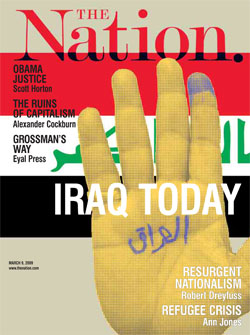 Robert Dreyfuss looks at the regional elections held in Iraq on 31 January and finds good news. A new alliance of Shi’a and Sunni groups is beginning to operate in Iraqi politics. Soon, Dreyfuss hopes, this alliance will be strong enough to present itself as a genuinely nationalist bloc and to insist on an end to the US occupation.
No such development is in sight in Afghanistan. An editorial expresses the fear that the Obama plan to send more US troops to that country will make “Bush’s War” into Mr O’s very own.
Katha Pollitt speaks up for free speech. On the twentieth anniversary of the Ayatollah Khomeini’s fatwah against Salman Rushdie, she finds fault with fellow leftists whose only response to violent behavior by Muslims who have taken offense at speech labeled anti-Islamic is to “see these incidents as gratuitous provocations by insensitive Westerners” and to support restrictions on speech that amount to blasphemy laws. She grants that many of the incidents that have generated violent responses in the Muslim world have indeed been gratuitous provocations by insensitive Westerners, and is happy to list extremists from other religious groups whose conduct has been every bit as deplorable as the worst we have seen from Khomeini and his coreligionists. But:
Appeals to the hurt feelings of religious people are just a dodge to protect the antidemocratic and retrograde policies of religious states and organizations. We’re all adults; we have to live with unwelcome expression every day. What’s so special about religion that it should be uniquely cocooned? After all, nobody at the UN is suggesting that atheists should be protected from offense–let alone women, gays, leftists or other targets popular with the faithful. What about our feelings? How can it be logical to say that women can’t point out sexism in the Bible or the Koran but clerics can use those texts to declare women inferior, unclean and in need of male control? And what about all the abuses religions heap on one another as an integral part of their “faith”?
An essay about Israeli novelist David Grossman of course concerns itself chiefly with Grossman’s insights into the Israeli/ Palestinian conflict. What sticks with me from the essay is this quote from Grossman about writing:
[Y]ears ago, reflecting on a story he was writing that featured a bitter, emotionally unstable protagonist, he described his desire to have the tale surprise him. “More than that, I want it to actually betray me,” he wrote.
To drag me by the hair, absolutely against my will, into the places that are most dangerous and most frightening for me. I want it to destabilize and dissolve all the comfortable defenses of my life. It must deconstruct me, my relations with my children, my wife, and my parents; with my country, with the society I live in, with my language.
Posted by acilius on February 22, 2009
https://losthunderlads.com/2009/02/22/the-nation-9-march-2009/

Posted by acilius on February 22, 2009
https://losthunderlads.com/2009/02/22/a-banana-by-andy-warhol/
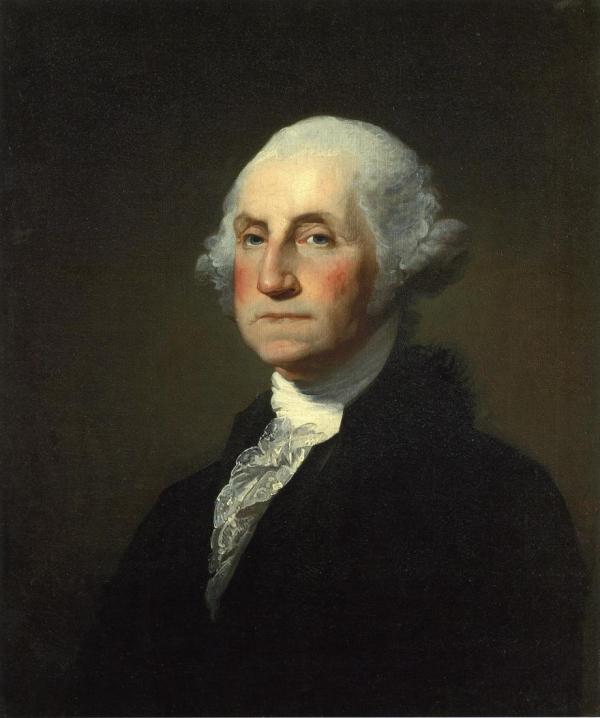
Since today is George Washington’s birthday, I decided to include my favorite of his writings, his letter to the Congregation Yeshuat Israel of Newport, Rhode Island.
Letter from George Washington to the Hebrew Congregation at Newport
c. August 1790
Gentlemen:
While I received with much satisfaction your address replete with expressions of esteem, I rejoice in the opportunity of assuring you that I shall always retain grateful remembrance of the cordial welcome I experienced on my visit to Newport from all classes of citizens.
The reflection on the days of difficulty and danger which are past is rendered the more sweet from a consciousness that they are succeeded by days of uncommon prosperity and security.
If we have wisdom to make the best use of the advantages with which we are now favored, we cannot fail, under the just administration of a good government, to become a great and happy people.
The citizens of the United States of America have a right to applaud themselves for having given to mankind examples of an enlarged and liberal policy—a policy worthy of imitation. All possess alike liberty of conscience and immunities of citizenship.
It is now no more that toleration is spoken of as if it were the indulgence of one class of people that another enjoyed the exercise of their inherent natural rights, for, happily, the Government of the United States, which gives to bigotry no sanction, to persecution no assistance, requires only that they who live under its protection should demean themselves as good citizens in giving it on all occasions their effectual support.
It would be inconsistent with the frankness of my character not to avow that I am pleased with your favorable opinion of my administration and fervent wishes for my felicity.
May the children of the stock of Abraham who dwell in this land continue to merit and enjoy the good will of the other inhabitants—while every one shall sit in safety under his own vine and fig tree and there shall be none to make him afraid.
May the father of all mercies scatter light, and not darkness, upon our paths, and make us all in our several vocations useful here, and in His own due time and way everlastingly happy.
G. Washington
Posted by acilius on February 22, 2009
https://losthunderlads.com/2009/02/22/george-washingtons-letter-to-the-hebrew-congregation-of-newport-rhode-island/
 acilius
 believer1
 lefalcon
 losthunderlads
 vthunderlad
 Panther Red