
An unlikely speculation about Mr O

florida avenue meetinghouseThe BBC’s outgoing North America editor, Justin Webb, writes:
The other fascinating development in recent days has been the end – or not – of the Obamas’ search for a church.

I have suggested it before but let me lay it on the line here in black and white: THE MAN IS A QUAKER. He may not yet know it but that is where his search should end. There is a lovely Meeting House somewhere around Dupont Circle as well so he could get there easily.

I think the meetinghouse Webb is referring to is the one on Florida Avenue, which was originally built so that Herbert Hoover, the first Quaker to occupy the US presidency, would have a grand place to worship. 

Elsewhere, Webb identifies himself as “the product of a Quaker school so am incapable of lying.”  So I suppose he must be in earnest, though I can’t seem to find why he thinks that Mr O is a Quaker.  Perhaps it has something to do with his ethnic background.  The country with the largest number of the world’s Quakers is Kenya, B. H. Obama, Senior’s homeland; though virtually all of them are members of the Luhya tribe of western Kenya, not the Luo tribe from which the elder Mr O sprang.  Despite the similarity in the names “Luo” and “Luhya,” the two peoples are quite unrelated.  So I doubt that would be it.

The banana coffin

Banana art in the news:

banana casket

MONTROSE, Colo.—Casket makers catering to natural burials have offered biodegradable coffins made of such materials as recycled newspapers or cardboard. Montrose-based Ecoffins USA is selling caskets made of banana sheaves.

They take six months to two years to biodegrade.

Marketing director Joanna Passarelli says the company sold $40,000 worth of banana-sheaf or bamboo coffins to funeral homes last year.

At least 14 funeral homes around the country offer them.

Ecoffins USA is the sister company of The SAWD Partnership, which has helped fuel the “green” funeral movement in the United Kingdom.

In natural burials, bodies aren’t embalmed and eventually decompose into the earth.

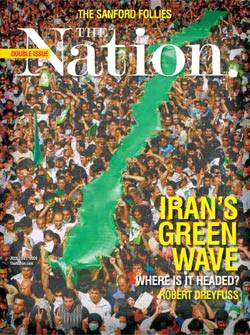
The Nation, 20 July 2009

nation 20 july 2009An article by Robert Dreyfuss explores the division among the Iranian political elite that has contributed to the recent mass demonstrations there.  Dreyfuss convinces me that the government has a narrow base of support among elite groups in the city of Teheran.  Most of the people he talks to regard Ayatollah Khamenei and President Ahmedinejad as too hard-line and traditionalist, while many others are turning to rightist groups that accuse those men of being too soft.  However, I’m skeptical of Dreyfuss’ attempts to suggest that the Teherani elite is in this matter representative of the country as a whole.  Dreyfuss cites the Chatham House study which compared voter turnout in Iran’s 2005 presidential election with turnout in this year’s contest, concluding that the number of votes reported had increased by so much that fraud was a likelier explanation than was a rise in actual participation.  On Dreyfuss’ own showing, though, the opposition has the support of many key power players.  Among them are many men who may be in a position to falsify votes.  And the fact remains that the only opinion poll conducted in Iran before this year’s election predicted the same result that the authorities certified.  The election may well have been a phony, but Dreyfuss definitely wrong to say that it “seems far-fetched” to think that Ahmedinejad may have won. 

(more…)

The American Conservative, August 2009

american conservative august 2009With this issue, our favorite “Old Right” read gives up its quixotic biweekly publication schedule and becomes the monthly it should always have been.  

In the cover story, Brendan O’Neill casts a gimlet eye on the environmental initiatives now chugging through official Washington.   He sees in them little more than a series of raids on the treasury by well-connected businesses.  He cites Gabriel Calzada, a Spanish economist who found that every job his country’s wind power initiative had created represented a cost of $2,200,000 to the taxpayer.  Of course, the jobs don’t pay $2,200,000- most of that money goes to corporate interests.  O’Neill argues that the alternative energy plans now under consideration in Washington are at least as bad as is Spain’s wind power initiative. 

Former US Army interrogator Matthew Alexander explains what he did in Iraq that his colleagues didn’t.  He followed the rules, they didn’t.  He treated detainees with respect, they didn’t.  He obtained useful intelligence, they didn’t.  When information he had elicited led to successful US military operations, they got medals, he didn’t. 

(more…)

Banana Art Today

Click on the image for its source.   

beagle-nana

These two look happy: 

loving couple

These don’t look too tasty:

don't look tasty

(more…)

Ukulele and Languages

ukulele and languagesUkulele and Languages collects ukulele videos in (you’ll never guess!) various languages.

The latest post includes a couple of videos of Danish songs; this one, by “EvertParkLars,” is particularly likable.

Voodoo Marmalade is apparently Portugal‘s answer to the Ukulele Orchestra of Great Britain.  They are off to a good start; considering that UOGB has been at it for 24 years, I hope no one will think I’m being sniffy if I say that Voodoo Marmalade has some way to go before they match them. 

This page of eastern European ukuleleists ends with a video in Polish called “Ukulele Kajaki” (“Ukulele Kayak.”)  I don’t understand a word of the lyrics, but the guy’s voice sounds like it’s saying something hilarious.

Is there Latin?  Of course there’s Latin!  Here’s “Love Machine” redone as “Machina Amoris.”

The Atlantic, July/ August 2009

the atlantic july and august 2009We as a species are currently dumping massive amounts of carbon into the upper atmosphere.  Average temperatures around the world are rising at an alarming rate, evidently at least in part as a consequence of this dumping.  No movement is in prospect that would stop the dumping, or even reduce it substantially.  So, what to do?  Some scientists and engineers want to remake the rest of the earth’s climate to accommodate our carbon dumping habit.  How could this be done?  There are several possible methods. 

We could shoot sulphur dioxide into the upper atmosphere.  That would be remarkably affordable- for as little as a billion dollars, it could end global warming.  The drawback is that eventually sulphur would rain down from the sky, and if we stopped shooting new sulphur dioxide up there global temperatures would increase dramatically in a very short period.  Also it would cause severe droughts throughout central Africa, a region which has not exactly been among the big winners of industrialization to start with, so that seems unfair. 

Also we could dump iron powder in the Antarctic Ocean, causing a huge plankton colony to bloom and suck carbon dioxide out of the atmosphere.  We’d have to be a bit careful about that- half a supertanker’s worth of iron powder could feed a big enough plankton bloom to trigger a new Ice Age.  And when plankton dies, it releases methane, which is a much more effective greenhouse gas than carbon dioxide. 

There are also people who would like to block sunlight by shooting millions of clay discs at the Lagrange point between the earth and sun.  These skeets might well reduce average temperatures on the earth, but they could also stop the formation of ozone in the atmosphere.  And without an ozone layer, life as we know it could not exist on the surface of the earth.  So that’s a little bit on the risky side too.  So it seems like reducing carbon emissions might be worthwhile after all. 

(more…)

The most ambitious installment of xkcd I’ve seen

overstimulated

The return of Weirdomatic?

Weirdomatic collects interesting pictures from around the web.  It was one of my favorite sites for quite a while.  It stopped updating last year, but now there’s a new gallery up.  I certainly hope it’s a sign of things to come. 

ice_cream_machine_25

Some interesting things in this week’s issue of The Economist

economist 27 june 2009I subscribed to The Economist for years and years.  I liked its quick notes about little countries that major media outlets ignore completely.  After a few years of reading it regularly, it came to seem like a person.  In particular, it seemed like a 23 year old bond trader who thinks that he rules the world, or is about to.  Obnoxious as that fellow might be in person, in the form of a magazine he was, at his worst, something I could set on a table and forget about.  More often his outlandish politics were good for a laugh.  I still remember the first number of The Economist I read, a 1983 issue with Nicolae Ceaucescu’s picture on the front, labeled “The Sick Man of Communism.”  What sticks out is a leading column about Lebanon, the last paragraph of which began with some phrase like “Though colonialism is unfashionable at the moment,” and went on to suggest that the best thing for that country might be occupation and domination by Syria.  Time and again The Economist makes remarks like that, which only a staff as extremely young as that which in fact does produce the magazine could make innocently.  And it can be a useful read- if I’d bet against every market prediction they made in the 1990s, I’d be a millionaire today. 

This time around, they have a leader and an article about the new Acropolis Museum, each concerned chiefly with the effect this facility will have on the dispute between Britain and Greece over the ownership of the friezes Lord Elgin took from the Parthenon in the period 1801-1805.  The British Museum has been taking care of them for over 200 years, the Greek government has been campaigning for their return to the Acropolis for almost 30 years.  The Economist is impressed by the new museum on the Acropolis, and wishes the British Museum would lend the friezes to the Greeks.  This solution would require the Greeks to renounce their claim of formal ownership of the friezes.  Previous Greek governments have seemed willing to make this concession, but the current one is not.  The Economist predicts that an uncompromising stand by the Greeks could unravel a great deal of the progress that has been made since December of 2002, when the world’s leading museums issued a statement called “the Munich Declaration”: 

The Munich declaration, as it is called, asserts that today’s ethical standards cannot be applied to yesterday’s acquisitions; but in return it acknowledges that encyclopedic museums have a special duty to put world culture on display.

This has led to a new level of co-operation between museums over training, curating, restoration and loans. Thousands of works are now lent each year between museums on every continent.

All this apparently will come crashing down unless the Greeks take the advice of The Economist.  Considering that much of the 6 March 1999 issue of that magazine was devoted to dire warnings of the chaos the world would face in the next decade as the price of oil dropped below $5 a barrel and stayed there, I wouldn’t worry overmuch about its predictions. 

(more…)