Some recent ukulele videos from YouTube

Since Al Wood started his extended Christmas break and put Ukulele Hunt on hiatus, some of us have been suffering withdrawal pains.  As a tribute to his Saturday UkeTube selections and in anticipation of his return next week, here are few videos I’ve been listening to lately.

What Do I Gotta Do, by Jeremiah Camacho

Under the Covers, by Kate Sloan  

Vangelis’ Missing, played by Ken Middleton

Tamacun, played by Brittni Paiva

Lilli Marleen, played by Bernd Dombrowski

The Cure’s “Friday I’m in Love,” performed by Najmah

Staten Island Slide, played by the Slavic Inferno 

Lauren O’Connell’s Sweet Lament, performed by Neva Keuroglian

My Blue Heaven, played by L. Strachey (aka ReyalpEleluku)

Deja Vu Date,” by Miss Zooey

By the Sleepy Lagoon,” arranged for ukulele and performed by Martin Wheatley

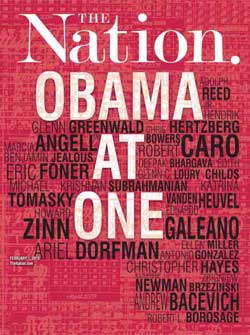
The Nation magazine’s first issues of 2010

1 February: The first issue to go to press after the earthquake in Haiti includes some recommendations for those who would like to find a good relief organization to give money.  The first organization I looked up when I heard about the quake was one I’d first read of in the pages of The Nation, MADRE.  In her year-end lists of groups that deserve financial support and elsewhere, Nation columnist Katha Pollitt has made mention of this organization, which supports groups around the world.  Most of MADRE’s partner groups are initiatives in poor countries, started and led by citizens of those countries, that prioritize the needs of women and girls.  MADRE’s Haitian partner is Partners in Health, which runs a network of clinics called Zanmi Lasante; they’re on the list.  The magazine’s website includes several more pleas for Haiti; see here and here

In the same issue, Robin Einhorn attacks Gordon Wood’s recent book about the early federal period of the United States, arguing that Wood shows a “remarkably naive sense of politics” that allows him to keep the South at the margins of his story and free white male Northerners at the center of it.  Even as he puts the focus on a rapidly industrializing region, Einhorn argues, Wood shows an uncritical admiration on for the agrarian politics of Thomas Jefferson and his party.  Einhorn grants that Wood’s chapter on the politics of slavery is excellent, but says that confining the topic to a single chapter, quarantined from the rest of the book, is profoundly misleading.  In the end, Einhorn declares that Wood has succeeded in thinking like Thomas Jefferson, but that this is no unmixed virtue:

If Jefferson had known nearly as much about his society as Wood does, Empire of Liberty is the book he would have written. It is no coincidence that the title is Jefferson’s, a phrase encapsulating his brand of velvet-gloved imperialism. Wood seems to know that there was an iron fist lurking inside, but he identifies with an audience that treasures the national fantasy of egalitarian triumph that Jefferson represents. Like Jefferson, Wood nods to the evil of slavery and the violence of westward expansion. Unlike Jefferson, he realizes that there was something undesirable about the way men treated women. But Wood’s focus remains squarely on the subculture of white men–especially in the North–who energetically pursued their liberty and happiness in the “republicanized” world of postrevolutionary America. 

25 January: Alexander Cockburn is disappointed with R. Crumb’s version of the Book of Genesis.  In Cockburn’s view, Crumb does not thoroughly deflate monotheism, but produces a more or less reverent text.  “If a conclusive disresepcting of Genesis was required, wouldn’t you think R. Crumb was the man for the job?… But the overall effect is more solemn than satirical.”  Cockburn is also disappointed that Crumb depicts the characters of the book as recognizably Jewish (in fact stereotypically Jewish, “hairy” and “with big noses,”) missing an opportunity to make the point that “There never was a Jewish people, only a Jewish religion” (a line Cockburn quotes from Israeli journalist Tom Segev) and that Zionism is therefore an illegitimate enterprise.  Indeed at one point Cockburn claims to have “wondered whether Crumb, a Catholic long ago, had converted to Zionism.” 

I agree with Cockburn about a lot of things, but when he turns to Judaism and the Jews I sometimes suspect him of being a bit cracked.  Not that I want to wave the flag for Zionism, but it doesn’t seem especially reasonable to expect a graphic novel, even when that graphic novel is R. Crumb’s adaptation of Genesis, to achieve everything he demanded of it.   

11 January: A piece about the Polaroid camera and the pictures it took includes this:

Polaroid’s “now” having been driven into the past, it has become ripe for nostalgia. Found Magazine, launched in 2001, was well ahead of the Polaroid nostalgia wave and spun off a whole book of Found Polaroids in 2006, when the end of the road was already in sight. But for its author, Jason Bitner, the medium had always been “instant nostalgia–framed and faded, a picture that already looked decades old.”

The same issue includes an essay about Thelonious Monk that ends with this anecdote:

Monk liked to wear a formidable ring bearing his name when he played, an encumbrance that no pianist in his right mind would want to burden a hand with. While he was flashing his ring for the world to see, from his own perspective he saw something else. “KNOW” said the ring, more or less, to the audience. “MONK” was the reply when he saw it himself.

.

The Tank Chair

Thanks to “Hairball of Hope,” a regular commenter at Alison Bechdel’s “Dykes to Watch Out For” blog, for calling my attention to the “Tank Chair,” an all-terrain wheelchair. 

Wintertime Adventures

This afternoon Mrs Acilius’ power wheelchair got stuck in the snow on an unshoveled sidewalk. She’d wanted to go through the street, but had let me convince her that the snow on the sidewalk looked to be worn down enough that she could get through. It worked just fine, until the very end, when she hit a narrow pass in the snow and couldn’t move forward or back. She drove forward and back while I pushed, but it wasn’t budging. Two people converged on us, a fashionably dressed woman of about 60 and a thin man of about 20 with a thousand-yard stare and summer clothes, obviously just back from someplace much colder and much scarier than our college town. (”You have been in Afghanistan, I perceive”…)

Anyway, the two of them greeted us with offers to help push. The first words out of Mrs Acilius’ mouth were “I’m going to live here from now on, apparently.” The young man couldn’t bring himself to believe that pushing wouldn’t solve the problem, and kept looking for ways to grab hold of the chair.

The woman said that what we needed was a shovel. She looked at the business next to the sidewalk, a funky little used-record store, and said it was too bad they didn’t have a snow shovel. “I bet you a nickel they do have a shovel,” I said. “Well, look at their ramp,” she said. The ramp was covered with snow, but she went in anyway, perhaps curious to see whether I’d pay that nickel.

We waited a moment. I told Mrs Acilius that I supposed she had been right about using the street. She reminded me that it was my idea to use the sidewalk. Channeling General Buck Turgidson, I said I din’t think it was fair to indict an entire plan because of one failure. She seemed to think that was funny.

The young man asked me if we could grab the small wheels on the front of Mrs Acilius’ chair. Mrs Acilius wasn’t opposed to this plan, but before we could put it into effect the woman came out of the store, followed by its proprietor bearing a snow shovel. I took the shovel and dislodged Mrs Acilius’ chair.  The young man pushed her forward once I’d broken up the snow.

Underground homes

To some, the idea of an underground house will suggest the early Stone Age.  To others, it will suggest James Bond attacking a bunch of guys in jumpsuits.  To some, however, it suggests a great deal more than that, as Alexandra documents at Weirdomatic.

Separated at birth?

Newsweek thinks Mississippi’s Governor Haley Barbour looks like a future president:

I think he looks more like a figure from the past:

This So-Called Post-Post-Racial Life

If you like what we do here at Los Thunderlads, you’ll probably like “This So-Called Post-Post-Racial Life: Life, Culture, and Politics in the Obama Age.”  The author writes short narratives that raise surprising questions about American life.  Some particularly strong recent posts include “Racism, A Love Story“; “The War on the New Year“; and “Santa Claus Is a Black Man- And a Black Woman.”

“A Language with a Name is an Idea, Not a Fact”

Bruegel's "Tower of Babel"

In 1995, Michael Billig published a book called Banal Nationalism, in which he argued that the ideology of nationalism has penetrated the modern mind more deeply than we commonly realize.  I haven’t read the book, but I might soon, since a remark about it on Ingrid Piller’s blog at  “Language on the Move” has been preying on my mind for several weeks.  In a post called “Sociolinguistics 2.0,” Piller wrote:

Michael Billig (1995) coined the term “banal nationalism” to describe all those mundane forms of nationalism that produce and reproduce the nation – such as the daily weather forecast on TV, which even in the smallest landlocked nation is presented against the background of a national map as if the weather was tied to national boundaries. Irritatingly, for any critical sociolinguist, the ToC of many journals in the field reads like a list of textbook examples of banal nationalism: study after study of this, that and the other thing in this, that and the other national language. Bourdieu (1991, p. 45) says it all:

To speak of the language, without further specification, as linguists do, is tacitly to accept the official definition of the official language of a political unit.

Sociolinguistics 2.0 can and must do better! Let’s stop pretending that English, German, Japanese or any other language with a name have some kind of primordial existence and are not in need of further explanation. The interesting questions are around language as “a cause, a solution, a muse for the national self, and a technology of the state” (Ayres 2009, p. 3).

(Follow the link above for the full citations.) 

The sentence “A language with a name is an idea, not a fact” is the heading Piller gives these remarks.  The more I think about that sentence and these remarks, the more puzzled I become. 

Certainly it is up to people to decide the boundaries that separate one language from another.  These boundaries do not exist in nature, as things that scientists working in a laboratory can discover and reveal to an unknowing world.  So to ask whether Flemish and Dutch, for example, are separate languages is to ask who does and does not believe that Flemish and Dutch are separate languages, and how those beliefs affect their linguistic behavior.  I think this is what Piller means by “A language with a name is an idea, not a fact”, but I’m not sure- who believes what and how those beliefs show in their behavior are questions of fact, after all. 

The references to Billig and Pierre Bourdieu suggest to me that the “idea” Piller has in mind is the modern nation-state.  If that is so, then I’m not sure how broadly she means her assertions to apply.  The idea of languages as individual entities with names was thousands of years old before the nation-state emerged.  Doubtless the emergence of the nation-state and of nationalism as an ideology has given us a different understanding of this idea than the ancients had.  So when we read, for example, an ancient Roman like Ennius claiming that he had three hearts because he could speak three languages, Latin Greek, and Oscan, we may well attribute thoughts to him that a man of the third century BC could not have entertained. 

Still, an idea of a language as an entity distinct from other languages and capable of bearing a name seems to be very widespread and very old.  Perhaps very old indeed; in 2008, I posted a link to an argument to the effect that when language was first spoken, more than one language may have been spoken.  If so, the idea of “a language” may already have been familiar to the first generation of language speakers.   

This is mere speculation, of course.  But I wonder how deep the idea that there are multiple languages in the world goes in the practice of language.  Perhaps the very act of speaking is always the act of speaking a particular language, as opposed to any other language.  So if Ennius spoke Oscan as a boy in a mostly Greek-speaking town in Calabria, he was, among other things, asserting his identity as a non-Greek.  If he spent his adult life in Rome speaking Latin, he was, among other things, signaling his intention to assimilate to Roman social norms.  Of course, in those days “identity” and “assimilation” were very different things than they are in a world where they are mediated by the modern state and its ideologies.  But perhaps something recognizable as identity and something recognizable as assimilation have existed from the dawn of language.

Amanda Carr

Boston’s Amanda Carr is not only a vocalist, but a fine composer of jazz as well.   Her MySpace page highlights some of her originals; here are two YouTube samples.

If You Could See Me Now“- the notes on this video claim that Amanda Carr’s favorite movie is THX-1138.  Her music gives me a high opinion of her, if she’s a fellow THXnik I have an even higher opinion.

A promotional video for 2009’s “Common Thread

Miscellaneous links to end the year

There are a bunch of links I’ve been meaning to post here; so, as a sort of year-end housecleaning, here they are.

Artist and friend of the blog Liza Cowan on the world’s largest photograph, as of 1904.

The Paranoid Center: How the panic over right-wing violence is being used to marginalize peaceful dissent,” from Reason magazine. 

A much-discussed article from The Independent about how to keep young Muslims from turning into terrorists.

Osama bin Laden probably died years ago, but Americans and others go on marching to their deaths in the name of a campaign against him.  

Repentance is knowing that I am loved,” according to a certain “Father Gregory” of the Orthodox Church in America.   

Imagine yourself as a contestant in a beauty pageant.  A judge asks you a question about an explosively controversial topic.  You had no reason to expect the question, and have not prepared an answer.  What do you do?  Friend of the blog Ellie is a former beauty pageant contestant who has some pointers for you.   

The thank-you key (thanks to Cymast for pointing that one out to me.)

The world’s least comfortable chairs.

Taschen book catalog entry for Insects of Surinam, by Maria Sibylla Merian, edited by Katharina Schmidt-Loske. 

Do you like the Periodic Table of the Elements?  Then you’ll love the Periodic Dessert Tray of the Elements!

Some characteristic symptoms of phony science.

Curved yellow fruit.

Get out your red and green 3D glasses to view these Italian postage stamps.