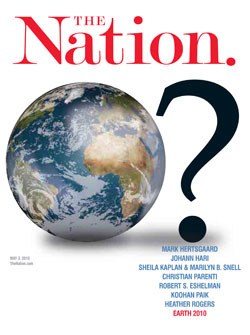
The Nation, 10 May 2010

Jerry Coyne asks why so many Americans who are capable of accepting the germ theory of disease in a perfectly calm state of mind become so agitated by the theory of evolution by natural selection that they would rather seek refuge in the most far-fetched mythological tales than accept it.  Coyne remarks on two possible explanations for this continent-wide panic attack:

One answer is religion. Unlike germ theory, the idea of evolution strikes at the heart of human ego, suggesting that we were not the special object of God’s attention but were made by the same blind and mindless process of natural selection that also built ferns, fish and rabbits. Another answer is ignorance: most Americans are simply unaware of the multifarious evidence that makes evolution more than “just a theory,” and don’t even realize that a scientific theory is far more than idle speculation.

I don’t  know if either of these explanations really gets us very far.  After all, before Hippocrates it was widely assumed that health or illness was chiefly a sign of a person’s relationship to the gods and other supernatural forces.  So a healthy person enjoyed the favor of the gods, and one who fell ill had incurred the displeasure of one of them.  Recovery from illness was a sign that the sufferer had made up with the supernatural powers lurking inside the world.  The intimate, ongoing relationship between human bodies and supernatural powers that an idea like that implies would strike me as suggestive of a far more elevated view of humanity’s role in the cosmos than would tales of a single incident long ago in which the gods or a god created or earliest ancestor.  If the Greeks didn’t collapse in anxiety at the advent of Hippocrates and the idea that health might have more to with the body’s chemical makeup and physical structure than with the attentions of the gods, I don’t see why modern biology should have triggered such strange reactions from contemporary Americans. 

As for the notion that “most Americans… don’t even realize that a scientific theory is far more than idle speculation,” that’s easy to believe if you listen to the way the word “theory” figures in the rhetoric of Creationists and their enablers.  However, once the topic turns from evolution to a topic which does not excite their anxiety, those same people behave quite differently.  Hearing about the “theory of gravity,” they do not draw the conclusion that they can jump from the top of a skyscraper and float away.  

Elsewhere in the issue, Kai Bird describes the polarization of society in Israel/ Palestine.  He predicts that “a hundred years from now, people will look back to the early twenty-first century and wonder at the fools who delayed peace with their messianic notions.”  Bird’s description of the loop in which unrealistic ideas feed lawless behavior, which in turn reinforces those unrealistic ideas, might help explain the puzzle Coyne mentions.  Fundamentalists stake the whole truth of their religion on one interpretation of one passage of scripture.  Scientific evidence emerges that makes it difficult to believe that this interpretation could be an accurate description of history.  Rather than adapt their ideas, the fundamentalists try to shout their opponents down.  The more they shout, the less conceivable it becomes to them that they might be wrong.  So perhaps the anxiety with which Creationists greet evolutionary theory is a self-perpetuating loop.  Maybe the Greeks would have fallen into a similar loop in the time of Hippocrates had any group decided they would lose something vital unless they started shouting against him.      

The issue also includes a couple of pieces about US policy in Central Asia, an investigation revealing that a significant percentage of the US defense budget is being funneled directly to prominent families in Kyrgyzstan, and a report on some not-very-attractive characters who are likely to gain influence in that country as a result of the popular backlash there against the enrichment of these families.  As with Israel/ Palestine, so too in the USA militarism feeds on itself.  The more involved Americans become in the occupations of Afghanistan, Iraq, and other countries, the less conceivable it becomes to them that these occupations might be wrong.  So they greet proposals for withdrawal with reactions that show little sign of a thought-through conception of national interest, and everything to do with the fear of losing face.

Four links

While checking the links on our page of “General Interest Blogs and Miscellaneous” to make sure they were all still live, I noticed a few things I wanted to mention.

Via the Ancient World Bloggers Group, an article in MacLean‘s asks whether religious universities serve the public good. 

Chris Clarke explains why “Desert Solar is Not Renewable Energy

Duncan Mitchel claims that “The scale of the crimes involved in the case of US Presidents is far greater than even Popes.” 

Ross Cowan has posted a couple of things (here and here) about the phalanx in ancient Rome

How people found us yesterday

WordPress bloggers often obsess over one particular feature the service offers, which is a list of the search terms that brought views to the site on each day.  Since Los Thunderlads is a general interest blog, our list of search terms sometimes resembles a cross-section of what people are looking for when they search the web.  Here are the search engine terms that brought people here yesterday:

burqa  
periodic table  
nostalgia  
banana  
snake  
georgia o’keeffe paintings  
andy warhol banana  
bacteriophage model  
stanley fish habermas  
burqas  
sulla  
yinka shonibare  
barney fife photos  
barney fife  
ugly hijabi  
gordon lightfoot  
andy warhol banane  
female sex comics guns  
lionel trilling  
bioethics  
zippers in art  
gay periodic table  
shonibare  
naughty muslim women  
google books frontispiece  
burqa pictures  
chadri naked  
bacteriophages  
white tie  
kids playing  
vietnam sheaf  
women who like rape  
rape of the sabine  
veiled face  
“barney fife”  
horse embryo  
hijab fashion  
royal albert hall  
period table  
logicomix  
muslim women street  
patricia piccinini  
banana andy warhol  
roman military soldier equipment  
giuseppe arcimboldo  
muslimcouple  
red transparent umbrella  
chemistry textbook periodic table  
robot thinking  
aden yemen map  

As was the case in my previous post along these lines, I can explain some of these, but not all.  Moreover, there are some which,  while I can explain how they led people here, I cannot explain how anyone came to search for them.  For example, “gay periodic table” seems to have led here; but why anyone searched for that particular phrase leaves me at a loss.  That two people came here yesterday as the result of searching for it seems really strange.  And why this site should rank third in a Google Images search for “horse embryo”, I have no idea.

Barack Obama, Secret Agent Man

Yesterday, beloved public figure Steve Sailer posted some circumstantial evidence suggesting that Barack Obama’s parents might have been connected to the Central Intelligence Agency, and that their connections might have been of value to Mr O himself at various points in his career.  The evidence is scattered over three continents and several decades, and as such can hardly be called conclusive.  Sailer mentions that Stanley Ann Dunham’s employment at the US embassy in Jakarta in the late 1960s, when that embassy was regarded throughout the region as the hub for the agency’s activities in Southeast Asia; and that Barack Obama, Senior was a close associate of Tom Mboya, a strongly pro-American political leader in Kenya in the same period.  As for Mr O, after graduating from Columbia in the 80s he took a job at a company called Business International, a newsletter firm which the New York Times in 1977 identified as a CIA front organization.  None of this information is new; Sailer himself has been publicizing it for years.  But it is handy to have it in one place.    

Sailer’s post opens with these sentences:

The more I think about it, the more likely it seems to me that Barack Obama had a little bit of help along the way from the CIA. Yet, the more I think about it, the less important that seems.
If you conceive of the CIA not as an omnipotent puppet-master, but as a player in an international version of the municipal Favor Bank familiar from The Wire and The Bonfire of the Vanities in which various players scratch each others’ backs, then the idea that Obama might have had a little help along the way (e.g., perhaps a recommendation that helped him transfer from Occidental to Columbia’s International Relations program despite spending most of his time at Oxy getting high), the more likely and less significant it seems. 

The concept of the “Favor Bank” is one Sailer has developed at some length.  Among his interests are the traditional strategies various non-Muslim minority communities in Southwest Asia have used to get by in the centuries since the rise of Islam, and the ways offshoots of these communities in the Americas have adapted those traditional strategies to their new social environments.  So he’s always writing about Armenians, Jews, and others.  Sailer’s citations of a TV show and an 80s airport novel show that he isn’t particularly concerned with the scholarly literature on this subject.  He doesn’t have to give citations; he’s a blogger, not an academic.  Still, it would be nice if he occasionally pointed his readers toward some of already-published anthropological and sociological research.  

I want to make two points.  First, rather than the “Favor Bank,” I would invoke C. Wright Mills’ concept of the “Power Elite.”  In his 1956 book of that title, Mills argued that national policy in the USA is formulated by a “Power Elite” consisting of senior figures in business, the military, and politics.  This elite did not spring into existence overnight, but grew up gradually as American capitalism and military power grew.  Thinking of this elite, I would agree with Sailer that the CIA is not an “omnipotent puppet-master,” and not an alien mechanism foisted on the old Republic, but that it is of a piece with the rest of the American establishment. 

I should think it would be rather interesting if Mr O in fact owed part of his rise to cozy relations with an institution so close to the heart of the Power Elite.  That would show that his left-of-center admirers and his right-of-center detractors are equally foolish in their shared belief that he might bring radical change to the USA.  That Sailer does not see this story as interesting tells us, I think, something about his view of the president.  Sailer wrote a book-length analysis of Mr O’s memoir Dreams from My Father: A Story of Race and Inheritance.  The subtitle “A Story of Race and Inheritance” is clearly music to Sailer’s ears; he occasionally ridicules authors whom he believes to be understating the importance of race in the president’s life story, and race and inheritance are the two lodestars of Sailer’s own writing.  If the idea of Mr O’s CIA connections is getting steadily less interesting to Sailer, therefore, perhaps the reason might be that he wants to reduce the president’s biography to a “Story of Race and Inheritance,” and as Sailer learns more about those connections he finds it ever harder to do that. 

Sailer calls himself a “race realist,” arguing that race, which he defines as “a partly inbred extended biological family,” is by itself capable of explaining many social phenomena, including mean IQ scores among various population groups, crime rates, etc.  If Sailer is right and Mr O did inherit connections to the CIA, then his “Story of Race and Inheritance” suddenly drifts outside the scope of that sort of thinking.  He would have inherited those ties through a bureaucratic organization, not through a network of kinsmen.  While the fact that most of the people he has met would classify the president as African American might have given a particular shape to those connections, we cannot know what that shape might be unless we know a great deal about the institutional culture of the CIA in the later decades of the Cold War and something about the personal interactions among the young Mr O and the CIA men concerned with him. 

So, Sailer, despite his eagerness to identify circumstances in which race stands alone as an explanation of social phenomena, seems to have come upon a story which could serve as a perfect illustration of what social scientists mean when they argue that race and inheritance are not things that stand on their own, but that they exist only as features characterizing particular social encounters.  Ideas about race and customs relating to inheritance may shape a social encounter.  What is real, though, are particular social encounters and people who share them, not the ideas and customs that shape those encounters.

We will rigorously observe the laws, but only the ones we make up as we go

This issue of The Nation includes a review of a recent exhibition of photographs by Miroslav Tichý .  Tichý was a reclusive man whose major body of work consists of photographs he took without the consent, or in many cases the knowledge, of the women he was photographing.  This project might have been tolerable if Tichý had confined himself to views available in the public spaces of his hometown, Kyjov in the Czech Republic.  This, however, he did not do.  Tichý’s favorite subject was a woman’s exposed backside.  Since these are rarely seen in public spaces, Tichý seems to have made a habit of trespassing into the homes of the women of Kyjov to catch them as they came and went to the bath, changed clothes, etc.  The Nation‘s reviewer takes stern exception not only to Tichý’s activities, but also to the exhibit, protesting that the museum has presented the photographs without fully explaining how Tichý came to capture those images of those particular women.  The reviewer surmises that this was done in hopes that patrons would not ask that question, that they would behave as though the women of Kyjov were Tichý’s to do with as he liked. 

While Tichý’s treatment of his neighbors showed no regard for the laws of Czechoslovakia or for those of common decency, he did invent certain laws for himself and followed them rigorously in his work.  To quote a few remarks from the review to this effect:

If we disregard the few remarks about his original intentions that Tichy made some forty years after the fact–most of which are self-deprecating and puncture meaningfulness whenever it seems to bubble up–his work routine appears remarkably disciplined, even rigorous, and indifferent to the claims of his subjects…

And:

A few rare shots record glances cast directly at the photographer–the women generally not looking pleased. They seem to have had a hunch about where they stood in this transaction. “To photograph is to appropriate the thing photographed,” Susan Sontag wrote. “It means putting oneself into a certain relation to the world that feels like knowledge–and, therefore, like power.” This dynamic may explain why backsides so predominate in Tichy’s oeuvre: besides having a clear preference for the angle, he probably found it easier to photograph women when they weren’t facing him…

And:

In other words, nearly all of Tichy’s photographs bypass what has been, from the medium’s first decades, central to its nature: a moment of recognition. We generally expect photographs of people to record a glance, however fleeting, between the person behind the camera and whoever is in front of it; in a random lineup of major twentieth-century photographs, you could probably identify who took many of them by the expressions on their subjects’ faces… In most of his photographs, it’s the absence of exchange that grants the subjects distinction and dignity–an autonomy that, by the same stroke, Tichy denies by taking their picture without their consent.

Tichý’s habit of following laws he invented for himself and disregarding those that might protect other people from his abuse links this review to a piece on The Nation‘s website about the Obama administration’s recently revealed decision to order the assassination of an American citizen, Anwar al-Awlaki.  While most prominent members of the Democratic Party have deferred to Mr O’s judgment in this matter, Congressman Dennis Kucinich has spoken out against this order in particular and against the use of assassination as a tactic in the USA’s antiterrorism efforts generally:

“In the real world, things don’t work out quite so neatly as they seem to in the heads of the CIA,” says Kucinich. “There’s always the possibility of blowback, which could endanger high-ranking US officials. There’s the inevitable licensing of rogue groups that comes about from policies that are not strictly controlled and that get sloppy–so you have zero accountability. And that’s not even to get into an over-arching issue of the morality of assassination policies, which are extra-constitutional, extra-judicial. It’s very dangerous from every possible perspective.”

He added: “The assassination policies vitiate the presumption of innocence and the government then becomes the investigator, policeman, prosecutor, judge, jury, executioner all in one. That raises the greatest questions with respect to our constitution and our democratic way of life.”

Kucinich says the case of al-Awlaki is an attempt to make “a short-cut around the Constitution,” saying, “Short-cuts often belie the deep and underlying questions around which nations rise and fall. We are really putting our nation in jeopardy by pursuing this kind of policy.”

Mr O doesn’t really seem all that different from Miroslav Tichý, nor does the Democratic Party’s acquiescence in its titular leader’s practice of “targeted killings” seem all that different from the museum’s attempt to gloss over the more troubling aspects of Tichý’s method.  In each case, a man marketed as new and fresh, an outsider who challenges a repressive status quo, imitates some of the most repressive practices of that status quo.  As the outsider artist Tichy emulates the Czechoslovakian secret police’s practice of intruding on citizens and photographing them without their consent, perpetuating this practice even after the dissolution of Czechoslovakia, so the “outsider candidate” Mr O becomes a president who perpetuates Bush and Cheney’s most bloodthirsty policies.

Less chilling than the lecherous Tichý and of course far less chilling than the homicidal Obama administration was Uruguayan novelist Juan Carlos Onetti (1909-2003.)  Onetti was, technically speaking, a political novelist; his work was sufficiently engagé that Uruguay’s ham-fisted dictator Juan María Bordaberry thought him worth imprisoning in 1974.  If the description of Onetti’s work in this issue’s essay is accurate, however, Onetti can hardly have represented a direct threat to Bordaberry’s regime.   His approach was so esoteric that the thought his novels might be published seemed self-evidently absurd to Onetti’s friends.  The rules Onetti followed as he composed his work were so different from those known elsewhere in literature that readers had to grope through the most disparate extremes of twentieth century prose to find parallels to them.  Eccentric as his methods may have been, Onetti’s influence on Latin American writers of the generation after him has been widespread and intense.

A deal with the devil

Afghan boy dancing

Citizens of the United States of America and other countries that have armies stationed in Afghanistan may wonder what sort of Afghans have made themselves allies of the forces operating in our names.   An article by Kelly Beaucar Vlahos on antiwar.com sheds a great deal of light on this question.  Vlahos quotes Patrick Cockburn’s remark that “one reason Afghan villagers prefer to deal with the Taliban rather than the government security forces is that the latter have a habit of seizing their sons at checkpoints and sodomizing them.”  There’s a great deal more to it than that, unfortunately.  On 20 April, PBS’ documentary series Frontline will be airing a report called “The Dancing Boys of Afghanistan” which should bring this situation to broader notice in the States. 

The portrait Vlahos and others paint suggests that the USA and the other foreign armies are in such a weak position in Afghanistan that they could not remain there if they did not have the support of men who make a lifestyle of enslaving and raping children.  If true, that is not only a reason to call for an end to the occupation of Afghanistan, but also a reason to discard the notion of “humanitarian military intervention.”  Whatever evils we may begin a war intending to stop are likely to be dwarfed by the evils we will have to promote in order to succeed in that war.

What is the best way to avoid disappointment?

The web edition carries the text of a speech in which philosopher Judith Butler praised the majority of the Student Senate at the University of California’s Berkeley campus who last month voted to stop investing in General Electric and United Technologies because of their role in the occupation of Gaza.  Professor Butler argues that, while there is no single Jewish voice and no single Jewish position on any issue, this vote is in keeping with the finest elements of the ethical tradition she learned as a Jewish child:

So if someone says that it offends “the Jews” to oppose the occupation, then you have to consider how many Jews are already against the occupation, and whether you want to be with them or against them. If someone says that “Jews” have one voice on this matter, you might consider whether there is something wrong with imagining Jews as a single force, with one view, undivided. It is not true. The sponsors of Monday evening’s round table at Hillel made sure not to include voices with which they disagree. And even now, as demonstrations in Israel increase in number and volume against the illegal seizure of Palestinian lands, we see a burgeoning coalition of those who seek to oppose unjust military rule, the illegal confiscation of lands, and who hold to the norms of international law even when nations refuse to honor those norms.

What I learned as a Jewish kid in my synagogue–which was no bastion of radicalism–was that it was imperative to speak out against social injustice. I was told to have the courage to speak out, and to speak strongly, even when people accuse you of breaking with the common understanding, even when they threaten to censor you or punish you. The worst injustice, I learned, was to remain silent in the face of criminal injustice. And this tradition of Jewish social ethics was crucial to the fights against Nazism, fascism and every form of discrimination, and it became especially important in the fight to establish the rights of refugees after the Second World War. Of course, there are no strict analogies between the Second World War and the contemporary situation, and there are no strict analogies between South Africa and Israel, but there are general frameworks for thinking about co-habitation, the right to live free of external military aggression, the rights of refugees, and these form the basis of many international laws that Jews and non-Jews have sought to embrace in order to live in a more just world, one that is more just not just for one nation or for another, but for all populations, regardless of nationality and citizenship. If some of us hope that Israel will comply with international law, it is precisely so that one people can live among other peoples in peace and in freedom. It does not de-legitimate Israel to ask for its compliance with international law. Indeed, compliance with international law is the best way to gain legitimacy, respect and an enduring place among the peoples of the world.

I suspect that the high hopes Professor Butler seems to place in “compliance with international law” are bound to be disappointed.  Indeed, her evocation of the ethical traditions of Judaism recalls an earlier generation of well-meaning Zionists, who hoped that a people who had so often been the victims of nationalism in its most extreme forms would draw on those ethical traditions to create a new, consistently humane form of nationalism.  If that hope has been disappointed, surely it is because nationalism itself is inhuman, because to be a nationalist is to take social relationships people pretend to have with those they have never met and to try to make those impersonal relationships do the work of personal bonds between kinsmen, neighbors, and friends.  The cover story in this week’s issue of the print magazine, about the shoddy medical treatment military veterans receive upon returning to the hyper-nationalistic USA, shows how shallow these relationships are, and how little even people who embody the most cherished fantasies and symbols of nationalism can expect from the people who cheer them on in the abstract.  If a modern bureaucratic state based on nationalism is doomed to be an instrument of brutality, surely a modern bureaucratic state based on internationalism could only be worse. 

Be that as it may, no world-state seems to be in the offing, nor does any existing nation-state seem at all likely to subordinate its own interests to an internationalist ideology any time soon.  So perhaps such an ideology might at times be useful as a counterpoint to the excesses of nationalism, in situations where kinship groups and neighborhoods have been too drained of life to put any real curbs on the state.    

Paul Buhle discusses his part in efforts to build an antiwar coalition of right-wing “paleoconservatives” and left-wing anti-imperialists.  Buhle acknowledges that he and many other lefties once persuaded themselves that the election of Barack Obama would represent a dramatic improvement  in US policy.  He and they are now suffering a disappointment in Mr O that the paleocons avoided. 

A review of Perry Anderson’s new book on the European Union dwells on Anderson’s disappointment in that institution.  In the late 90s Anderson looked at the European Union and saw in it something like what Paul Buhle would see a decade later when looking at then-Senator Obama, an emerging force that might unleash a pent-up demand for social democracy and peaceful internationalism.  Both Anderson and Buhle seem to be more than a little bit envious of old-fashioned conservatives who would never have formed such hopes in the first place. 

Columnist Gary Younge declares that Britons facing the UK’s upcoming General Election would like to get rid of the Labour Party, but that they are increasingly disappointed to find that the opposition Tories have nothing to offer.  The Tories (or as I affectionately dub them, the Conservative and Unionist Party of the United Kingdom of Great Britain and Northern Ireland) offer a “less xenophobic agenda” than previously, apparently in an attempt to reach out to voters who have black friends; the only clear result of this reduction in displays of xenophobia is the likelihood of a “sharp rise in votes for the extreme right.”  Meanwhile, the Tories back all of Labour’s least popular policies, and fail to leaven them with even the lip service to economic egalitarianism that has kept most of Labour’s core supporters in the fold in recent years.

Stanley Fish, Jurgen Habermas, and the Future of Rationality

In last night’s posting on his New York Times blog, Stanley Fish* wrote that the philosopher/social theorist Jürgen Habermas no longer believes that people can build a world of peaceful coexistence simply by reasoning together, but that the future belongs to those traditions that can bridge the gap between faith and reason.  Fish quotes Habermas and adds a comment:

Jurgen Habermas

“Among the modern societies, only those that are able to introduce into the secular domain the essential contents of their religious traditions which point beyond the merely human realm will also be able to rescue the substance of the human.”

The question of course is what does Habermas mean by “introduce”? How exactly is the cooperation between secular reason and faith to be managed? Habermas attempted to answer that question in the course of a dialogue with four Jesuit academics who met with him in Munich in 2007. The proceedings have now been published in Ciaran Cronin’s English translation (they appeared in German in 2008) under the title “An Awareness of What is Missing: Faith and Reason in a Post-secular Age.”

*Whom some of you know as “Stanley Sturgeon,” as is explained on page 8 of this document 

The American Conservative, May 2010

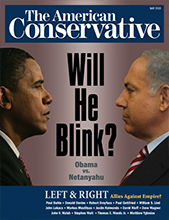
Can left-wing opponents of the American Empire join with right-wing defenders of the Old Republic to build an effective antiwar movement in the USA?  Fourteen authors, including leftists like Paul Buhle and Matthew Yglesias and rightists like Paul Gottfried and John Lukacs, consider the question.     

The cover image, representing a face-off between Barack Obama and Binyamin Netanyahu, is a bit of an absurdity.  These two men disagree on certain issues and cannot afford to ignore one another, but they are neither adversaries in world affairs nor equal in international influence.  This absurdity strikes me as out of place.  The American Conservative‘s  line about Israel/ Palestine seems simply to be that the USA should moderate its support of Israel; some of the magazine’s contributors might go so far as to advocate a policy of complete neutrality between Israel and its Arab antagonists, while others would recommend that the USA continue its substantive support of Israel, but would counsel American officials to tone down some of their more overheated Zionist preachments.  Most contributors are located somewhere between these viewpoints.  That range of opinion hardly qualifies the magazine as extremist, yet the cover image and article titles such as “Normalizing Relations” (about Mr O’s willingness “to take on America’s most influential ally”), “Out From the Shadows” (in which we are told that the American-Israel Political Action Committee now “confronts its worst fear: daylight,”) and “Can We Avoid Israel’s War?” (about US-Iran relations)suggest the overwrought tone that we expect from the fringes of the debate. 

The issue includes a reprint of a story by the late Louis Auchincloss, “America First,” originally published in Auchincloss’ collection Skinny Island.  Set in 1941, it tells the story of Elaine Wagstaff, a rich old American lady who was driven from her adopted home in Paris when the Germans overran France and moved in with her grown daughter Suzanne in New York.  Elaine’s friends are ardent advocates of US intervention to aid Britain in its fight against the Third Reich; Suzanne’s social circle are equally ardent in their opposition to such intervention.  At first, Elaine goes along with her daughter and joins the America First Committee, an organization which did in fact exist and which was at its peak the largest antiwar group the USA has ever seen (including such members as Auchincloss’ kinsman Gore Vidal.)  Elaine finds the America Firsters so uncouth compared to her Francophile friends that she eventually finds she cannot tolerate their company.  Elaine turns away from Suzanne and Suzanne’s friends, returning to her old circle and their interventionist views. 

The fascinating thing about this story is how little the characters’ political allegiances have to do with any of the ostensible reasons people usually give to justify them.  None of them really cares very much about who rules Europe or what happens to the people who live there.  Suzanne recoils from her son-in-law’s antisemitism, not because she cares at all about the fate of Europe’s Jews, but because in her circles antisemitism “was ‘hick’: one could not be bigoted and ‘top-drawer.'”  Nor does any character show a very clear idea of what the national interest of the United States might require.  Each character has devised a little drama in his or her head in which s/he plays the leading role and each of the others is assigned a supporting part.  Elaine’s fascination with France has been a bitter disappointment to Suzanne; Suzanne’s staid absorption in American high society has been a disappointment to Elaine.  Suzanne has scripted a drama in which Elaine will make a lifetime of disappointments up to her by playing a supporting role.  Politics is to her merely the stage on which this drama will play out.  Conversely, Elaine is attached to her old friends and to their shared fantasy of a life in the upper reaches of French society.  When she chooses interventionism, she is in fact choosing them and that fantasy.  Through most of the story The last line of the story is It is an ugly story, in a way, but one that rings true.    

An article about the Southern Poverty Law Center (SPLC) cites numerous publications over the years that have exposed the SPLC as a racket that does virtually nothing to advance its stated aim of battling white supremacists, but a great deal to enrich its leaders.  There doesn’t seem to be anything new in this piece, but it might be useful to have several exposés all cited in one place.   

Bill Kauffman’s column calls on the people of Idaho to embrace a writer who was born in their state and spent most of his life there, Vardis Fisher (1895-1968.)  Kauffman lists two books by the late Mr Fisher that sound interesting, a novel called Mountain Man and the WPA‘s Guide to Idaho.  He also mentions Fisher’s novelistic history of the world in twelve volumes that “drove away most of his modest readership.”  Acknowledging that Fisher’s defense of free-market capitalism and rebellion against his Mormon upbringing left him “almost a parody of the cantankerous libertarian/ village atheist,” Kauffman argues that he deserves remembering as a placeful man, who stayed in Idaho and devoted himself to the spirit of that place when he might have gone to the metropolis and lived for money and fame.

More Veiled Women

Hijabi Barbie

Years ago, LeFalcon posted a few stray remarks here about women’s dress in Islam.  Last year, Cymast posted a news item about Nicolas Sarkozy’s push to ban the burqa in France.  Months ago, I posted some images of veiled Muslim women.  That’s a rather slim selection of material, and yet every day search terms such as “burqa,” “hijab,” “chador,” “abaya,” and “niqab” send people to this blog.  As a service to those readers, here are some links to images of veiled women.   

  1. Indonesian Women Preparing to Pray. A dynamic study in white and red.
  2. Niqabi Riding an Escalator.   An airport scene.    
  3. Two Women With Soft Drinks. One heavily veiled, the other in Western dress.
  4. Two Women Riding the London Tube.  One in a chador, the other in Western dress.
  5. Veiled Catwalk Model.  The veil looks strange to most Westerners; this shot brings out the strangeness of a custom many of those same Westerners take for granted, the model’s catwalk.   
  6. A Partly Veiled Catwalk Model.  Recognizably Middle Eastern dress, though nothing especially “Islamic” about it
  7. The Outfit is Advertised as “Modest”  The model’s attire is quite modest, but her pose suggests a prostitute waiting for customers.  
  8. Warhol-style Hijabi.   I’m sure she’s somebody famous, but I can’t place her.  The picture appeared with this news story about the play The Hijabi Monologues
  9. Simpsons Character in Hijab.  Apparently sometime after I stopped watching The Simpsons, they introduced some Muslim characters.
  10. Punk Hijabi” She’s very clever, I’d recommend taking a moment to study her outfit. 
  11. On the Internet, No One Knows You’re Wearing a Niqab.  In the USA, the two women in this photo would probably be separated by a sheet of bulletproof glass. 
  12. Her face is covered by the colors of the American flag,  the rest of her is covered by a chador
  13. The Iranian women’s volleyball team in action.  Their opponents seem distracted by their outfits. 
  14. Academic Robes and Face Veil.  I rather wish the angle were wider.  The expression on the face of the graduate behind her makes me suspect there was a sort of contest to see who could be the most modest. 
  15. Women Holding a Sign that Reads “Hijab is My Choice, Not Compulsion”

Also worth a look is a site called “The Hijablog,” fashion commentary addressed to the conservative Muslim woman.