On 16 December 2010, Swiss Senator Dick Marty presented to the Council of Europe a report that he had been commissioned to make. Senator Marty demonstrated that the government of Kosovo, led by Prime Minister Hashim Thaci, operates a network of “clinics” in which ethnic Serbs and other political prisoners are routinely killed. Their organs are removed and sold on an international black market.
The Marty Report has barely been noticed in US media. News outlets that in 1999 were flooded with tales of atrocities that Serbs were supposed to be committing against ethnic Albanians in Kosovo have been entirely silent. If it weren’t for notices of the Marty Report in Alexander Cockburn’s column in The Nation, in Cockburn’s newsletter Counterpunch, and on Antiwar.com, even so devoted a reader of news as your humble correspondent would have missed the story completely.
In the 1920s and early 1930s, so many people took up the ukulele that it was a staple of popular culture to complain about the annoyance of bad amateur ukers. Reyalp Eleluku, the Backward Ukulele Player, often posts reports of anti-ukulele sentiment from that period. Nowadays the uke is back in fashion, and with that fashion has come more complaining about people who play badly in public.
In the same years, the comic stripBlondie debuted in US newspapers. Blondie has kept going ever since; it has never changed the Art Deco-inspired drawing style that made it so hip back then.
Today’s Blondie might have appeared in the strip’s first year of publication, 1930:
In this one, the narrator (who may be Leisa Rea, or may be the Biscuit-Eyed Lady, or may be someone else altogether) calls Phil Collins a gorilla, then admits to liking him:
For some time, violent imagery has characterized much American political discussion. For example, two weeks ago Mrs Acilius and I watched the 1996 documentary A Perfect Candidate, a chronicle of a US Senate race in Virginia; the Republican candidate goes hunting with some supporters, one of whom brings a small boy along. The boy, wielding a rifle, is asked what he’s hunting. “Hares,” he says. Then he adds, “Hares and Democrats.” The adults laugh, the camera zooms in on the boy’s face. He seems a bit baffled by their reaction, unsure what it is that’s supposed to be funny.
Saturday’s shooting of 20 people in Tucson, Arizona, among them Congresswoman Gabrielle Giffords, prompted many to decry this violent imagery. In particular, former Alaska Governor Sarah Palin’s habit of using firearms-related graphics and figures of speech when calling for the defeat of her political opponents, Representative Giffords among them, has occasioned much complaint.
Governor Palin has refused to apologize for her remarks, calling herself the victim of a “blood libel.” By this she apparently means that her critics have accused her of causing the massacre. This stand might make sense in a court proceeding, where apologies count as admissions of legal responsibility. If the governor were a defendant in such a proceeding, then her defiant attitude and the fear of censorship that many on the Right have raised would be understandable. Yet no such proceedings are even remotely likely, and her refusal to apologize is certainly not winning her any fans. She seems to be trapped in a self-defeating pattern of behavior.
In a comment elsewhere, I’ve suggested that the USA might be a better place if the ethical concept of “taste” were revived. If we still had the idea that there are such things as “good taste” and “bad taste,” then someone in Governor Palin’s position might have options that are currently not available to her. She could recognize that it is in bad taste to talk about shooting people, apologize for that bad taste, and resolve to show good taste in the future. This would not imply a damaging admission; everyone on earth has at some point or other flown off the handle and acted like a jerk. Therefore, everyone should be prepared to accept such an apology.
If, on the other hand, the governor believes that the political situation in the USA is so bad that it is necessary to disregard the canons of taste and to continue using the violent imagery that has become her trademark, then a society in which the concept of taste still had ethical force would take that belief of hers seriously. Good taste is not the highest of the virtues, and it can be disregarded in crises. By continuing to use violent imagery after the massacre in Tucson had reminded everyone that it is in extremely bad taste, therefore, the governor would be making it clear that she regards the political situation in the USA as a crisis. She could then defend this view, and potential voters could assess the soundness of her judgment based on that defense.
Saturday, some guy shot 20 people in Tucson, Arizona. The first person he targeted was U.S. Representative Gabrielle Giffords.
In the days since, the American media has been flooded with speculation as to the shooter’s motives. Many people, such as this cartoonist, have focused on the fact that Giffords is a member of the Democratic Party, and a great deal of very heated rhetoric has been directed against that party. Quite a few have focused on a map former Alaska Governor Sarah Palin posted on Facebook with a symbol of crosshairs on Giffords’ district. Others have brought up the fact that Giffords is the first Jewish person elected to Congress from Arizona and speculated that the shooter might have been anti-semitic. Still others have brought up the debate about immigration currently raging in Arizona and have suggested that it somehow made Giffords a target.
I suggest we look at the victims and ask at which of them the shooter aimed his gun. His first shot was discharged point-blank into the congresswoman’s head. He also targeted Mavanell Stoddard, hitting her with 3 rounds before her husband, Dorwan, made his way in front of her and gave his life to save hers. Dorthy Morris was apparently also a target; her husband, George, also threw himself on his wife during the shooting, though he was too late to save her life. Did the shooter think Mrs Stoddard and Mrs Morris were likelier to be Democrats their husbands? Or that they were likelier to be Jewish? Or that they were likelier to share Giffords complex and nuanced views on immigration? Maybe! Perhaps they were wearing T-shirts decorated with a donkey, a Star of David, and the slogan “Honk if you love to spend hours discussing immigration policy.” Or maybe they had something else in common.
To my knowledge, no detailed forensic reconstruction of the shooting has yet been published. However, what has come out suggests that most of the women and girls who were shot were standing closer to the shooter and were in his line of sight, while the men were either too far away to have been deliberately targeted (for example, Judge John Roll), or gave their lives in deliberate acts of heroism like those of Mr Stoddard and Mr Morris. The Feminist Peace Network has made the point that the shooter seems to have targeted women; I haven’t seen that point elsewhere yet.
Stuart Klawans lists 15 interesting movies that were released in 2010:
Carlos
A Prophet
Wild Grass
Life During Wartime
The Social Network
Inside Job
Last Train Home
The Illusionist
The Kids Are All Right
Lebanon
The Ghost Writer
Winter’s Bone
Never Let Me Go
Alice in Wonderland
Marwencol
The only one of these I’ve seen is The Ghost Writer. I’d rather not do business with Roman Polanski, but I couldn’t resist a movie that, in Klawans’ words, represents “a wickedly clever revenge fantasy directed against a British prime minister much like Tony Blair.” The only one I’m adding to our Netflix queue is Marwencol, since Klawans’ description of it is even less resistible:
Finally, in the category of odd, affecting little documentaries, perhaps the best of the year was Jeff Malmberg’s Marwencol. The title is the name of a Belgian town—an imaginary one, where it’s forever World War II—which Mark Hogancamp of Kingston, New York, painstakingly built at scale model using plastic dolls and hobby-shop materials. This project was his self-prescribed occupational and psychological therapy, after a severe beating outside a bar left him with neither memories nor normal motor functions. The film gradually reveals why Hogancamp was beaten, how he changed afterward and what became of his fantasy town; but best of all, Malmberg brings his camera right into the model, to show you a Marwencol as large and vivid as its creator needs it to be.
That sounds like the perfect movie for me; I love documentaries, I’m intrigued by creative miniatures, and a sizable portion of my imagination is permanently billeted in German-occupied Western Europe in 1942.
Klawans opens his column with the fact that Jafar Panahi, one of the world’s great filmmakers, is in prison on purely political charges. Klawans hopes that some demonstration on behalf of Panahi will be arranged at the Academy Awards, and that this will be helpful.
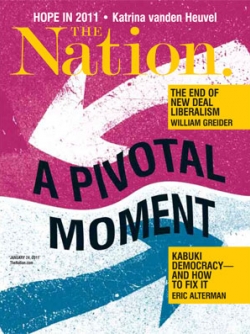
Elsewhere in the issue, William Greider decides that last year’s events prove that the New Deal and Great Society coalitions are thoroughly dead; Eric Alterman calls for institutional reform in US politics; Eric Foner points out that Barack Obama is one of a startlingly small number of African Americans in public office; James Ledbetter argues that Dwight Eisenhower was deeply influenced by articles that appeared in The Nation; and Patricia J. Williams outlines how the ostensibly individualistic policies of the American Right are designed to foster the rise of “a controlling class of the economically privileged- to wit, an oligarchy.”
YouTube user Religious Fiction considers a question that she has heard from many believers: If there is no God, why live? The question itself puzzles her, and she suggests that YouTubers should have a big conversation about it:
She says that no theist has ever explained to her “why living with the assumption that there is a God is so great.” She finds it “hard to imagine that there are gobs of theists out there who would honestly think that they have no reason to live if their assumptions and their doctrine just slipped a bit or maybe even had a profound change.”
It’s true that quite a lot of people do talk as if belief in God were the only thing that made life tolerable, and that it is quite strange of them to do so. Few people, after all, commit suicide, and most of those who do exhibit one of a very small number of psychological disorders. The idea of suicide may have a compelling power over many imaginations, but in terms of actual practice suicide is an eccentricity. When Albert Camus opens his Myth of Sisyphus with the claim that the only serious philosophical question is whether life is worth living, therefore, it is as if he had said that the only serious philosophical question is whether one ought to ride a unicycle.
That much said, does the frequency with which believers suggest that life would not be tolerable without their beliefs show that they are mentally ill? I say not. I think Thomas Fleming’s “Five Good Reasons Not to Be an Atheist,” discussed below, explain why a happy, well-adjusted person could believe that a loss of religious faith would mean a loss of the will to live.
I would focus on the third and fourth of Fleming’s five reasons. “Atheists have no religious calendars” and “Poor atheists… have no sacred spots.” These points show, first, that it is not as propositions that the doctrines of a religion have power for its adherents, but as narratives. The doctrines of a faith are a story in which the believer is given roles to play; the calendar is set of occasions on which the believer will enact those roles one by one, and will join with others as they play their own roles in the same story. The sacred narrative consecrates particular places, places where key events in the narrative have taken place or will take place. People can bond with each other as they share a relationship to these places. Thus, the sacred narrative gives structure to a believer’s experience of both time and space. Discard the sacred narrative, and we may choose between a life with no sense of narrative structure or the acceptance of a new master narrative to create a new sense of structure. “Life with no sense of narrative structure” sounds like a definition of clinical depression. If we experience life as just one thing after another, we may very well wonder what the point is of living. “The acceptance of a new master narrative,” on the other hand, sounds less like the outgrowing of illusions for which atheists strive than like a conversion from one religion to another.
The most interesting reply to ReligiousFiction’s invitation that I’ve seen is from QualiaSoup.
QualiaSoup usually does an excellent job explaining where arguments against a secular interpretation of physical phenomena go wrong; there’s a fine example here. Addressing this question, he proposes a master narrative about knowledge vindicating ignorance. Scientific advances and antiracist action make life worth living because they both represent blows against ignorance. QualiaSoup in fact takes on something of the character of a prophet when laying out this narrative. Indeed, he presents himself as a prophet who brings not peace, but a sword; his image of a family is a group of people divided by various dark lines, such as “prejudice” and “hate”; these lines cannot be erased until all submit together to the liberating power of knowledge. Otherwise, our prophet will set a man at variance with his father, and the daughter against her mother, and the daughter-in-law against her mother-in-law, and the enemies shall be of one household. He makes this point at greater length here.
Many commenters on QualiaSoup’s video say that people should be hurt if their relatives say that life would be intolerable without religious faith. I disagree with this position, for two reasons. First, it is through narrative that family relationships are defined. Two people may have common ancestors within living memory, and yet feel no kinship at all. Meanwhile, many people quite seriously regard pets with whom they have no common ancestor in the last 100,000,000 years as family members. Change the narrative you accept, and your relationships with others will change in ways that cannot be predicted.
Second, let us assume that some person (say, a man named Bob) does live simply for the sake of his or her family. Let us assume further that Bob lives in a society where it is a great advantage to be classified as “white,” and that the people Bob recognizes as close kin are all classified that way. How could Bob justify working to abolish that advantage? Indeed, if Bob considers his life worth living solely or chiefly because he wants to serve the interests of his family, would it not seem natural to him to lay down his life for the sake of perpetuating discrimination in favor of whites? I certainly agree that Bob ought to find value in his family and enjoy sharing his life with them, but unless he adopts a narrative that can sometimes override that value in the name of a broader kinship he will be doomed to support white supremacy.
Need an unstructured life be dismal? Certainly there are experiences that are pleasurable whether or not we see them as connected to any other experience. The physical satisfaction that follows a vigorous workout is pleasurable even if we never give a thought to the benefits it might have for our health; a successful sexual encounter is enjoyable even if it does not strengthen the bond between the partners; solving a problem brings a thrill even if that problem is not part of an important research program. To keep those self-contained pleasures fresh, however, we must continually increase our level of activity. For example, when I was in graduate school I was a postmodernist. The first few years I worked happily, convinced that what I was doing was of value because it was part of the postmodernist contribution to the study of ancient Greek and Latin. There came a time when I decided that postmodernism was a dead end. Rather than give up, I began to work much harder. I found that if I put in 100 hours a week, each piece of work I did still gave me a thrill, even though I no longer believed in the overall project that had once justified it. I couldn’t sustain that frenzied pace, but many do. And isn’t frenzied activity one of the worst problems our world faces? What is behind war, what is behind the destruction of our natural environment, if not people who have thrown themselves into ever-more frenzied activity rather than taking pleasure in the traditional rewards of life?
Irving Babbitt used to say that peace was a religious virtue. This was a bit of a paradox, since Babbitt himself was not all religious and not at all warlike. I think the paradox is resolvable, however. A sacred narrative, with its religious calendar and its holy places, gives its believers something steady and finite. If the world around them is at peace, they can find meaning and satisfaction without disrupting it. On the other hand, those who try to live without a sacred narrative cannot be still, regardless of the conditions in which they find themselves.
Racial theorist J. Philippe Rushton has gained notoriety for what blogger Steve Sailer has dubbed “Rushton’s Rule.” Sailer summarizes Rushton’s Rule in these words: “on a remarkably wide variety of physical, mental, and social measures, you find the African and East Asian averages at opposite ends, with the white average in the mediocre middle.” Rushton himself speculates that the first population to migrate from Africa and make a go of it in East Asia found itself in a much colder climate than had prevailed in Africa, while the first Europeans found average temperatures midway between those in Africa and those which confronted the first East Asians. Rushton appeals to adaptations would have enabled those early settlers to leave descendants outside Africa as an explanation for the statistical pattern he has described.
Be that as it may, references to Rushton’s Rule always leave me thinking about something else. If you keep getting the same answer, it’s probably because you are asking the same question. Granted that there is “a remarkably wide variety” to the measures which Rushton discusses, mightn’t he in fact have shown that there is an equally remarkable, if less obvious, uniformity to the tests that produce these results?
-The artist Philip Guston wrote “I believe it was John Cage who once told me, ‘When you start working, everybody is in your studio—the past, your friends, enemies, the art world, and above all, your own ideas—all are there. But as you continue painting, they start leaving, one by one, and you are left completely alone. Then, if you’re lucky, even you leave.” (Quoted in a book review by Barry Schwabsky)
-“WikiLeaks is revealing information citizens need to know—it’s a good thing. Assange may or may not have committed sex crimes according to Swedish law. Why is it so hard to hold those two ideas at once?” (Katha Pollitt)
Maybe Guston could have answered Pollitt’s question. When you start thinking politically, everybody is in the debate in your head- the past, our friends, enemies, the televised world, and above all, your own ideas about authority- all are there. But as you continue thinking, they start leaving, one by one, and you are left completely alone. Then, if you’re lucky, even you leave. Maybe an artwork takes on a personality of its own, independent of all those other personalities, and so too an understanding of politics takes on an independent personality too. Once you get to that point, Assange can be a villainous cad or an object of persecution or a bit of both, and the Wikileaks revelations can stand on their own regardless.




 acilius
 believer1
 lefalcon
 losthunderlads
 vthunderlad
 Panther Red


