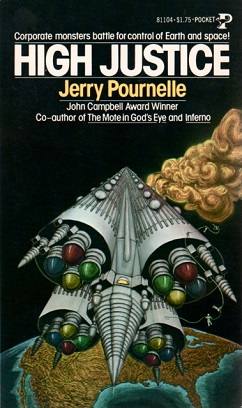
A few weeks ago, I stopped in a used book store I hadn’t visited in a long while. I picked up some old paperback science fiction novels. One that shed quite a bit of light on contemporary politics was Jerry Pournelle’s 1977 High Justice. There’s the requisite dose of grandiose technological fantasy- fusion powered tugs hauling icebergs to deserts, massive ocean thermal energy conversion projects, brain implants giving individuals instant access to computer networks, and of course space stations and asteroid mining. There is also a grim political landscape in which all governments are hopelessly corrupt and only multinational corporations run by visionary billionaires can deliver industrial development, and they only if they are left unaccountable to anyone or anything.
The characters are pure cardboard, simply illustrations of whatever tendency the author is trying to depict. When he wants to make some harsh remarks about Africa south of the Sahara, he first tells us that the people who speak them are black; when he wants to say something that could be taken as demeaning to women, he gives the lines to a figure with a given name like “Laurie Jo” or “Ann.” Not that the white men are realized any more substantially, but at least they are not always sock puppets for his own potentially objectionable views. Sometimes they are sock puppets for opinions he disagrees with.
Pournelle’s political ideas are summed up in this exchange between utterly idealistic liberal politician Aeneas MacKenzie and utterly realistic billionaire Laurie Jo Hansen:
“Laurie Jo, should power like yours exist?”
“Without power, none of this would exist. You can’t do anything without power.”
“Yes.” They’d been through it before, endlessly. “But it must be responsible power. It must be directed for–“
“For what, Aeneas? Something trite, like ‘the betterment of mankind’? Who chooses the goals? And how do you see that the choice is kept, once made? Responsible, Aeneas? To the people? You tried that.”
Jerry Pournelle, High Justice, New York 1977, page 100.
And that’s it- the dash following “directed for” is all the consideration given to political theory, the branch of philosophy concerned with the questions “Who chooses the goals?” and “How do you see that the choice is kept, once made?” And “You tried that” is all the consideration given to the idea of government in the name of the people. Books like Pournelle’s had an obvious influence on the multi-billionaires whose voices are so loud in today’s politics; his grisly vision is not the weakest of the many factors that drive their behavior.
When I was a kid in the 1970s, I would often hear my older brothers talking with each other and with my parents about Vietnam and Watergate. I would ask them to explain what those words meant, which presented them with quite a challenge when I was three or four years old. I never gave up, though, and by the time I’d figured them out I was not only hooked on those topics but on history in general, including the political history of the USA in the decades following the Second World War. I grew up to become a classical scholar, but when I’m not professionally engaged with ancient Greek and Latin literature my mind still wanders to those matters.
I’ve been spending a bit of my free time talking about such things on Twitter lately, especially in threads growing out of posts made by commentator Richard Brookhiser. The other day, for example, Mr Brookhiser brought up an interlocutor of his who speculated that right-wing Congressman John Ashbrook’s 1972 primary challenge to Richard Nixon’s reelection campaign was an attempt to clear the field for Ronald Reagan to replace Nixon as the Republican nominee. In response, I pointed out that Reagan already faced a formidable rival for conservative support in Vice President Spiro Agnew, and that if Ashbrook had somehow knocked Nixon out of the race he would have established himself as a substantial figure in his own right, another obstacle to any attempt Reagan might have made to launch a bid of his own.
The national attention given to yesterday’s election for mayor of New York reminded me of another 1960s-1970s figure who captured my attention when I was a child, John V. Lindsay. When I was about nine years old, I was watching the old Batman show when the character of Mayor Linseed appeared. My mother was with me, and she laughed out loud. She said that the actual mayor of New York in those days was named Lindsay. “Linseed” didn’t strike me as clever enough wordplay to account for her laughter, and she said that indeed it was not why she was laughing. What struck her as funny was that while the actual Mayor Lindsay was a ridiculously handsome man, whose good looks sometimes got in the way of his political career, the makers of Batman had cast a plain-faced character actor as his fictional counterpart. Evidently they were afraid that even in their fictional universe, it would be too much to ask people to believe that the mayor of such a big city could look like a movie star. I’ve also mentioned John Lindsay on Twitter quite a few times in recent months.
Mayor LindsayMayor Linseed (Byron Keith)
What has really kept Mayor Lindsay front of mind for me lately is not so much the comparisons I’ve seen between him and Mayor-elect Mamdani, but another item I’m checking off the list of things I was curious about when I was a kid. In those days, people ten or twenty years older than me would occasionally mention the TV show Dark Shadows, a daytime soap opera that added a vampire to its cast and became a big hit. I couldn’t imagine that- to me, soaps were the dullest things imaginable, windows into the lowest cavern of Hell, the circle of ice where absolutely nothing happens. I wasn’t a great horror fan, but I knew that vampires got people moving and couldn’t imagine how one would fit into a genre that seemed to cultivate tedium for its own sake.
I stumbled on Dark Shadows when the Sci Fi Channel was running it in the 90s, and was intrigued. I didn’t have the time to keep up with it for very long, though. So when during the COVID-19 lockdowns my wife and I found that the entire series was available for free to watch on demand, I suggested we take a look. We wound up watching the whole thing in a little more than a year. In the 2022, I realized that the calendar was the same as it was in 1966. I decided to watch each episode on the 56th anniversary of its original broadcast. So I watched episode #1 on Monday, 27 June 2022. My plan was to post any thoughts I might have in the comment sections of blogs about the show, as I had done in 2020 and 2021.
I quickly found that, while some blogs were still keeping their comboxes open, no community like the one I had participated in at Danny Horn’s Dark Shadows Every Day could be found in any of them. So if I were going to write up my thoughts about the show in the way I wanted to do, I would have to post them on a blog of my own. I decided to stick with my idea about the calendar, and have each post go live on the anniversary of the episode it reviews. At first I assumed no one would read the site, and gave it a name no one would be likely to find. But people did start reading and responding to it, so I changed its name to Dark Shadows Commentary. That’s where the bulk of my online writing as “Acilius” has been since then, which is one of the reasons this site has been so quiet. Since John Lindsay was Mayor of New York the entire time Dark Shadows was being produced in that city, it’s no wonder he keeps popping into my head.
Aeon magazine posts a short article by Matyáš Moravec about philosophers at Cambridge in the mid-twentieth century who took a serious interest in telepathy at a time when the same university was a center of the Analytic school.
Of course it would lead to interesting places were it proven that telepathy exists. How does it work, exactly? Who has it and who doesn’t? How does one develop the ability of one’s mind to communicate directly with other minds? What have people used that power to do thus far in the history of the world? The questions just keep coming, each more fascinating than the one before.
But it strikes me that the question of whether telepathy exists is, if anything, even more interesting if the answer is no than it would be if it were yes. I can read my own mind, why can’t I read yours? Once we allow ourselves to be puzzled by that, we find ourselves facing a very weighty business. To give a full account of a world in which minds exist apart from each other, impermeable by each other’s operations except indirectly as mediated by sensory stimulus, we would need, at a minimum, the whole of brain science, and perhaps of several other disciplines as well.
An article in The New York Times Magazinereminds me of my typology of stories involving fictional US presidents. Fictional presidents appear in three kinds of stories- satires, nightmares, and fairy tales. In satires, they show that the rot goes all the way to the top. In nightmares, they show that even the highest authorities are powerless to help. In fairy tales, they stand in for the king and say the magic words or make the grand gestures that solves everyone’s problems. The most memorable stories tend to mix these three genres. So Fail-Safe, Superman II, and Independence Day mixed nightmare and fairy tale, Dr Strangelove and Mars Attacks mixed nightmare and satire, and Dave mixed satire and fairy tale. But pure forms can be effective too. Among examples mentioned in the article, Veep is pure satire, Seven Days in May is pure nightmare, and The West Wing and The American President are pure fairy tale, but they are all quite memorable.
The article mentions the apparently happy ending of Seven Days in May as a relic of a more optimistic time, but in fact it just heightens the nightmare. Sure, the president foils the coup and removes the villainous General Scott and the other plotters from the top echelons of the military, and the press corps applauds him on live television. But the president is still despised by the electorate, Scott is still hugely popular, and the president admits to Scott that he can never expose his crimes. He won’t even reveal what he knows about Scott’s extra-marital affair and complicate his public image. The Constitution will survive until the next scheduled election, but there is little doubt how that election will turn out, or what Scott will do once he has been voted into the office he was so narrowly prevented from seizing.
The novel makes this even clearer. Written in 1962, it supposes that John Kennedy lived to serve two full terms as president, at the end of which the country was mired in a war between Communists and non-Communists in a country on the other side of the world (in the novel, Iran,) crime in the streets was spiraling, college and university campuses were hotbeds of unrest, African American neighborhoods were scenes of large-scale rioting, and the economy suffered from high rates of inflation. This imaginary 1968 saw the election of a Republican president who failed to address any of those problems in a way the public could accept, and so President Lyman defeated him for reelection in 1972. Lyman ends the war in Iran with a treaty that at first seems to ensure a division of Iran like that of Korea after 1953, and that treaty is popular enough that he can persuade the Senate to ratify a nuclear disarmament treaty he has negotiated with the Soviet Union. But the Iranian Communists don’t respect their treaty, and they take over the rest of the country. Alarmed by the thought of what might happen if the Soviets don’t honor their part of the disarmament treaty, the US electorate votes for a Republican Senate in 1974, but Lyman insists on going ahead with dismantling the USA’s nuclear warheads. The coup attempt takes place in May 1975, and after foiling it Lyman moderates his stance on disarmament. The other problems are still in place, and American democracy looks like a dead duck.
The movie Seven Days in May was directed by John Frankenheimer, who not long before had directed the film version of another political nightmare, The Manchurian Candidate. That one doesn’t have a president character, just a couple of senators and some presidential candidates. But it is an unusually pure example of a cinematic nightmare. That’s clear if you try to explain the plot. How does any event in it follow from any other, how could the villains have imagined their plans would work, what are the scope and limits of their power of mind control, and why does Frank Sinatra’s character have the authority to do any of the things he does? None of these questions has an answer that even begins to make sense by the logic we use in the daylight hours, but by the associative logic of dreams it all flows with a terrible inevitability.
I teach ancient Greek and Latin at a university in the interior of the USA. I’ve often given a course on the ancient Mediterranean world in general, a core curriculum class that draws a cross-section of the undergraduate student body. When I first taught it, I was required to use a textbook by D. Brendan Nagle, called The Ancient World: A Social and Cultural History.
Teaching from that book, I spent a good deal of time talking and thinking about things that were outside my scholarly emphasis. For example, Nagle puts heavy emphasis on Athens’ relative prosperity in the immediate aftermath of the Bronze Age and its conservatism in the centuries that followed. That led me to wonder if the two were related- perhaps the Athenians so prided themselves on the advantages they once enjoyed over their neighbors that they couldn’t imagine having anything to learn from them, and so ended up as quite an old-fashioned place before their age of reform started in the seventh century BCE.
If that was what happened, it would be an example of what I sometimes think of as “The Heyday Effect.” This effect can be seen, not only in sovereign states like ancient Athens, but any group that gives its members one of the major focal points of their identities- political parties, religious traditions, families, professions, etc. When members look back on a specific period in the past and see their group doing what they think it could and should be doing now, they will tend to attach themselves to everything associated with that period.
I say “When members look back… and see” because the Heyday Effect can operate regardless of the historical facts about the period- the heyday might not in fact have been so great, indeed it may be entirely fictional, but what governs people’s current behavior is their belief that it was real. That’s just W. I. Thomas’ “definition of the situation”- situations defined as real are real in their consequences.
I say “what they think it can and should be doing now” because I acknowledge that a Heyday Effect doesn’t pop up out of thin air- it is rooted in the material interests people currently have, in what they want to keep and what they want to gain, even as it influences the way they evaluate those interests.
I say “everything associated with that period” because a Heyday Effect is not a product of sustained rational calculation. It doesn’t apply just to the practices and institutions that actually contributed to whatever success the group had in its heyday, or that could have been expected to contribute to the successes ascribed to imaginary heydays. Everything left over that reminds people of the heyday becomes precious. If it is positively destructive of the current interests of the people who look back on the heyday, they will sooner or later let it go, but they will be so reluctant to do so that they will likely spend a great deal of time trying to convince themselves and anyone who tries to reason with them that it is somehow worth keeping.
pretty obvious to anyone with a BRAIN that all the bad stuff happening right now is the result of someone’s genie wish going wrong. and I don’t want to point fingers. but. was anyone making a big deal about having a genie recently. and has that person been oddly quiet.
Pinboard brings common sense to bear on some ideas about sending people into outer space:
A good but rarely used heuristic for evaluating space designs is just to ask, would this be a stupid idea on Earth? It's kind of a corollary to Ceglowski's law that hard problems don't become easier by putting them in space.
The most important news story of the last several years:
Ten months ago, we launched the Vesuvius Challenge to solve the ancient problem of the Herculaneum Papyri, a library of scrolls that were flash-fried by the eruption of Mount Vesuvius in 79 AD.
Today we are overjoyed to announce that our crazy project has succeeded. After 2000… pic.twitter.com/fihs9ADb48
A conversation between Otto von Bismarck and U. S. Grant:
A conversation between Otto von Bismarck and Ulysses S. Grant:
Grant (upon accepting an invitation to attend a review of the Crown Prince's soldiers in Berlin): "The truth is I am more of a farmer than a soldier. I take little or no interest in military affairs …" [here, as in…
T Greer on the Iliad as post-apocalyptic literature:
When I taught the Iliad I emphasized that it should be understood as a true example of post-apocalyptic literature: it was not *about* life as imagined after the post-apocalypse, but was written by people actually living after the collapse imagining what life was like before it. https://t.co/MV077klLqu
Tom Hamilton’s wife gave their child some shocking news about herself:
My wife, showing a childhood photo of herself riding a horse: “This is me when I was little.” The five-year-old, genuinely shocked: “You were a *horse*?”
Paul Schofield proves that some people will get mad at you for saying the most anodyne things possible:
There should be room in academia for professors who don't publish, but who know things. Not dead wood, who stopped learning in 1995. I mean: leaves for the summer, reads all summer rather than write, smokes a pipe on the quad and will talk to you about stuff.
My wife’s mom has Alzheimer’s disease. Earlier tonight, we left her parents alone at their Airbnb while we took the kids to urgent care for ear infections. Her dad fell asleep on the couch. Her mom wandered out the door… 🧵
From Latif Nasser, another story that begins within the family circle, this time ending very far away:
Last January, I noticed something peculiar in my 2yo’s bedroom that – after a year of obsessive reporting – led me to a profound cosmic revelation about what’s even possible in our universe. A 🧵. pic.twitter.com/pHFStIdawh
William B. Fuckley on one of the ways in which inclusion policies ensure that the same people get included generation after generation:
a very distasteful thing that I've noticed in Academia is that implicitly knowing which hardships you're 'supposed' to highlight & how to do so in applying for things and selling yourself is very much a class background thing, & it isn't mostly working class people who know it.
Bradley Birzer says something about World War Two:
Imagine being told in 1944 that Russia is our noble ally and, three years later, in 1947, that it is the essence of all evil. The latter, of course, was correct, but it still must've been jarring. Makes Orwell's 1984 seem all the more credible.
I read these four Luwian words aloud and found that, quite without intending to do so, I was singing them. I found it through Shadi Bartsch, and she says she had the same experience:
A. Z. Foreman starts a thread that includes some gems.
Translate the names of historical figures to make them sound like they’re involved in organized crime.
Charlemagne = Big Carl Francesco Petrarca = Frankie the Rock Charles Martel = Chuck the Hammer John Calvin = Baldy Sean Flavius Josephus = Joey the Golden Kid Robert le Fort =…
— A. Z. Fοrеmаn: Sеrious Philolοgy, Sillу Βеhavior (@azforeman) August 1, 2023
Abby Denton has a great idea for a novel:
You could probably find a fascinating bildungsroman in his time in that Abottabad mansion alongside a whole family. We know from the hard drive at least one person there, presumably one of the kids, was a pretty Westernized nerd. Imagine family dinners with Osama bin Laden.
Ken Layne tells us that the theme song to Pee-Wee’s Playhouse was sung by Cyndi Lauper. I’d always assumed it was Mae Questel, the original voice of Betty Boop and Olive Oyl, who was indeed still working when the song was recorded. Instead, it was an outstanding imitation of and tribute to Questel.
Cyndi Lauper sang the Pee-Wee's Playhouse theme (by Paul Reubens, Devo's Mark Mothersbaugh & Groundling/Pee-Wee writer/actor George McGrath) but she made 'em keep it secret. Completely unhinged performance, just beautiful. https://t.co/BXsSe5Nn1A
Frank Whitehouse lays out some facts about something Elon Musk is doing that doesn’t even have the saving grace of making him a laughingstock:
In essence SpaceX is being handed a virtual monopoly on a finite and very valuable resource. And they aren’t even being given it for free. We’re paying them to do it — SpaceX got $3bn in US govt contracts last year alone
My Warren G. Harding-themed tweets never get the love they deserve, not even this one I put up on the centenary of his death:
The last US president not to lead the country into a war was also the first to risk his political career for racial equality and the one who freed thousands of political prisoners. He died 100 years ago today. pic.twitter.com/WT7o6NUMvG
I hope it's always true. The idea is there subjects to which anyone, given instruction, can contribute, and to which no two people are likely to make the same contributions. That's why "the humanities" is a good name for those subjects- they are the common business of all humans. https://t.co/ID5N7DU5ST
A couple of years ago, I picked up a volume at a used book sale titled A David Lodge Trilogy. It includes three novels, Changing Places (1975,) Small World (1984,) and Nice Work (1988.) When those novels were relatively new and I was a college student thinking of going to graduate school in Classics, a professor of mine had recommended Small World to me, so I’d been aware of Lodge’s fiction for a long time.
The very cover of the edition I read (Penguin, 1993)
Changing Places evokes life on the campuses of the University of California at Davis and the University of Birmingham in 1969 with a great deal of atmosphere. Unfortunately, the story has many weak points and Lodge uses the same device to paper over all of them, which is to set the characters having sex with each other. For example, when one of the two middle-aged professors at the center of the book stumbles into a roomful of hippies and Lodge can’t figure out a way to get him out without ruining the jokes, an orgy starts up, from which the professor excuses himself. And when the novel is approaching its ending and Lodge doesn’t have a conclusion, the two professors swap wives and the four of them wind up talking about it. That conversation does involve an interesting moment, when the professors have run out of things to say about the situation and wind up talking about literary theory. The wives are exasperated with this, and the one who is becoming a feminist asks the other if she doesn’t recognize the sound of men talking. A page after that, the book just stops. As it may as well- once you realize Lodge isn’t going to go more than twenty pages without another unmotivated, inconsequential sexual encounter, there isn’t any logical reason for it to be any particular length. It would be bad enough if these encounters appeared as real erotica, but Lodge is so much a professional Englishman that no sex scene he writes is complete until the parties break an awkward silence with embarrassed apologies.
Small World has the same problem on an even larger scale. About half the book consists of sex scenes that merely cover up an awkward spot in story logic or a character’s lack of personality. He even pads it out with excurses here and there assuring us that everyone is having a tremendous amount of sex.
The main story is a young literary scholar’s quest to find a mysterious woman he met at a conference. She is a specialist in romance from Apuleius to Spenser. At one point, the young man is at an airport and a gate agent tells him he missed the woman not long before. She repeats to the young man something the young woman told her:
Real romance is a pre-novelistic kind of narrative. It’s full of adventure and coincidence and surprises and marvels, and has lots of characters who are lost or enchanted or wandering about looking for each other or for the Grail or something like that. Of course, they’re often in love, too.
A David Lodge Trilogy: Small World (Penguin, 1993) pages 493f
That’s what, in the literary criticism business, they call a programmatic statement. The parts of Small World that go somewhere make up a romance in that sense.
I should mention that there are some funny bits. For example, at one point a character is kidnapped by a gang who know that his wife has written a novel that sold millions of copies and made her very rich. What they don’t realize is that she is in fact his ex-wife, and the novel is about how much she hates him. When they demand that she pay them $500,000 to release him, she responds by asking how much she would have to pay for them to keep him. When her agent explains that it will be bad for her image if she sticks to that line, she offers them $10,000. The negotiations that follow are worth several laughs.
I was tempted to stop after Small World, but was glad I read Nice Work. It is by far the best of the three. I was a bit concerned at the outset. Lodge pauses several times to give detailed reports on the characters’ bathroom functions. That was hardly a step up from the sex scenes, but it tapers off after the first 40 pages. From then on, there is no filler and there are no dead spots to paper over.
The two main characters are a young woman who teaches English literature and Women’s Studies at the same lightly fictionalized version of the University of Birmingham that had figured in the two previous novels, and a middle-aged man who manages a factory across town from campus. The woman has a very apt name for a literary critic- Doctor Penrose. That’s what critics do, doctor what was left behind when the pen rose for the last time. Her first name is Robyn, suggesting that her work involves robbin’ the texts of some meaning they ought to have.
Doctor Penrose makes a programmatic statement herself. She tells students in a tutorial:
Unable to contemplate a political solution to social problems they described in their fiction, the industrial novelists could only offer narrative solutions to the personal dilemmas of their characters… In short, all the Victorian novelist could offer as a solution to the problems of industrial capitalism were: a legacy, a marriage, emigration, or death.
A David Lodge Trilogy: Nice Work (Penguin 1993) page 643
From this moment, we know that before we reach the end of the novel the four solutions available to Penrose’s own problems will be a legacy, a marriage, emigration, or death. It’s also worth noting that at no point does it seem to dawn on her that she has disproven her own thesis. If those were the only answers Dickens, Gaskill, Kingsley, Gissing, and company could give to questions about the problems of industrial capitalism, either they were a load of idiots, or those were not the questions they were asking at all.
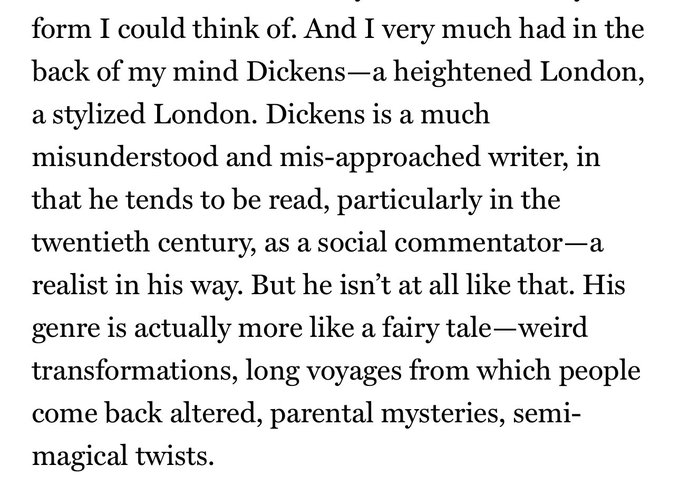
The very day I read that passage, I looked at Twitter and saw that several people had posted this quote from the recently deceased Martin Amis:
Nice Work was shortlisted for all the major prizes in 1988, and Amis made that remark in 2012. So there is a very good chance Amis read the book when it was new, and by the time twenty four years had passed had forgotten that it was not an original insight.
It is also just possible that Amis had read the theorist Lodge has studied most deeply in his work as a literary scholar, Mikhail Bakhtin. It’s the sort of observation a reading of Bakhtin’s work on genre and the carnivalesque might inspire.
At any rate, Nice Work is the sort of romance that appeals to people who fancy themselves hard-headed realists. Lodge gives enough detail about how people who work in universities interact with each other, how people who work in factories interact with each other, and how people from each interact with people from the other that it’s easy to imagine someone taking him to task for failing to propose a concrete solution to the problems of the higher education and manufacturing sectors of the British economy of the 1980s. So easy, in fact, that I suspect Lodge was playing a practical joke on the real-life Robyn Penroses of the period. Even if you aren’t inclined to fall into his trap, it is still enjoyable to read his plausible description of those two sides of Birmingham in those days and feel that you have visited a real place and become acquainted with a whole society.
A thread in which Cranky Federalist takes apart the stories of the USA’s alleged founders:
There's no way these "Adams" and "Jefferson" figures were real. You mean to tell me they founded rival political factions, were bitter rivals, reconciled, then died on the 50th anniversary of the country's independence? https://t.co/2AlSIPPosF
Eric Adler notices something odd about his academic colleagues:
Some of my colleagues in the humanities seem eager both to "decolonize the curriculum" and also to remove our college's language requirement. They want a "decolonized" course of study that's entirely in English.
They do not appear to notice the contradictions in their position.
Sam Haselby has had it with our current crop of “public intellectuals”:
The Iraq War is the historic crime of our era (it poisoned our politics). But it enjoyed bipartisan support, so the primary ideological function of neoliberal elites over the past decade has been to conjure things like the Confederacy and Richard Nixon to blame instead. https://t.co/NwP3oNLl07
Not qualified to comment on the classical music world but the version of this argument in literary circles has always seemed to me fallacious. Study of "the canon" fosters the material conditions, institutional support and critical practices for receptivity to other traditions https://t.co/M91AFXkHJ0
Christopher Rees reminisces about a ceremonial occasion that went well:
and the part when he put the crown on the King's head backwards, and the part when he got down to swear an oath of allegiance to the King, he got down alright, except he couldn't get up again, so the King and a few Bishops had to help him up. Apart from that it went well. 3/3
— Christopher Rees (@ChrisReesBettws) May 16, 2023
A classic from Murrman5 about what happens when you give advice:
*holds up 2 ties* which one, I have a big meeting today "both are nice" [wife calls later] "how'd it go" well, wearing 2 ties was a disaster
never realized that "I want the guy bribing me to like me" might be an acceptable defense for receiving a bribe but that's why i'm not the GOP's star witness https://t.co/6biJmDWTmw



 acilius
 believer1
 lefalcon
 losthunderlads
 vthunderlad
 Panther Red