War for Helen?

prez01-startrek09b

One of the less well-known legends of Helen’s later life, from Star Trek comics #9

The Classics blog Sententiae Antiquae has a post today about the story that the Trojan War was triggered by Queen Helen of Sparta running off with Paris, alias Alexander, a Trojan prince. The post quotes several ancient Greek authors, sketching a variety of ways in which the ancients crafted the tale and a variety of purposes which they used it to serve.

They quote Herodotus’ remarks about the story:

“If Helen really were in Ilium, they would have given her back to the Greeks whether Paris wanted them to or not. Priam was not so out of his mind, nor were his other subjects, that they would want to risk their own bodies and children and the city itself just so that Paris could sleep with Helen.”

εἰ ἦν Ἑλένη ἐν Ἰλίῳ, ἀποδοθῆναι ἂν αὐτὴν τοῖσι Ἕλλησι ἤτοι ἑκόντος γε ἢ ἀέκοντοςἈλεξάνδρου. οὐ γὰρ δὴ οὕτω γε φρενοβλαβὴς ἦν ὁ Πρίαμος οὐδὲ οἱ ἄλλοι οἱ προσήκοντες αὐτῷ, ὥστε τοῖσι σφετέροισι σώμασι καὶ τοῖσι τέκνοισι καὶ τῇ πόλι κινδυνεύειν ἐβούλοντο, ὅκως Ἀλέξανδρος Ἑλένῃ συνοικέῃ. 

(Book 2, chapter 110)

I offered this comment:

I’ve always been puzzled by the tradition that regards it as self-evidently absurd that a major war could have been sparked by something like Helen and Paris running off together. It sounds pretty plausible to me.

Had Priam known, as a certainty, that Menelaos and Agamemnon would raise the army Homer describes, lay siege to Troy for 10 years, and then destroy the city, probably he would have handed Helen over the minute Menelaos demanded her. The legend says that it took years to put the coalition together, so that first demand probably came from a military power that Priam could easily have defeated. For Priam to have complied with that demand would have been to present himself as a soft target to every power with designs on Troy.

Even if he had known that a vast army was coming after him and that they would defeat him, however, after that first minute had passed it would have become extremely difficult for Priam to surrender Helen. Every moment Helen was in Troy, a larger share of Priam’s prestige was invested in keeping her there. After just a few days, giving her up would have been a severe loss of face. And the way politics works, if you lose face severely enough, there’s no limit to what you can lose.

I think of the week that followed 11 September 2001. The USA demanded that the Taliban hand over Osama bin Laden; some very well-informed people of my acquaintance were quite sure that bin Laden and his circle had planned and ordered the attacks without informing the Taliban leadership, but were also sure that the Taliban leaders would not comply with the American demand, even though they knew that refusing to do so would result in the bombing, invasion, and occupation of Afghanistan, because complying would invite out-factions within their movement to stage a coup. Either way, they would lose control of the country. But while they might escape from the American onslaught with their lives, and perhaps even with a chance at returning to power if the occupation went badly, a coup would lead directly to their deaths.

Large-scale rationality, with economic interests and geopolitical power structures and so on, that’s very important in keeping a war going and setting the range of possible postwar environments. But the events that lead up to war take place at a different level, where there’s a lot of contingency and a lot of personality. That must have been quite obvious in ancient times, when a policymaker in Asia Minor had no way of getting information in real time about military alliances that are or are not being formed in mainland Greece, but plenty of information about who’s dominant in the face to face relationships he has with the people around him.

I teach Latin and Greek at a mid-ranking college in the interior of the USA. When the story of Helen and Paris comes up in my classes, I ask my students to imagine what might happen if Michelle Obama fell in love with Ji Xinping’s son and the two of them ran off together. It would be a tremendous challenge to diplomacy to prevent even that situation from ending in disastrous violence. How much more volatile would the situation be if, instead of a bilateral confrontation between nuclear-armed superpowers who are connected by an incalculable number of electronic communications on a daily basis, the parties were loose and shifting coalitions with no access to even the most basic information about each other’s positions and capabilities.

Donald Trump is too poor to run for president

nopants

That barrel is terrific

The winning candidates in each of the last few US presidential races have headed campaigns in the course of which about $1,000,000,000 was spent. There is no reason to suppose that the winner of the 2016 race will ride any smaller a wave of money.

Donald Trump claims to possess a personal fortune of $10,000,000,000. This claim is unlikely to be true. More to the point, whatever the true scale of Mr Trump’s wealth, very few businesspeople are in a position to liquidate 10% of their holdings in order to finance one personal project. Mr Trump’s debts and other commitments are such that he is surely not at liberty to do that. Estimates of Mr Trump’s cash on hand range from $70,000,000 to $250,000,000, far short of the amount that is typically spent even on winning a major party’s nomination, let alone competing against the nominee of the other major party in the general election.

Mr Trump continues to assert that he has enough money to self-finance.  His refusal to solicit campaign donations is so essential to his appeal that it is unclear how he could start asking for money without dynamiting his base of support.

That creates two problems. First, Mr Trump’s campaign expenditures thus far have been quite modest. He has received so much coverage free of charge from cable news and other media outlets (all the way down to this blog post, apparently) that he hasn’t needed to buy advertising. The only way he can keep gaining that free coverage is to make news, and the only way he can make news is by making remarks that are more shocking than any he has made before. Unless conditions turn so bad that the electorate starts looking for an out-and-out revolution, that’s a one-way street that leads directly to a brick wall.

If Mr Trump somehow manages to be elected president, he would face a second problem. Assume that the net worth of all of his assets really were as high as $10,000,000,000. And assume that he was able to sell them all at their full value, despite the fact that every potential buyer would know that that he was under pressure to sell them. Assume all that. A US president is effective only to the extent that s/he is the leader of an effective party. If Mr Trump has $10,000,000,000, it might conceivably be possible for him to spend $1,000,000,000 of that and finance a successful campaign for the presidency. But even $10,000,0000,000 would not be enough to finance the entire Republican Party for four to eight years. Presidents help their parties raise money. They are expected to do it. If Mr Trump should refuse to do that, he would quickly lost the support of his party and with it any chance he might have of enacting his platform.

Scope and Limits

When we started this blog, my attitude towards religion was very much that expressed by Philip Larkin in his poem “Church-Going.” Visiting a church on an empty weekday, the poet wonders “who/ will be the last, the very last, to seek/ This place for what it was”; will it be someone looking for scholarly information, or for a nostalgic thrill, or for something to steal; or:

will he be my representative,

Bored, uninformed, knowing the ghostly silt
Dispersed, yet tending to this cross of ground
Through suburb scrub because it held unspilt
So long and equably what since is found
Only in separation – marriage, and birth,
And death, and thoughts of these – for whom was built
This special shell? For, though I’ve no idea
What this accoutred frowsty barn is worth,
It pleases me to stand in silence here;

A serious house on serious earth it is,
In whose blent air all our compulsions meet,
Are recognised, and robed as destinies.
And that much never can be obsolete,
Since someone will forever be surprising
A hunger in himself to be more serious,
And gravitating with it to this ground,
Which, he once heard, was proper to grow wise in,
If only that so many dead lie round.

In those days, as indeed in all my days up to that point, I was like my parents, a mellow sort of agnostic who had a sense that the grown-up thing to do was to treat all the world’s major religions with as much respect, and as little outright incredulity, as possible.  I was indeed Larkin’s representative, visiting churches and other houses of worship on occasion, not to humble myself before the God in whom I could not quite imagine believing, but as a step towards assuming an adult mien.

Nowadays I’ve become a mellow sort of Christian. But the last day or two, I’ve found myself reminiscing about my Larkin-like past self. What brought me back to this was the front page of yesterday’s New York Daily News:
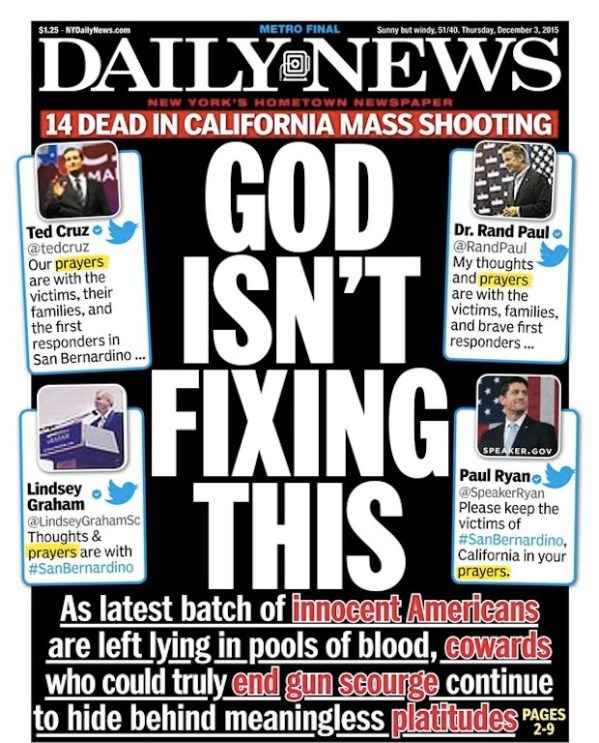
cvrch3swoauqkqy-1

I saw a blog post about this by Rod Dreher that got me thinking. I read Mr Dreher’s blog every day, largely because his views are very different from mine. He is a self-identified member of the Christian Right, while I would be considered an ultra-progressive Christian if I had joined almost any group other than the Episcopal Church. So, Mr Dreher regularly hyperventilates with rage and terror over developments that I find either unimportant or entirely desirable, and occasionally ignores or even praises developments that would move me to purple-faced fury. It does me a lot of good to look at him when he’s worked up and to realize that I would look as ridiculous to him or people like him if I were to choose to get on my high horse and get all worked up about my opinions as his profession of opinion writing requires him to do about his opinions.

Mr Dreher’s post yesterday wasn’t entirely free of hyperventilation, but it did include some very good bits. There were long quotes from an Atlantic Monthly piece in which Emma Green patiently dissects the understanding of prayer that seems to inform this “prayer-shaming,” contrasting it most pungently with a request for prayer that one of the victims texted while hiding from the gunmen. Mr Dreher also quotes to good effect an essay by mellow secularist Roland Dodds on why the Left needs a vibrant Christianity.

And Mr Dreher contributes several highly trenchant remarks of his own. For example:

This is not a post about gun control, about which I believe honorable people can disagree (though let it be said that not everyone who disagrees, on both sides of the issue, does so honorably). This is a post about liberals — ordinary liberals, not fringe folk like boob-choppers — who hate conservative Christians so much that they react to a mass shooting by denouncing those Christians for praying for the dead, calling their prayers “meaningless platitudes” (unlike #SendOurGirlsHome, I guess).

This is where I remembered my Larkin-like former self. Hashtag activism, like the #SendOurGirlsHome campaign, differs from prayer, as prayer is practiced in the world’s major religions, in that it is simply an attempt to make oneself feel powerful in the face of a situation where one is in fact powerless. Prayer can be used to do that, of course, as can any practice around which superstitions accrete.

But look at the most prominent prayers of the world’s major religions. When Muslims make their confession of faith, they say that there is no God but God and Muhammad is his prophet. To say that there is no God but God is to acknowledge that there are limits to the power of human beings. The state can’t raise the dead and deliver final justice, which is what “Fixing This” would mean in the aftermath of a mass shooting.  The market can’t, and the individual can’t. Those are all phantasms created by human beings in the course of their interactions with one another, by themselves as inert and as much a dead-end as were any of the idols of wood and stone that Muhammad busied himself destroying.  To say “Muhammad is his prophet” is to say that, limited as we are, we do have access to knowledge of our duties and we have been granted the power to at least try to fulfill those duties. So a prayer like that acknowledges both the scope and the limits of human power and of human moral responsibility.

In my youth, I spent a great deal of time studying the works of the theorist Irving Babbitt (1865-1933.) As I was when I was reading his works, Babbitt was an agnostic who believed that there were great truths to be found in the world’s religions. He embarked on a Perennialist project, finding that all of the great wise men of history, including the founders of every major religion, agreed with him on all the most important issues of morality, politics, art, etc. It’s easy to look at that sort of conclusion and chuckle, but it is worth pointing out that Babbitt’s students from China, such as the famous Lin Yutang, remarked that his understanding of Confucius was deep and that his learning in Confucian and Buddhist thought was comparable to that of experts in their homeland.

One of Babbitt’s great contributions to the study of Buddhism was his translation of the Dhammapada. In that translation and in the accompanying essay, “The Buddha and the Occident,” Babbitt stresses the contrast the Buddha draws between pamada, which Babbitt translates as “laziness,” and its negation, appamada, which he translates in a variety of ways. Since pamada is often characterized by frantic activity, it may seem odd to call it laziness- perhaps “procrastination” would create a clearer mental image. What one does in a state of pamada, one does as an evasion of the true work of adjusting one’s will to the higher law, the moral constants of the cosmos.

In this distinction, I think I see the same sense of the scope and limits of human responsibility that informs the Muslim confession of faith.  Our attempts to control the material world, to control other people, to remake the past, are futile, are pamada, because these things are not in fact within our power. We show true appamada only when we surrender our useless attempts to control the outside world and concentrate our energies on controlling ourselves so that we may conform to the supernatural order.  As we approach this conformity, we may become more active or less active in the world, but that activity is incidental to the great struggle within.

As for Christians, when we say the Lord’s Prayer we too acknowledge the scope and limits of our powers. “Our Father,” we call God- we are his children, not his servants, for the servant does not know the master’s business; but we know God’s business. If we are children, we are heirs, and heirs have the power and the duty to do the father’s business. But our knowledge is limited, and our power is limited. The prayer brings us up against those limits sharply. We are so weak and needy as to be dependent on God even for our daily bread; so broken that we are dependent on him even for the forgiveness we continually need to receive and to give, and for freedom from an infinite array of temptations, none of which we could resist on our own. It is his will that is to be done, not ours.

“Thy will be done.” I often think of a colleague of mine who, many years after earning his doctorate, after decades of toiling in low-paying jobs in and out of his his field, was finally about to receive tenure at a university. Then his wife, a nurse who worked with the severely disabled, was hit by a reckless driver and herself rendered massively disabled, physically and cognitively. He took early retirement to care for her full-time. He remarked “Sometimes it dawns on you just what those words we say every day really mean.” Thy will be done.

Whatever else it may or may not do, prayer does cure the state of mind which reflexively demands “Fix this!” in the face of death. It may be, as Alexander Schmemann so memorably argued, that the Christian does look at death with defiance, confident that God will fix this. But God will fix it in God’s own time, in God’s own way, which is beyond our power and beyond our imagining.

As for gun control, if it is a good idea, then surely prayers like those which Muslims, Buddhists, Christians, and others say will incline them to support it, inasmuch as these prayers involve accepting that there is a sphere within which do have the power and therefore the duty to do good things. Most of the world’s population does, after all, follow one or another of the great religions, and in very few countries are legislators and rulers unable to find ways to pass the time.

What does induce culpable inactivity, I would say, is exhausted panic. Earlier today I saw a brief article in which Hamilton Nolan points out that, in all likelihood, “You Will Not Die in a Mass Shooting.” Of course the first comment identified “this pronouncement” as “basically the working talking point of every conservative politician ever” and extrapolated from it the idea that “People don’t ever really die in ‘mass shootings.'” As if people who do not actively believe that they personally are about to die in a mass shooting will not accept the reality of mass shootings or support policies that they were convinced would reduce the likelihood of mass shootings, as if there was no space between panicked lunacy and sullen lunacy. Realism, as in the acceptance of the fact that human power is considerable but not infinite that prayer induces, creates such a space, while sentimentalism collapses it. So, I call for your prayers today.


Maps and Territories

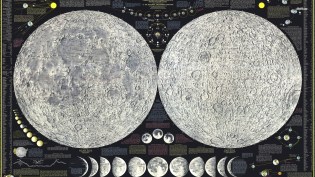
15827-moon-map-1920x1080-space-wallpaper.jpg

One of my favorite maps, available for purchase here

It’s odd how the mind works.  If you’d asked me last night if I’d ever heard the phrase “stackable probabilities,” I would have said that I had not. Yet this morning, I woke up from a dream in which I was looking at a photograph of the surface of the Moon while a voice in the background explained that “a map is not an image depicting a territory, it is a graphic representation of related sets of stackable probabilities.”

I woke up before the voice could explain what that meant. Since I have never studied statistics, and did not know until I googled it that there really is such a phrase as “stackable probabilities,” probably the only way a voice in a dream of mine could explain it would be if I were sleeping in a room where someone was giving such an explanation.  Making it even stranger that such a phrase would pop into my head, most of the results for “stackable probability” that came up in that Google search were from gaming forums, and I haven’t spent any time playing or discussing electronic games since about 1983.

Anyway, it is in fact plausible that someone might describe a map as graphic representation of related sets of stackable probabilities. As I understand it, a set of probabilities is stackable if it is made up of a series of variables, each of which is dependent on the item preceding it in the series but independent of the item following it.  So there can be river systems only where the parts of a landmass vary in elevation, but parts of a landmass can vary in elevation where there are no river systems.

It becomes plausible to think of maps as summaries of probability structures rather than as images of territory when we consider that maps of large areas of the Earth’s surface do not feature cloud formations, and that maps of coastlines do not show the tide either coming in or going out. It’s virtually certain that a satellite photo of a continent or an ocean would show at least a few clouds, and utterly certain that the seas continuously show tidal motion, but there is no relationship between the probability that any particular cloud formation or state of the tides will prevail at a given moment and the probability that a user will consult the map at that moment.

Standard features of large-scale maps of populated areas, features such as mountains, rivers, roads, cities, centers of extractive industry, coasts, political boundaries, etc, are likely to be there and to be of interest to a user of the map. Moreover, these standard features are also the features most plainly related to each other. Roads connect cities to each other and to centers of extractive industry, unless mountains, coastlines, or political boundaries block them; rivers flow from mountains to coasts and cities grow along them; etc.

In my dream, I was looking at a photograph of the surface of the Moon. There are no rivers, roads, cities, industries, coasts, or political boundaries there. So, what is the difference between a photograph of the Moon’s surface and a map of the Moon’s surface? Add labels naming the mountains, craters, maria, etc, add notations of the elevation of those features, and isn’t the result a map?

I’m inclined to think not. Several times Apollo astronauts lost their way on the Moon; the best-known such episode came during the Apollo 14 extra-vehicular activity, when Alan Shepard and Edgar Mitchell lost so much time trying to orient themselves that they did not manage to reach the rim of Cone Crater, a key mission objective. Many have accused  Admiral Shepard of showing a cavalier attitude to the geological aspects of the mission; most notable of these is perhaps David Reynolds, author of a well-regarded book called Apollo: The Epic Journey to the Moon, 1963-1972 (Zenith Press, 2013.) Be that as it may, Captain Mitchell is a famously conscientious man (as witness his willingness to sound rather odd at times,) and it is difficult to believe that he did not use every available resource to prepare himself for such an important assignment.

I suspect the problem was that the resources available to Captain Mitchell and his superior officer included too many photographs and too few real maps.  On a surface where the horizon is so much closer than it is on the Earth, people do not have conventional reference points and cannot rely on reflexive mental habits to determine their location. The essential visual aid for such travelers is therefore one which illustrates, not the surface features which their experience on Earth has not prepared them to interpret, but such statistical relationships among those surface features as are likely to shape their journey.

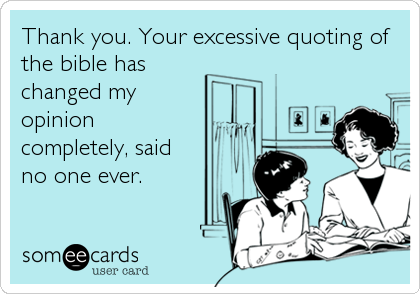
Four reasons why quoting the Bible rarely settles political disagreements

I spend a fair bit of time hanging out with mild-mannered progressive Christians.  One thing that I like about the members of that group is that they don’t often try to spring Bible quotes on you as a means of settling political disagreements.  The last couple of weeks, though. there has been a tremendous amount of backsliding among progressive Christians in this regard. As a result, I’ve been avoiding social media lately.* So many of my friends have been quoting passages from Leviticus and the Gospel According to Luke as if those passages made it obvious what policies the United States of America and the European Union should adopt towards refugees and migrants from southwest Asia, and have been calling down fire and brimstone on those who are unconvinced, that my news feed on Facebook and my stream on Twitter have started to feel like a tent revival with an especially dyspeptic preaching staff.  Quite a few people whom I know to be committed universalists, believers in a doctrine holding that all souls are destined for salvation, have posted statements that those who do not share their position on this issue will be going to Hell.

There are many hazards to attempts to use the Bible to settle political disagreements.  Some are more obvious than others.  For example:

  1. Not everyone agrees that the Bible is authoritative. This is a sufficiently familiar point that I can hardly imagine it needs elaboration.
  2. Not everyone who does agree that the Bible is authoritative agrees on how it should be interpreted.In connection with border policy, relaxationists like to quote two excerpts from the Gospel of Luke. These excerpts are the parable of the “Good Samaritan,” and the parable of the sheep and the goats.  The Samaritan is good because he shows hospitality to a non-Samaritan, the shepherd chooses those who perform such acts of mercy as welcoming strangers and rejects those who do not.  Advocates of a relaxationist stand on border policy trot these verses out in confidence that they will clobber restrictionists into silence.

    And so they may.  But beware.  One Samaritan is good to the beaten man; three Jews are bad to him.  That story could as easily be called “The Parable of the Bad Jews” as the “The Parable of the Good Samaritan.”  And so on with the rest of the Gospel of Luke, including the sheep and the goats.  The consistent, overarching theme of the whole thing is that early first century Jews are hypocrites, unworthy of their divine heritage, and that they will be punished unless they join the movement forming around Jesus.  Progressive Christians reflexively identify themselves and the church as the heirs of this rebuke, and say that the strictures that Jesus lays upon the superficially pious Jews of his day apply to the superficially Christians of our day.  But that is not the only interpretation Luke has received over the centuries.  Plenty of readers, among them people wielding whatever form of sacred or secular authority you may find impressive, have read Luke as a mandate for every form of anti-Jewish activity, up to and including genocidal violence.  If that’s the road you’re bent to follow, nothing in the Bible will stop you traveling down it.

  3. The Bible is a complex book, political disputes are complex situations, and overlaying the one complexity on top of the other leads to more confusion than enlightenment.  It’s hard for me to imagine that anyone really does not accept that a book like the Bible, 36,000 verses in a variety of languages and literary genres, produced by the work of untold numbers of people over more than a dozen centuries, can provide a reader with support for any position that reader would like to see supported. Still, people do seem to lose sight of this.Here’s a tweet that exemplifies the problem:https://twitter.com/owillis/status/666345924013252609

    To which a smart-aleck might reply that the command to uproot the seed of Amalek is limited neither by the liturgical calendar nor by the passage of centuries, and inquire if that is the model Mr Willis would have us follow.

    If we do want to stick with something specifically called for by the liturgical calendar, in the impeccably progressive Episcopal Church this morning’s Daily Office reading from the Old Testament was from the prophet Joel (chapter 3, verses 1-2 and 9-17.) It includes a call for the Jews of the Diaspora to reverse what Isaiah had seen, to beat ploughshares into swords and pruning hooks into spears, to stand in the valley and do battle for the heritage of Israel.  It concludes with the lines “And Jerusalem shall be holy, and strangers shall never again pass through it.”

    I’d certainly rather we lean towards a relaxationist line than a restrictionist one, and if we have no choice but to cite Bible verses in defense of border policy, I’d always prefer a sanitized view of Luke to a full-throated version of Joel, or Exodus, or Deuteronomy, or Samuel, or Joshua.  But I think a wiser use of the Bible starts with verses 26.4 and 26.5 of the Book of Proverbs:
    26.4. Answer not a fool according to his folly, lest thou also be like unto him.
    26.5. Answer a fool according to his folly, lest he be wise in his own conceit.

    Do these verses contradict each other?  Obviously they contradict each other; that’s the point.  The Bible is a reliable companion, and can be a wise counselor, if we listen to it in the right mind.  But it doesn’t make our decisions for us.  We’re still responsible for living our lives.  We need our own judgment to tell us whether any particular group of people are fools or not.  Having decided that they are fools, we need our judgment to decide whether, in a given situation, it is more important to keep ourselves distinct from their foolishness or to try to persuade them to leave it behind.  Once we’ve made that decision, the appropriate proverb will tell us the consequence of our decision.  Holding aloof from folly, we must abide it in silence.  Trying to correct folly, we must ourselves become somewhat foolish.

    In regard to border policy, I think the Bible is useful to us only after we have decided whether we, like Moses and Joshua and Samuel and Joel, are members of a community that is called upon to establish itself as a distinct people with a distinct destiny in the divine drama of history, or whether we, like the contemporaries of Jesus as described in Luke, are members of a community that has gone as far in that drama as distinctiveness will take it and so must set our distinctions aside and embrace a new kind of identity.  I tend to lean toward the shedding distinctiveness side, and rarely read the violent passages of scripture without horror and revulsion.  But my progressive friends, in their spasms of self-righteousness, have managed to take their immigration relaxationism so far that I am coming to see value even in the injunctions to smite Amalek.

  4. One theme the Bible makes abundantly clear is that God will surprise us.  The Bible time and again tells us explicitly that God will surprise us; it articulates a world-view every portion of which implies that God will surprise us; it tells the stories of hundreds of people, all of whom are at some point God surprises; and readers of the Bible, every time they turn to it with their ears and minds open, will be freshly surprised by its contents.  Sometimes the surprises the Bible tells us to watch for will be pleasant. God will answer prayers, make miracles, and provide evidence that we are right and the other fellow is wrong.  These are very agreeable surprises.  Other times the surprises are extremely disagreeable.  Among the consequences of disagreeable surprises is the realization that all of our beliefs have been ill-founded.  Therefore, citing the Bible in order to justify one’s certitude that one’s beliefs are well-founded is likely to exasperate those daily readers of the Bible who have internalized its injunctions to accept that God alone is wise, that God alone knows in full what God’s plans are for us and for the world, and that God’s ways are not our ways and cannot be searched by our lights.

*WordPress is an unsocial medium, an online hermitage, as witness the fact that it’s almost indecent to blog under your real name here.

I think I’ve figured out the 2016 Republican presidential contest

Yesterday I saw a piece on Politico called “Jeb Bush is 2016’s John Kerry.” Reading that, it struck me why I had thought that Wisconsin governor Scott Walker had a 90% chance of emerging as next year’s Republican nominee for president: I was unconsciously assuming that the 2016 Republican contest would play out along the lines of the 2004 Democratic contest.

In the Politico piece author Bill Scher mentions that former Florida governor John Ellis “Jeb” Bush is currently registering 4% support on polls of likely Republican primary voters, then reminds us that in November 2003 then-Massachusetts senator John Forbes “John Forbes” Kerry registered 4% support in polls of likely Democratic primary voters. Since Mr Kerry went on to win his party’s nomination, Mr Scher suggests, Mr Bush might be able to follow his example and become the Republican nominee next year.

I don’t agree with Mr Scher’s analysis. What makes the 2016 Republican contest look so much like the 2004 Democratic one is that the early going is dominated by an unlikely insurgent, former Vermont governor Howard Brush “Doctor” Dean among the Democrats in 2004, loudmouth landlord Donald John “Don John” Trump among the Republicans this year.  In each case, the insurgency is fueled by the disconnect between the party’s elite and its mass supporters over one key issue. In 2004, the vast majority of Democrats were firmly convinced that it had been a mistake for the USA to invade Iraq the year before, while the party’s moneymen were giving their backing to presidential candidates and other politicians who supported the war. Dr Dean rose to the head of the Democratic polls as the only seemingly plausible candidate who was unequivocally opposed to the war. This time around, over 90% of Republicans are firmly convinced that immigration policy should be made more restrictive, while the party’s moneymen are giving their backing to presidential candidates and other politicians who want to make it less restrictive. As the loudest and most extreme restrictionist voice, Mr Trump has driven relaxationists like Mr Bush to the sidelines.

How did John Kerry, who voted for the invasion of Iraq in 2002 and didn’t admit that he’d been wrong to do so until 2006, manage to win the nomination of a party whose voters were almost as solidly against that war in 2004 as Republican voters are today against the relaxationist line on immigration to which candidates like Mr Bush are committed? First, he benefited from good luck, as Dr Dean and then-Missouri Representative Richard “Dick” Gephardt allowed themselves to be drawn into a highly visible and extremely unattractive personal feud in the days leading up to the Iowa caucuses, an event held in a state where people famously value politeness.  That feud knocked those two men out of contention there, opening the door for Mr Kerry to win a surprise victory in Iowa which led directly to wins in New Hampshire and the other early states, turning him from a no-hoper to a front-runner almost overnight.

Second, the only people who pay much attention to a presidential campaign the year before the voting starts are enthusiasts and professionals. The enthusiasts greatly outnumber the professionals, and are not consistently focused on the ability of a candidate to win a general election. Once the voting starts, a wider variety of people check in to the process, and electability is usually one of their top concerns. Dr Dean did not look like a very good bet to beat George Walker “W” Bush in that year’s general election, and other antiwar candidates, such as then-Ohio Representative Dennis “Look at My Wife!” Kucinich and the Rev’d Mr Alfred “Al” Sharpton seemed likely to pose even less formidable challenges to Mr Bush.  Mr Kerry struck those voters as a likelier winner, and while his support for the Iraq war would prove to be an embarrassment in the general election, his background as a leader of Vietnam Veterans Against the War and as a relatively dovish senator reassured Democrats that once in office, he would be eager to end the ongoing wars and reluctant to launch new ones.

Mr Bush may yet benefit from fighting among the top-tier candidates, but the rest of the scenario that put Mr Kerry on the top of the Democratic ticket seems most unlikely to replay itself in his favor. As the brother of George W. Bush, Mr Bush has always faced serious doubts about his electability, making him an unlikely recipient of votes from people looking for a winner.  And as someone who has for decades been outspoken and firm in his support for a relaxationist approach to immigration, he has no credentials at all that would make him acceptable to Republican restrictionists as Mr Kerry’s antiwar past made him acceptable to Democratic doves. In that way, Mr Bush’s 2004 analogue is not the once-and-future peace campaigner Mr Kerry, but then-Connecticut senator Joseph Isadore “Joe” Lieberman, whose near-universal name recognition as the Democrats’ 2000 vice presidential nominee gave him a place at the top of the polls when campaigning started, but whose relentless hawkishness pushed him first to the back of the Democratic pack, and then out of the party altogether.

Other candidates who might be acceptable to the Republican party’s elites, notably former Hewlett-Packard CEO Cara Carleton “Carly” Forina and New Jersey governor Christopher James “Chris” Christie, have been making restrictionist noises of late.  If history repeats itself in the way Mr Scher suggests, it will likely be one of those two, not Mr Bush, who clambers over the wreckage of the Trump insurgency to enter the top tier of candidates.

So, how do I think the race will go?  The Republican elites who have despaired of Mr Bush are now apparently trying to push Florida senator Marco Antonio “I dreamed there was an Emperor Antony” Rubio forward. If r Rubio manages to open the voting by winning the Iowa caucuses on 1 February, he will likely go into the 9 February New Hampshire primary with the kind of momentum that swept John Kerry to victory in that contest in 2004, and like Mr Kerry will be poised to run the table of major contests, winning the nomination easily.

If Mr Rubio does not win Iowa, the likeliest winner there is Dr Benjamin Solomon “Ben” Carson, whose deep well of support from the Christian right virtually ensures that he can stay in the nomination race as long as he likes, taking 10%, 20%, 30% of the vote in state after state until the last primaries on 28 June.  Dr Carson has no plausible path to the nomination, but his supporters are so devoted and well-organized that no foreseeable event that will force him to drop out of the field.

If neither Mr Rubio nor Dr Carson wins Iowa, then the winner there is likely to have been Texas senator Rafael Edward “Ted” Cruz.  Mr Cruz is running a campaign that strikes many observers as the most similar to a winning campaign of any in the field at the moment, he has been concentrating his efforts on Iowa, and his hard-right profile might appeal to Republican caucus-goers.  If Mr Cruz does win Iowa, he will probably go directly to South Carolina for a showdown with Dr Carson.  If Mr Cruz wins both Iowa and South Carolina, he might consolidate the support of the Republican right-wing; if not, he will struggle to stay in the field, no matter how well-balanced the structure of his campaign may be.

New Hampshire’s primary is the least predictable of the early contests.  Seven candidates have a real chance of winning there: Mr Rubio, Mr Christie, Mr Kasich, Ms Fiorina, Mr Trump, Mr Cruz, and Mr Bush.  While New Hampshire is typically leery of hard-right figures such as Mr Cruz, the presence of so many other candidates, coupled with the possibility of a boost from an upset win in Iowa, makes it possible that he might win there with 20% of the vote or so.  And Mr Trump’s strong polling in that state is to be taken relatively seriously, as New Hampshire residents do check into the process a bit earlier than do most Americans.

If Mr Christie, Ohio governor John Richard “Ouch! My Back!” Kasich, Ms Fiorina, or Mr Bush should win the New Hampshire primary, that candidate would become an alternative for Republican elites in case Mr Rubio falters.  It would be very difficult for any of these candidates to follow up such a win, however, since none of then is currently operating an organization in or raising funds from even half the states where the nomination will be decided.  And none of those four can continue without a win in New Hampshire.  But Mr Rubio is in many ways an extraordinarily slight figure; he does not lead the field in national polling, early-state polling, fundraising, cash on hand, organization, endorsements, or any other measurable index of strength.  He is a first-term senator who would be facing an uphill battle for reelection were he trying to become a second term senator; only 15% of Floridian voters say they would like to see him as president.  So he might collapse after a loss in New Hampshire, and one of these four might move into the elite-favorite role.  If that is Mr Christie or Ms Fiorina, that role might culminate in the nomination.  Mr Bush and Mr Kasich, however, are so badly compromised in so many ways that even the united support of the establishment probably could not get them past Mr Cruz or Mr Trump.

If the winner in New Hampshire is Mr Rubio, Mr Trump, or Mr Cruz, those elites will have only Mr Rubio available to them as the sort of candidate who makes them comfortable.  That would suit Mr Rubio’s interests, of course. However, it may also suit Mr Trump or Mr Cruz.  Those men do not want to gain the support of the party’s establishment; they want to revolutionize the party and replace its establishment.  If the GOP’s principal moneymen rally around Mr Rubio after New Hampshire, Mr Trump or Mr Cruz may choose that moment to drive the message home to the party’s restrictionist base that Mr Rubio is as much a relaxationist as Mr Bush.  Drop that hammer, and the Rubio 2016 may seem less like an army to march with and more like a burning building to be trapped in come the Super Tuesday primaries and caucuses of 1 March.

So there are a number of ways that the race could play out.  It is quite possible that Mr Rubio will win every major contest.  It is equally possible that after Super Tuesday, Mr Trump and Mr Cruz will be the two candidates fighting it out for the nomination.  The “smart-money” pundits seem to be expecting a Rubio-Cruz showdown; I don’t see a lot of scenarios where those two men are both viable candidates after 1 March, though certainly some of them are possible.  And one of the other four elite-friendly candidates could win New Hampshire, pick up the wreckage of a Rubio collapse, and go on to edge out Mr Cruz or Mr Trump after a hard-fought primary season.

Twilight of the Honkies?

I follow a number of right-leaning websites, largely because I like to get all points of view.  A few days ago, I saw a post on Steve Sailer’s blog about a study by Angus Deaton and Ann Case which indicated that death rates among whites aged 45-54 in the USA jumped significantly in the years 1999-2013, a jump which contrasted with steady declines in mortality among other demographic cohorts in the USA and elsewhere.  Mr Sailer has followed this post up herehere, here and here; the significance he finds in the topic can be found in the titles of his first and fifth posts: “#WhiteLivesDon’tMatter” and “Why Wasn’t the Big 1999-2002 Rise in Death Rate Among 45-54 Year Old Whites Noticed Until 2015?”  Other conservative bloggers have found great significance in the conclusions Professors Deaton and Case have drawn; for example, Rod Dreher sees in these figures signs that life is losing its meaning for poor whites in the USA, while Anatoly Karlin sees an ominous parallel to the decline and fall of the Soviet Union.

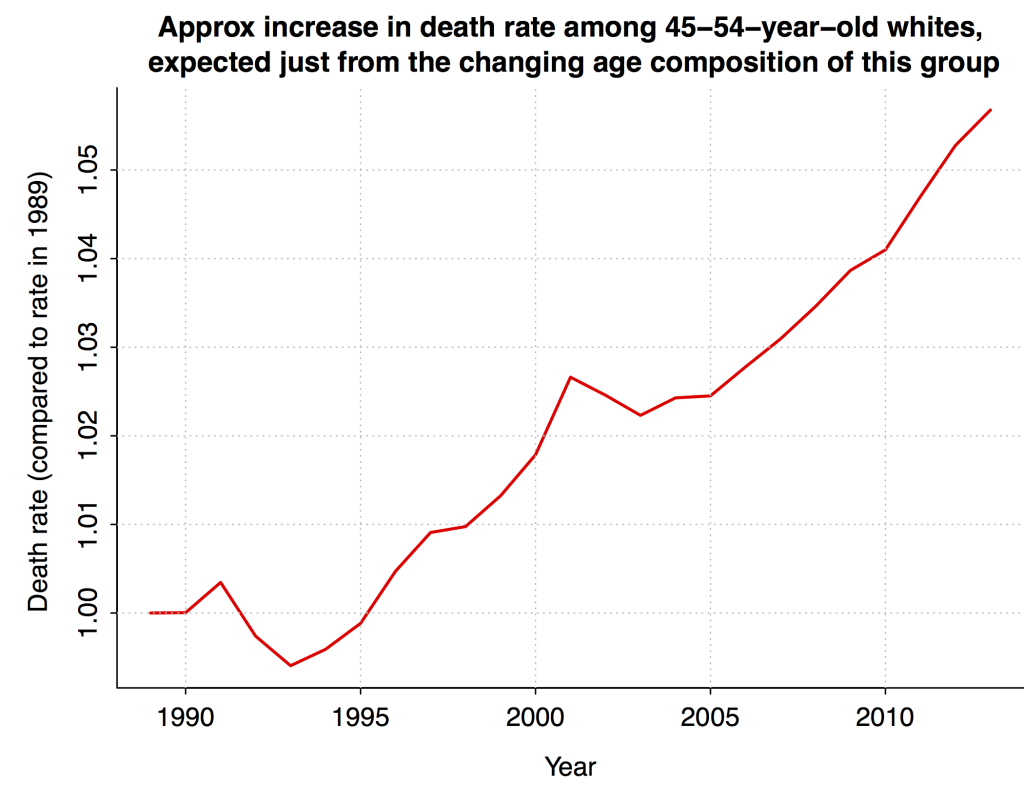
Columbia University statistician Andrew Gelman points out a problem with the analysis on which Professors Deaton and Case have based their conclusions. In 1999, the median age within the 45-54 years old subgroup of US whites was a lot closer to 45 than to 54, while in 2013 it was much closer to 54.  The Deaton and Case study does not adjust for this difference in age distribution.  Deaton and Case give us this spectacular graph:

Screen-Shot-2015-11-05-at-7.53.11-PM

Correcting for age distribution alone, Professor Gelman produces this figure:

births4-1024x805

Which accounts for the entire effect illustrated by the bright red line in the Deaton/ Case paper.

Professor Gelman argues that the Deaton/ Case findings are still newsworthy, if not as sensational as their interpretation would suggest.  Why did mortality among US whites aged 45-54 remain steady in years when virtually every comparable demographic experienced a significant decline in mortality?

I don’t know the answer to this question, but I suspect it will turn out to be something pretty obvious. My first thought is base rate.  After all, middle-aged white Americans are, on average, one of the most prosperous large groups on earth, and have been so for a great many years.  That isn’t to deny that pockets of deep poverty like those which so concern Mr Dreher do exist among US whites at the left end of the income distribution curve, but the income level at the middle of the white American bell curve is quite high by global standards and has been for many generations. So, any easy measures that could move the needle up on average life expectancy among a population have probably long since been taken with regard to middle-aged white Americans.

The second thing that comes to my mind is obesity.  Americans in general are pretty fat; this animated gif that the Centers for Disease Control and Prevention released a couple of years ago illustrates just how fat we’ve been getting, and whites are certainly not immune to the problem:

If the median white American gained as much weight as this figure suggests in the years leading up to and beyond 1999, it is a sign of extraordinary advances in medical care that the mortality rate among US whites aged 45-54 did not jump by at least as much as the original Deaton/ Case interpretation indicated.  That other groups actually experienced declines in mortality while undergoing equal or greater increases in obesity would support the base rate explanation to which I referred above, that African Americans and nonwhite US Hispanics, having on average lower incomes than US whites, were also on average later in receiving new forms of medical intervention and other benefits of modernity than were their white compatriots.

Texas Crazy

Contrary to the poster for this 2008 film, none of the witnesses from the 19th century said the Wild Man hurt them

A few days ago, it turned up in the news that in Norway, “Texas” is slang for “crazy.”  According to Anne Ekern, an official of the Norwegian consulate in Houston whom National Public Radio talked with, the use of “Texas” as an expression meaning something wild, exciting, or out of control “goes back to Norwegians watching cowboy movies” and was familiar to her in as a phrase adults used when she was a child in Norway in the 1970’s.

US left-wingers, among them most of the people I see on social media, love this story, and have been gleefully sharing as fact the theory that it stems from the Lone Star State’s often ultra-conservative politics.  I started wondering about this when I noticed that Norwegian friends of mine were mentioning that they’ve only heard “Texas” used to mean crazy in the sense of wild or unpredictable, not mentally unwell.

That, combined with the explanation Ms Ekern offered, reminded me of a memory I had as a child in the 1970s, not in Norway, but in the USA.  My older brother showed up at a family function with a long, unkempt beard.  Our grandmother, who’d last seen him clean-shaved, laughed and said that he looked like the Texas Wild Man.  I’d often heard people of her generation (she was born in 1905) use the phrase “Texas Wild Man” to refer to eccentric people, and I was curious where it came from.  So I asked her.  She said she didn’t know where it came from, but that it was a familiar expression when she was growing up.  The younger adults assured her that it was still in common use, and I told her that I had heard it before.  We all speculated for a few minutes as to what its origin might be.  I don’t remember what our hypotheses were; I’m sure the longtime popularity of cowboy movies must have figured in some of them, as it does in Ms Ekern’s theory about the Norwegian use of “Texas.”

Another kind of Texas Wild Man

However, when I finally got round to googling “Texas Wild Man” yesterday, I found out that cowboy movies had nothing to do with it.  “The Texas Wild Man,” also known as “The Texas Wild Woman” and “The Wild Man of the Navidad,” was a half-human, half-ape creature of whom various people in and around Lavaca County, Texas reported catching glimpses from 1834 until 1851.  A number of anomalous footprints and other bits of evidence lent credence to the testimonies of a large and diverse array of witnesses.  The people held in slavery in that area called the creature whom they saw by moonlight “The Thing That Comes.”  In the 1830s not many people were in a position to know what or who might be living in the wilds of southeast Texas; the mystery of the half-man, half-ape “Thing That Comes” made its way around the world, keeping the phrase “Texas Wild Man” alive in US slang well into the 1970s, and perhaps keeping an echo of it ringing even in Norway.

On 21 February 1986, a column appeared in the Victoria, Texas Advocate (also available here) putting forward an explanation as to what exactly was behind the sightings of the Wild Man of the Navidad.  Columnist Henry Wolff, Jr read an article from the Texas Historical Quarterly of October 1900.  In that article, Mr Wolff found the recollections of “Mrs Dilue Harris, who was the wife of Ira S. Harris, an early Colorado County sheriff.”  Mrs Harris explained that the Wild Man was one of a group of Africans held in slavery on a plantation near the town of Columbus, a plantation belonging to a man named Ben Fort Smith.  The Wild Man had escaped from Smith’s plantation, fled to the Navidad river, and remained at liberty for quite some time.  Mrs Harris, relying on her memory to recount events of more than half a century before, apparently said that the Wild Man was captured in 1846; however, Mr Wolff cites a scholar named Brownson Malsch who found a newspaper article published on 7 August 1851 reporting that the Wild Man had been captured a few days before, that on 1 August he had been sold back into slavery at an auction where a man named Payton Bickford paid $207 for him, and that within hours of that sale the Wild Man had escaped from Payton Bickford and was now in jail along with three other men.  Evidently the Wild Man’s name was revealed in this article to be Jimbo.

Mr Wolff quotes a source telling us that when Jimbo was sent back to Payton Bickford after this escape, Bickford “turned him into the cornfield to fatten previous to closing his contract with Barnum for the sale of Jimbo.”  That Bickford was in negotiations with P. T. Barnum, already a world-famous impresario in 1851, for custody of Jimbo shows just how much publicity the Texas Wild Man must have attracted.  Something must have convinced Barnum that Jimbo would not bring him a triumph to match those he had enjoyed exhibiting various disabled and enslaved people as freaks, however, as Payton Bickford ultimately sold Jimbo, not as a public attraction, but as a field hand.  A Victoria County planter named Zebriam Lewis paid Bickford for Jimbo, and Jimbo was still in service to Lewis when slavery was abolished in 1865.  In 1865, Jimbo left the Lewis ranch for another ranch, belonging to someone called Carlos, and there he stayed until he died in 1884.  Mr Wolff quotes someone who knew Jimbo as saying “He was perfectly harmless, and never learned to speak English, talking in broken Spanish which could hardly be understood.”

So, the man who put the crazy in Texas, at least in “Texas” as a slang term, may not have been a far-right politician, but an African who refused to be enslaved.  Der ist helt Texas, indeed!

“Woman” vs “Female”

Here’s something I saw on twitter this morning:

That prompted a question from me:

I suspect that “Woman Trouble” (meaning, difficulties someone is having with a female romantic partner) and “Female Trouble” (meaning, ailments for which one might seek aid from a gynecologist) are both fairly problematic phrases, and I never use either.  In fact, I can’t think of anyone I know who uses them, except ironically and in the company of people who get the joke.  (And I know some people whose speech habits are pretty thoroughly untouched by feminism.)  That one has “woman” and the other has “female” doesn’t seem to matter much.

Anyway, poster Kait the Great then put up this clarification, perhaps not in response to me specifically:

Though I do still wonder about my original question.  Phrases like “Female Trouble” vs “Woman Trouble,” whatever else may be wrong with them, don’t suggest that “woman” and “female” are interchangeable.  If the problem with, say, “woman driver” as opposed to “female driver” comes from such a suggestion, then that might explain why “Female Trouble” and “Woman Trouble” are equally awkward.

Halloween logic

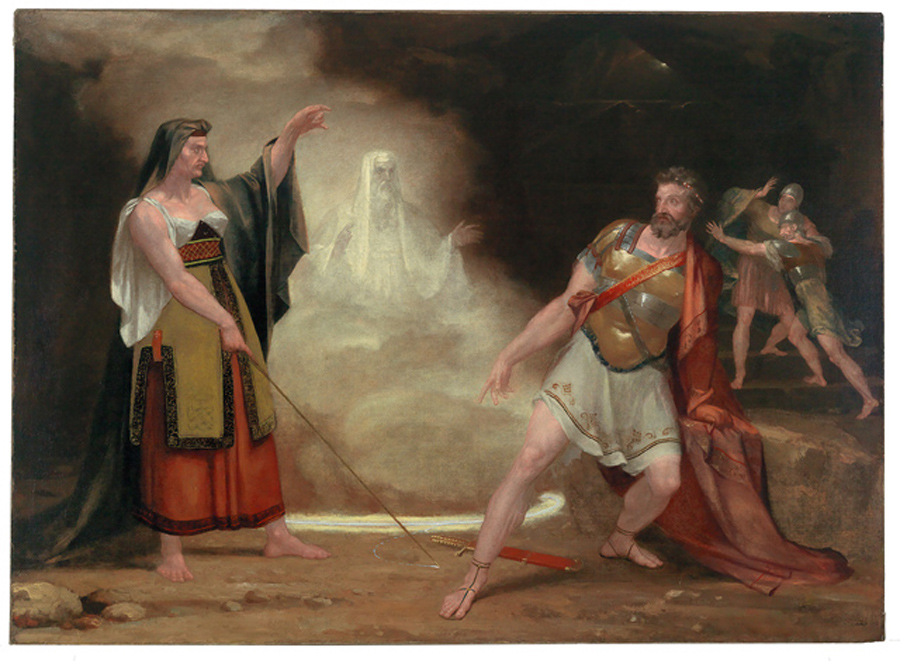
Saul and the Witch of Endor, by Washington Allston

A few days ago, Rod Dreher posted some thoughts about séances, mediums, and the like.  This prompted me to arrange some thoughts about the topic as a formal argument.

  1. Either disembodied spirits operate in the world, or they do not.
  2. If they do not, we ought not to do business with mediums, as they would not be able to deliver the service which they advertise.
    1. Moreover, any good we might incidentally receive in the course of our dealings with mediums would be, on the one hand, offset by the harm we would be doing by supporting a fraudulent business, and, on the other hand, would likely be available in other forms, offered by trustworthy psychotherapists or other honest dealers.
  3. If disembodied spirits do operate in the world, either they have intentions concerning our well-being, or they do not.
  4. If they do not have intentions concerning our well-being, we ought not to do business with mediums, as they would in such a case have no messages to convey to us.
  5. If they do have intentions concerning our well-being, either those intentions are all alike, or they are not all alike.
  6. If they are all alike, either all of them are friendly, or all of them are hostile.
  7. If all the intentions disembodied spirits have concerning our well-being are friendly, the degree of suffering and injustice humans endure in the world suffices to prove that those spirits are of little consequence in the world.
  8. If all the intentions disembodied spirits have concerning our well-being are hostile, the degree of prosperity and good feeling humans enjoy in the world suffices to prove that those spirits are of little consequence in the world.
  9. If disembodied spirits are of little consequence in the world, we ought not to do business with mediums, as the information they offer is of insufficient practical value to justify the investment, not only of money, but of intellectual attention and emotional energy, which they demand.
  10. If disembodied spirits exist, have intentions concerning our well-being, and are of great consequence in the world, points 7 and 8 above show that some of them must be friendly towards us, while others are hostile.
  11. There is not now and likely will never be an empirical test to determine whether a particular disembodied spirit is friendly or hostile in its intentions concerning our well-being.
  12. Either there are mediums who can facilitate communication between us and disembodied spirits, or there are not.
  13. If there are not, then we ought not to do business with mediums, for the same reasons explained under point 2 above.
  14. If there are, then we ought not to do business with mediums, as we would have no empirical test to determine whether the spirit communicating with us through the medium was a friendly spirit providing information that would lead us to good, or a hostile spirit providing information that would lead to our destruction.
    1. Even if a friendly spirit did provide us with information that would benefit us, the success of that act of communication would likely bring us back to the medium for further consultations.  Since there is no test to distinguish friendly spirits from hostile ones, each further consultation would represent another opportunity for a hostile spirit to approach us.
  15. Therefore, we ought not under any circumstances do business with mediums.

I rather wonder what the relationship is between a logical construction like this and the sorts of games fortune-tellers play.  Games such as the Tarot, the I Ching, the Ouija board, etc.

Once, when I was in a logic class in college, the professor said something he usually had occasion to say at least once a week, “A valid argument is one where, if you accept that the premises are true, you must accept that the conclusion is also true.”  What made this occasion different was what he said next: “You may wonder where that ‘must’ comes from.  Who says you ‘must’ accept the conclusion of a valid argument if its premises are true? That would appear to be an ethical statement.  In that sense logic is a subfield of ethics.”  This remark was particularly striking coming as it did from a professor who taught only logic, metaphysics, and the philosophy of mathematics.  He never taught ethics or anything too obviously derivative of ethics.  But it did seem unavoidable to him that logic was ultimately rooted in the moral sense.

A culture might regard a particular divination game as a holy act of obligation.  It is certainly the case that many groups of people defined by religion look on each others’ practices as so much traffic with the spiritual forces of darkness.  Perhaps the rules of logic according to which I constructed the argument above would seem to some or other religious group to be as peculiar and as unwholesome as the rules of a séance would appear to me.