
All posts for the month February, 2009
Is Your Marriage Ever Legal? Ask Ken Starr!
Posted by CMStewart on February 11, 2009
https://losthunderlads.com/2009/02/11/is-your-marriage-ever-legal-ask-ken-starr/
The Nation, 23 February 2009
 Stuart Klawans reviews three new films, Gomorrah, The Class, and Coraline. Gomorrah, he assures us, is not merely a hyper-violent Italian gangster movie, but a critique of globalization, a portrait of “what the world looks like when it has been remade by gangsters.” As a teacher myself, I was intrigued by Klawans’ description of The Class. Evidently the film depicts two hours in the life of a grammar and composition class in a French public school, taught by a man with a daring, aggressive technique. “François has no fear of sharp distinctions. His pedagogical method is to push his students and then to shove, so that he’s always on the verge of going too far with them–or finally steps over the line.” Coraline is evidently a reimagining of Kafka’s “In the Penal Colony.” While the story centers on a son’s obscure sense that his father has rejected him, the main action of the film begins with a girl openly rejecting her parents and leads her toward the same kind of destruction as Kafka’s character had witnessed.
Richard R. John explains how recent changes in rates and policies at the US Postal Service have rewarded mass-circulation magazines and penalized low-circulation magazines. A look at the subcategories under “Periodical Notes” will show that this is a matter of vital concern to your humble correspondent. (more…)
Posted by acilius on February 11, 2009
https://losthunderlads.com/2009/02/11/the-nation-23-february-2009/
Gooey Love Cake
Make this relatively quick and impressive cake for your Valentine.

suggestion: vanilla cake mix, banana creme pudding mix, caramel ice cream topping, banana
1 box cake mix
1 box instant pudding mix
1 jar (1 pound) ice cream topping
fruit, cut into small pieces as necessary
hint: Choose complimentary ingredient flavors.
1. Make cake batter (do not bake yet) according to box directions.
2. Make pudding according to pudding pie directions on box (reduced liquid), pulverizing lumps between fork tines and your finger.
3. Swirl 1/2 cake batter and 1/2 pudding together in a large cake pan.
4. Place fruit on swirled mixture.
5. Drizzle remaining cake batter and pudding over fruit.
6. Bake according to briefest time box directions.
7. At end of baking time, turn off oven, then open over door quickly, then close oven door and allow pudding cake to cool in warm oven.
8. Cover pudding cake with plastic wrap and refridgerate overnight.
9. Pour at least most of ice cream topping over pudding cake.
10. Arrange fruit on top of topping.
Posted by CMStewart on February 10, 2009
https://losthunderlads.com/2009/02/10/gooey-love-cake/
A novel interpretation of academic freedom
Thanks to 3quarksdaily for linking to this column by Stanley Fish. I’ve copied four excerpts below:
My assessment of the way in which some academics contrive to turn serial irresponsibility into a form of heroism under the banner of academic freedom has now been at once confirmed and challenged by events at the University of Ottawa, where the administration announced on Feb. 6 that it has “recommended to the Board of Governors the dismissal with cause of Professor Denis Rancourt from his faculty position.” Earlier, Rancourt, a tenured professor of physics, had been suspended from teaching and banned from campus. When he defied the ban he was taken away in handcuffs and charged with trespassing.
What had Rancourt done to merit such treatment? According to the Globe and Mail, Rancourt’s sin was to have informed his students on the first day of class that “he had already decided their marks : Everybody was getting an A+.”
Later:
Rancourt is a self-described anarchist and an advocate of “critical pedagogy,” a style of teaching derived from the assumption (these are Rancourt’s words) “that our societal structures . . . represent the most formidable instrument of oppression and exploitation ever to occupy the planet” (Activist Teacher.blogspot.com, April 13, 2007).
Among those structures is the university in which Rancourt works and by which he is paid. But the fact of his position and compensation does not insulate the institution from his strictures and assaults; for, he insists, “schools and universities supply the obedient workers and managers and professionals that adopt and apply [the] system’s doctrine — knowingly or unknowingly.”
It is this belief that higher education as we know it is simply a delivery system for a regime of oppressors and exploiters that underlies Rancourt’s refusal to grade his students. Grading, he says, “is a tool of coercion in order to make obedient people” (rabble.ca., Jan. 12, 2009).
It turns out that another tool of coercion is the requirement that professors actually teach the course described in the college catalogue, the course students think they are signing up for. Rancourt battles against this form of coercion by employing a strategy he calls “squatting” – “where one openly takes an existing course and does with it something different.”
And then:
Rancourt first practiced squatting when he decided that he “had to do something more than give a ‘better’ physics course.” Accordingly, he took the Physics and Environment course that had been assigned to him and transformed it into a course on political activism, not a course about political activism, but a course in which political activism is urged — “an activism course about confronting authority and hierarchical structures directly or through defiant or non-subordinate assertion in order to democratize power in the workplace, at school, and in society.”
Clearly squatting itself is just such a “defiant or non-subordinate assertion.” Rancourt does not merely preach his philosophy. He practices it.
How did Rancourt’s supervisors respond to his activities?
The record shows exchanges of letters between Rancourt and Dean Andre E. Lalonde and letters from each of them to Marc Jolicoeur, chairman of the Board of Governors. There is something comical about some of these exchanges when the dean asks Rancourt to tell him why he is not guilty of insubordination and Rancourt replies that insubordination is his job, and that, rather than ceasing his insubordinate activities, he plans to expand them. Lalonde complains that Rancourt “does not acknowledge any impropriety regarding his conduct.” Rancourt tells Jolicoeur that “Socrates did not give grades to students,” and boasts that everything he has done was done “with the purpose of making the University of Ottawa a better place,” a place “of greater democracy.”
Posted by acilius on February 10, 2009
https://losthunderlads.com/2009/02/10/a-novel-interpretation-of-academic-freedom/
Counterpunch, 1-31 December 2008
 Alexander Cockburn reviews Roger Deakin’s Notes from Walnut Tree Farm, a journal of country life by a leading British environmentalist. Cockburn describes a gentle, wistful book, not at all the sort of thing the pugnacious title of the newsletter leads to expect (and which he usually delivers.)
Posted by acilius on February 9, 2009
https://losthunderlads.com/2009/02/09/counterpunch-1-31-december-2008/
The Nation, 16 February 2009
 Gary Younge points out that Barack Obama is in fact the President of the United States. From this fact, he draws the conclusion that the time has come to put away the posters and other artwork endorsing him and get to work pressing him from the left, as others will surely do from the right.
Akiva Gottlieb reviews two novels by Bulgaria’s Angel Wagenstein, novels replete with heretical rabbis, lazy Nazis, and other exemplars of moral ambiguity. The review opens with a reference to Joshua Cohen’s “Untitled: A Review,” from Cohen’s short-story collection The Quorum. A reviewer finds on his doorstep a volume of six million crisp, white, blank pages. He decides that this book is a history of the Holocaust, in fact “the only way to write about the event, the idea.”
Eric Alterman takes on Rabbi Abraham Foxman and the Anti Defamation League of B’nai B’rith. Alterman contends that “Anti-Defamation League” is a double misnomer for this organization. He contends that it launches harsh attacks indiscriminately at all critics of Israel, attacks which less often counter defamation than they themselves amount to defamation; and that under Rabbi Foxman it is so much a one-man operation as hardly to qualify as a “league.”
The editors endorse Tom Geoghegan for Congress. (Others have done so since.) Geoghegan has written for many publications regularly noted here. A piece of his appeared in the final issue of The Baffler, for example, the only one that appeared after I started these notes.
Posted by acilius on February 9, 2009
https://losthunderlads.com/2009/02/09/the-nation-16-february-2009/
The American Conservative, 26 January 2009
Much of this issue is devoted to Israeli military operation in Gaza and its likely consequences for the politics of the Middle East. The four items I want to note are not related to that topic, however.
An obituary for Samuel Huntington notes that Huntington produced “pathbreaking scholarship in all four major subfields of political science.” This led me straight to Wikipedia, which lists the five major subfields of political science as “political theory, public policy, national politics, international relations, and comparative systems.” Which of these Huntington missed I don’t know.
Another obituary, for Father Richard John Neuhaus, includes a much harsher assessment of its subject. Neuhaus is described there as a 1950’s liberal whose lack of imagination led him to conclude his public life as the ringleader of a group of “predictable apologists for the very secular policies of the Bush administration, which were notable neither for their attention to claims of transcendent justice nor for their respect for the dignity of the human person.” Among Neuhaus’ many delinquencies was a public campaign of defamation he and his followers waged against the staff of Chronicles magazine in 1989.
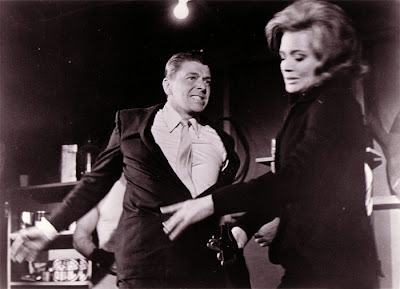
Ronald Reagan hitting a girl
A review of William F. Buckley, Junior’s The Reagan I Knew includes a couple of anecdotes from the book. I reproduce them below:
Buckley’s Reagan is robust: when we (and Buckley) first meet him, he is about to introduce a Buckley talk at a Los Angeles high school. But the microphones are dead and can only be switched on from a locked booth above the auditorium.
“His diagnosis seemed instantaneous,” Buckley recalls. “He was out the window, his feet on the parapet, his back to the wall, sidestepping carefully toward the control-room window. Reaching it, he thrust his elbow, breaking the glass, and disappeared into the control room.” In a moment, “we could hear the crackling of the newly animated microphone.”
At their final encounter, in 1990, the ex-president again demonstrates his adventurous streak. He holds out his cup of tea to Buckley: “Stick your finger in this.”
“What?”
“Yeah. Go ahead.”
The drink is scalding. “Now, watch this,” Reagan says as he swigs from the cup. “See? The tolerance of your mouth tissues is infinitely greater than that of your hand! … You know who taught me that? It was Frank Sinatra.”
You can see why someone lack that would grab people’s imaginations.
Posted by acilius on February 9, 2009
https://losthunderlads.com/2009/02/09/the-american-conservative-26-january-2009/
The Nation, 9 February 2009
 Alexander Cockburn quotes an interesting-sounding new book, Bad for Democracy: How the Presidency Undermines the Power of the People, by Dana Nelson. Unfortunately, Nelson does not recommend abolishing the presidency. She does have as set of proposals to reduce its power, and she exhorts her readers to find ways of participating in political life that do not involve voting or require fixing national attention on one man.
This issue includes part one of “Adventures in Editing,” Ted Solotaroff’s recollections of his time as an associate editor of Commentary in the early 60s. Anyone interested in writing will enjoy Solotaroff’s description of how he learned to do that job. Anyone interested in narcissists will enjoy his description of how Norman Podhoretz behaved as the editor-in-chief of the magazine in those days. One bit that sticks in my mind is near the end of the piece:
Shortly after I’d come to Commentary, I’d had a conversation with Norman about recruiting writers for the magazine. It didn’t seem to me such a big deal; I said I knew of four or five people at the University of Chicago alone who could write for Commentary.
“You think you do, but you don’t,” said Norman. “You don’t realize how unusual you were for an academic.”
I said I wasn’t that unusual: I’d lucked into an opportunity my friends hadn’t had. “I’ll bet you a dinner that I can bring five writers you’ve never heard of into the magazine in the next year.”
“I don’t want to take your money,” he said. “I’ll bet you won’t bring three.”
We turned out to both be right. With one exception, the novelist Thomas Rogers, none of the former colleagues I had in mind sent in a review or piece that was lively enough to be accepted. A former fellow graduate student, Elizabeth Tornquist, who was turning to political journalism, also managed to crack the barrier. The others had fallen into one or another mode of scholarly dullness or pedagogical authority and, despite my suggestions, had trouble climbing out to address the common reader. My efforts to point their prose and sense of subject in a broader direction brought little joy to either party. “How dare you revise my formulation of an intellectual problem” was a fairly typical reaction.
Which may explain why so few “little magazines” really make it. It certainly explains why someone Podhoretz was needed to make Commentary into the magazine it was. Only someone who didn’t mind losing friends could edit their work as mercilessly as was necessary to make a periodical worth reading and talking about; only someone who didn’t mind sucking up to the rich and famous could raise the money and generate the publicity necessary to keep it afloat.
Posted by acilius on February 9, 2009
https://losthunderlads.com/2009/02/09/the-nation-9-february-2009/
“Ain’t She Sweet”
From 1995’s The Beatles Anthology DVD: George Harrison plays the ukulele, Paul McCartney sings, Ringo Starr keeps time.
Posted by acilius on February 9, 2009
https://losthunderlads.com/2009/02/09/aint-she-sweet/
The Atlantic Monthly, January/ February 2009
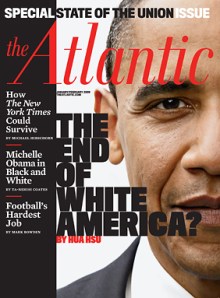
Garrett Epps declares the creation of the presidency to have been “The Founders’ Great Mistake.” You’d think the history of the last 85 years would have made that clear to everyone, but evidently it has not. Epps does not propose abolishing the presidency. Instead, he outlines a plan that would keep the office in existence, but make the president dependent on the support of a majority in Congress. In effect, Epps would replicate a parliamentary system. That would be, if anything, worse than what we have now. At least now the president and Congress can fight each other to a standstill. Under Epps’ system, there would never be an opposing force to block the worst ideas that came out of the leadership of the ruling party.
Mark Ambinder’s piece on the way the Obama campaign handled race as an issue contains an interesting line:
Even during the 2008 primaries, a discomfiting pattern had emerged: Barack Obama did his best overall in the states with the largest or the smallest percentages of African American voters—think of South Carolina, where blacks made up 55 percent of the Democratic-primary vote, and Vermont, where they made up less than 2 percent. Obama won in states where black Democrats had already attained a measure of political power, or where whites had never competed with blacks.
Ambinder seems close here to an idea that has been rattling around on the far right for some time. Some writers, such as Steve Sailer, have claimed that “white guilt” is in fact a sign of disengagement from African Americans. Whites who support policies that might put other whites at a disadvantage to African Americans do so in order to show their superiority over other whites. On this view, “white guilt” is not a sign of belief in the equality of African Americans. Quite the contrary, it rests on a belief that African Americans will never be able to compete at the highest levels of achievement. Those who declare themselves racked by white guilt do so in order to show that they themselves are able to do so, and look down on those whites who have to worry about African American competitors. I don’t know if I believe that idea, but I do think it deserves wider discussion than it has received. Certainly it shouldn’t be relegated to Sailer’s blog and similarly confined venues.
Mark Bowden profiles Bob Fishman, who directs CBS’ television broadcasts of NFL games. The sheer number of decisions Fishman must make in the course of a minute of airtime staggers the mind. Cognitive psychologists should study the guy.
Posted by acilius on February 8, 2009
https://losthunderlads.com/2009/02/08/the-atlantic-monthly-january-february-2009/
Who writes this?
 acilius
 believer1
 lefalcon
 losthunderlads
 vthunderlad
 Panther Red