
The American Conservative, 9 March 2009

Benjamin Disraeli as a Young Man

A review of Adam Kirsch’s biography of Benjamin Disraeli focuses on Kirsch’s idea that because Disraeli realized he could not stop his fellow nineteenth-century Englishmen from thinking of him primarily in terms of his Jewish ancestry, he “did not attempt to disguise his Jewish background.  He embellished it.”   Disraeli purported to be far more deeply involved with that side of his ancestry than he in fact was, even explaining his active membership in the Church of England as an example of his fealty to “the only Jewish institution that remains… the visible means which embalms the race.”  Meanwhile, the Jewish characters and themes in Disraeli’s novels appall modern sensibilities.  Sidonia, a character in the Young England trilogy (Coningsby, Sybil, and Tancred,) “looks like nothing so much as an anti-Semitic hate figure.  It is amazing, in fact, how Disraeli manages to combine in this one character every malicious slander and paranoid fear that the anti-Semitic imagination can breed.”  Disraeli’s manipulation of the label his fellows had imposed upon him enabled him to become prime minister of the United Kingdom.  Disraeli’s ability to “outline [an] agenda of radical change to be achieved conservatively, a political program that allowed him to reinvent himself as the representative not only of the wealthy and the working class but of the Tory Party, too” has inspired rightist politicians like Richard Nixon and the neocons.      

If Kirsch is right, Disraeli knotted his contemporaries’ perceptions of him around their image of “the Jew,” using their prejudices to transform  himself from a marginal figure unlikely to make a mark in politics into a figure of England’s national mythology.  Another complex of ideas twists around another such image in Brendan O’Neill’s  analysis of the thoughts of some of Israel’s more fervent defenders in the West.  O’Neill argues that the individuals he cites are less interested in Israel as an actual place inhabited by living people than they are in using a particular idea of Israel as a symbol for the values of the Enlightenment.  “In effect, Israel is cynically, and lazily, being turned into a proxy army for a faction in the Western Culture Wars that has lost the ability to defend Enlightenment values on their own terms or even to define and face up to the central problem of anti-Enlightenment tendencies today.”  This use of Israel as a pawn in cultural struggles centered elsewhere shades into philosemitism.  “[A]s Richard S. Levy writes in his book Anti-Semitism: A Historical Encyclopedia of Prejudice and Persecution, simple philosemitism, like anti-Semitism, also treats the Jews as ‘radically different or exceptional’…  Where anti-Semites project their frustrations with the world and their naked prejudices onto the Jews, and frequently onto Israel, too, the new philosemites project their desperation for political answers, for some clarity, for a return to Enlightenment values onto Israel and the Jews.  Neither is a burden the Jewish people can, or should be expected to, bear.”    
(more…)

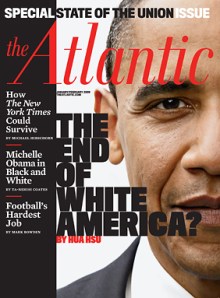
The Atlantic Monthly, January/ February 2009

atlantic-janfeb09

Garrett Epps declares the creation of the presidency to have been “The Founders’ Great Mistake.”  You’d think the history of the last 85 years would have made that clear to everyone, but evidently it has not.  Epps does not propose abolishing the presidency.  Instead, he outlines a plan that would keep the office in existence, but make the president dependent on the support of a majority in Congress.  In effect, Epps would replicate a parliamentary system.  That would be, if anything, worse than what we have now.  At least now the president and Congress can fight each other to a standstill.  Under Epps’ system, there would never be an opposing force to block the worst ideas that came out of the leadership of the ruling party. 

Mark Ambinder’s piece on the way the Obama campaign handled race as an issue contains an interesting line:

Even during the 2008 primaries, a discomfiting pattern had emerged: Barack Obama did his best overall in the states with the largest or the smallest percentages of African American voters—think of South Carolina, where blacks made up 55 percent of the Democratic-primary vote, and Vermont, where they made up less than 2 percent. Obama won in states where black Democrats had already attained a measure of political power, or where whites had never competed with blacks.

Ambinder seems close here to an idea that has been rattling around on the far right for some time.  Some writers, such as Steve Sailer, have claimed that “white guilt” is in fact a sign of disengagement from African Americans.  Whites who support policies that might put other whites at a disadvantage to African Americans do so in order to show their superiority over other whites.  On this view, “white guilt” is not a sign of belief in the equality of African Americans.  Quite the contrary, it rests on a belief that African Americans will never be able to compete at the highest levels of achievement.  Those who declare themselves racked by white guilt do so in order to show that they themselves are able to do so, and look down on those whites who have to worry about African American competitors.  I don’t know if I believe that idea, but I do think it deserves wider discussion than it has received.  Certainly it shouldn’t be relegated to Sailer’s blog and similarly confined venues.  

Mark Bowden profiles Bob Fishman, who directs CBS’ television broadcasts of NFL games.  The sheer number of decisions Fishman must make in the course of a minute of airtime staggers the mind.  Cognitive psychologists should study the guy.

The Nation, 1 December 2008

Nick Turse looks into American forces’ conduct of the war in Vietnam’s Mekong Delta in the period from 1 December 1968 to 1 April 1969.  Turse concludes that the facts were much worse than has generally been known in the USA.  Civilians were targeted more systematically than has been acknowledged, more of them were killed than has been acknowledged, and a coverup of the some of the worst atrocities continued for decades.  Turse quotes a contemporary letter signed “Concerned Sergeant.”  The otherwise anonymous soldier denounced the operations to which he was attached and estimated that the rate at which unarmed civilians were being killed amounted to “a My Lai a month.” 

Ever since Studs Terkel died, The Nation has been memorializing him.  In this issue, his editor, Andre Schiffrin, remembers their attempt to put together an oral history on the topic of power.  The project failed because none of their prospective subjects would even admit that he held power, let alone give insight into what it was like to use it.  That’s hardly surprising when Schiffrin describes the key to Terkel’s work.  His subjects talked to him, Schiffrin explains, because “he approached people with utter respect.  Those he talked to immediately felt this and poured their hearts out.”  Powerful people usually seem to expect to be approached with utter respect, if not indeed with abject servility.  That so many people from so many backgrounds found it a shock to be approached with respect is a sad commentary on our society. 

Hoosiers and others marveling at the fact that Indiana voted for Obama will enjoy Mark Hertsgaard’s piece about Luke Lefever, a plumber (a real one!) who volunteered for the Obama campaign in Elkhart. 

Siddhartha Deb reviews several novels by Elias Khoury.  At first, Deb praises the “fragmented” style of Khoury’s work as suitable to his native Lebanon, but at the end he suggests that the time may have come for a smoother style of writing and, apparently, a more settled view of Lebanese identity.

This brings us to Barry Schwabsky’s review of Art Worlds by Howard S. Becker and Seven Days in the Art World by Sarah Thornton.   Becker’s newly reprinted 1982 book is a sociological study of various milieux from which products came that could be called “art,” while Thornton, also a sociologist, spent her time in “an art world that claims the right to call itself the art world.”  Schwabsky puts the question:

In the sociologist’s art world, hierarchies, rankings, and orders of distinction proliferate.  Status and reputation are all, and questions about them abound.  Why does the seemingly kitschy work of Jeff Koons hang in great museums around the world while the equally cheesy paintings of Thomas Kinkade would never be considered?… How do conflicting views on the value of different kinds of artworks jell into a rough and shifting consensus about the boundaries of what will be considered art in the first place?

That’s quite a weighty question.  As for the Koons/ Kinkade riddle, my suspicion is that perspective drawing and the rest of the conventional skills of representational art are not really all that difficult to master.  Some years ago I read an essay by Eric Gill called “Art in Education: Abolish Art and Teach Drawing,” in which he argued that given a chance virtually any child could and would learn these techniques.  I haven’t seen any scientific work testing this hypothesis, but it doesn’t seem fantastic to me to think that if all children were introduced to art in the same way that, let’s say, Thomas Kinkade was, that some large percentage of the population would grow up to paint pictures very much like his.  If that is so, then the problem with Kinkade isn’t that he’s cheesy, but just that they are nothing special.  If a collector wants to attain a high rank, s/he can hardly buy paintings that may be very pleasant but that could be equalled by, let’s say, a third of the adult population. 

(more…)

The American Conservative, 14 July 2008 & 28 July 2008

14 July– A special issue on the causes and consequences of World War Two; the cover asks “How good was the good war?”  Seven contributors disagree on various points, but all concur that the international situation confronting the United States today bears very little resemblance to that which confronted Britain and France at the Munich Conference in 1938.  Several contributors cite Wilhelm II’s Germany on the eve of World War I as the state from which the USA could take the most powerful cautionary lesson.

Right-wing third party presidential candidates Bob Barr and Chuck Baldwin get friendly writeups.

Steve Sailer (lefalcon’s least favorite blogger, and for good reason) reviews Richard Florida’s Who’s Your City and slashes Florida’s claims about the “creative class” to bits.   Florida claims that culturally tolerant cities are the places where it is likeliest that creative elites will form and develop new, commercially successful products and systems.  Florida’s favorite example is Silicon Valley, which he says owed its genesis to the wide-open mores of San Francisco.  Sailer points out that Silicon Valley is in Palo Alto, 33 miles from San Francisco.  Sailer finds that Silicon Valley’s location is in fact typical of the geographical centers of innovation in today’s economy: “high tech regions don’t sprout in diverse cities but way out in the suburbs.  Think of Route 128 outside of Boston, the Dulles Corridor in the Virginia suburbs of Washington DC, the two Silicon Prairies west of Chicago and north of Dallas, or the biotech office parks next to Torrey Pines golf course in scenic North San Diego County.”  This pattern, Sailer asserts, holds because “Bohemians don’t invent gizmos.  Nerds do.  The geeks and the golf-playing sales guys who peddle their inventions are usually team players who are relatively monogamous and family-oriented.  They soon wind up in the ‘burbs, where they find backyards and good public schools.”  It’s after the inventions are made and the wealth starts coming in that the cultural openness and sophisticated urbanity Florida talks about comes in.

Fred Reed uses the inside back cover to take the USA to task for being a society that is “unrelaxed, therefore uncontemplative.”  Perhaps that’s why he lives in Mexico now.

28 July– Leon Hadar believes that the US invasion of Afghanistan in 2001-2002 was a just war, but that it is now long past time to withdraw US troops from the country.  He argues that it is unrealistic to expect a foreign army to bring order to Afghanistan.

Michael Brendan Dougherty reports on the apparently unanimous support that Roman Catholic bishops in the USA have given to the least restrictive immigration policies available.

David Gordon describes the “Rawlsekians,” a group of young libertarian thinkers who want to combine the egalitarian political philosophy of John Rawls with the neoliberal economics of Friedrich Hayek.  He finds the results unsatisfactory.

Ed West provides an hilarious review of a new book about the bin Laden family.  After running through many outlandish anecdotes about the family, he ends thus:

On the whole the bin Ladens seem to be a sympathetic bunch- charming fellows, mostly.  One has to come to the same conclusion as the FBI: there are millions of bin Ladens running around, and “99.999999% of them are of the non-evil variety.”

An email I sent to P, in which I critiqued your least-favorite blogger

P-funk has been sending me emails lately with his views on society and class in Brazil, a topic whereupon my ignorance is almost total.  So I keep trying to change the subject.  Something he said yesterday reminded me of a recent posting on Steve Sailer’s blog, so I took the opportunity to introduce him to that site and my reservations about it.  With P’s permission, I copy the message below.   (more…)