Among the nostalgists

When I was a kid in the 1970s, I would often hear my older brothers talking with each other and with my parents about Vietnam and Watergate. I would ask them to explain what those words meant, which presented them with quite a challenge when I was three or four years old. I never gave up, though, and by the time I’d figured them out I was not only hooked on those topics but on history in general, including the political history of the USA in the decades following the Second World War. I grew up to become a classical scholar, but when I’m not professionally engaged with ancient Greek and Latin literature my mind still wanders to those matters.

I’ve been spending a bit of my free time talking about such things on Twitter lately, especially in threads growing out of posts made by commentator Richard Brookhiser. The other day, for example, Mr Brookhiser brought up an interlocutor of his who speculated that right-wing Congressman John Ashbrook’s 1972 primary challenge to Richard Nixon’s reelection campaign was an attempt to clear the field for Ronald Reagan to replace Nixon as the Republican nominee. In response, I pointed out that Reagan already faced a formidable rival for conservative support in Vice President Spiro Agnew, and that if Ashbrook had somehow knocked Nixon out of the race he would have established himself as a substantial figure in his own right, another obstacle to any attempt Reagan might have made to launch a bid of his own.

The national attention given to yesterday’s election for mayor of New York reminded me of another 1960s-1970s figure who captured my attention when I was a child, John V. Lindsay. When I was about nine years old, I was watching the old Batman show when the character of Mayor Linseed appeared. My mother was with me, and she laughed out loud. She said that the actual mayor of New York in those days was named Lindsay. “Linseed” didn’t strike me as clever enough wordplay to account for her laughter, and she said that indeed it was not why she was laughing. What struck her as funny was that while the actual Mayor Lindsay was a ridiculously handsome man, whose good looks sometimes got in the way of his political career, the makers of Batman had cast a plain-faced character actor as his fictional counterpart. Evidently they were afraid that even in their fictional universe, it would be too much to ask people to believe that the mayor of such a big city could look like a movie star. I’ve also mentioned John Lindsay on Twitter quite a few times in recent months.

What has really kept Mayor Lindsay front of mind for me lately is not so much the comparisons I’ve seen between him and Mayor-elect Mamdani, but another item I’m checking off the list of things I was curious about when I was a kid. In those days, people ten or twenty years older than me would occasionally mention the TV show Dark Shadows, a daytime soap opera that added a vampire to its cast and became a big hit. I couldn’t imagine that- to me, soaps were the dullest things imaginable, windows into the lowest cavern of Hell, the circle of ice where absolutely nothing happens. I wasn’t a great horror fan, but I knew that vampires got people moving and couldn’t imagine how one would fit into a genre that seemed to cultivate tedium for its own sake.

I stumbled on Dark Shadows when the Sci Fi Channel was running it in the 90s, and was intrigued. I didn’t have the time to keep up with it for very long, though. So when during the COVID-19 lockdowns my wife and I found that the entire series was available for free to watch on demand, I suggested we take a look. We wound up watching the whole thing in a little more than a year. In the 2022, I realized that the calendar was the same as it was in 1966. I decided to watch each episode on the 56th anniversary of its original broadcast. So I watched episode #1 on Monday, 27 June 2022. My plan was to post any thoughts I might have in the comment sections of blogs about the show, as I had done in 2020 and 2021.

I quickly found that, while some blogs were still keeping their comboxes open, no community like the one I had participated in at Danny Horn’s Dark Shadows Every Day could be found in any of them. So if I were going to write up my thoughts about the show in the way I wanted to do, I would have to post them on a blog of my own. I decided to stick with my idea about the calendar, and have each post go live on the anniversary of the episode it reviews. At first I assumed no one would read the site, and gave it a name no one would be likely to find. But people did start reading and responding to it, so I changed its name to Dark Shadows Commentary. That’s where the bulk of my online writing as “Acilius” has been since then, which is one of the reasons this site has been so quiet. Since John Lindsay was Mayor of New York the entire time Dark Shadows was being produced in that city, it’s no wonder he keeps popping into my head.

Tweets of the Week: 24 April 2024

I saw this sequence and thought it was time to log off Twitter, that I had seen the day’s best post:

Then, minutes later, this spectacular banger showed up:

Here’s a memorable line from a great scholar and fine poet:

Avery Edison says what we’ve all been thinking:

Vinney Szopa contemplates what we’ve lost:

Samuel Biagetti sympathizes with a kind of poster that has been prominent lately:

Pinboard brings common sense to bear on some ideas about sending people into outer space:

dril pretends he isn’t already on Twitter:

Sheena Liam does nifty things with embroidery:

I promote a side project of mine:

Tweets of the Week: 5 August 2023

Even when you know that Helga Stentzel did this on purpose, it is as striking as if it had occurred naturally:

Bradley Birzer says something about World War Two:

Sir Geechie may be the Afro-Fogey, but he would have you know that he is also a wild man:

I read these four Luwian words aloud and found that, quite without intending to do so, I was singing them. I found it through Shadi Bartsch, and she says she had the same experience:

A. Z. Foreman starts a thread that includes some gems.

Abby Denton has a great idea for a novel:

Ken Layne tells us that the theme song to Pee-Wee’s Playhouse was sung by Cyndi Lauper. I’d always assumed it was Mae Questel, the original voice of Betty Boop and Olive Oyl, who was indeed still working when the song was recorded. Instead, it was an outstanding imitation of and tribute to Questel.

Andrea More gives voice to the real victims:


William Gerrard (alias “Bill Gerrard”) has insight into the motives of historical figures:

Frank Whitehouse lays out some facts about something Elon Musk is doing that doesn’t even have the saving grace of making him a laughingstock:

And a few of my own-

My Warren G. Harding-themed tweets never get the love they deserve, not even this one I put up on the centenary of his death:

I told Twitter something I tell my students:

A possible etymology of the name “Acilius”

I’ve long used “Acilius” as my screen-name, in tribute to Gaius Acilius, a Roman historian who was alive and doing interesting things in 155 BC.  It never occurred to me that anyone would know the etymology of the name “Acilius”; it was quite an old name among the Romans, and they did not really keep track of that sort of thing in those days.

A couple of months ago, I happened onto a post on the blog “Paleoglot” which led me to wonder if there might not be a way to explore the question of where the gens Acilia found its name.  Blogger Glen Gordon analyzes various occurrences of a stem acil- in Etruscan.  In his conclusion, Mr Gordon offers these definitions to cover the occurrences he has discussed:

I think we could define the English translations of the whole word family much better as part of a grander morphological design:

*aχ (v.) = ‘to do, to make, to cause’
> acas (v.) = ‘to craft, to make’
> acil (n.) = ‘thing, act; rite, holy service’ (> acil (v.) = ‘to do rites, to worship’)

The implied underlying verb here, *aχ, reminds me very much of the Indo-European *h₂eǵ-, as if borrowed from Latin agere ‘to drive, lead, conduct, impel’.

This intrigues me very much.  If the Etruscans borrowed such a word from Latin, that would suggest that the usual story about the relationship between Etruscan religion and Roman religion is misleading.  Rather than a situation in which the Etruscans molded the religious practices and ideas of their subjects, the early Romans, the presence of a Latinate word in Etruscan religious vocabulary would suggest a reciprocal relationship between the hegemonic Etruscans and their vassals.

On the other hand, if the similarity between acil- and agere is a mere coincidence, another possibility presents itself.  This is where the Acilii come to mind.  Perhaps the name “Acilius” is a combination of the Etruscan root acil-, with its sense of performing holy service, and the Latinate suffix -ius.  A fairly exact equivalent could be suggested, as chance would have it, in the English name “Priestley,” where the borrowed word priest is combined with the indigenous suffix -ley.  So perhaps all these years I’ve been unwittingly associating myself with such distinguished polymaths as Joseph Priestley and J. B. Priestley.

The Battle of the Acilian Chuckle

Victor Mair is one of the most distinguished scholars of Chinese language and literature in the United States.  Among his many services to the enlightenment of his countrymen are Professor Mair’s frequent contributions to Language Log.

I mention Professor Mair’s great eminence because he and I recently engaged in a remarkably absurd conflict.  (more…)

Where the action is these days

I haven’t posted much here lately, though I’ve been quite active at our sister site, Thunderlads After Hours (our tumblr.)  Just today, I put up three pictures of dogs riding tricycles, as well as a post that starts with an old Peanuts strip, continues with a quote from Oliver Cromwell, and concludes with a remark about the purpose of theology.  Also today, I put up a quote from Franz Kafka and added a comment in which I tried to explain my attitude towards mysticism.  In fact, I posted a total of fifteen things there today.  Aside from the five I’ve listed, the rest are just photos to which I added little or no comment when I saw them on my dash and hit “reblog.”    That’s the thing about tumblr, it’s so easy to slap stuff up there.


Some comments that have appeared on the backup site

I maintain a site on blogspot that consists almost entirely of reposts from this site.  This site is a backup, so that I won’t lose too much of my work in case something happens to WordPress.  As of now, there is little reason for anyone to read that site.

Every so often, a person offers a comment on the blogspot site.  I rather feel for these people, since there is virtually no chance that anyone but me will see what they have written, and I will occasionally go for weeks or even months on end without checking.  So, early in July, someone posting under the screen name “erplus” wrote this, in reply to my notes on an essay on theoretical studies in biology that Miriam Markowitz wrote for The Nation magazine last year:

please see the reader letter below which The Nation refused to publish neither in print nor online; tell me about esprit du corps.
====================
Miriam Markowitz did not do her home work for an article that contains way too many platitudes imported from secondary sources. Just two examples.
A) Markowitz writes that Darwin’s “only explanation for the evolution of sterile insects was the good of the group.” This is a lie long peddled by Hamilton and his sycophants. In the The Origin of Species, Darwin wrote clearly that “This difficulty, though appearing insuperable, is lessened, or, as I believe, disappears, when it is remembered that selection may be applied to the family, as well as to the individual, and may thus gain the desired end. Breeders of cattle wish the flesh and fat to be well marbled together. An animal thus characterized has been slaughtered, but the breeder has gone with confidence to the same stock and has succeeded” [www.classicreader.com/book/107/59/]. Here “the family” does not stand for the mafia and “stock” does stands for a kin group. These passages and others by Darwin about “kin selection” are highlighted and justly celebrated in DJ Futuyma’s textbook of reference Evolutionary Biology and in EO WIlson’s Sociobiology. This intellectual heist by the late Hamilton and his sycophants is perhaps the most brazen ever, since it’s literally Darwin whom they insist(ed) in trying to rob!
B) Markowitz treats Dawkins as a scientist but he is not. In the said “Evolutionary Biology” textbook, e.g., Dawkins’ popular-science books are cited for the metaphoric syllogism about genes with intentionality; otherwise there is only a citation for a paper with trivial applied math. Dawkins indeed has never made a discovery. Had Markowitz talked to say E.Sober or even Futuyma, she would have written a much better article.
Given the above and much much more, Nation readers stand warned that almost nothing in Markowitz article has any depth, especially her cheapo-melodramatic pieties towards the end (albeit certainly not because Dawkins and Co. are right about anything).

I didn’t see this comment until Sunday, almost two months after erplus posted it.  I felt bad about that, especially since he had asked us about the original posting before turning to the blogspot site.  I apologized for my negligence there, and repeat that apology here.  Sorry, erplus!  I hope you find it in yourself to forgive me.

I have served a couple of other commenters slightly better, at least to the extent of reading their comments in a timely fashion.  Charles J. Shields gave us the following:

Just a note to let you know about a book blog I’ve started with a different twist: “Writing Kurt Vonnegut.” Every Saturday, I post another excerpt from my notebook as Vonnegut’s biographer— profiles of the people I met, the difficulties encountered, and the surprises, such as finding 1,500 letters he thought he had lost forever. It’s a blog written in episodes about being a literary detective.

Perhaps you’d like to give it a look at http://www.writingkurtvonnegut.com

All the best,

Charles J. Shields
And So It Goes: Kurt Vonnegut, A Life (Holt, November 2011)

That was in response to my repost of “Kurt Vonnegut, Junior, on Extended Families.”  Writing Kurt Vonnegut is worth a look, and so I thank Mr Shields for letting me know about it.

(more…)

Stirring the pot

Lately I’ve been copying my posts from here to a site I maintain on Blogspot (or as I sometimes call it, “Blogs’ Pot.”)  I’m doing this simply to back them up in case something goes wrong with WordPress.  So far I’ve copied my posts from the launch of the blog in July 2007 through January 2009, and from May 2010 through the present.  I haven’t copied all of them, just the ones that I’d miss if they vanished completely.

I’ve made no effort at all to publicize that other site, yet it has drawn a surprising number of pageviews and even a few comments.  One comment about the US Civil War was so substantial that I had to break my reply to it into two parts (1, 2).  I didn’t expect anyone to read acilius.blogspot.com, and am mystified that anyone has taken an interest in it.

Why I Post Under a Pseudonym

Under a false name

Lately I’ve been leafing through the Penguin Classics version of Søren Kierkegaard’s Papers and Journals.  One of the major themes is his relationship to the pseudonyms under which he wrote.  For example, on page 204 we find this passage, dated 9 February 1846:

Up to now I’ve been of service by helping the pseudonyms to become authors.  What if I decided from now on to do in the form of criticism what little writing I can allow myself?  I’d then commit what I have to say to reviews in which my ideas developed out of some book or other, so that they could also be found in the book.  At least I’d escape being an author. 

I suppose my use of the pseudonym “Acilius,” together with the preponderance of “Periodicals Notes” and Quick Links here, is among other things a strategy to avoid becoming an author.  But that isn’t the whole story.  Returning to Kierkegaard, here is a passage from later in 1846, found on page 225 of the book:

The idea I expressed in my life to support the pseudonymous writings was in total consistency with them.  If, with such an enormous productivity, I had led a secluded, hidden life, seldom appearing in public and then with a serious mien as befits a thinker, a professor face, heaven help me!  All that crawls of silly girls, young students, and the like would have discovered that I was profound.  That would have been hugely inconsistent with my work.  But what care fools about consistency- and how many wise men are there in each generation? 

When I first read this bit two or three weeks ago, I had just been thinking about my reasons for blogging under a pseudonym.  Coming upon it helped me formulate three specific reasons.

First, I teach at a college.  Many of my students look me up on Google.  If I blogged under my real name, they would immediately find this site.  I already catch them spouting opinions which they take to be mine in an attempt to make points.  If I were to make hundreds of posts in which I give my opinions about virtually every possible subject so easy for them to find, I could expect to encounter that sort of thing every day. 

Second, I often tell little stories about people I know.  Since I use a pseudonym and do not identify these people, the reader cannot be expected to know who they are.  Even readers who know me and recognize the characters may find something of the detachment of fiction in a story published under a pseudonym.  If I were to use my real name, however, I would have an obligation to give the others a right to rebut what I have written about them. 

Third, I am not the sole author of this site.  Others post here, still others comment here.  Some of these are people who are connected to me in some identifiable way (for example, my wife) and who may occasionally make remarks here that they would not want to share with everyone in the world.  If I obscure my identity by using a pseudonym, those others may be able to preserve some measure of privacy.

Best of Los Thunderlads

(The following was originally posted by Acilius on 9 December 2008)

aaaorangehowfi_m

Teamwork

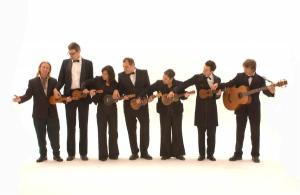
Last month, I mentioned that  the Ukulele Orchestra of Great Britain was releasing two new albums.  Our copies arrived last week, and Mrs Acilius and I can give them enthusiastically positive reviews. 

fidicula-inter-angelosThe Christmas album, referred to on their website as “Christmas with the Ukulele Orchestra of Great Britain” but labeled as Fiducula inter Angelos (“Miniature Lyres among the Angels,”)  does not after all include the performances they issued last year as a virtual album called “Never Mind the Reindeer.”  Those performances are still available on iTunes.   I do miss the rendition of “The Holly and the Ivy” from last year, but new tracks like the “Wenceslas Canticle” and a vocalese version of  “Winter Wonderland” more than make up for its absence.  Their “Jingle Bells Canticle” gets us (Mr & Mrs Acilius and the dogs) dancing every time we hear it.  Here’s ukulelehunt‘s review of the album. 

live-in-londonIn a comment on last month’s post, ukulelehunt’s proprietor Al Wood, a.k.a. Woodshed, gave it as his opinion that Live in London #1 is the UOGB’s best album yet.   I agree, though Mrs Acilius still leans toward Precious Little.  She plans to walk down the aisle to that album’s recording of “Finlandia” when we make the “Mrs” part official in May, so it has a sentimental importance to her.  Though when we listened to Live in London #1 and heard Hester Goodman’s rendering of “Teenage Dirtbag” as a ballad of adolescent lesbian angst, Mrs Acilius was so enthusiastic I wondered if she was about to suggest using that instead.  She assured me that her enthusiasm was strictly political, stemming from a conviction that sexual minorities need representation in music.  That she has a crush on Hester is purely by the way.  Here is an unflattering picture of Hester sitting next to George Hinchliffe that I could look at if I were in a jealous mood, which of course I never am.    

(more…)