Stuart Klawans lists 15 interesting movies that were released in 2010:
Carlos
A Prophet
Wild Grass
Life During Wartime
The Social Network
Inside Job
Last Train Home
The Illusionist
The Kids Are All Right
Lebanon
The Ghost Writer
Winter’s Bone
Never Let Me Go
Alice in Wonderland
Marwencol
The only one of these I’ve seen is The Ghost Writer. I’d rather not do business with Roman Polanski, but I couldn’t resist a movie that, in Klawans’ words, represents “a wickedly clever revenge fantasy directed against a British prime minister much like Tony Blair.” The only one I’m adding to our Netflix queue is Marwencol, since Klawans’ description of it is even less resistible:
Finally, in the category of odd, affecting little documentaries, perhaps the best of the year was Jeff Malmberg’s Marwencol. The title is the name of a Belgian town—an imaginary one, where it’s forever World War II—which Mark Hogancamp of Kingston, New York, painstakingly built at scale model using plastic dolls and hobby-shop materials. This project was his self-prescribed occupational and psychological therapy, after a severe beating outside a bar left him with neither memories nor normal motor functions. The film gradually reveals why Hogancamp was beaten, how he changed afterward and what became of his fantasy town; but best of all, Malmberg brings his camera right into the model, to show you a Marwencol as large and vivid as its creator needs it to be.
That sounds like the perfect movie for me; I love documentaries, I’m intrigued by creative miniatures, and a sizable portion of my imagination is permanently billeted in German-occupied Western Europe in 1942.
Klawans opens his column with the fact that Jafar Panahi, one of the world’s great filmmakers, is in prison on purely political charges. Klawans hopes that some demonstration on behalf of Panahi will be arranged at the Academy Awards, and that this will be helpful.
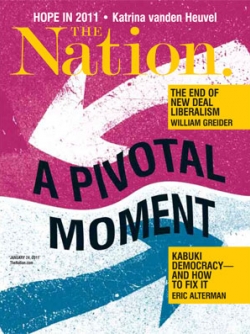
Elsewhere in the issue, William Greider decides that last year’s events prove that the New Deal and Great Society coalitions are thoroughly dead; Eric Alterman calls for institutional reform in US politics; Eric Foner points out that Barack Obama is one of a startlingly small number of African Americans in public office; James Ledbetter argues that Dwight Eisenhower was deeply influenced by articles that appeared in The Nation; and Patricia J. Williams outlines how the ostensibly individualistic policies of the American Right are designed to foster the rise of “a controlling class of the economically privileged- to wit, an oligarchy.”
YouTube user Religious Fiction considers a question that she has heard from many believers: If there is no God, why live? The question itself puzzles her, and she suggests that YouTubers should have a big conversation about it:
She says that no theist has ever explained to her “why living with the assumption that there is a God is so great.” She finds it “hard to imagine that there are gobs of theists out there who would honestly think that they have no reason to live if their assumptions and their doctrine just slipped a bit or maybe even had a profound change.”
It’s true that quite a lot of people do talk as if belief in God were the only thing that made life tolerable, and that it is quite strange of them to do so. Few people, after all, commit suicide, and most of those who do exhibit one of a very small number of psychological disorders. The idea of suicide may have a compelling power over many imaginations, but in terms of actual practice suicide is an eccentricity. When Albert Camus opens his Myth of Sisyphus with the claim that the only serious philosophical question is whether life is worth living, therefore, it is as if he had said that the only serious philosophical question is whether one ought to ride a unicycle.
That much said, does the frequency with which believers suggest that life would not be tolerable without their beliefs show that they are mentally ill? I say not. I think Thomas Fleming’s “Five Good Reasons Not to Be an Atheist,” discussed below, explain why a happy, well-adjusted person could believe that a loss of religious faith would mean a loss of the will to live.
I would focus on the third and fourth of Fleming’s five reasons. “Atheists have no religious calendars” and “Poor atheists… have no sacred spots.” These points show, first, that it is not as propositions that the doctrines of a religion have power for its adherents, but as narratives. The doctrines of a faith are a story in which the believer is given roles to play; the calendar is set of occasions on which the believer will enact those roles one by one, and will join with others as they play their own roles in the same story. The sacred narrative consecrates particular places, places where key events in the narrative have taken place or will take place. People can bond with each other as they share a relationship to these places. Thus, the sacred narrative gives structure to a believer’s experience of both time and space. Discard the sacred narrative, and we may choose between a life with no sense of narrative structure or the acceptance of a new master narrative to create a new sense of structure. “Life with no sense of narrative structure” sounds like a definition of clinical depression. If we experience life as just one thing after another, we may very well wonder what the point is of living. “The acceptance of a new master narrative,” on the other hand, sounds less like the outgrowing of illusions for which atheists strive than like a conversion from one religion to another.
The most interesting reply to ReligiousFiction’s invitation that I’ve seen is from QualiaSoup.
QualiaSoup usually does an excellent job explaining where arguments against a secular interpretation of physical phenomena go wrong; there’s a fine example here. Addressing this question, he proposes a master narrative about knowledge vindicating ignorance. Scientific advances and antiracist action make life worth living because they both represent blows against ignorance. QualiaSoup in fact takes on something of the character of a prophet when laying out this narrative. Indeed, he presents himself as a prophet who brings not peace, but a sword; his image of a family is a group of people divided by various dark lines, such as “prejudice” and “hate”; these lines cannot be erased until all submit together to the liberating power of knowledge. Otherwise, our prophet will set a man at variance with his father, and the daughter against her mother, and the daughter-in-law against her mother-in-law, and the enemies shall be of one household. He makes this point at greater length here.
Many commenters on QualiaSoup’s video say that people should be hurt if their relatives say that life would be intolerable without religious faith. I disagree with this position, for two reasons. First, it is through narrative that family relationships are defined. Two people may have common ancestors within living memory, and yet feel no kinship at all. Meanwhile, many people quite seriously regard pets with whom they have no common ancestor in the last 100,000,000 years as family members. Change the narrative you accept, and your relationships with others will change in ways that cannot be predicted.
Second, let us assume that some person (say, a man named Bob) does live simply for the sake of his or her family. Let us assume further that Bob lives in a society where it is a great advantage to be classified as “white,” and that the people Bob recognizes as close kin are all classified that way. How could Bob justify working to abolish that advantage? Indeed, if Bob considers his life worth living solely or chiefly because he wants to serve the interests of his family, would it not seem natural to him to lay down his life for the sake of perpetuating discrimination in favor of whites? I certainly agree that Bob ought to find value in his family and enjoy sharing his life with them, but unless he adopts a narrative that can sometimes override that value in the name of a broader kinship he will be doomed to support white supremacy.
Need an unstructured life be dismal? Certainly there are experiences that are pleasurable whether or not we see them as connected to any other experience. The physical satisfaction that follows a vigorous workout is pleasurable even if we never give a thought to the benefits it might have for our health; a successful sexual encounter is enjoyable even if it does not strengthen the bond between the partners; solving a problem brings a thrill even if that problem is not part of an important research program. To keep those self-contained pleasures fresh, however, we must continually increase our level of activity. For example, when I was in graduate school I was a postmodernist. The first few years I worked happily, convinced that what I was doing was of value because it was part of the postmodernist contribution to the study of ancient Greek and Latin. There came a time when I decided that postmodernism was a dead end. Rather than give up, I began to work much harder. I found that if I put in 100 hours a week, each piece of work I did still gave me a thrill, even though I no longer believed in the overall project that had once justified it. I couldn’t sustain that frenzied pace, but many do. And isn’t frenzied activity one of the worst problems our world faces? What is behind war, what is behind the destruction of our natural environment, if not people who have thrown themselves into ever-more frenzied activity rather than taking pleasure in the traditional rewards of life?
Irving Babbitt used to say that peace was a religious virtue. This was a bit of a paradox, since Babbitt himself was not all religious and not at all warlike. I think the paradox is resolvable, however. A sacred narrative, with its religious calendar and its holy places, gives its believers something steady and finite. If the world around them is at peace, they can find meaning and satisfaction without disrupting it. On the other hand, those who try to live without a sacred narrative cannot be still, regardless of the conditions in which they find themselves.
Racial theorist J. Philippe Rushton has gained notoriety for what blogger Steve Sailer has dubbed “Rushton’s Rule.” Sailer summarizes Rushton’s Rule in these words: “on a remarkably wide variety of physical, mental, and social measures, you find the African and East Asian averages at opposite ends, with the white average in the mediocre middle.” Rushton himself speculates that the first population to migrate from Africa and make a go of it in East Asia found itself in a much colder climate than had prevailed in Africa, while the first Europeans found average temperatures midway between those in Africa and those which confronted the first East Asians. Rushton appeals to adaptations would have enabled those early settlers to leave descendants outside Africa as an explanation for the statistical pattern he has described.
Be that as it may, references to Rushton’s Rule always leave me thinking about something else. If you keep getting the same answer, it’s probably because you are asking the same question. Granted that there is “a remarkably wide variety” to the measures which Rushton discusses, mightn’t he in fact have shown that there is an equally remarkable, if less obvious, uniformity to the tests that produce these results?
-The artist Philip Guston wrote “I believe it was John Cage who once told me, ‘When you start working, everybody is in your studio—the past, your friends, enemies, the art world, and above all, your own ideas—all are there. But as you continue painting, they start leaving, one by one, and you are left completely alone. Then, if you’re lucky, even you leave.” (Quoted in a book review by Barry Schwabsky)
-“WikiLeaks is revealing information citizens need to know—it’s a good thing. Assange may or may not have committed sex crimes according to Swedish law. Why is it so hard to hold those two ideas at once?” (Katha Pollitt)
Maybe Guston could have answered Pollitt’s question. When you start thinking politically, everybody is in the debate in your head- the past, our friends, enemies, the televised world, and above all, your own ideas about authority- all are there. But as you continue thinking, they start leaving, one by one, and you are left completely alone. Then, if you’re lucky, even you leave. Maybe an artwork takes on a personality of its own, independent of all those other personalities, and so too an understanding of politics takes on an independent personality too. Once you get to that point, Assange can be a villainous cad or an object of persecution or a bit of both, and the Wikileaks revelations can stand on their own regardless.
Paul Elmer More’s essay on Quaker poet John Greenleaf Whittier, mentioned below, quotes Whittier’s poem “The Meeting.” The poem is long, and not aimed at 21st century literary sensibilities. It begins with a long passage from a visitor who reproves Whittier for attending the silent meetings of Quakers, deprecating them as “dull rites of drowsy-head” and extolling the outdoors as the proper place to worship the God who created nature. In response, Whittier explains that wilderness is full of distractions, while the surroundings within the meetinghouse focus the mind on God. More was an excellent critic, and chose the perfect lines to quote:
But nature is not solitude:
She crowds us with her thronging wood;
Her many hands reach out to us,
Her many tongues are garrulous;
Perpetual riddles of surprise
She offers to our ears and eyes;
….
And so I find it well to come
For deeper rest to this still room,
For here the habit of the soul
Feels less the outer world’s control;
The strength of mutual purpose pleads
More earnestly our common needs;
And from the silence multiplied
By these still forms on either side,
The world that time and sense have known
Falls off and leaves us God alone.
I recommend the whole poem. Not least because the theme developed in my earlier post, that Quakerism tends to obscure the importance of habit in human life, is partially belied by Whittier’s lively interest in this topic.
J. David Hoeveler, who in 1977 published the indispensable book The New Humanism: A Critique of Modern America, 1900-1940, contributes to this issue of The American Conservativean article about one of the main subjects of that book, Irving Babbitt (1865-1933.) Babbitt, Paul Elmer More, and the other critics in the New Humanist group were identified as political and social conservatives in their own day, and it has been conservative intellectuals who have kept their names alive. Hoeveler argues that Babbitt would have been deeply uncomfortable with much that characterizes the right wing of today’s Republican Party. Hoeveler identifies four major strands in this movement, which he labels “imperialist conservatism,” “”populist conservatism,” “libertarian conservatism,” and “religious conservatism.” Since Babbitt was an outspoken opponent of all forms of military intervention the US undertook throughout his life, Hoeveler has an easy time showing that he would have been unlikely to support America’s ongoing current wars and level of military spending. Nor would the Babbitt whose main political concern was saving democracy by reconciling it to the “aristocratic principle” have found much to attract him in the populist right’s denunciation of “liberal elites.”
Hoeveler says surprisingly little about Babbitt’s likely attitude toward the libertarian right. To the extent that libertarians set up the unfettered operation of the market as an ideal, it should be clear that Babbitt would have opposed them. In the opening of Democracy and Leadership, Babbitt’s 1924 political magnum opus, he mentions that one hears that the future will be taken up with “the economic problem.” If so, Babbitt declares, “the future will be very superficial.” Though his political attitudes were certainly conservative, in some ways even reactionary, Babbitt was leery of capitalism. In social arrangements that separate economic activity from family relationships and community bonds, he saw a world grown cold and senseless. Babbitt would not have denied that the market was competent to allocate resources for efficient production, but would have argued that outside the limits of that sphere its judgments were meaningless. Seeing successful businessmen consulted as experts on education and public policy, Babbitt told an old French story about a butcher who suddenly found himself needing an attorney. When several lawyers offered their services, he evaluated them by the standards of his own profession and chose the fattest one.
Discussing the religious right, Hoeveler points out that Babbitt was very leery of their theological and political predecessors. Himself irreligious, Babbitt thought that religion was necessary for social control and the development of a high culture. However, he did not believe that all religious movements were equally capable of having these effects. Babbitt admired contemporary Confucianism, early Indian Buddhism, and later Massachusetts Puritanism, as traditions that inculcated self-discipline and rewarded intellectualism. The enthusiasms and eccentricities of Pentecostal and fundamentalist groups horrified him.
The American ConservativereprintsPresident Dwight Eisenhower’s 1961 Farewell Address, still famous for its warning against “the acquisition of unwarranted influence, whether sought or unsought, by the military-industrial complex.” In his commentary on the address, Michael Desch argues that Eisenhower was wrong to imply that economic interests drive America’s interventionism. In view of the amount of money that defense contractors annually collect from the US taxpayer and the number of people whose livelihood derives directly or indirectly from those contractors, Desch’s claim seems preposterous on its face. However, an article by Eamonn Fingleton elsewhere in the issue lends it a degree of plausibility. Fingleton’s article, “Empire is Bad Business,” documents the ways in which US militarists have actively lobbied foreign governments to give preferential treatment to Japanese exporters over American exporters as part of deals to keep US bases in Japan. Fingleton quotes trade economist Pat Choate: “Essentially we gave away our electronics industry in return for Japanese support in Vietnam. In any other country there would have been riots in the streets.” Fingleton makes a strong case that the masters of the permanent war economy have played a leading role in the hollowing out of American manufacturing. Thus, “military-industrial complex” is a misnomer. However, Eisenhower’s broader point might stand. American capitalists now pin their hopes of future profit on globalization, not on the development of any one country. In that sense, they have become a revolutionary class, alienated from national loyalties. The US military establishment is their militant wing, enforcing globalization.
Brian Doherty’s “Dignity Doesn’t Fly” has the subtitle “Peepshow scanners may not catch terrorists, but who says they’re supposed to?” Laying out the shortcomings of the Transportation Safety Administration’s plan to probe air passengers in intimate ways, Doherty says that “The TSA has created the perfect enemy for any bureaucracy: one that can never be defeated, that could be anyone, and that creates excuses to funnel money to favored interests until the end of time.” The worst aspect of the whole affair, for Doherty, is the apparent popularity of the TSA’s depredations. Among those who support the scans, “the TSA seems to have succeeded in constructing a new morality,” one in which personal dignity is of no value and the agents of the state are above judgment.
Chronicles, too, includes a piece about the TSA. While Doherty spends much of his piece demonstrating that the TSA’s scanners would not detect even the bombs that gave them the pretext to start using them, Chronicles‘ Douglas Wilson would oppose the scans even if everything the TSA and its apologists say were true. Wilson brings up the Third Amendment to the US Constitution, prohibiting the US from quartering soldiers in private homes. When that Amendment was passed in 1789, it represented a real limitation on the federal government’s ability to defend its citizens from invading armies. As such, it “was designed to interfere with national security.” It proves that the framers believed that the rights and dignity of citizens were more important than national security.
Also in Chronicles, Thomas Fleming offers “The Five Good Reasons” not to be an atheist. “Atheists have no god to worship” is number one; this is a good reason not to be an atheist, Fleming argues, because humans are generally inclined to worship something, and without gods they’ll only start worshipping other, worse things. Reason two: “They have no religion to practice.” That allegedly makes life dull, or did make it dull for Fleming when he was an atheist. Number three: “Atheists have no religious calendars.” This robs life of rhythm. Time is then just one thing after another. Fourth: “Poor atheists… have no sacred spots, no churches or shrines.” Atheist space is as featureless as atheist time. With no store of special stories to differentiate one place from another, atheists not only cannot value places as holy, but lose a means of bonding to each other as people who share relationships with those places. Fifth, atheists have no sacred texts. “Scriptures and even canonical literature, because they are sources of authority that lie beyond our own individual whims, discipline our minds and tastes and compel us to have a share in the common sense of our people.” Fleming and others in the Chronicles crowd often cite Irving Babbitt; this sentence of his could have come directly from any of Babbitt’s books.
All five of Fleming’s “Five Good Reasons” are summed up by Steve Martin:
The last page of each of these magazines is devoted to a column by Taki Theodoracopulos. They are not the same column. The difference between them shows the difference between the publications. For The American Conservative, Taki praises Kate Middleton, who is supposed to marry an English prince. Taki praises her for being lower-middle class, and therefore likely to have enough common sense to behave properly in her new role, unlike the feather-headed daughters of the aristocracy. Readers of The American Conservative might find this unvarnished class-stereotyping provocative, and Taki’s stories of his social life among the royals exciting.
When it comes to crossing the boundaries of political correctness, Chronicles readers are used to headier stuff. So his column in that magazine does not praise future princesses. Instead, he opens by mentioning that a man from Somalia was arrested in Oregon on terrorism charges, and goes on to ask “Why are Somalis, in particular, and Muslims, in general, allowed to immigrate over here?” That question in itself is fairly standard fare for the pages of Chronicles; most contributors to the magazine, however, would not have included some of Taki’s rhetorical flourishes, such as his reference to the man arrested in Oregon as “the subhuman- his surname is Mohamud, what else?” Talking with other readers of these two magazines, I sometimes complain about Taki and his obviously deliberate attempts to offend; uniformly, these readers say that they usually skip his page.
During our Christmas break, the Believer and I read the latest issue of the Quaker publication Friends Journal. I also read several books, among them the third volume of Paul Elmer More’s Shelburne Essays. The themes of this month’s issue of the magazine seemed to coincide in some interesting ways with the themes More explored in that 1905 collection.
Phil H. Gulley’s article on “The Meaning of Universalism” brings to mind two of More’s essays, the one on Quaker poet John Greenleaf Whittier, also the one on William Cowper. More argues that Cowper was the first English poet to make home life a major theme of poetry, and that Whittier was at his finest in exploring scenes of home. In that way, Gulley is a follower of Whittier, for his essay is strongest in its vivid scenes from his childhood home. Explaining his belief that there is no Hell, but an afterlife in which every human will proceed to salvation, Gulley tells of his parents insisting that he invite every child in the neighborhood to his eighth birthday party. From that point on, he couldn’t imagine that God would give a party and leave anyone uninvited.
In his essay on William Cowper, More connects the poet’s poor mental health to his fervent belief in Jean Calvin’s doctrine of Predestination. Calvin argued that the human will is powerless to accomplish anything of importance, certainly powerless to earn salvation, so that it is only by the free and arbitrary grace of God that some few souls, the Elect, are spared damnation. Of this doctrine, More writes:
Good Dr Holmes has somewhere written that it was only decent for a man who believed in this doctrine to go mad. Well, Cowper believed in it; there was no insulating pad of worldly indifference between his faith and his nerves, and he went mad.
The most obvious thing about this Universalism is that it is a form of Predestinarianism. It differs from Calvin’s doctrine only in expanding the number of the Elect to include all humans. I cannot see that one form of Predestinarianism should be radically healthier than another. Perhaps the belief that our actions on earth are of no importance to a kindly, indulgent God who can deny us nothing we might desire would lead to another set of delusions than those which would haunt believers in a doctrine that preaches that our actions are of no importance to a capricious, inscrutable God who will save or damn us without reason, but neither doctrine seems likely to inspire clear-headed realism.
If Gulley himself has kept his wits intact, I hasten to add, it is less likely because of an “insulating pad of worldly indifference” than it is a testament to the parents he commemorates so fondly. As it so happens, Gulley’s father Norm was a coworker and a good friend of my father’s, and I was an occasional visitor in the home where he grew up. My visits came after Phil Gulley had left for school, but I can confirm that they had created one of the most wholesome environments imaginable.
Another piece in the issue describes people who came from very different environments. In her “Teaching in a Culture of Poverty and Violence,” Stephanie Wilder describes her work as a teacher in a facility for juvenile offenders in Philadelphia who have been convicted of serious crimes. Some of these crimes are very serious indeed; the Believer and I both lost sleep after reading that “One of my students raped and brutally beat an 87-year-old woman. He waited for her daughter to arrive home and then did the same to her.” Wilder begins the next paragraph by acknowledging that “My students are unlikely to change. The recidivism rate in juvenile justice is over 90 percent.”
Wilder turns to an obvious question: “So why do I continue to work in juvie?” After saying that as a Quaker, she is “reminded to seek that of God in everyone,” Wilder goes on to say that “I have learned to let go of my attachment to outcomes.” She focuses on what she can control- her own behavior- not on her students’ behavior, which she can’t control. “The boys use the expression, ‘Don’t test my gangsta!’ It means, ‘Don’t push me so far that I lose control.’ I feel that my ‘gangsta’ is my Quaker beliefs and values in the face of anger and violence. I am sorely disappointed in myself when my gangsta is tested and I lose control and raise my voice or get disappointed.”
I’m sure Wilder’s basic point is sound- there is no point in focusing on other people’s behavior when all we can control is our own. It is possible to take this too far, however. Her presence in the classroom has an influence on the boys. All of the stories she tells make it sound like her students respond to her principled nonviolence and solicitous concern for that of God in them with unbounded contempt. If that is the case, then she may in fact be making it more likely that they will reoffend. If the face of the justice system is someone they regard as a joke, then it can hardly deter them from continuing with the lives of crime in which they have already become so deeply invested. As I reads the piece, I kept hoping that Wilder would describe some way that she found to use therapeutic methods based on the “Criminal Thinking” psychological model, or some other approach that has actually had success steering violent offenders away from their patterns.
A look back at the “Sokal hoax,” an event of the mid-90s that made it possible for me to stop studying Deconstructionism. (Michael Bérubé)*
“Etymology is perhaps the most intellectually frustrating field of study because, as a general rule, all clever theories about the origin of any word are wrong. The real explanation is always something boring and senseless, like “from a West Frisian word for turnip greens.”” (Sailer)**
In an interview about herself, Alison Bechdel says that when she was a child, pop culture images of women always emphasized their femininity, so that they were “not generic, they were always female people.” (Alison Bechdel)***

 Stuart Klawans lists 15 interesting movies that were released in 2010:

 acilius
 believer1
 lefalcon
 losthunderlads
 vthunderlad
 Panther Red