The Nation, 16 February 2009

16febnationGary Younge points out  that Barack Obama is in fact the President of the United States.  From this fact, he draws the conclusion that the time has come to put away the posters and other artwork endorsing him and get to work pressing him from the left, as others will surely do from the right.

Akiva Gottlieb reviews two novels by Bulgaria’s Angel Wagenstein, novels replete with heretical rabbis, lazy Nazis, and other exemplars of moral ambiguity.  The review opens with a reference to Joshua Cohen’s “Untitled: A Review,” from Cohen’s short-story collection The Quorum.  A reviewer finds on his doorstep a volume of six million crisp, white, blank pages.  He decides that this book is a history of the Holocaust, in fact “the only way to write about the event, the idea.” 

Eric Alterman takes on Rabbi Abraham Foxman and the Anti Defamation League of B’nai B’rith.  Alterman contends that “Anti-Defamation League” is a double misnomer for this organization.  He contends that it launches harsh attacks indiscriminately at all critics of Israel, attacks which less often counter defamation than they themselves amount to defamation; and that under Rabbi Foxman it is so much a one-man operation as hardly to qualify as a “league.”   

The editors endorse Tom Geoghegan for Congress.  (Others have done so since.)  Geoghegan has written for many publications regularly noted here.  A piece of his appeared in the final issue of The Baffler, for example, the only one that appeared after I started these notes

(more…)

The Nation, 9 February 2009

9febnationAlexander Cockburn quotes an interesting-sounding new book, Bad for Democracy: How the Presidency Undermines the Power of the People, by Dana Nelson.  Unfortunately, Nelson does not recommend abolishing the presidency.  She does have as set of proposals to reduce its power, and she exhorts her readers to find ways of participating in political life that do not involve voting or require fixing national attention on one man. 

This issue includes part one of “Adventures in Editing,” Ted Solotaroff’s recollections of his time as an associate editor of Commentary in the early 60s.  Anyone interested in writing will enjoy Solotaroff’s description of how he learned to do that job.  Anyone interested in narcissists will enjoy his description of how Norman Podhoretz behaved as the editor-in-chief of the magazine in those days.  One bit that sticks in my mind is near the end of the piece:

Shortly after I’d come to Commentary, I’d had a conversation with Norman about recruiting writers for the magazine. It didn’t seem to me such a big deal; I said I knew of four or five people at the University of Chicago alone who could write for Commentary.

“You think you do, but you don’t,” said Norman. “You don’t realize how unusual you were for an academic.”

I said I wasn’t that unusual: I’d lucked into an opportunity my friends hadn’t had. “I’ll bet you a dinner that I can bring five writers you’ve never heard of into the magazine in the next year.”

“I don’t want to take your money,” he said. “I’ll bet you won’t bring three.”

We turned out to both be right. With one exception, the novelist Thomas Rogers, none of the former colleagues I had in mind sent in a review or piece that was lively enough to be accepted. A former fellow graduate student, Elizabeth Tornquist, who was turning to political journalism, also managed to crack the barrier. The others had fallen into one or another mode of scholarly dullness or pedagogical authority and, despite my suggestions, had trouble climbing out to address the common reader. My efforts to point their prose and sense of subject in a broader direction brought little joy to either party. “How dare you revise my formulation of an intellectual problem” was a fairly typical reaction.

Which may explain why so few “little magazines” really make it. It certainly explains why someone Podhoretz was needed to make Commentary into the magazine it was.  Only someone who didn’t mind losing friends could edit their work as mercilessly as was necessary to make a periodical worth reading and talking about; only someone who didn’t mind sucking up to the rich and famous could raise the money and generate the publicity necessary to keep it afloat.

The Nation, 2 February 2009

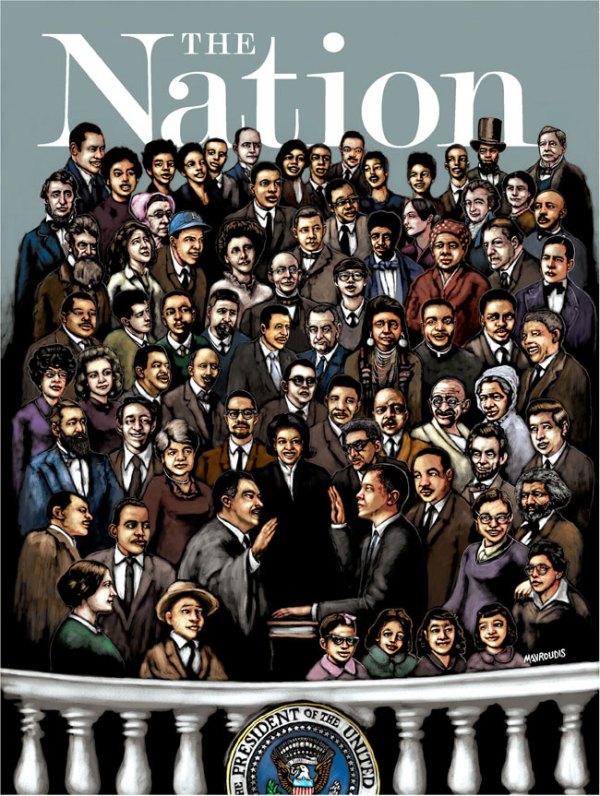
Click on the image to see who's who

Click on the image to see who's who

Several articles about Barack Obama and what he should do, now that all the historical figures pictured on the cover are watching him. 

A review of a new biography of George Plimpton makes me want not only to look at that book, but also to read some of Plimpton’s own writings, notably Shadow Box, Paper Lion, and Edie

The preacher who delivered the invocation at Mr O’s inauguration, Rick Warren, represented a disappointment to those advocates of the rights of sexual minorities who had done so much to support Mr O when he was seeking the nomination.  Jon Wiener points out that Warren’s clout is so far reaching that the US Senate in 2002 voted unanimously for a bill to relieve him of the necessity to pay federal income tax.  The bill was specifically craftedto nullify an ongoing suit against Warren for tax evasion.  The key parts of the bill appear to apply to Warren, and only to Warren.  If Rick Warren has that kind of power, no wonder  Mr O thought he could gain by favoring him over some of his most important supporters. 

On a happier note, we read about Julius Genachowski, an old friend whom Mr O has named to head the Federal Communications Commission.  John Nichols assures us that Genachowski sees the main question in media policy as the question of democracy.  Committed to the promotion of “openness, free speech, competition, innovation, access, economic growth, and consumer welfare,” Genachowski will be in a position to strengthen America’s democratic institutions.

The Nation, 26 January 2009

26-jan-nationEric Foner finds much to praise in Abraham Lincoln, chiefly his “capacity for growth” and his belief that “there was a bedrock principle of equality that transcended race- theequal right to the fruits of one’s labor.”  Foner dwells on the Second Inaugural, asking us to imagine the moral courage it must have required for Lincoln to name the evil at the heart of the Civil War not as Southern treason, but as “American slavery.”  The famous passage saying that we must acquiesce in God’s will to punish us for that sin even if  “all the wealth piled by the bondman’s two hundred and fifty years of unrequited toil shall be sunk, and until every drop of blood drawn with the lash shall be paid by another drawn by the sword” raises Foner’s special approbation.  “In essence, Lincoln was asking Americans to confront unblinkingly the legacy of bondage and to think about the requirements of justice.”

Two other pieces deal with the relationship between modern institutions and the ancient past.  Britt Peterson‘s  review of several books about looted work from southwest Asia and southeast Europe that has made its way into museums around the world begins with a story that raises a basic question.  In 1995, the Metropolitan Museum of Art in New York was forced to send acollection known as”the Lydian hoard” to Turkey, since the artifacts had been stolen from sites in that country.  However, the Turks had not yet come to Turkey when those artifacts were produced in the seventh and sixth centuries BC.  Therefore, the artifacts are not especially interesting to nationalist-minded Turks.  They are now housed in a small museum in the town of Usak.  This museum receives barely 100 visitors a year, fewer than the exhibit used to recieve in a typical  hour at the Met.  Some pieces have been stolen and replaced with obvious copies.  Do the artifacts have a value intrinsic to themselves?  Or is their worth a function of the use we make of them and the concern we have for them?  If the latter is the case, then what, exactly, was stolen from the Turks when the Hoard was originally looted? 

Anthony Grafton’s review of the recently published correspondence of Gershon Scholem and Morton Smith revolves around the question of whether Morton Smith’s greatest claim to fame was a forgery.  In 1973, Morton Smith published a document that he claimed to have discovered fifteen years before.  This Greek manuscript, apparently written in the eighteenth century, Morton Smith identified as a copy of a second century letter from one of the fathers of the church, Clement of Alexandria.  The letter consisted of a complaint that a group of heretics were giving Christianity a bad name by following practices outlined in a text they called “the secret gospel of Mark.”  The letter allows that there was in fact a secret gospel of Mark, which added to the canonical gospel stories about Jesus initiating select followers into mysterious kinds of knowledge.  The heretics, the letter claims, have taken this secret gospel and added even more to it.  In fact, they claimed that Christians were exempt from all moral laws and could find salvation by committing sins.  Their favorite sins seems to have involved homosexual behavior, and their version of “secret Mark” seems to have suggested that Jesus also had a fondness for such behavior. 

As soon as Morton Smith published the letter, there was suspicion that it was a forgery.   Red flags went up when it was noticed that every single word in the letter appears somewhere else in the extant works of Clement of Alexandria.  Students preparing assignments for ancient Greek and Latin prose composition classes have traditionally been required to imitate the style of one or another ancient author.  Those students will typically draw their vocabulary from lists of words their model used.  But of course the author himself would not have had such a list in front of him. Writing in his native language, he would have been at liberty to use whatever word seemed best to him.  Indeed, no ancient text of any substance consists exclusively of words the author uses elsewhere.  The fact that this letter does makes it look more like the work of an outstanding Greek prose comp student, which Morton Smith was, than like a genuine ancient text.  As a clincher, a writer named Stephen Carlson pointed out that a reference to the packaging of salt in “Clement’s” letter makes no sense in the context of ancient practices, but is intelligible only in light of the anti-clumping process patented in 1910 by the Morton Salt Company.  Thus, Morton Smith may have signed his work.

UPDATE:  It’s in this issue that Stuart Klawans praises Silent Light, Carlos Reygadas’ film about Mennonites in Mexico, and delivers one-paragraph slams against Oscar contenders The Curious Case of Benjamin Button, Slumdog Millionaire, The Reader, Revolutionary Road, and Doubt.   I’ve seen Doubt and liked it, but his description is as funny as it is unfair:

Doubt: It was a dark and stormy night in American Catholicism, when Sister Meryl Streep and Father Philip Seymour Hoffman settled in for 104 minutes of shouting at each other. Co-starring Amy Adams as the sweetest young nun in the parish–a role I’d be happy to see her play, if John Waters were the director. Maybe in the new year.

William Eggleston

From "Cadillac"

From "Cadillac"

The only thing I wanted to note about the January 12/19 issue of The Nation was a review of an exhibition of photographs by William Eggleston.  So here are some photos by Eggleston, courtesy of The Eggleston Trust.

From "Southern Suite"

From "Southern Suite"

The Nation, 5 January 2009

nation-5-jan

A few things stand out in this issue.  Two pieces by A. C. Thompson, the cover story with a general focus and another about one particular case, detail acts of violence committed in the aftermath of Hurricane Katrina by groups of white homeowners who banded together to keep blacks out of their neighborhoods. 

On a happier note, Katha Pollitt offers her annual list of do-gooders who deserve our financial support.  Each of the ten she cites sounds terrific, I’d single out Iraq Veterans Against the War as the group with the most urgent agenda. 

A collection of poems by the late Jack Spicer includes some love letters Spicer wrote, an editorial decision which moves the reviewer to comment on Spicer’s views about the relationship between poetry and correspondence.  While Spicer often compared poems to personal correspondence, and “the idea or form of the letter underlies much of his published work,” in practice he always maintained a sharp distinction between the two genres.  “What Spicer recognized as poetry was always fierce and contentious and, despite the devices that feign otherwise, written to no one and for no one. ”  Indeed, Spicer’s discussion of Emily Dickinson centered on the difficulty of distinguishing between letters and poems, taking it for granted that this distinction was a needful one.

(more…)

The Nation, 29 December 2008

nation-29-decIn this issue, Patricia Williams rakes up one of the celebrities made by Campaign 2008, claiming that in the gap between the actual Sam Wurtzelbacher and the imaginary Joe the Plumber lies the deadliest part of the American Dream.  Joe the Plumber is a man who labors ceaselessly, gets his hands dirty, is looked down on by the people who rule the country, and earns over $250,000 annually.  Sam the non-Plumber is a man who labors ceaselessly, gets his hands dirty, is looked down on the people who rule the country, and can barely pay his bills from month to month.  Americans work the longest hours and enjoy the fewest social protections of any industrialized population.  The “Joe the Plumber” story is the myth that keeps us from supporting reforms that would help us get rid of this system. 

An editorial urges readers to support Stanford University Professor Linda Darling-Hammond for US Secretary of Education.  Currently head of President-elect Obama’s working group on education policy, Darling-Hammond is identified with a group of educational thinkers whom The New York Times calls “professionalization advocates, ” believers in the idea that “the policy emphasis should be on raising student achievement by helping teachers improve their instruction.”  The school of thought which opposes the professionalization advocates, and which has in fact claimed a virtual monopoly on the title of “education reformers” in recent years,  are called “efficiency hawks,” who want ever more emphasis on standardized tests and centralized bureaucratic control of schools.  The editorial starts with an irresistible quote from Darling-Hammond: “If we taught babies to talk as most skills are taught in school, they would memorize lists of sounds in a predetermined order and practice them alone in a closet.”

A short piece details anti-Russian bias at the Washington Post.  There’s also a review of a couple of new slang dictionaries.

The Nation, 22 December 2008

morandi_02_l1

Giorgio Morandi, Natura Morta, 1916

It’s usually the reviews that feature most prominently in my notes about The Nation.  That’s because the notes are about things I might want to look up again, and The Nation‘s articles and columns are usually of strictly timely interest.  This week’s issue is no exception.

In this issue, Arthur Danto reviews a retrospective of Giorgio Morandi‘s paintings currently showing at the Metropolitan Museum of Art.  I’ve always had a fondness for Morandi’s subdued color schemes and restricted perspective.   Danto claims that the objects in Morandi’s still lifes seem much more active than is typical for the genre; sometimes they seem “to interact and jostle” as if competing for space on the table.  He cites this 1961 painting as an especially crowded one.  He may be onto something; for example, this 1914 piece does seem to point forward to the Futurists.  But more often when I look at Morandi I see pictures like the one I’ve posted here, quiet images that neither call out for attention with flash nor resist the viewer with trickery, but, rather, allow those who are so minded to take whatever look they wish.   

Throughout a review of a reissue of Lionel Trilling’s The Liberal Imagination runs the question of what it might mean for literature to have, as Trilling always insisted it should have, a serious moral purpose.  Trilling tries to answer the question with a remark about The Adventures of Huckleberry Finn, an answer the reviewer finds unsatisfactory:

“No one who reads thoughtfully the dialectic of Huck’s great moral crisis will ever again be wholly able to accept without some question and some irony the assumptions of the respectable morality by which he lives, nor will ever again be certain that what he considers the clear dictates of moral reason are not merely the engrained customary beliefs of his time and place.” One response to this might be to say that anyone capable of this kind of “thoughtful” reading is not likely to be a prisoner of social convention in the first place, and vice versa. The passage risks both patronizing the imagined reader and imputing an unrealistic power to Twain’s book. In such passages, the adjective “moral” appears overworked, now indicating the merely conventional social codes, now referring to the wider human vision offered by the critic.

A fair criticism, one must admit.  Humanists from Plato on would have to plead guilty to the charges the reviewer levels against Trilling here. 

Elsewhere in the issue, Katha Pollitt quotes New York University historian Linda Gordon, a founder of Feminists for Obama, calling on feminists to keep up pressure on Mr O, since that’s what their opponents will be doing.  She also quotes an op-ed by economist Randy Albelda calling for increased investment in health, education, eldercare, and other industries that employ many women as part of any economic stimulus plan.  Alexander Cockburn points out that in the aftermath of the Mumbai shootings, several top Indian officials were driven from office in disgrace, a stark contrast with the failure of any senior American to so much as admit error in the aftermath of 9/11.  Stuart Klawans reviews recent films Milk, Australia, and Wendy and Lucy.

The Nation, 15 December 2008

nation-15-dec-08Highlights of this issue include a review of Passionate Uprisings: Iran’s Sexual Revolution, a study of sexual behavior among well-to-do young heterosexual Tehranis by Iranian-American anthropologist Pardis Mahdavi.  In the course of extensive field work, Professor Mahdavi discovered that worries older Iranians routinely express about risky sexual behavior among the young are quite well-founded, at least as regards the population she studied.  Group sex seems to be common.  Evidently repressive laws against premarital sex, enforced ignorance of birth control and STDs, and an intensely patriarchal family structure don’t guarantee universal chastity after all.  Who knew?  The reviewer, Laura Secor, wishes for further studies that would systematically compare the experiences of Iranians of different social classes, sexual identities, and geographical locations.  With that kind of research, we might be able to figure out what if anything this risky behavior means for Iranian politics.  Of course, a study like that would be unlikely to take place in today’s Iran.  To illustrate the difficulty, Secor begins her review by quoting Mahdavi’s meeting with an Iranian sex ed teacher who could not understand why her students were reluctant to tell her about their sex lives.  The woman was wearing a double hijab that gave her such an imposingly traditional appearance that even Professor Mahdavi became self-conscious.    

William Greider points out that New York Federal Reserve chief Timothy Geithner, President-elect Obama’s pick to be the new treasury secretary, was the negotiator who worked out many of the worst parts of the Wall Street bailout; Greider frets that Mr O may go down in history as the man responsible for the economic meltdown if he doesn’t withdraw Geithner’s name and rethink his approach to the crisis.

The Nation, 8 December 2008

The Fall Books Issue“- it seems a bit late this year… but worth the wait.

Torie Osborn wonders how California could have passed anti-same sex marriage Proposition 8.  Her view is that No on 8 forces neglected Los Angeles County, despite decades of experience showing that antigay measures win or lose based on the margins in that county.  She also has some harsh words for the Obama campaign for allowing voters to believe (mistakenly!) that Mr O backed Proposition 8. 

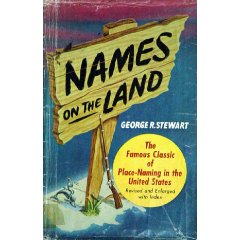
Christine Smallwood reviews a new edition of George R. Stewart’s 1945 book Names on the Land.  A collection of anecdotes about how various places in the USA got their names, this highly regarded work inspires Smallwood’s unreserved praise.  She goes on at some length about Stewart’s other works, including environmental fiction like Earth Abides, “the first American postapocalyptic thriller,” and Ordeal by Hunger, a novelization of the Donner Party.  She tells us that Names on the Land was Stewart’s own favorite of his books.  It raises no less a question than “what is America?,” Smallwood says.  And answers that question: “Not the leader of the Free World and not the scourge of the world, but a history of settlement.”  This answer would hardly have been extraordinary in 1945.  The book does sound interesting.   The cover of the first edition illustrates Smallwood’s review, and is reproduced below.

0189b2c008a04d1d62183010__aa240__l

(more…)