The Nation, 27 April 2009

nation-27-april-2009Classicist Emily Wilson reviews Anne Carson‘s An Oresteia.  Carson translates Aeschylus’ Agamemnon, Sophocles’ Electra, and Euripides’ Orestes to make a trilogy that not only tells why the legendary prince Orestes killed his mother Clytemnestra and what consequences that matricide had in their world, but a trilogy that also suggests how the moral ideas of the Athenians might have changed in response to the social and political crises of the fifth century BC.  

Aeschylus’ Agamemnon was produced in 458 BC, when Athens’ empire was at its zenith and its form of democracy seemed infinitely adaptable to whatever challenges the future might present.  In the Agamemnon, Aeschylus puts the motivations of the gods and of humans on display together, suggesting that while each may be temporarily obscure, nonetheless both can ultimately become transparent.   When Clytemnestra kills her husband Agamemnon, her children inherit from their father the responsibility to avenge him by killing their mother.  Faced with this horrifying duty, Orestes and his sister Electra seem as though they may have been plunged into an incomprehensible moral universe.  Yet democracy, Athenian democracy, will settle the matter and allow the survivors of the cycle of violence to reason together once more.   Orestes will ultimately appear before Athens’ Areopagus Council, which will sit in judgment of his case and reach a verdict that even the Furies themselves must accept. 

Sophocles’ Electra dates from a time much later than that of Aeschylus’ play, probably the last decade of the fifth century.  By that time, Athens had been embroiled in the Peloponnesian Wars for a generation.  Isolated in mainland Greece, Athens had suffered heavy defeats in one theater after another.  To many Athenians, it seemed that the war had discredited democracy.  Not only had the war the people voted to enter brought Athens actual disaster and likely destruction, but the heaviest of all Athens’ losses were suffered in a war with another radical democracy, Syracuse.  In 411, Sophocles himself would figure prominently in a move to scrap democracy and institute a government by an oligarchic group known as “the Four Hundred.”  The Four Hundred didn’t last long, but the optimism of Aeschylus’ day would never be possible to the Athenians again.  Accordingly, Sophocles’ view is darker Aeschylus’.  Wilson says that for Sophocles, “the will of the gods is hard to interpret, and the focus of the play is on the turbulent feelings of human characters and the contradictory narratives they create to serve their advantage.”  For my part, I think it would be better to say that for Sophocles, the gods are not on display- we may be visible to them, but they are never truly visible to us.  We can understand only his human characters, and then only by discovering the ways in which they have deceived themselves.  Wilson writes that “The play is disturbing in both its emphasis on desperate grief and the suggestion that the only cure for such pain is retribution reaped with scams and lies. Unlike in Aeschylus, there is no hope of a political solution.” 

Orestes, produced in 408, is in some ways Euripides’ strangest play, and Wilson labels it the darkest of the three Carson has chosen.  Euripides is closer to Aeschylus than to Sophocles in his belief that the motivations of gods and humans are intelligible, but unlike them in his doubt that understanding those motivations will bring us any closer to a world that we can judge fairly.  (more…)

The Nation, 20 April 2009

nation-20-april

Businessman Leo Hindery and former US Senator Donald Riegle write a proposal for “The Jobs Solution” to our country’s current economic woes.  Point 3 reads:

Concrete efforts to restore the essential tax-policy link between productivity growth and wage gains, which will almost surely mean adopting a value-added tax of the sort nearly every other developed country already has.

The Value Added Tax seems to be showing up everywhere these days; I’m starting to lean prettily heavily in favor of the idea of abolishing the corporate income tax and payroll taxes and replacing them with an American version of VAT. 

Stuart Klawans reviews a movie that our own LeFalcon and VThunderlad seem to find infinitely fascinating, Watchmen.   To be precise, the headline of his column lists Watchmen as one of the movies he will review, but what he actually does is open with a few paragraphs satirizing the disillusioned tough-guy prose style that apparently characterizes the Watchmen franchise, then tell a story about how he was shown the wrong movie at the critics’ preview.  The high point of this story comes when he claims that he thought he was seeing one of the most discussed visuals from Watchmen, that is, the long blue penis of a character who is naked throughout the movie, only to realize that his eyes were playing tricks on him:

The movie starts. Immediately, I see the blue penis, and the special effects are staggering. It walks on its own. It speaks. I suddenly realize it is Clive Owen, clean-shaven for a change, striding up to inspect Julia Roberts’s cleavage at a garden party. This is not Watchmen. It is Duplicity.

(more…)

The Nation, 13 April 2009

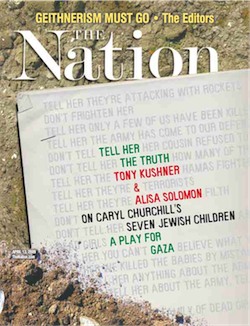
nation-13-april-09Tony Kushner and Alisa Solomon review Caryl Churchill‘s new play, Tell Her the Truth, which tells the history of the Arab-Israeli conflict in ten minutes.  “Why is the play so short?  Probably because Churchill means to slap us out of our rehearsed arguments to look at the immediate human crisis.”  Churchill cares about what human beings are doing to each other and how they justify what they have done to themselves and to each other, especially in the justifications parents give their children.  Tell Her the Truth consists of a series of lines giving the parents of seven unseen Jewish children advice as to what they should tell those children about various historical acts of violence, some committed against Jews in the name of antisemitism, some committed by Jews in the name of Zionism. 

Tell Her the Truth, like every publication critical of Israeli policy, has attracted charges of antisemitism; much of the case against it apparently hinges on a line that does not appear in the play.  Some have claimed that the play raises the spectre of “blood libel,” the old idea that Jews ritually murder Gentile children.  “Those who level the blood-libel accusation insist that Churchill has written “tell her I’m happy when I see their children covered in blood.””  What she actually wrote was quite different: “tell her I look at one of their children covered in blood and what do I feel? tell her all I feel is happy it’s not her.”  Kushner and Solomon interpret the real line thusly: “The last line of the monologue is clearly a warning: you can’t protect your children by being indifferent to the children of others.”

(more…)

The Nation, 6 April 2009

nation-6-april-2009Lorna Fox Scott reviews the new Library of America volume True Crime: An American Anthology, edited by Harold Schechter.  She quotes Americans who have tried to explain acts of extreme violence that their countrymen have committed.  Cotton Mather could say that acts of violence were symptoms of irreligion.  But what would Mather have made of a case like this?

Farmer Yates, who in 1781, as he tells his examiners in what reads like an uncensored transcript, is suddenly commanded by an unidentified “Spirit” to slaughter his beloved family for being “idols”? Vividly reliving the inner struggle of human love with mystic duty, in between enthusiastic pursuits of the victims through the snow, this text stands out as the only perpetrator’s narrative in the collection; its anonymous presenter cannot in the end decide whether Yates was stricken by “the effect of insanity” or “a strong delusion of Satan.” The old certainties are fraying.

Ambrose Bierce was less interested in explaining why people commit acts of extreme violence then in pointing out the glee with which the public receives accounts of those acts:

His “Criminal Market Review” from the late 1860s is unusual for its admission that crime is not so much a deviation as the very image of the national economy: “Robberies are looking up; Assaults, active; Forgeries, dull.” Taking a swipe at the veiled Californian relish in violence–“Our joy at the mutilation of old Hulton has been deeply unspeakable; our lively interest in the shooting and hacking of and by the Dudleys, Ingham and Miller, has been testified in a novel and interesting manner by a private scalp dance at our own apartments”–Bierce links this to the war. “It pleasantly reminds us of the time when we were a soldier.” Then, like Twain satirizing the social worship of “blackguards”: “Yosemite is a conceded fiction, and the Big Trees a screaming joke…. But we are handy with the pistol and wield a butcher-knife as deftly as an Indian or anybody.”

Twentieth century writing has shown new forms of self-consciousness.  Edna Ferber’s comments on the trial of Richard Bruno Hauptmann include not only scorn for the gawking crowd but sympathy for the accused murderer; Zora Neale Hurston’s reports on the trial of Ruby McCollum, a black woman accused of shooting a white physician, show the defendant and the crime lost to public awareness as black and white act out the rituals of race. 

Fox quotes a haunting conversation that occurred in 1949.  A man had gunned down a dozen people on the street in his New Jersey neighborhood, then gone home.  The phone rang.  He answered it.  Calling was a reporter from The Camden Evening Courier

Mr. Buxton asked how many persons Unruh had killed.
 The veteran answered. “I don’t know. I haven’t counted. Looks like a pretty good score.”
  “Why are you killing people?”
  “I don’t know,” came the frank answer. “I can’t answer that yet. I’ll have to talk to you later. I’m too busy now.”

(more…)

The Nation, 30 March 2009

nation-30-march-2009A review of The Politics of Truth: Selected Writings of C. Wright Mills mentions  Mills’ concept of “crackpot realism,” introduced in his Causes of World War Three to explain how a group of highly intelligent people could come to believe that each step in a course of action certain to lead to their destruction was the safest, most prudent one possible.  Mills feared that “citizenship was obsolete”; “Modern society made freedom in the liberal sense of autonomous and reflective citizenship increasingly impossible.” 

The new Library of America volume The Lincoln Anthology: Great Writers on his Life and Legacy from 1860 to  Now draws  a review titled “Sallow, Queer, and Sagacious.”  Dissenters from the celebration of Abraham Lincoln as America’s great secular saint are well represented in the volume.  Among them are Edmund Wilson, whose portrait of the sixteenth president in 1962’s Patriotic Gore has reminded more than one critic of Stalin, and Lerone Bennett Jr, who since the 1960s has been arguing that Lincoln was no friend to black America.

The Nation, 23 March 2009

Photographer Walker Evans collected picture postcards, and the Metropolitan Museum of Art is exhibiting them.  Here’s one:

walkerevans_12_el

Evidently Calvin Trillin reads Los Thunderlads.  Here’s the first half of this week’s doggerel:

Republicans had hoped they might rekindle
Their party’s prospects through one Bobby Jindal.
But Jindal proved an easy man to mock
(He’s like the dorky page on 30 Rock).

Below find an excerpt from an article headlined “America is #… 15?” by Dalton Conley.  23-march-2009-nationThe article is about the Human Development Index, or HDI, a statistic that has since 1990 been used to gauge the relative well-being of people in various countries.  The American HDI was released for the first time last year.  As the article puts it, “The score consists of three dimensions: health, as measured by life expectancy at birth; access to knowledge, captured by educational enrollment and attainment; and income, as reflected by median earnings for the working-age population.”  The HDI was first developed by Pakistani economist Mahbub ul Haq to enable humanitarian aid groups and development economists to gauge the relative well-being of people in poor countries.  “With some slight adjustments, the index was retrofitted to work for rich countries,” and the results for the USA are quite disturbing. 

(more…)

The Nation, 16 March 2009

nation-16-marchFrances Richard reviews recent books about the nature of photography, citing along the way several not-so-recent but extremely interesting titles.  Among these is Downcast Eyes by Martin Jay, a study of twentieth century French thinkers who have argued that vision is overrated.  Also, Michael Fried’s 1967 essay “Art and Objecthood,” in which he introduced the idea that he’s been working on ever since, that we change people and situations when we make them objects of vision and that it is dishonest of us to pretend that our making images and looking at them is an innocent activity that has no effect on anyone or anything else.   

A review of Steven Shapin’s The Scientific Life: A Moral History of a Late Modern Vocation focuses on the influence of corporate money on scientific research.  The reviewer holds that this is the most important question Shapin ought to have addressed in his history of the last few decades of science, and that it is a question he takes far too lightly. 

Gary Younge argues that only an energized Left can turn the populist impulses that the current global economic crisis has spawned into something constructive.   “The last time things looked this bad globally, we ended up with Nazism, fascism and war,” Younge points out, claiming that today’s right-wing populists are little better than their counterparts of the period after the Great War.  The most memorable part of Younge’s column for me was the story at the beginning:

When I was a student in the Soviet Union, during Gorbachev’s final months, my landlady used to take the dog out for a walk at the same time every night. Since it was winter and I am no dog lover, I decided not to join her. But when the weather cleared up I once accompanied her and found that she met several other local dog owners at exactly the same time. The timing, it turned out, was no coincidence. They called it Dog Hour–the moment when the state-sponsored news program RUSSIA-VOTEVremya came on, and they therefore left the house.


Following the news over the past few months, I have felt like taking a quick walk around the block myself. Watching global capitalism disintegrate in real time is a dizzying experience.

The Nation, 9 March 2009

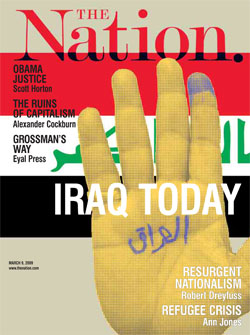
nation-9-march-2009Robert Dreyfuss looks at the regional elections held in Iraq on 31 January and finds good news.  A new alliance of Shi’a and Sunni groups is beginning to operate in Iraqi politics.  Soon, Dreyfuss hopes, this alliance will be strong enough to present itself as a genuinely nationalist bloc and to insist on an end to the US occupation. 

No such development is in sight in Afghanistan.  An editorial expresses the fear that the Obama plan to send more US troops to that country will make “Bush’s War” into Mr O’s very own. 

Katha Pollitt speaks up for free speech.   On the twentieth anniversary of the Ayatollah Khomeini’s fatwah against Salman Rushdie, she finds fault with fellow leftists whose only response to violent behavior by Muslims who have taken offense at speech labeled anti-Islamic is to “see these incidents as gratuitous provocations by insensitive Westerners” and to support restrictions on speech that amount to blasphemy laws.  She grants that many of the incidents that have generated violent responses in the Muslim world have indeed been gratuitous provocations by insensitive Westerners, and is happy to list extremists from other religious groups whose conduct has been every bit as deplorable as the worst we have seen from Khomeini and his coreligionists.  But:

Appeals to the hurt feelings of religious people are just a dodge to protect the antidemocratic and retrograde policies of religious states and organizations. We’re all adults; we have to live with unwelcome expression every day. What’s so special about religion that it should be uniquely cocooned? After all, nobody at the UN is suggesting that atheists should be protected from offense–let alone women, gays, leftists or other targets popular with the faithful. What about our feelings? How can it be logical to say that women can’t point out sexism in the Bible or the Koran but clerics can use those texts to declare women inferior, unclean and in need of male control? And what about all the abuses religions heap on one another as an integral part of their “faith”?

An essay about Israeli novelist David Grossman of course concerns itself chiefly with Grossman’s insights into the Israeli/ Palestinian conflict.  What sticks with me from the essay is this quote from Grossman about writing:

[Y]ears ago, reflecting on a story he was writing that featured a bitter, emotionally unstable protagonist, he described his desire to have the tale surprise him. “More than that, I want it to actually betray me,” he wrote.

To drag me by the hair, absolutely against my will, into the places that are most dangerous and most frightening for me. I want it to destabilize and dissolve all the comfortable defenses of my life. It must deconstruct me, my relations with my children, my wife, and my parents; with my country, with the society I live in, with my language.

The Nation, 2 March 2009

nation-2-march-09A review of several new books from and about Iran mentions the thinker Jalal Al-e Ahmad and his concept of gharbzadegi, or “intoxication with all things western”  The reviewer assures us that this concept represents “one of the most influential critiques of the West.”  In fact, he takes issue with some of the books under review for failing to presuming to discuss twentieth-century Iranian intellectual life, yet failing to mention the presence in that life of so towering a figure as Al-e-Ahmad.  Since I’d never heard of Al-e-Ahmad or gharbzadegi, I thought I’d better make a note of this.  So here are links to the Wikipedia articles about Al-e-Ahmad and gharbzadegi

An interview with astrophysicist Adam Frank focuses on Frank’s religious ideas.  Frank’s big idea seems to be that religious systems give us a way of processing and talking about emotions like awe and wonder that come upon us when we notice the scope and orderliness of natural phenomena.  Frank shows his Astronomy 101 class a TV documentary about the origin of the universe, then asks them what they think of the music.  His point is that the documentarians are packaging the Big Bang as a creation myth.  Frank does not mean this as a condemnation of the show- on the contrary, he embraces this myth-making.  Frank’s attitude reminds me of an idea I mentioned here a few days ago.  I’ve long thought there was a great deal to be said about the relationship of scientific theories about the origin of the universe to traditional creation myths.

The Nation, 23 February 2009

23febnationStuart Klawans reviews three new films, Gomorrah, The Class, and CoralineGomorrah, he assures us, is not merely a hyper-violent Italian gangster movie, but a critique of globalization, a portrait of “what the world looks like when it has been remade by gangsters.”  As a teacher myself, I was intrigued by Klawans’ description of The Class.  Evidently the film depicts two hours in the life of a grammar and composition class in a French public school, taught by a man with a daring,  aggressive technique.  “François has no fear of sharp distinctions. His pedagogical method is to push his students and then to shove, so that he’s always on the verge of going too far with them–or finally steps over the line.”  Coraline is evidently a reimagining of Kafka’s “In the Penal Colony.”  While the story centers on a son’s obscure sense that his father has rejected him, the main action of the film begins with a girl openly rejecting her parents and leads her toward the same kind of destruction as Kafka’s character had witnessed.   

Richard R. John explains how recent changes in rates and policies at the US Postal Service have rewarded mass-circulation magazines and penalized low-circulation magazines.  A look at the subcategories under “Periodical Notes” will show that this is a matter of vital concern to your humble correspondent.  (more…)