The Nation, 5 October 2009

nation 5 october 2009We take sexual violence seriously here at Los Thunderlads, and so welcome the first installment of The Nation‘s investigation of sex trafficking and of what’s being done in the name of stopping it.  The first part looks at some projects that don’t seem to be helping; the second part will look at other approaches that might represent an improvement.

At the opening of this first part, Noy Thrupkaew interviews Gary Haugen and Patrick Stayton of International Justice Mission, an evangelical Christian group that stages vigilante raids on brothels in southeast Asia; Thrupkaew then talks with other people who have tried to help the women and girls IJM has “freed,” finding that many of them wind up returning to sex work, if anything finding themselves more helpless after the raid than they had been before.  Not only did IJM dump their “rescuees” with other NGOs, simply assuming that those organizations would somehow take care of them, they made no effort to differentiate between, on the one hand, women who had chosen sex work as the least worst option available to them and, on the other, women and girls who had been forced or deceived into it.  Nor did they choose their allies intelligently; IJM’s strategy of working closely with the Cambodian police seems rather dubious when we read one Cambodian policeman’s confession of the nightly rapes he and his colleagues perpetrated against the sex workers in their district, and when we read reports that many Cambodian policemen are active in sex trafficking rings.  Thrupkaew closes this first part of the series with the voices of two other women who are on the ground in Cambodia trying to help victims of sex trafficking there:


(more…)

The Nation, 28 September 2009

nation 28 september 2009In this issue, Kim Phillips-Fein looks at a topic we spend a significant amount of time on here at Los Thunderlads, the political label “conservative” and the odd collections of people and ideas that have been grouped under it over the years.  Phillips-Fein faces an impossible task; her 3-page piece is packaged as a review essay on 12 books, and as she goes she is constrained to mention several more books and articles.  What she has written would be a fine introduction to a bibliography on recent scholarship about the American Right.  There is one snippet in the piece I’d like to quote.  Describing the attempt by New York Times writers David Brooks and Sam Tanenhaus to enshrine a traditionalist conservatism of the sort that writers like Irving Babbitt, Russell Kirk, and George Nash found in the writings of Edmund Burke, Phillips-Fein expresses skepticism that such a conservatism is likely to flourish in America.  “That Brooks and Tanenhaus find the motif of Burke appealing is largely a sign of their longing to revive a serious, sophisticated and mature conservatism, and their sense that, thanks to the radicals, the right is in desperate straits and has entered a period of decline.” 

I don’t know whether Tanenhaus and Brooks believe that the American Right is in decline as a political force.  I for my part find it hard to escape the conclusion that it is in a very bad way as an intellectual tradition.  Readers of this blog will have noticed that I spend a lot of time reading magazines like The American Conservative and Chronicles; so it shouldn’t be surprising that I sympathize with their desire to provide America with a conservatism worth arguing against. 

A column about Harvard Medical School’s vague conflict-of-interest policy mentions the fact that some researchers at that institutions have received over $1 million dollars from companies they are supposed to be observing disinterestedly.  Its dean “wants to increase, not decrease, the  school’s connections with industry.”

(more…)

The Nation, August and September 2009

It’s been a busy few weeks in the Acilius household, and the blog has suffered.  Here are quick notes on four recent issues of The Nation.

nation 21 september 2009

21 September: A special issue on food brings a bit of New Left- Old Right convergence as Michael Pollan writes in praise of Wendell Berry. 

Alice Waters writes about the idea of “Edible Education,” and describes what happens in schools where the cafeteria not only serves wholesome food, but involves students in the processes of preparing and cleaning up after the meal.  Waters quotes Thomas Jefferson on the virtues of the yeomanry, and concludes with a claim that “Edible Education” can help to build an ocietyethic of stewardship and with it a caring society. 

nation 14 september 2009

14 September: A call for an investigation of the CIA’s conduct in recent years addresses claims that such an investigation would demoralize the agency’s staff.  The article quotes former NSC official Richard Clarke:

Richard Clarke has little patience for it. “What bothers me,” he says, “is the CIA’s tendency whenever they’re criticized to say, If you do your job, if you do oversight seriously–which Congress almost never does–then we’ll pout. Some of us, many, will not just pout; we’ll retire early. Our morale will be hurt.” And if morale is hurt and the agencies are gutted, they argue, the country will be exposed to attack. In other words: “If you, Congress, do oversight, then we’ll all die. Can you imagine FEMA or the agricultural department saying we’re all going to retire if you conduct oversight?” Clarke asks in disbelief.

A harshly negative review of a retrospective of the works of artist Dan Graham mentions a work the reviewer considers superior to Graham’s,  Mel Bochner and Robert Smithson’s Domain of the Great Bear, which appeared as an article in Art Voices magazine in Fall of 1966, and thus “inaugurated this genre” of magazine piece as conceptual art, the genre in which Graham would earn fame.   

A review of a new selection of Wallace Stevens’ poetry mentions many poems,but leaves out that we might have expected to see discussed in a magazine with its issue date, “The Dwarf”:

Now it is September and the web is woven.

The web is woven and you have to wear it.

The winter is made and you have to bear it.

The winter web, the winter woven, wind and wind.

For all the thoughts of summer that go with it,

In the mind, pupa of straw, moppet of rags.

It is the mind that is woven, the mind that was jerked

And tufted in straggling thunder and shattered sun. 

It is all that you are, the final dwarf of you,

That is woven and woven and waiting to be worn,

Neither as mask nor as garment but as a being,

Torn from insipid summer, for the mirror of cold,

Sitting beside your lamp, there citron to nibble

And coffee dribble… frost is in the stubble.


nation 31 august 200931 August: Benjamin Barber points out that public space

is not merely the passive residue of a decision to ban cars or a tacit invitation to the public to step into the street. It must be actively created and self-consciously sustained against the grain of an architecture built as much for machines as people, more for commercial than common use.

He argues that public art is an essential part of public space.  Getting rid of cars is the easy part; filling a space with art, and with people who are alive to that art and to each other, is harder.

The Nation, 3 August 2009

nation 3 august 2009Jonathan Schell’s remembrance of former Defense Secretary Robert Strange McNamara begins with the story of Schell’s meeting with McNamara in 1967, at which he, then a young reporter for The New Yorker, briefed the secretary on what he had seen American forces doing in Vietnam.  Schell would not hear from McNamara after that meeting, but declassified documents would subsequently reveal that the secretary had responded to it by attempting to discredit Schell’s story and block its publication.  Schell mentions McNamara’s subsequent contrition for his Vietnam policies, stressing that the remorse he suffered was quite trivial compared with the what the people of Vietnam suffered during the war McNamara did so much to design.  Still, Schell points out, McNamara was unique among high-level US policymakers of recent decades in publicly admitting error.  The piece ends with Schell’s line “If there is a statue made of McNamara, as there probably will not be, let it show him weeping.  It was the best of him.” 

(more…)

The Nation, 20 July 2009

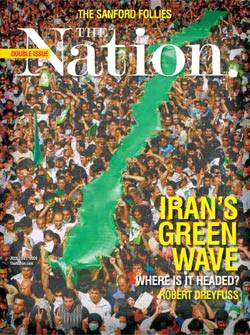
nation 20 july 2009An article by Robert Dreyfuss explores the division among the Iranian political elite that has contributed to the recent mass demonstrations there.  Dreyfuss convinces me that the government has a narrow base of support among elite groups in the city of Teheran.  Most of the people he talks to regard Ayatollah Khamenei and President Ahmedinejad as too hard-line and traditionalist, while many others are turning to rightist groups that accuse those men of being too soft.  However, I’m skeptical of Dreyfuss’ attempts to suggest that the Teherani elite is in this matter representative of the country as a whole.  Dreyfuss cites the Chatham House study which compared voter turnout in Iran’s 2005 presidential election with turnout in this year’s contest, concluding that the number of votes reported had increased by so much that fraud was a likelier explanation than was a rise in actual participation.  On Dreyfuss’ own showing, though, the opposition has the support of many key power players.  Among them are many men who may be in a position to falsify votes.  And the fact remains that the only opinion poll conducted in Iran before this year’s election predicted the same result that the authorities certified.  The election may well have been a phony, but Dreyfuss definitely wrong to say that it “seems far-fetched” to think that Ahmedinejad may have won. 

(more…)

The Nation, 13 July 2009

nation 13 july 2009Alex Cockburn rages at the Americans who cheerlead for the protests in Iran while they ignore politics in their own country, giving the Obama administration carte blanche to break every promise Mr O made to help working people and curb the national security state.  As for Cockburn’s view of Iran, readers of his newsletter Counterpunch are familiar with his suspicion that the protests are something of a phony put up by advocates of war.   

An editorial about the Obama administration’s approach to the righs of sexual minorities begins by pointing out that in Mr O’s first bid for public office, for the Illinois state senate in 1996, he was asked where he stood on same-sex marriage.  Unlike other candidates, who either checked “yes” or “no,” Mr O went out of his way to add the sentence “I favor legalizing same-sex marriages, and would fight efforts to prohibit such marriages.”  At that time no state recognized same-sex marriages, and many criminalized same-sex sex.  Now, the country has moved on.  Even the governor of Utah has endorsed civil unions for same sex couples.  And Mr O has moved backward.  Now he opposes same-sex marriages, presides over the continuation of “don’t ask- don’t tell,” and hasn’t lifted a finger to support legislation to protect sexual minorities from workplace discrimination, legislation 89% of Americans say they favor.  The editorial sums it up: “At this rate, Obama is in danger of being outpaced on gay rights not just by the American people but by the nonsuicidal wing of the Republican Party.”  

Lisa Duggan celebrates Salt Lake City’s surprisingly visible, surprisingly politicized sexual minorities.  Countering those who have called for a boycott of Utah to protest the role of Mormons in the campaign to end gender-neutral marriage in California, Duggan quotes Salt Lake City residents who’ve called for a “New Queer Pioneer Movement,” one that would emulate the sect trains of the Mormon nineteenth century and flood the state with same-sexers. 

Joseph Stiglitz claims that the current global economic crisis presents us with a stark alternative: either we adopt nationalistic policies of subsidy and protection that mean we renounce economic globalization, or we adopt United Nations-based regulatory schemes that mean we embrace political globalization.  As Stiglitz is the head of the UN’s Commission of Experts on the crisis, it will not come as a complete surprise that he favors the latter option.

(more…)

Seven recent issues of The Nation

Ever since I started writing here, I’ve been referring to “Mrs Acilius.”  Until last month, that was a bit of an exaggeration, as I had not actually married the lady in question.  We tied the knot 12 May.  So lately, I’ve had things on my mind other than this blog.  That’s why I haven’t been posting “Periodicals Notes” regularly.  But I’ve vowed to catch up.  So here are my notes on the last seven, yes seven, issues of The Nation.

nation 25 may 200925 May: It’s been almost 60 years since a jury found that former State Department official Alger Hiss was lying when he denied that he had passed classified documents to an agent of Soviet military intelligence during the years 1934-1938.  The Nation has never let go of the Hiss case, and still publishes articles, columns, and reviews at regular intervals maintaining his innocence.  When Hiss died in 1996, I read a few books about the case.  Hiss’ own book, In the Court of Public Opinion, and his son Tony’s memoir of him, Laughing Last; Alistair Cooke‘s A Generation on Trial; and Allan Weinstein’s Perjury.  I mention the fact that I read these four books not because they qualify me as an expert on a matter as complex and hotly disputed as the Hiss case; obviously they do not.   All I want to do is explain that I have a certain familiarity with the Hiss case, and that I take an interest in discussions of it. 

D. D. Guttenplan reviews two recent books, Susan Jacoby‘s Alger Hiss and the Battle for History and Spies: The Rise and Fall of the KGB in America, by John Earl Haynes, Harvey Klehr, and Alexander Vassiliev.  In regard to Spies, Guttenplan’s main goal is disprove the book’s accusation that journalist I. F. Stone was a Soviet agent.  I would be inclined to say that Guttenplan achieves that goal easily.  I haven’t read the book, but unless there is a great deal more to it than Guttenplan acknowledges it would seem that its authors have not only failed to make the case against Stone, but have actually made a compelling case that Stone could not have been the man the Soviets codenamed “Blin” “”Pancake.”)  

Guttenplan’s contribution to the Hiss debate is less of a triumph.  The review goes on and on about the absence of Hiss’ name from declassified KGB documents.  It would be difficult to imagine a less relevant point.  Hiss was never accused of spying for the KGB.  The KGB was an organ of Soviet State Security.  Hiss was accused of passing documents, not to Soviet State Security, but to Soviet Military Intelligence (the GRU.)  The man who identified himself as Hiss’ contact was Whittaker Chambers, whom no one denies was an operative of Soviet Military Intelligence.  In the Soviet system, Military Intelligence was a bitter rival of State Security; they most assuredly did not share with each other the names of highly placed agents whom they had recruited. 

Hiss’ defenders are not alone in ignoring this point.  So, those who are most convinced of his guilt often bring up the “VENONA Intercepts,” cables sent by KGB station chiefs in Washington to Moscow and intercepted by the FBI in the years 1946-1980.  These cables use the codename “ALES” to refer to a man who sounds more like Alger Hiss than anyone else, and describe him as an agent of Soviet intelligence.  They do not report direct contacts with ALES, however, nor do they include any intelligence gathered from him.  The likeliest explanation, then, is that the station chief had heard a rumor that Hiss was working for Soviet Military Intelligence and was reporting this rumor to headquarters.  That such rumors were circulating about Hiss in various intelligence services around the world before Chambers made his charges public has been known for some time; in the first edition of Perjury, published in 1978, Allan Weinstein devoted a whole appendix to indications that a number of European intelligence services believed Hiss was a Soviet agent.  VENONA does nothing but add Soviet State Security to the list of these services.   

nation 1 june 20091 June:  Akiva Gottlieb reviews Clint Eastwood’s latest bout of macho self-pity masquerading as a movie.  The last two paragraphs sum up Gottlieb’s view:

In the closing scene of Gran Torino, a lawyer reads from the dead man’s will, which Walt had written himself. It turns out that he had chosen to bequeath the titular totem of middle-class luxury to Thao, “on the condition that you don’t chop-top the roof like one of those beaners, don’t paint any idiotic flames on it like some white trash hillbilly and don’t put a big gay spoiler on the rear end like you see on all of the other zipperheads’ cars.” In other words, Walt gets to keep his racial epithets and be the hero, too. The closing credits roll over a shot of Thao cruising in his new vehicle of assimilation, with Eastwood’s raspy voice cooing gently on the soundtrack, reminding the next generation just who we have to thank for our liberty.

(more…)

The Nation, 18 May 2009

nation-18-may-2009It was William Wordsworth who asked “Where are they now, those wanton boys/ for whose free range the daedal earth/ was filled with animated toys/ and implements of frolic mirth;/  with tools for ready wit to guide,/ and ornaments of seemlier pride,/ more fresh, more bright, than princes wear;/ for what one moment flung aside,/ another could repair; what good or evil have they seen/ since I their pastime witnessed here,/ their daring wiles, their sportive cheer?”   

That was what Wordsworth asked.  As a columnist for The Nation, Katha Pollitt isn’t allowed to ask such congenial questions.  In this issue, she asks where the Bush-Cheney administration officials responsible for the torture regime are now.  Wanton boys they are, indeed.  But no longer do they range quite so freely over the daedal earth; Judge Baltasar Garzón has ruled Europe off limits for them.   Former assistant attorney general, now federal judge Jay Bybee gave an opinion that treatment which did not result in permanent physical injury could not be considered torture; as if “what one moment flung aside, another could repair.”  Their “animated toys” are to be released from the Satanic toyboxes of Guantanamo Bay and the leftover Gulags of eastern Europe; the “implements of frolic mirth” the wanton boys once directed to be used are to be relegated to the ever-more distant past, along with the photos that came from Abu Ghraib prison five years ago.  True, the new administration’s reluctance to prosecute the architects of the torture regime does raise the worry that they may be looking on that regime as so many “tools for ready wit to guide.”  And the wanton boys themselves do not seem to be suffering; banks, investment firms, universities, and think tanks have given the worst of them positions that could pay for “ornaments of seemlier pride, more fresh, more bright, than princes wear.”  Pollitt jokes that she herself would be better off had she quit journalism and taken a job marketing torture:

I could have nicknamed waterboarding “drinking tea with Vice President Cheney,” although come to think of it, waterboarding is a euphemism already. Maybe that’s why people didn’t catch on that it was the same thing we prosecuted Japanese interrogators for doing in World War II. In the Tokyo trials it was called “the water treatment,” or “the water cure,” or just plain “water torture.” Calling it “water torture” was probably what got those Japanese into trouble. That, and losing the war.

(more…)

The Nation, 11 May 2009

nation-11-may-2009

The recent release of Bush-era “torture memos” occasions an argument to the effect that those responsible for the writing of those memos and the implementation of the procedures described in them must be held to account.  This must be done, less to honor a duty to the past than to establish a precedent for the future:

As a former constitutional law lecturer, Obama should have a firmer grasp of the point of executive accountability. It is not merely to “lay blame,” as he suggests; it is to set boundaries on presidential behavior and to clarify where wrongdoing will be challenged. Presidents, even those who profess honorable intentions, do not get to write their own rules. Congress must set and enforce those boundaries. When Obama suggested that CIA personnel who acted on the legal advice of the Bush administration would not face “retribution,” Illinois’s Jan Schakowsky, chair of the House Permanent Select Committee on Intelligence’s subcommittee on oversight and investigations, offered the only appropriate response. “I don’t want to compare this to Nazi Germany, but we’ve come to almost ridicule the notion that when horrific acts have been committed that people can use the excuse that, Well, I was just following orders,” explained Schakowsky, who has instructed aides to prepare for a torture inquiry. “There should be an open mind of what to do with information that we get from thorough investigations,” she added.

There must also be a proper framework for investigations. Gathering information for the purpose of creating a permanent record is only slightly superior to Obama’s banalities about wanting to “move forward.” Truth commissions that grant immunity to wrongdoers and bipartisan commissions that negotiate their way to redacted reports do not check and balance the executive branch any more than “warnings” punish speeding motorists.

A short piece remarks on the success leading neocons have had in publicizing the view that piracy off the Horn of Africa is a national security threat to the USA.  The Washington Post, for example, the other day tossed off a reference to “ties between al Qaeda and” the group that recently hijacked the Maersk Alabama, ties which appear to be wholly imaginary. 

(more…)

The Nation, 4 May 2009

nation-4-may-2009Never let it be said that The Nation‘s editors don’t have a sense of humor.  They assigned Michelle Orange to review a new collection of letters by Graham Greene.  It reminds me of an idea I had once of assembling a panel consisting of classical scholars Peter Green, Peter White, and Peter Brown

Katha Pollitt asks why women stay with abusive men, and finds that in many cases it’s because they feel sorry for their abusers.

In the online edition, Dave Zirin complains that too much of the publicity that the University of Connecticut’s women’s basketball team has received for its awe-inspiring season and national championship has focused on its male head coach.   

Also in the online edition, an army officer outlines military options for responding to piracy.  I don’t care much about piracy, but this little piece is a handy primer on some of the most basic terms of military science.