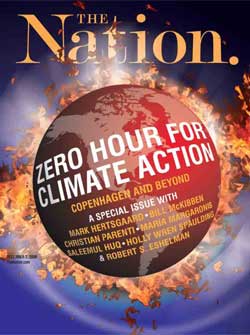
The Nation, 15 February 2010

Ramon Fernandez was a French fascist who actively collaborated with the Nazis during their occupation of France.  His son, Dominique Fernandez, has written a biography of his father.  The Nation‘s review describes this biography as the culmination of Dominique Fernandez’ life’s work, his attempt to comprehend what his father did and why he did it.

Anyone who hoped that the election of Barack Obama as US president heralded a return to the rule of law will be dismayed by the news sections of this issue.  An article on “America’s Secret Afghan Prisons” lays out evidence that the Mr O’s administration, so far from ending Bush-Cheney’s policies of torture  and disappearance, has intensified those policies.  That article’s author, Anand Gopal, gave an interview about the story, which you can listen to here

Reports suggesting that three men who allegedly hanged themselves at the Guantanamo Bay detention camp in 2006 were in fact murdered move the editors to say that Mr O’s refusal to order investigations into the charges against his predecessor amount, not only to dereliction of his duty as a law-enforcement officer, but to a cover-up of crimes against humanity. 

Defense Secretary Robert Gates’ acknowledgement that the Blackwater Group’s soldiers-for-hire are operating in Pakistan and the Pentagon’s subsequent assertion that the secretary never said the words he was shown on television saying prompts the magazine to quote the Washington adage, “Never believe anything until it’s been officially denied.”  Any Nation readers unconcerned by Blackwater’s expanding operations might want to look at a web-only piece, “Blackwater’s Youngest Victim.”

The Nation, 8 February 2010

I had never heard of Alice Guy Blaché before I saw a review in this issue of a biography of her;  that turns out to have been a severe gap in my knowledge of the early history of cinema. 

An editorial calls for forgiving the foreign debt that has done so much to harm Haiti over the years; a short essay by Amy Wilentz decries the “genteel racism” of many who have shown disdain for that nation; and Calvin Trillin’s doggerel verse expresses disgust at a couple of idiots who said ugly things in the aftermath of the earthquake. 

An editorial about the election of Senator Naked (R-Massachusetts) reminded me of some info I owe to blogger Maggie Jochild.  Maggie quotes a mass email from Democracy for America:

Last night, Democrats lost Ted Kennedy’s Senate seat in a bitter special election. This is already a sad day for all of us who loved Ted Kennedy. But to make it even worse, conservative Democrats and Washington talking heads are claiming that the loss happened because Congress was “too far to the left.”

They’re wrong again — and we can prove it.

We had Research 2000 poll voters immediately after the Election ended: Even Scott Brown voters want Democrats to be bolder and they want healthcare reform that includes a public option.

You read that right. By a margin of three-to-two, former Obama voters who voted for Republican Scott Brown yesterday said the Senate healthcare bill “doesn’t go far enough.” Six-to-one Obama voters who stayed home agreed. And to top it off, 80% of all voters still want the choice of a public option in the bill.

The message is clear, there is only one way out of this mess if Democrats want to win in 2010. It’s time to pass healthcare with 51 votes in the Senate using the budget reconciliation process. And it must include the most popular piece of bold reform: the choice of a public option.

Jo Ann Wypiewski reminds us of one reason why Senator Naked’s election is not entirely bad news; his opponent did make her name by hounding innocent people into prison.

The Nation magazine’s first issues of 2010

1 February: The first issue to go to press after the earthquake in Haiti includes some recommendations for those who would like to find a good relief organization to give money.  The first organization I looked up when I heard about the quake was one I’d first read of in the pages of The Nation, MADRE.  In her year-end lists of groups that deserve financial support and elsewhere, Nation columnist Katha Pollitt has made mention of this organization, which supports groups around the world.  Most of MADRE’s partner groups are initiatives in poor countries, started and led by citizens of those countries, that prioritize the needs of women and girls.  MADRE’s Haitian partner is Partners in Health, which runs a network of clinics called Zanmi Lasante; they’re on the list.  The magazine’s website includes several more pleas for Haiti; see here and here

In the same issue, Robin Einhorn attacks Gordon Wood’s recent book about the early federal period of the United States, arguing that Wood shows a “remarkably naive sense of politics” that allows him to keep the South at the margins of his story and free white male Northerners at the center of it.  Even as he puts the focus on a rapidly industrializing region, Einhorn argues, Wood shows an uncritical admiration on for the agrarian politics of Thomas Jefferson and his party.  Einhorn grants that Wood’s chapter on the politics of slavery is excellent, but says that confining the topic to a single chapter, quarantined from the rest of the book, is profoundly misleading.  In the end, Einhorn declares that Wood has succeeded in thinking like Thomas Jefferson, but that this is no unmixed virtue:

If Jefferson had known nearly as much about his society as Wood does, Empire of Liberty is the book he would have written. It is no coincidence that the title is Jefferson’s, a phrase encapsulating his brand of velvet-gloved imperialism. Wood seems to know that there was an iron fist lurking inside, but he identifies with an audience that treasures the national fantasy of egalitarian triumph that Jefferson represents. Like Jefferson, Wood nods to the evil of slavery and the violence of westward expansion. Unlike Jefferson, he realizes that there was something undesirable about the way men treated women. But Wood’s focus remains squarely on the subculture of white men–especially in the North–who energetically pursued their liberty and happiness in the “republicanized” world of postrevolutionary America. 

25 January: Alexander Cockburn is disappointed with R. Crumb’s version of the Book of Genesis.  In Cockburn’s view, Crumb does not thoroughly deflate monotheism, but produces a more or less reverent text.  “If a conclusive disresepcting of Genesis was required, wouldn’t you think R. Crumb was the man for the job?… But the overall effect is more solemn than satirical.”  Cockburn is also disappointed that Crumb depicts the characters of the book as recognizably Jewish (in fact stereotypically Jewish, “hairy” and “with big noses,”) missing an opportunity to make the point that “There never was a Jewish people, only a Jewish religion” (a line Cockburn quotes from Israeli journalist Tom Segev) and that Zionism is therefore an illegitimate enterprise.  Indeed at one point Cockburn claims to have “wondered whether Crumb, a Catholic long ago, had converted to Zionism.” 

I agree with Cockburn about a lot of things, but when he turns to Judaism and the Jews I sometimes suspect him of being a bit cracked.  Not that I want to wave the flag for Zionism, but it doesn’t seem especially reasonable to expect a graphic novel, even when that graphic novel is R. Crumb’s adaptation of Genesis, to achieve everything he demanded of it.   

11 January: A piece about the Polaroid camera and the pictures it took includes this:

Polaroid’s “now” having been driven into the past, it has become ripe for nostalgia. Found Magazine, launched in 2001, was well ahead of the Polaroid nostalgia wave and spun off a whole book of Found Polaroids in 2006, when the end of the road was already in sight. But for its author, Jason Bitner, the medium had always been “instant nostalgia–framed and faded, a picture that already looked decades old.”

The same issue includes an essay about Thelonious Monk that ends with this anecdote:

Monk liked to wear a formidable ring bearing his name when he played, an encumbrance that no pianist in his right mind would want to burden a hand with. While he was flashing his ring for the world to see, from his own perspective he saw something else. “KNOW” said the ring, more or less, to the audience. “MONK” was the reply when he saw it himself.

.

The Nation, 4 January 2010

Several reports on the Copenhagen summit on climate change draw Alexander Cockburn out with a column trumpeting his dissent from the view that by dumping such great volumes of greenhouse gases in the upper atmosphere humans are doing enormous harm to the environment.  Cockburn never convinces me when he mounts this hobby-horse of his, but I must confess to taking pleasure in the self-righteous sputtering that fills the letters to the editor in the subsequent issues.  For every well-reasoned counterargument from someone with a grasp of the science and a solid case to make against Cockburn’s claims, the magazine must receive hundreds of letters from people who are not at all equipped to analyze climate data but who are entirely prepared to denounce a heretic and cast him out.  I’m fairly sure that Cockburn is wrong and his detractors are right about climate.  At the same time, I’m quite certain that he is doing a public service by luring would-be enforcers of orthodoxy into the open.  He’s even doing a favor to them; if the self-appointed Grand Inquisitors have the sense to read their letters and realize that they have made fools of themselves,  they might shed their crusading demeanor and adopt a more wholesome attitude.

On The Nation‘s website, there’s a piece about the president of Italy’s parliament, Gianfranco Fini.  The piece notes the rather amazing fact that this man whose political career began in the neofascist Italian Social Movement has became “the country’s most responsible right-wing politician.”  Several months ago, The Independent praised Fini’s willingness to stand up to Prime Minister Silvio Berlusconi in defense of values like accountable government, a secular state, and openness to immigration, values that liberals and socialists are supposed to care about but that the leaders of Italy’s center-left parties seldom lend their full-throated support.  The Independent called Fini “the best leader the Italian Left never had.”  This really is an extraordinary transformation; as recently as 1994, Fini described Benito Mussolini as “the greatest statesman of the twentieth century.”  How anyone could possibly apply that label to il Duce is beyond me.  Before Mussolini came to power he was in some ways an intriguing figure, I grant you.  He led an highly colorful life, full of adventure and rich in ideas.  As a national leader, however, Mussolini was a disaster by any standard of evaluation.  The evil he did (for example, sending 3,000 Italian Jews to die in Hitler’s camps) infinitely outweighed any good with which he could be credited, yet in the end it was his sheer incompetence that triumphed even over his murderous villainy.  This is a digression, I suppose; Gianfranco Fini seems to be highly competent, and no more likely to commit murder than the average Western European politician. 

Katha Pollitt’s annual list of worthy charities includes, as usual, MADRE, a fund that backs various groups of women in poor countries who have organized themselves to combat their own problems on their own terms.  For example:

In Iraq, it supports Yanar Mohammed’s network of secret shelters for women fleeing domestic violence and honor murder. In Kenya, it works on water purification projects that free women from the task of transporting water over long distances. In Bolivia, it helps indigenous women prepare to run for political office. Right now, 100 percent of your gift goes directly to projects.

Barry Schwabsky’s review of some recent retrospectives on abstract painting includes a snippet that may provoke a response.  After telling us that he experiences art one work at a time and looks with a skeptical eye on all art history that describes movements and schools, Schwabsky says:

Abstraction arguably should have even less to do with movements than any other art: a movement of abstractionists would be a contradiction in terms, like a church of atheists. Abstractionists, like atheists, are united only in what they reject. Abstraction is not a specific way of doing art–on what basis can Jackson Pollock, Lucio Fontana and Daniel Buren be considered part of a single movement? Rather, it is a considered effort not to do what Western artists have made it their job to do for hundreds of years: namely, to construct credible depictions of people, places and things. What if anything else goes?

Perhaps that’s why, as Bob Nickas points out in his new book Painting Abstraction: New Elements in Abstract Painting (Phaidon Press; $75), “so many contemporary artists who paint nonrepresentational pictures reject the notion that their work is in fact abstract.” They realize that the name itself, as handy and unavoidable as it undoubtedly may be, conveys a false sense of unity. Other commonalities, even those that would rightly strike us as quite superficial, can be more important.

Tiger Woods crops up.  Ever since news started hitting the papers of Woods’ very active extramarital sex life, I’ve been thinking of William Blake.  “Tiger, tiger, burning bright,/ in the forests of the night…”  Or is it “Tiger, Tiger, burning sensation/ experienced during urination…”  Anyway, the item here is all about how Tiger Woods has spent his career promoting sleazy schemes by global bad actors such as Chevron and the Philippine government, all the while pretending that he had nothing to do with politics.

The Nation, lately

Here are the first two paragraphs of Stuart Klawans’ review of Richard Linklater’s docudrama, Me and Orson Welles:

 The story of an omelet told from an eggshell’s point of view, Me and Orson Welles relates the events of one week in November 1937, when a fictional high school student named Richard happens upon some actors goofing off on New York’s Forty-first Street and gets cast in a show that just might open: the Mercury Theatre’s soon-to-be-legendary Caesar. A day-tripping kid from the suburbs will accidentally participate in greatness. As the Mercury’s office manager and all-purpose sweetheart puts it, he will get to sit at the feet of Orson Welles and be showered with his spittle.

As swift and stripped-down as its title, the Caesar into which Richard has wandered will thrillingly transform Shakespeare’s Roman general into a present-day dictator in jackboots and black shirt, provided the director and star ever lets the play get out of rehearsals. Welles is a dictator too, you see, though without any ideal of military discipline, and evidently can’t bear to set an opening date, because then the chaos would end and he could no longer go on bullying and seducing and making everyone in the company wait on his every whim. “Can you play the ukulele?” Welles demands of Richard upon seeing him on the sidewalk, as if it were the first question that would pop into anyone’s mind. Without asking why, Richard looks Welles in the eye, lies and says yes. Welles stares back, recognizes the lie and hires him anyway, telling him he’s now Lucius. It seems the dictator has found a new underling, one with just enough spirit to make him temporarily interesting to break.

“Can you play the ukulele?” is a fine greeting so far as I’m concerned… 

That’s from the 21 December issue, as is Lori Wallach’s piece about the World Trade Organization.  Wallach has done yeoman work over the years publicizing the fact that the World Trade Organization is not just about “trade,” but takes a wide variety of issues out of the democratic process in its member states and subjects them to cloistered bureaucracies that respond only to major corporate interests.   

The main thing I want to remember from the 14 December issue is a piece about the killing of Fred Hampton.  Fred Hampton was the chairman of the Black Panther Party in Chicago when police shot him to death at his home, 2337 West Monroe Street, on 4 December 1969.  The official story from the Chicago Police Department at the time was that Hampton fired first; crime scene photos showing that most of the blood Hampton lost drained into his mattress suggested that he was in bed throughout the gun battle.  Hampton must have been very tired indeed to have remained in bed while waging a firefight against the police.    

The author of the piece is Jeffrey Haas.  Here is Haas’ summary of his own role in the response to Hampton’s death:

I was the first person to interview the survivors in the police lockup, where Hampton’s crying and pregnant fiancée told me that after she was pulled from the room, police came in and fired two shots into Hampton and said, “He’s good and dead now.” The autopsy showed he had been shot twice in the head at point-blank range. My colleagues went to the raid scene, examined the bullet holes and found that the trajectory of all the bullets except one was from the direction of the police toward the Panthers. Later, an FBI firearms expert testified that more than eighty shots were fired by the police at the Panthers, with only one coming from a Panther. That one shot was fired in a vertical direction by a falling Mark Clark after he had been fatally wounded.

Two years after the murder, antiwar activists raided the FBI office in Media, Pennsylvania, and found and distributed documents that demonstrated that FBI chief J. Edgar Hoover was conducting a secret war on the left–the Counterintelligence Program, or Cointelpro. Its most aggressive and lethal tactics were used against the black movement, and the Panthers in particular. Cointelpro mandated FBI agents in cities with Panther chapters to “cripple,” “disrupt” and “destroy” the Panthers and their breakfast program and to prevent the rise of a “messiah” who could unify and electrify the black masses.

In 1969 I was a young, newly radicalized lawyer, one of the founders of a collective called the People’s Law Office, which represented the Panthers. After successfully defending the survivors of the raid against bogus criminal charges, we filed a civil rights suit against the police and the prosecutor, and later the FBI. My book The Assassination of Fred Hampton chronicles our long legal and political struggle to uncover the truth about the FBI’s role in the killing. After thirteen years of litigation, we proved that the raid was a Cointelpro operation. FBI agents in Chicago gave Hanrahan and the Chicago police a floor plan of Hampton’s apartment, which included the location of the bed where Hampton would be sleeping. They urged Hanrahan to conduct the raid and later took credit for it in internal documents. The FBI informant who provided the floor plan was given a bonus because his information was deemed to be of “tremendous value” to what one agent referred to as the “success” of the raid.

Noam Chomsky has called the murder of Fred Hampton “the gravest domestic crime of the Nixon Administration.” It is hard to imagine a more serious abuse by a government than the deliberate assassination of a citizen for his political beliefs and activity. But though we were finally able to reveal that Hampton’s death had been an assassination, it has never gotten the attention it deserves. The government’s cover-up and stonewalling basically worked.

(more…)

Virtue Engendered; or, Big States Breed Small Souls

I found two highlights in this issue: a review of Michael Sandel’s Justice: What’s the Right Thing to Do? and a review of David Finkel’s The Good Soldiers

Harvard philosopher Michael Sandel is a major figure in the revival of “virtue ethics,” the school of thought pioneered by Aristotle.   As its name suggests, virtue ethics tends to emphasize the importance of developing particular character traits.  Virtue ethics was out of fashion among academic philosophers for quite a long time, but now it seems to be on an equal footing with the two other leading schools of ethical thought, utilitarianism and deontology. Utilitarianism is a set of approaches that take their cue from Jeremy Bentham’s definition of the Good as that which brings the greatest amount of pleasure to the greatest number of people; deontology first crystallized in the work of Immanuel Kant, defender of the idea that moral duty and rational understanding are inseparable one from another.  So, an advocate of utilitarianism might argue that we should sustain friendships because societies composed of people who like each other tend to have lots of healthy and cheerful citizens, and an advocate of deontological ethics might argue that we should sustain friendships because the universe only makes sense to people who recognize a duty to grow close to each other.  An advocate of virtue ethics, on the other hand, might argue that being a friend means developing traits of character that are valuable in themselves and that can be attained in no other way.     

Sandel, like other virtue ethicists, is associated with a tendency in political theory called “communitarianism.”  Communitarians criticize classical liberalism for its image of the individual human being as a self-contained unit.  As The Nation‘s reviewer puts it:

Nearly thirty years ago, in his massively influential debut in political theory, Sandel argued that communal belonging precedes individual freedom–that, in his language, the self is “encumbered” and therefore not altogether prior to the ends it chooses. An intrepid technical dissection of his colleague [John] Rawls’s epoch-making A Theory of Justice (1971), Liberalism and the Limits of Justice made Sandel’s name as a “communitarian.” Sandel demonstrated that for Rawls, the freedom of individual choice alone is the morally relevant starting point for inquiry into justice, an assumption that renders things like family ties, religious belief, group loyalty and historical identity irrelevant, except as a secondary extra. Communitarians like Sandel, Charles Taylor (with whom Sandel studied as a Rhodes scholar at Oxford) and Michael Walzer responded that most people, even in liberal societies, prize those things at least as much as personal autonomy. The most attractive part of Sandel’s criticism was his contention that relationships, rather than being the result of previous choices, are the sphere in which identity is possible at all. (To put it in more technical terms, there is no individual subject not intersubjectively constituted from the first.) Ever since making these claims, even as political theory has substantially evolved, Sandel has continued to argue for the priority of the communal good in an account of justice, even as he recognizes its risks for liberty.

Because a person’s virtues are part of his or her identity, communitarianism and virtue ethics inevitably go hand in hand.    

The same review discusses a book by Amartya Sen that prompts the reviewer to mention that many philosophers were dismayed when political theorist John Rawls declared that the nation-state was “the natural forum for justice.”  Otherwise dedicated Rawlsians rebelled against this pronouncement, arguing that justice requires a worldwide framework.  I value Sandel and the communitarians because their position points to a different response to Rawls.  I haven’t studied Rawls’ work deeply, but what I have read suggests to me that his theory does indeed presuppose the nation-state as the standard of community.  The communitarians, on the other hand, have the intellectual resources to challenge that standard, not by arguing that the nation-state is too small to be just, but that it is too big.  The nation-state, especially in the form of continental behemoths like the USA or the former USSR or China or India or the European Union, is bloated beyond any capacity to nurture healthy relationships.  The only connection citizens of such enormous empires can achieve with each other is the one they feel when they cheer their rulers on and rejoice as their warriors smash the Enemy, whoever that Enemy may be at the moment.  The qualities of character that we develop when we do those things are hardly to be called virtues. 

That big states breed small souls is supported by material cited from David Finkel’s reports from Iraq.  The American public is separated from the perspective of the American soldier by official censorship, and so has a distorted view of what is being done in its name in Iraq.  Senior American commanders, too, have a distorted view, in their case because sycophantic briefing officers tell them what they want to hear rather than what their subordinates on the ground are actually seeing and doing.  The reviewer describes a scene in which Finkel reports on a briefing given to the celebrated General David Petraeus.  Finkel attended the briefing, and had been an eyewitness of the firefights deascribed in the briefing.  He makes it clear that what the general heard had little or no relationship to the events Finkel saw.  Even ground troops themselves see an ever smaller portion of what they are doing; “the Pentagon’s continued dependence on unmanned Predator drone attacks in Afghanistan and Pakistan means that even soldiers aren’t seeing the full contours of the global battlefield,” as the reviewer points out.  Of course, it’s long been an axiom of military history that a researcher should ask a participant in a battle for eyewitness accounts only of events that took place within a meter of that participant’s face, and shouldn’t expect extreme clarity even in those accounts.  But these added degrees of separation certainly don’t improve our ability to take responsibility for what is done in our name.  Finkel apparently pulls out the emotional stops in an attempt to protest against this separation:

The chasm between over here and over there is central to another heartbreaking sequence, when the wife of a severely wounded soldier transferred from Iraq to the National Naval Medical Center in Bethesda, Maryland, remembers a visit from President Bush. Finkel recounts not only what the soldier’s wife said to the president–“Thank you for coming”–and not only what she wished she had said to him–“He doesn’t know how it feels”–but why she hadn’t said it: “Because I felt it would not have made any difference.” Communication is fruitless, because if Bush can’t see the problem staring at him from that hospital bed, he’s already living on too remote a planet.

(more…)

How the US funds the Taliban

nation 30 november 2009Welcome to the wartime contracting bazaar in Afghanistan. It is a virtual carnival of improbable characters and shady connections, with former CIA officials and ex-military officers joining hands with former Taliban and mujahedeen to collect US government funds in the name of the war effort.

In this grotesque carnival, the US military’s contractors are forced to pay suspected insurgents to protect American supply routes. It is an accepted fact of the military logistics operation in Afghanistan that the US government funds the very forces American troops are fighting. And it is a deadly irony, because these funds add up to a huge amount of money for the Taliban. “It’s a big part of their income,” one of the top Afghan government security officials told The Nation in an interview. In fact, US military officials in Kabul estimate that a minimum of 10 percent of the Pentagon’s logistics contracts–hundreds of millions of dollars–consists of payments to insurgents.

Understanding how this situation came to pass requires untangling two threads. The first is the insider dealing that determines who wins and who loses in Afghan business, and the second is the troubling mechanism by which “private security” ensures that the US supply convoys traveling these ancient trade routes aren’t ambushed by insurgents.

Read the article.

The Nation, 9 November 2009

nation 9 nov 09For me, the highlight of this issue was a review of Mary Beard‘s The Fires of Vesuvius: Pompeii Lost and Found.  Beard’s “down to earth portrait of Pompeii” is informed by her grasp of “the latest research in demography, the history of Roman politics, architecture, ancient economics, feminist and post-colonial studies.” 

The same issue includes a number of articles about the war in Afghanistan.  As the editors summarize this symposium:

The principal rationale for America’s expanding military commitment in Afghanistan is that a Taliban takeover there would directly threaten US security because it would again become a safe haven for Al Qaeda to plot attacks against the United States. But the essays by Stephen Walt and John Mueller strongly refute that assumption, pointing out that a Taliban victory would not necessarily mean a return of Al Qaeda to Afghanistan, and that in any case the strategic value of Afghanistan and Pakistan as base camps for Al Qaeda is greatly exaggerated and can be easily countered.

Similarly, proponents of sending more troops to Afghanistan argue that Taliban success would embolden global jihadists everywhere and destabilize Pakistan in particular. Yet, as the essays by Selig Harrison and Priya Satia show, this narrative does not fit the realities. While American policy-makers and Al Qaeda may think of this as a grand meta-struggle between the United States and global jihadism, many Taliban fighters are motivated by other factors: by traditional Pashtun resistance to foreign occupation; by internal ethnic politics, such as rebellion against the Tajik-dominated government of Hamid Karzai; or by anger over the loss of life resulting from American/NATO aerial attacks that have gone awry.

As for Pakistan, the essays by Manan Ahmed and Mosharraf Zaidi explain why the Taliban threat to Pakistan is not as serious as many assume, and why a newly democratic Pakistan has turned increasingly against Islamist extremists. As Ahmed and Zaidi suggest, Pakistanis are quite capable of defending their country–not for American interests but for their own reasons–and Pakistani stability is more likely to be threatened than enhanced by military escalation in Afghanistan.

And finally, Robert Dreyfuss offers an exit strategy: as it winds down its counterinsurgency, Washington should encourage an international Bonn II conference that would lead to a new national compact in Afghanistan.

Well, not quite “finally.”  The issue also includes a piece by Ann Jones about Afghan women.  Jones mentions groups like Feminist Majority that argue for a continued US troop presence in the name of Afghan women’s rights.  She mentions her own years of experience working with women in Afghanistan, and gives it as her assessment that “an unsentimental look at the record reveals that for all the fine talk of women’s rights since the US invasion, equal rights for Afghan women have been illusory all along, a polite feel-good fiction that helped to sell the American enterprise at home and cloak in respectability the misbegotten government we installed in Kabul.”  In light of the fiercely patriarchal Shi’ite Personal Status Law (the SPSL, “or as it became known in the Western press, the Marital Rape Law,”) she goes on to say that “From the point of view of women today, America’s friends and America’s enemies in Afghanistan are the same kind of guys.”  She is unimpressed by the number of women in the Afghan parliament:

But what about all the women parliamentarians so often cited as evidence of the progress of Afghan women? With 17 percent of the upper house and 27 percent of the lower–eighty-five women in all–you’d think they could have blocked the SPSL. But that didn’t happen, for many reasons. Many women parliamentarians are mere extensions of the warlords who financed their campaigns and tell them how to vote: always in opposition to women’s rights. Most non-Shiite women took little interest in the bill, believing that it applied only to the Shiite minority. Although Hazara women have long been the freest in the country and the most active in public life, some of them argued that it is better to have a bad law than none at all because, as one Hazara MP told me, “without a written law, men can do whatever they want.”

Jones sees little hope, and much tragic irony in the possibilities facing Afghanistan:

So there’s no point talking about how women and girls might be affected by the strategic military options remaining on Obama’s plate. None of them bode well for women. To send more troops is to send more violence. To withdraw is to invite the Taliban. To stay the same is not possible, now that Karzai has stolen the election in plain sight and made a mockery of American pretensions to an interest in anything but our own skin and our own pocketbook. But while men plan the onslaught of more men, it’s worth remembering what “normal life” once looked like in Afghanistan, well before the soldiers came. In the 1960s and ’70s, before the Soviet invasion–when half the country’s doctors, more than half the civil servants and three-quarters of the teachers were women–a peaceful Afghanistan advanced slowly into the modern world through the efforts of all its people. What changed all that was not only the violence of war but the accession to power of the most backward men in the country: first the Taliban, now the mullahs and mujahedeen of the fraudulent, corrupt, Western-designed government that stands in opposition to “normal life” as it is lived in the developed world and was once lived in their own country. What happens to women is not merely a “women’s issue”; it is the central issue of stability, development and durable peace. No nation can advance without women, and no enterprise that takes women off the table can come to much good.

Jones knows Afghanistan quite well; I know it not at all.  I can only hope that there is something left in the local culture of the seeds from which a relatively woman-friendly Afghanistan once grew, and that those seeds will again send up green shoots once foreign armies leave the country .

They cry peace, peace, when there is no peace

nation 2 november 2009Of several pieces on the awarding of the Nobel Peace Prize to Barack Obama, the best is by Alexander Cockburn, who recounts the genuinely gruesome records of other recipients of that prize.  Of the three US presidents who preceded the incumbent as winners of that revered accolade, Cockburn declares the least wicked to have been Jimmy Carter.  That is the same Jimmy Carter who “amped up the new cold war, got Argentinian torturers to train the Contras and above all dragged the United States into Afghanistan.”  In closing, Cockburn lists some recipients of the International Stalin Prize for Strengthening Peace Among Peoples.  It’s rather hilarious sobering  to look at the murderer’s row of Nobel Peace Prize winners and then consider that figures as substantial as Paul Robeson, Bertolt Brecht, and Pablo Neruda won something as disreputable-sounding as the International Stalin Prize for Strengthening Peace Among Peoples. 

Two pieces tell of changing attitudes towards Israel/ Palestine among American Jews.  Adam Horowitz and Philip Weiss (of the Mondoweiss blog) report on the refusal of established American Jewish organizations to follow the people they are supposed to represent and start looking for peaceful solutions to the conflict.  Another article reports on Tom Dine, a former top lobbyist for the hardline American-Israel Political Action Committee who is now working to promote a two-state solution and calling for a warming of relations between the US and Syria.  The online edition of The Nation also carries a noteworthy piece this week about Palestinian children in Israeli prisons.

How to remember the future

nation 26 october 2009Stuart Klawans reviews Alain Resnais’ Wild Grass, in which the 87 year old master filmmaker returns once more to his great theme of memory and desire.  Resnais excels at depicting  characters who cannot quite tell the difference between the past and the future.  In this film, two middle-aged Parisians think about flirting with each other.  Confused as to which of their feelings are hopes for the future and which are regrets for the past, they struggle to see each other as they are and their relationship as it might be.  Successful lovemaking, apparently, requires us to find a way to distinguish between the future and the past.  

Many have said that the purpose of philosophy is to teach us how to die.  This line always reminds me of what John Silber said in 1990 when he was running for governor of Massachusetts and a voter asked him what the public schools should teach children: “Teach them that they are going to die.”  Silber was not elected, needless to say.  A review essay considers the idea of philosophy as a preparation for a good death.  There are some interesting quotes and paraphrases along the way.  For example, Freud contended that such teaching is pointless, because we cannot imagine our own death.  Thinking of Resnais’ films, we might add to Freud’s argument an appendix that although it may be certain that our future will end with death, there is nothing like it in our past.  We cannot envision death, because we cannot remember it.  Nor can we accept it as long as our hopes for the future pervade our minds.  To accept death, we would have to break from both the past and the future, and feel only the present instant as real.  Elizabeth Kubler-Ross saw this, and at times preached a Buddhist-inspired doctrine urging us to emulate death in life by emptying ourselves of ego, and to see only the present, unaffected by memories or regrets, hopes or fears.  But she could not follow this through; as she neared death herself, Kubler-Ross clung to Hollywood-inspired fantasies of indefinitely long life.  Dying, like lovemaking, requires us to distinguish between the future and the past.        

(more…)