The American Conservative, 23 February 2009

Woodrow Wilson

Woodrow Wilson

Daniel McCarthy chronicles the American Right’s shift from the skepticism about the office of US President that fueled the principled critique of excessive presidential power that thinkers like James Burnham and Willmoore Kendall sustained in the middle decades of the twentieth century to the abject presidentialism of the Bush/ Cheney Republicans.  McCarthy does not suggest an agenda for curbing the power of the presidency; still less does he express agreement with my favorite idea, abolishing the office.  He does not even hope for a return to the arrangement of the nineteenth century, when the Congress was the senior partner in the leadership of the federal government.  The wish he does express is that conservatives will once more express a wish for a return to those days.   

Richard N. Gamble, author of the magnificent book The War for Righteousness: Progressive Christianity The Great War, and the Rise of the Messianic Nation and of a neat article about Irving Babbitt’s view of Abraham Lincoln, reviews several  recent books about Woodrow Wilson’s foreign policy.  Most interesting to me were Gamble’s remarks about What the World Should Be: Woodrow Wilson and the Crafting of a Faith-Based Foreign Policy, by Malcolm D. Magee.  The key paragraph is this:

Magee gets Wilson largely right, but one further refinement of his analysis would have been helpful in connecting American Christianity and the “faith-based foreign policy” of the subtitle. It is not enough to say that Wilson was a Calvinist or a Presbyterian. Wilson, as Magee’s evidence makes clear, was a particular kind of Calvinist and Presbyterian. He adhered to a branch of Calvinism that tried to reorder every institution by bringing it under Christ’s dominion. Magee refers to “the Presbyterian tradition,” but it is doubtful there ever has been anything so unified in American history. Wilson owed his view of the church and the world not to confessional Presbyterianism but to the transformationist strand of evangelicalism that came to dominate mainstream Presbyterianism in the late 19th century. Wilson imbibed an activist faith that in many ways distorted historic Presbyterianism. He rejected creedal, confessional Presbyterianism. In order to understand his foreign policy, then, we must understand not his Presbyterian roots in general, but the fact that he emerged from a branch of Protestantism that had more in common with low-church, sentimental, meliorist evangelicalism than with historically Reformed Christianity. Magee fills in an important dimension of Wilson’s thought and personality, but finding the precise faith on which Wilson based his foreign policy requires that the story of American Christianity be told a bit differently.

Kirkpatrick Sale reviews a novel by Carolyn Chute, The School on Heart’s Content Road.  In a fictional town in a rural Maine, a commune full of aging hippies form an unlikely alliance with the local underemployed rednecks.  Forming a militia, they decide that the only way for Mainers to reclaim their freedoms is to secede from the USA.  Since Chute is herself a member of the real-life 2nd Maine Militia and an advocate of the dissolution of the USA, it is perhaps surprising that the militiamen are an unimpressive bunch whose revolt peters out into drunkenness and random fornication.  But not so surprising that she promises a series of four sequels. 

Bill Kauffman goes to his favorite gun show and reports that the American Left is missing a fertile recruiting ground there.  The attendees are “working and rural citizens who are pro-Bill of Rights, anti-corporatist, and open to radical alternatives.”

The American Conservative, 9 February 2009

dorothealangeConsidering the state of America’s economic system today, it’s hardly surprising that this issue focuses chiefly on economics.

Adam Fergusson provides a synopsis of his long out of print book When Money Dies, an elegantly written study of the cultural and psychological effects of hyperinflation on the middle classes in Germany during the 1920s.  An introductory note mentions that Amazon lists a copy of the book for $2,500.  Gripping as the synopsis is, it isn’t hard to see why someone would be reluctant to part with a copy of the book for less.  On the other hand, the high price may represent a fear that Weimar-style hyperinflation will soon strike here, a fear that Fergusson’s prose, vivid as that of any nightmare-inducing tale of terror, will certainly feed.

George Selgin, professor of economics at the University of West Virginia, argues that while deflation resulting from a collapse in demand is a very bad thing, there is also a good kind of deflation.  This good deflation results from an increase in supply.  Indeed, Selgin points out, prices in gold-standard countries fell and average of 2% annually from 1873-1896, years during which output in those same countries increased at almost 3%.  This good deflation is perfectly natural- “technology was improving, so goods cost less to produce.  Why shouldn’t prices reflect that reality?”  In fact, Selgin argues, supply-driven deflation “never exceeds an economy’s rate of productivity growth, and that rate itself sets a lower bound to equilbrium real rates of interest.”  So, supply-driven deflation is not a destabilizing phenomenon, but a stabilizing one. 

Another article notes the rise in popular opposition to central banking since Representative Ron Paul made the abolition of the Federal Reserve a central plank of his 2008 presidential bid.  A number of high profile financial commentators, such as potential US Senate candidate Peter Schiff, have taken up the “End the Fed” banner.

The American Conservative, 26 January 2009

Much of this issue is devoted to Israeli military operation in Gaza and its likely consequences for the politics of the Middle East.  The four items I want to note are not related to that topic, however. 

An obituary for Samuel Huntington notes that Huntington produced “pathbreaking scholarship in all four major subfields of political science.”  This led me straight to Wikipedia, which lists the five major subfields of political science as “political theory, public policy, national politics, international relations, and comparative systems.”  Which of these Huntington missed I don’t know.

Another obituary, for Father Richard John Neuhaus, includes a much harsher assessment of its subject.  Neuhaus is described there as a 1950’s liberal whose lack of imagination led him to conclude his public life as the ringleader of a group of “predictable apologists for the  very secular policies of the Bush administration, which were notable neither for their attention to claims of transcendent justice nor for their respect for the dignity of the human person.”  Among Neuhaus’ many delinquencies was a public campaign of defamation he and his followers waged against the staff of Chronicles magazine in 1989.    

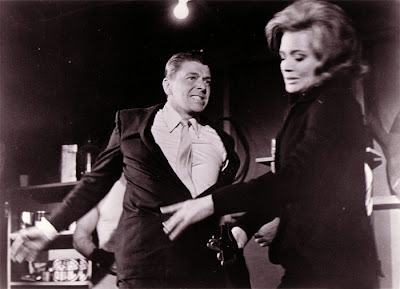
Ronald Reagan hitting a girl

Ronald Reagan hitting a girl

A review of William F. Buckley, Junior’s The Reagan I Knew includes a couple of anecdotes from the book.  I reproduce them below:

Buckley’s Reagan is robust: when we (and Buckley) first meet him, he is about to introduce a Buckley talk at a Los Angeles high school. But the microphones are dead and can only be switched on from a locked booth above the auditorium.

“His diagnosis seemed instantaneous,” Buckley recalls. “He was out the window, his feet on the parapet, his back to the wall, sidestepping carefully toward the control-room window. Reaching it, he thrust his elbow, breaking the glass, and disappeared into the control room.” In a moment, “we could hear the crackling of the newly animated microphone.”

At their final encounter, in 1990, the ex-president again demonstrates his adventurous streak. He holds out his cup of tea to Buckley: “Stick your finger in this.”

What?

“Yeah. Go ahead.”

The drink is scalding. “Now, watch this,” Reagan says as he swigs from the cup. “See? The tolerance of your mouth tissues is infinitely greater than that of your hand! … You know who taught me that? It was Frank Sinatra.”

You can see why someone lack that would grab people’s imaginations.  

New Year, Old Right

The latest issues of my two standard “paleocon” reads, The American Conservative and Chronicles, include fewer really noteworthy articles than average.  The election of Mr O as president and a solidly Democratic Congress freed them to turn from the constant struggle to show how they differ from the Bush/ Cheney Right and toward standard-issue conservative territory, denouncing government spending, unconventional family structures, etc. 

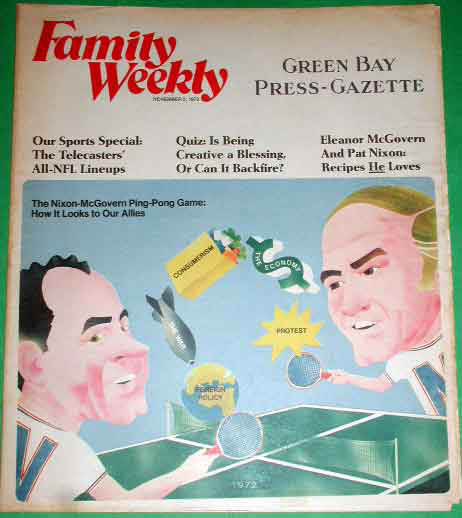
The contest, 1972

The contest, 1972

In The American Conservative, Daniel McCarthy argues that George McGovern’s 1972 presidential campaign triggered a transformation of the Republican Party by driving Cold War liberals into its ranks.  Mary Wakefield reviews Richard Dowden’s Africa: Altered States, Ordinary Miracles, Wakefield reports that Dowden, the current director of the Royal African Society, is deeply pessimistic about western programs to aid Africa, but deeply optimistic about Africans’ ability to build a future for themselves if left alone. 

Sheldon Richman offers a succinct explanation of the Austrian school of economics’ theory of malinvestment and uses this theory to explain the current financial crisis.  David Gordon reviews a book by the most celebrated living opponent of the theory of malinvestment, Paul Krugman. 

Aung San Suu Kyi

Aung San Suu Kyi

Jim Pittaway,  licensed psychotherapist and friend of the late Michael Aris, applies his professional expertise and his personal animosity to Aris’ widow, Aung San Suu Kyi, to an analysis of western policy towards Burma.  The professional expertise part is quite illuminating.  Suggesting that we should view the Burmese regime’s relationship to its people as one of captor to hostage, he asks us to apply “the biggest rule of hostage crises: unless you can take him out right now, don’t threaten the perp.”  Since the 1990 election, the West’s dealings with Burma have consisted primarily of a series of idle threats, and the hostages have paid the price. 

(more…)

The American Conservative, 15 December 2008

George Frost Kennan, by Ned Seidler

George Frost Kennan, by Ned Seidler

Several pieces this time despair of any prospect that traditionalist conservatism will reassert itself as a force to be reckoned with in American politics.  What, then, do the writers for this traditionalist publication believe is to be done? 

At least two of them seem to think that the time may have come to give up on the USA altogether.  Bill Kauffman writes an admiring piece about Kirkpatrick Sale’s Third North American Secessionist Convention, singling out for praise the doughty Yankees of the Second Vermont Republic, who want to break away from the continental Leviathan in the name of Ethan Allen, Robert Frost, and maple syrup.  A review of Lee Congdon’s George Kennan: A Writing Life includes remarks on Kennan’s argument in his late work Around the Cragged Hill that the USA is too big for anyone’s good and should be broken into smaller constituent republics. 

Elsewhere, a letter to the editor takes issue with those who claim that neoconservative advocates of the 2003 invasion of Iraq could have been so foolish as actually to have believed the sorts of things they said in public at that time.  The correspondent asks the magazine to “spare me the ‘neocons were dumb to believe Iraq would turn into Ohio’ nonsense.  These grown-up guys, smart enough to become advisors to the political leadership of the most powerful military on the planet, weren’t convinced of something a 10-year old knew?  Please.  It’s nice to imagine that some massively dumb, partially blind, amazing social phenomena led us into this debacle, but the truth seems simpler and more banal: the neocons didn’t care and neither did we.” 

The fallacy here seems obvious.  “These grown-up guys, smart enough to become advisors to the political leadership of the most powerful military on the planet”- that’s an impressive description.  The correspondent is right to be impressed, we should be impressed as well.  But keep in mind, every one of the members of that group was at least as impressed by his or her colleagues as we are.  Sitting at a table surrounded by such people, who would dare be the first to say something radically different from what the others were saying?  Unless someone goes first and breaks the spell, a roomful of extremely competent people can march blindly into mistakes any well-informed individual, sometimes any normal 10-year old, could have warned them against.  Many policymakers are acutely aware of this danger; indeed, when President Truman made George Kennan head of policy planning at the US  State Department in the late 1940’s he explicitly defined Kennan’s job as speaking up against the preconceptions under which others were laboring and breaking the spell of those preconceptions.

(more…)

The American Conservative, 17 November 2008

In a used book store years ago, I bought some old issues, circa 1965, of National Review.  They weren’t all that interesting on their own merits.  What stuck in my mind about them was the sadness that ran through them.  Each article seemed to be a form of mourning for a kind of politics that was no longer possible, for a kind of country that no longer existed.

That’s very much the feeling I got from this issue of The American Conservative.  The cover features a checklist of G. W. Bush’s “Missions Accomplished”: “Start a war (or two); Shred Constitution; Crash economy” etc, etc.  Inside is a five article retrospective on the horrors of the Bush-Cheney administration (including articles by our old friends Alexander Cockburn and Allen Carlson.)  As Bush and company prepare to leave office, these articles take on a strangely distant sound.

Michael Brendan Daugherty looks at the results of California’s Proposition 8 and concludes that it is likely to be the last victory that he and his fellow opponents of same-sex marriage will be likely to celebrate.  Pointing out that Proposition 8 and similar measures have passed only because so many voters aged over 65 backed them, Daugherty claims that “Absent an incredible shift in attitudes, same sex marriage will soon command majority support.”

David Gordon gives a favorable review to James Kalb’s The Tyranny of Liberalism.  Apparently Kalb defines “liberalism” as “the rejection of moral authorities that transcend human purposes,” and from this definition lays great mischief at the feet of the liberal tradition.  I’ve read several interesting articles by Kalb, for example in the journal Telos, and have gone to his blog in hopes of finding more like those articles.  But I must say I’ve been disappointed.  His editors must add a lot of value to his work- the blog usually includes several overly abstract defenses of the Roman Catholic faith that Kalb has adopted, interspersed with current affairs commentary from what it might be charitable to call an anti-Zionist perspective.

I’m getting to be quite fond of their backpage columnist, Bill Kauffman.  This time around Kauffman remembers novelist John Gardner, who like him lived in Batavia, New York.  After describing the lengths to which he and his fellow Batavians have gone to keep the memory of Gardner and his works alive, Kauffman interjects, “You know what?  Gardner is not even among my hundred favorite American novelists.  But he is ours.  That is enough.”  When I was a teenager, I read Gardner’s The Art of Fiction.  I remember that it was pleasant to read, that’s all I do remember of it.

The American Conservative, 3 November 2008

The cover of this issue features caricatures of Senators John McCain and Barack Obama, advertising 18 short pieces by various contributors explaining how they reacted to the presence of that pair as candidates for US president.  Of those 18, 4 expressed support for Obama, 3 for McCain, 2 for Constitution Party nominee Chuck Baldwin, 2 for Libertarian Party nominee Bob Barr, 1 each for non-candidates Ward Connerly and Ron Paul, and the remaining 5 backed no one

John Schwenkler reports from the Middlebury Institute’s Third North American Secessionist Conference in Manchester, New Hampshire.  Headed by old-time New Left leader Kirkpatrick Sale, the Middlebury Institute gives equal footing to far left groups like the Second Vermont Republic and far right groups like the League of the South, much to the dismay of bien-pensant liberals.  Sale and company argue that “the so-called American Revolution… was a war of secession, not a revolt” and that separatism has a long history in American history, a history reaching far beyond the late unpleasantness between the states.  Schwenkler quotes Emory University philosopher Donald Livingston, a scholar of the Scottish Enlightenment who has apparently turned in recent years to Aristotle’s Politics and its emphasis on the proper scale of human communities.  Aristotle might have argued that the United States is simply too big to do any good.  Aristotle followed Plato in his belief that there was an appropriate size for a human society, that too small a group would be doomed to perpetual poverty while too large a group would lack any real bond of community.  This focus on the need for human communities to be built on a human scale has been one of the recurring themes in political theory ever since.  Because Livingston has spoken harsh words against Abraham Lincoln and the centralization of power in Washington that followed the Civil War, he has occasionally been smeared as a racist. 

Austin Bramwell argues that conservatives would be better off if there were no conservative political movement.  One may be tempted to add that in this they are like everyone else.  Bramwell’s claim is that what conservative intellectuals have to offer is something of value to independent minded individuals, but useless as a battle cry for partisans.  As examples of the kind of conservative intellectuals he has in mind, Bramwell offers Joseph Schumpeter, Jane Jacobs, Tom Wolfe, Jacques Barzun, Noam Chomsky, E. O Wilson, and Steven Pinker.  Bramwell classifies Schumpeter as conservative for precisely the reason so many on the right are uncomfortable with him today, his support for a “semi-feudal, mixed constitution” that would act to temper capitalism.  Jacobs self-identification as a leftist does not trouble Bramwell; her focus on the need for society to be constituted on a human scale and her opposition to centralized planning put her in his camp.  Chomsky, Wilson, and Pinker make the list because of the defenses each has offered for the idea that human behavior has biological bases that social planning cannot overwrite.  Indeed, Bramwell turns Chomsky’s ceaseless denunciations of US foreign policy into a conservative credential by pointing out that “Chomsky describes his politics as an attack on social engineering as he perceives it.” 

Howard Anglin reviews Marilynn Robinson’s novel Home, declaring that “Without artists like Robinson, without books like Home and the institutions they celebrate, our civilization cannot last long… If Marilynn Robinson is a liberal, then America needs more liberals.”  Considering that the review opens by quoting Robinson’s 2004 statement that “I am myself a liberal,” this last sentence would seem rather odd in a magazine called The American Conservative.  The rest of the quote (from her 2004 essay “The Tyranny of Petty Coercion” ) shows that she is about as conservative as Noam Chomsky and Kirkpatrick Sale:

I am myself a liberal.  By that I mean I believe that society exists to nurture and liberate the human spirit, and that large-mindedness and openhandedness are the means by which these things are to be accomplished.  I am not ideological.

(more…)

The American Conservative, 20 October 2008

Psychotherapist Jim Pittaway looks at John McCain and sees a man badly in need of psychiatric evaluation.  Pittaway stresses that he would never diagnose a patient whom he has not met, but published accounts of McCain’s experiences and behavior suggest that he may suffer from moderate Traumatic Brain Injury.  Pittaway writes:

There are three signal characteristics of moderate TBI: emotional disregulation (volatility), perseveration (inability to let go of thoughts or feelings or to see them in broader perspective), and concrete thinking (abstractions and nuance are compressed into right or wrong, good or evil, people are either “for me or against me.”) 

McCain’s notoriously bad temper (for example, hitting a 93 year old colleague on the Senate floor), his insistent repetition of ideas that have been proven false (for example, claiming that Iran was arming the anti-Iranian group “al Qaeda in Iraq,” a claim that earlier this year humiliated him when he had to be publicly corrected by a friend- and which he then continued to repeat at subsequent appearances), and his habit of describing every conflict as a moral struggle (for example, briefed on some structural difficulties in international finance his response was to ask the briefer “So, who’s the villain?”) suggest the behavior patterns associated with moderate TBI.  Torture and beatings McCain has described receiving from his North Vietnamese captors could hardly have failed to inflict substantial injury on his brain.  Psychiatric tests and neurological scans can rule TBI in or out rather easily, but McCain has made it clear he will never submit to such examination.  McCain’s stated belief that he avoided any psychological damage by sheer willpower is what psychologists call “magical thinking,” and suggests that his psychological wounds are surrounded with a formidable structure of denial. 

Pittaway himself has treated many TBI patients, and his description of their lives is terrifying if it applies to a man who may find his finger on the nuclear trigger.  “Difficulties with abstract thinking breed obsessive behaviors and tendencies to personalize issues in very concrete terms in lieu of dealing with nuance and complexity.”  Moreover:

In my work with TBI patients with moderate symptoms, I am invariably struck by the level of frustration they encounter on a daily basis.  Unless it is severe, brain injury is a closed wound.  Since victims appear undamaged, everyone around them expects- and they themselves often expect- normal skill sets, behaviors, and emotional ranges.  The energy it takes to compensate for functional deficits is extraordinary, and the absence of affirming feedback breeds a senseof isolation that morphs over time into deep-seated resentment.  It ismuch, much easier to stay focused on one thing, which accounts for the characteristic obsessiveness.  Execution is driven by resentment and anger rather than objective circumstances.  Thisbreeds a toughness that can endure enormous amounts of stress before decompensation- which is almost always of an extremely violent nature- occurs.

Elsewhere in the same issue, David Gordon looks at Public Choice Economics.  Public Choice economists argue that indifference to politics is rational among voters, inasmuch as no one vote is likely to decide an election.  Gordon points out that there are other motives for voting than the hope that one will decide the election.  For example, even votes for a losing candidate may send a message that the eventual winners will notice, and being among the winners of a high-profile contest brings a satisfaction that many people desire. 

John Derbyshire reviews the “Stuff White People Like” book.  Unlike The Atlantic‘s reviewer, Derbyshire doesn’t get the significance of the phrase “White People”-the targets of Lander’s mockery are trendy progressives who would hate to be labeled as typically white.  He does mention Lander’s personal favorite among sites that have imitated his, “White Stuff People Like” (plaster, cream cheese, plastic bags, swans, mayonnaise, cocaine, and snow are the list so far.)

The American Conservative, 6 October 2008

For me, the highlight of this issue was a piece by Claes G. Ryn, editor of Irving Babbitt in Our Time, The Representative Writings of Irving Babbitt, and the author of Will, Imagination and Reason: Irving Babbitt and the Problem of Reality.  Unfortunately Professor Ryn does not mention Babbitt’s name in this article, but he does give a strongly Babbittian analysis of the so-called “conservatism” that has entranced so many of America’s policy makers.  After rehearsing Babbitt’s argument that our Constitution can work only in a society where people are committed to simplicity, value tradition, and are accustomed to respecting limits, Ryn discusses the theories of Leo Strauss, whom he considers to be a sort of anti-Babbitt.  “According to Strauss,” Ryn writes, “no real philosopher gives credence to ‘the conventional’ or ‘the ancestral,’ to use his terms.  Respecting them represents the greatest of all intellectual sins, ‘historicism.’  Inherited ways are, he insisted, mere accidents of history.  Respect is owed to the ‘simply right,’ which is ahistorical and rational.”  It is this ahistorical, anti-traditional, intellectualistic creed that has inspired neoconservative thinkers who have argued in favor of the wars and other power grabs of the current administration in Washington.

More from the antiwar Right

The American Conservative, 8 September 2008

Two major articles deal with the fear that haunts many of the “Old Right” contributors to this publication, the fear that America is becoming dependent on foreign powers.  An obituary for Lieutenant General William Odom discusses the testimony the general gave to the US Senate in early April, in which he pointed out that US forces in Iraq depend “on a long and slender supply line from Kuwait, which runs through territory controlled by Shi’ite forces friendly to Iran” [a quote from the obituarist, not Odom’s own words.)  American service personnel in Iraq are therefore hostages at the disposal of Iran. 

Andrew Bacevich attacks American consumerism and its economic consequences.  Our insatiable appetite for luxuries, Bacevich argues, has saddled us with debts and a dependence on imported fuels that we can manage only by maintaining a constant war footing, while our wars serve only to increase our debts and deepen our dependence.   

The American Conservative, 25 August 2008

Remember George W Bush saying that the fall of Saddam Hussein meant that the “rape rooms” in his prisons would forever close?  Abu Ghraib made a sick joke out of that boast.  Well, the return of rape rooms wasn’t the end of it.  Since the current war began in March 2003, well over 2 million Iraqis have been forced from their homes.  Most of them left empty-handed.  How have they been surviving since?  Kelley Beaucar Vlahos shows how; tens of thousands of Iraqi women and girls have been forced into prostitution.  No one in authority is even collecting statistics about these victims of daily rape, much less trying to help them.   On the contrary, when it was revealed that a major US defense contractor was shuttling women and girls between Kuwait and Baghdad to be used as sex slaves, the story went nowhere.  The matter remained so obscure that even Vlahos misreports the name of the whistleblower who revealed it.  She calls him Bruce Halley.  His name is Barry Halley. 

(more…)