The American Conservative, November 2009

american conservative november 2009In this issue, former FBI employee Sibel Edmonds names some prominent US officials whom she believes to have accepted bribes from foreign governments.   

Eve Tushnet visits a Washington, DC locale known to the federal government as Meridian Hill Park, though she has “only seen its maiden name in two places: District government plaques and local girl Florence King’s autobiography, Confessions of a Failed Southern Lady.”  Everyone else calls it Malcolm X Park.  Tushnet compares the design of the place to a ziggurat, a Sicilian village, a complex borad game, and the world’s largest Slinky.  I can see why; there are also some views which remind me of M. C. Escher.  Whatever the park’s designers were thinking, they don’t seem to have been thinking of crime prevention.  “It’s an array of alcoves linked by narrow paths and staircases… The high walls and ample foliage make it a haven for people whose professions or hobbies require a talent for lurking.”  No one seems to be committing any crimes during Tushnet’s visit, though she does have her suspicions about a man who introduces himself as a podiatrist.  

A humor piece is written as if it were a diary entry by classicist-cum-neoconservative madman Victor Davis Hanson.  The locution “No American wishes to contemplate the idea of war, but” occurs three times, the locution “No Namibian mercenary wishes to contemplate the idea of war, but” occurs once.  A truly Hansonian piece, I’d say.   

(more…)

The American Conservative, October 2009

american conservative october 2009

The cover may suggest an alarmist piece about Pakistan.  The article actually in the issue, though, is precisely the opposite.  Granting that Pakistan is an important country that has very serious problems, it asserts that there is no chance that it will break up, fall into the hands of Osama bin Laden, or launch a nuclear attack.  If the USA sobers up and pursues a more realistic policy in Afghanistan, Pakistan might even make progress on its real problems.

Elsewhere in the issue, Andrew Bacevich quotes Cold Warrior Richard Pipes’ 1979 declaration to the effect that since Afghanistan is a place of no strategic importance, the Soviet invasion of that country must have been a step towards a goal elsewhere.  Bacevich agrees that Afghanistan was without strategic importance when Pipes said that, and says that it continues to be so.  Where he disagrees with Pipes is in his assessment of the rationality of the Soviet leadership of the 1979-1989 period, and indeed of the US leadership of today.  He claims that the Soviets invaded Afghanistan because they believed that showing power there would shore up their empire; in fact, the Soviet occupation of Afghanistan was a significant factor in the eventual collapse of the USSR.  Likewise, America’s leaders want to persist in Afghanistan, not because of they have made any rational calculation indicating that they should, but because they are dare not make a calculation that might indicate that they should not.

This issue includes a piece by always-intriguing, highly eccentric writer Eve Tushnet.  Tushnet has a gift for the lapidary; she describes growing up in Washington, DC as one of very few white children in her neighborhood, albeit one “weird enough that my skin color was not one of the obvious targets of teasing.”  Recounting her childhood Halloweens, she writes that “A mask is above all an attempt to communicate, to create and reshape meaning over the silence of skin.”  Quite a provocative phrase, “the silence of skin.”  On a par with her line from 2008, “by religion, I mean an understanding of the nature of love.”

(more…)

The American Conservative, September 2009

american conservative september 2009One of the traits of this magazine is a tendency to grandiose theoretical explanations.  That’s one of the things I like about it; I’m into grandiose theoretial explanations myself.  It isn’t scholarly publication, and few of its authors have academic reputations to defend, so that tendency is not always restrained by the standards that keep theorizing under control in academic journals.  Sometimes that means that the magazine runs a provocative, bold idea that might not have survived heavier editing; sometimes it means that it runs something that’s just plain cheesy quality.  Again, I’m a pretty cheesy guy, so that’s okay with me. 

For example, this month Ted Galen Carpenter points out that Americans by and large are quick to view political disputes in foreign countries in a romantic light, seeing the ghost of Thomas Jefferson in all sorts of unlikely figures.  The next piece, by John Laughland, picks up on this same theme, explaining this American tendency as a sign of the influence of the philosophy of the Enlightenment.  Laughland writes that “the key to understanding the West’s love of revolutions” is Westerners’ characteristic desire to believe that “politics can and should be a story with a happy ending.”  This desire has run rampant in the West ever since the thinkers of the Enlightenment undermined the traditional Christian belief that the cosmos was ordered in a hierarchy, that justice was to be found in that hierarchy, and that the ruler’s power should be limited because the ruler was subordinate to God.  Laughland identifies Immanuel Kant as “the greatest of all Enlightenment philosophers,” and summarizes Kant’s theory as a belief that ordinary reality is unknowable, but that the highest reality is “the categorical imperative- an abstract universally valid proposition that becomes real when it is willed.”  Proceeding from these rather drastic simplifications, Laughland declares that:

The attraction of Enlightenment liberalism, therefore, is the result of a deep emotional need for a philosophical sytem that enables man to create a reality in a universe he does not understand and thereby to escape from the difficulties of the world by believing that everything will turn out all right in the end.  Lacking a real belief in the afterlife, it also holds that the drama of human salvation is played out in this world, in history and politics. 

Again, this is a severe oversimplification, but it has a certain plausibility.  Where Laughland really goes off the rails is in his closing section, in which he argues that Enlightenment liberalism has an “objective ally” in Islam:

[B]ecause it has no priesthood, Islam, and especially Shi’ism, is fundamentally a “democratic” religion comparable to Puritanism and other forms of Presbyterianism.  There is no established hierarchy; the Koran must be read equally by all.  Of course Allah is supreme and Islam demands absolute submission to Him; on the face of it, this seems the opposite of the liberal model in which the individual is subjected only to himself.  But this very submission is egalitarian, creating a mass of individuals who are equal in their abstractness.  Moreover, God’s will is [merely] will, it has no correlation with natural law as in the Christian or Jewish traditions.  Islam is therefore a profoundly voluntarist religion.  Because Allah is absolutely transcendent and unknowable, he is like the Kantian thing-in-itself: mere command. 

(more…)

The American Conservative, August 2009

american conservative august 2009With this issue, our favorite “Old Right” read gives up its quixotic biweekly publication schedule and becomes the monthly it should always have been.  

In the cover story, Brendan O’Neill casts a gimlet eye on the environmental initiatives now chugging through official Washington.   He sees in them little more than a series of raids on the treasury by well-connected businesses.  He cites Gabriel Calzada, a Spanish economist who found that every job his country’s wind power initiative had created represented a cost of $2,200,000 to the taxpayer.  Of course, the jobs don’t pay $2,200,000- most of that money goes to corporate interests.  O’Neill argues that the alternative energy plans now under consideration in Washington are at least as bad as is Spain’s wind power initiative. 

Former US Army interrogator Matthew Alexander explains what he did in Iraq that his colleagues didn’t.  He followed the rules, they didn’t.  He treated detainees with respect, they didn’t.  He obtained useful intelligence, they didn’t.  When information he had elicited led to successful US military operations, they got medals, he didn’t. 

(more…)

The American Conservative, 18 May 2009

The Balance of Power

The Balance of Power

Michael Desch’s cover story, “Apocalypse Not,” argues that while Iran is nowhere near having nuclear weapons, things wouldn’t be so bad even if it did have them.  Desch quotes some of the overheated rhetoric of anti-Iranian hawks.  One line that stuck out for me was a quote from Israeli prime minister Binyamin Netanyahu: “You don’t want a messianic apocalyptic cult controlling atomic bombs. When the wide-eyed believer gets hold of the reins of power and the weapons of mass death, then the entire world should start worrying.”  To which an uncharitable observer might add, he should know… 

In response to assertions of this sort, Desch points out, first, that deterrence kept both Joseph Stalin and Mao Tse-tung from using nuclear weapons, and no one seriously argues that Iran’s leadership today is more warlike than were Stalin or Mao.  Second, the Iranian political system does not centralize decision-making to any one man, as the Soviet and Chinese systems did in the days of Stalin and Mao.  Therefore, it is far less vulnerable to the paranoid delusions of a single leader than were the systems those men dominated.  So if nuclear deterrence was good enough to keep Stalin and Mao in check, it should be good enough to keep Ahmedinejad in check as well.  Desch goes further, arguing that acquiring a nuclear arsenal might even lead the Iranian regime to become less difficult for its neighbors to live with.  The existence of such an arsenal might enable the US and Israel to adopt a containment strategy towards Iran, which might lead to a mellowing of the regime, as the Soviet regime mellowed in the decades of containment following Stalin’s death.     

Stuart Reid claims that “The truth is that man is no longer civilized enough to wage war.”  What we call war, earlier ages would have seen as sheer murder. 

A review of Defending the Republic: Constitutional Morality in a Time of Crisis commends its authors, conservative legal scholars and political theorists, for recognizing that while the center-left still tries to use the courts to do what should be done through the elected branches of government, “there is an anti-constitutional Right as well.”  Irving Babbitt scholar Claes G. Ryn contributes an essay to the volume in which he equates the neoconservatives with the Jacobins of the French Revolution, likening the wars of the Bush/Cheney years with the Vendée and the first stirring of Napoleon’s campaigns of conquest.  The title of Ryn’s essay is “Neo-Jacobin Nationalism or Responsible Nationhood?,” proposing a dichotomy of the sort Babbitt would have relished.   Ryn develops the same dichotomy here.

The American Conservative, 4 May 2009

mrhardingposterI’ve long thought that the last truly acceptable US president was Warren G. Harding.  He was virtually the last president not to have committed American forces to a new war.  On the contrary, President Harding pulled US troops out of Russia, where his predecessor Woodrow Wilson had sent them to fight alongside the anti-Bolshevik forces.  He negotiated a peace with Germany separate from the  Versailles treaty and free from that document’s vengeful anti-German provisions and its dangerously open-ended entanglement with the League of Nations.  He concluded the Washington Naval Convention, an agreement which staved off the kind of arms race at sea that had led to the First World War.  And while most other president’s have treated the other countries in the western hemisphere with barely disguised contempt, a habit which made it possible for Woodrow Wilson actually to say of his 1913 incursions into Mexico that he was going to use the US military to “teach the Latin American republics to elect good men,” Harding showed genuine respect for his countries neighbors.  In a 1920 campaign speech, he denounced Wilson’s intervention in Haiti, saying:

Practically all we know is that thousands of native Haitians have been killed by American Marines, and that many of our own gallant men have sacrificed their lives at the behest of an Executive department in order to establish laws drafted by the Assistant Secretary of the Navy. … I will not empower an Assistant Secretary of the Navy to draft a constitution for helpless neighbors in the West Indies and jam it down their throats at the point of bayonets borne by US Marines. 

The Assistant Secretary of the Navy in question was at that time also the Democratic Vice Presidential nominee.  This official had publicly said that “The facts are that I wrote the Haitian Constitution myself, and if I do say it, I think it’s a pretty good constitution.”  The man’s name?  Franklin Delano Roosevelt.  As president, FDR would speak of a “Good Neighbor Policy” toward the other states in the Americas, but as a party to the invasion and occupation of Haiti during the Wilson administration he was rather less entitled to be called a “good neighbor” than was Harding.    

Harding’s peaceful record in foreign policy was matched by his concern for liberty at home.  Unlike most of his successors, Harding did not increase the number of grounds on which Americans could be imprisoned; on the contrary, he released the political prisoners Woodrow Wilson’s administration had locked up during the First World War and the subsequent First Red Scare.  He even invited the most famous of these prisoners, Socialist leader Eugene V. Debs, to have Christmas dinner with him at the White House. 

(more…)

The American Conservative, 20 April 2009

http://www.amconmag.com/issue/2009/apr/20/

humane-economyAn old, and possibly apocryphal, story anchors Dermot Quinn’s appreciation of twentieth century German-Swiss economist Wilhelm Röpke.   Röpke was walking along a road with Ludwig von Mises, the great champion of free-market economics.  The two saw a neighborhood garden in a crowded urban center.  Seeing land that was in high demand for residential and commercial development given over to an elaborate tangle of separate plots and shared irrigation,Mises sniffed that it was “a most inefficient way of producing vegetables.”  Perhaps so, said Röpke.  “But it is a most efficient way of producing human happiness.”  Röpke has attracted every label in economics, from socialist to free marketer.  None of those labels really fit Röpke, because they all classify thinkers by which answer they offer to questions about what sort of economic system allocates resources most efficiently.  These questions struck Röpke as absurd.  Though as a technical economist Röpke had few peers, his interests were always in human beings and their development, not in any of the fashionable abstractions of his time such as “The Economy” or “The Market” or “The State” or “The Proletarian Revolution” or “The Aryan Race.”     

Barack Obama was elected president with the votes of millions of Americans who had had enough of war.  Now that Mr O has announced plans to increase troop levels in Afghanistan and officials of his administration have suggested that they may expand the Afghan war into Pakistan, his antiwar supporters are hardly raising a peep.  This leads Justin Raimondo to ask “Was the Left antiwar or just anti-Bush?”  Raimondo started antiwar.com when President Bill Clinton ordered US forces to bomb Serbia in 1999.  At the same time, your humble correspondent was also active in the antiwar movement.  Like Raimondo, I was struck by the passivity with which the supposedly dovish members of the Democratic Party went along with that adventure.  I’d always been curious about the antiwar Right, ever since I was a little kid hearing my parents reminisce about how their staunchly Republican parents had opposed FDR’s military interventionism with the same fervor that they opposed his economic interventionism.  After 1999, I was convinced that the “Old Right” was indispensible to any effort to break America of its addiction to warfare. 

The “Deep Background” column is less pessimistic about Afghanistan, pointing out that while “the nation-building agenda” that Mr O has publicly espoused for Afghanistan “is unrealistic and likely unattainable, a security framework to facilitate the kind of limited political consensus that would permit American withdrawal might just be achievable.”  So, the grounds for hope is that the stated purposes of Mr O’s actions in Afghanistan are so patently absurd that they likely mask an unstated plan to withdraw American forces from the country. 

Peter Hitchens, whose brother is also a magazine journalist, worries that all is not well in the new South Africa.  President-designate Jacob Zuma’s fondness for the song “Bring Me My Machine Gun,” his closeness to the South African Communist Party, his refusal to be interviewed by journalists, his open practice of polygamy, his public boasts that he used to make a habit of beating homosexuals senseless, his apparent belief that HIV-AIDS is something that can be cured by a nice hot shower, and his former role as the defendant in a rape trial all combine to suggest to Hitchens that Zuma might be something less than the ideal leader for South Africa at this particular moment in its history.

The American Conservative, 6 April 2009

carter1

The man who gave the speech

Sean Scallon argues that Jimmy Carter’s 15 July 1979 address to the nation, known to political infamy as the “malaise speech,” showed an awareness of America’s limits that made it the most truly conservative public statement any president has made in recent decades.  Nor does the speech deserve its reputation as a political disaster.  Carter’s approval ratings went up after he delivered it, and only dropped when he engaged in the “political gimmick” of demanding that his whole cabinet resign.  Carter didn’t really lose the public, the piece claims, until he responded to the Soviet invasion of Afghanistan with an ultra-hawkish policy.  His hard line contradicted all the wisdom and humility in the speech; coming on its heels, it seemed to spring from a fit of hysteria.  The contradiction between Carter’s sober words of July and his sabre-rattling of a few weeks later left him intellectually defenseless when Ronald Reagan, a cheerful man unburdened by any public record suggesting cautious realism, presented the same hard line militarism as the centerpiece of his campaign to unseat Carter. 

The man who responded to the Soviet invasion of Afghanistan

The man who responded to the Soviet invasion of Afghanistan

(more…)

The American Conservative, 23 March 2009

Sun and Wind on the Roof, by John Sloan

Sun and Wind on the Roof, by John Sloan


Bill Kauffman takes on the idea of a federal department of Arts and Culture, a proposal long championed by someone he admires, Quincy Jones.  Kauffman quotes the painter John Sloan, who in 1944 said, “Sure, it would be fine to have a Ministry of Fine Arts in this country.  Then we’d know where the enemy is.”  He goes on to praise William Saroyan, whose pacifist principles led him to refuse to shake President Roosevelt’s hand at a reception during World War II, and William Faulkner, who rejected a social invitation from President Kennedy on the grounds that “the White House is too far to go for dinner.”  Kauffman himself once served on a National Endowment for the Arts panel, and the experience convinced him that Quincy Jones was wrong and these men were right.

Paul Gottfried argues that, contrary to what one might gather from cable TV, for most of the history of the USA it has been conservatives who have been the most prominent and most consistent opponents of the expansion of militarism and of presidential power.  For example, the only senator to vote against internment of Japanese-Americans during World War Two was the original “Mr. Republican,” Robert Alphonso Taft.  Today’s “conservative” militarists, Gottfried claims, have succeeded because their approach enables them to combine two basically disparate impulses:

Neoconservative historiography prevailed against the Old Right because it could build on the Left’s moral assessments- treating Lincoln and General Sherman as great emancipators, for example- while at the same time tapping into the patriotic, pro-military sentiments of American Republicans and Fox News-viewing conservatives.

The American Conservative, 9 March 2009

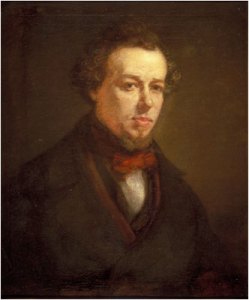
Benjamin Disraeli as a Young Man

A review of Adam Kirsch’s biography of Benjamin Disraeli focuses on Kirsch’s idea that because Disraeli realized he could not stop his fellow nineteenth-century Englishmen from thinking of him primarily in terms of his Jewish ancestry, he “did not attempt to disguise his Jewish background.  He embellished it.”   Disraeli purported to be far more deeply involved with that side of his ancestry than he in fact was, even explaining his active membership in the Church of England as an example of his fealty to “the only Jewish institution that remains… the visible means which embalms the race.”  Meanwhile, the Jewish characters and themes in Disraeli’s novels appall modern sensibilities.  Sidonia, a character in the Young England trilogy (Coningsby, Sybil, and Tancred,) “looks like nothing so much as an anti-Semitic hate figure.  It is amazing, in fact, how Disraeli manages to combine in this one character every malicious slander and paranoid fear that the anti-Semitic imagination can breed.”  Disraeli’s manipulation of the label his fellows had imposed upon him enabled him to become prime minister of the United Kingdom.  Disraeli’s ability to “outline [an] agenda of radical change to be achieved conservatively, a political program that allowed him to reinvent himself as the representative not only of the wealthy and the working class but of the Tory Party, too” has inspired rightist politicians like Richard Nixon and the neocons.      

If Kirsch is right, Disraeli knotted his contemporaries’ perceptions of him around their image of “the Jew,” using their prejudices to transform  himself from a marginal figure unlikely to make a mark in politics into a figure of England’s national mythology.  Another complex of ideas twists around another such image in Brendan O’Neill’s  analysis of the thoughts of some of Israel’s more fervent defenders in the West.  O’Neill argues that the individuals he cites are less interested in Israel as an actual place inhabited by living people than they are in using a particular idea of Israel as a symbol for the values of the Enlightenment.  “In effect, Israel is cynically, and lazily, being turned into a proxy army for a faction in the Western Culture Wars that has lost the ability to defend Enlightenment values on their own terms or even to define and face up to the central problem of anti-Enlightenment tendencies today.”  This use of Israel as a pawn in cultural struggles centered elsewhere shades into philosemitism.  “[A]s Richard S. Levy writes in his book Anti-Semitism: A Historical Encyclopedia of Prejudice and Persecution, simple philosemitism, like anti-Semitism, also treats the Jews as ‘radically different or exceptional’…  Where anti-Semites project their frustrations with the world and their naked prejudices onto the Jews, and frequently onto Israel, too, the new philosemites project their desperation for political answers, for some clarity, for a return to Enlightenment values onto Israel and the Jews.  Neither is a burden the Jewish people can, or should be expected to, bear.”    

(more…)