Chronicles, December 2010

Lawrence Dennis and his foster mother circa 1908, when he toured England as "the boy evangelist"

I never quite finished my notes on the December 2010 issue of far-right Chronicles magazine, but it includes several notable pieces.  So I’ll mention them now, months late though I may be.

Justin Raimondo brings up one of his favorite writers, Lawrence Dennis.  Dennis is also one of my favorites, though I think it is rather stretching matters for Raimondo to call Dennis an “African-American intellectual.”  Certainly Dennis’ background was African-American; when the 12 year old Dennis toured England as “the boy evangelist” in 1908, his ethnicity gave him an exotic appeal.  And he was undoubtedly an intellectual.  When he was on trial for sedition in 1944, government witness Hermann Rauschning startled the prosecutor by testifying that Dennis was not a tool of the Nazis, but was a thinker fit to be compared with Oswald Spengler.  Dennis was conducting his own defense; when time came for him to cross-examine Rauschning, he rose and thanked him.   Yet Dennis was hardly the spokesman for the African American experience that we’ve come to expect when we hear the phrase “African American intellectual.”  He said little about the African American experience, and never presented himself as a representative of African Americans.  Indeed, the only book-length study of Dennis is titled The Color of Fascism: Lawrence Dennis, Racial Passing, and the Rise of Right Wing Extremism in the United States, and interprets Dennis’ writings and political behavior as symptoms of a life spent passing for white.  As Robert Nedelkoff put it in a sympathetic piece about Dennis that he contributed to issue #13 of The Baffler (published in October 1999,) “when he spoke of race relations he made no reference to his being of a particular race” (page 99.)  Nedelkoff’s piece, covering pages 93-100 in that issue of The Baffler, was the second place I’d read of Dennis; the first was the chapter on Dennis in Ronald Radosh’s 1975 book Prophets on the Right.  Between them, these pieces convinced me that Dennis was more interesting than his onetime embrace of the label “fascist” would indicate.  In a series of books published between 1933 and 1941, Dennis predicted that the USA would eventually adopt an economic system similar to those prevailing in Italy and Germany at that time; that this new system would be promoted as a triumph of America’s traditional system; and that he himself would be prosecuted for sedition for saying that free speech was obsolete.  Looking back in his final book, Operational Thinking for Survival (1969,) Dennis concluded that all of his predictions had been vindicated.

Chilton Williamson shares fond memories of the time when he and the late Joseph Sobran worked together at National Review.   I always looked forward to Sobran’s columns because of the witty remarks that so often appeared there, though I can’t say I ever found a well-constructed argument in any of them.  I must mention a grievance I have against Sobran.  One of the statements he made that got him fired from National Review and driven to the fringes of society was praise for the magazine Instauration.  Because I found much to admire in Sobran’s work, I looked for Instauration.  When the magazine became available online, I read several issues.  I’d expected an intellectual magazine marked by a hard-headed conservatism, with some pieces that crossed the line into racial prejudice.  In other words, I was braced for something rather like Chronicles, only more extreme.  Imagine my disappointment when instead I found a racist tract containing article after article dismissing the Holocaust as a hoax (in the first issue the editors express great satisfaction in putting the word “Holohoax” into print.)

George McCartney reviews the movie The Social Network, by Aaron Sorkin.  Sorkin’s grand project seems to be showing groups of aggressive, self-indulgent people clashing with each other in the course of work that creates a benign product.  The difficulty with such works as The Social Network and The West Wing is that the real-life counterparts of Sorkin’s characters seem to be far more quietly efficient and their products far more problematic than he allows.  So Mark Zuckerberg is rumored to be rather a pleasant sort of chap; Facebook has unnerving features that lead me to call its administrators “the Zuckforce.”  Actual staffers in the White House probably spend less time dashing about the corridors and snarling at each other than they do showing friendliness and good manners; but the US presidency, as they help to constitute it, may well be the single most destructive institution in the world today.  Someone like Lawrence Dennis, were he to see a society with a surveillance network like Facebook and a political leader who starts a war every year or two, would likely show little interest in whether the people administering that network and staffing that leader observed the social graces.  In the popularity of Facebook, he might see a people who had become so thoroughly inured to surveillance that they can enjoy themselves only in an environment structured to record their every move; in The West Wing, a people so inured to war that they expect to enjoy a cozy relationship with the chief warlord.

Intimacy and humanity

A doodle by Franz Kafka, with a comment by Acilius*

Part I.  Some remarks about Franz Kafka

In the Autumn of 1921, Franz Kafka wrote a letter to his sister Elli Herrmann in which he discussed, among other things, Jonathan’s Swift’s educational ideas.  This letter, published in an English translation in The Chicago Review in 1977,** contains these passages:

This, then, is what Swift thinks***:

Every typical family represents merely an animal connection, as it were, a a single organism, a single bloodstream.  Cast back on itself, it cannot get beyond itself.  From itself it cannot create a new individual and to try to do so through the education within the family is a kind of intellectual incest. (page 49)

Kafka enlarges on this statement through two very interesting paragraphs, in the first of which he describes the family as “an organism, but an extremely complex and unbalanced one”; in the second, he attributes the unbalanced character of the family to “the monstrous superiority in power of the parents  vis-á-vis the  children for so many years.”  He then comes to the heart of the matter:

The essential difference between true education and family education is that the first is a human affair, the second a family affair.  In humanity every individual has its place or at least the possibility of being destroyed in its own fashion.  In the family, clutched in the tight embrace of the parents, there is room only for certain people who conform to certain requirements and moreover have to meet the deadlines dictated by the parents.  If they do not conform, they are not expelled- that would be very fine, but it is impossible, for we are dealing with an organism here- but accursed or consumed or both.  The consuming does not take place on the physical plane, as in the archetype of Greek mythology (Kronos, the most honest of fathers, who devoured his sons; but perhaps Kronos preferred this to the usual methods out of pity for his children.)

The selfishness of parents- the authentic parental emotion- knows no bounds.  Even the greatest parental love is, as far as education is concerned, more selfish than the smallest love of the paid educator.  It cannot be otherwise.  For parents do not stand in a free relationship with their children, as an adult stands to a child- after all, they are his own blood, with this added grave complication: the blood of both the parents.  When the father “educates” the child (it is the same for the mother) he will, of course, find things in the child that he already hates in himself and could not overcome and which he now hopes to overcome, since the weak child seems to be more in his power than he himself.  And so in a blind fury, without waiting for the child’s own development, he reaches into the depths of the growing human being to pluck out the offending element…  Or he finds things in the child that he loves in himself or longs to have and considers necessary for the family.  Then he is indifferent to the child’s other qualities.  He sees in the child only the thing he loves, he clings to that, he makes himself its slave, he consumes it out of love.  (page 50)

After this description, Kafka finds it necessary to clarify.  “I repeat: Swift does not wish to disparage parental love; on the contrary, he considers it so strong a force that under certain circumstances children should be shielded from this parental love” (page 51.)  He concludes:

What then must be done?  According to Swift, children should be taken from their parents.  That is to say, the equilibrium the family animal needs should be postponed to a time when children, independent of their parents, should become equal to them in physical and mental powers, and then the time is come for the true and loving equilibrium to take place, the very thing that you call “being saved” and that others call “the gratitude of children” and which they find so rarely.

[snip]

Of course Swift does not deny that parents under certain circumstances can be an excellent unit for educating children, but only strangers’ children.  That, then, is how I read the Swiftian passage.

If Kafka shared the view that “parents under certain circumstances can be an excellent unit for educating children, but only strangers’ children,” one may wonder what those circumstances would be.  What always comes to my mind when I read that line is the passage in The Castle when K. is told that he and Frieda are to make their home in a classroom:

You have, Land-Surveyor, to clean and heat both classrooms daily, to make any small repairs in the house, further to look after the class and gymnastic apparatus personally, to keep the garden path free of snow, run messages for me and the woman teacher, and look after all the work in the garden in the warmer seasons of the year.  In return for that you have the right to live in whichever one of the classrooms you like; but when both rooms are not being used at the same time for teaching, and you are in the room that is needed, you must of course move to the other room.  You mustn’t do any cooking in the school; in return you and your dependents will be given your meals here in the inn at the cost of the Village Council.  That you must behave in a manner consonant with the dignity of the school, and in particular that the children during school hours must never be allowed to witness any unedifying matrimonial scenes, I mention only in passing, for as an educated man you must of course know that.  In connection with that I want to say further that we must insist on your relations with Fräulein Frieda being legitimized at the earliest possible moment.  About all this and a few other trifling matters an agreement will be made out, which as soon as you move over to the school must be signed by you.”  To K. all this seemed of no importance, as if it did not concern him, or at any rate did not bind him; but the self importance of the teacher irritated him, and he said carelessly: “I know, they’re the usual duties.” ****

In this passage I suppose we see the obverse of the point Kafka finds in Swift.  As the family is an impossible setting for the education that raises a person above the animal level, so a schoolroom is an impossible setting for the animal connection that grounds the intimacies of family life.

The overall impression is of a horror of intimacy.  Kafka, or Jonathan Swift as Kafka interprets him,  recoiled from the intimacy of the bond between parent and child and dreamed of replacing that bond with the professional relationship between teacher and pupil.  Throughout his diaries, Kafka mirrors the desire to replace an urgently intimate relationship with a coolly professional one as he confesses that he is holding Felice Bauer and her successors at a distance while developing an ominous fascination with prostitutes.  Take for example this passage, which he wrote on 19 November 1913:

I intentionally walk through the streets where there are whores.  Walking past them excites me, the remote but nevertheless existent possibility of going with one.  Is that grossness?  But I know no better, and doing this seems basically innocent to me and causes me almost no regret.  I want only the stout, older ones, with outmoded clothes that have, however, a certain luxuriousness because of various adornments.  One woman probably knows me by now.  I met her this afternoon, she was not yet in her working clothes, her hair was still flat against her head, she was wearing no hat, a work blouse like a cook’s, and was carrying a bundle of some sort, perhaps to the laundress.  No one would have found anything exciting in her, only me.  We looked at each other fleetingly.  Now, in the evening, it had meanwhile grown cold, I saw her, wearing a tight-fitting, yellowish-brown coat, on the other side of the narrow street that branches off from the Zeltnerstrasse, where she has her beat.  I looked back at her twice, she caught the glance, but then I really ran away from her.

This uncertainty is surely the result of thinking about F. *****

Self-critical as he was, Kafka analyzed his behavior towards his fiancee as a series of attempts to avoid intimacy, and he felt terrible about it.  It’s with another image of streets and alleys that Kafka confesses that he has willfully kept Felice at a distance, and done her harm thereby:

Coitus as punishment for the happiness of being together.  Live as ascetically as possible, more ascetically than a bachelor, that is the only possible way to endure marriage.  But she?

And despite all this, if we, I and F., had equal rights, if we had the same prospects and possibilities, I would not marry.  But this blind alley into which I have slowly pushed her life makes it an unavoidable duty for me, although its consequences are by no means unpredictable.  Some secret law of human relationship is at work here.******

In his letter to Elli, Kafka had spoken of the relationship between parents and children as monstrously deformed by the imbalance of power between the parties, and had speculated about a way to introduce a balance between them.  Here again he is concerned about inequality in an intimate relationship, seeing his relationship with Felice as one in which he has been cast as her oppressor by the different standards to which society held men and women.  From a certain perspective we can say that Kafka speaks as a feminist in these passages; but it would be far more accurate to say that he speaks as a liberal.  To the extent that liberalism can be defined as the doctrine that society should be based on reason, the views Kafka attributes to Swift might almost be called liberalism’s reductio ad absurdum.  Perhaps this thoroughgoing liberalism reflects a side of Kafka’s sincere belief.  It is not difficult to imagine the author of the famous “Letter to His Father” speaking in this vein, and his diary entry dated 19 June 1914 suggests that Elli might have heard sentiments like those her brother here attributes to Jonathan Swift from another sibling as well:  “How the two of us, Ottla and I, explode in rage against every kind of human relationship.”*******  Perhaps, too, his willingness to believe that Swift is speaking straightforwardly when he praises the Lilliputians is in part a response to the fact that Swift, as a British subject who wrote in English, symbolized a world power that was in 1921, under the banner of liberalism, enforcing policies in Central Europe that did in fact break up families and push people into the care of impersonal institutions.

If Kafka saw families as single organisms which deformed the individuals in them, it can hardly be surprising that he was desperate to avoid forming one.  But what of other institutions that promise intimate experiences, but involve unequal power relationships that might overwhelm their individual members?  What of religion, for example?

Several times in his diaries, Kafka reflects on the intimacy of shared religious experience, often in such a way as to connect that intimacy with the sort of raw animality that he finds in the parent-child bond.   Note this account of a bris:

This morning my nephew’s circumcision.  A short, bow-legged man, Austerlitz, who already has 2800 circumcisions behind him, carried the thing out very skillfully.  It is an operation made more difficult by the fact that the boy, instead of lying on a table, lies on his grandfather’s lap, and by the fact that the person performing the operation, instead of paying close attention, must whisper prayers.  First the boy is prevented from moving by wrappings which leave only his member free, then the surface to be operated on is defined precisely by putting on a perforated metal disc, then the operation is performed with what is almost an ordinary knife, a sort of fish knife.  One sees blood and raw flesh, the moule bustles about briefly with his long-nailed, trembling fingers and pulls skin from some place or other over the wound like the finger of a glove.  At once everything is all right, the child has scarcely cried.  Now there remains only a short prayer during which the moule drinks some wine and with his fingers, not yet entirely unbloody, carries some wine to the child’s lips.  Those present pray: “As he has now achieved the covenant, so may he achieve knowledge of the Torah, a happy marriage, and the performance of good deeds.”

Today when I heard the moule‘s assistant say the grace after meals and those present, aside from the two grandfathers, spent the time in dreams or boredom with a complete lack of understanding of the prayer, I saw Western European Judaism before me in a transition whose end is clearly unpredictable and about which those most closely affected are not concerned, but, like all people truly in transition, bear what is imposed upon them.  It is so indisputable that these religious forms which have reached their final end have merely a historical character, even as they are practiced today, that only a short time was needed this very morning to interest the people present in the obsolete custom of circumcision and its half-sung prayers by describing it to them as something out of history.********

These paragraphs sit oddly together.  The opening remark that the “operation” is impeded by the traditional circumstances of its performance is belied by the lovingly detailed description of those circumstances and their profound peacefulness.  Obviously it would be missing the point entirely to turn this most intimate of rituals into an antiseptic operating room procedure.  Without the grandfather’s lap, the prayers, the wine, the hushed relatives, and the picturesque rabbi with his unassuming double-edged knife, it’s simply a medical procedure, to be recommended perhaps in rare cases.  The “operation” itself is the least defensible part of the whole thing, from the strictly rational point of view a modernizer might have been expected to adopt in 1911.  With “obsolete” in the last sentence, however, we return to the conceit that the narrator is unaware of this absurdity, that he sincerely wants to create an up-to-date circumcision, a sterilized scientific bris for the age of progress.

Undoubtedly Kafka’s irony is at work here, an irony which perhaps might have borne richer fruit in a more polished composition.  Indeed, he seems to have been dissatisfied with the entry; the next day, he wrote an account of the highly unsanitary circumcision practices allegedly prevalent among Russian Jews, which is so remarkably ugly that it reads like an antisemite’s fever dream.   I’ll quote only the last four sentences of this nauseating passage:

The circumciser, who performs his office without payment, is usually a drinker- busy as he is, he has no time for the various holiday foods and so simply pours down some brandy.  Thus they all have red noses and reeking breaths.  It is therefore not very pleasant when, after the operation has been performed, they suck the bloody member with this mouth, in the prescribed manner.  The member is then sprinkled with sawdust and heals in about three days. *********

The next paragraph is more palatable, if not exactly convincing:

A close-knit family life does not seem to be so very common among and characteristic of the Jews, especially those in Russia.  Family life is also found among Christians, after all, and the fact that women are excluded from the study of the Talmud is really destructive of Jewish family life; when the man wants to discuss learned talmudic matters- the very core of his life- with guests, the women withdraw to the next room even if they need not do so- so it is even more characteristic of the Jews that they come together at every possible opportunity, whether to pray or to study or to discuss divine matters or to eat holiday meals whose basis is usually a religious one and at which alcohol is drunk only moderately.  They flee to one another, so to speak.**********

In both of these passages, we see a similar movement from the first paragraph to the second.  The first paragraph describes in considerable detail a ritual in which people share what appear to be bonds of great intimacy, the second explains that this intimacy is mediated through something that keeps those same people from becoming too close to each other.  At his nephew’s circumcision, the ritual is lovely and tranquil; among the Russian Jews of Kafka’s Prague imagination, the ritual is an obscene Bacchanal (believe me, the passage I quoted is the printable part.)  The Prague Jews in attendance at his nephew’s circumcision only appear to be sharing a moment of the closest intimacy; in fact, their attention is focused on the distant history behind the ceremony, and only incidentally do they relate to each other at all.  The Russian Jews of Kafka’s imagination also seem to be sharing something very personal, but when we follow them home from their loathsome debauch we find that they are deeply intellectual and only too mindful of the proprieties.

Not only does Kafka see religion as a sphere in which people only appear to achieve intimacy with each other.  He also imagines the supernatural realm as a set of equally diffident relationships.  Take this diary entry, for example:

The invention of the devil.  If we are possessed by the devil, it cannot be by one, for then we should live, at least here on earth, quietly, as with God, in unity, without contradiction, without reflection, always sure of the man behind us.  His face would not frighten us, for as diabolical beings we would, if somewhat sensitive to the sight, be clever enough to prefer to sacrifice a hand in order to keep his face covered with it.  If we were possessed by only a single devil, one who had a calm, untroubled view of our whole nature, and freedom to dispose of us at any moment, then that devil would also have the power to hold us for the length of a human life high above the spirit of God in us, and even to swing us to and fro, so that we should never get to see a glimmer of it and therefore should not be troubled from that quarter.  Only a crowd of devils could account for our earthly misfortunes.  Why don’t they exterminate each other until only a single one is left, or why don’t they subordinate themselves to one great devil?  Either way would be in accord with the diabolical principle of deceiving us as completely as possible.  With unity lacking, of what use is the scrupulous attention all the devils pay us?  It simply goes without saying that the falling of a human hair must matter more to the devil than to God, since the devil really loses that hair and God does not.  But we still do not arrive at any state of well-being so long as the many devils are within us. ************

I’ve never understood the appeal of the distant, indifferent gods of Epicurus and the deists; evidently Kafka does.

Part II.  Three pieces in the May 2011 issue of The Atlantic

Kafka’s letter to Elli may also have shed some light on another English author, one born the year after he wrote it: Philip Larkin.  Larkin’s most famous lines are undoubtedly the opening of his “This Be the Verse“:

They fuck you up, your Mum and Dad.

They may not mean to, but they do.

They fill you with the faults they had,

And add some extra, just for you.

The May 2011 issue of the Atlantic includes a review of a new collection of  Philip Larkin’s letters to Monica Jones, with whom the poet had a relationship that not even Kafka’s famously frustrated girlfriends could have envied.  The reviewer, Peter Hitchens’ less interesting brother Christopher, notes that Larkin and Jones “did not cohabit until very near the end, finally forced into mutual dependence by decrepitude on his part and dementia on hers: perhaps the least romantic story ever told.”  He supports this description with numerous quotations from letters in which Larkin apologizes for the rarity and unpleasantness of their sexual encounters.

Where Kafka retreated into a fascination with prostitutes as a way of avoiding intimacy with Felice, Larkin kept his relationship with Monica arid in part by becoming “a heroic consumer of pornography and an amateur composer of sado­masochistic reveries” and amassing “the vast library of a hectically devoted masturbator.”  Larkin’s interest in sadomasochism may have helped him develop this idea:

I think—though of course I am all for free love, advanced schools, & so on—someone might do a little research on some of the inherent qualities of sex—its cruelty, its bullyingness, for instance. It seems to me that bending someone else to your will is the very stuff of sex, by force or neglect if you are male, by spitefulness or nagging or scenes if you are female. And what’s more, both sides would sooner have it that way than not at all. I wouldn’t.

People often accuse feminist thinkers Andrea Dworkin and Catharine MacKinnon of holding the view to which Larkin gives voice here; I don’t actually believe they do, but perhaps some of the reason people are so fond of caricaturing their views in this way is that they suspect it is the truth and they wish someone would say it.

In the same issue, Benjamin Schwarz writes an essay about novelist James M. Cain, Cain’s novel Mildred Pierce, and a TV adaptation of the novel that was due to air when the magazine was on the stands.*************  This paragraph caught my attention:

[I]n Mildred Pierce, Cain wrote the greatest work of American fiction about small business. He made compelling the intricacies of real-estate deals and cash flow, of business planning and bank loans, and of relations with suppliers and customers. (“She had a talent for quiet flirtation,” as Cain explained Mildred’s technique, “but found that this didn’t pay. Serving a man food, apparently, was in itself an ancient intimacy; going beyond it made him uncomfortable, and sounded a trivial note in what was essentially a solemn relationship.”) He rendered the plodding method and the fundamental gamble of small-time commerce—the foundation of Los Angeles’s service-oriented economy—not just absorbing but romantic.

The quote from Cain might have intrigued both Kafka and Larkin. Each of those men managed to conduct his sex life in a way that had more of solemnity than of intimacy about it, and in each case it was through “small-time commerce” (with prostitutes in Kafka’s case and with magazine vendors in Larkin’s) that a barrier was put around sexuality to keep it from becoming too intimate.

Ta-Nehisi Coates compares Barack Obama with Malcolm X.  Here’s an important paragraph from Coates’ piece:

For all of Malcolm’s prodigious intellect, he was ultimately more an expression of black America’s heart than of its brain. Malcolm was the voice of a black America whose parents had borne the slights of second-class citizenship, who had seen protesters beaten by cops and bitten by dogs, and children bombed in churches, and could only sit at home and stew. He preferred to illuminate the bitter calculus of oppression, one in which a people had been forced to hand over their right to self-defense, a right enshrined in Western law and morality and taken as essential to American citizenship, in return for the civil rights that they had been promised a century earlier. The fact and wisdom of nonviolence may be beyond dispute—the civil-rights movement profoundly transformed the country. Yet the movement demanded of African Americans a superhuman capacity for forgiveness. Dick Gregory summed up the dilemma well. “I committed to nonviolence,” Marable quotes him as saying. “But I’m sort of embarrassed by it.”

Again, this reminds me of Kafka, in particular of his ideas about education. Parents may hand over their right to educate their children to teachers whose relationship to students is impersonal, and it may be beyond dispute that this is called for.  But it is sort of embarrassing to admit that the passionate relationships within the family must sometimes be reined in, that children have needs that are not simply outside the scope of what parents can provide, but needs that cannot be met in the presence of the parents.  That applies as well to the need for defense against physical violence as to the need for education.

Coates finds two similarities between Mr X and Mr O.  First is their common emphasis on the theme of self-invention, second their symbolic roles as powerful African American men:

For all of Malcolm’s invective, his most seductive notion was that of collective self-creation: the idea that black people could, through force of will, remake themselves… For black people who were never given much of an opportunity to create themselves apart from a mass image of shufflers and mammies, that vision had compelling appeal.

What gave it added valence was Malcolm’s own story, his incandescent transformation from an amoral wanderer to a hyper-moral zealot. “He had a brilliant mind. He was disciplined,” Louis Farrakhan said in a speech in 1990, and went on:

I never saw Malcolm smoke. I never saw Malcolm take a drink … He ate one meal a day. He got up at 5 o’clock in the morning to say his prayers … I never heard Malcolm cuss. I never saw Malcolm wink at a woman Malcolm was like a clock.Farrakhan’s sentiments are echoed by an FBI informant, one of many who, by the late 1950s, had infiltrated the Nation of Islam at the highest levels:

Brother Malcolm … is an expert organizer and an untiring worker … He is fearless and cannot be intimidated … He has most of the answers at his fingertips and should be carefully dealt with. He is not likely to violate any ordinances or laws. He neither smokes nor drinks and is of high moral character.In fact, Marable details how Malcolm was, by the end of his life, perhaps evolving away from his hyper-moral persona. He drinks a rum and Coke and allows himself a second meal a day. Marable suspects he carried out an affair or two, one with an 18-year-old convert to the Nation. But in the public mind, Malcolm rebirthed himself as a paragon of righteousness, and even in Marable’s retelling he is obsessed with the pursuit of self-creation. That pursuit ended when Malcolm was killed by the very Muslims from whom he once demanded fealty.

And:

Among organic black conservatives, this moral leadership still gives Malcolm sway. It’s his abiding advocacy for blackness, not as a reason for failure, but as a mandate for personal, and ultimately collective, improvement that makes him compelling. Always lurking among Malcolm’s condemnations of white racism was a subtler, and more inspiring, notion—“You’re better than you think you are,” he seemed to say to us. “Now act like it.”

Ossie Davis famously eulogized Malcolm X as “our living, black manhood” and “our own black shining prince.” Only one man today could bear those twin honorifics: Barack Obama. Progressives who always enjoyed Malcolm’s thundering denunciations more than his moral appeals are unimpressed by that message. But among blacks, Obama’s moral appeals are warmly received, not because the listeners believe racism has been defeated, but because cutting off your son’s PlayStation speaks to something deep and American in black people—a belief that, by their own hand, they can be made better, they can be made anew.

Like Malcolm, Obama was a wanderer who found himself in the politics of the black community, who was rooted in a nationalist church that he ultimately outgrew. Like Malcolm’s, his speeches to black audiences are filled with exhortations to self-creation, and draw deeply from his own biography. In his memoir, Barack Obama cites Malcolm’s influence on his own life:

His repeated acts of self-creation spoke to me; the blunt poetry of his words, his unadorned insistence on respect, promised a new and uncompromising order, martial in its discipline, forged through sheer force of will. All the other stuff, the talk of blue-eyed devils and apocalypse, was incidental to that program, I decided, religious baggage that Malcolm himself seemed to have safely abandoned toward the end of his life.

Kafka was no prophet of self-invention, collective or otherwise, and charismatic leaders never attracted his attention.  However, the one political cause that sometimes did inspire him was Zionism.  He even seems to have toyed with the idea of moving to Palestine himself.  He occasionally made harsh remarks about Jews as a people, such as the Russian circumcision story quoted above.   Those remarks appear in the context of an explicit longing for a new social order in which Jews will no longer be everywhere in the minority, everywhere under pressure to assimilate, everywhere humiliated and relegated either to the squalor of poverty or to the shadow world of the metropolitan bureaucracy.  So I’m sure he would have understood the appeal of the Nation of Islam quite well.  Perhaps what Kafka hoped to find in the kibbutz he dreamed of joining, and what Malcolm X hoped for during his Black Muslim period, was a new world where family relations were untroubled by the stigmas imposed on the family from without.

Coates seems to favor such an interpretation of Malcolm X.  He begins his piece by talking about his mother’s childhood, spent largely in the absorption of homemade hair-straightening product.  He commits a pun when he says that at 12, his mother was relaxed for the first time in her life.  It turns out that she had undergone a hair-straightening treatment called a “relaxer.”  He goes on to describe his own childhood, passed in the 1970s, in an atmosphere where the legacy of Malcolm X was everywhere.  He suggests that he enjoyed an easy intimacy with his parents that his grandparents had never had a chance to share with them, in part because his grandparents had felt an obligation to press the standards of white America onto their children.*************

When Kafka talks about the unreasoning animality at the heart of the relationship between parent and child, and the imbalance of power that inevitably deforms that relationship, I wonder if he might imagine a world where those qualities would be tempered.  Perhaps in a family that is not pervaded by the sense of being a guest, and not a welcome guest, in the only home available to it the parents might have emotional and intellectual resources available within themselves, and social support available from their neighbors, sufficient to reinvent the parent-child relationship in such a way that its animal character is sublimated into something as humanizing as any school.  And perhaps in such a society the family’s bonds with its neighbors would include the children in a complex enough social order that the parents’ power would be moderated.  One wishes Kafka had lived to see the establishment of the state of Israel; I wonder whether he would have advised Israeli Jewish parents to send their children to boarding schools.

*A sketch by Franz Kafka, published on page 354 of Franz Kafka, Diaries 1910-1923 (Schocken Classics, 1976); edited by Max Brod, translated by Joseph Kresh

**”Two Letters by Franz Kafka,” edited and translated by Richard Winston and Clara Winston; Chicago Review, volume 29, number 1 (Summer 1977,) pages 49-55

***Kafka is referring to chapter six of Gulliver’s Travels.  In his previous letter to Elli, he had written thus:

For myself I have (among many others) one great witness, whom I quote here, simply because he is great and because I have read this passage only yesterday, not because I presume to have the same opinion.  In describing Gulliver’s travels in Lilliput (whose institutions he praises highly), Swift says: “Their notions relating to the duties of parents and children differ extremely from ours.  For, since the conjunction of male and female is founded upon the great law of nature, in order to propagate and continue the species, the Lilliputians will needs have it that that men and women are joined together like other animals by the motives of concupiscence, and that their tenderness toward their young proceedeth from the like natural principle.  For which reason they will never allow that a child is under any obligation to his father for begetting him or to his mother for bringing him into the world, which, considering the miseries of human life, was neither a benefit on itself nor intended so by his parents, whose thoughts in their love-encounters were otherwise employed.  Upon these and the like reasonings, their opinion is that the parents are the last of all others to be trusted with the education of their own children.”  He obviously means by that, altogether in keeping with your distinction between “person” and “son,” that if a child is to become a person, he must be removed as soon as possible from the brutishness, for so he expresses it, the mere animal conjunction from which he has his being.  (from Franz Kafka, Letters to Family, Friends, and Editors, translated by Richard and Clara Winston; Schocken Books, 1977, page 293.)

It may prevent misunderstanding if I mention that in his original letter, Kafka quoted Swift in German translation, not in the original text the Winstons provide above (see pages 342-343 in Franz Kafka, Briefe 1902-1924, edited by Max Brod; Schocken Books, 1958.)

****Kafka, The Castle, translated by Willa and Edwin Muir (Schocken Books, 1982) page 123

*****Kafka, Diaries, page 238 (19 November 1913)

******Kafka, Diaries, page 228 (14 August 1913)

*******Kafka, Diaries, page 290 (19 June 1914)

********Kafka, Diaries, pages 147-148 (24 December 1911)

*********Kafka, Diaries, pages 151-152 (25 December 1911)

**********Kafka, Diaries, page 152 (25 December 1911)

***********Kafka, Diaries, pages 204-205 (9 July 1912)

************Yes, I know that was several months ago.  I’m sorry, I’ve been busy.

*************And yes, I know that “press the standards of white America onto their children” is, in the context of a story about hair straightening, also a pun.  It’s catching, I’m afraid.

Paradox of Humanism

The oldest of Irving Babbitt’s published writings is an essay called “The Rational Study of the Classics,” which appeared in The Atlantic Monthly in March 1897 (in volume 79, issue 473, pages 355-365.)   Babbitt, then in his early 30s, ends this piece with this paragraph:

There was never a greater need of the Hellenic spirit than there is today, and especially in this country, if that charge of lack of measure and sense of proportion that foreigners bring against Americans is founded in fact.  As Matthew Arnold has admirably said, it is the Greek writers who best show the modern mind the path that it needs to take; for modern man cannot, like the man of the Middle Ages, live by the imagination and the religious faculty alone; on the other hand, he cannot live solely by the exercise of his reason and understanding.  It is only by the fusion of these two elements that of his nature that he can hope to attain a balanced growth, and this fusion of the reason and the imagination is found realized more perfectly than elsewhere in the Greek classics of the great Age.  Those who can receive the higher initiation into the Hellenic spirit will doubtless remain few in number, but those few will wield a potent force for good, each in his own circle, if only from the ability they will thereby have acquired to escape from contemporary illusions.  For of him who has caught the profounder teachings of Greek literature we may say, in the words of the Imitation, that he is released from a multitude of opinions.  (Quoted from pages 57-58 of Irving Babbitt: Representative Writings, edited by George A. Panichas; University of Nebraska Press, 1981.)

I find the paraphrase of Thomas á Kempis strangely telling.  Babbitt continually asserted the unity of human experience, arguing that the similarities between a properly lived human life in any one time or place and a properly lived life in any other time and place will prove to be more important than the differences between them.  To sustain this idea, it is necessary to do two apparently contradictory things at the same time.  On the one hand, one must hold as few opinions as possible and set as low a value as possible on opinions, since opinions are plainly among the things that set one person apart from another.  On the other hand, one must have an opinion ready to account for each of the differences that sort people into groups.

Babbitt himself abounded with opinions.  Sometimes the number of his opinions, the range of topics about which he had opinions, and the vehemence with which he expressed his opinions drove Babbitt to the point of self-parody.  Perhaps the most obvious example of this is chapter six of his magnum opus, Rousseau and Romanticism (1919), titled “Romantic Love.”    In this piece, Babbitt analyzes the love lives of various leading Romantic poets and novelists, arguing that the instability and eccentricity of some of their intimate attachments was the consequence of their theory of the will, and denouncing them ferociously for it.  Babbitt hands down his verdicts on Novalis, Shelley, Chateaubriand, and any number of other figures in such dizzyingly rapid succession that one cannot but smile at his gusto.  I’ve often suspected that Vladimir Nabokov had at some point read Babbitt’s withering attack on Novalis’ infatuation with the pubescent Sophie von Kühn and used it as the basis of Lolita.

I bring this up, not to beat old Babbitt when he’s down (he’s been dead since 1933, you can’t get much further down than that,) but to point out that I have fallen into the same dilemma.  In December 2009, I reviewed the Ukulele Orchestra of Great Britain’s performance at the Albert Hall on this blog; in that review, I wrote the following sentences about Hester Goodman’s rendition of “Teenage Dirtbag”:

When I talked about Hester’s “Teenage Dirtbag” in my review of Live in London #1,  I summarized it as a “ballad of adolescent lesbian angst”; it’s sobering to see how many visitors still come to this site having googled “hester goodman lesbian.”  At the risk of drawing more of that traffic, I’ll say that the human race would be the poorer if some among us did not go through adolescent lesbian angst.  I’d go so far as to label adolescent sexual angst in all its forms as an indispensable part of the human experience.  Hester has produced a powerful testament to that form of adolescent angst, and my hat’s off to her for it.

In that “indispensable part of the human experience” and the proclamations that surround it, we have a humanistic opinion eliding the differences of sexual identity and sexual response that often sort people into groups.  More recently, I asked here “Why do people have opinions about homosexuality?”  In that post, I wondered whether there was any need for anyone to hold an opinion about that topic.  Clearly those two posts don’t sit very comfortably together.  Perhaps their apparent contradiction, like Babbitt’s apparent self-contradiction, points up a paradox that humanists in general are hard put to escape.

Libertarians and marriage

I’ve fallen far behind my usual pace in sharing my “Periodicals Notes“; that pesky offline part of the world keeps distracting me with things like work, family, etc etc.  There’s a great deal of work I ought to be doing right now, as a matter of fact, but I can’t resist taking time to note a couple of pieces in the latest issue of The American Conservative. As you can see from the cover illustration, the magazine’s contributors generally oppose official recognition of homosexual unions, holding that marriage is an institution that must be reserved for one elephant and one statue, and solemnized by a self-certified ophthalmologist.

I’ve long been puzzled by the low quality of arguments offered against same-sex marriage.  Opponents have had a great deal of time to come up with reasons why only opposite sex couples should be allowed to marry.  Their position is broadly popular, and they have at their disposal the resources of major religious organizations, conservative think-tanks, and much of the press.  You’d think that with all that on their side, they would be able to produce an argument that would be at least superficially plausible.  Yet, when asked to defend their position, supporters of the status quo trot out arguments that are so feeble they inspire, not even laughter, but sheer pity.  At the outset of his article in this issue, “Stonewalling Marriage,*” Justin Raimondo describes the situation with admirable clarity:

Opponents of same-sex marriage have marshaled all sorts of arguments to make their case, from the rather alarmist view that it would de-sanctify and ultimately destroy heterosexual marriage to the assertion that it would logically lead to polygamy and the downfall of Western civilization. None of these arguments—to my mind, at least—make the least amount of sense, and they have all been singularly ineffective in beating back the rising tide of sentiment in favor of allowing same-sex couples the “right” to marry.

Raimondo goes on to offer what the cover advertises as “A Libertarian Case Against Gay Marriage.”  Indeed, it would be difficult to imagine a statement more typical of libertarianism than these paragraphs:

Of course, we already have gay marriages.  Just as heterosexual marriage, as an institution, preceded the invention of the state, so the homosexual version existed long before anyone thought to give it legal sanction. Extending the authority of the state into territory previously untouched by its tender ministrations, legalizing relationships that had developed and been found rewarding entirely without this imprimatur, would wreak havoc where harmony once prevailed.  Imagine a relationship of some duration in which one partner, the breadwinner, had supported his or her partner without much thought about the economics of the matter: one had stayed home and tended the house, while the other had been in the workforce, bringing home the bacon. This division of labor had prevailed for many years, not requiring any written contract or threat of legal action to enforce its provisions.

Then, suddenly, they are legally married— or, in certain states, considered married under the common law. This changes the relationship, and not for the better. For now the property of the breadwinner is not his or her own: half of it belongs to the stay-at-home. Before when they argued, money was never an issue: now, when the going gets rough, the threat of divorce—and the specter of alimony—hangs over the relationship, and the mere possibility casts its dark shadow over what had once been a sunlit field.

Who finds libertarianism appealing?  This passage might suggest two groups.  First, there are people who have known many couples who lived together for a long time, then married, only to go through a calamitous divorce shortly afterward.  I suppose most Americans under the age of 60 could name at least a dozen such couples among their personal acquaintances.   When I’ve seen the sequence long cohabitation/ brief marriage/ bitter divorce, I’ve always tended to explain the marriage as a desperate attempt to put some life back into a failing relationship.

But some might look at the sequence differently, and wonder whether the relationships would have continued had the partners not ventured into the dread precincts of matrimony.  Elsewhere in the issue, a piece* is built around the observation that young Americans tend to take many Libertarian ideas for granted; perhaps the changes in family structure that have shaped the lives of so many in recent generations have been part of the reason for this intellectual climate. Second, there are people who hold power in their relationships with others because they control economic resources on which those others depend.  Some such people acknowledge the responsibilities that come with such power.  Others not only refuse to accept those responsibilities, but do not like even to admit that they are in a position of power at all.  For them, “money was never an issue,” when the other parties in their relationships simply submitted to their will as regards it.  Once those parties gain a share in the control of those resources as a matter of right, suddenly the terms of the relationship must be negotiated, not decreed by the “breadwinner.”  From the viewpoint of the deposed “breadwinner,” this development might very well look like a departure from a “sunlit field”  of liberty to the “dark shadow” of conflict, but the newly empowered “stay-at-home” may see matters quite differently.

Of course, it isn’t only in the relationship between income-earners and their non-employed partners that one holding economic power may deny the existence of that power and see only the prospect of conflict when a subordinate acquires an independent standing.  Employers often pretend that they are on an equal footing with their employees, and denounce trades unions as monstrous powers which bring disharmony into what would otherwise be an idyll of brotherhood.  A fine example of this sort of thing can be found in this issue, in Peter Brimelow’s “Less Perfect Unions,” which denounces American schoolteachers for organizing their profession.

When Raimondo reaches the heart of his argument against same-sex marriage, he presents a case that will be familiar to anyone who has followed the arguments gay liberationists have made over the years.  Same-sexers, he argues, simply do not need “to entangle themselves in a regulatory web and risk getting into legal disputes over divorce, alimony, and the division of property.”  Opposite sex couples may believe that their shared interest in any children they may produce justifies such “entanglement”; Raimondo doesn’t agree with them, but in deference to their assessment of their needs he stops short of the gay liberationist cry of “Smash the Family!  Smash the State!,” and does not call for the end of official recognition of opposite sex unions.

He does take a page from the gay liberationist handbook, though, when he argues that same-sex marriage threatens to “take the gayness out of homosexuality.”  “By superimposing the legal and social constraints of heterosexual marriage on gay relationships, we will succeed only in de-eroticizing them.”  Raimondo extols the gay liberation movement of the late 1960s and early 1970s for its anti-state focus, and insists that the lack of official sanction and the formalization that goes with it have made homosexuality itself a force to resist the modern state.  Same-sex marriage, Raimondo argues, would rob homosexual relations of their anarchic character, and reconstitute them as a pillar of the established order. Why, then, has the demand for gender-neutral marriage become central to the role of same-sexers in US politics?  Raimondo has a theory:

The homosexual agenda of today has little relevance to the way gay people actually live their lives.

But the legislative agenda of the modern gay-rights movement is not meant to be useful to the gay person in the street: it is meant to garner support from heterosexual liberals and others with access to power. It is meant to assure the careers of aspiring gay politicos and boost the fortunes of the left wing of the Democratic Party. The gay marriage campaign is the culmination of this distancing trend, the reductio ad absurdum of the civil rights paradigm.

The modern gay-rights movement is all about securing the symbols of societal acceptance. It is a defensive strategy, one that attempts to define homosexuals as an officially sanctioned victim group afflicted with an inherent disability, a disadvantage that must be compensated for legislatively. But if “gay pride” means anything, it means not wanting, needing, or seeking any sort of acceptance but self acceptance.  Marriage is a social institution designed by heterosexuals for heterosexuals: why should gay people settle for their cast-off hand-me-downs?**

It seems a bit indecent to quibble with the content of so impassioned a peroration, especially considering that the issue is a more personal one for a same-sexer like Raimondo than it is for me.  However, I would point out that he is shifting his ground here.  Earlier, he had claimed that marriage evolved spontaneously among heterosexuals, who improvised various means of ensuring their interest in their children would be recognized.  To the extent that the institution was “designed,” that design came after the state intervened in this evolution and hijacked it to serve its own purposes.  Now, he implies that marriage is suitable for heterosexuals after all, but not for homosexuals.  This shift is important, because it shows him backing away from liberationism and its implication that people should discard the labels they wear, band together, and create a world free of the old restrictions.  It leaves him all too much at home under the banner of “American Conservative.”

*Sorry, subscribers only

**UPDATED: Paragraph breaks inserted here after publication

Granta 114

Issue 114 of Granta is titled “Aliens,” though it really should have been called “Running Water.”  There are two detailed descriptions of bathroom sinks; Philip Oltermann’s memoir of the years when he was an adolescent and his family relocated from their native Germany to the UK includes this:

Either way, the toilet wasn’t the real centrepiece of the English bathroom; the sink was.  There were two taps: one for hot water and one for cold.  The cold water was freezing; the hot water boiling.  Right here was a puritan manifesto against the luxuries of modern living: the invention of the mixer tap had been stubbornly shunned.  It took me years to internalize the handwashing routine I can now perform in my sleep- criss-crossing my soapy hands between the two jets of water while regulating the water pressure with my wrist.

The bathroom sink in the apartment where I lived when I first met the lady who would become Mrs Acilius operated in precisely the same fashion; when I read the paragraph above aloud to her it brought vivid memories to us both.  Though, fortunately, we never had “an awkward encounter with a plumber who spent a week trying to fix a burst pipe before breaking down in tears and admitting that he didn’t have a clue what he was doing.”

The second description of a sink is in Chris Dennis’ “Here’s What You Do,” a short story in the second person, a description of American prison life addressed to the convict living it:

Your cell has a toilet with a sink attached.  The sink is attached to the top of the toilet where you think the tank should be.  At first this made you uncomfortable about washing your hands.  You’re used to it now.  You have to straddle the toilet facing the tank or stand to the side of it when you brush your teeth, or wash, or get a drink.  You push a button above the faucet and the water comes.

The main character of Madeleine Thien’s “James” is also a prisoner for much of the story, though he does not have plumbing in his cell.  He is held captive by the Khmer Rouges during their time in power in Cambodia.

With the blindfold on, he felt absurdly safe.  They surrounded him: bare feet on the thirsty ground, rifles smartly reloaded, the smell of the campfire.  He heard someone getting a haircut, the scissors stuttering like a solitary cricket.  He heard a fire starting and water boiling, he ate mushy gruel with his hands, he itched all over from the ants in the dirt, his tongue felt cracked.  Night and day, his feet were shackled, he had to piss into a foul bamboo container, he was constipated.  Everything hurt.  He couldn’t believe it was possible to be scared so long.

A few lines down we read that James’ fear “made him feel temporary, like an insect clinging to a drain.”  He was in a boat on a river when he was taken prisoner; he takes refuge in childhood memories of his brother, of being beside the sea with him, of feeling the rain with him.

Nami Mun’s “The Anniversary” is a tale of an unhappy marriage, set during a driving rain; at the climactic moment, the main character fears that “Everything in her life- her baby, her marriage, herself- would sink slowly under water.”

The role that water, or rather, the effects of water, plays in shaping the topography of a desperately dry land is at the heart of Robert MacFarlane’s “Walking on the West Bank.”  MacFarlane accompanies a man named Raja Shehadeh on the strolls he has been taking through the countryside around his hometown of Ramallah regularly for most of his sixty years.  Shehadeh,  a lawyer who began his education at the Quaker school in Ramallah, has become quite well known for his insistence on continuing what was once the most ordinary of Palestinian habits.   He has developed an appreciation for the landscape of the West Bank that is among the most valuable of the possessions the Israeli occupation has stripped from that tiny region’s inhabitants:

Raja is a good route-finder.  Over decades of sarha [roaming,] he has gained, as he puts it, “an eye for the ancient tracks that criss-cross the hills, like catwalks.”  Near the qasr [small tower,] he picks up an obviously old path which leads down to the floor of the valley, the dry wadi bed.  There, the path merges with the wadi, following the natural line in the landscape for both walkers and water.  We pass coils of barbed wire, snaking out of the silt on the wadi floor.  More bullet casings.  Reminders that this valley was fought over in 1967; that Ramallah was besieged and bombarded as recently as  2003.

One of Shehadeh’s very few fellow-roamers is a German geologist named Clemens Messerschmid.  The day after a rainstorm, Shehadeh, MacFarlane, and Messerschmid wander about the area near Ras Karkar.  Messerschmid reviews some basic points of hydrogeology:

He explains that geologists describe the solvent action of rainwater on limestone as the creation of “preferential pathways.”  With each shower of rain, drops of water are sent wandering across the surface of the limestone, etching the track of their passage with acid as they go.  These first traverses create tiny shallow channels, which in turn attract the flow of subsequent water, such that they become more deeply scored into the rock.  Through the action of water, a hairline crack over time becomes a runnel, which becomes a fracture site, which becomes an escarpment edge.

In a landscape where limestone is a significant surface formation, these larger-scale fissures are often decisive in the development of terracing and of footpaths.  Humans and animals, seeking a route, are guided by the preconfigured habits of the terrain.  These walkers create preferential pathways, which in turn attract the flow of subsequent walkers, all of whom etch the track of their passage with their feet as they go.  In this way the chance path of a raindrop hundreds of thousands of years previously determines the route of a contemporary walker.

It may determine the route of contemporary walkers like Shehadeh and Messerschmid, but of course very few such walkers still dare to roam about the West Bank.  Messerschmid has produced a study, not mentioned in MacFarlane’s piece or available in English, in which he shows how the disruptions the Israeli security forces have imposed on the natural flow of traffic through the West Bank have created an artificial shortage of water there.

Two narratives set in Africa contain little water, but a great deal of beer.  Mark Gevisser’s “Edenvale” begins with a recollection of his own wedding to his male partner in a government office outside Johannesburg, then spends most of its space remembering two gay men of the generation before his, a Zulu named Edgar and a Xhosa named Phil, who were very close friends though not lovers.  Coming of age in South Africa in the 1950s and 60s, Phil and Edgar led the same-sex parts of their lives as “After-Nines,” men who stayed in bars until the other patrons were either gone or too drunk to notice what was going on around them.  The open homosexuality of the new South Africa is something Phil and Edgar can admire, though it came too late for either of them to imagine coming out of the closet.

Binyavanga Wainaina’s “One Day I Will Write About This Place” tells the hilarious story of a Kenyan government official sent to a remote part of the country to encourage cotton planting, and meeting a charismatic local chief who mocks the stodgy demeanor of the official and his fellow Kikuyu.  His ethnic pride injured, the official responds by getting liquored up and dancing the dombolo.  He never does get around to telling them about the advantages of cotton.

The issue also contains a series of reminiscences by Paul Theroux of the time when he lived in the UK, from 1971 to 1990.  The only water in this piece are the Atlantic waves into which Robert Maxwell flung himself.  There is a great deal of blood, especially the blood of slaughtered police officers Yvonne Fletcher and Keith Blakelock, of Lady Lucan (who sought refuge from her murderous husband in a pub called The Plumbers’ Arms,) of the victims of the Yorkshire Ripper.  The most Theroux-like line in the whole issue is Philip Oltermann’s bit about the plumber bursting into tears as he admits his incompetence; I still can’t believe it wasn’t from Theroux’ piece.


Who is on whose side?

The latest issue of Counterpunch (the newsletter that “Tells the Facts and Names the Names,” according to its masthead) includes some interesting bits.

Andrew Levine’s article about the ongoing disagreements between the governor and the public employee unions in the state of Wisconsin includes this description of Barack Obama:

a Nobel Peace laureate who wages multiple self-defeating wars of choice, a Constitutional Law professor who continues Bush era attacks on the rule of law (while protecting Bush era war criminals from being brought to justice), a community organizer who stifles efforts to relieve poverty (disingenuously, in the name of cutting budget deficits)

I can’t think of a more trenchant summary of the paradoxical Mr O that could be expressed in so few words.

Esam al-Amin’s article about the recent uprisings in Tunisia, Egypt, and other Arab countries quotes some authors not usually cited in leftist periodicals, among them Alexis de Tocqueville (“In a revolution, as in a novel, the most difficult part to invent is the end”), Joseph de Maistre (“The counterrevolution will not be a reverse revolution, but the reverse of a revolution”,) and Andrew Jackson (“In his farewell address in 1837, President Andrew Jackson said it best
when he reminded his people that ‘eternal vigilance by the people is the price of
liberty,’ and that one ‘must pay the price’ in order ‘to secure the blessing.'”)

I would never have voted for Jackson for any office, not only because my wife is a Cherokee but also because I am at heart a Whig who leaves a place open at the table in case Henry Clay should return to earth.  I would happily have voted for the liberal Tocqueville, though I’ve never succeeded in reading more than two pages of any of his writings at a time before drowsiness forced me to stop.  As for Joseph de Maistre, as an adherent of the republican tradition I disagree with his views on every level.   Still, I find it as difficult to put his books down as it is to wade through Tocqueville’s, so I’m glad I’m not the only person who both wants to see government by the people and to read books by Joseph de Maistre.

The Higher Cannibalism

On 16 December 2010, Swiss Senator Dick Marty presented to the Council of Europe a report that he had been commissioned to make.  Senator Marty demonstrated that the government of Kosovo, led by Prime Minister Hashim Thaci, operates a network of “clinics” in which ethnic Serbs and other political prisoners are routinely killed.  Their organs are removed and sold on an international black market.

The Marty Report has barely been noticed in US media.  News outlets that in 1999 were flooded with tales of atrocities that Serbs were supposed to be committing against ethnic Albanians in Kosovo have been entirely silent.  If it weren’t for notices of the Marty Report in Alexander Cockburn’s column in The Nation, in Cockburn’s newsletter Counterpunch, and on Antiwar.com, even so devoted a reader of news as your humble correspondent would have missed the story completely.

The Nation looks back at 2010

Stuart Klawans lists 15 interesting movies that were released in 2010:

  1. Carlos
  2. A Prophet
  3. Wild Grass
  4. Life During Wartime
  5. The Social Network
  6. Inside Job
  7. Last Train Home
  8. The Illusionist
  9. The Kids Are All Right
  10. Lebanon
  11. The Ghost Writer
  12. Winter’s Bone
  13. Never Let Me Go
  14. Alice in Wonderland
  15. Marwencol

The only one of these I’ve seen is The Ghost Writer.  I’d rather not do business with Roman Polanski, but I couldn’t resist a movie that, in Klawans’ words, represents “a wickedly clever revenge fantasy directed against a British prime minister much like Tony Blair.”  The only one I’m adding to our Netflix queue is Marwencol, since Klawans’ description of it is even less resistible:

Finally, in the category of odd, affecting little documentaries, perhaps the best of the year was Jeff Malmberg’s Marwencol. The title is the name of a Belgian town—an imaginary one, where it’s forever World War II—which Mark Hogancamp of Kingston, New York, painstakingly built at scale model using plastic dolls and hobby-shop materials. This project was his self-prescribed occupational and psychological therapy, after a severe beating outside a bar left him with neither memories nor normal motor functions. The film gradually reveals why Hogancamp was beaten, how he changed afterward and what became of his fantasy town; but best of all, Malmberg brings his camera right into the model, to show you a Marwencol as large and vivid as its creator needs it to be.

That sounds like the perfect movie for me; I love documentaries, I’m intrigued by creative miniatures, and a sizable portion of my imagination is permanently billeted in German-occupied Western Europe in 1942.

Klawans opens his column with the fact that Jafar Panahi, one of the world’s great filmmakers, is in prison on purely political charges.  Klawans hopes that some demonstration on behalf of Panahi will be arranged at the Academy Awards, and that this will be helpful.

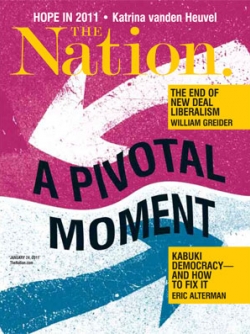
Elsewhere in the issue, William Greider decides that last year’s events prove that the New Deal and Great Society coalitions are thoroughly dead; Eric Alterman calls for institutional reform in US politics;  Eric Foner points out that Barack Obama is one of a startlingly small number of African Americans in public office; James Ledbetter argues that Dwight Eisenhower was deeply influenced by articles that appeared in The Nation; and Patricia J. Williams outlines how the ostensibly individualistic policies of the American Right are designed to foster the rise of “a controlling class of the economically privileged- to wit, an oligarchy.”

“Then, if you’re lucky, even you leave.”

Two items of note in the 10/17 January issue of The Nation:

-The artist Philip Guston wrote “I believe it was John Cage who once told me, ‘When you start working, everybody is in your studio—the past, your friends, enemies, the art world, and above all, your own ideas—all are there. But as you continue painting, they start leaving, one by one, and you are left completely alone. Then, if you’re lucky, even you leave.”  (Quoted in a book review by Barry Schwabsky)

-“WikiLeaks is revealing information citizens need to know—it’s a good thing. Assange may or may not have committed sex crimes according to Swedish law. Why is it so hard to hold those two ideas at once?” (Katha Pollitt)

Maybe Guston could have answered Pollitt’s question.  When you start thinking politically, everybody is in the debate in your head- the past, our friends, enemies, the televised world, and above all, your own ideas about authority- all are there.  But as you continue  thinking, they start leaving, one by one, and you are left completely alone.  Then, if you’re lucky, even you leave.  Maybe an artwork takes on a personality of its own, independent of all those other personalities, and so too an understanding of politics takes on an independent personality too.  Once you get to that point, Assange can be a villainous cad or an object of persecution or a bit of both, and the Wikileaks revelations can stand on their own regardless.

The Old Right in the New Year

The current issues of The American Conservative and Chronicles appeared in our mailbox yesterday; here are my notes on them.

J. David Hoeveler, who in 1977 published the indispensable book The New Humanism: A Critique of Modern America, 1900-1940, contributes to this issue of The American Conservative an article about one of the main subjects of that book, Irving Babbitt (1865-1933.)  Babbitt, Paul Elmer More, and the other critics in the New Humanist group were identified as political and social conservatives in their own day, and it has been conservative intellectuals who have kept their names alive.  Hoeveler argues that Babbitt would have been deeply uncomfortable with much that characterizes the right wing of today’s Republican Party.  Hoeveler identifies four major strands in this movement, which he labels “imperialist conservatism,” “”populist conservatism,” “libertarian conservatism,” and “religious conservatism.”  Since Babbitt was an outspoken opponent of all forms of military intervention the US undertook throughout his life, Hoeveler has an easy time showing that he would have been unlikely to support America’s ongoing current wars and level of military spending.    Nor would the Babbitt whose main political concern was saving democracy by reconciling it to the “aristocratic principle” have found much to attract him in the populist right’s denunciation of “liberal elites.”

Hoeveler says surprisingly little about Babbitt’s likely attitude toward the libertarian right.   To the extent that libertarians set up the unfettered operation of the market as an ideal, it should be clear that Babbitt would have opposed them.  In the opening of Democracy and Leadership, Babbitt’s 1924 political magnum opus, he mentions that one hears that the future will be taken up with “the economic problem.”  If so, Babbitt declares, “the future will be very superficial.”  Though his political attitudes were certainly conservative, in some ways even reactionary, Babbitt was leery of capitalism.  In social arrangements that separate economic activity from family relationships and community bonds, he saw a world grown cold and senseless.  Babbitt would not have denied that the market was competent to allocate resources for efficient production, but would have argued that outside the limits of that sphere its judgments were meaningless.  Seeing successful businessmen consulted as experts on education and public policy, Babbitt told an old French story about a butcher who suddenly found himself needing an attorney.  When several lawyers offered their services, he evaluated them by the standards of his own profession and chose the fattest one.

Discussing the religious right, Hoeveler points out that Babbitt was very leery of their theological and political predecessors.  Himself irreligious, Babbitt thought that religion was necessary for social control and the development of a high culture.  However, he did not believe that all religious movements were equally capable of having these effects.  Babbitt admired contemporary Confucianism, early Indian Buddhism, and later Massachusetts Puritanism, as traditions that inculcated self-discipline and rewarded intellectualism.  The enthusiasms and eccentricities of Pentecostal and fundamentalist groups horrified him.

The American Conservative reprints President Dwight Eisenhower’s 1961 Farewell Address, still famous for its warning against “the acquisition of unwarranted influence, whether sought or unsought, by the military-industrial complex.”  In his commentary on the address, Michael Desch argues that Eisenhower was wrong to imply that economic interests drive America’s interventionism.  In view of the amount of money that defense contractors annually collect from the US taxpayer and the number of people whose livelihood derives directly or indirectly from those contractors, Desch’s claim seems preposterous on its face.  However, an article by Eamonn Fingleton elsewhere in the issue lends it a degree of plausibility.  Fingleton’s article, “Empire is Bad Business,” documents the ways in which US militarists have actively lobbied foreign governments to give preferential treatment to Japanese exporters over American exporters as part of deals to keep US bases in Japan.  Fingleton quotes trade economist Pat Choate:  “Essentially we gave away our electronics industry in return for Japanese support in Vietnam.  In any other country there would have been riots in the streets.”  Fingleton makes a strong case that the masters of the permanent war economy have played a leading role in the hollowing out of American manufacturing.  Thus, “military-industrial complex” is a misnomer.  However, Eisenhower’s broader point might stand.  American capitalists now pin their hopes of future profit on globalization, not on the development of any one country.  In that sense, they have become a revolutionary class, alienated from national loyalties.  The US military establishment is their militant wing, enforcing globalization.

Brian Doherty’s “Dignity Doesn’t Fly” has the subtitle “Peepshow scanners may not catch terrorists, but who says they’re supposed to?”  Laying out the shortcomings of the Transportation Safety Administration’s plan to probe air passengers in intimate ways, Doherty says that “The TSA has created the perfect enemy for any bureaucracy: one that can never be defeated, that could be anyone, and that creates excuses to funnel money to favored interests until the end of time.”  The worst aspect of the whole affair, for Doherty, is the apparent popularity of the TSA’s depredations.  Among those who support the scans, “the TSA seems to have succeeded in constructing a new morality,” one in which personal dignity is of no value and the agents of the state are above judgment.

Chronicles, too, includes a piece about the TSA.  While Doherty spends much of his piece demonstrating that the TSA’s scanners would not detect even the bombs that gave them the pretext to start using them, Chronicles‘ Douglas Wilson would oppose the scans even if everything the TSA and its apologists say were true.  Wilson brings up the Third Amendment to the US Constitution, prohibiting the US from quartering soldiers in private homes.  When that Amendment was passed in 1789, it represented a real limitation on the federal government’s ability to defend its citizens from invading armies.  As such, it “was designed to interfere with national security.”  It proves that the framers believed that the rights and dignity of citizens were more important than national security.

Also in Chronicles, Thomas Fleming offers “The Five Good Reasons” not to be an atheist.  “Atheists have no god to worship” is number one; this is a good reason not to be an atheist, Fleming argues, because humans are generally inclined to worship something, and without gods they’ll only start worshipping other, worse things.  Reason two: “They have no religion to practice.”  That allegedly makes life dull, or did make it dull for Fleming when he was an atheist.  Number three: “Atheists have no religious calendars.”  This robs life of rhythm.  Time is then just one thing after another.  Fourth: “Poor atheists… have no sacred spots, no churches or shrines.”  Atheist space is as featureless as atheist time.  With no store of special stories to differentiate one place from another, atheists not only cannot value places as holy, but lose a means of bonding to each other as people who share relationships with those places.  Fifth, atheists have no sacred texts.  “Scriptures and even canonical literature, because they are sources of authority that lie beyond our own individual whims, discipline our minds and tastes and compel us to have a share in the common sense of our people.”  Fleming and others in the Chronicles crowd often cite Irving Babbitt; this sentence of his could have come directly from any of Babbitt’s books.

All five of Fleming’s “Five Good Reasons” are summed up by Steve Martin:

The last page of each of these magazines is devoted to a column by Taki Theodoracopulos.  They are not the same column.  The difference between them shows the difference between the publications.  For The American Conservative, Taki praises Kate Middleton, who is supposed to marry an English prince.  Taki praises her for being lower-middle class, and therefore likely to have enough common sense to behave properly in her new role, unlike the feather-headed daughters of the aristocracy.  Readers of The American Conservative might find this unvarnished class-stereotyping provocative, and Taki’s stories of his social life among the royals exciting.

When it comes to crossing the boundaries of political correctness,  Chronicles readers are used to headier stuff.  So his column in that magazine does not praise future princesses.  Instead, he opens by mentioning that a man from Somalia was arrested in Oregon on terrorism charges, and goes on to ask “Why are Somalis, in particular, and Muslims, in general, allowed to immigrate over here?”  That question in itself is fairly standard fare for the pages of Chronicles; most contributors to the magazine, however, would not have included some of Taki’s rhetorical flourishes, such as his reference to the man arrested in Oregon as “the subhuman- his surname is Mohamud, what else?”  Talking with other readers of these two magazines, I sometimes complain about Taki and his obviously deliberate attempts to offend; uniformly, these readers say that they usually skip his page.