The American Conservative, 9 February 2009

dorothealangeConsidering the state of America’s economic system today, it’s hardly surprising that this issue focuses chiefly on economics.

Adam Fergusson provides a synopsis of his long out of print book When Money Dies, an elegantly written study of the cultural and psychological effects of hyperinflation on the middle classes in Germany during the 1920s.  An introductory note mentions that Amazon lists a copy of the book for $2,500.  Gripping as the synopsis is, it isn’t hard to see why someone would be reluctant to part with a copy of the book for less.  On the other hand, the high price may represent a fear that Weimar-style hyperinflation will soon strike here, a fear that Fergusson’s prose, vivid as that of any nightmare-inducing tale of terror, will certainly feed.

George Selgin, professor of economics at the University of West Virginia, argues that while deflation resulting from a collapse in demand is a very bad thing, there is also a good kind of deflation.  This good deflation results from an increase in supply.  Indeed, Selgin points out, prices in gold-standard countries fell and average of 2% annually from 1873-1896, years during which output in those same countries increased at almost 3%.  This good deflation is perfectly natural- “technology was improving, so goods cost less to produce.  Why shouldn’t prices reflect that reality?”  In fact, Selgin argues, supply-driven deflation “never exceeds an economy’s rate of productivity growth, and that rate itself sets a lower bound to equilbrium real rates of interest.”  So, supply-driven deflation is not a destabilizing phenomenon, but a stabilizing one. 

Another article notes the rise in popular opposition to central banking since Representative Ron Paul made the abolition of the Federal Reserve a central plank of his 2008 presidential bid.  A number of high profile financial commentators, such as potential US Senate candidate Peter Schiff, have taken up the “End the Fed” banner.

Counterpunch, 16-31 January 2009

free-tradeFrom Paul Craig Roberts, part two of a three-part survey of economics.  In Part One, published issue-before-last, Roberts had defended supply-side economics as the insight that reducing marginal tax rates increases the amount of goods available in the economy at every price range.  In this original sense, Roberts asserted, supply-side had “nothing to do with trickle-down economics or the claim that tax cuts pay for themselves.”  Roberts claimed that when inflation declined after the Reagan tax cuts of the 80s, the old Keynesian theory that loosening fiscal policy would raise prices was definitively refuted and supply-side just as definitively established.  This article was essentially a synopsis of Roberts’ 1984 book The Supply-Side Revolution

In this issue, Roberts argues that the doctrine of comparative advantage, for 200 years the cornerstone of the intellectual defense of free trade, does not apply to today’s world.  Roberts says that comparative advantage, as originally laid out by David Ricardo and elaborated ever since, rests on two basic presuppositions.  First, that the differing geographical, demographic, and climatic characteristics of countries would mean that in each country there would be different opportunity costs associated with choosing to make one product rather than another.  Second, that “the natural disinclination which every man has to quit the country of his birth and connections” meant that capital and, to a lesser extent, labor would remain fixed within national boundaries. 

Today, Roberts declares, both of these presuppositions are exploded.  In our world, “most combinations of inputs that produce outputs are knowledge-based.  The relative price ratios are the same in every country.  Therefore, as opportunity costs do not differ across national boundaries, there is no basis for comparative advantage.”  The second presupposition is even more thoroughly discredited.  Not only do owners of capital routinely migrate from country to country, but in the era of multinational corporations and electronic communications owners of capital need not follow their investments abroad to supervise their operations. 

Roberts cites many scholarly publications that challenge the doctrine of comparative advantage.  Among them: Global Trade and Conflicting National Interests, by Ralph E. Gomory and William J. Baumol; The Predator State, by James K. Galbraith; Robert E. Prasch’s January 1996 article in The Review of Political Economy,  “Reassessing the Theory of Comparative Advantage“; and, from 1888, R. W. Thompson’s History of Protective Tariff Laws


http://www.counterpunch.org/

The Nation, 23 February 2009

23febnationStuart Klawans reviews three new films, Gomorrah, The Class, and CoralineGomorrah, he assures us, is not merely a hyper-violent Italian gangster movie, but a critique of globalization, a portrait of “what the world looks like when it has been remade by gangsters.”  As a teacher myself, I was intrigued by Klawans’ description of The Class.  Evidently the film depicts two hours in the life of a grammar and composition class in a French public school, taught by a man with a daring,  aggressive technique.  “François has no fear of sharp distinctions. His pedagogical method is to push his students and then to shove, so that he’s always on the verge of going too far with them–or finally steps over the line.”  Coraline is evidently a reimagining of Kafka’s “In the Penal Colony.”  While the story centers on a son’s obscure sense that his father has rejected him, the main action of the film begins with a girl openly rejecting her parents and leads her toward the same kind of destruction as Kafka’s character had witnessed.   

Richard R. John explains how recent changes in rates and policies at the US Postal Service have rewarded mass-circulation magazines and penalized low-circulation magazines.  A look at the subcategories under “Periodical Notes” will show that this is a matter of vital concern to your humble correspondent.  (more…)

Counterpunch, 1-31 December 2008

deakinAlexander Cockburn reviews Roger Deakin’s Notes from Walnut Tree Farm, a journal of country life by a leading British environmentalist.  Cockburn describes a gentle, wistful book, not at all the sort of thing the pugnacious title of the newsletter leads to expect (and which he usually delivers.)

The Nation, 16 February 2009

16febnationGary Younge points out  that Barack Obama is in fact the President of the United States.  From this fact, he draws the conclusion that the time has come to put away the posters and other artwork endorsing him and get to work pressing him from the left, as others will surely do from the right.

Akiva Gottlieb reviews two novels by Bulgaria’s Angel Wagenstein, novels replete with heretical rabbis, lazy Nazis, and other exemplars of moral ambiguity.  The review opens with a reference to Joshua Cohen’s “Untitled: A Review,” from Cohen’s short-story collection The Quorum.  A reviewer finds on his doorstep a volume of six million crisp, white, blank pages.  He decides that this book is a history of the Holocaust, in fact “the only way to write about the event, the idea.” 

Eric Alterman takes on Rabbi Abraham Foxman and the Anti Defamation League of B’nai B’rith.  Alterman contends that “Anti-Defamation League” is a double misnomer for this organization.  He contends that it launches harsh attacks indiscriminately at all critics of Israel, attacks which less often counter defamation than they themselves amount to defamation; and that under Rabbi Foxman it is so much a one-man operation as hardly to qualify as a “league.”   

The editors endorse Tom Geoghegan for Congress.  (Others have done so since.)  Geoghegan has written for many publications regularly noted here.  A piece of his appeared in the final issue of The Baffler, for example, the only one that appeared after I started these notes

(more…)

The American Conservative, 26 January 2009

Much of this issue is devoted to Israeli military operation in Gaza and its likely consequences for the politics of the Middle East.  The four items I want to note are not related to that topic, however. 

An obituary for Samuel Huntington notes that Huntington produced “pathbreaking scholarship in all four major subfields of political science.”  This led me straight to Wikipedia, which lists the five major subfields of political science as “political theory, public policy, national politics, international relations, and comparative systems.”  Which of these Huntington missed I don’t know.

Another obituary, for Father Richard John Neuhaus, includes a much harsher assessment of its subject.  Neuhaus is described there as a 1950’s liberal whose lack of imagination led him to conclude his public life as the ringleader of a group of “predictable apologists for the  very secular policies of the Bush administration, which were notable neither for their attention to claims of transcendent justice nor for their respect for the dignity of the human person.”  Among Neuhaus’ many delinquencies was a public campaign of defamation he and his followers waged against the staff of Chronicles magazine in 1989.    

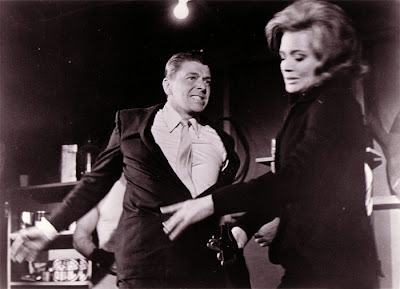
Ronald Reagan hitting a girl

Ronald Reagan hitting a girl

A review of William F. Buckley, Junior’s The Reagan I Knew includes a couple of anecdotes from the book.  I reproduce them below:

Buckley’s Reagan is robust: when we (and Buckley) first meet him, he is about to introduce a Buckley talk at a Los Angeles high school. But the microphones are dead and can only be switched on from a locked booth above the auditorium.

“His diagnosis seemed instantaneous,” Buckley recalls. “He was out the window, his feet on the parapet, his back to the wall, sidestepping carefully toward the control-room window. Reaching it, he thrust his elbow, breaking the glass, and disappeared into the control room.” In a moment, “we could hear the crackling of the newly animated microphone.”

At their final encounter, in 1990, the ex-president again demonstrates his adventurous streak. He holds out his cup of tea to Buckley: “Stick your finger in this.”

What?

“Yeah. Go ahead.”

The drink is scalding. “Now, watch this,” Reagan says as he swigs from the cup. “See? The tolerance of your mouth tissues is infinitely greater than that of your hand! … You know who taught me that? It was Frank Sinatra.”

You can see why someone lack that would grab people’s imaginations.  

The Nation, 9 February 2009

9febnationAlexander Cockburn quotes an interesting-sounding new book, Bad for Democracy: How the Presidency Undermines the Power of the People, by Dana Nelson.  Unfortunately, Nelson does not recommend abolishing the presidency.  She does have as set of proposals to reduce its power, and she exhorts her readers to find ways of participating in political life that do not involve voting or require fixing national attention on one man. 

This issue includes part one of “Adventures in Editing,” Ted Solotaroff’s recollections of his time as an associate editor of Commentary in the early 60s.  Anyone interested in writing will enjoy Solotaroff’s description of how he learned to do that job.  Anyone interested in narcissists will enjoy his description of how Norman Podhoretz behaved as the editor-in-chief of the magazine in those days.  One bit that sticks in my mind is near the end of the piece:

Shortly after I’d come to Commentary, I’d had a conversation with Norman about recruiting writers for the magazine. It didn’t seem to me such a big deal; I said I knew of four or five people at the University of Chicago alone who could write for Commentary.

“You think you do, but you don’t,” said Norman. “You don’t realize how unusual you were for an academic.”

I said I wasn’t that unusual: I’d lucked into an opportunity my friends hadn’t had. “I’ll bet you a dinner that I can bring five writers you’ve never heard of into the magazine in the next year.”

“I don’t want to take your money,” he said. “I’ll bet you won’t bring three.”

We turned out to both be right. With one exception, the novelist Thomas Rogers, none of the former colleagues I had in mind sent in a review or piece that was lively enough to be accepted. A former fellow graduate student, Elizabeth Tornquist, who was turning to political journalism, also managed to crack the barrier. The others had fallen into one or another mode of scholarly dullness or pedagogical authority and, despite my suggestions, had trouble climbing out to address the common reader. My efforts to point their prose and sense of subject in a broader direction brought little joy to either party. “How dare you revise my formulation of an intellectual problem” was a fairly typical reaction.

Which may explain why so few “little magazines” really make it. It certainly explains why someone Podhoretz was needed to make Commentary into the magazine it was.  Only someone who didn’t mind losing friends could edit their work as mercilessly as was necessary to make a periodical worth reading and talking about; only someone who didn’t mind sucking up to the rich and famous could raise the money and generate the publicity necessary to keep it afloat.

The Atlantic Monthly, January/ February 2009

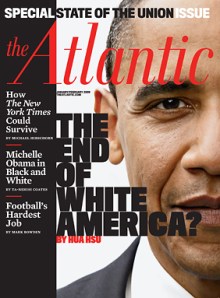
atlantic-janfeb09

Garrett Epps declares the creation of the presidency to have been “The Founders’ Great Mistake.”  You’d think the history of the last 85 years would have made that clear to everyone, but evidently it has not.  Epps does not propose abolishing the presidency.  Instead, he outlines a plan that would keep the office in existence, but make the president dependent on the support of a majority in Congress.  In effect, Epps would replicate a parliamentary system.  That would be, if anything, worse than what we have now.  At least now the president and Congress can fight each other to a standstill.  Under Epps’ system, there would never be an opposing force to block the worst ideas that came out of the leadership of the ruling party. 

Mark Ambinder’s piece on the way the Obama campaign handled race as an issue contains an interesting line:

Even during the 2008 primaries, a discomfiting pattern had emerged: Barack Obama did his best overall in the states with the largest or the smallest percentages of African American voters—think of South Carolina, where blacks made up 55 percent of the Democratic-primary vote, and Vermont, where they made up less than 2 percent. Obama won in states where black Democrats had already attained a measure of political power, or where whites had never competed with blacks.

Ambinder seems close here to an idea that has been rattling around on the far right for some time.  Some writers, such as Steve Sailer, have claimed that “white guilt” is in fact a sign of disengagement from African Americans.  Whites who support policies that might put other whites at a disadvantage to African Americans do so in order to show their superiority over other whites.  On this view, “white guilt” is not a sign of belief in the equality of African Americans.  Quite the contrary, it rests on a belief that African Americans will never be able to compete at the highest levels of achievement.  Those who declare themselves racked by white guilt do so in order to show that they themselves are able to do so, and look down on those whites who have to worry about African American competitors.  I don’t know if I believe that idea, but I do think it deserves wider discussion than it has received.  Certainly it shouldn’t be relegated to Sailer’s blog and similarly confined venues.  

Mark Bowden profiles Bob Fishman, who directs CBS’ television broadcasts of NFL games.  The sheer number of decisions Fishman must make in the course of a minute of airtime staggers the mind.  Cognitive psychologists should study the guy.

The Nation, 2 February 2009

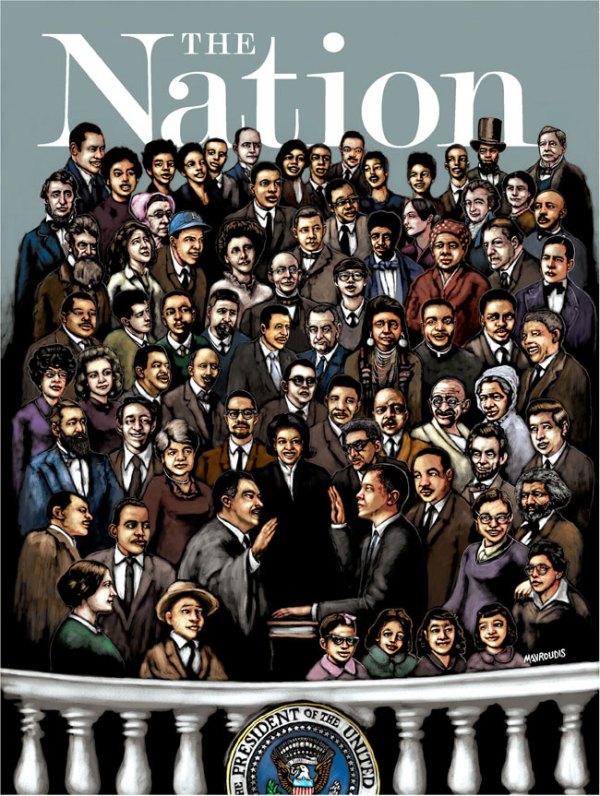
Click on the image to see who's who

Click on the image to see who's who

Several articles about Barack Obama and what he should do, now that all the historical figures pictured on the cover are watching him. 

A review of a new biography of George Plimpton makes me want not only to look at that book, but also to read some of Plimpton’s own writings, notably Shadow Box, Paper Lion, and Edie

The preacher who delivered the invocation at Mr O’s inauguration, Rick Warren, represented a disappointment to those advocates of the rights of sexual minorities who had done so much to support Mr O when he was seeking the nomination.  Jon Wiener points out that Warren’s clout is so far reaching that the US Senate in 2002 voted unanimously for a bill to relieve him of the necessity to pay federal income tax.  The bill was specifically craftedto nullify an ongoing suit against Warren for tax evasion.  The key parts of the bill appear to apply to Warren, and only to Warren.  If Rick Warren has that kind of power, no wonder  Mr O thought he could gain by favoring him over some of his most important supporters. 

On a happier note, we read about Julius Genachowski, an old friend whom Mr O has named to head the Federal Communications Commission.  John Nichols assures us that Genachowski sees the main question in media policy as the question of democracy.  Committed to the promotion of “openness, free speech, competition, innovation, access, economic growth, and consumer welfare,” Genachowski will be in a position to strengthen America’s democratic institutions.

Chronicles, February 2009

lincoln-coverChronicles is often criticized for its “neo-Confederate” bent.  The two hundredth anniversary of Abraham Lincoln’s birth draws that side of the magazine out in force. 

Joseph E. Fallon quotes extensively from Lincoln’s friends and associates to the effect that the sixteenth president had little use for Christianity.  He then analyzes Lincoln’s use of religious imagery in his speeches, arguing that he exploited beliefs which he did not share to browbeat his countrymen into supporting a policy of extreme violence and unaccountable executive power.  Fallon dwells on the Second Inaugural Address, claiming that the famous passage saying that we must acquiesce in God’s will to punish us for that sin even if  “all the wealth piled by the bondman’s two hundred and fifty years of unrequited toil shall be sunk, and until every drop of blood drawn with the lash shall be paid by another drawn by the sword” represents a particularly gruesome moral inversion.  “Lincoln assiduously promoted the idea that, while he was blameless for the war, its death and destruction served some higher good.”  Fallon closes with a paraphrase of a well-known line which he attributes to Voltaire, that those who can make you believe absurdities can make you commit atrocities. 

Thomas Fleming asserts that the Civil War cost the lives of “600,000 American soldiers and perhaps twice as many noncombatants (most of them black.)”  I’ve often heard the figure 621,000 as the number of combat fatalities in the Civil War, the other two claims in that sentence were news to me.  I don’t know all that much about the Civil War, so for all I know Fleming could be right.  He goes on: “Some years ago, when I was debating Lincoln’s legacy, a graduate student asked if I did not think the war that freed the slaves was worth the cost.  He was actually shocked that I did not think that hundreds of thousands of dead slaves would have agreed with him.” 

The cost of the Civil War to southern blacks is also a major theme of Clyde Wilson’s “The Trasury of Counterfeit Virtue.”  “The notion that soldiers in blue and emancipated slaves rushed into each other’s arms with shouts of Glory Hallelujah is pure fantasy,” writes Professor Wilson.  Instead, the historical record shows one case after another when Union forces tortured, raped, and slaughtered blacks with impunity.  Wilson cites Ambrose Bierce to the effect that the only blacks he saw with the Union army were those whom officers were using as slaves. 

Joseph Sobran mentions Lincoln’s statement, from the First Inaugural, that “the Union is much older than the Constitution,” only to dismiss it as evidence that “Lincoln’s knowledge of history was shaky.”  I think there’s a bit more to be said for this claim than Sobran allows.  Certainly the thirteen colonies that broke away in 1775-1783 had by that time for many years been much more closely linked to each other than any of them had been to other parts of the British Empire. 

Justin Raimondo, editor of antiwar.com, looks at the comparisons between President Obama and his predecessor that one hears so often these days and takes them with undiluted seriousness.   Lincoln, Raimondo reminds us, “suspended habeas corpus, jailed his opponents, and closed down newspapers that displeased him.”  Raimondo evidently fears that Mr O’s praise of Lincoln might mean that he plans to follow this example.  Lest this fear seem overdone, Raimondo does refer to the powers that presidents between Lincoln and Mr O have claimed for themselves.  One rather silly moment in Raimondo’s article comes near the beginning, when he quotes a description of the similarities between these two Illinoisan presidents that mentions the fact that they are both quite thin.  “Two thin men?  What normal person would make such a comparison?  To our elites, thinness is a sign of moral virtue.”  Well, perhaps the mention of it is also a sign that Lincoln and Mr O don’t really have that much in common, so that likeners have to draw on the most superficial resemblances. 

Daniel Larison, of the Eunomia blog, goes into depth on a theme that Professor Wilson also addressed, the role of Lincoln in fusing Big Government with Big Business and laying the foundations of the corporatist-militarist economic and political system the United States has today.  Larison mentions Canadian philosopher George Grant, a critic of bigness in both economic and political institutions.  “Over 40 years ago, Canadian philosopher George Grant said that American conservatives must oppose economic centralization if they seriously hope to pursue political decentralization.”