The Nation, 27 April 2009

nation-27-april-2009Classicist Emily Wilson reviews Anne Carson‘s An Oresteia.  Carson translates Aeschylus’ Agamemnon, Sophocles’ Electra, and Euripides’ Orestes to make a trilogy that not only tells why the legendary prince Orestes killed his mother Clytemnestra and what consequences that matricide had in their world, but a trilogy that also suggests how the moral ideas of the Athenians might have changed in response to the social and political crises of the fifth century BC.  

Aeschylus’ Agamemnon was produced in 458 BC, when Athens’ empire was at its zenith and its form of democracy seemed infinitely adaptable to whatever challenges the future might present.  In the Agamemnon, Aeschylus puts the motivations of the gods and of humans on display together, suggesting that while each may be temporarily obscure, nonetheless both can ultimately become transparent.   When Clytemnestra kills her husband Agamemnon, her children inherit from their father the responsibility to avenge him by killing their mother.  Faced with this horrifying duty, Orestes and his sister Electra seem as though they may have been plunged into an incomprehensible moral universe.  Yet democracy, Athenian democracy, will settle the matter and allow the survivors of the cycle of violence to reason together once more.   Orestes will ultimately appear before Athens’ Areopagus Council, which will sit in judgment of his case and reach a verdict that even the Furies themselves must accept. 

Sophocles’ Electra dates from a time much later than that of Aeschylus’ play, probably the last decade of the fifth century.  By that time, Athens had been embroiled in the Peloponnesian Wars for a generation.  Isolated in mainland Greece, Athens had suffered heavy defeats in one theater after another.  To many Athenians, it seemed that the war had discredited democracy.  Not only had the war the people voted to enter brought Athens actual disaster and likely destruction, but the heaviest of all Athens’ losses were suffered in a war with another radical democracy, Syracuse.  In 411, Sophocles himself would figure prominently in a move to scrap democracy and institute a government by an oligarchic group known as “the Four Hundred.”  The Four Hundred didn’t last long, but the optimism of Aeschylus’ day would never be possible to the Athenians again.  Accordingly, Sophocles’ view is darker Aeschylus’.  Wilson says that for Sophocles, “the will of the gods is hard to interpret, and the focus of the play is on the turbulent feelings of human characters and the contradictory narratives they create to serve their advantage.”  For my part, I think it would be better to say that for Sophocles, the gods are not on display- we may be visible to them, but they are never truly visible to us.  We can understand only his human characters, and then only by discovering the ways in which they have deceived themselves.  Wilson writes that “The play is disturbing in both its emphasis on desperate grief and the suggestion that the only cure for such pain is retribution reaped with scams and lies. Unlike in Aeschylus, there is no hope of a political solution.” 

Orestes, produced in 408, is in some ways Euripides’ strangest play, and Wilson labels it the darkest of the three Carson has chosen.  Euripides is closer to Aeschylus than to Sophocles in his belief that the motivations of gods and humans are intelligible, but unlike them in his doubt that understanding those motivations will bring us any closer to a world that we can judge fairly.  (more…)

The Nation, 20 April 2009

nation-20-april

Businessman Leo Hindery and former US Senator Donald Riegle write a proposal for “The Jobs Solution” to our country’s current economic woes.  Point 3 reads:

Concrete efforts to restore the essential tax-policy link between productivity growth and wage gains, which will almost surely mean adopting a value-added tax of the sort nearly every other developed country already has.

The Value Added Tax seems to be showing up everywhere these days; I’m starting to lean prettily heavily in favor of the idea of abolishing the corporate income tax and payroll taxes and replacing them with an American version of VAT. 

Stuart Klawans reviews a movie that our own LeFalcon and VThunderlad seem to find infinitely fascinating, Watchmen.   To be precise, the headline of his column lists Watchmen as one of the movies he will review, but what he actually does is open with a few paragraphs satirizing the disillusioned tough-guy prose style that apparently characterizes the Watchmen franchise, then tell a story about how he was shown the wrong movie at the critics’ preview.  The high point of this story comes when he claims that he thought he was seeing one of the most discussed visuals from Watchmen, that is, the long blue penis of a character who is naked throughout the movie, only to realize that his eyes were playing tricks on him:

The movie starts. Immediately, I see the blue penis, and the special effects are staggering. It walks on its own. It speaks. I suddenly realize it is Clive Owen, clean-shaven for a change, striding up to inspect Julia Roberts’s cleavage at a garden party. This is not Watchmen. It is Duplicity.

(more…)

Chronicles, April 2009

George McCartney’s review of the movie The Reader begins with a description of a comedy sketch in which Kate Winslet said that making a movie about the Holocaust is a sure way to win an Oscar.  That part starts at 3:13 in the clip below.

McCartney argues that the movie misses the moral point of Bernhard Schlink’s novel.  Movie and novel both dramatize a sexual relationship in the late 1950s between Hanna, a former Nazi concentration camp guard, and Michael, at the time a 15 year old boy.  The two see each other again years later, when Hanna and other war criminals are on trial and Michael is a law student observing the process.  For McCartney, the key scene in the novel comes at this trial:

In the novel, Schlink’s point is that Hanna is being personally scapegoated for crimes that many others participated in, whether actively or passively.  To prosecute her without admitting this is to perpetuate the nation’s guilt and ramify its bitter consequences.  The novel fully dramatizes the wholly unwarranted self-righteousness of the other young German law students as they observe the trial.  They take it as an occasion to despise the older generation, including their parents, for their complicity in the policies of the Third Reich.  Michael would undoubtedly be with them but for his relationship with Hanna.  As it is, he’s left with the impossible burden of coming to terms with her culpability in the midst of his lingering feelings for her. 

Questioned at this trial about mass murders in which she participated, Hanna asks the judge in a state of true bewilderment, “What would you have done?” 

Of course, with the moral clarity available after events, it’s all too obvious what she should have done.  Schlink’s larger point is that it’s also obvious what the Germans should have done about their Nazi rulers.  But as Hitler rose to power and the Nazis took command of state institutions, barraging the populace with ceaseless propoaganda complemented by a relentless program of civilian surveillance, what course was safely open to the ordinary individual?  It’s easy, Schlink implies, for those who enjoy freedom today to say their elders should have resisted.  Of course they should have.  So should the Russians have resisted the rise of the Bolsheviks and Stalin’s police state.  So should all Americans have denounced George W. Bush’s criminal policies.  Schlink argues that these should haves are only helpful in the present if applied by those who realize that they themselves may not have had the moral heroism necessary to stand up to those in power.   

The novel “does a fair job of examining” the “deformation of a soul” like Hanna’s, a deformation which made it possible for her to commit acts of immense violence while seeing herself only as a victim.  The movie, by contrast, dwells on the actors’ physical nakedness, offering little insight into the psychological terrain in which the characters made their decisions.   “We need to see more than the actors’ breasts, buttocks, and genitalia to understand them.  We need principally to understand what happened to Hanna to make her the way she is.  On screen, we never do.” 

McCartney also objects to the fact that the sex scenes are played out between an 18 year old man playing a 15 year old boy and a 33 year old woman.  “In a film that means to expose the ongoing effects of abuse, we’re edified by the spectacle of a boy actually being abused by his director and his costar.  What else can we call what happens to David Kross in this movie?… [I]s 18 the age whhen, for professional reasons, a boy can disregard the sexual appeal of a nude 33 year old actress pressing against his naked body?  Who’s kidding whom?” 

(more…)

The Funny Times, April 2009

funny-times-april-2009Since that one guy stopped being US president – what was his name?  You remember him, he had a Texas accent and a constant cocaine sniffle.  Anyway, since he went away the Funny Times seems to have been devoting more space to old and possibly corny jokes.  

These  examples come from Planet Proctor.  Here’s a quote from Eleanor Roosevelt:

I had a rose named after me and was very flattered.  But I was not pleased to read the description in the catalogue: ‘No good in a bed, but fine against a wall.’

This was presented as a true story: 

A teacher designed a study testing the senses of first graders using a bowl of Lifesavers to identify flavors by color: red for cherry, yellow for lemon, green for lime, and orange for- orange.  Finally the teacher gave them all HONEY Lifesavers, but after popping them into their eager little mouths, none of the children could identify the taste; so she said, “I’ll give you all a clue.  This is what your mother may sometimes call your father.”  One little girl looked up in horror, spit out her Lifesaver, and yelled “Oh my God!  They’re assholes!” 

(more…)

The American Conservative, 6 April 2009

carter1

The man who gave the speech

Sean Scallon argues that Jimmy Carter’s 15 July 1979 address to the nation, known to political infamy as the “malaise speech,” showed an awareness of America’s limits that made it the most truly conservative public statement any president has made in recent decades.  Nor does the speech deserve its reputation as a political disaster.  Carter’s approval ratings went up after he delivered it, and only dropped when he engaged in the “political gimmick” of demanding that his whole cabinet resign.  Carter didn’t really lose the public, the piece claims, until he responded to the Soviet invasion of Afghanistan with an ultra-hawkish policy.  His hard line contradicted all the wisdom and humility in the speech; coming on its heels, it seemed to spring from a fit of hysteria.  The contradiction between Carter’s sober words of July and his sabre-rattling of a few weeks later left him intellectually defenseless when Ronald Reagan, a cheerful man unburdened by any public record suggesting cautious realism, presented the same hard line militarism as the centerpiece of his campaign to unseat Carter. 

The man who responded to the Soviet invasion of Afghanistan

The man who responded to the Soviet invasion of Afghanistan

(more…)

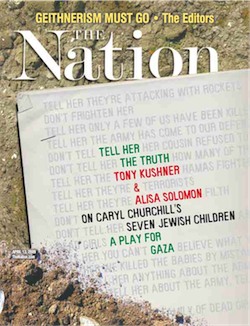
The Nation, 13 April 2009

nation-13-april-09Tony Kushner and Alisa Solomon review Caryl Churchill‘s new play, Tell Her the Truth, which tells the history of the Arab-Israeli conflict in ten minutes.  “Why is the play so short?  Probably because Churchill means to slap us out of our rehearsed arguments to look at the immediate human crisis.”  Churchill cares about what human beings are doing to each other and how they justify what they have done to themselves and to each other, especially in the justifications parents give their children.  Tell Her the Truth consists of a series of lines giving the parents of seven unseen Jewish children advice as to what they should tell those children about various historical acts of violence, some committed against Jews in the name of antisemitism, some committed by Jews in the name of Zionism. 

Tell Her the Truth, like every publication critical of Israeli policy, has attracted charges of antisemitism; much of the case against it apparently hinges on a line that does not appear in the play.  Some have claimed that the play raises the spectre of “blood libel,” the old idea that Jews ritually murder Gentile children.  “Those who level the blood-libel accusation insist that Churchill has written “tell her I’m happy when I see their children covered in blood.””  What she actually wrote was quite different: “tell her I look at one of their children covered in blood and what do I feel? tell her all I feel is happy it’s not her.”  Kushner and Solomon interpret the real line thusly: “The last line of the monologue is clearly a warning: you can’t protect your children by being indifferent to the children of others.”

(more…)

The Atlantic Monthly, April 2009

the-atlantic-april-2009

Robert Wright’s “One World, Under God” begins with the assertion that most New Testament scholars now regard the Gospel of Mark as significantly older than the other gosples, perhaps not much newer than the oldest writings in the New Testament, Paul’s letters.  Mark stands out from the other gospels in that the sayings of Jesus recorded there are all quite harsh:

The Jesus in Mark, far from calmly forgiving his killers, seems surprised by the Crucifixion and hardly sanguine about it (“My God, my God, why have you forsaken me?”). In Mark, there is no Sermon on the Mount, and so no Beatitudes, and there is no good Samaritan; Jesus’ most salient comment on ethnic relations is to compare a woman to a dog because she isn’t from Israel.

The gentle Jesus meek and mild whom liberal Christians preach and the “great moral teacher” whom moderate secularists and ecumenical-minded non-Christians praise appears in the gospels of Luke and Matthew.  If these accounts took shape as long after Mark’s as Wright says they may have done, then it is possible that they were influenced by Paul:

Of course, since Paul was writing after the time of Jesus, it’s been natural to assume he got these ideas from the teachings of Jesus. But when you realize that Jesus utters the word love only twice in the Gospel of Mark—compared with Paul’s using it more than 10 times in a single letter to the Romans—the reverse scenario suggests itself: maybe the Gospel of Mark, which was written not long after the end of Paul’s ministry, largely escaped Pauline influence, and thus left more of the real Jesus intact than Gospels written later, after Paul’s legacy had spread.

This hypothesis cuts against the grain of New Testament criticism, which at least since the Enlightenment has tended to cast Paul as the main figure in an effort to make Jesus seem less like a sweetheart and more like an apocalyptic crank than he really was.  Perhaps the opposite was the case, and it was Paul who invented the idea of Christianity as a religion of boundless good will. 

(more…)

The Nation, 6 April 2009

nation-6-april-2009Lorna Fox Scott reviews the new Library of America volume True Crime: An American Anthology, edited by Harold Schechter.  She quotes Americans who have tried to explain acts of extreme violence that their countrymen have committed.  Cotton Mather could say that acts of violence were symptoms of irreligion.  But what would Mather have made of a case like this?

Farmer Yates, who in 1781, as he tells his examiners in what reads like an uncensored transcript, is suddenly commanded by an unidentified “Spirit” to slaughter his beloved family for being “idols”? Vividly reliving the inner struggle of human love with mystic duty, in between enthusiastic pursuits of the victims through the snow, this text stands out as the only perpetrator’s narrative in the collection; its anonymous presenter cannot in the end decide whether Yates was stricken by “the effect of insanity” or “a strong delusion of Satan.” The old certainties are fraying.

Ambrose Bierce was less interested in explaining why people commit acts of extreme violence then in pointing out the glee with which the public receives accounts of those acts:

His “Criminal Market Review” from the late 1860s is unusual for its admission that crime is not so much a deviation as the very image of the national economy: “Robberies are looking up; Assaults, active; Forgeries, dull.” Taking a swipe at the veiled Californian relish in violence–“Our joy at the mutilation of old Hulton has been deeply unspeakable; our lively interest in the shooting and hacking of and by the Dudleys, Ingham and Miller, has been testified in a novel and interesting manner by a private scalp dance at our own apartments”–Bierce links this to the war. “It pleasantly reminds us of the time when we were a soldier.” Then, like Twain satirizing the social worship of “blackguards”: “Yosemite is a conceded fiction, and the Big Trees a screaming joke…. But we are handy with the pistol and wield a butcher-knife as deftly as an Indian or anybody.”

Twentieth century writing has shown new forms of self-consciousness.  Edna Ferber’s comments on the trial of Richard Bruno Hauptmann include not only scorn for the gawking crowd but sympathy for the accused murderer; Zora Neale Hurston’s reports on the trial of Ruby McCollum, a black woman accused of shooting a white physician, show the defendant and the crime lost to public awareness as black and white act out the rituals of race. 

Fox quotes a haunting conversation that occurred in 1949.  A man had gunned down a dozen people on the street in his New Jersey neighborhood, then gone home.  The phone rang.  He answered it.  Calling was a reporter from The Camden Evening Courier

Mr. Buxton asked how many persons Unruh had killed.
 The veteran answered. “I don’t know. I haven’t counted. Looks like a pretty good score.”
  “Why are you killing people?”
  “I don’t know,” came the frank answer. “I can’t answer that yet. I’ll have to talk to you later. I’m too busy now.”

(more…)

The Nation, 30 March 2009

nation-30-march-2009A review of The Politics of Truth: Selected Writings of C. Wright Mills mentions  Mills’ concept of “crackpot realism,” introduced in his Causes of World War Three to explain how a group of highly intelligent people could come to believe that each step in a course of action certain to lead to their destruction was the safest, most prudent one possible.  Mills feared that “citizenship was obsolete”; “Modern society made freedom in the liberal sense of autonomous and reflective citizenship increasingly impossible.” 

The new Library of America volume The Lincoln Anthology: Great Writers on his Life and Legacy from 1860 to  Now draws  a review titled “Sallow, Queer, and Sagacious.”  Dissenters from the celebration of Abraham Lincoln as America’s great secular saint are well represented in the volume.  Among them are Edmund Wilson, whose portrait of the sixteenth president in 1962’s Patriotic Gore has reminded more than one critic of Stalin, and Lerone Bennett Jr, who since the 1960s has been arguing that Lincoln was no friend to black America.

The American Conservative, 23 March 2009

Sun and Wind on the Roof, by John Sloan

Sun and Wind on the Roof, by John Sloan


Bill Kauffman takes on the idea of a federal department of Arts and Culture, a proposal long championed by someone he admires, Quincy Jones.  Kauffman quotes the painter John Sloan, who in 1944 said, “Sure, it would be fine to have a Ministry of Fine Arts in this country.  Then we’d know where the enemy is.”  He goes on to praise William Saroyan, whose pacifist principles led him to refuse to shake President Roosevelt’s hand at a reception during World War II, and William Faulkner, who rejected a social invitation from President Kennedy on the grounds that “the White House is too far to go for dinner.”  Kauffman himself once served on a National Endowment for the Arts panel, and the experience convinced him that Quincy Jones was wrong and these men were right.

Paul Gottfried argues that, contrary to what one might gather from cable TV, for most of the history of the USA it has been conservatives who have been the most prominent and most consistent opponents of the expansion of militarism and of presidential power.  For example, the only senator to vote against internment of Japanese-Americans during World War Two was the original “Mr. Republican,” Robert Alphonso Taft.  Today’s “conservative” militarists, Gottfried claims, have succeeded because their approach enables them to combine two basically disparate impulses:

Neoconservative historiography prevailed against the Old Right because it could build on the Left’s moral assessments- treating Lincoln and General Sherman as great emancipators, for example- while at the same time tapping into the patriotic, pro-military sentiments of American Republicans and Fox News-viewing conservatives.