
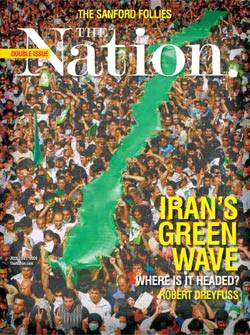
 An article by Robert Dreyfuss explores the division among the Iranian political elite that has contributed to the recent mass demonstrations there. Dreyfuss convinces me that the government has a narrow base of support among elite groups in the city of Teheran. Most of the people he talks to regard Ayatollah Khamenei and President Ahmedinejad as too hard-line and traditionalist, while many others are turning to rightist groups that accuse those men of being too soft. However, I’m skeptical of Dreyfuss’ attempts to suggest that the Teherani elite is in this matter representative of the country as a whole. Dreyfuss cites the Chatham House study which compared voter turnout in Iran’s 2005 presidential election with turnout in this year’s contest, concluding that the number of votes reported had increased by so much that fraud was a likelier explanation than was a rise in actual participation. On Dreyfuss’ own showing, though, the opposition has the support of many key power players. Among them are many men who may be in a position to falsify votes. And the fact remains that the only opinion poll conducted in Iran before this year’s election predicted the same result that the authorities certified. The election may well have been a phony, but Dreyfuss definitely wrong to say that it “seems far-fetched” to think that Ahmedinejad may have won.
All posts in category Periodical Notes
The Nation, 20 July 2009
Posted by acilius on July 2, 2009
https://losthunderlads.com/2009/07/02/the-nation-20-july-2009/
The American Conservative, August 2009
 With this issue, our favorite “Old Right” read gives up its quixotic biweekly publication schedule and becomes the monthly it should always have been.
In the cover story, Brendan O’Neill casts a gimlet eye on the environmental initiatives now chugging through official Washington. He sees in them little more than a series of raids on the treasury by well-connected businesses. He cites Gabriel Calzada, a Spanish economist who found that every job his country’s wind power initiative had created represented a cost of $2,200,000 to the taxpayer. Of course, the jobs don’t pay $2,200,000- most of that money goes to corporate interests. O’Neill argues that the alternative energy plans now under consideration in Washington are at least as bad as is Spain’s wind power initiative.
Former US Army interrogator Matthew Alexander explains what he did in Iraq that his colleagues didn’t. He followed the rules, they didn’t. He treated detainees with respect, they didn’t. He obtained useful intelligence, they didn’t. When information he had elicited led to successful US military operations, they got medals, he didn’t.
Posted by acilius on July 2, 2009
https://losthunderlads.com/2009/07/02/the-american-conservative-august-2009/
The Atlantic, July/ August 2009
 We as a species are currently dumping massive amounts of carbon into the upper atmosphere. Average temperatures around the world are rising at an alarming rate, evidently at least in part as a consequence of this dumping. No movement is in prospect that would stop the dumping, or even reduce it substantially. So, what to do? Some scientists and engineers want to remake the rest of the earth’s climate to accommodate our carbon dumping habit. How could this be done? There are several possible methods.
We could shoot sulphur dioxide into the upper atmosphere. That would be remarkably affordable- for as little as a billion dollars, it could end global warming. The drawback is that eventually sulphur would rain down from the sky, and if we stopped shooting new sulphur dioxide up there global temperatures would increase dramatically in a very short period. Also it would cause severe droughts throughout central Africa, a region which has not exactly been among the big winners of industrialization to start with, so that seems unfair.
Also we could dump iron powder in the Antarctic Ocean, causing a huge plankton colony to bloom and suck carbon dioxide out of the atmosphere. We’d have to be a bit careful about that- half a supertanker’s worth of iron powder could feed a big enough plankton bloom to trigger a new Ice Age. And when plankton dies, it releases methane, which is a much more effective greenhouse gas than carbon dioxide.
There are also people who would like to block sunlight by shooting millions of clay discs at the Lagrange point between the earth and sun. These skeets might well reduce average temperatures on the earth, but they could also stop the formation of ozone in the atmosphere. And without an ozone layer, life as we know it could not exist on the surface of the earth. So that’s a little bit on the risky side too. So it seems like reducing carbon emissions might be worthwhile after all.
Posted by acilius on July 1, 2009
https://losthunderlads.com/2009/07/01/the-atlantic-july-august-2009/
Some interesting things in this week’s issue of The Economist
 I subscribed to The Economist for years and years. I liked its quick notes about little countries that major media outlets ignore completely. After a few years of reading it regularly, it came to seem like a person. In particular, it seemed like a 23 year old bond trader who thinks that he rules the world, or is about to. Obnoxious as that fellow might be in person, in the form of a magazine he was, at his worst, something I could set on a table and forget about. More often his outlandish politics were good for a laugh. I still remember the first number of The Economist I read, a 1983 issue with Nicolae Ceaucescu’s picture on the front, labeled “The Sick Man of Communism.” What sticks out is a leading column about Lebanon, the last paragraph of which began with some phrase like “Though colonialism is unfashionable at the moment,” and went on to suggest that the best thing for that country might be occupation and domination by Syria. Time and again The Economist makes remarks like that, which only a staff as extremely young as that which in fact does produce the magazine could make innocently. And it can be a useful read- if I’d bet against every market prediction they made in the 1990s, I’d be a millionaire today.
This time around, they have a leader and an article about the new Acropolis Museum, each concerned chiefly with the effect this facility will have on the dispute between Britain and Greece over the ownership of the friezes Lord Elgin took from the Parthenon in the period 1801-1805. The British Museum has been taking care of them for over 200 years, the Greek government has been campaigning for their return to the Acropolis for almost 30 years. The Economist is impressed by the new museum on the Acropolis, and wishes the British Museum would lend the friezes to the Greeks. This solution would require the Greeks to renounce their claim of formal ownership of the friezes. Previous Greek governments have seemed willing to make this concession, but the current one is not. The Economist predicts that an uncompromising stand by the Greeks could unravel a great deal of the progress that has been made since December of 2002, when the world’s leading museums issued a statement called “the Munich Declaration”:
The Munich declaration, as it is called, asserts that today’s ethical standards cannot be applied to yesterday’s acquisitions; but in return it acknowledges that encyclopedic museums have a special duty to put world culture on display.
This has led to a new level of co-operation between museums over training, curating, restoration and loans. Thousands of works are now lent each year between museums on every continent.
All this apparently will come crashing down unless the Greeks take the advice of The Economist. Considering that much of the 6 March 1999 issue of that magazine was devoted to dire warnings of the chaos the world would face in the next decade as the price of oil dropped below $5 a barrel and stayed there, I wouldn’t worry overmuch about its predictions.
Posted by acilius on June 29, 2009
https://losthunderlads.com/2009/06/29/some-interesting-things-in-this-weeks-issue-of-the-economist/
The Atlantic Monthly, June 2009
 It’s hard to make South African president Jacob Zuma seem an attractive figure, and the profile of him here doesn’t try. What intrigued me was its description of an art Zuma has mastered, Zulu stick fighting:
During my November 2007 visit to his homestead, I spoke with one of his brothers, Mike. As we stood by an enclosure where an ox had been slaughtered earlier in the day, Mike told me that his brother was clever, and should never be counted out. He said that from an early age, Zuma had been a masterful practitioner of traditional Zulu stick fighting. His distinctive technique had been to forego the formalities and hold his stick casually, as if he was on a lark. He’d turn away from his opponent, crack a joke, and smile. When it was least expected, he would sweep the other boy off his feet. Stick fighting is essentially a test of balance, not brute strength, in which one turns an adversary’s lunging attacks back on him.
That sounds like a martial art anyone with the makings of a successful politician would be well suited to practice.
An article called “Do CEOs Matter?” describes the classification of corporate leaders into two major categories, “Unconstrained Managers” and Titular Figureheads.” The men who coined these phrases were Professors Donald Hambrick and Sydney Finkelstein. In the article where they introduced the dichotomy, Hambrick and Finkelstein wrote that “If we had to choose as a society between doing away with Figureheads or Unconstrained Managers, clearly it is the Figureheads we would keep.”
Posted by acilius on June 29, 2009
https://losthunderlads.com/2009/06/29/the-atlantic-monthly-june-2009/
The Nation, 13 July 2009
 Alex Cockburn rages at the Americans who cheerlead for the protests in Iran while they ignore politics in their own country, giving the Obama administration carte blanche to break every promise Mr O made to help working people and curb the national security state. As for Cockburn’s view of Iran, readers of his newsletter Counterpunch are familiar with his suspicion that the protests are something of a phony put up by advocates of war.
An editorial about the Obama administration’s approach to the righs of sexual minorities begins by pointing out that in Mr O’s first bid for public office, for the Illinois state senate in 1996, he was asked where he stood on same-sex marriage. Unlike other candidates, who either checked “yes” or “no,” Mr O went out of his way to add the sentence “I favor legalizing same-sex marriages, and would fight efforts to prohibit such marriages.” At that time no state recognized same-sex marriages, and many criminalized same-sex sex. Now, the country has moved on. Even the governor of Utah has endorsed civil unions for same sex couples. And Mr O has moved backward. Now he opposes same-sex marriages, presides over the continuation of “don’t ask- don’t tell,” and hasn’t lifted a finger to support legislation to protect sexual minorities from workplace discrimination, legislation 89% of Americans say they favor. The editorial sums it up: “At this rate, Obama is in danger of being outpaced on gay rights not just by the American people but by the nonsuicidal wing of the Republican Party.”
Lisa Duggan celebrates Salt Lake City’s surprisingly visible, surprisingly politicized sexual minorities. Countering those who have called for a boycott of Utah to protest the role of Mormons in the campaign to end gender-neutral marriage in California, Duggan quotes Salt Lake City residents who’ve called for a “New Queer Pioneer Movement,” one that would emulate the sect trains of the Mormon nineteenth century and flood the state with same-sexers.
Joseph Stiglitz claims that the current global economic crisis presents us with a stark alternative: either we adopt nationalistic policies of subsidy and protection that mean we renounce economic globalization, or we adopt United Nations-based regulatory schemes that mean we embrace political globalization. As Stiglitz is the head of the UN’s Commission of Experts on the crisis, it will not come as a complete surprise that he favors the latter option.
Posted by acilius on June 26, 2009
https://losthunderlads.com/2009/06/26/the-nation-13-july-2009/
The American Conservative, 18 May 2009

The Balance of Power
Michael Desch’s cover story, “Apocalypse Not,” argues that while Iran is nowhere near having nuclear weapons, things wouldn’t be so bad even if it did have them. Desch quotes some of the overheated rhetoric of anti-Iranian hawks. One line that stuck out for me was a quote from Israeli prime minister Binyamin Netanyahu: “You don’t want a messianic apocalyptic cult controlling atomic bombs. When the wide-eyed believer gets hold of the reins of power and the weapons of mass death, then the entire world should start worrying.” To which an uncharitable observer might add, he should know…
In response to assertions of this sort, Desch points out, first, that deterrence kept both Joseph Stalin and Mao Tse-tung from using nuclear weapons, and no one seriously argues that Iran’s leadership today is more warlike than were Stalin or Mao. Second, the Iranian political system does not centralize decision-making to any one man, as the Soviet and Chinese systems did in the days of Stalin and Mao. Therefore, it is far less vulnerable to the paranoid delusions of a single leader than were the systems those men dominated. So if nuclear deterrence was good enough to keep Stalin and Mao in check, it should be good enough to keep Ahmedinejad in check as well. Desch goes further, arguing that acquiring a nuclear arsenal might even lead the Iranian regime to become less difficult for its neighbors to live with. The existence of such an arsenal might enable the US and Israel to adopt a containment strategy towards Iran, which might lead to a mellowing of the regime, as the Soviet regime mellowed in the decades of containment following Stalin’s death.
Stuart Reid claims that “The truth is that man is no longer civilized enough to wage war.” What we call war, earlier ages would have seen as sheer murder.
A review of Defending the Republic: Constitutional Morality in a Time of Crisis commends its authors, conservative legal scholars and political theorists, for recognizing that while the center-left still tries to use the courts to do what should be done through the elected branches of government, “there is an anti-constitutional Right as well.” Irving Babbitt scholar Claes G. Ryn contributes an essay to the volume in which he equates the neoconservatives with the Jacobins of the French Revolution, likening the wars of the Bush/Cheney years with the Vendée and the first stirring of Napoleon’s campaigns of conquest. The title of Ryn’s essay is “Neo-Jacobin Nationalism or Responsible Nationhood?,” proposing a dichotomy of the sort Babbitt would have relished. Ryn develops the same dichotomy here.
Posted by acilius on June 26, 2009
https://losthunderlads.com/2009/06/26/the-american-conservative-18-may-2009/
Looking back, and further back
 The June and July issues of Chronicles, the rightwardmost of my regular reads, include a couple of pieces that seem to acknowledge that the basis of conservatism is nostalgia. That isn’t so bad, I suppose; everyone feels nostalgia, and people who are nostalgic for the same things can share a bond, and can sometimes nurture a gentleness together.
June: Roger McGrath reminisces about his childhood in a thinly populated, mostly rural California. He makes it sound like paradise, or like a place a rambunctious boy might have preferred to paradise.
Thomas Fleming builds a scholarly argument to the effect that early Christians were not pacifists. I often suspect that Fleming has a grudge against Quakerism. I’m not sure where he would have picked up such a grudge- he grew up in a family of atheists, so it isn’t rebellion against his parents. But this article seems like a detailed response to some or other Quaker tract. And he frequently denounces many practices that are associated with Friends, such as silent worship.
In a piece lamenting the rapid decline of global birthrates over the last 20 years, Philip Jenkins makes an interesting suggestion. Most demographers claim that when religious beliefs lose their social power, people choose to have smaller families. Jenkins suggests that the arrow of causality should point in the opposite direction. Perhaps it is the fact that people have fewer children that disinclines them from taking religion seriously. “Without a sense of the importance of continuity, whether of the family or of the individual, people lose the need for a religious perspective.” He quotes the philosopher Rüdiger Safranski. Safranski claims that a drop in birthrate
results in a dramatic lack of maturity in the way people choose to live their lives… For childless singles, thinking in terms of the generations to come loses relevance. Therefore, they behave more and more as if they were the last, and see themselves as standing at the end of the chain.
George McCartney praises Richard Yates’ 1961 novel Revolutionary Road as a biting satire of self-styled “nonconformists” who congratulate themselves on their superiority to others while they are in fact utterly conventional. McCartney condemns the recent film of the same title as an example of the sort of thing Yates was ridiculing. He praises Eran Riklis’ film The Lemon Tree, the story of a Palestinian woman who insists on taking care of the lemon grove she inherited from her father even after an Israeli cabinet minister appropriates the land in which it grows for his own private use. Her refusal to give up her ancestral claim is the sort of thing that warms the reactionary hearts of the Chronicles crowd, and I suppose it reflects the kind of nostalgia that a person really could build a humane politics around.
Posted by acilius on June 25, 2009
https://losthunderlads.com/2009/06/25/looking-back-and-further-back/
Seymour Melman
 The 1-15 June issue of Counterpunch features a story about the US government’s snooping on Professor Seymour Melman during the years 1958-1974. What I wanted to note were the titles of two of Melman’s books, Our Depleted Society and The Permanent War Economy. Also noteworthy is a review of Melman’s 1962 book The Peace Race that appears in his FBI file; apparently a researcher at the Bureau’s Central Research Section was assigned to write the book up. The remarkable thing about this review is how favorably it reported Melman’s argument against the Cold War military buildup.
Posted by acilius on June 25, 2009
https://losthunderlads.com/2009/06/25/seymour-melman/
Seven recent issues of The Nation
Ever since I started writing here, I’ve been referring to “Mrs Acilius.” Until last month, that was a bit of an exaggeration, as I had not actually married the lady in question. We tied the knot 12 May. So lately, I’ve had things on my mind other than this blog. That’s why I haven’t been posting “Periodicals Notes” regularly. But I’ve vowed to catch up. So here are my notes on the last seven, yes seven, issues of The Nation.
 25 May: It’s been almost 60 years since a jury found that former State Department official Alger Hiss was lying when he denied that he had passed classified documents to an agent of Soviet military intelligence during the years 1934-1938. The Nation has never let go of the Hiss case, and still publishes articles, columns, and reviews at regular intervals maintaining his innocence. When Hiss died in 1996, I read a few books about the case. Hiss’ own book, In the Court of Public Opinion, and his son Tony’s memoir of him, Laughing Last; Alistair Cooke‘s A Generation on Trial; and Allan Weinstein’s Perjury. I mention the fact that I read these four books not because they qualify me as an expert on a matter as complex and hotly disputed as the Hiss case; obviously they do not. All I want to do is explain that I have a certain familiarity with the Hiss case, and that I take an interest in discussions of it.
D. D. Guttenplan reviews two recent books, Susan Jacoby‘s Alger Hiss and the Battle for History and Spies: The Rise and Fall of the KGB in America, by John Earl Haynes, Harvey Klehr, and Alexander Vassiliev. In regard to Spies, Guttenplan’s main goal is disprove the book’s accusation that journalist I. F. Stone was a Soviet agent. I would be inclined to say that Guttenplan achieves that goal easily. I haven’t read the book, but unless there is a great deal more to it than Guttenplan acknowledges it would seem that its authors have not only failed to make the case against Stone, but have actually made a compelling case that Stone could not have been the man the Soviets codenamed “Blin” “”Pancake.”)
Guttenplan’s contribution to the Hiss debate is less of a triumph. The review goes on and on about the absence of Hiss’ name from declassified KGB documents. It would be difficult to imagine a less relevant point. Hiss was never accused of spying for the KGB. The KGB was an organ of Soviet State Security. Hiss was accused of passing documents, not to Soviet State Security, but to Soviet Military Intelligence (the GRU.) The man who identified himself as Hiss’ contact was Whittaker Chambers, whom no one denies was an operative of Soviet Military Intelligence. In the Soviet system, Military Intelligence was a bitter rival of State Security; they most assuredly did not share with each other the names of highly placed agents whom they had recruited.
Hiss’ defenders are not alone in ignoring this point. So, those who are most convinced of his guilt often bring up the “VENONA Intercepts,” cables sent by KGB station chiefs in Washington to Moscow and intercepted by the FBI in the years 1946-1980. These cables use the codename “ALES” to refer to a man who sounds more like Alger Hiss than anyone else, and describe him as an agent of Soviet intelligence. They do not report direct contacts with ALES, however, nor do they include any intelligence gathered from him. The likeliest explanation, then, is that the station chief had heard a rumor that Hiss was working for Soviet Military Intelligence and was reporting this rumor to headquarters. That such rumors were circulating about Hiss in various intelligence services around the world before Chambers made his charges public has been known for some time; in the first edition of Perjury, published in 1978, Allan Weinstein devoted a whole appendix to indications that a number of European intelligence services believed Hiss was a Soviet agent. VENONA does nothing but add Soviet State Security to the list of these services.
 1 June: Akiva Gottlieb reviews Clint Eastwood’s latest bout of macho self-pity masquerading as a movie. The last two paragraphs sum up Gottlieb’s view:
In the closing scene of Gran Torino, a lawyer reads from the dead man’s will, which Walt had written himself. It turns out that he had chosen to bequeath the titular totem of middle-class luxury to Thao, “on the condition that you don’t chop-top the roof like one of those beaners, don’t paint any idiotic flames on it like some white trash hillbilly and don’t put a big gay spoiler on the rear end like you see on all of the other zipperheads’ cars.” In other words, Walt gets to keep his racial epithets and be the hero, too. The closing credits roll over a shot of Thao cruising in his new vehicle of assimilation, with Eastwood’s raspy voice cooing gently on the soundtrack, reminding the next generation just who we have to thank for our liberty.
Posted by acilius on June 18, 2009
https://losthunderlads.com/2009/06/18/seven-recent-issues-of-the-nation/
Who writes this?
 acilius
 believer1
 lefalcon
 losthunderlads
 vthunderlad
 Panther Red
